
This study aims to evaluate the impact of farmer card use, a government program that facilitates farmers’ access to subsidized fertilizers, on maize production technical efficiency and analyze the determining factors of technical inefficiency. This study employed a frontier production model that enables farmer cards to increase maize production through technical efficiency improvement. Microeconomics theory of production underlies the analysis. Data for this study came from a farm survey of 398 maize growers in Java’s centre of maize production. Data were analyzed using a one-step regression frontier. The result shows that the farmer card partially functions as expected. It improves maize production through improved technical efficiency and increased use of subsidized inputs. Further studies are required using different samples, analysis models, and commodities in other regions. The use of farmer cards still needs clear explanations in the socialization process. Regular extension in collaboration with the private sector will be a good alternative. Improving maize production means increasing farmer income and stabilizing market prices.
Research Article · Volume 39, Issue 3, 13 September 2026 · Open Access
Utilization of Farmer Cards to Enhance Maize Production Through Technical Efficiency Improvement and its Determinants in Java, Indonesia
· · ·
Affiliations & Notes ⌄
- 1Agribusiness Study Program, Faculty of Animal and Agricultural Sciences, Universitas Diponegoro Indonesia
- 2Food Research for Safety, Security, and Sustainability (FORC3S), Indonesia
- 3Animal Sciences Study Program, Faculty of Animal and Agricultural Sciences, Universitas Diponegoro Indonesia. *Correspondence | Joko Mariyono, Agribusiness Study Program, Faculty of Animal and Agricultural Sciences, Universitas Diponegoro Indonesia
- 4Email: jokomariyono@live.undip.ac.id
Article Info ⌄
- Journal:
- Pakistan Journal of Agricultural Research
- Published:
- 13 September 2026
From the article
- This study assessed the effect of farmer card issuance on maize production in Java, where maize is massively cultivated.
- When farmers utilize the card to access subsidized fertilizers and other inputs applicable to maize farming, maize production increases substantially.
- The use of farmer cards has improved farm technical efficiency.
- This study suggests that farmer cards should be distributed to the selected farmers who really want to use the card.
Selected from the article's own text.
Abstract
Introduction
One of the leading agricultural products in Indonesia used as a raw material in the feeding industry is maize, which demonstrates the country’s strategic position in the economy. It should be noted that the livestock production issues in the country relate to feeding material and the profitability of poultry farming is determined by the feeding cost . Maize, as the primary ingredient in livestock feed, especially for the feed poultry industry, needs particular attention from the government. The nation’s maize supply must still meet domestic demand. The national production of maize increased slowly over the past 20 years, and the area under maize cultivation remained primarily unchanged (See: Appendix; Indonesian Statistical Agency, 2022; Ministry of Agriculture, 2022). The production rate increased as a result of the yield improvement. If there is a shortage of imported corn, the growth rate should not be able to meet the demand.
The government must implement policy changes and significantly raise maize output’s growth rate. Providing cutting-edge technology and financial resources to maize farmers is one intervention strategy. To increase output and productivity, maize farmers should have access to technology. Microcredit-based financial aid has boosted the use of technology . Due to the government’s low absorption of microfinance, farmers’ reluctance to obtain credit is one of the additional issues associated with microcredit. The Indonesian government has introduced a law limiting the amount of maize that can be imported . This approach suggests a sharp decline in the domestic maize supply. As a result, if domestic production is unable to meet local demand, the price of maize will increase in the home market. Costlier feeding results from rising maize prices, raising the cost of livestock products like meat, eggs, and poultry. The decline in the national supply of maize immediately brings on inflation in the food industry.
A farmer card has been introduced to anticipate farmer reluctance to access microcredit.
The card makes it simple to obtain funding to improve farming productivity. State-owned banks that work with the government program issue the farmer card debit card. It is specifically designed to read data on the allocation of subsidized fertilizer and subsidized payments through bank electronic data capture devices positioned at agricultural input suppliers. Every purchase of subsidized fertilizer will lower the savings balance and the quota for the distribution of subsidized fertilizer. According to the regions and crops planted, the farmer card provides information on each farmer’s needs and fertilizer allocation . Another advantage of the FC is that it makes it easier to distribute information about agricultural inputs and oversees the distribution of subsidized fertilizer by state-owned businesses that handle subsidized fertilizer, local governments, and state-owned businesses that supply agricultural inputs.
It is anticipated that maize growers who possess the card will receive financial assistance in a timely manner. Since FC’s introduction, further research on its application is still required, especially on how farmer cards might enhance maize farming’s performance. The current study intends to assess the factors influencing the usage of farmer cards in Java, Indonesia, as well as the application of farmer cards to enhance maize production by smallholder maize growers. These findings likely yield policy recommendations that can be suitably stated to improve maize production.
Material and Method
Theoretical framework
Farmer card is a card comprising credit of money that can be used to purchase agricultural factors such as fertilizers, seeds, pesticides and other inputs. Special for fertilizers, the cardholders get a special price for fertilizers for rice, maize and soybean. This situation means that the government provides partial subsidies for selected fertilizers. The cardholders are assumed to intensely use it to access agricultural inputs and other technology for maize production.
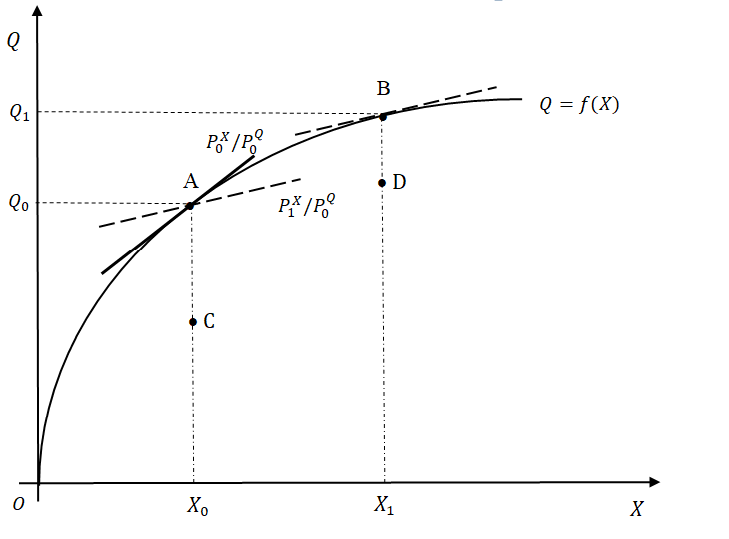
This study adopts and adapts a microeconomic theory of production ; . as the underlying analysis. It is assumed that one production function with the existing technology applies to all farmer communities at a time; farmers are rational and responsive to market changes to seek profit maximization. The maximum profit is achievable when the marginal product of an input is equal to the input price ratio over the output price. The card use enables farmers to access subsidized agricultural input inputs, particularly fertilizers. The impact of farmers who use farmer cards on agricultural production can be diagrammatically explained in Figure 1.
Let Q be output and X be input on the plane of X and Q. The relationship between output Q and input X follows the frontier production function, which denotes the best practice of firms that produce output at any level of inputs . It is figured by a curved line of Q = f(X), with ∂Q/∂X>0 and ∂2Q/∂X2<0. Let the prevailing output price be PQ and the input price be PX. Farmers maximize profit at the initial stage, in which they do not utilize the farmer card by allocating input X at X0 to produce output Q at Q1. With the prevailing farmgate prices of output and input, this allocation is optimal since the marginal product, ∂Q/∂X, is equal to the price ratio of input over output, PX0/PQ0. In Figure 1, it is represented by a straight line touching the production function at point A. Now, suppose farmers utilize farmer cards to access subsidized input X, which costs lower than non-subsidized input, or the price of subsidized input is lower than before. This change means a new price ratio of input over output, PX1/PQ0, which is lower than PX0/PQ0. In Figure 1, it is represented by a dashed line, which is less steep than the previous one. It can be seen that the dashed line crosses the production function at point A, indicating that the condition is no longer optimal. Farmers respond to this condition by increasing the use of input X from X0 to X1, resulting in an output increase from Q0 to Q1. This is a new optimal condition, where the dashed line makes a tangent at point B, or the marginal product of input, ∂Q/∂X, is equal to the new price ratio PX0/PQ0.
It should be noted that the above conditions that farmers are assumed to be technically efficient, where the production levels of Q lay on the frontier production function. In reality, farmers might not reach the frontier, and the actual production level initially and after accessing subsidized input stages are at points C and D, respectively. The distances of the actual level to the production frontier, point C to point A and point D to point B, represent technical inefficiency. The closer the actual output level to the frontier, the more efficient the farm production, and the higher the output level. Every farmer has a different inefficiency level, which is dependent on many factors, particularly related to managerial skills.
The impact of farmer card use on production presented in Figure 1 can be mathematically expressed as follows. Let the basic model of frontier production function be formulated as
Q = ψXaeu-v
Where Q is output, X is input, ψ and α are technology coefficients, v is technical inefficiency level representing deviations of actual output from the frontier, and u is error terms representing other factors outside in the system. The u has a symmetrical and normal distribution with zero mean and variance of σ2u, u⁓N(0, σ2u); and v has a half-normal distribution with zero mean and variance of σ2v, v⁓N(0, σ2v). The production deviations due to technical inefficiency are indicated by the ratio of σv/σu= γ, where 0< γ<1. If γ=0, it indicates that deviations from the frontier are entirely due to random errors; if γ =1 equal to one, it indicates all deviations from the frontier stem from technical inefficiencies.
The farmers are said to be technically efficient when the value of v is zero. In this case, farmer characteristics influencing technical inefficiency, which can be formulated as
v = f(Yi,ԑ)
where Yi is farm and farmer characteristics, and ԑis error terms representing other factors affecting technical inefficiency level.
Empirical work
This study empirically employs maize production by smallholder growers. In the classical production function, only physical inputs transformed into outputs are inserted directly into the production function, and the card use, along with other farmer characteristics, is put into the inefficiency factors. The model analysis can be described in the Cobb-Douglas production function as follows.
Q= ψLα1N α2M α3Z α4P α5eu-v
where L is land, N is labour, M is material, Z is fertilizers, and P is pesticides. Taking logarithmic operation at both left- and right-hand sides yields
Q= ψ+α1L+ α2N+ α3M+α4Z+ α5P+ u-v
where tilde (⁓) over variable represents logarithmic operation.
The technical inefficiency model can be formulated as
V= ϼ0+ ϼ1U+ ϼ2A+ ϼ3E+ ϼ4S+ ϼ5T+ ϼ6H+ ϵ
where U is farmer card use, A is age, E is education, S is experience, T is training, H is household members, ϼj is the inefficiency coefficients respective factor determinants, and ϵ is white noise representing other factors beyond the analysis. The reasons for including such factors are as follows. Special extension programs have socialized farmer cards along with other agricultural knowledge and innovation. Farmers seriously utilizing farmer cards are supposed to have higher managerial skills than their counterparts, which can improve efficiency. Age is considered a factor representing the maturity of the farmer. The education level represents human capital that reflects the rationality of the farmer. Experience and training represent the level of skills acquired by farmers. Such factors have been proven to influence farmers’ decisions about something new ; .
A set of hypotheses in this analysis is formulated as follows.
H0: αi=γ= ϼj=0;
H1: H0 is untrue.
In the H1, this study explicitly expects that 1>αi>0, which means that the producers allocate each input use at rational stages of production function; 1≥γ>0, meaning that there is inefficiency causing production deviations; ϼj ≠ 0, meaning that farmer card use and socio-economic and demographic factors determine technical inefficiency. The hypothesis was tested at a minimum of 90% confidence intervals. Analytical models specified in Equations (3) and Equation (4) were estimated using STATA ver. 13 (StataCorp, 2013).
Data and study sites
This study employed primary data collected from farm surveys in Java, Indonesia. In Java, maize is intensively cultivated, along with rice, as crop rotation. This study determined a sample size of 398 respondents, spread in two maize-producing regions of Central Java and three maize-producing regions of East Java. The determination of sample size was based on the limited availability of resources. The samples were selected using purposive sampling, where the farmer who holds a farmer card and grows maize year-round is the primary required criterion. Two sub-districts represented every district, and two villages represented every sub-district. Thus, the number of villages is 20, and about 20 farmers were selected in every village.
This analysis’s data were based on one crop cycle of the 2021 growing season. Table 1 presents the definition and measurement of selected variables applicable to this study.
Result and Discussion
The identity of the respondents in this study can be seen in terms of age, education and number of family dependents (Table 2). The average corn farmer is 50 years old, which is a productive age. The productive age dominates the farmers. Farmers who work at a productive age are expected to be better and more optimal than farmers who work at a non-productive age.
Table 1: Definition and unit measurement of selected variables
|
Variables |
Definition |
Unit |
|
Production, Q |
Total production of maize in one growing season |
kg |
|
Land, L |
Area cultivated to maize in one crop cycle |
hectare |
|
Labour, N |
Number of labourers employed in one growing season |
man-day |
|
Material, Ma |
Monetary value of material consisting of seeds, mulching, water irrigation, compost and others |
IDR |
|
Fertilizers, Z |
Amount of inorganic fertilizers consisting of Urea, ZA, KCl and Phosphate |
kg |
|
Pesticides, P |
Amount of pesticides containing liquid and solid formulation |
kg |
|
Farmer card use, Ub |
The use of farmer card by farmers to access subsidized fertilizers and other agricultural inputs. |
1: always 0: otherwise |
|
Age, A |
Age of farmers |
year |
|
Education, E |
Amount of time spent in formal education |
year |
|
Skill, S |
Experiences as being a farmer |
year |
|
Training, T |
Number of agricultural training during farmer life |
numeric |
|
Household member, H |
Number of family members |
numeric |
Source: authors’ creation
Note: a The unit measurement of material is in monetary value because it comprises more than one component with different physical units. b The farmer card use is considered high if farmers always use it to support their farming in every growing season. The use of farmer card is considered low if farmers occasionally or never use it to support their farming.
The majority of farmers’ education was relatively low. The average education level is in elementary school, which accounts for 62.3%. Education is an important thing that farmers use as capital to carry out their farming activities. The level of education can influence performance; the higher the level of education, the easier it will be for that person to adopt innovation, technology and information regarding the success of their farming business.
Most farmers held land areas up to 1 ha, which accounted for about 80%. Based on their land holding, the farmers were considered smallholders. This phenomenon is common in Java, where the availability of agricultural land is limited. Agricultural land conversion to other purposes is quite high, particularly for housing and industrial areas.
Table 2: Farmer characteristics in the study sites
|
Description |
Number |
Proportion (%) |
|
Age (year old) |
||
|
Range of 30 - 45 |
233 |
58.5 |
|
Range of 46 - 55 |
120 |
30.2 |
|
Range of 56 - 65 |
37 |
9.4 |
|
Greater than > 65 |
8 |
1.9 |
|
Education level |
||
|
Elementary school |
248 |
62.3 |
|
Junior high school |
90 |
22.6 |
|
Senior high school |
53 |
13.2 |
|
Tertiary school |
8 |
1.9 |
|
Landholding (ha) |
||
|
Less than 0.5 |
150 |
37.7 |
|
Between 0.5 and 1.0 |
173 |
43.4 |
|
Greater than 1 |
75 |
18.9 |
|
Family member |
|
|
|
Less than 3 |
68 |
17.0 |
|
Between 4 and 6 |
323 |
81.1 |
|
Greater than 6 |
8 |
1.9 |
Source: authors’ own analysis
The average farmer has a family member of five. 81.1% of farmers have family members of 4-6 people. A large number of family members will encourage farmers to increase their income further to meet the needs of the entire family; apart from that, it also affects the workforce who can help carry out farming. The average number of farming family members is five people, and most of the family members assist in carrying out farming activities; this is done to minimize costs incurred in using labour from outside the farming family members.
|
No |
Input |
Unit |
Average |
Std. Deviation |
|
1 |
Land |
ha |
0.68 |
0.28 |
|
2 |
Seeds |
kg |
17.52 |
5.35 |
|
3 |
Urea fertiliser |
kg |
250.79 |
10.38 |
|
4 |
NPK fertiliser |
kg |
221.90 |
33.27 |
|
5 |
Pesticides |
kg |
0.66 |
0.52 |
|
6 |
Labour |
man-day |
52.95 |
14.76 |
Source: authors’ own analysis
Input allocation in maize farming can be seen in Table 3. The average land area owned by respondent farmers is 0.68 ha—the seeds used by farmers average 17.5 kg. The use of seeds by farmers can affect production results. Therefore, farmers must be able to choose superior seeds to plant so they do not have a considerable risk of failure . The average urea fertilizer used by respondents was 250.8 kg, while the average NPK fertilizer used by respondents was 221.9 kg. Fertiliser application was carried out twice on average during planting so plants could grow well and increase production. Fertiliser is considered one of the factors that can influence production results. Therefore, fertilizers must be given appropriately or by recommendations to avoid production failures.
Table 4: Estimated frontier production function and inefficiency model
|
Variable |
Coeff. |
z-value |
Sig. |
|
|
Frontier production function |
||||
|
Constant |
A |
1.923 |
2.73 |
*** |
|
Land (L) |
α1 |
0.512 |
3.62 |
*** |
|
Labour (N) |
α2 |
0.034 |
1.38 |
ns |
|
Materials (M) |
α3 |
0.213 |
2.27 |
** |
|
Fertilisers (F) |
α4 |
0.221 |
2.36 |
** |
|
Pesticides (P) |
α5 |
0.066 |
2.21 |
** |
|
Inefficiency model |
||||
|
Constant |
ϼ0 |
0.674 |
4.42 |
*** |
|
Card use (U) |
ϼ1 |
-0.124 |
-3.54 |
*** |
|
Age (A) |
ϼ2 |
0.072 |
1.82 |
* |
|
Education (E) |
ϼ3 |
-0.027 |
-3.54 |
** |
|
Skills (S) |
ϼ4 |
-0.098 |
-0.87 |
ns |
|
Training (T) |
ϼ5 |
-0.032 |
-2.46 |
** |
|
Household (H) |
ϼ6 |
-0.125 |
-2.14 |
** |
|
Inefficiency existence |
γ |
0.85 |
4.42 |
*** |
|
Overall LR-test |
137.47 |
*** |
||
|
Log-likelihood |
-872.56 |
|||
|
Estimated technical efficiency |
0.74 |
|||
Source: authors’ own analysis.
Note: All variables are in logarithmic operation except farmer card use. The dependent variable is production. ***, ** denote significance at 99%, 95% confident intervals; superscript of ns denotes insignificant.
The average use of pesticides by respondent farmers is 0.7 kg. The pests and diseases that attack the crops are primarily caterpillars and downy mildew. Pest and disease control was carried out by spraying pesticides appropriate to the pest and disease infestations. The average number of workers used by respondents is 53.0 man-days. This level is considered high, which is common in rural Java as there is a tradition of gotong-royong comprising exchange and voluntary labour.
The effect of utilizing farmer cards on the production of maize can be seen in the estimated analysis model presented in Table 4. The result shows a robust estimation, where the value LR-test for the overall model is highly significant. The values of variable coefficients lay between zero and one, indicating that maize production operates in the rational stage, where the maximum profit can be reached. Almost all variables provide a significant effect on production, except for labour. Labour is insignificant, which is understandable in the case of farming in Java. In rural areas of Java, there is a tradition of exchange and voluntary labour called gotong royong. During planting and harvesting seasons, farmers work together in a village. With such a tradition, the number of labourers devoted to farming is more than necessary.
Land has the highest coefficient, indicating that land productivity can be increased. Land extension with the same level of other factors will increase maize production. It should be noted that land fertility in Java is the highest among agricultural land in Indonesia. This study is consistent with the previous study in Asian countries that land is the most productive factor in Vietnam ; 2006), India ; and the Philippines .
Materials and fertilizers have almost similar coefficient values. This means that both inputs function as necessary in enhancing maize production. Materials containing seeds and water irrigation are essential in the farming system . Fertilizers play a significant function in improving maize production. Note that seed technology in maize has developed revolutionarily. Many seed companies have produced improved open-pollinated and hybrid seeds. The advanced seeds are very responsive to fertilizers.
Pesticides show low coefficient values. This finding is understandable and acceptable in the case of maize farming because maize is not too susceptible to pests and diseases when the crop is cultivated in a healthy agroecosystem. The number of insect pests in maize is not as complex as in vegetable farming, and the types of diseases in maize are not as many as in other cereal crops and vegetables. Pesticides are protective input, and the benefits of pesticide use will be observable if infestations of pests and diseases exist ; 2009). Farmers have applied pesticides based on integrated pest and disease management (IPDM) principles. Many farmers have completed field schools with a particular topic of IPDM and implemented the principles . The significant coefficient of pesticides indicates pest and disease infestation during the season, so pesticide application provides benefits. The significant coefficient of pesticides indicates pest and disease infestation during the season, so pesticide application provides benefits.
The total number of coefficients is around unity, meaning that the maize production technology is a constant return to scales; doubling all factors simultaneously results in double production. This is consistent with Hayami and Ruttan’s (1985) statement that small-scale farming in Asian countries generally follows this phenomenon. The sign and magnitude of the significant factor coefficients are acceptable to the underlying production economics theory.
The value of γ is about 0.8 in the model, which means that about 80% of the variation of production from deviation stems from the frontier. The variation of technical inefficiency depended on using the farmer card, which has a significant negative value. This means that the technical efficiency of maize farming increases when farmers utilize farmer cards intensely. Consequently, production of maize increased significantly because farmers added more agricultural inputs, particularly subsidized fertilizers. They were guaranteed to obtain agricultural inputs on time and in the right amount when they regularly planned to run maize farming together with rice farming. As farmer cards provide farmers with financial access, this phenomenon seems like a soft agricultural loan. Many previous studies of agricultural credit are in line with this finding. Among others, Assima et al. (2022) and Smale et al. (2020) found positive effects of the subsidy on farm production in Mali. Ganbold et al. (2022) reveal that cash incentives and soft loans for purchasing inputs positively affect agricultural productivity through efficiency improvement. Kumar et al. (2023) also found that farmers in rural India increased agricultural input when they accessed agricultural card credit. Mariyono (2019) shows that farmers who have access to rural credit can increase their income by applying more advanced technology due to credit access. However, the number of farmers who access the credit is limited because of farmer-perceived complex procedures to access credit. Differently, farmers who hold farmer cards have simple access. In this stage, access to the financial support provided by farmer cards can be considered more straightforward than that provided by rural credit facilities.
The average efficiency is about 75%, which can be considered moderate. There is still room to increase the production of maize by improving technical efficiency. From the estimated technical inefficiency model, the use of farmer cards significantly mitigates technical inefficiency. Thus, encouraging farmers to use farmer cards can improve maize production resulting from technical efficiency improvement.
It has been proven that farmer cards provide significant economic benefits to maize growers when they are used intensely to access advanced agricultural inputs. Socio-demographic factors are also supposed to determine the variation in technical inefficiency of maize farming. Age, education, and training significantly influence the technical inefficiency. Age shows a positive sign, implying that the older the farmers are, the less technically efficient they are. Even though age represents a person’s maturity, it leads to less efficiency. This is particularly true if the farmers were still young. However, the majority of farmers who hold farmer cards are already old. In many studies, old farmers hesitate to make revolutionary changes as they enjoy convenient zones. A study by Mariyono (2019) shows a similar phenomenon related to the adoption of complex technology in vegetable farming. Formal education has a significant negative effect, which means that the more formally educated farmers are, the more efficient they are in operating Maize farming. This finding is very logical since formal education builds rationality. Farmers with high education levels have a rational motive to use farmer cards to improve their farming performance. Similarly, training also significantly affects inefficiency. Farmers who have participated in more training are more efficient than their counterparts in running farms, which is also reasonable since training equips farmers with knowledge and skills. Training and education are components of human capital that improve farmer capacity. The effect of human capital enhancement on technology adoption has been studied (among others: ; ; , and the results align with this finding. Experience that does not affect the technical efficiency is understandable for this study since farmers holding farmer card have an almost similar experience. Farmer cards have been socialized massively by the government to convince farmers that holding farmer cards will make it easy to access available agricultural inputs. The massive socialization of farmer cards is effective in convincing farmers. This finding aligns with a study in rural India by Kumar et al. (2023) that found that socio-economic factors affect farmers’ decision to use agricultural credit cards.
With the chance to improve maize production through technical efficiency improvement, the prospect of boosting the livestock industry, particularly for poultry farming, is promising in the near future. A study by Setiadi et al. (2022) found that poultry farming is a significant contributor to farmers’ income, and the increase of maize production through technical efficiency enhancement leads to the sustainability of poultry farming . This finding implies that factors reducing technical inefficiency, particularly farmer cards, should be socialized to farmers who grow maize.
Conclusion and Policy Implication
Maize, one of the cereal crops, is crucial in buffering the Indonesian economy and other strategic agricultural commodities. Maize serves as the main raw material in feed industries and places a solid foundation on the country’s economy. Recent regulations to limit imported corn have the potential to trigger price hikes and a domino effect, leading to food price inflation. Improvement in domestic maize production is necessary, and the government intervenes by issuing a farmer card, a kind of financial support allocated to farmers. Farmers who hold cards are expected to utilize them to access available agricultural inputs such that maize production increases to substitute for imported corn. This study assessed the effect of farmer card issuance on maize production in Java, where maize is massively cultivated. By modelling farmer cards as a factor affecting the technical efficiency of maize production, this study found that the purpose of farmer card use provides favourable outcomes. When farmers utilize the card to access subsidized fertilizers and other inputs applicable to maize farming, maize production increases substantially. The use of farmer cards has improved farm technical efficiency. Since the use of the card was partial, not all farmers who held the card benefited. Not all farmers use the card. The socio-demographic and technical characteristics of farmers determined the farmer card use. The old farmers were reluctant to utilize card facilities and educated and trained ones were enthusiastic about utilizing them to access agricultural inputs. Based on the study findings, it is strongly recommended that farmer cards be introduced to other maize farming communities to scale up the economic benefits. It is a reality that not all farmers utilize the card intensely, and not all members of farmer communities are given it. This study suggests that farmer cards should be distributed to the selected farmers who really want to use the card. Those who already hold the card but have yet to utilize it can be sent to special training or extension programs. This can be conducted by collaboration between local government and non-government organizations using available funding. Agricultural extension services at provincial and district levels can provide venues to facilitate the training programs. There are many spaces in agricultural extension agencies in every sub-district that can be used as training venues.
Acknowledgement
The authors thank the farmers and enumerators for their valuable time gathering information about this study. This is to acknowledge that this study was funded by the Faculty of Animal and Agricultural Sciences, Universitas Diponegoro, through a special appointment scheme. The results and interpretations of this study do not represent the opinions of the funding provider, and the authors are responsible for all interpretations and any shortcomings in this paper.
Novelty Statement
The novelty of this article is the farmer card applicable to maize farming and technical efficiency that has not been analyzed. The methodological aspects incorporate socio-economic and demographic factors serving as control variables to prove the robustness of farmer card utilization in increasing maize production.
Author’s Contribution
Joko Mariyono, Agus Setiadi, Limbang K. Nuswantara, and Bambang W.H.E. Prasetiyono: Conceptualized the research work.
Joko Mariyono and Agus Setiadi: conducted data cleaning and econometric analysis and prepared the initial draft of the paper.
Limbang K. Nuswantara and Bambang W.H.E. Prasetiyono: Supervised the analysis, and reviewed and edited the final draft.
Generative AI and AI-assisted technology statement
The authors declare that no generative AI and AI assisted technology was used in the creation of this manuscript.
Conflict of interest
The authors have declared no conflict of interest.
Figures
Changes in production due to the farmer card use
References
- Amfo, B., A.B. Shafiwu, and M. Tanko. 2024. Fertiliser subsidy in Ghana: a gain or loss of cocoa productivity?. Intl. J. Prod. Perf. Mgt., 73 (1): 303-326. https://doi.org/10.1108/IJPPM-04-2022-0194[CrossRef]
- Anonymous, 2016. Pemerintah Stop Impor Jagung Mulai Tahun 2017, Investasio, available at: http://investasio.com /2016/05/25/pemerintah stop-impor-jagung -mulai-tahun- 2017/ (accessed April 14, 2023).
- Assima, M.A., G. anello, and M. Smale. 2022. Articulating fertilizer subsidy effects on women’s diet quality by food supply source in Mali. CABI Agric. and Biosci., 3 (42): 1-115. https://doi.org/10.1186/s43170-022-00085-8[CrossRef]
- Che, T.N., T. Kompas, and N. Vousden. 2001. Incentives and static and dynamic gains from market reform: rice production in Vietnam. Austral. J. Agric. Res. Econ., 45(4): 547-572. https://doi.org/10.1111/1467-8489.00157[CrossRef]
- Che, T.N., T. Kompas, and N. Vousden. 2006. Market reform, incentives and economic development in Vietnamese rice production. Comp. Econ. Stud., 48(1): 277-301. https://doi.org/10.1057/palgrave.ces.8100113[CrossRef]
- Fahmi, D.N. and M. Maria. 2020. Persepsi petani terhadap implementasi kartu tani (Studi Kasus desa Kadirejo, Kecamatan Pabelan, Kabupaten Semarang). J. Agrisep: Kajian Masalah Sosial Ekonomi Pertanian dan Agribisnis, 19 (2): 315-330. https://doi.org/10.31186/jagrisep.19.2.315-330[CrossRef]
- Foguesatto, C.R. and J.A.D. Machado. 2022. Adoption of sustainable agricultural practices in Brazil: understanding the influence of socio-economic and psychological factors. J. Agrib. in Dev. and Emg. Econ., 12(2): 204-222. https://doi.org/10.1108/JADEE-11-2020-0256[CrossRef]
- Ganbold, N., S. Fahad, H. Li, and T. Gungaa. 2022. An evaluation of subsidy policy impacts, transient and persistent technical efficiency: A case of Mongolia. Env., Dev. Sust., 24: 9223–9242. https://doi.org/10.1007/s10668-021-01821-2[CrossRef]
- Guntukula, R. and P. Goyari. 2022. How does the yield variability in rainfed crops respond to climate variables? Evidence from pulses yields in Telangana, India. J. Agrib. Dev. Emg. Econ., 12(2): 262-280. https://doi.org/10.1108/JADEE-12-2020-0307[CrossRef]
- Hayami, Y. and V.W. Ruttan. 1985. Agricultural Development: an international perspective, Johns Hopkins Univ. Press, Baltimore.
- Indonesian Statistical Agency. 2022. Indonesian Agricultural Outlook. Indonesian Statistical Agency, Jakarta.
- Indrarosa, D., J. Mariyono, S.I. Santoso, and S. Sutaryo. 2024. Factors determining knowledge acquisition in livestock waste management training held by Animal Husbandry Training Centre at Songgoriti, Batu – Indonesia. IOP Conf. Series: Earth Env. Sci., 1364(1): 012026 https://doi.org/10.1088/1755-1315/1364/1/012026.[CrossRef]
- Kalirajan, K.P. 1990. Rice Production: An Econometric Analysis. New Delhi: Oxford & IBH Publishing Co.PVT.LTD.
- Kalirajan, K.P., G. Mythili, and U. Sankar. 2001. Accelerating Growth through Globalization of Indian Agriculture. New Delhi: MacMillan.
- Kumar, A., V.K. Sonkar, and K.S. Aditya. 2023. Assessing the impact of lending through Kisan Credit Cards in Rural India: Evidence from Eastern India. Eur. J. Dev. Res., 35 (3): 602-622. https://doi.org/10.1057/s41287-022-00522-4[CrossRef]
- Kumbhakar, S.C. and C.A.K. Lovell. 2000. Stochastic Frontier Analysis, Cambridge: Cambridge University Press. https://doi.org/10.1017/CBO9781139174411[CrossRef]
- Mariyono, J. 2007. The impact of IPM training on farmers’ subjective estimates of economic thresholds for soybean pests in central Java, Indonesia. Intl. J. Pest Mgt., 53(2): 83-87. https://doi.org/10.1080/09670870601119106[CrossRef]
- Mariyono, J. 2009. Socially inefficient use of pesticides due to negative externalities: a case of Indonesian rice agriculture. Intl. J. Ecol. Dev., 13(S09): 93-107.
- Mariyono, J. 2018. Empowering rural livelihoods through farmers’ field school on vegetable production in aceh province-Indonesia. J. Rural Dev., 37(1): 129–145. https://doi.org/10.25175/jrd/2018/v37/i1/122696[CrossRef]
- Mariyono, J. 2019. Farmer training to simultaneously increase productivity of soybean and rice in Indonesia. Intl. J. Prod. Perf. Mgt., 68(6): 1120–1140. https://doi.org/10.1108/IJPPM-10-2018-0367[CrossRef]
- Mariyono, J., J. Waskito, A. Kuntariningsih, G. Gunistiyo, and S. Sumarno. 2020. Distribution channels of vegetable industry in Indonesia: impact on business performance. Intl. J. Prod. Perf. Mgt., 69(5): 963–987. https://doi.org/10.1108/IJPPM-11-2018-0382[CrossRef]
- Mensah, A., M. Asiamah, C.A. Wongnaa, F. Adams, S. Etuah, E. Gaveh, and P. Appiah. 2021. Adoption impact of maize seed technology on farm profitability: evidence from Ghana. J. Agrib. Dev. Emerg. Econ., 11(5): 578-598. https://doi.org/10.1108/JADEE-06-2020-0120[CrossRef]
- Ministry of Agriculture. 2022. Agricultural Production Indonesia. Ministry of Agriculture, Indonesia. Jakarta.
- Nicholson, W. and C. Snyder. 2008. Microeconomic Theory: Basic Principles and Extensions, Eleventh Ed. South-Western, Cengage Learning.
- Pindyck, P.S. and D.L. Rubinfeld. 1995. Microeconomics, London: Prentice Hall.
- Santoso, S.I., A. Setiadi, and M.S. Ningrum. 2023. Profitability of broiler chicken business in Kudus Regency, Central Java, Indonesia. Adv. Anim. Vet. Sci., 11(12): 2075–2081. https://doi.org/10.17582/journal.aavs/2023/11.12.2075.2081[Full text][CrossRef]
- Santoso, S.I., A. Setiadi, and W.D. Prastiwi. 2023. Sustainability performance of Indonesian duck farming and the related determinants. Adv. Anim. Vet. Sci., 11(7): 1176–1182.
- Setiadi, A., S.I. Santoso, M. Mukson, and W. Roessali. 2022. Contract broiler farming as an effective pathway to improve rural prosperity in Indonesia. Intl. Soc. Sci. J., 72(244): 461–473 https://doi.org/10.1111/issj.12330.[CrossRef]
- Setiadi, A., S.I. Santoso, E. Suprijatna, T.A. Sarjana, and J. Mariyono. 2021. Productive and economic performances of magelang duck fed on fermented kariba weed. Amer. J. Anim. Vet. Sci., 16(4): 289–294. https://doi.org/10.3844/ajavsp.2021.289.294[CrossRef]
- Smale, M., V. Thériault, and N.M. Mason. 2020. Does subsidizing fertilizer contribute to the diet quality of farm women? Evidence from rural Mali. Food Sec., 12: 1407–1424. https://doi.org/10.1007/s12571-020-01097-w[CrossRef]
- Stata Corp. 2013. Stata: Release 13 Statistical Software. College Station, StataCorp.
- Villano, R. and E. Fleming. 2006. Technical inefficiency and production risk in rice farming: evidence from central Luzon Philippines. Asian Econ. J., 20(1): 29-46. https://doi.org/10.1111/j.1467-8381.2006.00223.x[CrossRef]
Services
Article usage statistics
Loading…