
This study aims to examine the impact of the performance of rice producer cooperatives on the well-being of its members in Central Java, Indonesia. Assessing the efficiency and profitability of rice producer cooperatives is essential for guaranteeing a sufficient food supply in Indonesia. Cooperatives that operate efficiently and generate profits play a vital role in maintaining a stable rice supply and satisfying the food requirements of the people. This study utilised structural equation modeling (SEM) to analyse the interconnectedness of variables. The study examined the independent variables of organisational factors, business aspects, service quality, and human resource development. Performance was evaluated as a moderating variable, while member welfare was the dependent variable. The study collected data from five rice producer cooperatives in Central Java that had their annual general meetings for 2022/2023. Each cooperative had 40 members, resulting in a total of 200 samples. The results suggest that organisational factors, business factors, service quality, and human resource development benefit the well-being of members in these cooperatives. These findings emphasise the significance of rice producer cooperatives consistently improving their organisational, commercial, service, and human resource development elements to promote member welfare sustainably. Thus, implementing strategies that facilitate the effective and efficient management of these aspects is anticipated to substantially contribute to enhancing income and the quality of life for cooperative members. Additionally, this will strengthen the position of cooperatives as sustainable and competitive pillars of the local and regional economy.
Research Article · Volume 39, Issue 3, 13 September 2026 · Open Access
The Effect of Agricultural Cooperative Performance on the Welfare of Cooperative Members in Central Java, Indonesia
· ·
Affiliations & Notes ⌄
- 1Department of Digital Agribusiness, Faculty of Food Securtiy, Universitas Negeri Surabaya, Indonesia
- 2Agribusiness Study Program, Faculty of Animal and Agricultural Sciences, Universitas Diponegoro Indonesia
- 3Food Research for Safety, Security, and Sustainability (FORC3S), Indonesia. *Correspondence | Joko Mariyono, Agribusiness Study Program, Faculty of Animal and Agricultural Sciences, Universitas Diponegoro Indonesia
- 4Email: jokomariyono@live.undip.ac.id
Article Info ⌄
- Journal:
- Pakistan Journal of Agricultural Research
- Published:
- 13 September 2026
From the article
- The organisational factors, commercial factors, services, and the development of human resources highly impact the welfare of cooperative members.
- Furthermore, cooperative performance is a moderating factor that enhances the correlation between these factors and the welfare of cooperative members.
- This suggests that endeavours to enhance the prosperity of cooperative members should encompass enhancements in organisational structure, business strategy, service quality, human resource development, and an augmentation in overall cooperative performance.
- However, it is necessary to compare cooperatives in different regions or industrial sectors to determine if there are notable variations in the impact of organisational, business, service, and human resource development aspects on member welfare.
Selected from the article's own text.
Abstract
Introduction
In general, cooperatives become a fundamental part of the Indonesian economy as stated in the Indonesia Fundamental Constitution 1945. It is supported by the fact that cooperatives play a crucial role in Indonesia’s economy (Grashius and Cook, 2021). Cooperatives contribute to the overall national economy and serve as a means to attain social objectives and promote communal well-being, which aligns with the values of the Fundamental State of Pancasila and the Constitution. As per the provisions of Law Number 25 of 1992 on Cooperatives, cooperatives function as socio-economic entities to enhance the well-being of their members and the broader society. Furthermore, cooperatives play a crucial role in enhancing agriculture and rural areas by facilitating farmers’ improved access to production facilities, technology, and information. Cooperatives enable farmers to secure finance at a reduced interest rate, expand their market reach, obtain improved pricing for their commodities, and exchange knowledge and skills to enhance agricultural output . Cooperatives also enhance rural infrastructure by supporting the establishment of storage, processing, and distribution facilities for agricultural goods. This, in turn, enhances food security and overall well-being in rural areas .
Shortly speaking, cooperatives provide a collective platform for resource sharing, fair pricing, better market access, and support services. This is because of the following mechanisms. Cooperatives allow farmers to assemble resources to purchase inputs like seeds, fertilisers, and equipment at lower costs due to bulk buying. This reduces production costs, increasing farmers’ profit margins. Cooperatives frequently provide training on modern farming techniques, financial literacy, and sustainable practices. This knowledge improves yields, product quality, and environmental sustainability. Cooperatives contribute to local community development by reinvesting profits in community services and infrastructure, enhancing the overall quality of life in rural areas. This indicates that cooperatives significantly boost rural incomes, productivity, and resilience, directly linking cooperative participation to improvements in farmers’ livelihoods. Mariyono et al. (2020) highlight that many small farmers struggle to access profitable markets individually due to limited resources and bargaining power, and the cooperatives can negotiate better prices and provide access to larger markets, improving income potential.
Nevertheless, attaining this objective is challenging. Some cooperatives in Indonesia have yet to achieve the benefit of their members, and some have ceased operations due to failure. According to the Central Bureau of Statistics (2019), the data indicates a 16.97% decline in operational cooperatives, dropping from 152,174 units in 2017 to 126,343 units in 2018. In 2019, the total count of cooperatives decreased by 2.61%, resulting in 123,048 units. Out of these, 3295 cooperative units ceased their activities. Despite a 1.96% rise in the number of cooperatives in 2022, this growth was not substantial, suggesting that the performance of cooperatives could have been better . Identifying and communicating cooperative performance to relevant parties can be necessary to demonstrate operational outcomes within a specific timeframe, as evaluated by comparing various measurements or standards established throughout the planning process . Cooperative performance encompasses more than just operational sustainability and profitability. It also involves member empowerment, social impact, innovation, adaptability to changes in the business environment, and the welfare of its members. Cooperatives must prioritise optimal performance to ensure their long-term viability and sustainability. Central Java Province encompasses diverse cooperatives, including some specialising in the agricultural sector, particularly in acquiring staple commodities such as rice.
The need for rice as a fundamental dietary staple remains constant, as rice continues to be a significant necessity for the Indonesian population . Statistics Indonesia (2023) states that the rice intake of the Indonesian population is 1.635 kg per year, surpassing the global average of only 60 kg per year. Hence, it is imperative to enhance the capacity of rice-producer cooperatives in order to avert food crises and enhance the well-being of their members and the wider populace. Central Java is home to several cooperatives that specialise in rice procurement. Some notable examples are the Citra Kinaraya Demak Cooperative, Anugrah Klambu Grobogan Cooperative, Gardu Tani Al-Barokah Cooperative, Tresno Tani Appoli Boyolali Cooperative, and Sumber Rejeki Cooperative. Nevertheless, not all of these cooperatives can thrive and progress effectively, which impacts the well-being of its members. Hence, analysing the cooperative performance and its impact on the well-being of rice cooperative members in Central Java is intriguing.
Materials and Methods
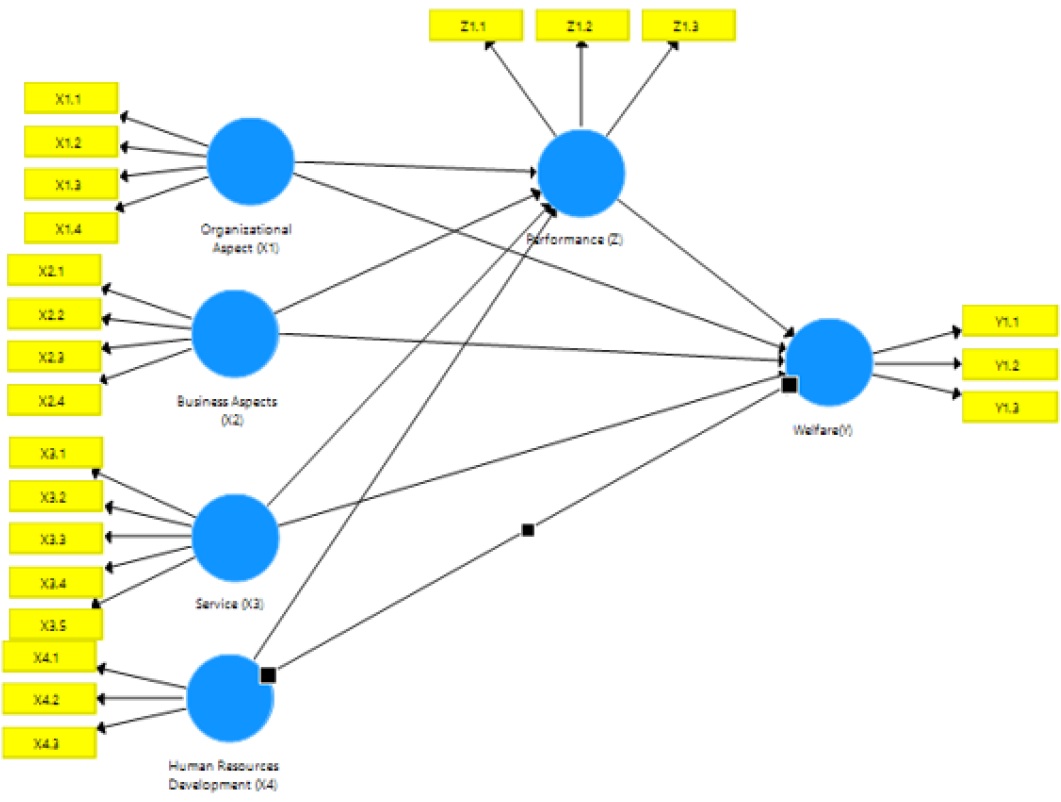
The study was carried out at the Citra Kinaraya Demak Cooperative, Anugrah Klambu Grobogan Cooperative, Gardu Tani Al-Barokah Semarang Cooperative, Tresno Tani APPOLI Cooperative, and Organic Farmers Association Producer Cooperative (APOB). The five cooperatives were selected based on their status as rice producer cooperatives that have effectively carried out the 2023/2024 Year-End Meeting (RAT), as confirmed by data from the Central Java Cooperative and MSME Office. This study employs the concept of cooperative performance as proposed by Pakaya (2017). Cooperative performance is believed to impact the well-being of cooperative members in this scenario. The study examines the effect of performance on well-being by analysing the elements of organisational aspects, business aspects, services, and resource development using a structural equation modelling (SEM) model. The research references are ; ; Agustia et al., 2016; . The study has a sample size of 200 farmers who are affiliated with the cooperative. Specifically, there are 40 farmers from Citra Kinaraya Cooperative, 40 from Anugrah Klambu Cooperative, 40 from APPOLI, and 40 from APOB Cooperative. Data were collected and compiled via comprehensive interviews performed between 2023 and 2024. The hypothesis of this study posits that all factors benefit the well-being of cooperative members. The data was subsequently analysed using SmartPLS, employing the following analytical model.
Result and Discussion
First, let us describe the selected aspects of farmer characteristics in Table 1.
The average age of Central Java agricultural cooperative respondents is 54.3. Central Java’s agricultural cooperatives’ productive age includes their age, but this stresses the necessity of member
Table 1: Respondent characteristics.
|
Description |
Unit |
Percentage |
|
People |
% |
|
|
Age (year) |
||
|
31-40 |
19 |
9.5 |
|
41-50 |
49 |
24.5 |
|
51-60 |
78 |
39.0 |
|
≥61 |
54 |
27.0 |
|
Total |
200 |
100.0 |
|
Education |
||
|
Elementary school |
25 |
12.5 |
|
Junior high school |
35 |
17.5 |
|
Senior high school |
105 |
52.5 |
|
Bachelor’s degree |
32 |
16.0 |
|
Total |
200 |
100.0 |
|
Gender |
||
|
Male |
160 |
80.0 |
|
Female |
40 |
20.0 |
|
Total |
200 |
100.0 |
Source: Authors’ survey.
regeneration by encouraging younger generations to participate in cooperative sustainability and dynamics. Rambe et al. (2023) said cooperatives can ensure future generation leadership and involvement by establishing specific educational and training programs that provide new creativity and spirit. To achieve an appropriate age balance in their membership, cooperatives can use training and mentoring programs to combine the experience of older members with the energy and invention of younger members. Senior high school education accounts for 52.5% of agricultural cooperative members in Central Java, demonstrating that while some have undergraduate degrees, most are still in secondary school. This may impact cooperative management, agricultural technologies, and innovation. Therefore, cooperatives can host practical and technical training programs and workshops for modern agriculture. According to Sing and Sahoo (2020), enhancing the proficiency of agricultural cooperative members can be accomplished by conducting workshops that utilise the Focus Group Discussion (FGD) approach to promote agricultural sustainability. This program might encompass farm management, modern cultivation methods, agricultural technology, and financial and marketing management. This survey found 160 males (80%) and 40 women (20%) in Central Java agricultural cooperatives. Women’s traditional position as home caretakers may limit their participation in cooperative activities. Semaun (2018) contends that men are inclined to prioritise productivity over reproductive responsibilities, whereas women seldom have the chance to take breaks from their domestic duties. Women frequently prioritise extensive family duties. This can impede their ability to commit time and effort to participate fully in cooperative activities.
The indicators in this study have successfully undergone the instrument test (outer model), specifically the validity and reliability tests. The validity test comprises convergent, average variance extracted (AVE), and discriminant validities. Two specific reliability tests are commonly used: composite reliability and Cronbach’s Alpha. All tested indicators were deemed valid and reliable. Subsequently, the inner model analysis is utilised to assess the causal connection between variables, either directly or indirectly, through route analysis, revealing the overall outcome of the positive path coefficient value. Table 2 displays the outcomes of the route coefficient analysis.
Table 2: Results of path analysis values.
|
Variables |
Path coefficient |
Description |
|
Organizational Aspects (X1)→ Performance (Z) |
0.094 |
Significant |
|
Business Aspects (X2)→ Performance (Z) |
0.086 |
Significant |
|
Service (X3) → Performance (Z) |
0.193 |
Significant |
|
Human Resource Development (X4)→ Performance (Z) |
0.241 |
Significant |
|
Performance (Z) →Welfare (Y) |
0.478 |
Significant |
Source: Authors’ analysis.
In addition, the R square test serves as a coefficient of determination, indicating the degree to which exogenous latent variables impact endogenous latent variables. According to Chin (2013), the criteria for R Square values are as follows: A value of 0.67 is considered strong, 0.33 is considered moderate, and 0.19 is considered weak. The R-Square value results are displayed in Table 3.
Table 3: The R-squared value results.
|
Variables |
R-Squared |
Adjusted R-squared |
|
Welfare |
0.903 |
0.900 |
|
Performance |
0.838 |
0.835 |
Source: Authors’ analysis.
Both variables exhibit a R Square value greater than 0.67, indicating a high correlation. These findings indicate that characteristics such as organisational features, business aspects, services, and human resource development collectively contribute to 90.3% of member welfare, with the remaining 9.7% being influenced by other factors. The Cooperative Performance is mainly explained by 83.8%, while various factors influence the remaining 16.2%. Next, the Goodness of Fit Index (GoF) test will evaluate the model’s fit.


As per Hair (2017), the model fit test can be classified into three categories: Small (0.00-0.2), medium (0.25 - 0.37), and high (0.38-1.00). This indicates that the research model is appropriate, strong, and viable. Both the internal and external models are utilised to demonstrate the general suitability of the model. Subsequently, to evaluate the hypothesis, H0 is rejected when the p-value is less than 0.05. Therefore, the predictor has a substantial impact on dependent variables.
Table 4: Outcomes of hypothesis testing.
|
Variables |
p-values |
Description |
|
Organizational Aspects (X1) → Welfare (Y) |
0.010 |
Significant |
|
Organizational Aspects (X1) → Performance (Z) |
0.001 |
Significant |
|
Business Aspects (X2) → Welfare (Y) |
0.028 |
Significant |
|
Business Aspects (X2) → Performance (Z) |
0.000 |
Significant |
|
Service (X3) → Welfare (Y) |
0.000 |
Significant |
|
Service (X3) → Performance (Z) |
0.000 |
Significant |
|
Human Resource Development (X4) → Welfare (Y) |
0.000 |
Significant |
|
Human Resource Development (X4) → Performance (Z) |
0.000 |
Significant |
|
Performance (Z) → Welfare (Y) |
0.000 |
Significant |
Source: Authors’ analysis.
Table 4 demonstrates a significant beneficial impact of organisational characteristics on the welfare of cooperative members, as indicated by the p-value of 0.010, which is less than the significance level of 0.05. Based on the field observations, it is evident that cooperatives consistently conduct quarterly meetings and provide training sessions for both administrators and members. This organisational feature demonstrates the level of member involvement in cooperative operations (Lor and Britz, 2020). Table 4 demonstrates that organisational aspects favour cooperative performance, as indicated by a p-value of 0.001, which is less than 0.05. This suggests that the identification and involvement of a competent organisation member contribute to this good effect. The recruitment process for cooperative members is conducted transparently and inclusively, ensuring that all members are involved in decision-making to achieve a consensus, fostering a sense of belonging among cooperative members.
Moreover, the business elements significantly benefit the well-being of cooperative members, as indicated by a p-value of 0.028, which is less than the threshold of 0.05. The cooperative enterprise exerts a substantial impact on the well-being of its members. Cooperatives have the potential to enhance the well-being of their members by creating additional value for the cooperative enterprise . The performance of cooperatives is also significantly impacted by business factors. Cooperative financing is derived from the residual profit (SHU) and the firm’s operation, enhancing cooperative performance. The diluted cooperative operates a business specialising in rice and its derivatives, sold under its own brand. In addition, the service has a significant positive impact on the member well-being variable, as indicated by a p-value of 0.000, less than 0.05. Every member of the cooperative is entitled to equal service, as the cooperative’s objective is to meet the requirements of its members through collaborative endeavours. Cooperative members are provided with services for obtaining high-quality seeds, accessing financial loan services, and receiving aid with land. Services also impact the effectiveness of cooperatives .
Cooperatives aim to expedite loan disbursement to ensure timely utilisation of funds, prevent adverse credit history, and generate profits to enhance cooperative performance. Human development has a beneficial impact on the welfare of cooperative members and cooperative performance, as indicated by a p-value of 0.000, which is less than 0.05. Cooperatives frequently organise diverse training, counselling sessions, and seminars to enhance cooperative human resource development, ultimately enhancing cooperative performance. Ultimately, the collective performance of a cooperative has a direct impact on the well-being and prosperity of its members. As the cooperative’s performance improves, the positive impact on the welfare of its members will increase. Collaborative performance is crucial for advancing the economic well-being of cooperative members .
It has been proven that cooperatives become the fundamental backbone of the rural and sub-urban economies. Cooperatives are considered a respectable economic vehicle because they prioritise shared welfare, not merely seeking personal gain. The 1945 Constitution of Indonesia states that cooperatives are the main pillars of the country’s economy. This is regulated in Article 33, which is the philosophical basis and legal basis for economics in Indonesia. This article emphasises that the economy is structured as a joint venture based on the principle of family, and cooperatives are considered the business that best reflects the values of togetherness and social justice in Indonesia. The following is the essence of Article 33 related to cooperatives as the central pillar of the economy: Article 33 Paragraph (1): The economy is structured as a joint venture based on the principle of family. This paragraph refers to the collective spirit manifested in cooperatives, where its members bear profits and risks together. Article 33 Paragraph (3): The land, water, and natural resources contained therein are controlled by the state and used for the greatest prosperity of the people. This underlines the importance of national economic management in the people’s interests, where cooperatives are often a means for the community to gain fairer access to economic resources.
Conclusions and Recommendations
This study analysed the role of agricultural cooperatives in improving farmers’ welfare. Using the model of structural equations, it has been shown that agricultural cooperatives can be instrumental in enhancing farmers’ prosperity. Organising farmers into cooperatives gains collective bargaining power, allowing them to secure better prices, reduce input costs, and access resources that might otherwise be inaccessible individually. Based on the analysis, here is how cooperatives drive prosperity for farmers. The organisational factors, commercial factors, services, and the development of human resources highly impact the welfare of cooperative members. Furthermore, cooperative performance is a moderating factor that enhances the correlation between these factors and the welfare of cooperative members. This suggests that endeavours to enhance the prosperity of cooperative members should encompass enhancements in organisational structure, business strategy, service quality, human resource development, and an augmentation in overall cooperative performance. However, it is necessary to compare cooperatives in different regions or industrial sectors to determine if there are notable variations in the impact of organisational, business, service, and human resource development aspects on member welfare. Provincial cooperative offices or academics can undertake this task.
As cooperatives provide farmers with economic benefits, it is strongly recommended that successful cooperatives be cloned in other regions that have similar resources. In the existing regions where the cooperatives are successful, farmers who have not been members are strongly encouraged to join the cooperative. This will improve rural and regional economic development, as has been expected for a long time ago through the 1945 Indonesian Constitution.
Acknowledgement
The authors thank the cooperative administrators and members for their valuable time collecting information for this study. This study has received partial funding from the Government of Indonesia through the scholarship scheme for postgraduate studies. The findings do not immediately represent the funding provider opinion, and the authors take responsibility for all interpretations and shortcomings in this paper.
Novelty Statement
The novelty of this paper is on the model of analysis using structural equation modelling, and constructed variables of business performance.
Author’s Contribution
Khoiriyatun Widyastuti, Joko Mariyono and Siwi Gaytri: Conceptualised the research work.
Khoiriyatun Widyastuti and Joko Mariyono: Supervised the analysis, and reviewed and edited the final draft.
Generative AI and AI assisted technology statement
The authors declare that no generative AI and AI assisted technology was used in the creation of this manuscript.
Conflict of interest
The authors have declared no conflict of interest.
Figures
Analytical Model
References
- Agustia, D. and D.A. Soufyan. 2018. Performance of Baitul Qiradh Cooperative (KBQ) Baburrayan in Aceh Tengah District, Aceh Province.
- Ahmed, M.H. and H.M. Mesfin. 2017. The impact of agricultural cooperatives membership on the well-being of smallholder farmers: Empirical evidence from eastern Ethiopia. Agric. Food Econ., 5(6): https://doi.org/10.1186/s40100-017-0075-z[CrossRef]
- Arianti, F.D. and A.Y. Fadwiwati. 2023. The transformation of rice crop technology in Indonesia: Innovation and sustainable food security. Agronomy, 13(1): 1-20. https://doi.org/10.3390/agronomy13010001[CrossRef]
- Central Bureau of Statistics. 2019. Statistical yearbook of Indonesia 2019. BPS-Statistics Indonesia, Jakarta.
- Chin, W.W., 2013. The partial least squares aproach to structural equation modeling. Modern Methods Bus. Res., 295: 336.
- Dwiastuti, R., S. Nurfaidah and E. Pratiwi. 2020. The impact of cooperative services on agricultural performance: Evidence from Indonesia. Int. J. Agric. Econ., 5(1): 25-35.
- Eliyawati, W., N. Sutjipta and I.G.S.A. Putra. 2016. Service quality and member satisfaction level of the Suraberata Village Cooperative Unit in Selemadeg Barat District. J. Manajemen Agribis., 4(1): 2355-0759.
- Engkus and E. Lisnawati. 2021. Human resource development in enhancing the performance of cooperative managers in Sukabumi City. J. Ekon., 7(3): 57. Sekolah Tinggi Ilmu Ekonomi PGRI Sukabumi.
- Gelius, P., U. Brandes, C. Sommer and A. Rütten. 2017. Key performance indicators of cooperative planning processes: Case study results from German sport science and physical activity promotion projects. Germ. J. Exercise Sport Res., 47(3): 1-19.
- Grashuis, J. and M.L. Cook. 2021. Members of cooperatives: More heterogeneous, less satisfied? Int. Food Agribus. Manage. Rev., 24(5): 813–825. https://doi.org/10.22434/IFAMR2020.0086[CrossRef]
- Hair, 2017. A primer on partial least squares structural equation modeling (PLS-SEM). Thousand Oaks. In Sage.
- Hodgson, G.M., 2018. Cooperatives, economic democratisation and rural development. Rev. Int. Polit. Econ., 25(3): 379-404.
- Lor, L. and J. Britz. 2017. Member participation and cooperative performance: Implications for agricultural policy. J. Agric. Resour. Econ., 42(1): 123-140.
- Mariyono, J., J. Waskito, A. Kuntariningsih, G. Gunistiyo, and S. Sumarno. 2020. Distribution channels of vegetable industry in Indonesia: Impact on business performance. Int. J. Prod. Perf. Manage., 69(5): 963-987. https://doi.org/10.1108/IJPPM-11-2018-0382[CrossRef]
- Ortmann, G.F. and R.P. King. 2007. Agricultural cooperatives I: History, theory and problems. Agrekon, 46(1). https://doi.org/10.1080/03031853.2007.9523760[CrossRef]
- Pakaya, R.A., 2017. Cooperative performance management. Yogyakarta : Zahir Publishing.
- Rambe, A., H. Siregar, H., and Z. Nasution 2021. Analysis of agricultural productivity improvement using technology adoption. Journal of Agribusiness Development, 15(2): 123–135.
- Semaun, S., 2018. The existence of women’s cooperatives in improving community income. Al-Maiyyah: Media of gender transformation in social religious paradigm, 11(2): 189-213. https://doi.org/10.35905/almaiyyah.v11i2.654[CrossRef]
- Singh, R. and P. Sahoo. 2020. Enhancing agricultural cooperative members’ proficiency through Focus Group Discussion (FGD) workshops for sustainable farming practices. J. Agric. Educ. Exten., 26(4): 365-382.
- Statistics Indonesia, 2023. Average per capita weekly consumption of several essential food items, 2012. Jakarta: Statistics Indonesia.
Services
Article usage statistics
Loading…