
During our monitoring of non-indigenous species in four Tunisian marinas between May and December 2019, we discovered a colonial ascidian with striking orange zooids arranged in irregular and elongated rows within a transparent tunic. This species caught our attention due to its vibrant coloration and morphology, which closely resembled that of Botrylloides violaceus and B. leachii. It was found to predominantly grow on fouling invertebrates, solitary ascidians, and other fouling organisms. The species was later identified as Botrylloides niger Herdman, 1886. We provide herein a molecular analysis of B. niger, using the mitochondrial Cytochrome oxidase (COI) gene as a DNA barcode. Sequences comparison of Tunisian B. niger with those deposited in GenBank belonging to different countries showed a percentage of similarity ranging from 80.63% to 100%. Phylogenetic analysis suggested that Tunisian B. niger might have been introduced from the Gulf of Mexico.
Research Article · Volume 57, Issue 5, 29 August 2025 · Open Access
Unveiling the Hidden Identities of Botrylloides niger Herdman, 1886 in Tunisian Marinas Using DNA Barcoding
· · · · · ·
Affiliations & Notes ⌄
- 1Laboratory Diversity Management and Conservation of Biological Systems (LR18ES06), Faculty of Sciences of Tunis, University of Tunis El Manar, Tunis, Tunisia 2Laboratory of Biochemistry and Biotechnology (LR01ES05), Faculty of Sciences of Tunis, University of Tunis El Manar, Tunis, Tunisia 3High Institute of Biotechnology of Sidi Thabet, University of Manouba, Biotech Pôle, BP-66, 2020 Sidi Thabet, Ariana, Tunisia * Corresponding author: mnasri.intissarnis@gmail.com
Article Info ⌄
- Journal:
- Pakistan Journal of Zoology
- Published:
- 29 August 2025

From the article
- B. niger identification can be challenging due to its morphological similarity with other Botrylloides species.
- We report herein the first molecular identification of the non-indigenous B. niger in Tunisia.
- This assertion is based on personal observations of this species in multiple Tunisian marinas, especially in significant numbers post summer season.
- Finally, in the phylogenetic tree B. niger clustered with its closest species B. leachi confirming the previous morphological identification.
Selected from the article's own text.
Abstract
Introduction
Botrylloides niger Herdman, 1886 (Class: Ascideacea, Family: Styelidae) is a colonial tunicate species commonly found in various marine environments, including marinas. This sessile organism grows up to several centimeters in diameter and is discovered on various surfaces including invertebrates (personal observations), mussel farms , as epiphytes on seaweed , oyster banks , and in diverse habitats including lakes and lagoons ; , and marinas (according to personal observations and . They are attached to variety of substrates, including rocks, debris, moorings, ropes, and other artificial structures ; . Temiz et al. (2023) classified this species as invasive having originating from the West Atlantic region. This filter-feeding has been observed in various locations worldwide, including temperate regions along both coasts of North America , the coast of Israel ; , and around the Suez Canal . Most recently, Temiz et al. (2023) reported sightings of this species along the coasts of the north-eastern Mediterranean Sea within the Antalya, Mersin and Hatay regions as well as in the Fusaro Lake in Italy . It was first reported in 2019 in Tunisia’s marinas including those in Gammarth, Port El Kantaoui and Cap Monastir marinas . However, it has not yet been reported in other coasts of Mediterranean Sea or might be identified as another species due to its strong morphological similarity with different species such as B. leachii ; ; . According to Pérès (1958) who initially identified B. niger as Metrocarpa nigrum, the first specimen of B. niger was sampled in Israel in 1952. It would have been the first known instance of the species in the southern region of the Mediterranean Sea.
The morphological identification is a crucial first step in the species identification. In the case of B. niger, it can be challenging because colonial tunicates are known for their high levels of morphological convergence and plasticity ; , making them difficult to distinguish between closely related species based solely on their morphological features . Additionally, many colonial tunicates can change their morphological appearance in response to environmental conditions , further complicating the process of morphological identification.
Monniot and Monniot (1997) described this species as Botryllus niger which evolved to Botrylloides niger ; Herdman, 1886). Then numerous authors used different taxonomic nomenclature for B. niger, including reclassification into different genera, or synonyms with other species. The complexity of the taxonomic identification of B. niger and other closely related species was due to the difficulty of distinguishing between species based on only morphological features , such as colony shape, size, and zooids arrangement; these characteristics were often unreliable and leading to numerous misidentifications and taxonomic confusion cited above .
Recently, advances in molecular techniques have provided a more reliable approach for species identification, and DNA barcoding has become a powerful tool for resolving the taxonomic confusion of B. niger and other similar species ; ; ; ; ; ; . DNA barcoding uses a short, standardized segment of DNA to discriminate species. One of the most widely used DNA barcoding region is the mitochondrial Cytochrome C oxidase subunit I (COI) gene ; ; ; . The COI gene is an ideal barcoding region because it evolves rapidly and accumulates differences between species, allowing a clear distinction between closely related species. By comparing the COI sequences of specimens, researchers can identify the species affiliation with high accuracy; this is especially useful for organisms lacking morphological specific features or for species exhibiting a significant morphological plasticity.
Our aim is to identify B. niger using molecular data based on DNA barcoding and investigate the similarities between B. niger collected in Tunisia and those from different countries using phylogeographic assessments aiming to identify the possible origin of Tunisian specimens.
Materials and Methods
Sampling
Colonies were obtained from four recreational boating marinas distributed along the Tunisian coastline, namely Gammarth in the north-east, Port El Kantaoui and Cap Monastir in the center-east during May and December 2019, and Djerba in the south in December 2022 (Fig. 1). These colonies of B. niger were collected from artificial structures as ropes, buoys, docks and boat hulls. Samples were then relaxed with menthol crystals in seawater for approximately four hours and preserved in a 5% formaldehyde solution in seawater for 48h. A subsample of each colony was also preserved in 99% ethanol for DNA extraction ; .
Morphological analysis
Over 10 colonies were collected from artificial substrates in four marinas. Morphological analyses were carried out on the colonies characteristics (e.g., shape, colour, zooids arrangement and features (eg., number of anal lobes), tentacles, presence of sand within or only on the tunic surface ; .
The mitochondrial COI 1 analysis
Total DNA of B. niger colonies was extracted from 6-7 zooids sampled at marina Gammarth and preserved in 99% ethanol. Genomic DNA was extracted using two methods to have a good DNA quality: CTAB method and the DNeasy Blood and Tissue® kit (Wizard® Genomic DNA Purification Kit) following the producer’s protocol. DNA quality and quantity were measured using Qubit 3 fluorometer. To successfully amplify and identify the target species, 2 sets of primers with their corresponding COI barcoding regions, namely LCO1490 and HC02198 from Folmer et al. (1994), and mlCOIintF and jgHCO2198 from Leray et al. (2013) were tested (Table I). PCR amplifications were performed with a final reaction volume of 25 μl containing: 10 μM of each primer, TAKARA Taq polymerase (5 U), 50 mM Mg2+, 10 μM dNTP and 100 ng of genomic DNA. “Touchdown” PCR was carried out for 16 initial cycles: denaturation for 10s at 95°C, annealing for 30s at 62°C (-1°C per cycle) and extension for 60s at 72°C, followed by 25 cycles at 46°C.
Table I. COI primers used in this study.
| Primer | Sequences 5`→3` |
| LCO1490 | GGTCAACAAATCATAAAGATATTGG |
| HC02198 | TAAACTTCAGGGTGACCAAAAAATCA |
| MlCOIintF | GGWACWGGWTGAACWGTWTAYCCYCC |
| jgHCO2198 | GGRGGRTASACSGTTCASCCSGTSCC |
*Note: R, S, W, T are degenerate nucleotides with R= G/ A; S=G/C; W= A/ T; Y= T/ C
To check PCR reactions success, PCR products were separated on 1% agarose gel and detected by staining with Ethidium Bromide under UV light. The obtained amplicons were purified using spin columns (Wizard PCR Preps, Promega) following the manufacturer’s protocol and then sequenced for both directions (forward and reverse) by an ABI-373 automated DNA sequencing system.
Obtained sequences were manually edited using BioEdit version 7.7 software and deposited in the GenBank database. To conduct comparative analyses, a search was performed on January 30th, 2023 for homologous sequences of Botrylloides genus within the non-redundant nucleotide database of the NCBI (National Center for Biotechnology Information). Employing BLASTn using our B. niger sequences as the query.
The MEGA 11 software was used to calculate uncorrected pairwise distances with the Kimura-2-parameter (K2P) distance model, and to generate Phylogenetic trees. The consensus tree was evaluated from 500 bootstrap replications. The evolutionary distances were computed using the maximum composite likelihood method and the units of the number of base substitutions per site. The proportion of sites where at least one unambiguous base is present in at least one sequence for each descendent clade is shown next to each internal node in the tree
Results
Morphological analysis
All colonies of B. niger were collected from the four sampling marinas during May and December. Morphologically, this species shares similar colony color and zooids aspect with B. leachii. The specimens exhibit zooids arranged in a ladder-like configuration, a characteristic observed in multiple Botrylloides species, as a precaution in the absence of discernable eggs. We identify this species at the genus level as Botrylloides sp.
COI sequence comparisons
The mt COI gene fragment was successfully amplified from B. niger DNA, resulting in a single PCR product of 319 bp. The obtained sequence was deposited in the GenBank database and showed 100% BLAST similarity with B. niger from other worldwide specimens deposited into GenBank. A search in the nt-nr database identified 100 sequences belonging to six distinct genera with similarities ranging from 80.63% to 100%. Among these sequences, 42 sequences were classified as B. niger, or inaccurately labelled as B. nigrum. Table II displays the mean inter-species pairwise uncorrected distances calculated only for the confirmed Botrylloides sequences with a representative specimen of each species. The divergence among sequences ranged from 0.001 to 1.09. The highest distance was reported between Botrylloides cf. anceps and the other Botrylloides. B. aff. leachii (MG0095791), B. nigrum (NC_021467.1), and B. niger (OM866151.1) database sequences diverged less than 1% from the present sequences. Phylogenetic analysis of B. niger (OQ920906) from Tunisia clustered with all other B. niger strains in GenBank and was compared to other B. niger sequences from different regions, revealing some intraspecific variations (Fig. 2). The sequence obtained was remarkably grouped with
Table II. Pairwise uncorrected distances for inter-species comparisons within the genus Botrylloides. Square brackets contain the number of sequences analysed for each species. Min and max values are in bold. “B. niger (1)” is the sequence analysed in this study, while the label “Public B. niger” represents the sequences of B. niger present in the nt-nr database. AC number: 1 (OQ920906); 2 (NC_021467.1); 3 (ON053355.1); 4 (MT873573.1); 5 (LS992551.1); 6 (LS992546.1); 7 (ON098245.1); 8 (OM866151.1); 9 (MG009579.1).
| Percentage values | B. niger (1) | B. nigrum (2) | Botrylloides sp. (3) | B. cf. anceps (4) | B. perspicuus (5) | B. simoensis (6) | B. cf. lentus (7) | Public B. niger (8) | B. aff. leachii (9) |
| B. niger (1) | - | ||||||||
| B. nigrum (2) | - | - | |||||||
| Botrylloides sp. (3) | 0,15 | 0,15 | |||||||
| B. cf. anceps (4) | 1,09 | 1,09 | 1,07 | ||||||
| B. perspicuus (5) | 0,17 | 0,17 | 0,15 | 1,21 | |||||
| B. simodensis (6) | 0,17 | 0,17 | 0,14 | 1,33 | 0,08 | ||||
| B. cf. lentus (7) | 0,17 | 0,17 | 0,16 | 1,25 | 0,18 | 0,15 | |||
| Public B. niger (8) | - | - | 0,13 | 1,09 | 0,14 | 0,14 | 0,14 | ||
| B. aff. Leachii (9) | 0,01 | 0,01 | 0,15 | 1,09 | 0,16 | 0,16 | 0,15 | 0,01 | - |
B. niger sequences previously reported in Turkey, Italy, Mexico, Florida, Honolulu, Brazil, Panama, and Puerto Rico. The highest similarity was reported to B. niger strains isolated from Mexico (OP221206.1), Honolulu (MW817940.1), Hawaii (MW817940.1), Tunisia (OQ920906) and Italy (OM912589.1) sharing 100% nucleotide identity (Table III). Sequences of Tunisia and Italy clustered together and also with those of Mexico and Honolou suggesting an introduction of this species into the Mediterranean, particularly in Tunisia and Italy, via the Gulf of Mexico. B. niger from Turkey (OQ211502.1) is distant from the two sequences found in Tunisia and Italy which could indicate that there may be more than one clade in the Mediterranean.
Discussion
B. niger identification can be challenging due to its morphological similarity with other Botrylloides species. Therefore, it is likely that specimens of B. leachii collected in the south part of the Mediterranean Sea since 1960s onwards are B. niger (pers. com. Prof. Ramos-Espla). One of the main specific criteria is the coloration; however, in some cases, the misidentification may be due to a lack of self-collection and loss of coloration as result of preservation techniques that leading the degradation of morphological characteristics. It’s the case of many ascidians not easily identifiable with morphological methods. Molecular data, such as DNA barcoding has been used to avoid taxonomic confusion of this species and other closely related species ; ; ; . The COI gene has also gained popularity in recent years as a barcoding marker, especially for Botrylloides ; ; due to its higher level of resolution for species-level identification. Samples of B. niger colonies from marinas are not collected in a sterile environment. As a result, the isolated DNA is often composite DNA, including genetic material from other organisms such as polychaete worms, algae, bacteria, and nearby organisms that are either attached to the same substrate or attached to the colony itself, such as amphipods. This is the main barcoding difficulty we encountered due to the presence of mixed DNA. The 658 bp barcoding region of the COI gene is commonly employed for B. niger identification ; ; (Table III). However, in our case, these primers failed to amplify
Table III. COI sequences of the nt-nr database (NCBI, 19 January 2023) analysed in this study with identity percent > 80.50% to our sequence.
| AC number | Species description | bp | Locality | Year of submission | Reference |
| OQ920906 | Botrylloides niger | 319bp | Tunisia | 2023 | This study |
| OQ211497.1 | Botrylloides niger | 538 bp | Turkey | 2023 | Karahan unpub |
| OQ211502.1 | Botrylloides niger | 514 bp | Turkey | 2023 | Karahan unpub |
| OQ211498.1 | Botrylloides niger | 512 bp | Turkey | 2023 | Karahan unpub |
| OQ211499.1 | Botrylloides niger | 512 bp | Turkey | 2023 | Karahan unpub |
| OQ211501.1 | Botrylloides niger | 512 bp | Turkey | 2023 | Karahan unpub |
| OQ211500.1 | Botrylloides niger | 512 bp | Turkey | 2023 | Karahan unpub |
| OM912589.1 | Botrylloides niger | 795 bp | Italy | 2022 | Virgili et al., 2022 |
| OM912594.1 | Botrylloides niger | 777 bp | Italy | 2022 | Virgili et al., 2022 |
| OM912590.1 | Botrylloides niger | 771 bp | Italy | 2022 | Virgili et al., 2022 |
| OM912593.1 | Botrylloides niger | 768 bp | Italy | 2022 | Virgili et al., 2022 |
| OM866151.1 | Botrylloides niger | 602 bp | Italy | 2022 | Della Sala et al., 2022 |
| OP221206.1 | Botrylloides niger | 870 bp | Mexico | 2022 | Palomino-Alvarez unpub |
| MW858360.1 | Botrylloides niger | 836 bp | Florida | 2021 | Nydam unpub |
| MW817940.1 | Botrylloides niger | 854 bp | Honolulu | 2021 | Nydam unpub |
| LR828514.1 | Botrylloides niger | 846 bp | Brazil | 2020 | Gissi unpub |
| MW285094.1 | Botrylloides niger | 592 bp | Florida | 2020 | Nydam unpub |
| MT232728.1 | Botrylloides niger | 553 bp | Panama | 2020 | Nydam unpub |
| MT232723.1 | Botrylloides niger | 553 bp | Panama | 2020 | Nydam unpub |
| MW285095.1 | Botrylloides niger | 600 bp | Florida | 2020 | Nydam unpub |
| MT637961.1 | Botrylloides niger | 596 bp | Puerto Rico | 2020 | Streit et al., 2021 |
| MT637960.1 | Botrylloides niger | 596 bp | Puerto Rico | 2020 | Streit et al., 2021 |
| ON053355.1 | Botrylloides sp. | 859 bp | Saudi Arabia | 2022 | Nydam unpub |
| ON098245.1 | Botrylloides cf. lentus | 681 bp | Japan | 2022 | Nydam unpub |
| MT873573.1 | Botrylloides cf. anceps | 856 bp | Australia | 2020 | Salonna et al., 2021 |
| LS992551.1 | Botrylloides perspicuous | 844 bp | Australia | 2018 | Gissi unpub |
| LS992546.1 | Botrylloides simodensis | 856 bp | Japan | 2018 | Gissi unpub |
| MG009579.1 | Botrylloides aff. Leachii | 467 bp | Israel | 2017 | Reem et al., 2018 |
| NC_021467 | Botrylloides nigrum | 14427 bp | Israel | 2012 | Rubinstein et al., 2013 |
| MW285096.1 | Botryllus sp. | 689 bp | Florida | 2020 | Nydam unpub |
| KT693191.1 | Botryllus schlosseri | 625 bp | India | 2015 | Jaffar ali unpub |
| KU360789.2 | Botryllus aster | 515 bp | India | 2015 | Jaffar ali unpub |
| KU360787.2 | Botryllus arenaceus | 543 bp | India | 2015 | Jaffar ali unpub |
| MT840166.1 | Pyura herdmani | 1368 bp | Moroco | 2020 | Dinoi et al., 2021 |
| MH011447.1 | Polycarpa sp. | 487 bp | France | 2018 | Alie et al., 2018 |
| MN138378.1 | Cnemidocarpa finmarkiensis | 658 bp | Washington | 2019 | Leray unpub |
the target COI region which could be due to mutation in binding region leading to PCR failure, compared to 319 bp barcoding region described by Leray et al. (2013) were successfully used in our analysis. We report herein the first molecular identification of the non-indigenous B. niger in Tunisia. Similarities reported between sequences support a Gulf of Mexico origin. The hypothetical introduction of this species from the Gulf of Mexico to the Tunisian coasts, either directly or through secondary spread via Italy, could have occurred via multiple pathways. One probable scenario involves maritime shipping and global trade networks. This assertion is based on personal observations of this species in multiple Tunisian marinas, especially in significant numbers post summer season. These marinas act as hotspots for non-indigenous species (NIS) as a result of their composition of artificial substrates, which provide an ideal habitat for NIS in general , 2017; , b) and B. niger in particular . Furthermore, it has been suggested by Della Sala et al. (2022) that mussel farms are likely be the primary source of introduction for this species. Additionally, Temiz et al. (2023) have conducted research which suggests that the clade of B. niger present in Turkey differs from the clades found in our study area and Italy. This indicates that the Turkich clade may have been introduced from the Red Sea. However, further sequences will be required to investigate the potential occurrence of this species in Tunisia and the wider Mediterranean region to confirm its origin.
Finally, in the phylogenetic tree B. niger clustered with its closest species B. leachi confirming the previous morphological identification. It is crucial to identify of B. niger in order to fully comprehend its biology and particularly its impact as an invasive species in various regions of Tunisia and globally. A trough examination requiring detailed morphological descriptions and molecular investigations on a larger number of samples is acknowledged as necessary. In order to gain a comprehensive understanding, conducting a more in-depth morphological description and conduct molecular analyses on a greater number of samples is necessary.
Declarations
Acknowledgement
We are grateful to Master Imed Mzoughi of Hammamet Marina, Master Ahmed Mootamri of Gammarth Marina, Master Anis Zarrouk of Bizerte Marina, Master Haythem Yahya of El Kantaoui Marina, and Master Jamel of Cap Monastir Marina. For helping in collection of samples, we are grateful to Akrem Dridi, Mahran Afifi and Mbarka Bouzaien for their help in collecting samples.
Funding
The Tunisian Ministry of Higher Education and Scientific Research supported this study.
Statement of conflict of interest
The authors have declared no conflict of interest.
Figures
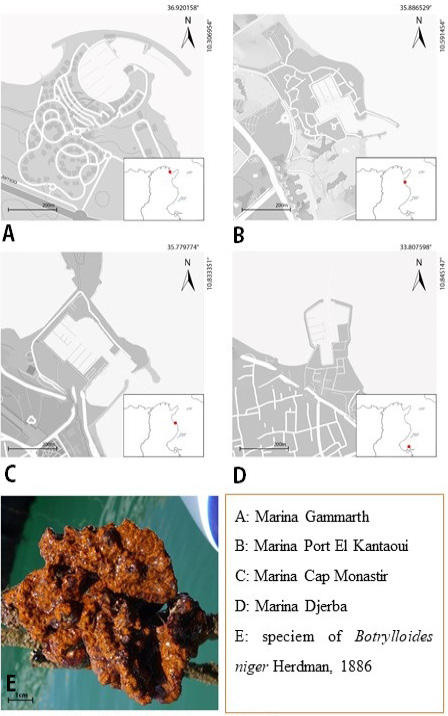
Sampled marinas along the Tunisian coasts.
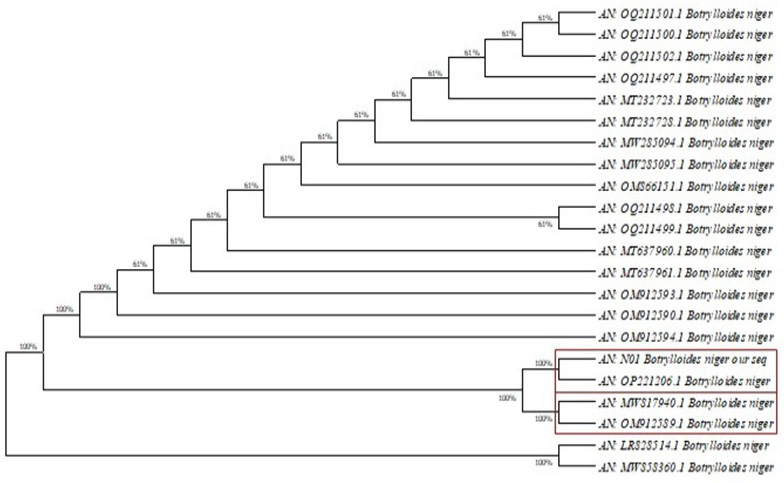
ML phylogenetic tree of the sequences based on COI nucleotide sequences of all deposited B. niger in GenBank. B. niger (Our seq) is the sequence analysed in this study.
References
- Alie, A., Hiebert, L.S., Simion, P., Scelzo, M., Prunster, M.M. Lotito, S., Delsuc, F., Douzery, E.J.P., Dantec, C., Lemaire, P., Darras, S., Kawamura, K., Brown, F.D. and Tiozzo, S., 2018. Convergent acquisition of non-embryonic development in styelid ascidians. Mol. Biol. Evol., 35: 1728–1743. https://doi.org/10.1093/molbev/msy068[CrossRef]
- Altschul, S.F., Gish, W., Miller, W., Myers, E.W. and Lipman, D.J., 1990. Basic local alignment search tool. J. mol. Biol., 215: 403–410. https://doi.org/10.1016/S0022-2836(05)80360-2[CrossRef]
- Bariche, M., Torres, M., Smith, C., Sayar, N., Azzurro, E., Baker, R. and Bernardi, G., 2015. Red Sea fishes in the Mediterranean Sea: A preliminary investigation of a biological invasion using DNA barcoding. J. Biogeogr., 42: 2363-2373. https://doi.org/10.1111/jbi.12595[CrossRef]
- Blanchoud, S., Rutherford, K., Zondag, L., Gemmell, N.J. and Wilson, M.J., 2018. De novo draft assembly of the Botrylloides leachii genome provides further in sight in to tunicate evolution. Sci. Rep., 8: 5518. https://doi.org/10.1038/s41598-018-23749-w[CrossRef]
- Brunetti, R., 2009. Botryllid species (Tunicata, Ascidiacea) from the Mediterranean coast of Israel, with some considerations on the systematics of Botryllinae. Zootaxa, 2289: 18-32. https://doi.org/10.11646/zootaxa.2289.1.2[CrossRef]
- Brunetti, R., Gissi, C., Pennati, R., Caicci, F.,Gasparini, F. and Manni, L., 2015. Morphological evidence that the molecularly determined Ciona intestinalis type A and type B are different species: Ciona robusta and Ciona intestinalis. Sys. Zool., 53: 186-193. https://doi.org/10.1111/jzs.12101[CrossRef]
- Chebbi, N., Mastrototaro, F. and Missaoui, H., 2010. Spatial distribution of ascidians in two Tunisian lagoons of the Mediterranean Sea. Cah. Biol. Mar., 51: 117-127.
- Della Sala, G., Coppola, D., Virgili, R., Vitale, G.A., Tanduo, V., Teta, R., Crocetta, F. and de Pascale, D., 2022. Untargeted metabolomics yields insights into the lipidome of Botrylloides niger Herdman, 1886, an ascidian invading the Mediterranean Sea. Front. mar. sci., 9: 865751. https://doi.org/10.3389/fmars.2022.865751[CrossRef]
- Dinoi, A., Rius, M., Tine, M. and Teske, P., 2021. Development of genetic tools for the redbait species Pyura herdmani and P. stolonifera, important bioengineers along African coastlines. Afr. J. mar. Sci., 43: 251-257. https://doi.org/10.2989/1814232X.2021.1925346[CrossRef]
- Ferrario, J., Marchini, A., Borelli, P., Gigli Berzolari, F. and Occhipinti A.A., 2016. A fuzzy boater model to detect fouling and spreading risk of non‐indigenous species by recreational boats. J. environ. Manage., 182: 198–207. https://doi.org/10.1016/j.jenvman.2016.07.029[CrossRef]
- Ferrario, J., Marchini, A., Caronni, S. and Occhipinti, A.A., 2017. Role of commercial harbours and recreational marinas for the spread of fouling non-indigenous species. Biofouling, 33: 651-660. https://doi.org/10.1080/08927014.2017.1351958[CrossRef]
- Folmer, O., Hoeh, W., Black, M. and Vrijenhoek, R., 1994. Conserved primers for PCR amplification of mitochondrial dna from different invertebrate phyla. Mol. Mar. Biol. Biotechnol., 3: 294–299.
- Halim, Y. and Messeih, M.A., 2016. Aliens in Egyptian waters. A checklist of ascidians of the Suez Canal and the adjacent Mediterranean waters. Egypt. J. Aquat., 42: 449-457. https://doi.org/10.1016/j.ejar.2016.08.004[CrossRef]
- Herdman, W.A., 1886. Report on the Tunicata collected during the Years 1873-1876. Part 2, ascidiae compositae. Zool. Chall. Exp., 14: 1– 425.
- Iyappan, K., Ananthan, G. and Sathishkumar, R., 2016. Molecular identification of ascidians from the Palk Bay Region, southeast coast of India. Mitochondrial DNA A: DNA Mapp., pp. 1–4.
- Karahan, A., Douek, J., Paz, G., Stern, N., Kideys, A.E., Shaish, L., Goren, M. and Rinkevich, B., 2017. Employing DNA barcoding as taxonomy and conservation tools for fish species censuses at the south eastern Mediterranean, a hot-spot area for biological invasion. J. Nat. Conserv., 36: 1-9. https://doi.org/10.1016/j.jnc.2017.01.004[CrossRef]
- Kumaran, N.S., Bragadeeswaran, S. and Meenakshi, V.K., 2017. Molecular level evolutionary relationship of the colonial ascidian Eudistoma viride from southeast coast of India. Int. J. Agric. environ. Sci., 12: 787-800.
- Lambert, G., 2009. Adventures of a sea squirt sleuth: Unraveling the identity of 669 Didemnum vexillum, a global ascidian invader. Aquat. Invasions, 4: 5-28. https://doi.org/10.3391/ai.2009.4.1.2[CrossRef]
- Leray, M., Yang, J.Y., Meyer, C.P., Mills, S.C., Agudelo, N., Rinwez, V., Boehm, J.T. and Machida, R.J., 2013. A new versatile primer set targeting a short fragment of the mitochondrial COI region for metabarcoding metazoan diversity: Application for characterizing coral reef fish gut contents. Front. Zool., 10: 34. https://doi.org/10.1186/1742-9994-10-34[CrossRef]
- Mastrototaro, F., Montesanto, F., Salonna, M., Grieco, F., Trainito, E., Chimienti, G. and Gissi, C., 2019. Hitch-hikers of the sea: Concurrent morphological and molecular identification of Symplegma brakenhielmi (Tunicata: Ascidiacea) in the western Mediterranean Sea. Mediterr. Mar. Sci., 20: 197-207. https://doi.org/10.12681/mms.19390[CrossRef]
- Mnasri-Afifi, I., Zribi, I, Abdelkader, I., Charfi-Cheikhrouha, F. and Zakhama-Sraieb, R. 2024. Rapid assessment survey of non-indigenous and cryptogenic species in Tunisian marinas. BioInvas. Rec., 13 (in press)Monniot, C. and Monniot, F., 1997. Records of ascidians from Bahrain, Arabian Gulf with three new species. J. nat. Hist., 31: 1623-1643. https://doi.org/10.1080/00222939700770871[CrossRef]
- Montesanto, F., Chimienti, G., Gissi, C. and Mastrototaro, F., 2022. Polyclinum constellatum (Tunicata, Ascidiacea), an emerging non-indigenous species of the Mediterranean Sea: Integrated taxonomy and the importance of reliable DNA barcode data. Mediterr. mar. Sci., 23: 69–83. https://doi.org/10.12681/mms.28311[CrossRef]
- Muirhead, J.R., Gray, D.K., Kelly, D.W., Ellis, S.M., Heath, D.D. and Macissac, H.J., 2008. Identifying the source of species invasions: Sampling intensity vs. genetic diversity. Mol. Ecol., 17: 1020–1035. https://doi.org/10.1111/j.1365-294X.2008.03669.x[CrossRef]
- Pereira, M.R., Machado, L.C., de Oliveira Carvalho, R.D., de Lima Cavalcanti, T.Y.V., da Silva Filho, G.B., de Sousa Lima, T., Fonseca, S.M.C., de Assis Leite Souza, F., da Luz Wallau, G., de Souza Mendonça, F. and de Oliveira Franca, R.F., 2022. Identification of a virulent Newcastle disease virus strain isolated from pigeons (Columbia livia) in north eastern Brazil using next-generation genome sequencing. Viruses, 14: 1579. https://doi.org/10.3390/v14071579[CrossRef]
- Pérès, J.M., 1958. Ascidies récoltées sur les côtes Méditerranéennes d’Israël. Bull. Res. Counc. Isr., 7: 143-150.
- Png-Gonzalez, L., Ramalhosa, P., Gestoso, I., Álvarez, S. and Nogueira, N., 2021. Non-indigenous species on artificial coastal environments: Experimental comparison between aquaculture farms and recreational marinas. J. Mar. Sci. Eng., 9: 1121. https://doi.org/10.3390/jmse9101121[CrossRef]
- Ramos-Esplá, A.A., 1988. Ascidias litorales del Mediterraneo Iberico: Faunistica, ecologia, y biogiografia. PhD thesis, University of Barcelone, Spain.
- Reem, E., Douek, J. and Rinkevich, B., 2018. Ambiguities in the taxonomic assignment and species delineation of botryllid ascidians from the Israeli Mediterranean and other coastlines. Mitochondrial DNA A: DNA Mapp., 29: 1073-1080. https://doi.org/10.1080/24701394.2017.1404047[CrossRef]
- Rinkevich, B., Shlemberg, Z., Lilkerlevav, T., Goren, M. and Fishelson, L., 1993. Life-history characteristics of Botrylloides (Tunicata) populations in Akko Ba Mediterranean coast of Israel. Isr. J. Zool., 39: 197-212.
- Rocha, R.M., Salonna, M., Griggio, F., Ekins, M., Lambert, G., Mastrototaro, F., Fidler, A. and Gissi, C., 2019. The power of combined molecular and morphological analyses for the genus Botrylloides: Identification of a potentially global invasive ascidian and description of a new species. Syst. Biodivers., 17: 509–526. https://doi.org/10.1080/14772000.2019.1649738[CrossRef]
- Rubinstein, N., Feldstein, T., Shenkar, N., Botero Castro, F., Griggio, F., Mastrototaro, F., Delsuc, F., Douzery, E.J.P., Gissi, C. and Huchon, D., 2013. Deep sequencing of mixed total DNA without barcodes allows efficient assembly of highly plastic ascidian mitochondrial genomes. Genome Biol. Evol., 5: 1185–1199. https://doi.org/10.1093/gbe/evt081[CrossRef]
- Salonna, M., Gasparini, F., Huchon, D., Montesanto, F., Haddas-Sasson, M., Ekins, M., McNamara, M., Mastrototaro, F. and Gissi, C., 2021. An elongated COI fragment to discriminate Botryllid species and as an improved ascidian DNA barcode. Sci. Rep., 11: 4078. https://doi.org/10.1038/s41598-021-83127-x[CrossRef]
- Sheets, E.A., Cohen C.S., Ruiz, G.M. and Rocha, R.M., 2016. Investigating the widespread introduction of a tropical marine fouling species. Ecol. Evol., pp. 1-19.
- Stefaniak, L., Lambert, G., Gittenberger, A., Zhang, H., Lin, S. and Whitlatch, R.B., 2009. Genetic conspecificity of the worldwide populations of Didemnum vexillum Kott, 2002. Aquat. Invasions, 4: 29-44. https://doi.org/10.3391/ai.2009.4.1.3[CrossRef]
- Stefaniak, L., Zhang, H., Gittenberger, A., Smith, K., Holsinger, K., Lin, S. and Whitlatch, R.B., 2012. Determining the native region of the putatively invasive ascidian Didemnum vexillum Kott, 2002. J. exp. Mar. Biol. Ecol., 422: 64–71. https://doi.org/10.1016/j.jembe.2012.04.012[CrossRef]
- Streit, O.T., Lambert, G., Erwin, P.M. and Lopez-Legentil, S., 2021. Diversity and abundance of native and non-native ascidians in Puerto Rican harbors and marinas. Mar. Pollut. Bull., 167: 112262. https://doi.org/10.1016/j.marpolbul.2021.112262[CrossRef]
- Tamura, K., Stecher, G. and Kumar, S., 2021. MEGA11: Molecular evolutionary genetics analysis version 11. Mol. Biol. Evol., 38: 3022–3027. https://doi.org/10.1093/molbev/msab120[CrossRef]
- Temiz, B., Öztürk, E., Blanchoud, S. and Karahan, A., 2023. Phylogeographic and morphological analysis of Botrylloides niger Herdman, 1886 from the northeastern Mediterranean Sea. Diversity, 15:367. https://doi.org/10.1101/10.3390/d15030367[CrossRef]
- Ulman, A., Ferrario, J., Forcada, A., Arvanitidis, C., Occhipinti-Ambrogi, A. and Marchini, A., 2019a. A hitchhiker’s guide to Mediterranean marinas travels for alien species. J. environ. Manage., 241: 329–339. https://doi.org/10.1016/j.jenvman.2019.04.011[CrossRef]
- Ulman, A., Ferrario, J., Forcada, A., Seebens, H., Arvanitidis, C., Occhipinti-Ambrogi, A. and Marchini, A., 2019b. Data from: Alien species spreading via biofouling on recreational vessels in the Mediterranean Sea. J. appl. Ecol., 56: 1-10. https://doi.org/10.1111/1365-2664.13502[CrossRef]
- Van Name, W., 1945. The north and south American ascidians. Bull. Am. Mus. nat. Hist., pp. 1-462.
- Viard, F., Roby, C., Turon, X., Bouchemousse, S. and Bishop, J., 2019. Cryptic diversity and database errors challenge non-indigenous species surveys: An illustration with Botrylloides spp. in the English Channel and Mediterranean Sea. Front. mar. Sci., 6: 615. https://doi.org/10.3389/fmars.2019.00615[CrossRef]
- Virgili, R., Tanduo, V., Katsanevakis, S., Terlizzi, F., Villani, G., Fontana, A. and Crocetta, F., 2022. The Miseno Lake (Central-Western Mediterranean Sea): An overlooked reservoir of non-indigenous and cryptogenic ascidians in a marine reserve. Front. mar. Sci., 9: 866906. https://doi.org/10.3389/fmars.2022.866906[CrossRef]
Services
Article usage statistics
Loading…