
The matched filter hypothesis proposes that the tuning of auditory sensitivity should match the spectral character of calls, suggesting that sender calls and receiver auditory systems have co-evolved. However, studies provide mixed evidence, and in some species, this match is imprecise. Here, we analyzed the acoustic characteristics of male calls and both male and female hearing sensitivity in an explosive-breeding toad Duttaphrynus melanostictus to test the matched filter hypothesis.Male toads emitted a series of multisyllabic calls that were composed of single notes with a dominant frequency of 1494 ± 80 Hz. The dominant frequency reflected body size and was static between males, suggesting it may be under stabilizing selection and used in species recognition. Sexual dimorphism in peripheral auditory sensitivity was also observedas females exhibited lower auditory thresholds than males across 600–2400 Hz frequency range. The relationship between vocalizations and hearing corresponded to the matched filter hypothesis, suggesting that male call spectral structure and hearing sensitivity in males and females may have co-evolved under sexual selection in D. melanostictus.
Research Article · Volume 51, Issue 2, 3 March 2019 · Open Access
The Vocalizations and Hearing Sensitivity of an Explosive-Breeding Tropical Toad from Southern China: A Test of the Matched Filter Hypothesis
· · · ·
Affiliations & Notes ⌄
- 1Ministry of Education Key Laboratory for Ecology of Tropical Islands, College of Life Sciences, Hainan Normal University, Haikou 571158, China 2Chengdu Institute of Biology, Chinese Academy of Sciences, Chengdu 610041, China , http://dx.doi.org/10.17582/journal.pjz/2019.51.2.737.745
Article Info ⌄
- Journal:
- Pakistan Journal of Zoology
- Published:
- 3 March 2019

From the article
- The male D. melanostictus emit a series of multisyllabic calls which are composed of single notes with dominant frequency 1494 ± 80 Hz.
- There was a significant sex difference in peripheral auditory sensitivity in D. melanostictus-females had more sensitive hearing than males.
- The sexual dimorphism in peripheral auditory sensitivity, and the spectral structures of male vocalizations matched both male and female hearing sensitivity.
- Although receiving systems and acoustic communication signals are thought to have co-evolved, sexual dimorphism in the peripheral auditory sensitivity was observed.
Selected from the article's own text.
Abstract
Introduction
Acoustic communication plays an important role in survival and reproduction ; ; ; . Acoustic properties and hearing sensitivity jointly affect acoustic communication ; ; . In anurans, acoustic properties (i.e., dominant frequency, note duration) are usually influenced by body size ; ; , suggesting they could facilitate decision-making related to male–male competition and/or female choice. However, some studies have found no relationship between acoustic properties and morphological characteristics, such as snout-vent length and head length ; ; .
Females receive and analyze the courtship calls produced by males to select suitable mates during the breeding season. Therefore, females may have the sensitive auditory perception to receive and analyze male attractive signals that are under sexual selection ; . Interestingly, studies of the American bullfrog (Rana catesbeiana; , the Hylidae (Eleutherodactylus coqui; , and the Ranidae (Odorrana tormota and O. graminea, ; ; suggest that hearing sensitivity differs between the two sexes, as evidenced by morphological characteristics, such as body size and the tympanic membrane, which could result in sexual dimorphism in hearing sensitivity in fishes and frogs ; van Dijk et al., 2002; . However, other studies contradict the hypothesis of sexual dimorphism in hearing sensitivity ; .
The match between the sensitivity of the auditory system and the energy spectrum of sender vocalizations influences the signal-to-noise ratio for receivers ; ; . The so-called “match filter hypothesis” has been widely verified in fishes ; , birds ; , insects , and frogs ; ; . However, recently studies found the match filter hypothesis was not always applicable in anurans ; . At present, no studies concerning hearing sensitivity and sexual differences in auditory sensitivity have been conducted in tropical island toads.
The black-spectacled toad Duttaphrynus melanostictus is a typical explosive breeder, with females larger than males , and males that produce mating calls . The species is widely distributed throughout Southeast Asia, with a range that spans Taiwan, southwestern and southern China (including Hainan Island), southward towards Indonesia, and westwards to India and Sri Lanka ; . The acoustic properties of this species were found to vary in individuals from Thailand , India , Myanmar , and Indonesia . In China, Wei et al. (2012) reported that the acoustic properties were highly variable across recording times, and analyzed the relationship between acoustic property and body size based on data from non-one by one individual under semi natural conditions. In this study, we addressed the following questions: (1) whether acoustic properties reflect the body size of the individual under natural conditions; and (2) whether there is sexual dimorphism in peripheral auditory sensitivity in this species. Finally, we tested the match filter hypothesis in D. melanostictus.
Materials and Methods
Animals
The experiment was conducted in an ecological park of Hainan Normal University (19° 59ʹ 54ʹʹ N, 110° 20ʹ 18.7ʹʹ E, elevation 35 m a.s.l.) in Hainan Province, China. Calls were recorded from 17 male D. melanostictus in November 2017. Nine females and 14 males were used in the auditory brainstem response (ABR) experiment. After the ABR experiments and individuals had recovered from anesthesia, they were returned to their original site within 24 h of being hand captured. The treatment procedures were approved by the Animal Care and Use Committee of the Chengdu Institute of Biology, Chinese Academy of Sciences.
Vocalization recordings
The vocalizations of male D. melanostictus were recorded using a directional microphone (Sennheiser ME66 with K6 power module) connected to a digital audio recorder (Marantz PMD 661, 16-bit, 44.1 kHz) placed approximately 1 m from subjects, from 20:30 to 23:30, at ambient temperature 19–26°C, and relative humidity 75–90%.
Morphological data
Individuals were captured after calls were recorded to investigate possible relationships between vocalization characteristics and body size. Snout-vent length, head length, and head width were measured using a digital caliper (10810206, Berrylion, China).
Auditory brainstem response measurements
The experiment was conducted at the same study site range from Nov 2017 to Jan 2018. In total, 23 toads (14 males, 9 females) were used. We used noninvasive ABR to measure hearing in toads that were lightly anesthetized via water immersion for 8–11 min (males) or 18–24 min (females), using a 0.2% solution of MS-222 (Tricaine Methane Sulfonate). Individuals were then placed in a soundproof acoustic chamber (0.5 × 0.5 × 0.5 m) ; . When an individual showed no pain response to stimulation of the hind leg muscles using forceps, it was proceeded to the next stage of the experiment. The stimulus, ABR acquisition, equipment control, and data management procedures were similar to those in our previous studies ; . In brief, for each specimen, three 27-gauge stainless steel electrodes (Rochester Electro-Medical, Inc. FL, USA) were inserted subdermally at (1) the midline above the medulla (approximately 3 cm caudally to the snout), and (2) above the tympanum, and (3) in the ipsilateral front leg as inverting, noninverting, and ground electrodes, respectively. The recording electrodes were connected to a head stage and amplifier (PA4 and RA4, 20 gain, TDT) via wires wrapped in tin foil.
The stimulus was generated and the ABR was recorded using a digital signal processor RM2 (Tucker-Davis Technologies, Gainesville, USA), via fiber optic cables linked to RA4 and a USB linked to a laptop computer running custom software (Open ABR). Two types of stimuli, tone pips and clicks, were generated using Open ABR and delivered using a portable amplified field speaker (SME-AFS, Saul Miner of Electronic Inc., USA), which was driven by an RM2 and positioned on the table (at a height of 105 cm), approximately 110 cm in front of the individual’s head. ABR recording stimulus levels were calibrated using a G.R.A.S. 46 BE ¼-inch microphone (G.R.A.S. Sound and Vibration, Denmark, tianjia) with a CCP Supply (Type 12 AL, G.R.A.S. Sound and Vibration, Denmark) to a 60-dB sound pressure level (dB SPL re: 20 uPa) positioned at the individual’s head. Stimuli were synthesized digitally at octave intervals from 0.6 kHz to 7 kHz, with a 1 ms rise/fall time, a 3 ms plateau time, and a sample rate of 24,414 Hz. The authors recognize that the brief stimuli and short rise/fall times of the tone bursts used in this study were not ideal for accurately determining thresholds for low frequency sounds. However, increased rise/fall times and longer stimulus durations affect the brainstem response morphology. Given these constraints, we chose a 5 ms tone train with a 1 ms rise/fall time. All biological signals were notch-filtered at 50 Hz during data collection ; ; .
The ABR thresholds were determined using methods similar to those in our previous studies ; . Threshold measurements were defined as the lowest stimulus level for which no repeatable responses were recognized and were initiated at 90 dB SPL and reduced in 5 dB steps. We assumed that the 90-dB level was higher than all ABR thresholds of D. melanostictus for the stimuli used. ABRs were obtained from each individual at frequencies between 0.6 kHz and 7 kHz for ABR threshold estimation ; .
Analysis and statistics
SPSS 19.0 (IBM SPSS Inc., Chicago, IL, USA) was used for analysis. All data were examined for assumptions of normality and homogeneity of variance using the Shapiro–Wilk and Levene’s tests, respectively. Spontaneous vocalizations from 17 males were obtained from the recordings, and the acoustic properties (dominant frequency, fundamental frequency, note number, inter-note interval, note duration, and call duration) of the calls were analyzed. The sonograms of calls were prepared using Praat software (Boersma and Weeninkk, Version 5.1.11, University of Amsterdam, The Netherlands). The files were analyzed and displayed using Adobe Audition 3.0 and Praat. The coefficient of variation (CV = SD/X*100%, where X is mean) for each acoustic property was computed separately to identify patterns of variation. Call properties were classified as static or dynamic based on inter-individual variation (CV) during bouts of calling ; . If the CV of a given call property was less than 5%, it was identified as “static” as there was little variation between calls. Conversely, call properties were identified as “dynamic” when the CV was greater than 10%. Pearson correlation analysis was used to detect relationships between the call properties. ABR thresholds obtained from females and males in response to tone and click stimuli were sorted and analyzed using Independent samples t-tests. Results were expressed as mean ± SD, and P <0.05 was considered statistically significant.
Table I.- Acoustic properties and morphological data of male Duttaphrynus melanostictus.
| Sample size | Mean ± SD | Max | Min | CV (%) | Type | |
| Dominant frequency (Hz) | 17 | 1494.27 ± 80.29 | 1636.00 | 1291.33 | 5.37 | Static |
| Fundamental frequency (Hz) | 17 | 569.73 ± 77.96 | 660.30 | 322.92 | 13.68 | Dynamic |
| Note number | 17 | 145.71 ± 62.39 | 315 | 52 | 42.82 | Dynamic |
| Inter-note interval (s) | 17 | 0.05 ± 0.02 | 0.09 | 0.03 | 29.69 | Dynamic |
| Note duration (s) | 17 | 0.11 ± 0.02 | 0.16 | 0.08 | 20.58 | Dynamic |
| Call duration (s) | 17 | 21.52 ± 8.70 | 45.30 | 6.97 | 40.41 | Dynamic |
| Snout-vent length (mm) | 17 | 72.39 ± 3.54 | 77.21 | 64.54 | - | - |
| Head length (mm) | 17 | 18.08 ± 1.49 | 18.09 | 19.98 | - | - |
| Head width (mm) | 17 | 25.86 ± 1.69 | 27.80 | 2.87 | - | - |
CV, coefficient of variation.
Results
Acoustic structure
Male toads emitted a series of multisyllabic calls that were composed of single notes with a dominant frequency of 1494 ± 80 Hz. Figure 1 depicts the waveform (A) and sonograms (B) of the types of calls of males. The call properties and morphological data are summarized in Table I. The dominant frequency was static, while the fundamental frequency, note number, inter-note interval, note duration, and call duration were dynamic. Mean CV for static property was 5.37% for dominant frequencies, whereas that for dynamic properties was 13.68% or greater (Table I).
Relationship between acoustic structure and body size
Correlation analysis (Fig. 2) showed that the dominant frequency was negatively correlated with snout-vent length (Fig. 2A) and head width (Fig. 2B). The note duration was significantly, positively correlated with head length (Fig. 2C). However, there were no significant correlations between fundamental frequency, note number, inter-note interval, or body size (all P > 0.05). The correlations between acoustic properties and body size are shown in Table II.
Table II.- Correlation analysis between acoustic properties and body size.
| Snout-vent length | Head length | Head width | |
| Dominant frequency | 0.01 | 0.07 | 0.02 |
| Fundamental frequency | 0.41 | 0.58 | 0.39 |
| Note number | 0.88 | 0.81 | 0.50 |
| Inter-note interval | 0.32 | 0.42 | 0.36 |
| Note duration | 0.94 | 0.01 | 0.09 |
| Call duration | 0.96 | 0.51 | 0.36 |
Sex differences in peripheral auditory sensitivity
Figure 3 shows a typical ABR response level series measured in one female and one male, for which thresholds of 40 dB SPL and 50 dB SPL were obtained, respectively. ABR thresholds are shown in Figure 4 (female, n = 9; male, n = 14). Figure 4 shows that the hearing frequency range was 0.6–2.0 kHz for females and 1.0–2.0 kHz for males. Remarkably, the best excitatory frequencies were 1.2–1.8 kHz in both females and males. Compared with males, the ABR thresholds in females were significantly smaller at 0.6–2.4 kHz (P <0.05).
Relationship between hearing sensitivity and vocalization characteristics
The ABR thresholds were lowest at a frequency of 1.8 kHz (42.2 ± 2.6 dB) (Fig. 5). The main energy spectrum of male vocalizations was 1.0–2.0 kHz, during which both male and female D. melanostictus showed sensitive auditory perception. In general, the spectral structures of male vocalizations matched both male and female hearing sensitivity.
Discussion
In anurans, classifying the diversification of calls is important for understanding their behavior and the evolution of acoustic communication . Sexual selection produces individuals that emit calls with longer call duration and more notes ; ; . The male D. melanostictus emit a series of multisyllabic calls which are composed of single notes with dominant frequency 1494 ± 80 Hz. These results were similar to those from another study of this species in Zhejiang Province, China , which showed a dominant frequency of about 1.5 kHz in males from the Bali population, Republic of Indonesia . However, they were different from results of males in Bangkok that have a dominant frequency of 1.0–1.7 kHz , and those in the Coorg population of Karnataka that have an average dominant frequency of 1.6 kHz , and those with a frequency over 3.0 kHz in Burma . Our results suggest that males compete by increasing the number of notes to make their acoustic signal more complex, and that the dominant frequency represents geographic variation in complexity. Geographic variation in anuran calls was also reported in Leptodactylus fuscus , Colostethus palmatus , and Dendropsophus cruzi .
As previously reported in Hyla labialis , Rhacophorus dennysi , and Philautus odontotarsus , the acoustic properties could also have reflected the body size of D. melanostictus. Furthermore, the dominant frequency was classified as static, suggesting it may be under stabilizing selection and is probably used in species recognition. However, the note and call durations were dynamic, suggesting they may be under directional selection and more likely used in mate choice ; .
Studies have verified that hearing sensitivity at all frequencies within the hearing range can be influenced by sex, and also influence thresholds in a stimulus-specific manner ; . There was a significant sex difference in peripheral auditory sensitivity in D. melanostictus-females had more sensitive hearing than males. However, this conclusion contradicts those from concave-eared torrent frogs, Odorrana tormota and large odorous frogs, O. graminea , in which males are more sensitive than females to ultrasound. Furthermore, in American bullfrogs, the males are more sensitive than females to low frequencies . Although these studies suggest sex-related differences in hearing sensitivity is species specific, the dimorphism in peripheral auditory sensitivity may result from differences in the breeding roles of the sexes. Interesting, our previous work suggested female choice plays a major role in shaping the mating behavior of this tropical toads .
The match between male acoustic signals and female hearing abilities is a common feature in call-producing and hearing species ; ; ; ; however, there are studies that contradict this ; ; . The match is thought to have arisen over evolutionary time, as it promotes conspecific information transfer and reduces interference from natural environments . In this study, we found that the tuning of female and male hearing sensitivity was well matched with the frequencies of male calls. This result clarified two aspects: for efficient communication in mixed-species choruses, the frequencies used in vocalizations and hearing was matched in each anuran species, and successful reproduction requires that females detect, recognize, and localize the vocalizations of a conspecific male ; . Moreover, in anurans, the auditory receiving systems are thought to have coevolved with acoustic sender signals specifically ; ; . The match between frequencies used in hearing and vocalizations in D. melanostictus suggested that they have co-evolved. Sexual selection produces males that produce more complex calls, and female evolved selective pressure lead to improved acoustic communication ; .
In conclusion, our results show that male D. melanostictus emit complex multisyllabic calls by increasing the number of notes. Dominant frequency and note duration could reflect body size in this species. The sexual dimorphism in peripheral auditory sensitivity, and the spectral structures of male vocalizations matched both male and female hearing sensitivity. Although receiving systems and acoustic communication signals are thought to have co-evolved, sexual dimorphism in the peripheral auditory sensitivity was observed. This suggested that female choice may play a more important role than male-male competition during breeding of this species.
Acknowledgements
We thank Chun Hua Zhou and Xin Tong Li for assistance with fieldwork. We also thank two anonymous reviewers and our handling editor for valuable criticism that has greatly improved this manuscript.
Statement of conflict of interest
The authors declare there are no competing interests.
Figures
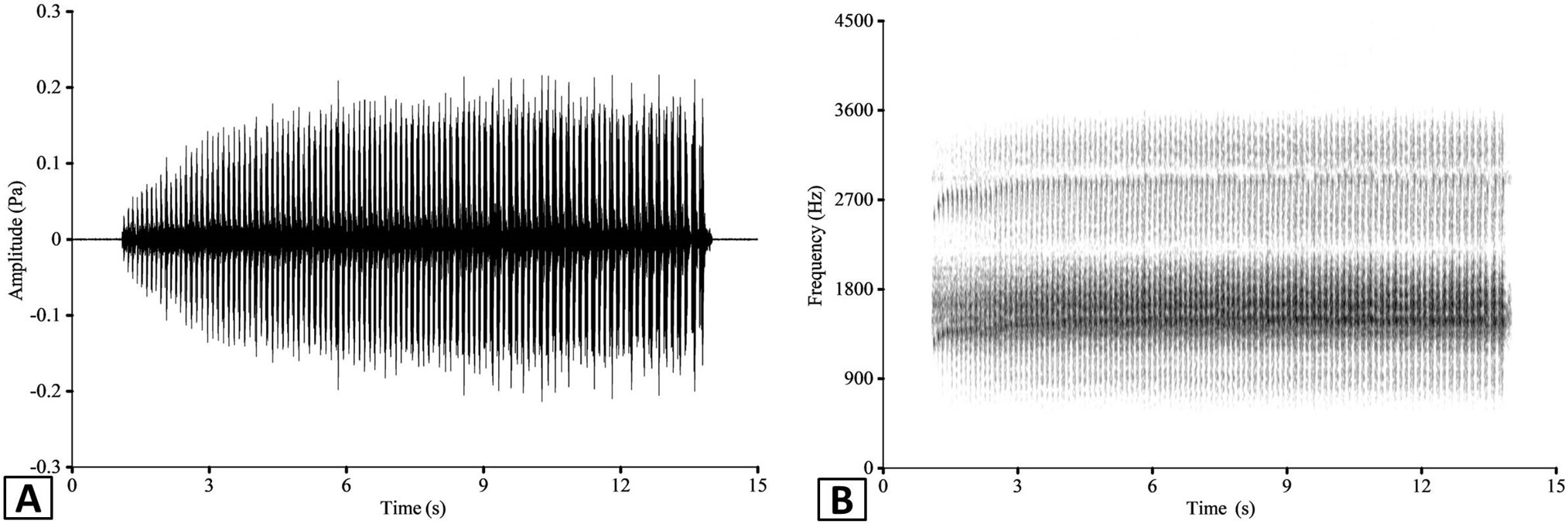
The waveform (A) and sonograms (B) obtained for advertisement calls of Duttaphrynus melanostictus.
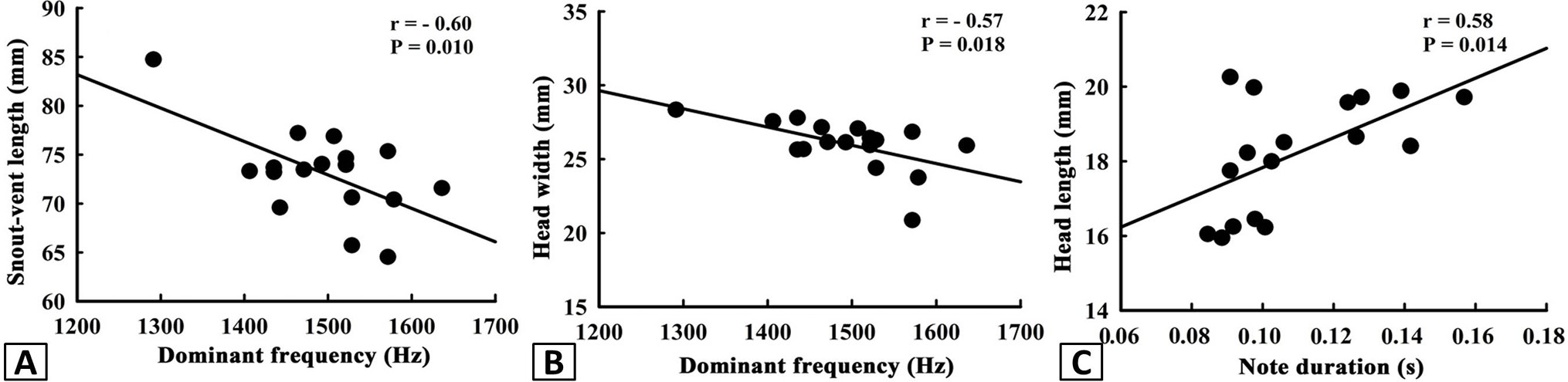
Relationships between male dominant frequency and snout-vent length (A) and head width (B) and note duration and head length (C).
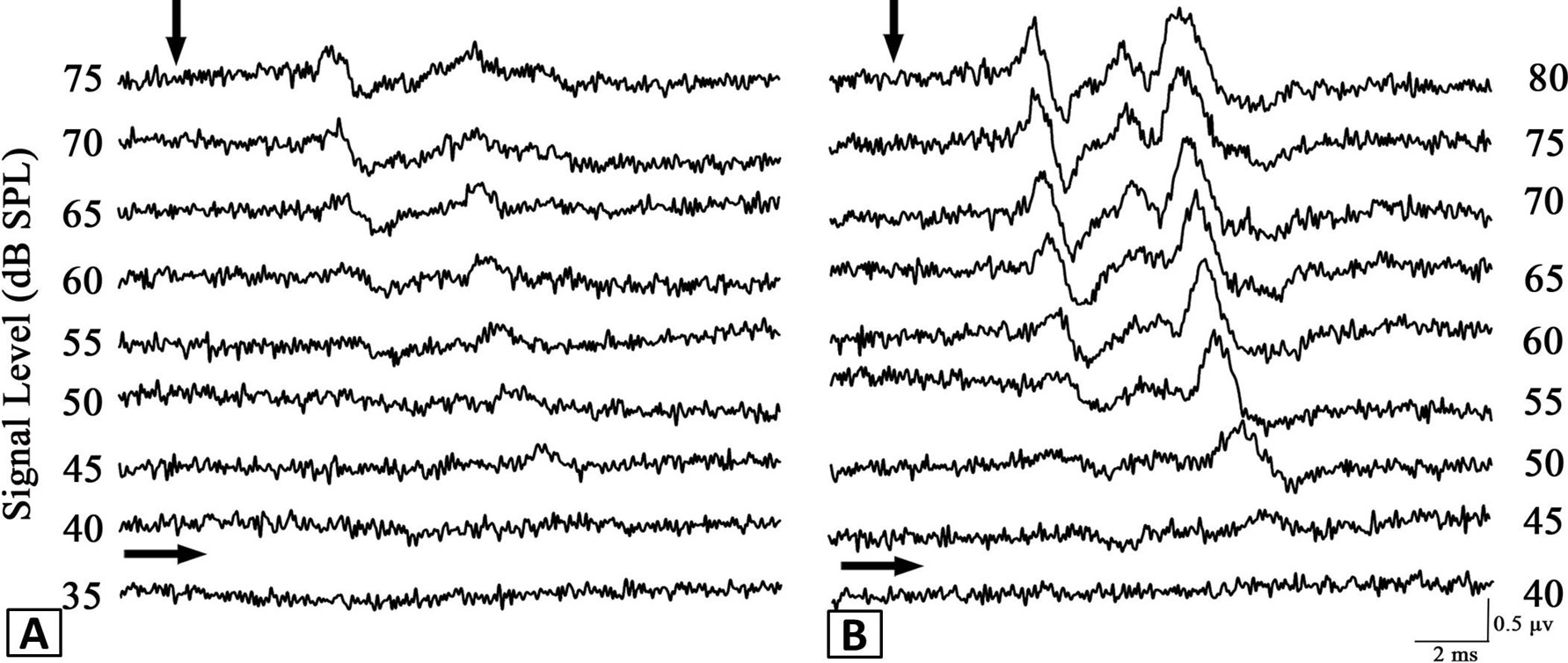
Auditory brainstem responses (ABR) as a function of stimulus intensity evoked by 1.8 kHz tone pips from a female (A) and a male (B).
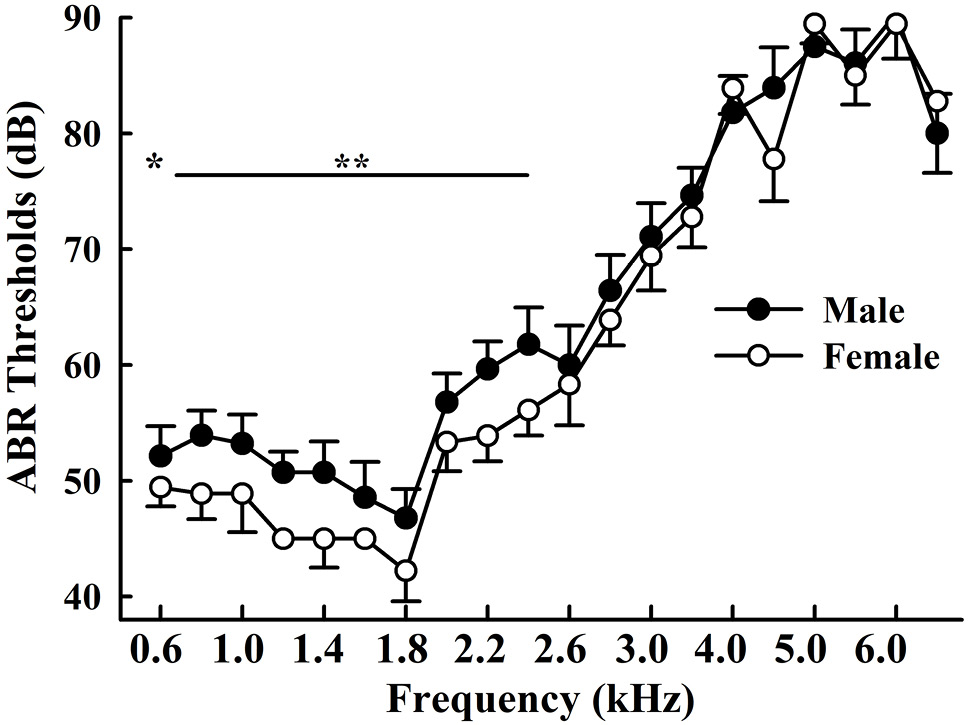
Auditory brainstem response (ABR) thresholds for Duttaphrynus melanostictus recorded in males and females. The data are represented as mean ± SD. *P < 0.05, **P < 0.01.
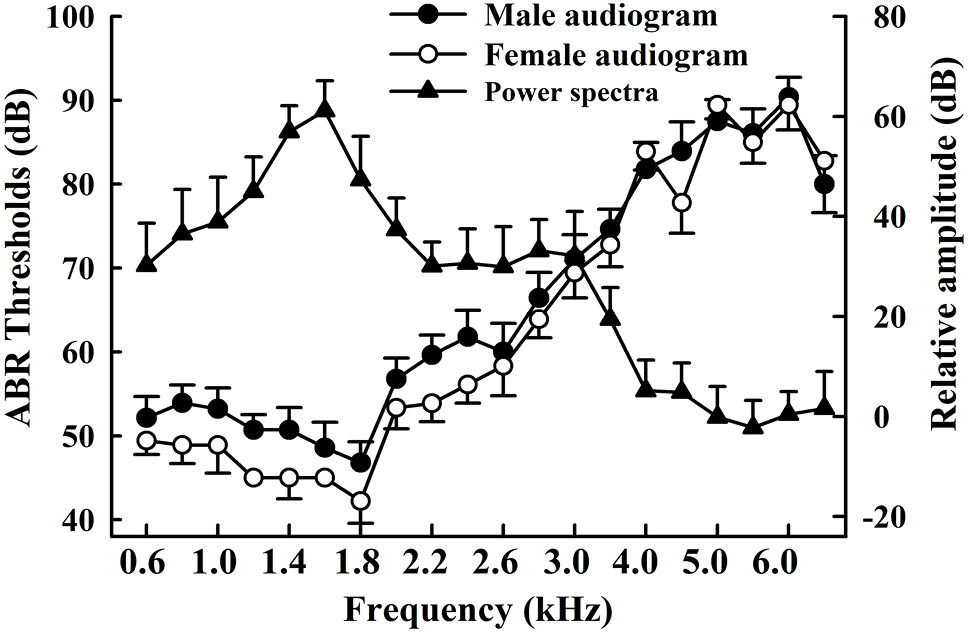
Audiogram and power spectra of Duttaphrynus melanostictus. Data are presented as mean ± SD.
References
- Bee, M.A., Perrill, S.A. and Owen, P.C., 1999. Size assessment in simulated territorial encounters between male green frogs (Rana clamitans). Behav. Ecol. Sociobiol., 45: 177-184. https://doi.org/10.1007/s002650050551[CrossRef]
- Bernal, X.E., Guarnizo, C. and Lüddecke, H., 2005. Geographic variation in advertisement call and genetic structure of Colostethus palmatus (Anura, Dendrobatidae) from the Colombian Andes. Herpetologica, 61: 395-408. https://doi.org/10.1655/04-87.1[CrossRef]
- Blaxter, J.H.S., 1981. The swimbladder and hearing. In: Hearing and sound communication in fishes (eds. W.N. Tavolga, A.N. Popper and R.R. Fay). Springer Berlin Heidelberg, New York, pp. 61-71. https://doi.org/10.1007/978-1-4615-7186-5_3[CrossRef]
- Brittan-Powell, E.F., Christensen-Dalsgaard, J., Tang, Y., Carr, C. and Dooling, R.J., 2010. The auditory brainstem response in two lizard species. J. Acoust. Soc. Am., 128: 787-794. https://doi.org/10.1121/1.3458813[CrossRef]
- Capranica, R.R. and Moffat, A.J.M., 1983. Neurobehavioral correlates of sound communication in anurans. In: Advances in vertebrate neuroethology (eds. J.P. Ewert, R.R. Capranica and D.J. Ingle). Plenum, USA, pp. 701-730. https://doi.org/10.1007/978-1-4684-4412-4_36[CrossRef]
- Caras, M.L., Brenowitz, E. and Rubel, E.W., 2010. Peripheral auditory processing changes seasonally in Gambel’s white-crowned sparrow. J. Comp. Physiol. A, 196: 581-599. https://doi.org/10.1007/s00359-010-0545-1[CrossRef]
- Carey, M.B. and Zelick, R., 1993. The effect of sound level, temperature and dehydration on the brainstem auditory evoked potential in anuran amphibians. Hear. Res., 70: 216-228. https://doi.org/10.1016/0378-5955(93)90160-3[CrossRef]
- Cocroft, R.B. and Ryan, M.J., 1995. Patterns of advertisement call evolution in toads and chorus frogs. Anim. Behav., 49: 283-303. https://doi.org/10.1006/anbe.1995.0043[CrossRef]
- Cui, J.G., Tang, Y.Z. and Narins, P.M., 2012. Real estate ads in Emei music frog vocalizations: Female preference for calls emanating from burrows. Biol. Lett., 8: 337-340. https://doi.org/10.1098/rsbl.2011.1091[CrossRef]
- Cui, J.G., Zhu, B.C., Fang, G.Z., Smith, E., Brauth, S.E. and Tang, Y.Z., 2017. Effect of the level of anesthesia on the auditory brainstem response in the Emei music frog (Babina daunchina). PLoS One, 12: e0169449. https://doi.org/10.1371/journal.pone.0169449[CrossRef]
- Davies, N.B. and Halliday, T.R., 1978. Deep croaks and fighting assessment in toads Bufo bufo. Nature, 274: 683-685. https://doi.org/10.1038/274683a0[CrossRef]
- Endler, J.A., 1992. Signals, signal conditions, and the direction of evolution. Am. Natural., 139: S125–S153. https://doi.org/10.1086/285308[CrossRef]
- Fei, L., Ye, C.Y. and Jiang, J.P., 2012. Colored atlas of Chinese amphibians and their distributions. Science and Technology Press, Sichuan.
- Feng, A.S., Narins, P.M., Xu, C.H., Lin, W.Y., Yu, Z.L., Qiu, Q., Xu, Z.M. and Shen, J.X., 2006. Ultrasonic communication in frogs. Nature, 440: 333-336. https://doi.org/10.1038/nature04416[CrossRef]
- Forstmeier, W., Nakagawa, S., Grifth, S.C. and Kempenaers, B., 2014. Female extra-pair mating: Adaptation or genetic constraint? Trends Ecol. Evol., 29: 456-464. https://doi.org/10.1016/j.tree.2014.05.005[CrossRef]
- Gall, M.D., Brierley, L.E. and Lucas, J.R., 2011. Species and sex effects on auditory processing in brown-headed cowbirds and red-winged blackbirds. Anim. Behav., 81: 973-982. https://doi.org/10.1016/j.anbehav.2011.01.032[CrossRef]
- Gerhardt, H.C., 1991. Female mate choice in treefrogs: Static and dynamic acoustic criteria. Anim. Behav., 42: 615-635. https://doi.org/10.1016/S0003-3472(05)80245-3[CrossRef]
- Gerhardt, H.C. and Huber, F., 2002. Acoustic communication in insects and anurans. Chicago University Press, Chicago.
- Gerhardt, H.C. and Schwartz, J.J., 2001. Auditory tuning and frequency preferences in anurans. In: Anuran communication (ed. M.J. Ryan). Smithsonian Institution Press, Washington DC, pp. 73-85.
- Gridi-Papp, M., Rand, A.S. and Ryan, M.J., 2006. Animal communication: Complex call production in the Túngara frog. Nature, 441: 38-38. https://doi.org/10.1038/441038a[CrossRef]
- Gutiérrez, G. and Lüddecke, H., 2002. Mating pattern and hatching success in a population of the Andean frog Hyla labialis. Amphibia-Reptilia, 23: 281-292. https://doi.org/10.1163/15685380260449162[CrossRef]
- Hampson, K. and Bennett, D., 2002. Advertisement calls of amphibians at Lackunda Estate, Coorg, Karnataka. In: Frogs of Coorg, Karnataka, India (ed. D. Bennett). Viper Press, Glossop, pp. 115-136.
- Henry, K.S. and Lucas, J.R., 2008. Coevolution of auditory sensitivity and temporal resolution with acoustic signal space in three songbirds. Anim. Behav., 76: 1659-1671. https://doi.org/10.1016/j.anbehav.2008.08.003[CrossRef]
- Hetherington, T.E., 1994. Sexual differences in the tympanic frequency responses of the American bullfrog (Rana catesbeiana). J. Acoust. Soc. Am., 96: 1186-1188. https://doi.org/10.1121/1.410326[CrossRef]
- Heyer, W.R., 1971. Mating calls of some frogs from Thailand. Fieldiana (Zool.), 58: 61-82.
- Heyer, W.R. and Reid, Y.R., 2003. Does advertisement call variation coincide with genetic variation in the genetically diverse frog taxon currently known as Leptodactylus fuscus (Amphibia: Leptodactylidae)? Anais Acad. Brasil. Ciênc., 75: 39-54. https://doi.org/10.1590/S0001-37652003000100006[CrossRef]
- Kostarakos, K., Hartbauer, M. and Römer, H., 2008. Matched filters, mate choice and the evolution of sexually selected traits. PLoS One, 3: e3005. https://doi.org/10.1371/journal.pone.0003005[CrossRef]
- Krishna, S.N. and Bosch, J., 2007. Breeding behaviour and advertisement calls of the tree-hole breeding frog Ramanella montana (Microhylidae) in the Western Ghats, S. India. Acta zool. Sin., 53: 575-578.
- Ladich, F. and Yan, H.Y., 1998. Correlation between auditory sensitivity and vocalization in anabantoid fishes. J. comp. Physiol. A, 182: 737-746. https://doi.org/10.1007/s003590050218[CrossRef]
- Liu, W.R., Shen, J.X., Zhang, Y.J., Xu, Z.M., Qi, Z. and Xue, M.Q., 2014. Auditory sexual difference in the large odorous frog Odorrana graminea. J. comp. Physiol. A, 200: 311-316. https://doi.org/10.1007/s00359-014-0885-3[CrossRef]
- Márquez, R. and Bosch, J., 1997. Male advertisement call and female preference in sympatric and allopatric midwife toads. Anim. Behav., 54: 1333-1345. https://doi.org/10.1006/anbe.1997.0529[CrossRef]
- Márquez, R. and Eekhout, X.R., 2006. Advertisement calls of six species of anurans from Bali, Republic of Indonesia. J. nat. Hist., 40: 571-588. https://doi.org/10.1080/00222930600712129[CrossRef]
- Márquez, R., Penna, M., Marques, P. and do Amaral, J.P.S., 2005. Diverse types of advertisement calls in the frogs Eupsophus calcaratus and E. roseus (Leptodactylidae): A quantitative comparison. Herpetol. J., 15: 257-263.
- Miranda, J.A. and Wilczynski, W., 2009. Sex differences and androgen influences on midbrain auditory thresholds in the green treefrog, Hyla cinerea. Hear. Res., 252: 79-88. https://doi.org/10.1016/j.heares.2009.04.004[CrossRef]
- Moreno-Gómez, F.N., Sueur, J., Soto-Gamboa, M. and Penna, M., 2013. Female frog auditory sensitivity, male calls, and background noise: Potential influences on the evolution of a peculiar matched filter. Biol. J. Linn. Soc., 110: 814-827. https://doi.org/10.1111/bij.12156[CrossRef]
- Narins, P.M. and Capranica, R.R., 1976. Sexual differences in the auditory system of the tree frog Eleutherodactylus coqui. Science, 192: 378-380. https://doi.org/10.1126/science.1257772[CrossRef]
- Ngo, B.V. and Ngo, C.D., 2013. Reproductive activity and advertisement calls of the Asian common toad Duttaphrynus melanostictus (Amphibia, Anura, Bufonidae) from Bach Ma National Park, Vietnam. Zool. Stud., 52: 47-59. https://doi.org/10.1186/1810-522X-52-12[CrossRef]
- Nityananda, V. and Bee, M.A., 2011. Finding your mate at a cocktail party: Frequency separation promotes auditory stream segregation of concurrent voices in multi-species frog choruses. PLoS One, 6: e21191. https://doi.org/10.1371/journal.pone.0021191[CrossRef]
- Penna, M., 2004. Amplification and spectral shifts of vocalizations inside burrows of the frog Eupsophus calcaratus (Leptodactylidae). J. Acoust. Soc. Am., 116: 1254-1260. https://doi.org/10.1121/1.1768257[CrossRef]
- Ron, S.R., 2008. The evolution of female mate choice for complex calls in Túngara frogs. Anim. Behav., 76: 1783-1794. https://doi.org/10.1016/j.anbehav.2008.07.024[CrossRef]
- Ryan, M.J., 1998. Sexual selection, receiver biases, and the evolution of sex differences. Science, 281: 1999-2003. https://doi.org/10.1126/science.281.5385.1999[CrossRef]
- Ryan, M.J. and Keddy-Hector, A., 1992. Directional patterns of female mate choice and the role of sensory biases. Am. Natural., 139: S4-S35. https://doi.org/10.1086/285303[CrossRef]
- Ryan, M.J. and Wilczynski, W., 1988. Coevolution of sender and receiver: Effect on local mate preference in cricket frogs. Science, 240: 1786-1788. https://doi.org/10.1126/science.240.4860.1786[CrossRef]
- Schrode, K.M., Buerkle, N.P., Brittan-Powell, E.F. and Bee, M.A., 2014. Auditory brainstem responses in Cope’s gray treefrog (Hyla chrysoscelis): Effects of frequency, level, sex and size. J. comp. Physiol. A, 200: 221-238. https://doi.org/10.1007/s00359-014-0880-8[CrossRef]
- Shen, J.X., Xu, Z.M., Yu, Z.L., Wang, S., Zheng, D.Z. and Fan, S.C., 2011. Ultrasonic frogs show extraordinary sex differences in auditory frequency sensitivity. Nat. Commun., 2: 342-347. https://doi.org/10.1038/ncomms1339[CrossRef]
- Shieh, J., 1993. The breeding ecology of Bufo melanostitus. MS thesis, Tunghai University, Taiwan, ROC.
- Sun, J.W.C. and Narins, P.M., 2005. Anthropogenic sounds differentially affect amphibian call rate. Biol. Conserv., 121: 419-427. https://doi.org/10.1016/j.biocon.2004.05.017[CrossRef]
- Tárano, Z., 2001. Variation in male advertisement calls in the Neotropical frog Physalaemus enesefae. Copeia, 4:1064-1072. https://doi.org/10.1643/0045-8511(2001)001[1064:VIMACI]2.0.CO;2[CrossRef]
- Tessarolo, G., Maciel, N.M., Ribeiro, Morais, A. and Bastos, R.P., 2016. Geographic variation in advertisement calls among populations of Dendropsophus cruzi (Anura: Hylidae). Herpetol. J., 26: 219-227.
- Van-Dijk, P., Mason, M.J. and Narins, P.M., 2002. Distortion product otoacoustic emissions in frogs: Correlation with middle and inner ear properties. Hear. Res., 173: 100-108. https://doi.org/10.1016/S0378-5955(02)00605-6[CrossRef]
- Wang, J.C., Cui, J.G., Shi, H.T., Brauth, S.E. and Tang, Y.Z., 2012. Effects of body size and environmental factors on the acoustic structure and temporal rhythm of calls in Rhacophorus dennysi. Asian Herpetol. Res., 3: 205-212. https://doi.org/10.3724/SP.J.1245.2012.00205[CrossRef]
- Wang, J.C., Wang, T.L., Fu, S.H., Brauth, S.E. and Cui, J.G., 2016. Auditory brainstem responses in the Chinese tiger frog Hoplobatrachus chinensis (Osbeck, 1765) (Anura: Dicroglossidae) reveal sexually dimorphic hearing sensitivity. Ital. J. Zool., 83: 482-489. https://doi.org/10.1080/11250003.2016.1222638[CrossRef]
- Wang, T.L., Jia, L.L., Zhai, X.F., Cui, J.G. and Wang, J.C., 2018. Atypical assortative mating based on body size in an explosive-breeding toad from a tropical island of southern China. Behav. Process., 151: 1-5. https://doi.org/10.1016/j.beproc.2018.02.018[CrossRef]
- Wei, L., Zhao, L.H., Ma, X.H., Fan, X.L., Ma, X.M. and Lin, Z.H., 2012. Advertisement call variability in the Black-spined toad Bufo melanostictus (Anura: Bufonidae) during the breeding season in Lishui, Zhejiang, China. Asian Herpetol. Res., 3: 157-162. https://doi.org/10.3724/SP.J.1245.2012.00157[CrossRef]
- Werner, Y.L., Pylka, J., Schneider, H., Seifan, M., Walkowiak, W. and Werner-Reiss, U., 2009. Function of the sexually dimorphic ear of the American bullfrog, Rana catesbeiana: brief review and new insight. J. exp. Biol., 212: 2204-2214. https://doi.org/10.1242/jeb.027516[CrossRef]
- Witte, K., Farris, H.E., Ryan, M.J. and Wilczynski, W., 2005. How cricket frog females deal with a noisy world: Habitat-related differences in auditory tuning. Behav. Ecol., 16: 571-579. https://doi.org/10.1093/beheco/ari032[CrossRef]
- Wogan, G.O.U., Win, H., Thin, T., Lwin, K.S., Shein, A.K., Kyi, S.W. and Tun, H., 2003. A new species of Bufo (Anura: Bufonidae) from Myanmar (Burma), and redescription of the little-known species Bufo stuarti Smith 1929. Proc. California Acad. Sci., 54: 141-153.
- Wright, T.F., Cortopassi, K.A., Bradbury, J.W. and Dooling, R.J., 2003. Hearing and vocalizations in the orange-fronted conure (Aratinga canicularis). J. comp. Psychol., 117: 87-95. https://doi.org/10.1037/0735-7036.117.1.87[CrossRef]
- Yan, H.Y., Fine, M.L., Horn, N.S. and Colón, W.E., 2000. Variability in the role of the gasbladder in fish audition. J. comp. Physiol. A, 186: 435-445. https://doi.org/10.1007/s003590050443[CrossRef]
- Yu, Z.L., Qiu, Q., Xu, Z.M. and Shen, J.X., 2006. Auditory response characteristics of the piebald odorous frog and their implications. J. comp. Physiol. A, 192: 801-806. https://doi.org/10.1007/s00359-006-0125-6[CrossRef]
- Zhang, D., Cui, J.G. and Tang, Y.Z., 2012. Plasticity of peripheral auditory frequency sensitivity in Emei music frog. PLoS One, 7: e45792. https://doi.org/10.1371/journal.pone.0045792[CrossRef]
- Zhao, L.H., Wang, J.C., Yang, Y., Zhu, B.C., Brauth, S.E., Tang, Y.Z. and Cui, J.G., 2017. An exception to the matched filter hypothesis: A mismatch of male call frequency and female best hearing frequency in a torrent frog. Ecol. Evol., 7: 419-428. https://doi.org/10.1002/ece3.2621[CrossRef]
- Zhu, B.C., Wang, J.C., Brauth, S.E., Tang, Y.Z. and Cui, J.G., 2017. The spectral structure of vocalizations match hearing sensitivity but imprecisely in Philautus odontotarsus. Bioacoustics, 26: 121-134. https://doi.org/10.1080/09524622.2016.1221778[CrossRef]
Services
Article usage statistics
Loading…