
Altitude, served as one common geographical gradient has been considered to have a major influence on the evolution of life-history traits, which leads to variation in temperature, food availability and duration of breeding season in amphibians. Here, we examined differences in somatic condition and testis mass of male Duttaphrynus melanostictus distributed in two altitudes (120 m and 1673 m above sea level) in Hunan and Yunnan Province, southwest China. We found that D. melanostictus displayed significant differences in body mass and relative testis mass between low- and high-altitude populations. Body mass and relative testis mass from the high-altitude population were larger than that of the low-altitude population in the species. We also found that testis mass increased with body mass and somatic condition. Furthermore, the somatic condition exhibited a significantly positive correlation with testis mass, indicating the condition-dependent testis mass in D. melanostictus.
Research Article · Volume 52, Issue 6, 17 September 2020 · Open Access
A Comparison of Somatic Condition and Testis Mass in Black-Spectacled Toad (Duttaphrynus melanostictus) between Two Populations at Different Altitudes
· · ·
Affiliations & Notes ⌄
- 1Key Laboratory of Southwest China Wildlife Resources Conservation (Ministry of Education), China West Normal University, Nanchong, 637009, Sichuan, China 2Key Laboratory of Artificial Propagation and Utilization in Anurans of Nanchong City, China West Normal University, Nanchong, 637009, Sichuan, China 3Institute of Eco-adaptation in Amphibians and Reptiles, China West Normal University, Nanchong, 637009, Sichuan, China , * Corresponding author: longjin07@126.com
Article Info ⌄
- Journal:
- Pakistan Journal of Zoology
- Published:
- 17 September 2020

From the article
- Testis mass at the high-altitude population was significantly larger than that at the low-altitude population (One-way ANOVA: F1,43 = 172.640, P < 0.001; Table I, Fig. 2).
- In addition, testis mass significantly differed between the populations, and this testis mass displayed an increase with increased altitude.
- In the study, testis mass was significantly positive associated with soma mass and somatic condition, suggesting that males in good body condition may have larger reproductive investment than males with poor body condition.
- In general, we observed significant variation in somatic condition and testis mass in D. melanostictus between different populations.
Selected from the article's own text.
Abstract
INTRODUCTION
The same species in different geographical locations tend to have different morphology, physiology, and life-history traits (e.g., egg size, clutch size, sperm length and number) due to variations in climate, resource availability, competition or predation risk (Bergmann, 1847;
; ; ; ; ; Liao et al., 2015a; Jin et al., 2016a; ; ; ; ;
; ; ;
. Since poikilotherms are dependent on the relatively systematic climatic gradients along altitude and/or latitude to create chances for clinal variation in trait expression through local adaptation, they are often used as one of the major indicators of climatic variations ; . For example, activity periods and breeding activity are often affected by seasonality and environmental temperature ; ; .A relatively short activity period at high altitude and/or latitude is often associated with larger eggs but relatively smaller clutches ; . Differences in egg size and clutch size have been studied intensively across a wide range of taxa in females (; ; ). However, the information on variation in testis mass remains poorly known in males.
Relative testis mass is widely used as a measure of male reproductive investment, and is considered under strong sexual selection ; ; ; ; ; ; ; . Therefore, when sperm competition is intense, males increase the investments in testes to enhance sperm production at inter- or intra-specific species level ; . Recent works have focused on between-population variation in testis mass linked with environmental factors ; ; ; Jin et al., 2016a). Individuals inhabiting at high altitude/latitude have smaller relative testes mass because the total energy collection is limited due to the decreased environmental temperature and shortened breeding season, possibly allowing relatively less energy to be allocated to reproduction ; ; ; .
Duttaphrynus melanostictus is a species widely distributed in South Asia, southeast Asia and southern China where they are found in ponds near grass clumps, kaleyard and stream near farmhouse with altitude ranging from 10 to 1700 m. The period of egg laying extends from March to July . So far, little information on difference in somatic condition and testis mass of this species across altitudinal populations is available. Here, we explored differences in somatic condition and testis mass in D. melanostictus between two populations at different altitudes. Previous studies have suggested that, at high altitude/latitude, lower environmental temperature and shorter breeding season decreased energy acquisition , thereby limiting somatic condition and investments in sperm production ; Jin et al., 2016b). Hence, we tested the hypotheses (1) that somatic condition and testis mass decrease with increasing altitude; (2) that testis mass increases with somatic condition.
MATERIAL AND METHODS
Study sites
We visited two D. melanostictus populations located at different altitudes in Hunan and Yunnan Province in Southwest China, from July to August, in 2018. The low-altitude population was located at 120 m in Yuanling (110°24.41′E, 28°26.18′N) in which toads were collected in a stream at the distance of 1 km to farmhouse. The high-altitude population was located at 1673 m in Midu (100°28.51′E, 25°20.24′N), where toads are captured in a stream at the distance of 0.5 km to farmhouse.
Samplings collection
A total of 45 adult males were collected. We captured all individuals by hand at night through using a 12-V flashlight in streams. Before processing, the toads were kept in individual rectangular tanks (1.0×0.5×0.5 m; L×W×H) with a water depth of 2 cm . All the individuals were killed by using single-pithing (Mai et al., 2017a; Liao et al., 2015b). Body size (snout-vent length: SVL) was measured to the nearest 0.1 mm with a vernier caliper and body mass to the nearest 0.1 mg using an electronic balance . Toads were dissected, and testes were removed and weighed to the nearest 0.1 mg using an electronic balance ; .
Statistical analyses
Body mass, soma mass (i.e., body mass‒testis mass), testis mass, and body size were log-transformed to achieve normality and improve homogeneity of the variances. We ran a linear regression treating log10 (body mass) as a dependent variable and log10 (body size) as an independent variable, and residual mass was used as an index to measure body condition , 2005; Jin et al., 2016a). Differences in body mass, testes mass and somatic condition (i.e., log10(soma mass) / log10(SVL)) between populations were tested using One-way ANOVA. To test statistical differences in relative testis mass (i.e., log10(testis mass) / log10(soma mass)) between the low- and high-altitude populations, we ran a generalized linear models (GLMs) treating testis mass as a dependent variable, population as fixed factors, and soma mass or somatic condition as covariate. All statistical tests were two-tailed, and the nominal significance level was set at P = 0.05. All analyses were performed by SPSS 22.0.
RESULTS
Body mass significantly differed between the populations, being larger for the high- altitude population than the low-altitude population (One-way ANOVA: F1,43 = 217.182, P < 0.001; Table I, Fig. 1). Testis mass at the high-altitude population was significantly larger than that at the low-altitude population (One-way ANOVA: F1,43 = 172.640, P < 0.001; Table I, Fig. 2). The difference in somatic condition between high- and low-altitude population was significant (One-way ANOVA: F1,43= 214.527, P < 0.001). Relative testis mass from the high-altitude was still larger than the low-altitude population when removing the influence of soma mass (GLMs: F1,43 = 19.203, P < 0.001) or somatic condition (GLMs: F1,43= 20.375, P < 0.001). Moreover, testis mass was positively correlated with soma mass (GLMs: F1,63= 8.417, P = 0.006) and somatic condition (GLMs: F1,43= 9.151, P = 0.004).
DISCUSSION
The results demonstrate that the black-spectacled toad exhibits striking differences in somatic condition between different populations, and this somatic condition displays an increase with altitude. In addition, testis mass significantly differed between the populations, and this testis mass displayed an increase with increased altitude. Moreover, testis mass was positively correlated with soma mass and somatic condition, suggesting that males invest more in their gonads in good somatic condition.
Testis mass relative to soma mass is widely used as a measure of reproductive investment in males
Table I. The body mass and testis mass for two populations viz. low altitude and high altitude of Duttaphrynus melanostictus males.
| Characters | Low-altitude population | High-altitude population | ||
| Mean ± SD | Range | Mean ± SD | Range | |
| Body mass (g) | 12.83 ± 2.44 | 9.43 - 19.16 | 31.77 ± 6.57 | 15.50 - 40.64 |
| Testis mass (mg) | 16.60 ± 7.43 | 5.40 - 37.80 | 82.34 ± 26.08 | 40.70 - 133.40 |
(Jin et al., 2016b; . It has been suggested by previous studies that there is a condition-dependent testis mass across a wide range of taxa ; ; ; Jin et al., 2016b; . Males with good somatic condition have relatively large relative testis mass than males in poor somatic condition ; Jin et al., 2016b). In the study, testis mass was significantly positive associated with soma mass and somatic condition, suggesting that males in good body condition may have larger reproductive investment than males with poor body condition. Similar results have been reported previously in other studies ; Mai et al., 2017b; ; ; ; .
Life-history strategy with respect to resource allocation for reproduction reflects a trade-off between current reproductive effort and future reproductive success and/or survival ; . In high-altitude or latitude, individuals experience less time for reproduction and the extended re-acquisition of resources necessary for survival, as a result, there was a negative relationship between testis mass and altitude or latitude in male frogs ; . However, we found a positive correlation between relative testis mass and altitude in this species, although there was a lower environmental temperature and shorter time available for reproduction in high-altitude population. Our evidence suggests that the increased resources required for survival in high-altitude cannot decline the energetic investment allocated to testis mass in D. melanostictus. Similar result has been reported in Dianrana pleuraden (Mai et al., 2017b) and Feirana quadranus . In addition, somatic condition displays an increase with altitude in this study suggesting that males with good somatic condition in high-altitude population have more resources available to invest in testes.
In general, we observed significant variation in somatic condition and testis mass in D. melanostictus between different populations. In addition, we found that somatic condition and testis mass displayed an increase with altitude and testis mass was positively correlated with somatic condition, suggesting that males with good somatic condition have more energy available to invest in testes.
ACKNOWLEDGEMENT
The study was supported by the National Natural Sciences Foundation of China (31772451), the Science and Technology Youth Innovation Team of Sichuan Province (19CXTD0022), the Key Cultivation Foundation of China West Normal University (17A006) and the Talent Project of China West Normal University (17YC335).
Ethical approval
All experiments involving the sacrifice of live animals were approved by the Animal Ethics Committee at China West Normal University.
Statement of conflict of interest
The authors declare that there is no conflict of interests.
Figures
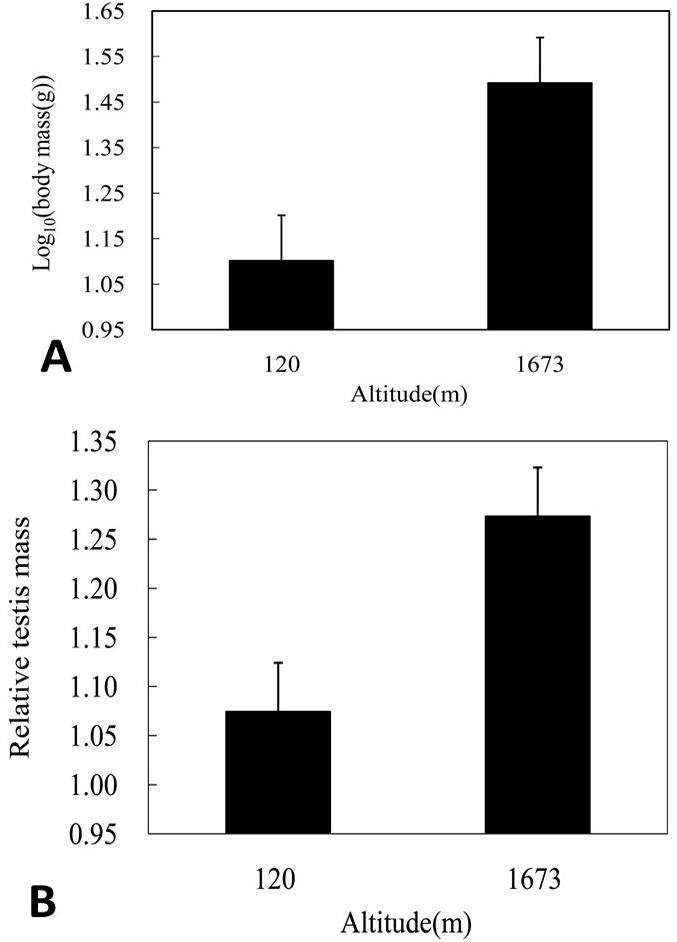
The difference in body mass (A), relative testis mass between low- and high-altitude population.
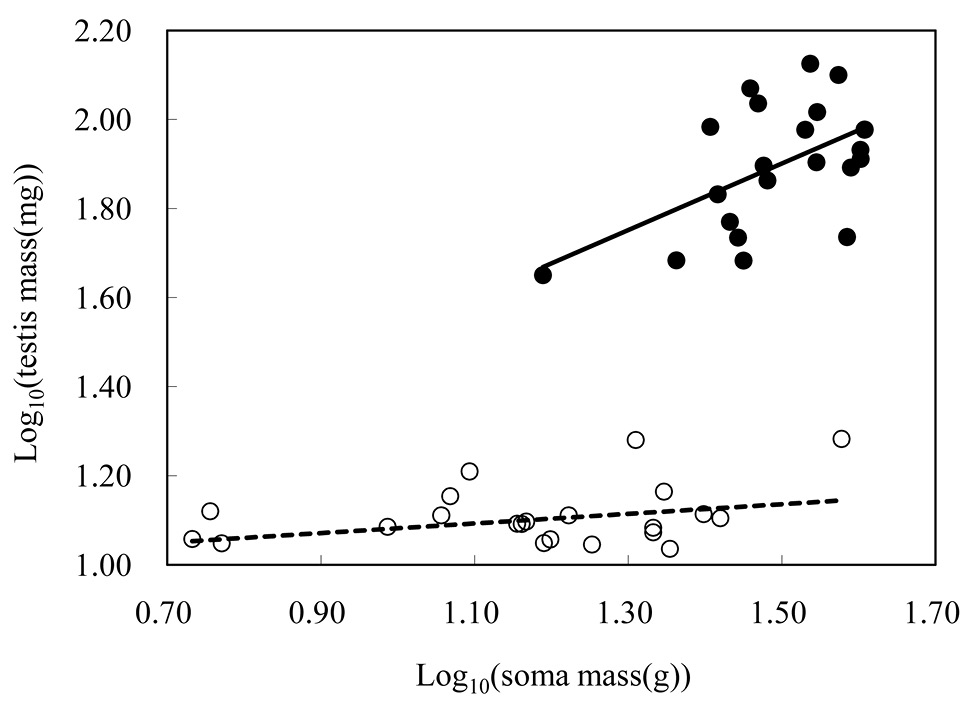
Relationships between testis mass and soma mass of Duttaphrynus melanostictus. Open circle/dashed line and close circle/real line represent the low- and high-altitude populations, respectively.
References
- Alton, L.A., Condon, C., White, C.R. and Angilletta, Jr., M.J., 2017. Colder environments did not select for a faster metabolism during experimental evolution of Drosophila melanogaster. Evolution, 71: 145-152. https://doi.org/10.1111/evo.13094[CrossRef]
- Atkinson, D. and Sibly, R.M., 1997. Why are organisms usually bigger in colder environments? Making sense of a life history puzzle? Trends Ecol. Evol., l12: 235-239. https://doi.org/10.1016/S0169-5347(97)01058-6[CrossRef]
- Bergmann, C., 1847. Über die Verhältnisse der Wärmeökonomie der Thiere zu ihrer Grösse. Göttinger Stud., 3: 595-708.
- Blanckenhorn, W.U. and Demont, M., 2004. Bergmann and converse Bergmann latitudinal clines in arthropods: two ends of a continuum? Integr. Comp. Biol., l44: 413-424. https://doi.org/10.1093/icb/44.6.413[CrossRef]
- Burness, G., Schulte-Hostedde, A.I. and Montgomerie, R., 2008. Body condition influences sperm energetics in lake whitefish (Coregonus clupeaformis). Can. J. Fish. aquat. Sci., 65: 615-620. https://doi.org/10.1139/f07-188[CrossRef]
- Byrne, P.G., Roberts, J.D. and Simmons, L.W., 2002. Sperm competition selects for increased testis mass in Australian frogs. J. Evol. Biol., 15: 347-355. https://doi.org/10.1046/j.1420-9101.2002.00409.x[CrossRef]
- Cai, Y.L., Mai, C.L., Yu, X. and Liao, W.B., 2018. Effect of population density on relationship between pre-and postcopulatory sexual traits. Anim. Biol., 69: 281-292. https://doi.org/10.1163/15707563-20181057[CrossRef]
- Chen, C., Huang, Y.Y. and Liao, W.B., 2016. A comparison of testes size and sperm length between Polypedates megacephalus populations at different altitudes. Herpetol. J., 26: 249-252.
- Chen, W., Pike, D.A., He, D.J., Wang, Y., Ren L.N., Wang, X.Y., Fan, X.G., and Lu X., 2014. Altitude decreases testis weight of a frog (Rana kukunoris) on the Tibetan plateau. Herpetol. J., 24: 183-188.
- Dziminski, M.A. and Alford, R.A., 2005. Patterns and fitness consequences of intraclutch variation in egg provisioning in tropical Australian frogs. Oecologia, 146: 98-109. https://doi.org/10.1007/s00442-005-0177-2[CrossRef]
- Dziminski, M.A., Roberts, J.D., Beveridge, M. and Simmons, L.W., 2010. Among- population covariation between sperm competition and ejaculate expenditure in frogs. Behav. Ecol., 21: 322-328. https://doi.org/10.1093/beheco/arp191[CrossRef]
- Endler, J.A., 1977. Geographic variation, speciation, and clines. Princeton University Press, Princeton, NJ.
- Fei, L., Ye, C.Y. and Jiang, J.P., 2010. Colored Atlas of Chinese Amphibians. Sichuan Publishing House of Science and Technology, Chengdu, China.
- Gomendio, M. and Roldan, E.R., 1991. Sperm competition influences sperm size in mammals. Proc. R. Soc. B., 243: 181-185. https://doi.org/10.1098/rspb.1991.0029[CrossRef]
- Gould, S.J. and Johnston, R.F., 1972. Geographic variation. Annu. Rev. Ecol. Syst., 3: 457-498. https://doi.org/10.1146/annurev.es.03.110172.002325[CrossRef]
- Hettyey, A., Laurila, A., Herczeg, G., Jönsson, K.I., Kovács, T. and Merilä, J., 2005. Does testis weight decline towards the subarctic? A case study on the common frog, Rana temporaria. Naturwissenschaften, 92: 188-192. https://doi.org/10.1007/s00114-005-0607-3[CrossRef]
- Hettyey, A. and Roberts, J.D., 2006. Sperm traits of the quacking frog, Crinia georgiana: Intra- and in-terpopulation variation in a species with a high risk of sperm competition. Behav. Ecol. Sociobiol., 59: 389-396. https://doi.org/10.1007/s00265-005-0062-3[CrossRef]
- Hjernquist, M.B., Söderman, F., Jönsson, K.I., Herczeg, G., Laurila, A. and Merilä, J., 2012. Seasonality determines patterns of growth and age structure over a geographic gradient in an ectothermic vertebrate. Oecologia, 170: 641-649. https://doi.org/10.1007/s00442-012-2338-4[CrossRef]
- Jin, L., Liu, W.C., Li, Y.H., Zeng, Y. and Liao, W.B., 2015. Evidence for the expensive-tissue hypothesis in the Omei Wood Frog (Rana omeimontis). Herpetol. J., 25: 127-130.
- Jin, L., Mi, Z.P. and Liao, W.B., 2016a. Altitudinal variation in male reproductive investment in a polyandrous frog species (Hyla gongshanensis jingdongensis). Anim. Biol., 66: 289-303. https://doi.org/10.1163/15707563-00002505[CrossRef]
- Jin, L., Yang, S.N., Liao, W.B. and Lüpold, S., 2016b. Altitude underlies variation in the mating system, somatic condition and investment in reproductive traits in male Asian grass frogs (Fejervarya limnocharis). Behav. Ecol. Sociobiol., 70: 1197-1208. https://doi.org/10.1007/s00265-016-2128-9[CrossRef]
- Kenthao, A. and Jearranaiprepame, P., 2018. Morphometric variations and fishery unit assessment of Cyclocheilichthys apogon (Actinopterigii: Cyprinidae) from three-different rivers in North-Eastern Thailand. Pakistan J. Zool., 50: 111-122.
- Lack, D., 1966. Population studies of birds. Oxford: Clarendon Press.
- Liao, W.B. and Lu, X., 2011. A comparison of reproductive output of the Omei Treefrog (Rhacophorus omeimontis) between high and low elevations. Anim. Biol., 61: 263-276. https://doi.org/10.1163/157075511X584218[CrossRef]
- Liao, W.B., Mi, Z.P., Zhou, C.Q., Jin, L., Lou, S.L., Han, X. and Ma, J., 2011. Relative testis size and mating systems in anurans: large testis in multiple-male mating in foam-nesting frogs. Anim. Biol., 61: 225-238. https://doi.org/10.1163/157075511X570312[CrossRef]
- Liao, W.B. and Lu, X., 2012. Adult body size = f (initial size + growth rate × age): explaining the proximate cause of Bergman’s cline in a toad along altitudinal gradients. Evol. Ecol., 26: 579-590. https://doi.org/10.1007/s10682-011-9501-y[CrossRef]
- Liao, W.B., Xiao, W.M. and Cai, Y.L., 2013a. Within population variation in testis size in the moleshrew (Anourosorex squamipes) (Mammalia: Soricidae). Ital. J. Zool., 80: 204-209. https://doi.org/10.1080/11250003.2013.777477[CrossRef]
- Liao, W.B., Lu, X. and Jehle, R., 2014. Altitudinal variation in maternal investment and trade-offs between egg size and clutch size in the Andrew’s toad. J. Zool., 293: 84-91. https://doi.org/10.1111/jzo.12122[CrossRef]
- Liao, W.B., Liu, W.C. and Merilä, J., 2015a. Andrew meets Rensch: sexual size dimorphism and the inverse of Rensch’s rule in Andrew’s toad (Bufo andrewsi). Oecologia, 177: 389-399. https://doi.org/10.1007/s00442-014-3147-8[CrossRef]
- Liao, W.B., Lou, S.L., Zeng, Y. and Merilä, J., 2015b. Evolution of anuran brains: disentangling ecological and phylogenetic sources of variation. J. Evol. Biol., 28: 1986-1996. https://doi.org/10.1111/jeb.12714[CrossRef]
- Liao, W.B., Luo, Y., Lou, S.L. and Jehle, R., 2016a. Geographic variation in life-history traits: growth season affects age structure, egg size and clutch size in Andrew’s toad (Bufo andrewsi). Front. Zool., 13: 6. https://doi.org/10.1186/s12983-016-0138-0[CrossRef]
- Liu, Q., Feng, H., Jin, L., Mi, Z.P., Zhou, Z.M. and Liao, W.B., 2018. Latitudinal variation in body size in Fejervarya limnocharis supports the inverse of Bergmann’s rule. Anim. Biol., 68: 113-128. https://doi.org/10.1163/15707563-17000129[CrossRef]
- Liu, Y.H., Liao, W.B., Zhou, C.Q., Mi, Z.P. and Mao, M., 2011. Asymmetry of testes in Guenther’s frog, Hylarana guentheri (Anuar: Ranidae). Asian Herpetol. Res., 2: 234-239. https://doi.org/10.3724/SP.J.1245.2011.00234[CrossRef]
- Lüpold, S., Jin, L. and Liao, W.B., 2017. Population density and structure drive differential investment in pre- and postmating sexual traits in frogs. Evolution, 71: 1686-1699. https://doi.org/10.1111/evo.13246[CrossRef]
- Mai, C.L. and Liao, W.B., 2019. Brain size evolution in anurans: A review. Anim. Biol., 69: 265-279. https://doi.org/10.1163/15707563-00001074[CrossRef]
- Mai, C.L., Liao, J., Zhao, L., Liu, S.M. and Liao, W.B., 2017a. Brain size evolution in the frog Fejervarya limnocharis does neither support the cognitive buffer nor the expensive brain framework hypothesis. J. Zool., 302: 63-72. https://doi.org/10.1111/jzo.12432[CrossRef]
- Mai, C.L., Liu, Y.H., Jin, L., Mi, Z.P. and Liao, W.B., 2017b. Altitudinal variation in somatic condition and investment in reproductive traits in male Yunnan pond frog (Pelophylax pleuraden). Zool. Anz., 66: 189-195. https://doi.org/10.1016/j.jcz.2016.12.002[CrossRef]
- Mi, Z.P., Liao, W.B., Jin, L., Lou, S.L., Cheng, J. and Wu, H., 2012. Testis asymmetry and sperm length in Rhacophorus omeimontis. Zool. Sci., 29: 368-372. https://doi.org/10.2108/zsj.29.368[CrossRef]
- Morrison, C. and Hero, J.M., 2003. Geographic variation in life-history characteristics of amphibians: A review. J. Anim. Ecol., 72: 270-279. https://doi.org/10.1046/j.1365-2656.2003.00696.x[CrossRef]
- Roff, D.A., 2002. Life-history evolution. Sinauer Associates, Sunderland, MA, USA.
- Samani, P., 2018. Digest: Evolution of sperm size and number in external fertilizers. Evolution, 72: 404-405. https://doi.org/10.1111/evo.13414[CrossRef]
- Schulte-Hostedde, A.I. and Millar, J.S., 2004. Intraspecific variation of testis size and sperm length in the yellow-pine chipmunk (Tamias amoenus): Implications for sperm competition and reproductive success. Behav. Ecol. Sociobiol., 55: 272-277. https://doi.org/10.1007/s00265-003-0707-z[CrossRef]
- Schulte-Hostedde, A.I., Millar, J.S. and Hickling, G.J., 2001. Evaluating body condition in small mammals. Can. J. Zool., 79: 1021-1029. https://doi.org/10.1139/cjz-79-6-1021[CrossRef]
- Schulte-Hostedde, A.I., Millar, J.S. and Hickling, G.J., 2005. Condition dependence of testis size in small mammals. Evol. Ecol. Res., 7: 143-149.
- Simmons, L.W. and Kotiaho, J.S., 2002. Evolution of ejaculates: patterns of phenotypic and genotypic variation and condition dependence in sperm competition traits. Evolution, 56: 1622-1631. https://doi.org/10.1111/j.0014-3820.2002.tb01474.x[CrossRef]
- Tang, T., Luo, Y., Huang, C.H., Liao, W.B. and Huang, W.C., 2018. Variation in somatic condition and testis mass in Feirana quadranus along an altitudinal gradient. Anim. Biol., 68: 277-288. https://doi.org/10.1163/15707563-17000142[CrossRef]
- Wu, Q.G. and Liao, W.B., 2017. Evidence for directional testes asymmetry in Hyla gongshanensis jindongensis. Acta Herpetol., 12: 89-93.
- Yang, S.N., Feng, H., Jin, L., Zhou, Z.M. and Liao, W.B., 2018. No evidence for the expensive-tissue hypothesis in Fejervarya limnocharis. Anim. Biol., 68: 265-276. https://doi.org/10.1163/15707563-17000094[CrossRef]
- Yu, X., Zhong, M.J., Li, D.Y., Jin, L., Liao, W.B. and Kotrschal, A., 2018. Large-brained frogsmature later and live longer. Evolution, 72: 1174-1183. https://doi.org/10.1111/evo.13478[CrossRef]
- Zeng, Y., Lou, S.L., Liao, W.B. and Jehle, R., 2014. Evolution of sperm morphology in anurans: Insights into the roles of mating system and spawning location. BMC Evol. Biol., 14: 104. https://doi.org/10.1186/1471-2148-14-104[CrossRef]
- Zhang, L.X. and Lu, X., 2012. Amphibians live longer at higher altitudes but not at higher latitudes. Biol. J. Linn. Soc., 106: 623-632. https://doi.org/10.1111/j.1095-8312.2012.01876.x[CrossRef]
- Zhang, L.X., Ma, X.Y., Jiang, J.P. and Lu, X., 2012. Stronger condition dependence in female size explains altitudinal variation in sexual size dimorphism of a Tibetan frog. Biol. J. Linn. Soc., 107: 558-565. https://doi.org/10.1111/j.1095-8312.2012.01953.x[CrossRef]
- Zhang, L.X., An, D., He, Y.X., Li, Z.B., Fang, B.H., Chen, X.H. and Lu, X., 2018. Variation in testis weight of the Tibetan toad Scutiger boulengeri along a narrow altitudinal gradient. Anim. Biol., 68: 429-439. https://doi.org/10.1163/15707563-17000016[CrossRef]
- Zhong, M.J., Wang, X.Y., Huang, Y.Y. and Liao, W.B., 2016. Altitudinal variation in organ size in Polypedates megacephalus. Herpetol. J., 27: 235-238.
- Zhong, M.J., Yu, X. and Liao, W.B., 2018. A review for life-history traits variation in frogs especially for anurans in China. Asian Herpetol. Res., 9: 165-174.
- Zhou, C.Q., Mao, M., Liao, W.B., Mi, Z.P. and Liu, Y.H., 2011. Testis asymmetry in the dark-spotted frog Rana nigromaculata. Herpetol. J., 21: 181-185.
Services
Article usage statistics
Loading…