Table 3: Comparative index of cow uterine contraction frequency in normal and pathological postpartum periods.
a Values within a row differ significantly at P<0.05; b Values within a row differ significantly at P<0.01; c Values within a row differ significantly at P<0.001
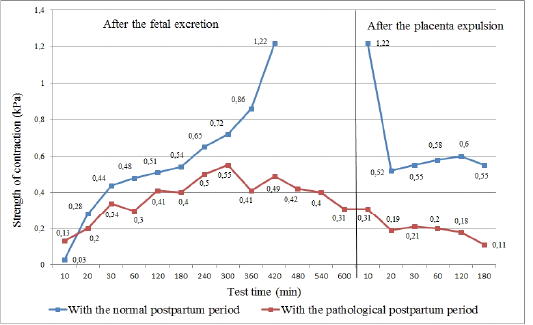
Table 1 (Figure 2) shows that in cows with the normal postpartum period, the strength of uterine contractions after fetal excretion within 7 hours (420 min) increased from 0.03±0.01 to 1.22±0.09 kPa. Spontaneous placenta expulsion in these cows took place on average 7 hours (420 min) after fetal excretion, after which the strength of uterine contractions during the first 10 min decreased from 1.22±0.09 to 0.52±0.04 kPa and then gradually increased to 0.60±0.02 kPa during 2 hours (120 min), after which it began to decrease to 0.55±0.02 kPa by 3 hours (180 min).
In cows with a pathological postpartum period, the strength of uterine contractions was wave-like and gradually increased from 0.13±0.03 to 0.55±0.06 kPa within 10 hours after the fetal excretion. In these cows, an average of 10 hours (600 minutes) later, an operative placenta expulsion was used. These cows had weaker uterine contractions than cows with the normal postpartum period, which was observed already by 20 min ― 0.08 kPa, by 30 min ― 0.1 kPa, by 60 min ― 0.18 kPa, by 120 min ― 0.1 kPa, by 180 min ― 0.14 kPa.
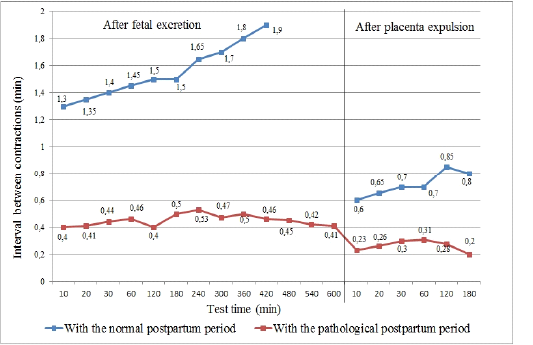
Table 2 (Figure 3) shows that in cows with a normal postpartum period, the duration of uterine contractions after fetal excretion increased from 1.30±0.09 to 1.90±0.07 minutes within 7 hours. Spontaneous placenta expulsion in these cows took place on average 7 hours (420 min) after fetal excretion, after which the duration of uterine contractions in the first 10 min was reduced from 1.90±0.07 to 0.60±0.07 and then gradually increased to 0.85±0.05 min within 2 hours (120 min), after which it began to decrease and decreased to -0.80±0.09 min by 3 hours (180 min).
The graphical data shows that in cows with a pathological postpartum period, the duration of uterine contractions after fetal excretion ranged from 0.40±0.02 to 0.53±0.02 within 10 hours. In these cows, an operational placenta expulsion was conducted within 10 hours (600 min) on average, after which the duration of uterine contractions during the first 10 min was reduced from 0.41±0.01 to 0.23±0.03 min and then gradually increased to 0.31±0.04 within 1 hour (60 min). The duration of uterine contractions then began to decrease (120 min ― 0.28±0.02 min, 180 min ― 0.20±0.01).
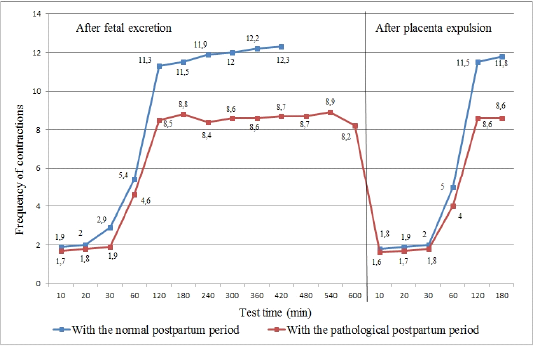
When labor and the postpartum period were normal, the frequency of uterine contractions in cows gradually increased from 1 to 13 times within 10-420 minutes after fetal excretion (Table 3, Figure 4). The uterus contracted 1-2 times (1.90±0.11) after 10 minutes, 1-3 times (2.00±0.16) after 20 minutes, 1-3 times (2.90±0.11) after 30 minutes, and 4-6 times (5.40±0.28) after 60 minutes, in 120 min ― 10-12 times (11.30±0.28), in 180 min ― 11-12 times (11.50±0.18), in 240 min ― 11-13 times (11.90±0.19), in 300 min ― 11-13 times (12.00±0.22), in 360 min ― 12-13 times (12.20±0.14), and in 420 min ― 12-13 times (12.30±0.16).
The frequency of uterine contractions, which were determined within 10-180 min after excretion of the placenta, was: in 10 min ― 1-2 times (1.80±0.14), in 20 min ― 1-2 times (1.90±0.11), in 30 min ― 1-3 times (2.00±0.11), in 60 min ― 4-6 times (5.00±0.22), in 120 min ― 10-12 times (11.50±0.24), and in 180 min ― 11-13 times (11.80±0.14).
In the pathological course of labor and the postpartum period (further development in cows of the retained placenta, subinvolution of the uterus, postpartum endometritis), the frequency of uterine contractions was considered within 600 min after fetal excretion and was from 1 to 9 times (in 10 min ― 1-2 times (1.70±0.16), in 20 min ― 1-2 times (1.80±0.14), in 30 min ― 1-2 times (1.90±0.11), in 60 min ― 3-5 times (4.60±0.23), in 120 min ― 7-9 times (8.50±0.28), in 180-600 min ― 7-9 times (from 8.20±0.31 to 8.90±0.11).
After manual excretion of the placenta within 10-180 minutes, the uterus contractions were: in 10-30 minutes ― 1-2 times (from 1.60±0.17 to 1.80±0.14), in 60 minutes ― 3-5 times (4.00±0.31), in 120-180 minutes ― 8-9 times (from 8.60±0.17 to 8.80±0.14).
Studies conducted in cows 30 minutes after fetal excretion show that in the pathological process of the placenta period of labor, the strength of uterine contractions decreased by 0.1 kPa (from 0.44±0.05 kPa to 0.34±0.05 kPa), the duration of uterine contractions was 0.96 min shorter (from 1.40±0.13 to 0.44±0.01 min), and the frequency of uterine contractions was one time lower (from 2.9 to 1.9 times) than that of animals with the normal process, which may serve as a criterion for predicting retained placenta.
Studies carried out on cows 30 minutes after the placenta expulsion show that when the pathological postpartum period flows, the strength of uterine contractions decreased by 0.34 kPa (from 0.55±0.05 kPa to 0.21±0), the duration of uterine contractions was 0.40 min shorter (0.70±0.06 min to 0.30±0.04 min), and the frequency of uterine contractions was 0.2 times shorter (from 2 to 1.8 times) than in animals with the normal process. This may serve as a criterion for predicting a delay in the excretion of congestion in the uterus of lochia, which leads to subinvolution of the uterus and postpartum endometritis.