
Marine viruses regulate the ocean ecology and the biological carbon pump by reprogramming host cells before they destroy them. Through auxiliary metabolic genes, infection resets intracellular stoichiometry and turns the host into a virocell, well before lysis. This review aim to the Multi-Scale Virocell-Engine Framework, which links that sub-cellular encounter to the global carbon export across three scales: biophysical contact and auxiliary metabolic gene expression; population control by Kill the Winner lysis and Piggyback-the-Winner lysogeny, and the split of carbon between the upper-ocean viral shunt and the deep-ocean viral shuttle. The three scales form a recursive loop, in which export and re-mineralization feed back into the nutrient and the host fields that set the next encounter. The framework thus connects the viral takeover of a single cell to the fate of carbon in the ocean.
Review · Volume 10, Issue 5, Pages 530–538, 27 October 2026 · Open Access
The Multi-Scale Virocell-Engine Framework: Connecting Sub-Cellular Marine Viral-Host Encounters to the Global Carbon Export
·
Affiliations & Notes ⌄
- 1Department of Medical Microbiology, Faculty of Medicine, Medical University of Sofia, Sofia, Bulgaria
- 2Faculty of Medicine, Medical University of Sofia, Sofia, Bulgaria
- *Correspondence | Nikolay Kalvatchev; Email: [email protected]
Article Info ⌄
- Journal:
- Novel Research in Microbiology Journal
- Submitted Date:
- 7 September 2026
- Accepted Date:
- 18 October 2026
- Published Date:
- 27 October 2026
Abstract
Introduction
Outnumbering cellular microorganisms ten to one, marine viruses are the most abundant biological entities in the global ocean (Suttle, 2005; . Historically, classical microbial ecology evaluated these entities through a singular lens as agents of microbial mortality. Early oceanographic models parameterized viral lysis strictly as an instantaneous sink converting particulate organic carbon (POC) to dissolved organic carbon (DOC). ; .
While the viral shunt model successfully reframed DOC on pathways, it relied on the assumption that the infected cell is a passive biological container destined for destruction. Over the past decade, advances in single-cell genomics, metatranscriptomics, and high-throughput culturing have challenged this premise . Viruses are now recognized as obligate genetic drivers that express auxiliary metabolic genes to extensively reprogram host cellular transcription, central carbon metabolism, and lipid biosynthesis, transforming the host into a modified physiological entity termed the virocell long before cell lysis occurs ; ; .
While this metabolic perspective is established, a cohesive synthesis connecting nanometer-scale encounters to basin-scale carbon fluxes remains lacking. Marine virology remains heavily compartmentalized at the cellular scale, lacking a cohesive synthesis that bridges the continuum from nanometer-scale viral-host encounter dynamics to basin-scale carbon export and nutrient stoichiometry. Furthermore, transitioning across these scales presents inherent modeling challenges, as micro-scale biochemical interactions are constantly moderated by intermediate physical and ecological filters, including ocean turbulence, hydrodynamic mixing, and grazing pressure .
The proposed framework directly links sub-cellular infection mechanics and auxiliary metabolic reprogramming directly to population-level density-dependent valves, such as the transition between lytic cascades and lysogenic states. In turn, these dynamics dictate whether organic matter is recycled in the upper ocean or shuttled via particle aggregation to the deep ocean ; Knowles et al., 2016; . The contribution of this review is therefore not a new mechanism but a unified, tiered architecture for organizing existing evidence, one that makes explicit the recursive couplings between scales that individual studies address only in isolation. Figure 1 summarizes this cross-scale architecture, representing the three tiers and their feedback couplings schematically.
Figure 1: The Multi-Scale Virocell-Engine Framework. Schematic representation of the cross-scale architecture governing marine viral-host interactions and global carbon export. Tier 1 (Cellular core): Encompasses nanometer-scale encounter kinetics, surface adsorption energetics, and auxiliary metabolic gene (AMG) reprogramming which overrides the host metabolic bottlenecks. Tier 2 (Population dynamics): Operates as a density-dependent valve regulating the transition between the Kill-the-Winner (KtW) lytic cascades and the Piggyback-the-Winner (PtW) lysogenic states. Tier 3 (Macro-scale flux): Governs the carbon bifurcation between the upper-ocean viral shunt (i.e., dissolved organic matter recycling via cell lysis) and the deep-ocean viral shuttle (i.e., enhanced particle aggregation and particulate organic carbon export). Dashed feedback loops indicate basin-scale upwelling and remineralization resetting the nutrient stoichiometry and the host encounter frequencies at the cellular base. (An original artwork created for this study; available under a Creative Commons CC BY 4.0 license).
Tier 1: The active virocell phase (biophysical encounter and takeover)
The virocell-engine framework is structured into distinct functional levels, beginning with Tier 1: the active virocell phase. Operating at the cellular scale (cells/ ml), this phase encompasses biophysical encounter and takeover governed by fluid dynamics, cell surface geometry, and transcriptional hijacking, ultimately setting the stage for marine carbon export in the epipelagic zone.
Susceptible host pool
Marine microbial communities form a diverse foundational reservoir capable of supporting viral infection and fueling the base of the engine. This pool encompasses distinct taxonomic groups, ranging from abundant prokaryotic cyanobacteria (i.e., Synechococcus and Prochlorococcus) to diverse eukaryotic microalgae, including diatoms and nanoflagellates. The baseline metabolic health, nutrient stress status, and standing stock concentrations of these populations dictate the initial vulnerability and fuel potential of the system before any viral contact takes place (Suttle, 2005; .
Host-virus collision cross-section
Once the hosts are available, physical transport mechanisms determine the rate at which viral particles encounter cellular surfaces. For small virions (Rv ≈ 20-100 nm), the brownian diffusion (Dv ≈ 10-8 cm2/s at 15 oC) governs the base collision kinetics, whereas larger microplankton hosts (Rh ≈ 2.0-20 µm) experience modified encounter frequencies driven by micro-scale fluid shear (γ ≈ 0.1-10/s) ; . Adsorption rate constants (kads) range from 10-10-10-9 ml/min for cyanophages to 10-8 ml/min for giant eukaryotic viruses ; . Classical encounter models adapted from colloid chemistry, such as Smoluchowski coagulation mechanics, demonstrate that successful contact depends heavily on these entity radii and shear dynamics :
Where; β is the collision frequency function, Rv and Rh are the radii of the virus and the host, Dv and Dh are their respective diffusion coefficients, and γ represents the fluid shear rate . In surface water, solar UV photo-inactivation drives a decay rate of kdecay ≈ 0.05-0.2/h, reducing the effective virion-host encounter success by 10%-30% prior to adsorption ; .
Prokaryotic and eukaryotic virocell takeover
Following successful adsorption across the cellular membrane, the interaction shifts from transport physics to intracellular hijacking, bifurcating into domain-specific metabolic takeovers that fundamentally reconfigure the ocean biogeochemistry. ; . Within cyanobacterial hosts, viral infection drives the rapid expression of host-hijacked metabolic pathways, including photosynthetic genes (psbA, psbD) and pentose phosphate pathway components (gnd). Viral gnd expression upregulates the pentose phosphate pathway flux by 300%-500%, thereby generating NADPH to support rapid viral nucleotide synthesis, while photosystem II efficiency (Fv/Fm) is maintained at >80% of baseline for 6-8 h post-infection ; . To meet these synthetic demands, the virocell increases the inorganic phosphate uptake by 2-5×, driving elemental C:N:P ratios down from the classical Redfield baseline (106:16:1) to stoichiometric ratios near 60C:12N:1P prior to cell rupture in order to fuel high-frequency replication and accelerate carbon cycling ; . In contrast, viral infection in microalgae induces extensive intracellular membrane restructuring, lipid and sphingolipid remodeling, and lineage-specific physiological processes such as altered coccolith calcification or frustule formation. This structural reprogramming alters the cellular buoyancy, nutrient stoichiometry, and food-web nutritional quality long before lysis occurs .
Host resistance, escape and UV-mediated abiotic inactivation
Infection efficiency is attenuated by host defense mechanisms (e.g., surface receptor mutations, Clustered regularly interspaced short palindromic repeats [CRISPR-Cas targeting]) and solar UV photo-inactivation (kdecay ≈ 0.05-0.2/h in surface water), which reduce the effective virion-host encounter success by10%-30%. . Simultaneously, free viral particles in the upper ocean face severe environmental attrition driven by high solar ultraviolet (UV) radiation, thermal degradation, and heavy metal stress, forming an abiotic sink that reduces the active viral abundance prior to host contact . The net rate of virocell conversion versus abiotic loss dictates the biological thresholds for the population-level regime shifts, which is explored in Tier 2.
Tier 2: Population dynamics tipping points and regime switches
Over intermediate temporal scales (1-10 d) localized infection kinetics scale into population mortality dynamics driven by host density and nutrient availability. At this intermediate tier, cumulative infection within the susceptible host pool drives the system towards a non-linear tipping point set by host density, nutrient availability, and viral encounter frequency ; Knowles et al., 2016).
The tipping point and lytic-lysogenic decision
Nutrient-replete, actively dividing hosts favor the lytic trajectory, maximizing progeny production and exerting the density-dependent control formalized by Kill-the-Winner (Fuhrman, 1999; . The alternative lysogenic or chronic carrier state, however, is governed by host abundance in a regime-dependent manner. Under severe nutrient stress or low host density, integration into the host genome acts as a survival strategy that conserves viral genotypes when lytic reproduction cannot sustain transmission ; . Specifically, dissolved inorganic phosphate depletion (<10 nmol/ l) or iron starvation (<0.1 nmol/ l) reduces lytic burst sizes by 70%-90% and triggers a 3-5 times increase in the frequency of lysogenized cells (FLC). When lytic conditions prevail, progeny yields diverge remarkably across the host taxa. Picocyanobacteria (i.e., Prochlorococcus, Synechococcus) yield burst sizes (b) of 20–150 progeny/ cell, whereas eukaryotic microalgae (Emiliania huxleyi) produce burst sizes of 400–1000 virions/ cell (Knowles et al., 2016; . This coexistence of lysogenic infection with sustained viral replication in fast-growing, numerically dominant hosts is formalized as Piggyback-the-Winner (Knowles et al., 2016; . The prevalence of lysogeny therefore reflects a balance among nutrient status, host density, and encounter frequency, with tipping points that remain poorly constrained in wild cyanobacteria ; Knowles et al., 2016). These regime relationships are represented as a phase diagram in Figure 2, with the lytic and lysogenic zones separated by the tipping point.
When lytic dominance prevails across a broad taxonomic group, daily host mortality rates reach 20%-50%/day, dismantling standing bloom biomass. Over a 3-7 d window, cell densities drop from peak levels of 104 cells/ml to <102 cells/mL, releasing an organic pulse of 20-100 µmol/l (POC) and 10-30 µmol/l (DOC) into the water column (Suttle, 1990; ; ; . This regime shift converts the standing primary production into a pulse of organic matter and initiates the transition towards a macro-scale biogeochemical export.
Figure 2: Schematic phase diagram of the lytic-lysogenic decision as a function of host cell density and lysogeny prevalence. Shaded regions indicate the KtW lytic cascade, the PtW temperate regime, and lysogeny as a low-density survival strategy, The dashed line indicates the poorly constrained tipping point between the regimes. Inset: virus-driven bloom collapse following threshold crossing. Schematic; quantitative boundaries are not yet resolvable in the field. (Adapted under the terms of the Creative Commons Attribution 4.0 International License, CC BY 4.0, from Silveira and Rohwer (2016); Knowles et al. (2016).
Figure 3: Mechanistic bifurcations of viral-mediated marine carbon allocation. Photosynthetically fixed carbon diverges into two contrasting pathways: (A) The viral shuttle: Infection-induced Transparent Exopolymer Particles (TEP) synthesis drives cellular aggregation, transforming buoyant picoplankton into heavy macromolecular masses that sink past ~100 m to accelerate deep-ocean carbon sequestration. (B) The viral shunt: cell lysis converts surface populations into Dissolved Organic Matter (DOM) and Particulate Organic Matter (POM) organic pools, bypassing zooplankton grazing to retain carbon in surface water and fuel the microbial loop. (An original artwork created for this study, conceptualized from Wilhelm and Suttle (1999); Guidi et al. (2016); Zimmerman et al. (2020), available under a Creative Commons CC BY 4.0 license).
Divergent population-level pathways
The lytic-lysogenic switch determines organic matter distribution: lytic cascades drive rapid cell rupture and localized carbon release, whereas temperate lysogeny preserves the host cell structural integrity ; Knowles et al., 2016; . This chronic pathway buffers the ecosystem against abrupt population collapses and, because the surviving hosts continue to fix carbon, it alters the stoichiometry and packaging of the organic matter that ultimately leaves the euphotic zone ; .
Ultimately, the population-level outcomes generated at Tier 2 determine the physical and chemical state of the organic matter released into the water column, establishing the exact precursor conditions required to drive either the viral shuttle or the viral shunt in Tier 3 ; ; Guidi et al., 2016).
Tier 3: Biogeochemical export and basin-scale feedback
Tier 3 models the export fate of the organic carbon across the epipelagic horizon (100 m) over weekly to seasonal cycles (Guidi et al., 2016). The particulate and dissolved matter generated by Tier 2 regime shifts bifurcates into two opposing pathways, the viral shuttle and the viral shunt, which dictate whether carbon is sequestered in the deep ocean or recycled within the upper water column ; Suttle, 2005). The divergent fates of photosynthetically fixed carbon along these two pathways are shown in Figure 3.
The viral shuttle: Accelerated deep-ocean export
When viral lysis intersects with high-biomass phytoplankton blooms, it initiates the viral shuttle, a mechanism that short-circuits the traditional grazing food webs and accelerates the carbon export ; . Virus-induced cell lysis releases massive quantities of sticky intracellular polysaccharides, neutral lipids, and macromolecular debris into the surrounding water, which spontaneously coagulate into transparent exopolymer particles ; . Cell lysis triggers a 300% – 800% spike in the local transparent exopolymer particle (TEP) concentrations, reaching 100–1000 µg Xanthan Gum Equivalents/L . These adhesive TEP matrices entrap the unlysed cells, viral particles, and mineral ballast (i.e., calcium carbonate coccoliths or biogenic silica), transforming slow-sinking single cells (0.1–2.0 m/day) into heavy, macromolecular aggregates that achieve vertical sinking velocities of 50 – 500 m/day (Guidi et al., 2016). By accelerating downward transport, these aggregates cross the 100 m epipelagic horizon in 1–5 days, escaping the upper-ocean microbial remineralization (Guidi et al., 2016; . By packing the organic carbon into fast-sinking aggregates, the viral shuttle bypasses microzooplankton grazing and microbial respiration in the epipelagic zone, facilitating a high-efficiency export flux into the deep-ocean interior for a long-term carbon sequestration (Guidi et al., 2016; .
The viral shunt: Surface retention and microbial cycling
Conversely, the viral shunt operates as a retention mechanism that decouples carbon export from primary production . Lysis events that break the cells down into DOM and POM rather than large aggregates keep the organic carbon suspended within the surface water (Fuhrman, 1999; Suttle, 2005). This dissolved and fine particulate pool is rapidly assimilated by the heterotrophic bacteria, fueling the microbial loop and driving high rates of community respiration that release carbon dioxide from surface waters into the atmosphere (CO2 outgassing) . At a planetary scale, marine viruses process 10%-20% of global net primary production (≈ 3-5 gigatons of carbon/ year {Gt C/year}). The viral shunt retains 80%-90% of this processed pool (≈ 2.5-4.2 Gt C/year) above the 100m horizon as DOM and fine POM, driving the heterotrophic bacterial respiration (Rbac) and maintaining the euphotic nutrient recycling. Conversely, the viral shuttle sequesters the remaining 10%-20% (≈ 0.1-0.5 Gt C/year), transporting it past the 100m horizon into deep-ocean sinks ; .
Recursive systemic feedbacks
The multi-scale trajectory of the virocell-engine framework does not terminate in the deep ocean or surface pools; rather, it closes through recursive biogeochemical feedbacks. Nutrient remineralization driven by the viral shunt fuels the baseline metabolic health of the Susceptible Host Pool in Tier 1, while the deep-ocean carbon sequestration via the viral shuttle modulates the global carbon cycles on century-to-millennial timescales ; . While their net contribution to sequestration remains quantitatively uncertain, the viruses operate as active, stoichiometric modulators of the biological carbon pump.
Global implications
The multi-scale trajectory of the virocell-engine framework reveals that marine carbon export is not merely a passive consequence of physical mixing or zooplankton grazing, but a biologically active process driven by viral manipulation of the host physiology. By bridging micro-scale metabolic reprogramming (Tier 1) and day-to-week population tipping points (Tier 2) with basin-scale export fluxes (Tier 3), this framework redefines the biological carbon pump as a multi-tiered continuum. Quantifying these global effects using integrated structural equation models or global regression analyses would clarify whether virus-induced pathways may exert primary control over the fate of primary production and its subsequent sequestration in the deep ocean. The framework yields three testable predictions. First, the net export efficiency should scale positively with the lytic fraction in nutrient-replete, calcifier- and diatom-dominated blooms, because lytic-driven TEP formation accelerates shuttle-type export. Second, in oligotrophic regimes where lysogeny prevails, export efficiency should instead track the rate of lysogen induction, so that carbon export peaks following abrupt induction events rather than during steady-state lytic activity. Third, the shunt-to-shuttle balance should depend systematically on the host cell geometry, with larger, calcified, or silicified hosts shifting the balance towards the shuttle, a prediction that is directly addressable with the Tier 1 encounter models. Table 1 condenses the evidence base and confidence for each mechanism of the virocell-engine cascade.
Table 1: Strength of evidence for each step of the virocell-engine cascade, from cellular takeover to carbon export.
Mechanism | Primary evidence | Confidence | Lead citation |
Viral shunt | Lysis-based DOM recycling, field and model support | High | Fuhrman (1999), Wilhelm and Suttle (1999) |
Kill the Winner | Density-dependent lytic control of dominant hosts | High | Thingstad (2000) |
AMG metabolic reprogramming | Cyanophage genomics, host transcriptomics | High | Mann (2003), Zimmerman et al. (2020) |
Viral shuttle | Bloom studies; sediment traps, export networks | Moderate | Guidi et al. (2016), Laber et al. (2018), Sheyn et al. (2018) |
Piggyback the winner/ lysogeny | Global viral community analyses | Moderate | Knowles et al. (2016); Silveira and Rohwer (2016) |
TEP-mediated aggregation | Coagulation experiments, bloom observations | Moderate | Passow (2002), Zimmerman et al. (2020) |
Host resistance and abiotic loss | Host immunity, UV inactivation studies | Moderate | Suttle (2007), Mojica and Brussaard (2026) |
Where; AMG: Auxiliary Metabolic Gene, TEP: Transparent Exopolymer Particles, POM: Particulate Organic Matter, DOM: Dissolved Organic Matter.
Conclusions and Recommendations
The virocell-engine framework gives a coherent, cross-scale account of how viral activity shapes the biological carbon pump. At the cellular scale, encounter and auxiliary metabolic reprogramming turn the host into a virocell before lysis. At the population scale, the balance between lytic and lysogenic outcomes sets the timing and form of the organic-matter release. At the basin scale, this release is partitioned between surface recycling through the viral shunt and deep export through the viral shuttle. Collectively, the three tiers describe carbon export as a biologically active continuum rather than a passive consequence of mixing or grazing. Extending this framework across the tropical and polar provinces, writing the couplings among the tiers in a quantitative form, and placing them in global biogeochemical models will show how marine ecosystems and climate feedbacks respond to the ongoing anthropogenic change. Viruses are active modulators of the biological carbon pump and incorporating this biological driver is essential for accurate predictive modeling of the ocean carbon cycle.
Novelty Statement
While marine microbial ecology has increasingly recognized the individual components of viral-mediated processes, such as nanometer-scale auxiliary metabolic gene reprogramming, population-level lytic-lysogenic regime switches, and basin-scale carbon fluxes, these scales have traditionally been studied in isolation. This review introduces the Multi-Scale Virocell-Engine Framework, providing the first cohesive, tiered synthesis that explicitly connects sub-cellular viral infection mechanics and physiological takeover directly to macroscopic biogeochemical outcomes and carbon export pathways. By framing the biological carbon pump as a continuous, recursive cascade rather than a set of disconnected phenomena, this work offers a unified architectural model to advance predictive marine ecosystem and climate modeling.
Author Contribution
NK: Conceptualization, methodology, verification, writing review and editing, supervision. AS: Resources, investigation, writing original draft.
Ethical approval
This study did not involve human participants, animal subjects, or restricted biological materials, and therefore ethical approval was not required.
Funding source
This research did not receive any specific grant from funding agencies in the public, commercial, or not-for-profit sectors.
Generative AI and AI assisted technology statement
The authors declare that no generative AI and AI assisted technology was used in the creation of this manuscript.
Conflict of interests
The authors have declared no conflicts of interest.
Figures
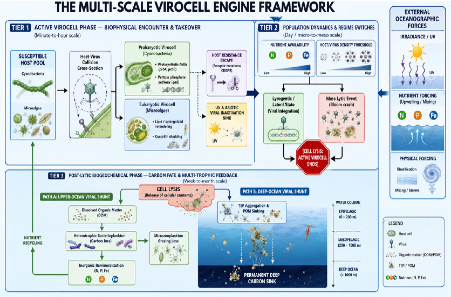
The Multi-Scale Virocell-Engine Framework. Schematic representation of the cross-scale architecture governing marine viral-host interactions and global carbon export. Tier 1 (Cellular core): Encompasses nanometer-scale encounter kinetics, surface adsorption energetics, and auxiliary metabolic gene (AMG) reprogramming which overrides the host metabolic bottlenecks. Tier 2 (Population dynamics): Operates as a density-dependent valve regulating the transition between the Kill-the-Winner (KtW) lytic cascades and the Piggyback-the-Winner (PtW) lysogenic states. Tier 3 (Macro-scale flux): Governs the carbon bifurcation between the upper-ocean viral shunt (i.e., dissolved organic matter recycling via cell lysis) and the deep-ocean viral shuttle (i.e., enhanced particle aggregation and particulate organic carbon export). Dashed feedback loops indicate basin-scale upwelling and remineralization resetting the nutrient stoichiometry and the host encounter frequencies at the cellular base. (An original artwork created for this study; available under a Creative Commons CC BY 4.0 license).
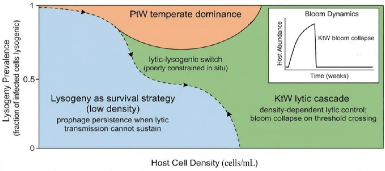
Schematic phase diagram of the lytic-lysogenic decision as a function of host cell density and lysogeny prevalence. Shaded regions indicate the KtW lytic cascade, the PtW temperate regime, and lysogeny as a low-density survival strategy, The dashed line indicates the poorly constrained tipping point between the regimes. Inset: virus-driven bloom collapse following threshold crossing. Schematic; quantitative boundaries are not yet resolvable in the field. (Adapted under the terms of the Creative Commons Attribution 4.0 International License, CC BY 4.0, from Silveira and Rohwer (2016); Knowles et al. (2016).
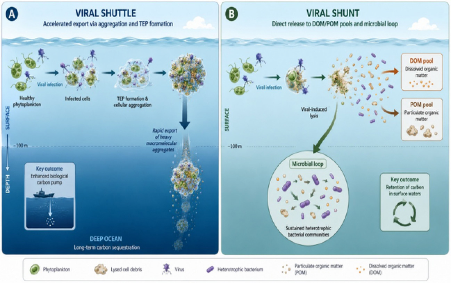
Mechanistic bifurcations of viral-mediated marine carbon allocation. Photosynthetically fixed carbon diverges into two contrasting pathways: (A) The viral shuttle: Infection-induced Transparent Exopolymer Particles (TEP) synthesis drives cellular aggregation, transforming buoyant picoplankton into heavy macromolecular masses that sink past ~100 m to accelerate deep-ocean carbon sequestration. (B) The viral shunt: cell lysis converts surface populations into Dissolved Organic Matter (DOM) and Particulate Organic Matter (POM) organic pools, bypassing zooplankton grazing to retain carbon in surface water and fuel the microbial loop. (An original artwork created for this study, conceptualized from Wilhelm and Suttle (1999); Guidi et al. (2016); Zimmerman et al. (2020), available under a Creative Commons CC BY 4.0 license).
References
- Azam, F. and Malfatti, F., 2007. Microbial structuring of marine ecosystems. Nat. Rev. Microbiol., 5(10): 782-791. https://doi.org/10.1038/nrmicro1747 [CrossRef]
- Biggs, T.E.G., Huisman, J. and Brussaard, C.P.D., 2021. Viral lysis modifies seasonal phytoplankton dynamics and carbon flow in the Southern Ocean. ISME J., 15(12): 3615-3622. https://doi.org/10.1038/s41396-021-01033-6 [CrossRef]
- Breitbart, M., 2012. Marine viruses: Truth or dare. Annu. Rev. Mar. Sci., 4: 425-448. https://doi.org/10.1146/annurev-marine-120709-142805 [CrossRef]
- Evans, C. and Brussaard, C.P.D., 2012. Regional variation in lytic and lysogenic viral infection in the Southern Ocean and its contribution to carbon export. Appl. Environ. Microbiol., 78(18): 6743-6748. https://doi.org/10.1128/AEM.01357-12 [CrossRef]
- Forterre, P., 2013. The virocell concept and environmental microbiology. ISME J., 7(2): 233-236. https://doi.org/10.1038/ismej.2012.110 [CrossRef]
- Fuhrman, J.A., 1999. Marine viruses and their biogeochemical and ecological effects. Nature, 399(6736): 541-548. https://doi.org/10.1038/21119 [CrossRef]
- Guidi, L., Chaffron, S., Bittner, L., Eveillard, D., Larhlimi, A., Roux, S., Darzi, Y., Audic, S., Berline, L., Brum, J.R., Coelho, L.P., Espinoza, J.C.I., Malviya, S., Sunagawa, S., Dimier, C., Kandels-Lewis, S., Picheral, M., Poulain, J., Searson, S., Tara Oceans Consortium Coordinators, Stemmann, L., Not, F., Hingamp, P., Speich, S., Follows, M., Karp-Boss, L., Boss, E., Ogata, H., Pesant, S., Weissenbach, J., Wincker, P., Acinas, S.G., Bork, P., de Vargas, C., Iudicone, D., Sullivan, M.B., Raes, J., Karsenti, E., Bowler, C. and Gorsky, G., 2016. Plankton networks driving carbon export in the oligotrophic ocean. Nature, 532(7600): 465-470. https://doi.org/10.1038/nature16942 [CrossRef]
- Jacquet, S., Miki, T., Noble, R., Peduzzi, P. and Wilhelm, S., 2010. Viruses in aquatic ecosystems: Important advancements of the last 20 years and prospects for the future in the field of microbial oceanography and limnology. Adv. Oceanogr. Limnol., 1(1): 97-141. https://doi.org/10.1080/19475721003743843 [CrossRef]
- Jover, L.F., Effler, T.C., Buchan, A., Wilhelm, S.W. and Weitz, J.S., 2014. The elemental composition of virus particles: Implications for marine biogeochemical cycles. Nat. Rev. Microbiol., 12(7): 519-528. https://doi.org/10.1038/nrmicro3289 [CrossRef]
- Knowles, B., Silveira, C.B., Bailey, B.A., Cantor, A., Cram, J.A., Silveira, C.B., Bailey, B.A., Barott, K., Cantu, V.A., Cobián-Güemes, A.G., Coutinho, F.H., Dinsdale, E.A., Felts, B., Furby, K.A., George, E.E., Green, K.T., Gregoracci, G.B., Haas, A.F., Haggerty, J.M., Hester, E.R., Hisakawa, N., Kelly, L.W., Lim, Y.W., Little, M., Luque, A., McDole-Somera, T., McNair, K., de Oliveira, L.S., Quistad, S.D., Robinett, N.L., Sala, E., Salamon, P., Sanchez, S.E., Sandin, S., Silva, G.G.Z., Smith, J., Sullivan, C., Thompson, C., Vermeij, M.J.A., Youle, M., Young, C., Zgliczynski, B., Brainard, R., Edwards, R.A., Nulton, J., Thompson, F. and Rohwer, F., 2016. Lytic to temperate switching of viral communities. Nature, 531(7595): 466-470. https://doi.org/10.1038/nature17193 [CrossRef]
- Laber, C.P., Hunter, J.E., Carvalho, F., Collins, J.R., Hunter, E.J., Schieler, B.M., Boss, E., More, K., Frada, M., Thamatrakoln, K., Brown, C.M., Haramaty, L., Ossolinski, J., Fredricks, H., Nissimov, J.I., Vandzura, R., Sheyn, U., Lehahn, Y., Chant, R.J., Martins, A.M., Coolen, M.J.L., Vardi, A., DiTullio, G.R., Van Mooy, B.A.S. and Bidle, K.D., 2018. Coccolithovirus facilitation of carbon export in the North Atlantic. Nat. Microbiol., 3(5): 537-547. https://doi.org/10.1038/s41564-018-0128-4 [CrossRef]
- Mann, N.H., 2003. Phages of the marine cyanobacterial picophytoplankton. FEMS Microbiol. Rev., 27(1): 17-34. https://doi.org/10.1016/S0168-6445(03)00016-0 [CrossRef]
- Mojica, K.D.A. and Brussaard, C.P.D., 2026. Marine viruses and their role in marine ecosystems and carbon cycling. Annu. Rev. Mar. Sci., 18: 351-380. https://doi.org/10.1146/annurev-marine-040324-020244 [CrossRef]
- Mojica, K.D.A., Huisman, J., Wilhelm, S.W. and Brussaard, C.P.D., 2016. Latitudinal variation in virus-induced mortality of phytoplankton across the North Atlantic Ocean. ISME J., 10(2): 500-513. https://doi.org/10.1038/ismej.2015.130 [CrossRef]
- Murray, A.G. and Jackson, G.A., 1992. Viral dynamics: A model of the effects of size, shape, motion and abundance of single-celled planktonic organisms and other particles. Mar. Ecol. Prog. Ser., 89: 103-116. https://doi.org/10.3354/meps089103 [CrossRef]
- Passow, U., 2002. Transparent exopolymer particles (TEP) in aquatic environments. Prog. Oceanogr., 55(3-4): 287-333. https://doi.org/10.1016/S0079-6611(02)00138-6 [CrossRef]
- Rosenwasser, S., Ziv, C., van Creveld, S.G. and Vardi, A., 2016. Virocell metabolism: Metabolic innovations during host-virus interactions in the ocean. Trends Microbiol., 24(10): 821-832. https://doi.org/10.1016/j.tim.2016.06.006 [CrossRef]
- Sheyn, U., Rosenwasser, S., Lehahn, Y., Barak-Gavish, N., Rotkopf, R., Bidle, K.D., Koren, I., Schatz, D. and Vardi, A., 2018. Expression profiling of host and virus during a coccolithophore bloom provides insights into the role of viral infection in promoting carbon export. ISME J., 12(3): 704-713. https://doi.org/10.1038/s41396-017-0004-x [CrossRef]
- Silveira, C.B. and Rohwer, F., 2016. Piggyback-the-Winner in host-associated microbial communities. NPJ Biofilms Microb., 2: 16010. https://doi.org/10.1038/npjbiofilms.2016.10 [CrossRef]
- Stewart, F.M. and Levin, B.R., 1984. The population biology of bacterial viruses: Why be temperate? Theor. Popul. Biol., 26(1): 93-117. https://doi.org/10.1016/0040-5809(84)90026-1 [CrossRef]
- Suttle, C.A., 2007. Marine viruses major players in the global ecosystem. Nat. Rev. Microbiol., 5(10): 801-812. https://doi.org/10.1038/nrmicro1750 [CrossRef]
- Suttle, C.A., 2005. Viruses in the sea. Nature, 437(7057): 356-361. https://doi.org/10.1038/nature04160 [CrossRef]
- Suttle, C.A., 1990. Infection of phytoplankton by viruses and reduction of primary productivity. Nature, 347(6292): 467-469. https://doi.org/10.1038/347467a0 [CrossRef]
- Talmy, D., Howard-Varona, C., Eveillard, D., Covert, M. and Sullivan, M.B., 2025. Viruses in multi-scale ocean models: Challenges and opportunities. Front. Mar. Sci., 12: 1717845. https://doi.org/10.3389/fmars.2025.1717845 [CrossRef]
- Thingstad, T.F., 2000. Elements of a theory for the mechanisms controlling abundance, diversity, and biogeochemical role of lytic bacterial viruses in aquatic systems. Limnol. Oceanogr., 45(6): 1320-1328. https://doi.org/10.4319/lo.2000.45.6.1320 [CrossRef]
- Weinbauer, M.G., 2004. Ecology of prokaryotic viruses. FEMS Microbiol. Rev., 28(2): 127-181. https://doi.org/10.1016/j.femsre.2003.08.001 [CrossRef]
- Wilhelm, S.W. and Suttle, C.A., 1999. Viruses and nutrient cycles in the sea. BioScience, 49(10): 781-788. https://doi.org/10.2307/1313569 [CrossRef]
- Wommack, K.E. and Colwell, R.R., 2000. Virioplankton: Viruses in aquatic ecosystems. Microbiol. Mol. Biol. Rev., 64(1): 69-114. https://doi.org/10.1128/MMBR.64.1.69-114.2000 [CrossRef]
- Zimmerman, A.E., Howard-Varona, C., Needham, D.M., John, S.G., Worden, A.Z., Sullivan, M.B., Waldbauer, J.R. and Coleman, M.L., 2020. Metabolic and biogeochemical consequences of viral infection in aquatic ecosystems. Nat. Rev. Microbiol., 18(1): 21-34. https://doi.org/10.1038/s41579-019-0270-x [CrossRef]
Services
Article usage statistics
Loading…
Related articles
- Towards Resilient Shrimp Aquaculture: A Review of Integrative Microbiome, Environment, and Host-Centered Strategies for Sustainable Disease ManagementAdvances in Animal and Veterinary Sciences · 2026
- Study of Respiratory Tissue Engineering Model for Viral Infection and Bacterial Microbiome Interaction Under Physiological and Pathological ConditionHosts and Viruses · 2021
- Severe acute respiratory syndrome Coronavirus-2 infection: A synopsis of the host immune responses and viral immune evasion strategies involvedNovel Research in Microbiology Journal · 2021
- Intra-Host Bayesian Phylogeography Linking Viral Evolution and Pathogenesis Comes to an AgeHosts and Viruses · 2015
- Multi-Organ Histopathology and Systemic Safety Profile of a High-Dose Recombinant Nipah Vaccine Candidate Formulated with SWE Adjuvant in Syrian Hamsters (Mesocricetus auratus)Advances in Animal and Veterinary Sciences · 2026
- One Health and Emerging Infectious and Viral Diseases: Insights from Host-Pathogen ResearchHosts and Viruses · 2024