
Demodex folliculorum and Demodex brevis that parasitize humans can cause multiple skin disorders, including pityriasis folliculorum, folliculitis, rosacea, blepharitis, seborrheic dermatitis, and perioral dermatosis. Paeonol is the main component isolated from the root bark of Paeonia suffruticosa which exhibits several beneficial effects such as anti-insect, anti-inflammatory, neuroprotective, anti-tumor, and anti-cardiovascular diseases. In this study, to evaluate the effectiveness of paeonol against human Demodex in vitro, the paeonol solution was directly used to contact and kill both Demodex species in vitro. The experiment showed that 40 mg/mL was the minimum effective concentration of paeonol for killing the two mite species; paeonol exhibited more remarkable killing effect on D. brevis than on D. folliculorum. This result suggests that paeonol has good acaricidal activity against human Demodex mite in vitro. Moreover, it is more effective against D. brevis than D. folliculorum.
Research Article · Volume 58, Issue 3, 8 April 2026 · Open Access
The In Vitro Evaluation of Acaricide Paeonol against Human Demodex (Acari: Demodicidae)
· · · · · · · · · ·
Affiliations & Notes ⌄
- 1Department of Medical Parasitology, Wannan Medical College, 22#, Wenchang West Road, Wuhu 241002, Anhui Province, China 2Department of Medical Parasitology, Qiqihaer Medical College, Qiqihaer 161000, Heilongjiang, China 3Anhui Provincial Key Laboratory of Biological Macromolecules, Wuhu 241002, Anhui, China * Corresponding author: zhaojh@wnmc.edu.cn, txniu@163.com, hnlyy198717@163.com
Article Info ⌄
- Journal:
- Pakistan Journal of Zoology
- Published:
- 8 April 2026

From the article
- A favorable correlation was noted between time and concentration and the total number of deceased human Demodex mites.
- The number of dead mites in 8 h increased as paeonol concentration increased, and the mortality rate reduced as paeonol concentration decreased.
- In this study, paeonol had a distinct killing effect on two types of human Demodex mites (D. folliculorum and D. brevis).
- According to the experimental findings, paeonol had a minimum effective dose of 40 mg/ml for killing both D. folliculorum and D. brevis, with paeonol having a higher killing effect on D. brevis than D. folliculorum during the 8-h period.
Selected from the article's own text.
Abstract
INTRODUCTION
Demodex, a genus of the family Demodicidae, sub-order Euacarophora, order Acariformes, and Arachnid, are a permanent ectoparasite of humans and mammals. Depending on the host and its morphological characteristics, more than 100 species or subspecies can live on humans, dogs, sheep, cattle, pigs, cats, mice, bats, pandas, and other mammals ; ; . Human Demodex, including Demodex brevis and Demodex folliculorum, inhabit the sebaceous glands and follicles of eyelashes and other body hairs, such as the nose, ears, beard, and eyebrows. Under normal conditions, D. brevis is more broadly dispersed throughout the body than D. folliculorum, despite the latter being more visible ; ; . D. folliculorum and D. brevis survive by accessing food in the hair follicle and sebaceous gland cells through their needle-like mouths . Human Demodex species are the most complex and commensal residents, but they can lead to some diseases and clinical symptoms termed demodicosis, such as decreased host immunity, sebaceous hyperplasia, and erythematotelangiectatic rosacea ; ; . Hence, the prevention and control of demodicosis are beneficial for physical and mental health of patients with demodicosis. Currently, the treatment of demodicosis mainly depends on chemical agents, including metronidazole, ivermectin, permethrin, benzoyl benzoate, crotamiton, lindane, and sulfur ; ; . Nevertheless, several studies have confirmed that these medicines could induce additional adverse drug reactions .
Paeonol (2ʹ-hydroxy-4ʹ-methoxyacetopheone) is the principle bioactive compound isolated from the root bark of moutan cortex (Paeonia suffruticosa Andrew) and is known for its natural bioactive phenol with antioxidant properties ; ; ; ; . Paeonol has prolonged clinical use history in morden China, and its dosage forms date back to as early as the 1970s . The pharmacological activity of paeonol was first recorded in traditional Chinese medicine 50 years ago . Previous studies have shown that paeonol had been extensively used because of its great pharmacological potential as an anti-inflammatory, anti-fungal, anti-viral, and insecticidal compound ; ; ; ; . Some studies have reported that paeonol is active against multiple species of mites, such as Dermatophagoides farina, Dermatophagoides pteronyssinus, Tyrophagus putrescentiae, and Aleuroglyphus ovatus ; ; , 2023b). However, it remains unclear whether paeonol has an acaricidal effect on Demodex. The present study was performed to evaluate the acaricidal efficacy of paeonol against human Demodex.
MATERIALS AND METHODS
Mite collection
Live mites dwelling in human sebaceous glands and hair follicles were obtained anonymously through the cellophane tape method. Transparent glue was pasted on the nose, nasal groove, forehead, zygoma, and chin of Demodex-positive patients until the next day, after being instructed to clean their face with tap water before sleeping. Next, the tape was removed and placed on the center of a new clean slide. Paeonol and paraffin oil were purchased from Shanghai McLean Biochemical Technology Co., Ltd.
Acaricidal activity of paeonol against human Demodex
Paeonol was diluted to the following concentrations with paraffin oil at 50 °C: 60, 50, 40, 30, 20, and 10 mg/mL. The living adult mites on the slides with activity intensity were observed, classified, and screened by light microscopy (Nikon, Tokyo, Japan) at 25–27 °C. Subsequently, each selected mite was placed on an independent slide. And, the drug solution to be tested was added to uniformly cover the mite body surface, and the slides were placed in a wet box with 60–70% relative humidity at room temperature. The survival and activity of mites were observed under the microscope and recorded at fixed periods. The mites were considered dead when the body pincers and tarsi were motionless for 1 min and remained unmovable when stimulated with an anatomical needle. The survival time of the mites was recorded. Negative control individuals were also evaluated by treatment with paraffin oil. In the 60, 50, 40, 30, 20 and 10 mg/ml groups, the numbers of D. folliculorum tested were 30, 31, 31, 33, 32 and 30, respectively; in the same concentration groups, the numbers of D. brevis were 27, 28, 27, 28, and 28, severally. In the negative control groups, the numbers of D. folliculorum and D. brevis were 10 and 13.
Statistical analysis
All statistical analyses were performed using IBM-SPSS software version 26 (IBM, Armonk, NY, USA). The primary statistical methods included the chi-square test and linear regression analysis.
RESULTS
Viability of paeonol against human Demodex
The mites were observed under a light microscope (Nikon, Tokyo, Japan) (Fig. 1). The initial state of the mites revealed that their holonomic bodies were active, with five or six tarsi; they also moved 6–8 times in a min (Fig. 2A, D). Following exposure to the paeonol solution, the bodies of both D. folliculorum and D. brevis significantly contracted and twisted; the body condition (more than six tarsi moved for more than 10 times in 1 min) was more strenuous than the initial activity state (Fig. 2B, E). After considerable struggle, their bodies gradually returned to their original appearance. The movement of the mites was delayed, podosoma and gnathosoma were expanded, opisthosoma was shortened, and the bodies of the mites became slightly more transparent than their primal form on death. There was no sign of movement in their pincers and tarsi for 1 min, even these parts were stimulated with a skinny anatomical needle, particularly in the 60, 50, and 40 mg/mL concentration groups (Fig. 2C, F). In the final stage of the 8-h observation period, the mites showed weak motor performance; only one leg moved 1–2 times in 1 min in response to the abovementioned stimulation, and the bodies of the mites did not change in the 30 mg/mL concentration group. The groups treated with paeonol at
10 or 20 mg/mL concentrations showed relatively vigorous movements without any needle, with the movement of two or three tarsi 3–5 times per min.
Acaricidal effect of paeonol on D. folliculorum
As shown in Table I no recorded deaths occurred in the pure paraffin oil negative control group. However, in the test groups, mite death was observed in the 60, 50, 40, 30, 20, and 10 mg/mL paeonol solutions containing paraffin oil for 8 h. Hence, the average dead time at 60, 50, and 40 mg/mL paeonol concentrations was 118, 142.2, and 240 min, respectively; furthermore, the average dead time was more than 480 min for 30, 20, and 10 mg/mL paeonol concentrations. The mortality rates in 8 h were 100%, 100%, 90.3%, 6.0%, 3.1%, and 3.3%, respectively. The results showed that with decreasing drug concentrations, the acaricidal effect faded over time, and the death time increased incrementally. No significant difference was observed between the 30 mg/mL group and the negative control group, the 20 mg/mL group and the negative control group, and the 10 mg/mL group and the negative control group (χ2 = 0.001, P > 0.05; χ2 = 0.001, P > 0.05; χ2 = 0.001, P > 0.05) based on the statistical analysis of the 8-h mortality period. A significant difference in mortality was noted between the 60, 50, and 40 mg/mL groups and the negative control group (χ2 = 34.844, P < 0.05; χ2 = 35.757, P < 0.05; χ2 = 24.468, P < 0.05). Therefore, the 40 mg/mL dose was the lowest effective concentration of paeonol on D. folliculorum in this study in 8 h.
Table I. Acaricidal activities of paeonol against D. folliculorum and D. brevis at different concentrations for 8 h.
| Concentration (mg/mL) | Total number | Dead | Mortality (%) | Average dead time (min) | Min. survival time (min) | Max. survival time (min) |
| D. folliculorum | ||||||
| 60 | 30 | 30 | 100.0 | 118.2 | 81 | 180 |
| 50 | 31 | 31 | 100.0 | 142.2 | 72 | 242 |
| 40 | 31 | 28 | 90.3 | 240 | 145 | >480 |
| 30 | 33 | 2 | 6.0 | >480 | 362 | >480 |
| 20 | 32 | 1 | 3.1 | >480 | 422 | >480 |
| 10 | 30 | 1 | 3.3 | >480 | 436 | >480 |
| Paraffin oil | 10 | 0 | 0 | >480 | >480 | >480 |
| D. brevis | ||||||
| 60 | 27 | 27 | 100 | 98.6 | 59 | 180 |
| 50 | 28 | 28 | 100 | 123.4 | 63 | 195 |
| 40 | 27 | 25 | 92.6 | 181 | 96 | >480 |
| 30 | 28 | 5 | 17.8 | >480 | 322 | >480 |
| 20 | 28 | 2 | 7.1 | >480 | 391 | >480 |
| 10 | 28 | 2 | 7.1 | >480 | 391 | >480 |
| Paraffin oil | 13 | 0 | 0 | >480 | >480 | >480 |
Acaricidal effect of paeonol on D. brevis
Table I shows that the average dead time was 98.6, 123.4, and 181 min for the 60, 50, and 40 mg/mL paeonol concentrations, respectively. Additionally, more than 480 min was required to kill mites at 30, 20, and 10 mg/mL concentrations. In the negative controls, all mites remained active. The mortality rates in 8 h were 100%, 100%, 92.6%, 17.8%, 7.1%, and 7.1% for 60, 50, 40, 30, 20 and 10 mg/mL concentrations, respectively. No apparent difference in the mortality rate was noted between the 30, 20, and 10 mg/mL groups and the negative control group (χ2 = 1.239, P > 0.05; χ2 = 0.440, P > 0.05; χ2 = 0.440, P > 0.05, respectively). However, the 60, 50, and 40 mg/mL groups showed a significant difference when compared with the negative control group (χ2 = 35.571, P < 0.05; χ2 = 36.512, P < 0.05; χ2 = 28.270, P < 0.05, respectively). Thus, the 40 mg/mL dose was the lowest effective concentration of paeonol against D. brevis in 8 h.
The acaricidal effect of paeonol on the two species of human Demodex
Table I and Figure 3 suggest that the average death time for D. brevis (98.6, 123.4, and 181 mins) was less than that of D. folliculorum (118.2, 142.2, and 240 min) in 60, 50, and 40 mg/mL concentration groups, respectively. Thus, an apparent difference was noted between D. brevis and D. folliculorum in the average death time at the same concentration groups. D. folliculorum (81, 72, 145, 365, 422, and 436 mins) showed a longer survival time than D. brevis (59, 63, 96, 322, 391, and 391) at the same concentration groups of paeonol. The death rates of D. folliculorum in 8 h were 100%, 100%, 90.3%, 6.0%, 3.1%, and 3.3% for 60, 50, 40, 30, 20, and 10 mg/mL paeonol concentrations, respectively; the death rates of D. brevis were 100%, 100%, 92.6%, 17.8%, 7.1%, and 7.1% for 60, 50, 40, 30, 20, and 10 mg/mL paeonol concentrations, respectively. Additionally, paeonol could kill more D. brevis than D. folliculorum, though higher drug concentrations resulted in faster death for both mite species. The average death time decreased with the increasing concentration of paeonol for both mite species. Thus, paeonol exhibited superior acaricidal activity against D. brevis than against D. folliculorum in terms of average death time, survival time, and mortality rate in 8 h.
DISCUSSION
Paeonol, with better therapeutic effects on pigmentation, psoriasis, eczema, and itchy skin, can bind to tyrosinase and inhibit the activity of enzymes to achieve whitening function ; . Holmes (2013) found that bacteria in Demodex could be involved in the development of rosacea and other facial dermatoses ; . Other studies have shown that symptoms were relieved after antibacterial treatment ; ; . Zhao (2017) indicated that Staphylococcus and Sphingomonas might be associated with the development of facial dermatoses by the denaturing gradient gel electrophoresis (DGGE) technique . Zeng et al. (2022) demonstrated that paeonol exhibits an antibacterial effect on Staphylococcus aureus . Thus, we can reasonably expand the real-world applications of paeonol on skin care products. Heczko et al. (2023) reported that the mites were considered dead when all the rotary movements of Demodex appendages ceased (Fig. 2G, H). Clanner-Engelshofen (2022) proposed that the immotile mites with symmetrically spaced legs were potentially dead owing to muscular flaccidity . In this study, we observed the body pincers and claw for 1 min and then stimulated the mite with an anatomical needle; if it remained motionless, we considered the mite to be dead . We also discovered some coelom and/or internal hydroskeleton in live D. folliculorum (Fig. 2I). The solid hydroskeleton may help the body to move by decreasing the contact surface to reduce friction when walking .
Although the 30, 20, and 10 mg/mL groups showed no significant difference with the negative control group in terms of the mortality rate in 8 h of treatment, the vitalities of mites were notably different at 8 h. The majority of mites exposed to the 30 mg/mL concentration of paeonol did not die but were carotic; only one leg moved with stimulation at the final stage of the 8-h in this research. However, the mites in the 20 or 10 mg/mL group actively moved even without needle stimulation at the end of 8 h. Therefore, a significant difference was noted between the 30 mg/mL group and the negative control group when the drug application time was prolonged. A favorable correlation was noted between time and concentration and the total number of deceased human Demodex mites. The number of dead mites in 8 h increased as paeonol concentration increased, and the mortality rate reduced as paeonol concentration decreased. This finding was comparable to previous reports ; .
CONCLUSION
In this study, paeonol had a distinct killing effect on two types of human Demodex mites (D. folliculorum and D. brevis). The movements were delayed, podosoma and gnathosoma expansion occurred, even shortening arose in the opisthosoma, and the bodies became slightly more transparent than primal form when death. The killing time was lengthened with decreasing concentration, thus showing an evident dependence on concentration. According to the experimental findings, paeonol had a minimum effective dose of 40 mg/ml for killing both D. folliculorum and D. brevis, with paeonol having a higher killing effect on D. brevis than D. folliculorum during the 8-h period.
Declarations
Acknowledgment
The authors are grateful to the Demodex-positive patients for providing a large number of mites to carry out the work.
Funding
This work was supported by grants from the Academic Aid Program for Top-notch Talents in Provincial Universities (gxbjZD2020071), Wuhu Key Research and Development Program of China (2021yf391) and Young and Middle-aged Research Fund of Wannan Medical College (WK202216).
IRB approval
The study was approved by Wannan Medical college (Wuhu, China), and all participants signed a written informed consent forms.
Data availability statement
The authors confirm that the data supporting the findings of this study are available within the article.
Generative AI and AI-assisted technology statement
The authors have declared that no generative AI or AI-assisted technologies were used to create this manuscript.
Statement of conflict of interest
The authors have declared no conflict of interest.
Figures
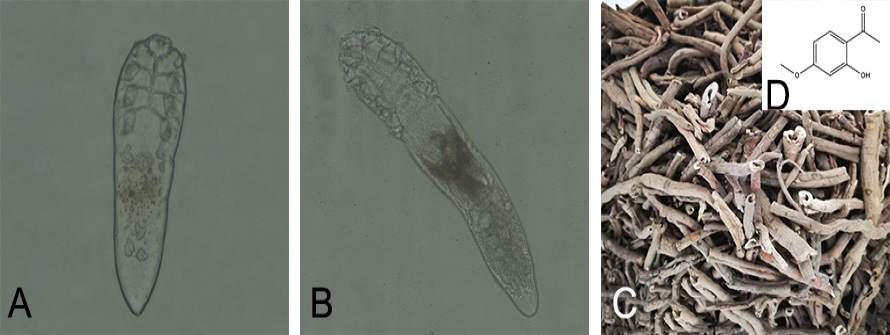
(A) Human Demodex brevis (Acari: Demodicidae). (B) Human Demodex folliculorum (Acari: Demodicidae). (C) Roots of moutan cortex. (D) Chemical structure of paeonol.
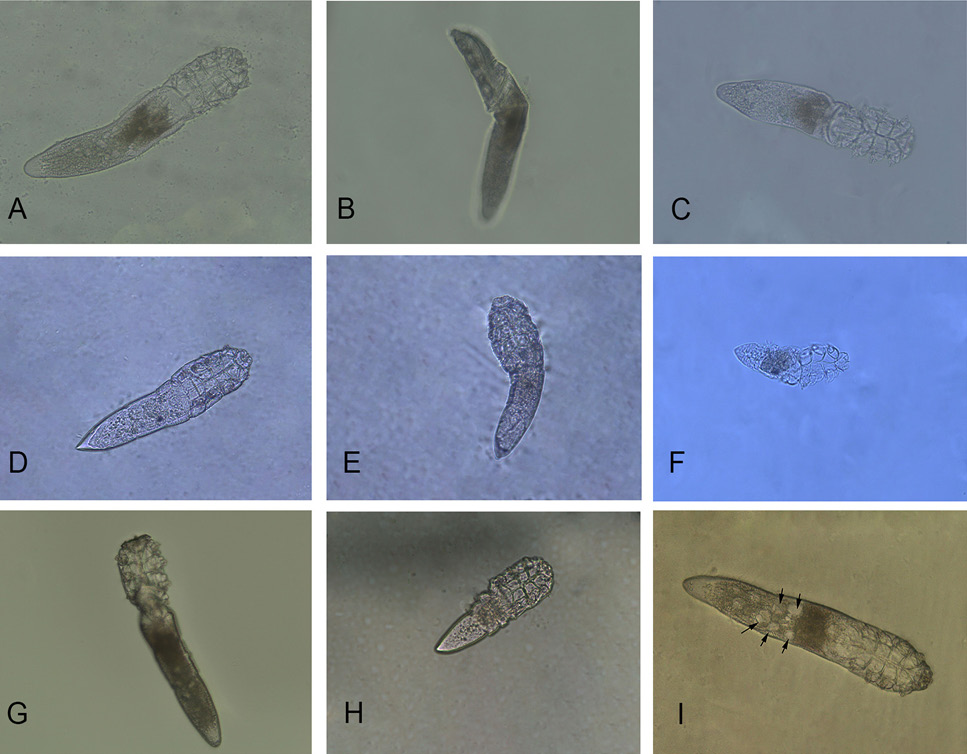
Morphological changes in human Demodex mites following treatment with paeonol (×400). (A) D. folliculorum before treatment with paeonol. (B) D. folliculorum exposed to paeonol. (C) dead D. folliculorum. (D) D. brevis before treatment with paeonol. (E) D. brevis exposed to paeonol. (F) dead D. brevis. (G) D. folliculorum was not completely dead; however, all rotary movements of appendages of the mite had ceased. (H) D. brevis was not completely dead; however, all rotary movements of appendages of the mite had ceased. (I) Untreated D. folliculorum. The arrows indicate some coelom and/or internal hydroskeleton, which may help the body of the mite to move by decreasing the contact surface to reduce friction when walking.
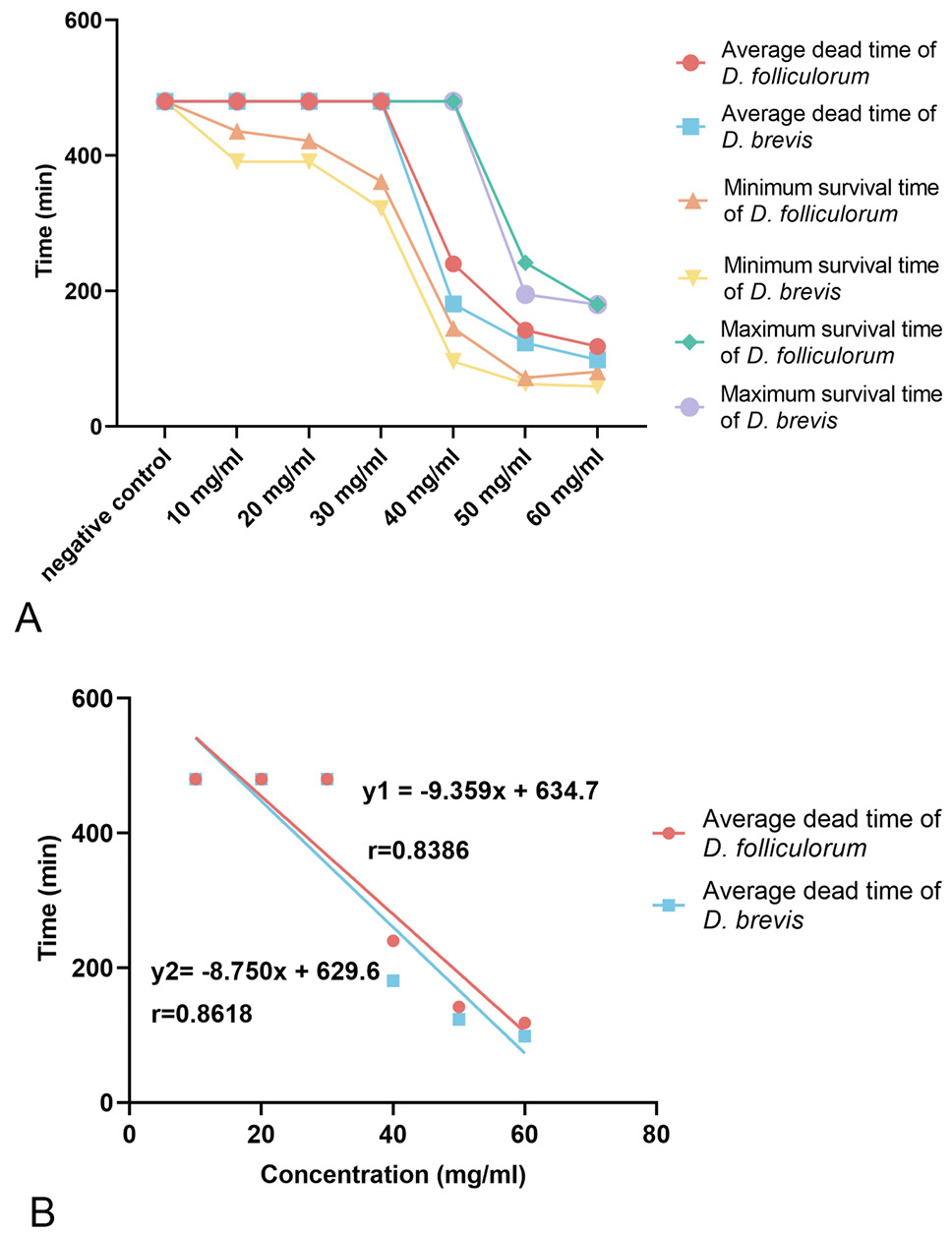
Effect of different concentrations of paeonol on the death times of human Demodex (A) and correlation analysis of the average death time of two species of Demodex (B).
References
- Adki, K.M. and Kulkarni, Y.A., 2020. Chemistry, pharmacokinetics, pharmacology and recent novel drug delivery systems of paeonol. J. Life Sci., 250: 18. https://doi.org/10.1016/j.lfs.2020.117544[CrossRef]
- Chudzicka-Strugala, I., Golebiewska, I., Brudecki, G., Elamin, W. and Zwozdziak, B., 2023. Demodicosis in different age groups and alternative treatment options. A review. J. clin. Med., 12: 23. https://doi.org/10.3390/jcm12041649[CrossRef]
- Clanner-Engelshofen, B.M., French, L.E. and Reinholz, M., 2020. Methods for extraction and ex-vivo experimentation with the most complex human commensal, Demodex spp. J. exp. appl. Acarol., 80: 59-70. https://doi.org/10.1007/s10493-019-00450-9[CrossRef]
- Clanner-Engelshofen, B.M., Ständer, L.M., Steegmuller, T., Kämmerer, T., Frommherz, L.H., Stadler, P.C., Gurtler, A. and Reinholz, M., 2022. First ex vivo cultivation of human Demodex mites and evaluation of different drugs on mite proliferation. J. Eur. Acad. Dermatol. Venereol., 36: 2499-2503. https://doi.org/10.1111/jdv.18468[CrossRef]
- Ding, M.G., Shi, R., Fu, F., Li, M., De, D.M., Du, Y.Y. and Li, Z.F., 2023. Paeonol protects against doxorubicin-induced cardiotoxicity by promoting Mfn2-mediated mitochondrial fusion through activating the PKCε-Stat3 pathway. J. Adv. Res., 47: 151-162. https://doi.org/10.1016/j.jare.2022.07.002[CrossRef]
- Du, J.J., Gao, R. and Zhao, J.H., 2021. The effect of volatile oil from chinese mugwort leaf on human demodecid mites in vitro. J. Acta Parasitol., 66: 615-622. https://doi.org/10.1007/s11686-020-00314-y[CrossRef]
- Elston, C.A. and Elston, D.M., 2014. Demodex mites. J. clin. Dermatol., 32: 739-743. https://doi.org/10.1016/j.clindermatol.2014.02.012[CrossRef]
- Elston, D.M., 2010. Demodex mites: Facts and controversies. J. clin. Dermatol., 28: 502-504. https://doi.org/10.1016/j.clindermatol.2010.03.006[CrossRef]
- Foley, R., Kelly, P., Gatault, S. and Powell, F., 2021. Demodex: A skin resident in man and his best friend. J. Eur. Acad. Dermatol. Venereol., 35: 62-72. https://doi.org/10.1111/jdv.16461[CrossRef]
- Forton, F.M. and De Maertelaer, V., 2021. Which factors influence Demodex proliferation? A retrospective pilot study highlighting a possible role of subtle immune variations and sebaceous gland status. J. J. Dermatol., 48: 1210-1220. https://doi.org/10.1111/1346-8138.15910[CrossRef]
- Guerrero-González, G.A., Herz-Ruelas, M.E., Gómez-Flores, M. and Ocampo-Candiani, J., 2014. Crusted demodicosis in an immunocompetent pediatric patient. J. Case Rep. Dermatol. Med., 2014: 458046. https://doi.org/10.1155/2014/458046[CrossRef]
- Gyawali, A., Krol, S. and Kang, Y.S., 2019. Involvement of a novel organic cation transporter in paeonol transport across the blood-brain barrier. J. Biol. Ther., 27: 290-301. https://doi.org/10.4062/biomolther.2019.007[CrossRef]
- Heczko, J., Schell, C., Pansick, A., Stein, R. and Perry, H.D., 2023. Evaluation of a novel treatment, selenium disulfide, in killing Demodex folliculorum in vitro. J. Can. J. Opthalmol., 58: 408-412. https://doi.org/10.1016/j.jcjo.2022.04.012[CrossRef]
- Holmes, A.D., 2013. Potential role of microorganisms in the pathogenesis of rosacea. J. Am. Acad. Dermatol., 69: 1025-1032. https://doi.org/10.1016/j.jaad.2013.08.006[CrossRef]
- Hsu, C.K., Hsu, M.M.L. and Lee, J.Y.Y., 2009. Demodicosis: A clinicopathological study. J. Am. Acad. Dermatol., 60: 453-462. https://doi.org/10.1016/j.jaad.2008.10.058[CrossRef]
- Jacob, S., VanDaele, M.A. and Brown, J.N., 2019. Treatment of demodex-associated inflammatory skin conditions: A systematic review. J. Dermatol. Ther., 32: 7. https://doi.org/10.1111/dth.13103[CrossRef]
- Jarmuda, S., O’Reilly, N., Żaba, R., Jakubowicz, O., Szkaradkiewicz, A. and Kavanagh, K., 2012. Potential role of Demodex mites and bacteria in the induction of rosacea. J. med. Microbiol., 61: 1504-1510. https://doi.org/10.1099/jmm.0.048090-0[CrossRef]
- Kim, H.K., Tak, J.H. and Ahn, Y.J., 2004. Acaricidal activity of Paeonia suffruticosa root bark-derived compounds against Dermatophagoides farinae and Dermatophagoides pteronyssinus (Acari: Pyroglyphidae). J. Agric. Fd. Chem., 52: 7857-7861. https://doi.org/10.1021/jf048708a[CrossRef]
- Lazaridou, E., Giannopoulou, C., Fotiadou, C., Vakirlis, E., Trigoni, A. and Ioannides, D., 2011. The potential role of microorganisms in the development of rosacea. J. JD Tsch. Dermatol. Ges., 9: 21-25. https://doi.org/10.1111/j.1610-0387.2010.07513.x[CrossRef]
- Li, Q., Zhao, Y., Zhu, X.M. and Xie, Y.L., 2021. Antifungal efficacy of paeonol on Aspergillus flavus and its mode of action on cell walls and cell membranes. J. LWT Fd. Sci. Technol., 149: 9. https://doi.org/10.1016/j.lwt.2021.111985[CrossRef]
- Lv, Q.H., Li, S.F., Wei, H.L., Wen, Z.M., Wang, Y.L., Tang, T.Z., Wang, J.F., Xia, L.N. and Deng, X.M., 2020. Identification of the natural product paeonol derived from peony bark as an inhibitor of the Salmonella enterica serovar Typhimurium type III secretion system. J. appl. Microbiol. Biotechnol., 104: 1673-1682. https://doi.org/10.1007/s00253-019-10290-7[CrossRef]
- Martinez-Diaz, G.J., Clark, K.M., Vasquez, J.G. and English, J.C., 2012. Facial erythematous annular plaques: a case of annular Demodex facial dermatitis? J. Am. Acad. Dermatol., 67: e268-e269. https://doi.org/10.1016/j.jaad.2012.05.015[CrossRef]
- Min, X.F., Lu, L., Xu, X.T., Wen, Y. and Zheng, X., 2023. Investigation on the inhibition mechanism and binding behavior of paeonol to tyrosinase and its anti-browning property by multi-spectroscopic and molecular docking methods. J. Int. J. Biol. Macromol., 253: 9. https://doi.org/10.1016/j.ijbiomac.2023.126962[CrossRef]
- Norn, M.S.J., 1982. Incidence of Demodex folliculorum on skin of lids and nose. J. Acta Ophthalmol., 60: 575-583. https://doi.org/10.1111/j.1755-3768.1982.tb00603.x[CrossRef]
- Paichitrojjana, A., 2022. Demodex: The worst enemies are the ones that used to be friends. J. Dermatol. Rep., 14: 9339. https://doi.org/10.4081/dr.2022.9339[CrossRef]
- Palopoli, M.F., Fergus, D.J., Minot, S., Pei, D.T., Simison, W.B., Fernandez-Silva, I., Thoemmes, M.S., Dunn, R.R. and Trautwein, M., 2015. Global divergence of the human follicle mite Demodex folliculorum: Persistent associations between host ancestry and mite lineages. J. Proc. natl. Acad. Sci. U.S.A., 112: 15958-15963. https://doi.org/10.1073/pnas.1512609112[CrossRef]
- Smith, G., Manzano-Marín, A., Reyes-Prieto, M., Antunes, C.S.R., Ashworth, V., Goselle, O.N., Jan, A.A.A., Moya, A., Latorre, A., Perotti, M.A. and Braig, H.R., 2022. Human follicular mites: Ectoparasites becoming symbionts. J. mol. Biol. Evol., 39: msacl125. https://doi.org/10.1093/molbev/msac125[CrossRef]
- Tak, J.H., Kim, H.K., Lee, S.H. and Ahn, Y.J., 2006. Acaricidal activities of paeonol and benzoic acid from Paeonia suffruticosa root bark and monoterpenoids against Tyrophagus putrescentiae (Acari: Acaridae). J. Pest Manage. Sci., 62: 551-557. https://doi.org/10.1002/ps.1212[CrossRef]
- Tang, H.Q., Yang, D., Zhu, L., Shi, F., Ye, G., Guo, H.R., Deng, H.D., Zhao, L., Xu, Z.W. and Li, Y.L., 2022. Paeonol interferes with quorum-sensing in Pseudomonas aeruginosa and modulates inflammatory responses in vitro and in vivo. J. Front. Immunol., 13: 14. https://doi.org/10.3389/fimmu.2022.896874[CrossRef]
- Wang, J.L., Wu, G.Y., Chu, H.P., Wu, Z.Y. and Sun, J.Y., 2020. Paeonol derivatives and pharmacological activities: A review of recent progress. J. Mini Rev. Med. Chem., 20: 466-482. https://doi.org/10.2174/1389557519666191015204223[CrossRef]
- Wei, F., Li, L., Kong, Y., Yan, X.F., Varghese, K.J., Zhang, S., Jiang, J., Chai, B. and Chen, H.X., 2023. Evidence for the clinical association between Demodex and rosacea: A review. J. Dermatology., 240: 95-102. https://doi.org/10.1159/000534245[CrossRef]
- Xu, H., Zhang, N. and Casida, J.E., 2003. Insecticides in Chinese medicinal plants: Survey leading to jacaranone, a neurotoxicant and glutathione-reactive quinol. J. Agric. Fd. Chem., 51: 2544-2547. https://doi.org/10.1021/jf021164x[CrossRef]
- Zeng, Q., Fu, Y.T., Yang, M., Wang, T., Wang, Y., Lv, S.H. and Qian, W.D., 2022. Effect of paeonol against bacterial growth, biofilm formation and dispersal of Staphylococcus aureus and Listeria monocytogenes in vitro. J. Biofouling., 38: 173-185. https://doi.org/10.1080/08927014.2022.2045014[CrossRef]
- Zhang, L., Li, D.C. and Lin, L.F., 2019. Paeonol: Pharmacological effects and mechanisms of action. J. Int. Immunopharmacol., 72: 413-421. https://doi.org/10.1016/j.intimp.2019.04.033[CrossRef]
- Zhao, Y., Feng, L. and Shi, J., 2006. Studies on the experiment of killing Demodex folliculorum in vitro with crude extract of Folium artemisiae argyi. J. Chin. J. Vector Biol. Contr., 17: 209.
- Zhao, Y.E., Yang, F., Wang, R.L., Niu, D.L., Mu, X., Yang, R. and Hu, L., 2017. Association study of Demodex bacteria and facial dermatoses based on DGGE technique. J. Parasitol. Res., 116: 945-951. https://doi.org/10.1007/s00436-016-5370-1[CrossRef]
- Zou, M.H., Xue, Q.Q., Guo, J.J., Teng, Q., Zhao, J.H. and Li, Y.Y., 2023a. Transcriptomics and proteomic-based study of the acaricidal mechanism of paeonol against Aleuroglyphus ovatus. J. Int. J. Acarol., 11. https://doi.org/10.1080/01647954.2023.2268621[CrossRef]
- Zou, M.H., Xue, Q.Q., Teng, Q., Zhang, Q.Q., Liu, T., Li, Y.Y. and Zhao, J.H., 2023b. Acaricidal activities of paeonol from Moutan cortex, dried bark of Paeonia x suffruticosa, against the grain pest mite Aleuroglyphus ovatus (Acari: Acaridae). J. exp. appl. Acarol., 91: 615-628. https://doi.org/10.1007/s10493-023-00861-9[CrossRef]
Services
Article usage statistics
Loading…