A significant impact of the addition of food baits was recorded on the attraction of Ferrolure+ especially with sugarcane and date palm as the number of RPW captures increased in these treatments as compared to other treatments.
The highest weekly mean RPW capture was recorded in sugarcane (17.67±0.88 weevils per traps) on July 13, 2018, followed by date palm (16.00±2.31 weevils per traps) and Ferrolure+ (13.67±4.48 weevils per trap) treatments, whereas 9.67±3.48 weevils per trap were recorded in banana mixed traps.
Overall mean capture of RPW attracted to different food baited Ferrolure+ traps showed a highly significant (F= 2.4486; P < 0.001) difference.
The addition of sugarcane and date palm stems in aggregation Ferrolure+ pheromone traps significantly enhanced their catching efficiency to attract relatively a greater number of RPW in comparison to traps containing only Ferrolure+.
Selected from the article's own text.
Abstract
Abstract | Red palm weevil (RPW), Rhynchophorus ferrugineus, is a globally serious pest of palms that is difficult to control because of its conspicuous habitat and damage. Considering the effectiveness of aggregation pheromone (Ferrolure+) against RPW in different regions of the world, we started experiments in June 2018 to evaluate the synergistic effect of various food baits on the performance of Ferrolure+ against RPW. Three locally available food baits i.e., date palm, sugarcane, and banana along with Ferrolure+ (positive control) and detergent water (negative control) were evaluated against RPW. Three hundred grams of each food bait along with Ferrolure + was used in the traps as weekly observations were taken on the RPW attracted in traps. Food and water were changed after weekly observations. The experiment was arranged in randomized complete block design where each treatment was replicated three times. Results confirmed a significant effect of the addition of sugarcane and date palm stems to enhance the mean capture of RPW compared to Ferrolure+ traps. The addition of banana stems captured a smaller number of weevils. The ability of Ferrolure+ to attract RPW increased till July 13, 2018, and then gradually declined as no weevils were captured after August 3, 2018. Moreover, the number of females captured in pheromone traps was two times more than the males. Therefore, the addition of either sugarcane or date palm stems with Ferrolure+ traps in infested date palm orchards can enhance the RPW capture for better monitoring and management.
Novelty Statement | The first systematic study conducted in the date palm hub of Pakistan i.e., Khairpur, Sindh using food baits along with aggregation pheromone (Ferrolure+). The addition of sugarcane and date palm stems significantly enhance the capture of RPW in Ferrolure+ traps, suggesting its inclusion in integrated RPW management can reduce the use of synthetic pesticides.
Introduction
Red palm weevil (RPW), Rhynchophorus ferrugineus (Coleoptera: Dryophthoridae), is one of the invasive pests of palms throughout the world ; . Rhynchophorus ferrugineus originated from the sub-continent (India and Pakistan) and then expands its range towards other regions of the world . The RPW cause damage to more than twenty-six palm species, belonging to sixteen different genera in almost all palm growing areas of Asia, North Africa, Europe, Oceania, and Caribbean countries (EPPO, 2007; , 2009). It is exceedingly difficult to detect the presence of the pest in the early stage of its attack because of its concealed nature of damage inside the tree. The attack of RPW may resulted in variable levels of damage as the loss of whole palms may occur in case of severe attack ; ; ; .
The control strategies against RPW throughout the world in general, and in Pakistan particularly, are based on the frequent application of synthetic pesticides ; . However, recent studies suggested the effectiveness of aggregation pheromones (Ferrolure+), not only in the monitoring but also in the mass trapping of RPW ; ; , 2014, 2016; . It is also observed that the addition of various food baits i.e., pineapple fruit, sago palm stem, and sugarcane stem, fermented dates, and chemicals like ethyl acetate has been found to have kairomonal effects to increase the effectiveness of the pheromone lures ; .
In Pakistan, Khairpur and Sukkur districts of Sindh are famous for the date cultivation where Aseel, Kupro, Karbalai, Kasho Wari, Gajar, Pathri are the widely grown, export-oriented date varieties (Soomro et al., 2020). These cultivars are susceptible to the attack of RPW as mostly local farmers depend upon systematic chemicals as the best available option to reduce RPW damage once their palms are damaged . However, these chemicals are very harmful to humans and their environment . Moreover, the use of aggregation pheromone Ferrolure+ is still in the preliminary stage in Pakistan . Therefore, considering the importance of aggregation pheromones and the potential role of food baits to enhance their effectiveness, studies were conducted to determine the effectiveness of aggregation pheromone, Ferrolure+, against RPW when applied with the addition of various food baits.
Materials and Methods
Study location
The experiments were conducted at densely populated and highly RPW infested date palm orchards in Khairpur, Pakistan. The size of the orchard was ten acres containing more than two hundred trees of date palm of different varieties and mixed ages. The experiment was set up on June 1, 2018, considering the active period of RPW due to the favorable environment for them as generally growers transplant suckers for the fresh propagation. In Sindh, Pakistan date palm orchards are mostly located in Khairpur and Sukkur districts, having similar environments . Therefore, the study only done at Khairpur (27°31’46.1”N 68°45’42.1”E) as the findings of study not only will be helpful for the growers of the study area i.e., Khairpur and Sukkur districts of Sindh, but also to dates cultivation of the world.
Preparation of pheromone traps
The preparation of traps was adopted from Soomro et al. (2020). The red colored plastic buckets that were rubbed from the sides were used for the pheromone traps. The buckets used were 36cm long 20 and 26 cm diameter bottom and top, respectively. Four equidistance rectangular openings were made at its lid and sides to facilitate the entry of the attracted weevils. Rhynchophorus ferrugineus aggregation pheromone (P028 Ferrolure+® ChemTica International, Costa Rica) that consists of 700 mg Ferrolure+ (4-methyl-5-nonanol and 4-methyl-5-nonanone) was affixed to the lower surface of the bucket lid with iron wire. At the bottom of bucket, two-liter water mixed with a detergent was used to retain the attracted RPW inside it (Figure 2). Moreover, water and detergent were changed on weekly basis to avoid the development of unpleasant odor in the traps.
Food baits used
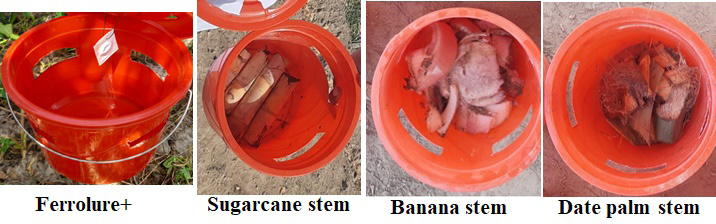
The food baits used in the study were stems of date palm, banana, and sugarcane along with pheromone (Ferrolure+) as positive control and a bucket with water only as a negative control (Figure 1). Three hundred grams of each food was placed in the bucket that was replaced along with water after the data collection to retain the freshness of the foods.
Table 1: Impact of different food baits on performance of aggregation pheromone to capture of Rhynchophorus ferrugineus (RPW).
Observation dates
Food baits
Overall mean
Sugarcane
Date Palm
Banana
Pheromone
Control
June 8, 2018
9.33±2.85c-i
8.67±4.48d-j
3.00±0.58i-m
4.33±2.03g-m
0.00m
5.13±1.71de
June 15, 2018
9.67±2.73b-h
7.33±2.67e-k
5.00±2.08g-m
6.67±2.85f-l
0.00m
5.73±1.62d
June 22, 2018
12.33±3.18a-f
10.67±3.84b-g
7.33±2.33e-k
9.00±4.51c-j
0.00m
8.00±2.01bcd
June 29, 2018
14.67±1.76a-d
12.00±3.46a-f
8.67±4.70d-j
10.67±2.40b-g
0.00m
9.47±2.26abc
July 6, 2018
15.33±2.91a-c
13.33±2.40a-e
9.33±3.76c-i
12.00±4.16a-f
0.00m
10.06±2.62ab
July 13, 2018
17.67±0.88a
16.00±2.31ab
9.67±3.48b-h
13.67±4.48a-e
0.00m
11.40±3.15a
July 20, 2018
12.33±1.20a-f
10.67±3.71b-g
2.67±0.67j-m
6.67±1.20f-l
0.00m
6.53±2.29cd
July 27, 2018
6.33±1.45f-m
4.00±1.53h-m
1.33±0.88k-m
1.67±1.67k-m
0.00m
2.73±1.08ef
August 3, 2018
2.00±0.58k-m
1.00±0.58k-m
0.33±0.33lm
0.67±0.33lm
0.00m
0.83±0.36f
*Means followed by same letters are not significantly different (LSD =6.9258, P<0.05).
Experimental design, data collection, and analysis
The experiment was arranged in a Randomized Complete Block Design (RCBD) with three replications for each treatment. The individual replicated traps were set one thousand meters apart from each other to reduce the competition among the treatments to attract RPW. The data was observed on weekly intervals since the installation of pheromone traps for the number of weevils attracted and retained in them. The attracted RPW were separated in females and males by observing their distinguish characteristics as suggested by Menon and Pandalai (1960) and Dembilio and Jacas (2011). The study was continued until the pheromones remained effective to attract RPW and the same was assumed when no weevil attracted in the traps for the two continuous weeks. The Analysis of Variance (ANOVA) and the Least Square Difference (LSD) @ 5% probability level were used for the data analysis and separation of means with significant differences, respectively. All the analysis were conducted using STATISTIX 8.3 computer software.
Results
Table 1 showed the results regarding the effect of the addition of various food baits i.e., the stem of date palm, sugarcane, and banana on the performance of aggregation pheromone, Ferrolure+, to attract RPW. A significant impact of the addition of food baits was recorded on the attraction of Ferrolure+ especially with sugarcane and date palm as the number of RPW captures increased in these treatments as compared to other treatments. The attraction of weevils was immediately recorded after the installation of traps on June 2, 2018, in various treated traps, with no weevil captured in control treatment traps with only water throughout the study duration. Moreover, pheromones remained active to attract weevils up to nine weeks after installation i.e., up to August 3, 2018. The highest weekly mean RPW capture was recorded in sugarcane (17.67±0.88 weevils per traps) on July 13, 2018, followed by date palm (16.00±2.31 weevils per traps) and Ferrolure+ (13.67±4.48 weevils per trap) treatments, whereas 9.67±3.48 weevils per trap were recorded in banana mixed traps. Date-wise data showed that several weevils attracted to various treatments indicated an increasing trend since the installation of traps up to the 6th week i.e., July 13, 2018, and then declined till the effectiveness of lures lasted. Accordingly, the maximum mean weekly weevil capture (11.40±3.15 weevils per trap) in various treatments was observed on July 13, whereas the minimum capture (0.83±0.36 weevils per trap) was observed on August 3, 2018. Therefore, a highly significant (F = 6.9258, P = 0.001) difference was recorded among various treatments regarding their effectiveness to capture RPW.
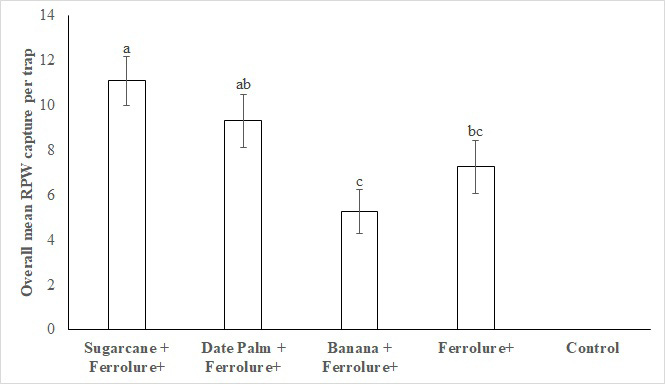
Overall mean capture of RPW attracted to different food baited Ferrolure+ traps showed a highly significant (F= 2.4486; P < 0.001) difference. The maximum and minimum capture of weevils was recorded in sugarcane (11.08±1.08 weevils per trap) and banana (5.25±0.98 weevils per trap) treatments, respectively. Moreover, overall mean capture of RPW in date palm mixed Ferrolure+ and only Ferrolure+ treatments were 9.30±1.20 weevils per trap and 7.26±1.17 weevils per trap, respectively (Figure 2).
Table 2 indicates the sex ratio of adult RPW attracted to various food baited pheromone treatments as the number of females captured in traps was double versus males. According to results, the maximum number of females were captured in sugarcane added pheromone treatments (201), followed by date palm (175) and Ferrolure+ (134) and banana (97) treatments. Overall, date palm (2.40: 1.00) and sugarcane (2.18: 1.00) mixed Ferrolure+ treatments showed the maximum and minimum female to male ratio. The female to male ratio recorded in banana and Ferrolure+ mixed treatments was 2.20: 1.00 and 2.23: 1.00, respectively. Overall, a total of 607 females and 269 males were captured in various food-baited pheromone traps, having a sex ratio 0f 2.26: 1.00 in favor of females.
Table 2: Sex Ratio of Rhynchophorus ferrugineus attracted to Ferrolure+ traps mixed with different food baits.
Food bait
Males
Females
Sex ratio
Male: Female
Sugarcane
92
201
1: 2.18
Date palm
73
175
1: 2.40
Banana
44
97
1:2.20
Ferrolure+
60
134
1: 2.23
Control
00
00
-
Overall
269
607
1:2.26
*Means followed by same letters are not significantly different (LSD =2.4486, P<0.05).
Discussion
The aggregation pheromones i.e., ferrolure and ferrolure+ containing ferrugineol; 4-methyl-5-nonanol are used on large-scale as a key component of RPW management in palm growing areas in different regions of the globe, however, their effectiveness showed variable results of success , 2014; ; ; . It has been suggested that the performance of pheromone traps against RPW in palm and coconut orchards can be increased with the addition of either different kinds of plant materials such as dried dates, shoots of palms, stems of sugarcane and banana and others or kairomonal materials such as ethyl propionate and ethyl acetate ; ; . These findings have supported the results of our study as sugarcane added pheromone traps captured a significantly higher number of RPW followed by traps containing date palm stems. Moreover, no significant impact of addition of banana was observed in the mean attraction of RPW Ferrolure+ traps.
Ideally, the food baits may have a high sugar content to maximize the attraction of weevils to the traps . Faleiro (2005) suggested that addition of 200 grams of coconut petiole per traps was found effective against RPW as captures of weevils declined gradually when traps were changed at 10-, 20-, and 30-days intervals. Another study captured comparatively a greater number of RPW using various food baits in the pheromone traps against RPW, with a maximum number of RPW attracted in traps containing pineapple, which represented around 41% of the total RPW captured in all the treatments . In a recent study in Egypt, a maximum number of RPW captures were recorded when date fruits were added to pheromone traps followed by sugarcane and the treatments having pheromone only. Thus, among total catches, the RPW captures in date fruits (1005) and sugarcane (807) represent 41.75 and 33.53%, respectively of the total catches .
In this study, the sex ratio in favor of captured females was recorded in all treatments as their number was more than twice than that of males. Most of the previous studies using pheromone traps for RPW in various geographical regions of the world confirmed higher capture of females than males ; , 2007, 2009; . Therefore, integration of Ferrolure+ pheromones as one of the key element of integrated RPW management due to its ability to catch more number of females, could result in less oviposition and lowering its future population and damage to the orchards .
It has been reported that captured females in pheromone traps were mostly young and gravid; therefore, attraction and capture of these females in pheromone traps could help to decline RPW population in the treated areas . Such higher attraction of females in Ferrolure+ traps may be because of their seasonal activity in the field as compared to males, mainly because of oviposition or due to the presence of basioconic sensillae on their antennae in large numbers than males . However, recent studies have reported that the use of Ferrolure+ traps in any given areas can only attract and capture a limited percentage of its population . Hence, it has been always suggested that to maximize the attraction and capture of RPW, particularly females, a comprehensive catching performance of the Ferrolure+ pheromones should be ensured by deploying the best available resources such as components of pheromone (lure, baits, and water), design and density of the traps along with their placement in the orchards ; ; .
Therefore, the findings of the study indicate that by using aggregation pheromones supplied with food baits, especially sugarcane and date palm stems, could enhance the number of catches of RPW adults, especially females. Moreover, a higher number of females attracted to food baited pheromone traps will also help in the reduction of the future buildup in the RPW populations, hence can result in lower losses to date palm trees. Moreover, integration of food-baited pheromone traps with other management tools by the growers i.e., sanitation, chemical control, could significantly reduce the population and damage of RPW to date palm orchards.
Conclusions and Recommendations
The addition of sugarcane and date palm stems in aggregation Ferrolure+ pheromone traps significantly enhanced their catching efficiency to attract relatively a greater number of RPW in comparison to traps containing only Ferrolure+. However, addition of banana did not show any positive impact to improve RPW catches in the pheromone traps. Study also confirmed catching of relatively more females than males in the Ferrolure+ traps. Therefore, it is suggested that the addition of either sugarcane or date palm stems should be incorporated in infested orchards to get the optimum attraction of RPW to get its better monitoring and management.
Acknowledgements
We highly acknowledge the cooperation of the staff of Agriculture Extension Department, Khairpur for their support during the conduct of this study
Conflict of interest
The authors have declared no conflict of interest.
Figures
Figure 1:.
Food baits used with aggregation pheromone Ferrolure+ in the study.
Figure 2:.
Influence of different food baits on overall mean capture of Rhynchophorus ferrugineus (RPW) using aggregation pheromone.
References
Abbas, M.K., El-Deeb, M.A., El-Zohairy, M.M. and Arafa, O.E., 2019. Impact of the aggregation pheromone traps baited with fermented food materials on the attraction of the red palm weevil, Rhynchophorus ferrugineus (Olivier) in Egypt. Egypt. J. Agric. Res., 97: 67-75. https://doi.org/10.21608/ejar.2019.68564[CrossRef]
Abraham, V.A., Faleiro, J.R., Al-Shuaibi, M.A. and Abdan, S.A., 2006. Status of pheromone trap captured female red palm weevils from date gardens in Saudi Arabia. J. Trop. Agric., 39: 197-199.
Al-Saoud, A.H., 2006. Control of the red palm weevil, Rhynchophorus ferrugineus Olivier (Coleoptera: Curculionidae) using aggregation pheromone. Damascus Univ. J. Agric. Sci., 22: 147-164.
Al-Saoud A.H., 2007. Importance of date fruit in red palm weevil, Rhynchophorus ferrugineus Olivier (Coleoptera: Curculionidae) aggregation pheromone traps. Acta Hortic., 736: 405–413. https://doi.org/10.17660/ActaHortic.2007.736.37[CrossRef]
Al-Saoud, A.H., 2009. Effect of red palm weevil, Rhynchophorus ferruginous Olivier (Coleoptera: Curculionidae) aggregation pheromone traps contains on the number of capture weevils. Damascus Univ. J. Agric. Sci., 25: 151-175.
Al-Saoud, A.H., Al-Deeb, M.A. and Murchie, A.K., 2010. Effect of color on the trapping effectiveness of red palm weevil pheromone traps. J. Entomol., 7: 54-59. https://doi.org/10.3923/je.2010.54.59[CrossRef]
Arfan, A.G., Soomro, M.H., Mastoi, M.I. and Talpur, M.A., 2017. Performance of aggregation pheromone against red palm weevil at district Khairpur and Sukkur, Pakistan. Pak. Entomol., 39: 9-12.
Avand-Faghih, A., 1998. Research on the control of red palm weevil, Rhynchophorus ferrugineus Oliv. (Coleoptera: Curculionidae) with synthetic attractants in Sistan and Blouchestan province (Iran). M.Sc. dissertation, Department of Plant Protection, College of Agriculture, University of Tehran. pp. 162.
Avand-Faghih, A., 2004. Identification et application agronomique de synergistes végétaux de la phéromone du charançon Rhynchophorus ferrugineus (Olivier) 1790 (Doctoral dissertation, INAPG (AgroParisTech).
Çıtırıkkaya, B., Tezcan, S. and Gülperçin, N., 2014. A short note on non-target fauna collected by pheromone traps of the red palm weevil, Rhynchophorus ferrugineus (olivier,1790) (Coleoptera: Dryophthoridae) in İzmir province of Turkey. Munis Entomol. Zool., 9: 792-794.
Dembilio, Ó. and Jacas, J.A., 2011. Basic bio-ecological parameters of the invasive Red Palm Weevil, Rhynchophorus ferrugineus (Coleoptera: Curculionidae), in Phoenix canariensis under Mediterranean climate. Bull. Entomol. Res., 101: 153-163. https://doi.org/10.1017/S0007485310000283[CrossRef]
Dembilio, Ó. and Jacas, J.A., 2015. Biology and management of red palm weevil. In: Sustainable pest management in date palm: Current status and emerging challenges (eds. W. Wakil, J.R. Faleiro and T.A. Miller). Springer, Cham., pp. 13-36. https://doi.org/10.1007/978-3-319-24397-9_2[CrossRef]
Dhouibi, M.H., Haouari, W., Khrissi, I., Guerret, O., Chaar, H. and de Cozar, K., 2018. Effect of different concentrations of M2ITM pheromone dispensers and the impact of water and paraffin in pheromone traps for Rhynchophorus ferrugineus (Coleoptera: Curculionidae) management in Tunisia. Int. J. Agric. Innov. Res., 6: 152-157.
El-Shafie, H.A.F. and Faleiro, J.R., 2017. Optimizing components of pheromone-baited trap for the management of red palm weevil, Rhynchophorus ferrugineus (Coleoptera: Curculionidae) in date palm agro-ecosystem. J. Pl. Dis. Prot., 124: 279-287. https://doi.org/10.1007/s41348-017-0097-5[CrossRef]
European and Mediterranean Plant Protection Organization (EPPO), 2007. Rhynchophorus ferrugineus and Rhynchophorus spalmarum. Eur. Mediterr. Pl. Prot. Bull., 37: 571–579. https://doi.org/10.1111/j.1365-2338.2007.01165.x[CrossRef]
Faleiro, J.R., 2005. Pheromone technology for the management of red palm weevil Rhynchophorus ferrugineus (Olivier) (Coleoptera: Rhynchophoridae). A key pest of coconut. Technical Bulletin 4, ICAR Research Complex for Goa, Ela, Old Goa, India.
Faleiro, J.R., 2006. A review of the issues and management of the red palm weevil Rhynchophorus ferrugineus (Coleoptera: Rhynchophoridae) in coconut and date palm during the last one hundred years. Int. J. Trop. Ins. Sci., 26, 35-154.
Faleiro, J.R., Rangnekar, P.A. and Satarkar, V.R., 2003. Age and fecundity of female red palm weevils Rhynchophorus ferrugineus (Olivier) (Coleoptera: Rhynchophoridae) captured by pheromone traps in coconut plantations of India. Crop Prot., 22: 999-1002. https://doi.org/10.1016/S0261-2194(03)00114-5[CrossRef]
Ferry, M. and Gomez, S., 2002. The red palm weevil in the Mediterranean area. Palms-Lawrence, 46: 172-178.
Hashim, S.M. and Ali, H.R., 2019. Environmentally safe non-traditional control measures of Rhynchophorus ferrugineus. Oliv. (Coleoptera: Dryophthoridae) in Palm Orchards in Egypt. J. Pl. Prot. Pathol., 10: 161-164. https://doi.org/10.21608/jppp.2019.40919[CrossRef]
Hoddle, M., Al-Abbad, A.H., El-Shafie, H., Faleiro, J., Sallam, A. and Hoddle, C., 2013. Assessing the impact of areawide pheromone trapping, pesticide applications, and eradication of infested date palms for Rhynchophorus ferrugineus (Coleoptera: Curculionidae) management in Al-Ghowaybah, Saudi Arabia. Crop Prot., 53: 152-160. https://doi.org/10.1016/j.cropro.2013.07.010[CrossRef]
Hoddle, M.S. and Hoddle, C.D., 2011. Evaluation of three trapping strategies for red palm weevil, Rhynchophorus ferrugineus (Coleoptera: Curculionidae) in the Philippines. Pak. Entomol., 33: 77-80.
Inghilesi, A.F., Mazza, G., Cervo, R., Gherardi, F., Sposimo, P., Tricarico, E. and Zapparoli, M., 2013. Alien insects in Italy: Comparing patterns from the regional to European level. J. Ins. Sci., 3: 1-13. https://doi.org/10.1673/031.013.7301[CrossRef]
Ju, R.T., Wang, F., Wan, F.H., and Li, B., 2011. Effect of host plants on development and reproduction of Rhynchophorus ferrugineus (Olivier) (Coleoptera: Curculionidae). J. Pest Sci., 84: 33-39. https://doi.org/10.1007/s10340-010-0323-4[CrossRef]
Malumphy, C. and Moran, H., 2007. Red palm weevil Rhynchophorus ferrugineus. Central Science Laboratory Plant Pest Notice 5. Available at: http://faculty.ksu.edu.sa/10439/Documents/fifty.pdf
Malumphy, C. and Moran, H., 2009. Red palm weevil Rhynchophorus ferrugineus. The Food and Environment Research Agency, Sand Hutton, York, YO41 1LZ, UK.
Manachini, B., Schillaci, D. and Arizza, V., 2013. Biological responses of Rhynchophorus ferrugineus (Coleoptera: Curculionidae) to steinernema carpocapsae (Nematoda: Steinernematidae). J. Econ. Entomol., 106: 1582-1589. https://doi.org/10.1603/EC13031[CrossRef]
Manzoor, M., Ahmad, J.N., Ahmad, S.J., Naqvi, S.A., Rasheed, R. and Haider, M.S., 2020. Population dynamics, abundance and infestation of the red palm weevil, Rhynchophorus ferrugineus (Olivier) in different geographical regions of date palm in Pakistan. Pak. J. Agric. Sci., 57: 381-391.
Menon, K.P.V. and Pandalai, K.M., 1960. Pests. In: The coconut palm. A monograph. Inrankulam, South India: Indian Central Committee. pp. 261-265.
Mohammadpour, K., Avand-Faghih, A. and Hosseini-Gharalari, A., 2018. The effect of date palm tissue and aggregation pheromone on attraction and trapping of Red Palm Weevil, Rhynchophorus ferrugineus Oliv. (Col.: Dryophthoridae). Acta Phytopathol. Entomol. Hungarica, 53: 233-239. https://doi.org/10.1556/038.53.2018.013[CrossRef]
Mostafalou, S. and Abdollahi, M., 2013. Pesticides and human chronic diseases: Evidences, mechanisms, and perspectives. Toxicol. Appl. Pharma., 268: 157-177. https://doi.org/10.1016/j.taap.2013.01.025[CrossRef]
Oehlschlager, A.C., 2005. Current status of trapping palm weevils and beetles. Planter, 81: 123-143.
Oehlschlager, A.C., 2016. Palm weevil pheromones–discovery and use. J. Chem. Ecol., 42: 617-630. https://doi.org/10.1007/s10886-016-0720-0[CrossRef]
Soomro, M.A., Mari, J.M., Nizamani, I.A. and Gilal, A.A., 2020. Impact of trapping density on the performance of aggregation pheromone against Rhynchorphorus ferrugineus (Coleoptera: Dryophthoridae). Int. J. Entomol. Res., 5: 129-132.
Vacas, S., Abad-Payá, M., Primo, J. and Navarro-Llopis, V., 2014. Identification of pheromone synergists for Rhynchophorus ferrugineus trapping systems from Phoenix canariensis palm volatiles. J. Agric. Fd. Chem., 62: 6053-6064. https://doi.org/10.1021/jf502663y[CrossRef]
Vacas, S., Melita, O., Michaelakis, A., Milonas, P., Minuz, R., Riolo, P., Abbass, M.A., Lo Bue, P., Colazza, S., Peri, E., Soroker, V., Livne, Y., Primo, J. and Navarro-Llopis, V., 2016. Lures for red palm weevil trap-ping systems: Aggregation pheromone and synthetic kairomone. Pest Manage. Sci., 73: 223–231. https://doi.org/10.1002/ps.4289[CrossRef]
Vacas, S., Primo, J. and Navarro-Llopis, V., 2013. Advances in the use of trapping systems for Rhynchophorus ferrugineus (Coleoptera: Curculionidae): Traps and attractants. J. Econ. Entomol., 106: 1739-1746. https://doi.org/10.1603/EC13105[CrossRef]
Wahizatul, A.A., Shahrol, N.D., Haris, M.H., Yong, K.W., Zazali, C. and Ahmad, S.S., 2014. Field trapping of adult red palm weevil, Rhynchophorus ferrugineus Olivier (Coleoptera: Curculionidae) with kairomone-releasing food baits and synthetic pheromone lure in a coconut plantation. Philipp. Agric. Sci., 97: 342-348.