Symmetrical peripheral gangrene (SPG) was initially described in 1981 by Hutchinson.
There are a total of 37 cases (including our patient) found to have malaria-induced symmetrical peripheral gangrene till date.
One should anticipate SPG as a complication of severe falciparum malaria.
SPG, when occurs, rapidly progresses to irreversible gangrene, thereby demanding amputation.
Selected from the article's own text.
Abstract
Veerabhadra Radhakrishna, Rajshekhar Patil, Nitin D. Tengli
*1Department of Paediatric Surgery, Indira Gandhi Institute of Child Health, Bangalore; 2Department of General Surgery, Basaveshwar Hospital, M.R. Medical College, Gulbarga, India.
Abstract | Introduction: Symmetrical Peripheral Gangrene (SPG) is defined as a symmetrical distal ischemic injury at two or more locations without any large vessels blockade. Malaria has been reported as one of the causes of SPG, although only 36 cases have been complicated with Symmetrical peripheral gangrene till date. Case Report: A 30-year male presented to us 15 days after the onset of malaria with gangrene of all four limbs with superadded infection. His wounds were debrided and amputated. Once the infection was controlled and gangrenous parts demarcated, amputations were done again for the lower limbs. Discussion: In P. falciparum infections, the processes of cytoadherence, rosetting, and agglutination are the factors responsible for the pathogenesis of SPG. It’s vital to identify this rare, quickly developing complication. Heparin is being tried; blood transfusion has also been explored in the management of some of the patients but not found to be effective. If allowed to advance, surgical intervention is unavoidable.
Symmetrical Peripheral Gangrene (SPG) is defined as a symmetrical distal ischemic injury at two or more locations without any large vessels blockade . Its pathogenesis is not well known, and it has been related to an extensive variety of infective and non-infective causative factors .
Malaria is one of the major parasitic infections occurring in humans, affecting 108 countries comprising more than three billion populations and causes approximately one million demises annually . It has been reported as one of the causes of SPG , although only 36 cases have been complicated with SPG till date. Here we report a case of Symmetrical Peripheral Gangrene in a patient with severe falciparum malaria presented to our institution. We have also reviewed all 37 cases, which hasn’t been done till date.
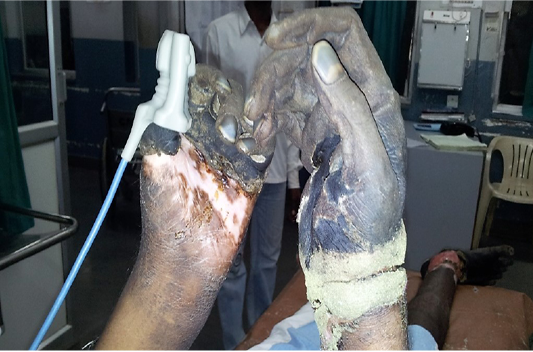
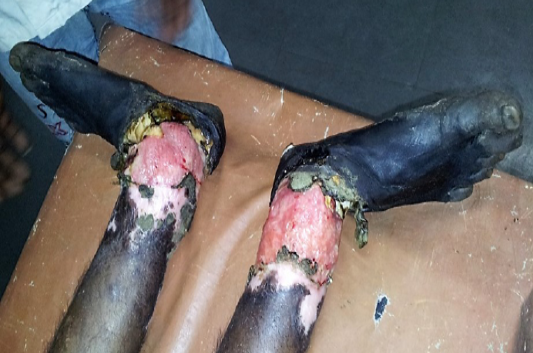
A 30-year male presented to emergency room with high-grade fever with chills and rigors for two days. Later he developed vomiting and became drowsy. A day later, he developed blackish discoloration of all four limbs (Figure 1 and 2). He was not a smoker, alcoholic or drug abuse; and had no history of diabetes, hypertension or any angiopathies. His cardiovascular, respiratory and abdominal examination was normal. He was diagnosed with severe falciparum malaria based on peripheral smear and treated with Artesunate as per CDC guideline (CDC guidelines 2013). As patient improved from severe illness, he got discharged against medical advice.
Fifteen days later the patient returned with gangrene of all four limbs with superadded infection. Vital and systemic examinations were found to be normal. His haemoglobin was 6.2g/dL, Total Count of 4600/mcL, platelet count of 428000/mcL; HIV, HBV, HCV, and VDRL on ELISA were negative. Blood sugar, Renal function tests, and clotting profile were normal. His wounds were debrided and amputated. After the infection was controlled, revision amputations were done for the lower limbs. He was referred to rehabilitation. Currently, he is performing his daily activities with minimal help from his family.
Symmetrical peripheral gangrene (SPG) was initially described in 1981 by Hutchinson. SPG commonly occurs with bacterial infections like Staphylococcal, Pneumococcal, Meningococcal, Streptococcal, E.coli, Pseudomonal septicemia, Viruses or Rickettsial infections (Ghosh nd Bandyopadhyay, 2011). Less commonly it follows after usage of drugs like ergot, vasopressin, noradrenaline, thiopentone or inadvertent intramuscular injection gone intra-arterially. Conditions like Polymyalgia rheumatica, Sickle cell disease, Raynaud’s phenomenon, diabetes mellitus, cryoglobulinemia and inherited coagulopathies like protein-C, S and Antithrombin-3 deficiency can also cause SPG .
World Health Organization defines complicated malaria as those accompanied by one or more of the following clinical or laboratory findings i.e. severe anemia, an impaired level of consciousness (Glasgow Coma Scale score 7), acidosis, hypoglycemia, hyperlactatemia, pulmonary edema, hyperparasitemia (of more than 5%), bleeding and renal impairment . This type of malaria has a mortality of more than 10% .
In P. falciparum infections, the erythrocytes develop membrane protuberanceson their surfaces 12–15 hours after the cell’s invasion by the parasite. These “knobs” produce a high-molecular-weight, strain-specific, antigenically variant erythrocyte membrane adhesive protein (PfEMP1) that facilitates attachment to receptors on the endothelium of venules and capillaries. This event is termed cytoadherence. The most important among these vascular receptors is intercellular adhesion molecule-1 (ICAM-1); others include thrombospondin (TSP), chondroitin sulfate B,endothelial leukocyte adhesion molecule-1 (ELAM-1), vascular cell adhesion molecule-1 (VCAM-1), his tidine rich protein (HRP) and CD36. Thus, the infected erythrocytes stick to the endothelium and eventually block capillaries and venules. Simultaneously, the P. falciparum–infected RBCs may also adhere to uninfected RBCs (to form rosettes) and to other parasitized erythrocytes (agglutination). The processes of cytoadherence, rosetting, and agglutination are the factors responsible for the pathogenesis of SPG ; .
There are a total of 37 cases (including our patient) found to have malaria-induced symmetrical peripheral gangrene till date. Mean age of this population was 28.6 years. The smallest patient affected was eleven months old, and the eldest patient was 65 years. Males were most commonly affected (20 patients; 54%) than females probably because males are at more risk of getting exposed to the mosquito bite. Except for one patient , all were found to have anemia. Fifteen patients were found to have thrombocytopenia.
The management of severe malaria is well standardized. But, the management of microvascular induced by malaria is not established. This includes the use of anti malarial therapy and occasional use of anticoagulants in the presence of ischaemic symptoms . Quinine was the most commonly used anti malarial in severe malaria. There was a suspicion of quinine as the reason for the development and progression of malaria-induced gangrene as in some cases; quinine was started before the onset of gangrene. But there’s no support in the literature.
The dreaded complication of malaria, Symmetrical peripheral gangrene, necessitates the eradication of the parasite with simultaneous treatment of the gangrene. It’s a challenge to identify this rare, hastily developing complication,
Table 1: Review of all Falciparum Malaria cases with SPG
No
Author
Country
Age/
sex
Hb (g/dL)
Plt
(lakh /
cu.mm)
Parasite count (%)
Clinical features
Antimalarial therapy
Anti-clotting therapy
Result
1
Edwards et al.
Zimbabwe
11/M
11.6
0.21
NA
DIC
Quinine
Heparin
Resolved
2
Edwards et al.
Zimbabwe
9/M
12.9
0.1
NA
DIC, Cerebral malaria
Quinine
Heparin, Streptokinase
Resolved
3
Chittichai et al.
Thailand
13/F
7.6
0.52
75
Cerebral Malaria
Quinine
None
Resolved
4
Chittichai et al.
Thailand
10/F
10.7
0.5
88
DIC, Cerebral malaria, jaundice
Quinine
None
Resolved
5
Kochar et al.
India
46/F
5
1.6
6
Prolonged Q-Tc, Atrial & Ventricular fibrillation
Quinine, Chloroquine
None
Amptuated
6
Anuradha S. et al
India
21/M
6.8
2.1
NA
DIC, dry gangrene of fingers and toes
Artesunate
None
Amptuated
7
Anuradha S. et al
India
59/M
5.5
1
NA
DIC, dry gangrene of fingers and toes
Quinine
None
Resolved
8
Anuradha S. et al
India
35/F
7.1
1.1
NA
DIC, dry gangrene of both feet
Quinine
None
Resolved
9
Jain D. et al.
India
26/F
10
NA
NA
Dry gangrene of fingers and toes
Quinine
None
Amptuated
10
Sharma SN et al.
India
22/M
13
1.9
NA
Dry gangrene of fingers and toes
Quinine
None
Amptuated
11
Liechti et al.
Switzerland
56/F
10.9
0.13
10.3
DIC, Cerebral Malaria
Quinine
Heparin
Amptuated
12
Sharma BD et al.
India
65/F
3.2
1.56
14
DIC, Cerebral malaria
Quinine
None
Amptuated
13
Tamhankar P. et al
India
3/F
6
0.8
90
Dry gangrene of fingers, toes, earlobes, patches on arms and legs
Quinine
None
Resolved
14
Agarwal et al.
India
10/F
4.4
0.92
>5
Dry gangrene of toes
Quinine
Heparin, Warfarin
Amptuated
15
Pramod S. et al.
India
1/F
4
70
5
Dry gangrene of thigh, lower left abdominal wall and gluteal region
Quinine
None
Resolved
16
Vipa et al.
Thailand
40/M
9.7
3.95
21
Dry gangrene over lower limbs
Artesunate
None
Resolved
17
Vipa et al.
Thailand
45/M
12.3
2.3
20
Dry gangrene of toes
Artesunate, Mefloquine
None
Amptuated
18
Vipa et al.
Thailand
59/M
10
3.4
11
Dry gangrene of toes
Artesunate, Mefloquine
None
Resolved
19
Kakati et al.
India
26/F
9.75
2.3
NA
Dry gangrene of toes
Artesunate, Ceftriaxone
None
Not stated
20
Raimund S. et al.
Uganda
61/M
NA
NA
NA
DIC, Dry gangrene of toes
Quinine, Mefloquine
None
Amptuated
21
Ghafoor SZ et al.
Nigeria
44/F
11.8
0.48
24
DIC, dry gangrene of fingers and toes
Artesunate, Doxycycline
Heparin
Resolved
22
Rajoo T. et al
India
6/F
5.6
0.84
>90
Dry gangrene of toes
Artesunate, Mefloquine, Primaquine
Heparin, Warfarin
Amptuated
23
Bhattacharya et
India
12/M
7
1.66
21
Dry gangrene of lower limbs
Quinine
None
Refused Amputation
24
Alkizim et al
Uganda
54/M
9.03
4.5
NA
Dry gangrene of hands and feet
Quinine
Clopidogrel
Amptuated
25
Ibrahim et al
Sudan
36/F
9.2
2.34
22
Cerebral Malaria, Renal failure
Quinine
None
Resolved
26
Ibrahim et al
Sudan
44/F
8.2
2
17
Cerebral malaria, Dry gangrene of toes
Quinine
None
Resolved
27
Masse et al
Belgium
63/F
NA
0.21
1
All four limbs digits gangrene, Bacteraemia, Candidemia
Quinine
None
Amputated
28
Martins DB et al
USA
11m
/M
NA
NA
NA
All four limbs digits gangrene
NA
NA
Auto amputation
29
Martins DB et al
USA
3/M
NA
NA
NA
Bilateral foot gangrene
NA
NA
Lost follow up
30
Martins DB et al
USA
6/M
NA
NA
NA
Bilateral foot gangrene
NA
NA
Amputated
31
Martins DB et al
USA
7/F
NA
NA
NA
Gangrene of left upper limb digits up to wrist, cerebral malaria
NA
NA
Amputated
32
Arora N et al
India
22/M
8
0.22
NA
Gangrene of hands & feet, DIC.
Artesunate
Heparin
Amputated
33
Raghunandan J
India
1.5/
M
7
1.5
NA
Gangrene of both hands
Artesunate
NA
Resolved
34
Abdali N et al
India
45/M
NA
NA
NA
Gangrene of all four limb digits
Artemisinin
Heparin
NA
35
Gupta A et al
India
50/M
NA
NA
NA
Gangrene of toes of both lower limbs
Quinine
None
Amputated
36
Rana A et al
India
17/M
1.1
0.1
NA
Gangrene of feet
Quinine
None
Resolved
37
Current Case
India
30/M
6.2
4.28
NA
Cerebral malaria, Gangrene of all 4 limbs
Artesunate
None
Amptuated
before ischemia sets in, as anticoagulants are not conventionally included in the management regime of common malaria. Heparin was tried in a few cases to combat thrombosis and gangrene formation, but no absolute protection has been found. Moreover, the high risk of haemorrhage in severe thrombocytopenia contraindicates the use of heparin.
As per the Table 1, anti-clotting therapy was given in nine cases; pre-gangrenous changes got resolved in three of them while five underwent amputation, result unknown for a patient. Anti-clotting therapy was not used in 28 cases and 11 of them got their pre-gangrenous changes resolved. It concludes that anti-clotting therapy has got no advantage in the treatment of SPG (Fischer’s exact test, p= 0.7).
Blood transfusion has also been tried in the management of some of the patients. But its advantage is still controversial .
The extremely short period of Malaria-induced SPG from onset to rapid progression of tissue necrosis practically gives no time to intervene. But with the correct and timely intervention, the ischemia may resolve before developing into gangrene. If the disease progresses, surgical techniques would be unavoidable, which depend on the extent and severity of gangrene ranging from debridement to amputation (Table 1). Our patient presented with gangrene with superadded infection, requiring amputation.
CONCLUSION
Falciparum Malaria is one of the commonest diseases worldwide. One should anticipate SPG as a complication of severe falciparum malaria. Timely and prompt management of the disease is a must. SPG, when occurs, rapidly progresses to irreversible gangrene, thereby demanding amputation. Concerned doctors should, therefore, be attentive and on the look-out for SPG to intervene quickly and halt its progression.
CONFLICT OF INTEREST
There is no conflict of interest.
AUTHORS COntribution
Dr Veerabhadra Radhakrishna conceptualized and designed the study, conducted the analyses, drafted the initial manuscript, and made final revisions based on critical feedback received from Drs Rajshekhar Patil and Nitin Tengli. Dr Rajshekhar and Nitin conceptualized the study in collaboration with Dr Veerabhadra, reviewed the results, and provided critical feedback for the manuscript; and all authors approved the final manuscript as submitted and agree to be accountable for all aspects of the work.
References
Centers for disease control and prevention treatment guidelines. Treatment of Malaria (Guidelines for Clinicians) https://www.cdc.gov/malaria/diagnosis_treatment/clinicians3.html
Ghosh SK, Bandyopadhyay D (2011). Symmetrical peripheral gangrene. Indian J. Dermatol. Venereol. Leprol. 77: 244-248 https://doi.org/10.4103/0378-6323.77481.[CrossRef]
Losert H, Schmid K, Wilfing A, Winkler S, Staudinger T, Kletzmayr J, Burgmann H (2000). Experiences with severe P falciparum malaria in the intensive care unit. Intensive Care Med. 26(2): 195-201. https://doi.org/10.1007/s001340050045[CrossRef]
Molos MA, Hall JC (1985). Symmetric peripheral gangrene and Disseminated intravascular coagulation. Arch. Dermatol. 121: 1057-1061. https://doi.org/10.1001/archderm.1985.01660080111027[CrossRef]
Riddle MS, Jackson JL, Sanders JW, Blazes DL (2002). Exchange transfusion as an adjunct therapy in severe Plasmodium falciparum malaria: a meta-analysis. Clin. Infect. Dis. 34(9): 1192-1198. https://doi.org/10.1086/339810[CrossRef]
Sharma SN (1987). Cutaneous gangrene in falciparum malaria: an unreported manifestation. J. Assoc. Physicians India. 35(2): 150–152.
White NJ, Breman JG (2012). Malaria. In: Longo DL, Kasper DL, Jameson JL, Fauci AS, Hauser SL, Loscazo J. Harrison’s Principles of Internal Medicine, 18th ed, Vol 1, The McGraw-Hill Companies, New York 1688-1705.
White N J (1996). Malaria. In: Gordon Cook. The Manson’s Tropical Disease. 20th Ed, London1087-1164.