
Malaria is a mosquito borne infectious disease caused by protozoan parasite of the genus Plasmodium. In Pakistan, P. vivax and P. falciparum are common species. The current study was designed to investigate the prevalence of malaria infection in District Lower Dir Pakistan. A total of 1750 blood samples were collected from seven tehsils of District Lower Dir (January to December 2013). The data were analysed tehsils wise, month wise, gender wise, age wise and species wise. Thick and thin smear were prepared and examined under microscope. The data was statistically analysed in Microsoft excel. Out of 1750, 214 (12.2%) blood samples were found positive. The higher rate of infection was found under the age group of ten year (14.9%) and lowest rate of infection was found (9.30%) in the age group of 11-30 in female. The maximum number of cases of malaria were detected in August (21.37%) and minimum number (4.8%) in January. The highest prevalence of malaria was noticed 15.2% in tehsil Timer gara and the lowest prevalence 9.6% was recorded in Samar Bagh. Gender wise prevalence was higher in children (14.9%) than in females (9.30%). The prevalence of P. vivax was higher (90%) than that of P. falciparum (10%). Consequently, the children under the age of ten years were found highly effected and implicated with weak immunity whereas P. vivax was found the most common causative agent of malaria in District Dir Lower, which needs immediate attention to take preventive measures.
Research Article · Volume 34, Issue 2, 5 December 2019 · Open Access
Prevalence of Malaria Infection in District Dir Lower, Pakistan
· · · · · · ·
Affiliations & Notes ⌄
- 1Shanghai Veterinary Research Institute, Chinese Academy of Agricultural Sciences, Shanghai 200241, China 2State Key Laboratory of Biogeology and Environmental Geology, China University of Geosciences, Wuhan, China 3Department of Zoology, University of Swabi, Swabi, Khyber Pakhtunkhwa, Pakistan 4Department of Zoology, Hazara University, Garden Campus Mansehra, Pakistan , Corresponding author: Hanif Ullah, hanifullah930@gmail.com
Article Info ⌄
- Journal:
- Punjab University Journal of Zoology
- Published:
- 5 December 2019
From the article
- In the current study, the prevalence of malarial parasite, P. vivax was higher (90%) while the P. falciparum (9.81%) lower.
- It’s concluded that Plasmodium vivax is the major species responsible for malarial infection in District Dir Lower.
Selected from the article's own text.
Abstract
Introduction
Malaria is known to be a major disease since centuries of tropical and subtropical countries particularly Africa and Asia, which continues causing significant morbidity and mortality worldwide (Abdul Kareem et al., 2017). A total of 106 countries were endemic for malaria and in 2010 about 216 million cases of malaria occurred and causing expected 655,000 deaths, mostly among African children under 5 years of age (WHO, 2011). Malaria is rare in the developed countries, remains one of the most prevalent Plasmodium infections in the developing and under developed world and about half of the world population lives in malaria endemic regions including countries Afghanistan, Iraq, Iran, Pakistan India, Bangladesh, Africa region, Middle East, Central and South America . Four species of Plasmodium, P. malariae, P. falciparum, P. vivax, and P. ovale are responsible for human malaria. But, P. vivax and P. falciparum account for the vast majority of cases However; P. falciparum causes significant mortality . P. falciparum is widespread . In addition, most prevailing species in Asia and Africa . However, in Pakistan Plasmodium infections are mainly attributed to P. vivax and P. falciparum and their primary vectors are Anopheles culicifacies and A. Stephensi . Recently, Khattak et al. (2013) reported that Plasmodium infections in Pakistan are frequently due to P. falciparum and P. vivax however, mixed species infections are also dominant. Despite the fact that Pakistan has been classified as a country with moderate malaria incidence and to some degree well-established control plans, however, being a part of malaria prevalent belt . Malaria persists as a severe public health issue and an assessed to cause at minimum 50,000 deaths nationwide per year . Several malaria epidemiological studies have been done in different areas of Pakistan, but the epidemiological data from many areas is still missing. The current study was done to investigate the occurrence of malaria infection among the local population of district Lower Dir, Pakistan.
Materials and Methods
Study area
Dir Lower is part of Malakand Division and lays in Hindukush range with an area of 1583 square km. It is located at latitudes 35°-10’ to 35°-16’N and longitude 71°-50’ to 71°-83’ E with an elevation from 1200m to 2800m. Panjkora River flows in the middle of the valley across the district (WFP, 2011). It is situated with Valley of Swat to the east, Dir upper in the North, Bajawar agency in the west and District Malakand to South. The population is 1.037 million . Dir lower is divided into seven tehsils namely Timergara, Balambat, Lalqila, Adenzai, Munda, Khall and Samarbagh . Climatic conditions of Dir lower shows that June is hottest month temperature (38 to 24°C), while January is the coldest months the temperature 13°C and 3°C in 2013. Relative Humidity is higher in January 89-49 and lowest humidity in June 49-33. The study area map showed in Figure 1.
Malaria cases were detected by the technique adopted by , thin and thick blood films were prepared by taking the blood of suspected patients from the selected localities of the study area (Table 1). From each locality, 250 blood samples were collected based on age and gender. From age one to 10 years mix age (boys and girls), from age11-30 and 31-above male and female each were selected separately. Blood slides were stained with Giemsa in laboratory. However, the Plasmodium species were identified with the help of keys ; Paniker-Jayaram, 2002).
Table 1: Tehsils wise prevalence of malaria.
| S. No | Name of tehsil | Total slide | Positive slide | Percentage |
| 1 | Timergara | 250 | 38 | 15.2 |
| 2 | Balambat | 250 | 28 | 11.2 |
| 3 | Khall | 250 | 32 | 12.8 |
| 4 | Adenzai | 250 | 27 | 10.8 |
| 5 | Samarbagh | 250 | 24 | 9.6 |
| 6 | Lalqila | 250 | 35 | 14 |
| 7 | Munda | 250 | 30 | 12 |
| Total | 1750 | 214 | 12.2 |
Results
A total of 1750 blood samples of patients were collected from various hospitals in district Dir. The positive cases recorded were 214 (12.2%) among which 193(90%) blood samples were containing P. vivax and 21(9.81%) were infected with P. falciparum.
Tehsil wise prevalence of malaria
Gender wise prevalence of malaria
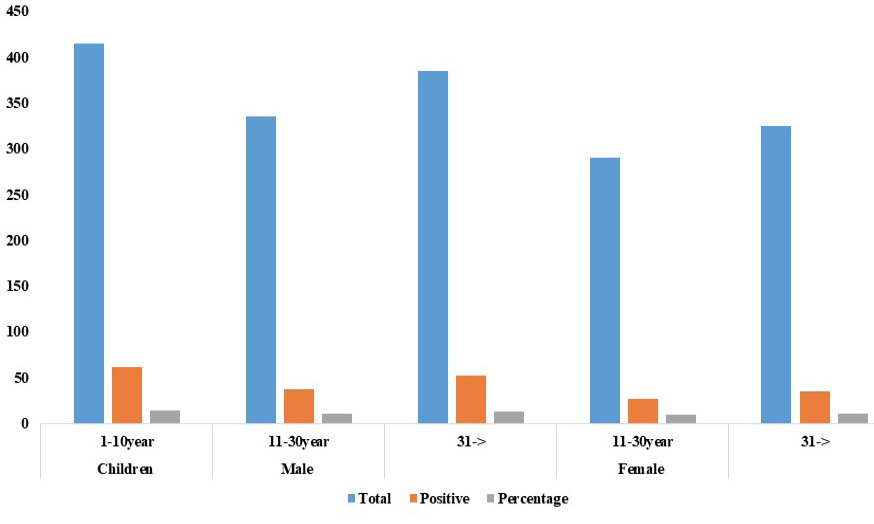
Total 415 blood sample were collected from children of both the genders among which 62(14.9%) were identified positive for malarial parasite. Moreover, 335 blood samples collected from males of age 11-30 years were found with 38(11.34%) positive cases whereas in 31≥ years 385 blood samples collected in which 52(13.50%) were positive. Additionally, 290 blood sample collected from females of 11-30 years, 27(9.30%) were found positive for malaria parasite and 325 blood samples from 31≥ years had 35(10.76%) malaria prevalence. Children were recorded highest rate of malaria. Overall prevalence noticed was 214(12.2%) in district Dir (Table 2; Figure 3).
Table 2: Gender wise prevalence of malaria.
| Gender | Age | Total | Positive | Percentage |
| Children | 1-10 | 415 | 62 | 14.9 |
| Male | 11-30 | 335 | 38 | 11.34 |
|
| 31-< | 385 | 52 | 13.50 |
| Female | 11-30 | 290 | 27 | 9.30 |
|
| 31-< | 325 | 35 | 10.76 |
| Total |
| 1750 | 214 | 12.2 |
Species wise prevalence of malaria
In the current study, P. vivax was found the most prevalent in children (90.33%) and P. falciparum was recorded the least one (8%). Among the males were comparatively found more effected than females (88%) by P. vivax whereas females were affected (11.2%) by P. falciparum, which is higher than in the children (8%) and males (10%). General trend of results indicate that P.vivax is highly prevalent species of malaria parasite in the human population of district lower Dir (Table 3; Figure 4).
Months wise prevalence of malaria
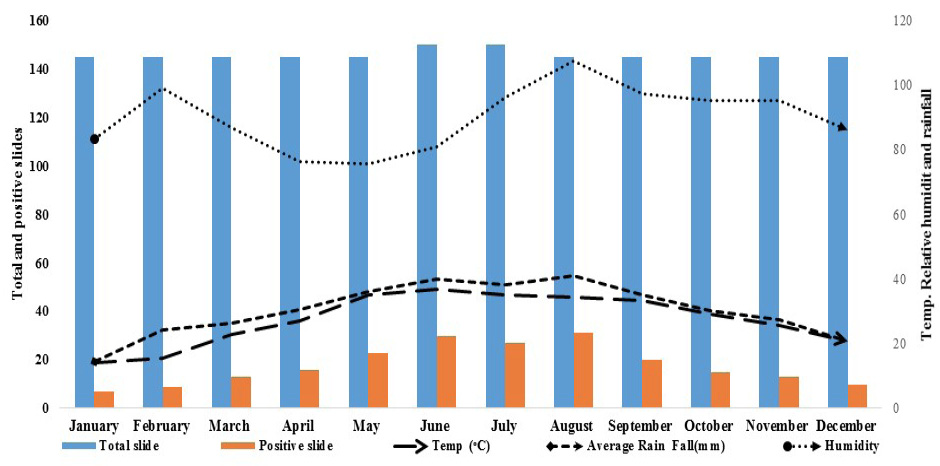
The month wise prevalence of malarial infection was found highest in August (21.37%) and the recorded temperature was 34.29ᵒC, humidity 66.5% and rainfall 6.64mm noticed is believed supporting factors for such a higher result. The lowest rate of infection was found in January (4.8%) also the temperature (14.14ᵒC), rainfall (0.20mm) and humidity 69% recorded was the least. (Table 4; Figure 5).
Table 3: Species wise prevalence of malaria.
| Gender | Total slide | Positive | P.vivax | Per% | P. falciparum | % |
| Children | 415 | 62 | 56 | 90.33 | 5 | 8 |
| Male | 720 | 90 | 81 | 90 | 9 | 10 |
| Female | 615 | 62 | 55 | 88 | 7 | 11.2 |
| Total | 1750 | 214 | 193 | 90 | 21 | 9.81 |
Table 4: Months wise prevalence of malaria.
| Months | Total slide | Positive slide | % | Temp (ᵒC) | Average rain fall(mm) | Humidity |
| January | 145 | 7 | 4.8 | 14.14 | 0.20 | 69 |
| February | 145 | 9 | 6.2 | 15.43 | 8.80 | 75 |
| March | 145 | 13 | 8.9 | 22.93 | 3.39 | 60.5 |
| April | 145 | 16 | 11 | 27.21 | 3.26 | 46 |
| May | 145 | 23 | 15 | 35.29 | 1.00 | 39.5 |
| June | 150 | 30 | 20 | 36.86 | 3.23 | 41 |
| July | 150 | 27 | 18 | 35.29 | 3.13 | 58 |
| August | 145 | 31 | 21.37 | 34.29 | 6.64 | 66.5 |
| September | 145 | 20 | 13.7 | 33.36 | 1.86 | 62 |
| October | 145 | 15 | 10.34 | 29.29 | 1.07 | 65 |
| November | 145 | 13 | 8.9 | 25.64 | 1.70 | 68 |
| December | 145 | 10 | 6.8 | 20.86 | 0.00 | 65.5 |
| Total | 1750 | 214 | 12.2 | 27.55 | 2.86 | 59.67 |
Discussion
The present study were conducted on malarial disease in District Dir Lower from January to December 2013. Malarial infection is one of the serious health issues in Pakistan. In the current study, the prevalence of malarial parasite, P. vivax was higher (90%) while the P. falciparum (9.81%) lower. We consider that the Plasmodium vivax is the major species responsible for malarial infection in District Dir Lower. Similarly the study reported (WHO, 2011) P. falciparum (61%) and P. vivax are most common (95%) from India, Indonesia and Myanmar. Mohammad and Hussan reported the P. falciparum (1.08%) and P. vivax (5.78%) in general population in Buner District. Idris et al. (2007) stated patient at Ayub teaching hospital Abbottabad P. Vivax (72.4%), P. falciparum 24.1 % mixed infection was seen in 3.44%. In the present study, the Age wise prevalence was higher in children (14.9%) due to low socio-economic conditions, which may be due to different geographical climatic factors. Suleman (2012) described the occurrence of malaria was highest in children (5.52%) in age group of 5-9 years, intermediate (3.37%) in age group of 10-14 years and lower (2.2%) in age group of 15-19 years, though the differences were not significant. Saleem et al. (2006) reported in KPK it was observed that cerebral malaria was more common in males (64%) and most vulnerable group was pregnant women. Yasinzai and Kakarsulemankhel (2009) reported total of 3765 blood samples 26.8% were found positive for malarial parasite. The incidence was higher (75.9%) in males, which is parallel to current result. Mohammad and Hussan (2011) reported months wise prevalence was higher in August (11.66%) and lowest march (3.98%) in district Buner. In the present study months wise prevalence was higher in August (21.37%) due to maximum rainfall and humidity and minimum cases were noted in January (4.8%). Pakistan is a tropical country where the most of peoples have agriculture profession. In rainfall season, the water accumulates and provides better condition for the mosquito breeding. The rate of malaria infection was high in the monsoon season from July to November. The results of our study are comparable with the results of others studies.
Conclusion
It’s concluded that Plasmodium vivax is the major species responsible for malarial infection in District Dir Lower. Consequently, the children under the age of ten years were found highly effected and implicated with weak immunity and poor hygienic conditions. Which needs immediate attention to take preventive measures.
Acknowledgments
We are thankful to the Qazi Laboratory, DHQ Hospital for facilities of lab for collection of sample from the local populations.
Conflict of interest statement
The authors declare no conflict of interest.
Figures
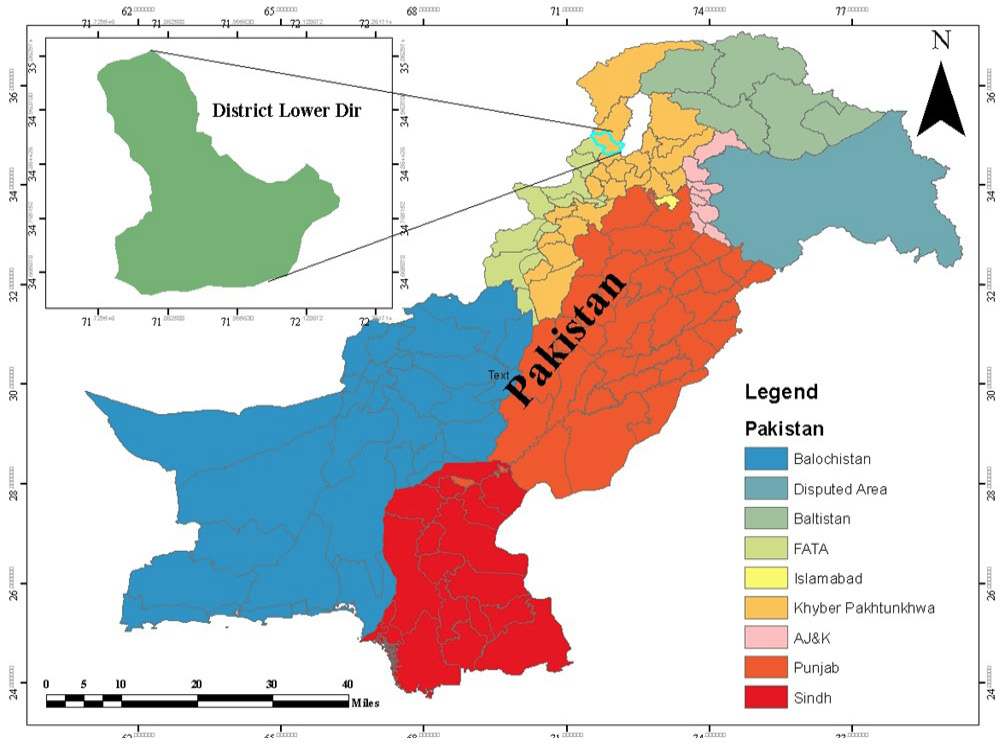
Map showing the study area.
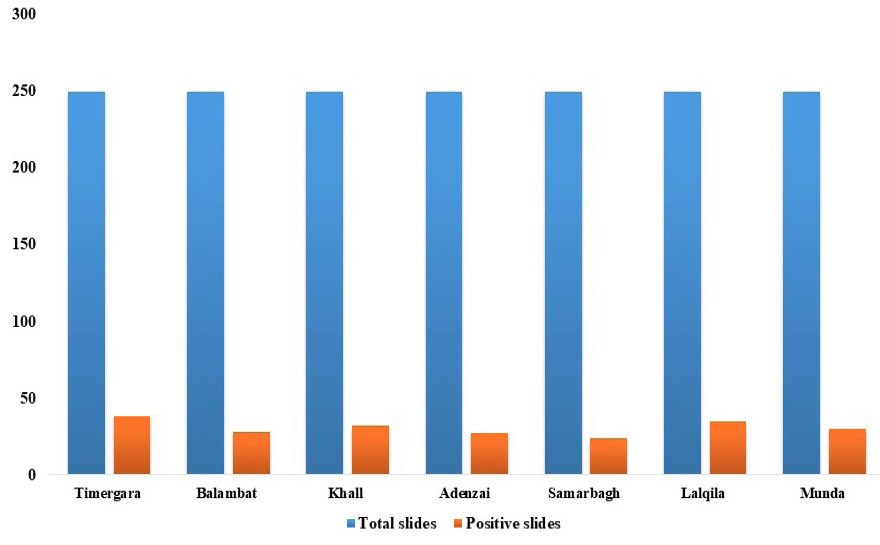
Tehsil wise prevalence of malaria.
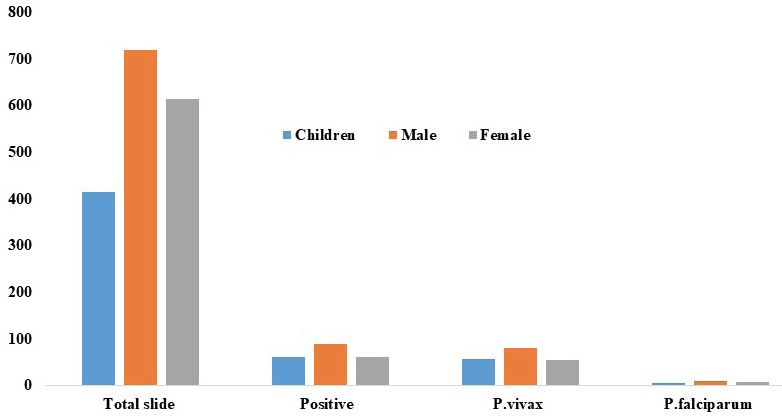
Gender wise prevalence of malaria.
Species wise prevalence of malaria.
Months wise prevalence of malaria.
References
- Abdulkareem, B.O., Adam, A.O., Ahmed, A.O., Mariam, A.A. and Samuel, U.U., 2017. Malaria-induced anaemia and serum micronutrients in asymptomatic Plasmodium falciparum infected patients. J. Parasitic Dis., 41: 1093-1097. https://doi.org/10.1007/s12639-017-0940-4[CrossRef]
- Ali, B. and Hashmi, K.Z., 1997. Prevalence of malaria among Karachites. Past Present. Inf. Dis. J. Pak., 4-9.
- Collins, W.E., 2012. Plasmodium knowlesi: a malaria parasite of monkeys and humans. Annu. Rev. Entomol., 57: 107-121. https://doi.org/10.1146/annurev-ento-121510-133540[CrossRef]
- Idris, M., Sarwar, J. and Fareed, J., 2007. Pattern of malarial infection diagnosed at Ayub teaching hospital Abbottabad. J. Ayub Med. Coll. Abbottabad, 19: 35-36.
- Khan, M.I., Ullah, H., Suleman, I., Khan, M.A.S., Naz, F., Rafi, M.A. and Mehmood, S.A., 2016. Diversity and distribution of butterflies (Insecta: Lepidoptera) of district Dir lower, Khyber Pukhtoonkhwa, Pakistan. Arthropods, 5: 11.
- Khatoon, L., Baliraine, F.N., Bonizzoni, M., Malik, S.A.N. and Yan, G., 2009. Prevalence of antimalarial drug resistance mutations in Plasmodium vivax and P. falciparum from a malaria-endemic area of Pakistan. Am. J. Trop. Med. Hyg., 81: 525-528. https://doi.org/10.4269/ajtmh.2009.81.525[CrossRef]
- Khattak, A.A., Venkatesan, M., Nadeem, M.F., Satti, H.S., Yaqoob, A., Strauss, K. and Plowe, C.V., 2013. Prevalence and distribution of human Plasmodium infection in Pakistan. Malaria J., 12: 297. https://doi.org/10.1186/1475-2875-12-297[CrossRef]
- Kreil, A., Wenisch, C., Brittenham, G., Looareesuwan, S. and Peck-Radosavljevic, M., 2000. Thrombopoietin in Plasmodium falciparum malaria. Br. J. Haematol., 109: 534-536. https://doi.org/10.1046/j.1365-2141.2000.02096.x[CrossRef]
- Manson-Bahr, P.E.C. and Bell, D.R., 1987. Malaria and babesiosis. Manson’s tropical diseases, 19th ed. London, Bailliere Tindall, pp. 3-51.
- Muhammad, N. and Hussain, A., 2011. Prevalence of malaria in general populationof distric Buner. J. Postgraduate Med. Inst., 17: 1.
- Panikar-Jayaram, C.K., 2002. Text book of medical parasitology, 5th Ed., Jaypee Brothers, Medical Publishers (P) Ltd. New Delhi, India.
- Rathor, H.R., Hassan, S.A., Hazrat, B. and Khan, I.A., 2012. Progress towards Millennium Development Goals: Strategic planning for malaria vector control in Pakistan. Pak. J. Pub. Hlth., 2: 36-40.
- Saleem, I., Pirzada, A.H. and Rahman, R.S., 2006. Noor-ul-Iman. Cerebral malaria: an experience in NWFP, Pakistan. Pak. J. Med. Sci., 14: 35-39.
- Snow, R.W., Craig, M., Deichmann, U. and Marsh, K., 1999. Estimating mortality, morbidity and disability due to malaria among Africa’s non-pregnant population. Bull. World Hlth. Org., 77: 624.
- Sood, R., 1989. Haematology, 3rd Edition. Jaypee Brothers, Med. Publishers (P), Ltd, New Delhi, India.
- Suleman, M., 2012. Malaria among the students of religious schools of Bannu district, Khyber Pakhtunkhwa, Pakistan. Pakistan J. Zool., 44: 959-962.
- WFP (World Food Program), 2011. School feeding project in targeted union councils in Lower Dir KPK., World Food Program.
- Wahab, M., Ahmed, M. and Khan, N., 2008. Phytosociology and dynamics of some pine forests of Afghanistan. Pak. J. Bot, 40: 1071-1079.
- WHO. 2011. World malaria report. Geneva: World Health Organization.
- WHO. 2011. Malaria Situation in South East Asia Region. Malaria Unit, Department of Communicable Diseases.
- Yasinzai, M.I. and Kakarsulemankhel, J.K., 2009. Prevalence of human malaria infection in bordering areas of East Balochistan, adjoining with Punjab: Loralai and Musakhel. J. Pak. Med. Assoc., 59: 20-22.
- Yasinzai, M.I. and Kakarsulemankhel, J.K., 2013. Prevalence of human malaria infection in Pakistani areas bordering with Iran. J. Pak. Med. Assoc., 63: 313-316.
Cited by 1 article
In journals published by ResearchersLinks.
Services
Article usage statistics
Loading…