
The present study was conducted from January 2013 to December of the same calendar year to cover all the four seasons. The data of this descriptive study was processed and analyzed to investigate the prevalence of malaria and its specific aetiologic agents in suspected patients reported to various laboratories of Agency Head Quarter Hospital Khar, Bajaur Agency. In this study, a total number of 9720 suspected individuals were examined; among which 1273 (13.1%) were found to be positive for malaria infection with different Plasmodium species in their blood smears. Male population accounts for higher prevalence rate (14.59%) than female (11.24%). The infection was more prevalent in November (21.4%), December (21.1%) and October (18%) and was lowest in the month of April (6.7%). The highest prevalence was recorded in autumn (36.8%) and summer (30.3%) and the lowest rate of infection was observed in spring (10.1%). Majority of the malarial cases were due to P. vivax, which was the most common species; P. falciparum was less common species and mix cases of infection due to both P. vivax and P. falciparum were rare. Majority of the people with age group above 15 years were more infected (14.07%). Such a highest incidence and prevalence of the infection revealed that malaria poses a great public health problem in the area, so Government and Health Authorities should pay attention on preventing and controlling the infection.
Short Communication · Volume 51, Issue 1, 21 January 2019 · Open Access
A Report on Prevalence of Malaria Infection in General Population of Bajaur Agency, FATA, Pakistan
·
Affiliations & Notes ⌄
- 1Department of Zoology, University of Peshawar, Peshawar, Khyber Pakhtunkhwa , * Corresponding author: ajmalkhan399@hotmail.com
Article Info ⌄
- Journal:
- Pakistan Journal of Zoology
- Published:
- 21 January 2019

From the article
- The incidence rate of malaria infection increased from June to December and then decreased from January to May (Fig. 1A).
- The infection rate was lowest (6.7%) in the month of April with only 5 positive cases.
- The highest prevalence was recorded in autumn (36.8%) and summer (30.3%) and the lowest rate of infection (10.1%) was observed in spring (Fig. 1B).
- It is concluded that malaria poses an important public health problem in Bajaur agency, FATA, Pakistan with majority of the cases in the months of November and December due to favourable environmental conditions for the growth of Plasmodium in these months and is higher in males than females.
Selected from the article's own text.
Abstract
Materials and methods
This study was conducted from January 1, 2013 to December 31, 2013 in Bajaur Agency, FATA, Pakistan. Bajaur Agency is a hilly terrain with a population of about 900,000 and is located at an elevation of 972 meters from sea level. The climate of the Agency is extreme having all the four seasons. The temperature in winter ranges from 5-16oC and in summer from 23-36oC. A number of springs and streams flow throughout the Agency that serves as a water source for drinking and irrigation purposes. Different types of crops and vegetables like maize, wheat, rice, tomato, potato, onion, cauliflower etc. are cultivated in the area.
In this study, a total of 9720 malaria suspected individuals of all age groups and both gender having symptoms like high fever, chills, sweating and body aches were examined, who visited various laboratories of Agency Head Quarter Hospital Khar, Bajaur Agency during the study period. Among the suspected individuals, 1961 were reported in age group below 5 years, 2997 in age group of 5-14 years and 4762 in age group of above 14 years. Similarly suspected male individuals were reported to be 5379 and females as 4341. The approval of the study was taken from Research Committee of Department of Zoology, University of Peshawar and the verbal consent was also obtained from all suspected individuals or their parents/guardians and they were assured that the provided information will be kept confidential and will be used for research purposes only.
The blood was collected from them and thick and thin smears were prepared . The slides were then air dried at room temperature for about 30 min, fixed with methanol for 2-3 min, stained with Giemsa’s stain, washed with tap water, dried in air and examined by a pathologist for any possible Plasmodium species under light microscope.
The data was analyzed and processed to investigate the prevalence of malaria as well as prevalence of P. vivax and P. falciparum in Bajaur Agency in correlation with socio-demographic and epidemiological characteristics.
The Chi-square test was used for determining the association between different age groups and sex of individuals with malaria infection by using the formula:
Χ 2 = ∑ (O−E)2 / E
Where, O represents the observed frequency and E represents the expected frequency under the null hypothesis and is computed by E = row total × column total / sample size. We will compare the value of test statistic to the critical value of χ2α with degree of freedom = (r - 1) (c - 1), and reject the null hypothesis if χ2 > χ2α.
Table I.- Total, sex wise and age wise prevalence of malaria infection in Bajaur Agency, FATA, Pakistan.
| Total cases | Positive cases | Percentage | ||
| Prevalence | ||||
| Total | 9720 | 1273 | 13.1% | |
| Gender | ||||
| Male | 5379 | 785 | 14.59% | |
| Female | 4341 | 488 | 11.24% | |
| Age | ||||
| < 5 | 1961 | 218 | 11.12% | |
| 5-14 | 2997 | 385 | 12.85% | |
| > 14 | 4762 | 670 | 14.07% | |
Results and discussion
Out of a total of 9720 suspected individuals visiting various laboratories of Agency Head Quarter Hospital Khar from January-December 2013, who were examined for the presence of malarial parasites, 1273 individuals were found positive for malarial parasites in their blood smears, suggesting 13% prevalence in Bajaur Agency during (Table I). A study conducted in Buner District of Khyber Pakhtunkhwa by Muhammad and Hussain (2003), reported 6.86% prevalence rate of malaria. The most likely reason behind the highest prevalence of the disease in Bajaur agency is the low economic level of the people as majority of the people work in rice fields having stagnant water where chances of infective mosquitoes bite are more. Moreover people do not spray insecticides in their residential areas and also they do not use mosquito nets while sleeping in open areas.
The incidence rate of malaria infection increased from June to December and then decreased from January to May (Fig. 1A). The highest incidence was reported in November (21.4%) with 129 positive cases out of 602 suspected cases, followed by December (21.1%) with 114 cases and October (18%) with 181 positive cases. The infection rate was lowest (6.7%) in the month of April with only 5 positive cases. The highest prevalence was recorded in autumn (36.8%) and summer (30.3%) and the lowest rate of infection (10.1%) was observed in spring (Fig. 1B).
Table II shows the species wise prevalence of malaria in different months. It is obvious that malaria cases were mostly due to P. vivax that occurs throughout the year, cases due to P. falciparum were less common and were rarely due to mix species (P. vivax + P. falciparum). Not a single case was reported to have infection due to P. malariae or P. ovale. The frequency of P. vivax was maximum in the months of June (96.6%), April (96.4%) and August (95.8%); while that of P. falciparum was maximum in the months of October (42%), November (41.9%) and December (30.7%). A previous study conducted in Buner also showed more or less similar results. The reasons of maximum cases of the disease in these months and seasons are most likely to be due to high rainfall, presence of stagnant water, high temperature, more cultivation of rice crops, sleeping in open places and less use of mosquito nets. In the study area, there occurs a high rainfall in the months of September, October and November and usually the Summer season is dry and Autumn is rainy due to which to which high population of mosquitoes is likely to occur in these months and seasons that can transmit the Plasmodium parasite from infected individuals to healthy people and thus the incidence of infection is increased.
Table II.- Mosquito species wise prevalence of malaria in Bajaur Agency, FATA, Pakistan during different months of 2013.
| Month | Positive cases | P. vivax (%) | P. falciparum (%) | Mix species (%) |
| January | 112 | 99 (88.4%) | 10 (8.9%) | 3 (2.7%) |
| February | 64 | 60 (93.8%) | 4 (6.2%) | 0 (0%) |
| March | 5 | 4 (80%) | 1 (20%) | 0 (0%) |
| April | 55 | 53 (96.4%) | 1 (1.8%) | 1 (1.8%) |
| May | 69 | 64 (92.8%) | 5 (7.2%) | 0 (0%) |
| June | 118 | 114 (96.6%) | 4 (3.4%) | 0 (0%) |
| July | 126 | 113 (89.7%) | 13 (10.3%) | 0 (0%) |
| August | 142 | 136 (95.8%) | 6 (4.2%) | 0 (0%) |
| September | 158 | 132 (83.5%) | 26 (16.4%) | 0 (0%) |
| October | 181 | 105 (58%) | 76 (42%) | 0 (0%) |
| November | 129 | 72 (55.8%) | 54 (41.9%) | 3 (2.3%) |
| December | 114 | 77 (67.5%) | 35 (30.7%) | 2 (1.8%) |
| Total | 1273 | 1029 (80.8%) | 235 (18.5%) | 9 (0.7%) |
Table II shows sex-wise and age wise prevalence of malaria. The prevalence rate was higher in male (14.59%) than female (11.24%). Our report is in line with previous studies ; . This is due to the fact that male work or sleep in open places without using mosquito nets so are more exposed to the bite of infected mosquitoes; while comparatively female are mostly well covered due to local and Pakhtoon culture. The infection was more prevalent (14.07%) in people with age group above 14 years, followed by the age group of 5-14 years (12.85%) and was less prevalent (11.12%) in children with age below 5 years. It appears that there is some association between sex and age of the patient and malaria infection at a 5% level of significance. A previous study conducted in Muzaffargarh also reported higher malaria cases in age group of 16-30 years. In another study conducted from 2004 to 2006, the maximum prevalence was reported in the age group 11-20 years. The reason for such a highest prevalence in the people of age above 14 years is the low economic level of the people of the area as majority of them are farmers and cultivated rice crops, vegetables etc. which need continuous supply of water that provide habitat for mosquito breeding. Moreover these people don’t take proper care of protecting themselves from the bite of mosquitoes and mostly sleep in open places without using mosquito nets, so these factors contributed to the spread of malaria infection in the area. On the other hand, children are restricted to homes and young individuals below 14 years are busy in schooling so comparatively they are less exposed to the bite of mosquitoes.
Conclusion
It is concluded that malaria poses an important public health problem in Bajaur agency, FATA, Pakistan with majority of the cases in the months of November and December due to favourable environmental conditions for the growth of Plasmodium in these months and is higher in males than females. The aetiologic agent of the infection was reported to be P. vivax and people with age group of above 15 were found to be more infected who have great exposure to the bite of mosquitos. The authorities are needed to pay attention on controlling and preventing the disease in the area.
Statement of conflict of interest
Authors have declared no conflict of interest.
Figures
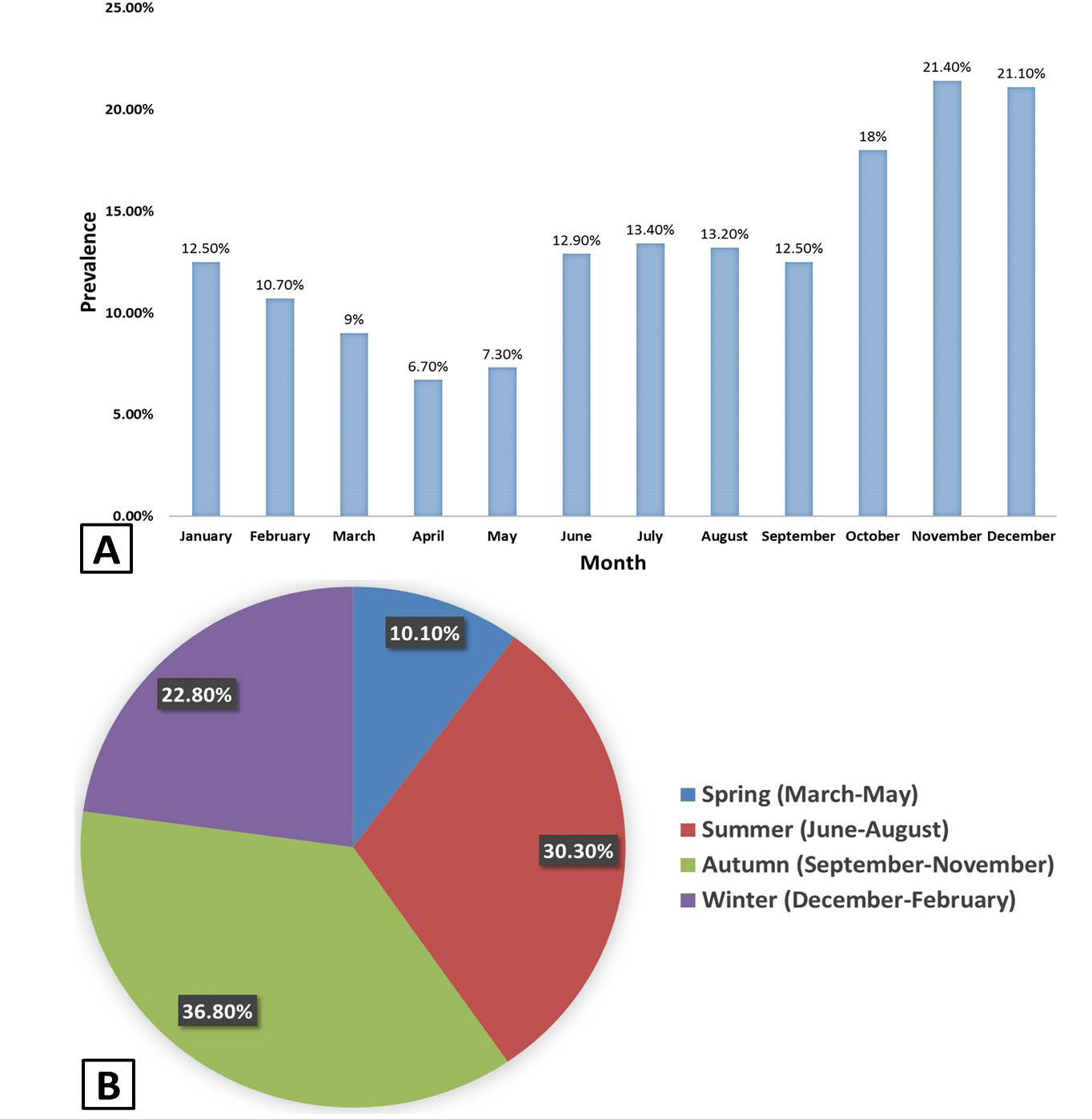
Month wise (A) and season wise (B) prevalence of malaria in Bajaur Agency during 2013.
References
- Awan, Z.U.R., Khan, A.K., Shah, A.H., Suleman, M. and Khan, M.A., 2012. Pakistan J. Zool., 44: 321-326.
- Kakar, Q., Khan, M.A. and Bile, K.M., 2010. E. Mediterr. Hlth. J., 16: 53-55.
- Khalili, M.B., Hossein, M., Tafti, A. and Sadeh, M., 2009. World J. med. Sci., 4: 41-45.
- Khan, H.U., Aziz, M., Khattak, M.H., Khan, I.U., Mahsud and Shah, S.H., 2006. Biomedica, 22: 99-104.
- Khattak, A.A., Venkatesan, M., Nadeem, M.F., Satti, H.S., Yaqoob, A., Strauss, K., Khatoon, L., Malik S.A. and Powle, C.V., 2013. Malaria J., 12: 297. https://doi.org/10.1186/1475-2875-12-297[CrossRef]
- Kreier, J.P., 1980. Malaria: Epidemiology, chemotherapy, morphology, and metabolism, Vol. 1. Academic Press, New York.
- Muhammad, N. and Hussain, A., 2003. J. Postgraduate med. Inst., 17: 75-80.
- Niringiye, A. and Douglason, O.G., 2010. Res. J. Environ. Earth Sci., 2: 194-198.
- Okonko, I.O., Soleye, F.A., Amusan, T.A., Ogun, A.A., Udeze, A.O., Nkang, A.O., Ejembi, J. and Faleyte, T.O.C., 2009. Malaysian J. Microbiol., 5: 113-118.
- Onyishi, G.C., Aguzie, I.O.N., Nwani, C.D., Obiezue, R.N.N. and Okoye, I.C., 2018. Pakistan J. Zool., 50: 1035-1041.
- Reza, Y.M. and Taghi, R.M., 2011. Asian Pac. J. Biomed., 1: 491-492. https://doi.org/10.1016/S2221-1691(11)60107-X[CrossRef]
- Sahar, S., Akhter, T., Bilal, H. and Rana, M.S., 2012. Pakistan J. Sci., 64: 64-66.
- Yasinzai, M.I. and Kakarsulemankhel, J.K., 2009. Biologia (Pakistan), 55: 43-50.
Services
Article usage statistics
Loading…