
The mature sunn pest E. testudinaria insects were gathered from wheat fields and transported to the laboratory. A physical control method was used as it has been identified as serious pest of wheat yield. It was exposed to varying durations (5,10, and 15 minutes) of ultraviolet irradiation (UVC) with a 254nm wave length under carefully monitored circumstances to ascertain the impact of radiation on egg hatching. The results indicated that different UVC-irradiation exposure times could affect egg hatchability, culminating in a gradual decrease in egg hatching percentages of 30.95, 16.66, and 2.38% respectively. Thus, UVC-irradiation was found to be an effective method for controlling the sunn pest E. testudinaria eggs.
Research Article · Volume 41, Issue 1, 28 January 2025 · Open Access
Study of Effect Ultra-Violet Rays on Egg Hatching of the Sunn Pest Eurygaster testudinaria
Affiliations & Notes ⌄
- 1Plant Protection, Faculty of Agriculture, Al-Muthanna University, Iraq. *Correspondence | Ahmed Shamkhi Jabbar, Plant Protection, Faculty of Agriculture, Al-Muthanna University, Iraq
- 2Email: ahmedshmky65@mu.edu.iq
Article Info ⌄
- Journal:
- Sarhad Journal of Agriculture
- Published:
- 28 January 2025
From the article
- The present findings showed that UV-irradiation reduced hatching of eggs; as exposure times rose, the impact became progressively greater.
- They reported that the proportion of Callosobruchus maculatus and Ephestia kuehniella eggs hatching decreased gradually as the length of irradiation exposure increased.
- The following conclusions were derived from this study regarding the effects of ultra violet irradiation on egg hatching of E. testudinaria: Increased exposure time to UVC radiation reduced egg hatching significantly.
- Thus, As a result this radiation UVC 254nm can be used insecticidal activity against E. testudinaria eggs.
Selected from the article's own text.
Abstract
Introduction
A particularly damaging bug species for wheat plants is the sunn pest (Eurygaster testudinaria) (Geoffroy) (Hemiptera: Scutelleridae). It makes the wheat lose its ability to make pasta and bread (Ilcin and Celik., 2021). It is currently necessary to investigate alternate, non-toxic pest management strategies due to the usage of pesticides and the environmental effects that follow. The advantages of irradiation over chemical pesticides, such as its absence of residue, make it a well-established method for reducing insects . Programs for integrated pest management (IPM) have effectively employed this nontoxic and ecologically friendly technique to control insects ; ; . The UV light is germicidal and is used to control insects. It is employed in physiological and embryological research as a beetle attractant and as an external disinfectant for insect eggs. In addition, Bhardwaj et al. (2019); Klingler and Bucher (2022) discovered that shorter wavelengths of UV had a greater inhibitory impact on organisms, causing the 305–315 nm region to be the highest for biological activity of solar UV radiation ; . Insect interactions with plants are negatively impacted by UV-B radiation through the activation of photomorphogenic alterations and their detrimental effects on insect behavior and health ; . The most active and potentially harmful kind of radiation is UV-C, which has a wavelength range of 100 to 280 nm . Due to this, some researchers are now exploring the prospect of employing UV radiation to prevent the growth of certain bug species, or at the very least to slow their growth ; . UV-C has been shown to be effective against several beetle and mite pests in stored products, with varying sensitivity depending on the period of exposure and the species of insect ; .
Irradiation damage is becoming a well-known method for killing insect eggs. It is used in physiological and embryological studies as a beetle attractant and as a surface disinfectant for insect eggs . Eggs of Callosobruchus maculatus exhibited an inverse relationship with UV exposure. Gradually fewer pulse beetle eggs hatched as the amount of time they were exposed to radiation increased . From a pest control perspective, significant reductions in egg hatching and adult emergence brought about by UV irradiation are advantageous. UV light affects the pulse beetle’s biological characteristics .
Many biological creatures are stressed as a result of UV radiation ; . It enters cells and causes photo-excited states in cell photosensitizers. Ultimately, it produces reactive oxygen species, which harm proteins, membrane lipids, and nucleic acids . Mutagenesis, changes to cell communication routes, and cytotoxicity are all examples of UV damage to cells. They all have significant impacts on many biological and cellular functions . UV rays have also been demonstrated to influence various biological processes in insects, such as embryonic physiology, biochemistry, and behavior . In addition, UV rays damage insects photoreceptors and induce oxidative stress . The objective of the current study was to ascertain how UV radiation affects E. testudinaria hatchability utilizing a non-chemical method that causes greater qualitative and quantitative damage.
Materials and Methods
Test insects
The mature sunn pest E. testudinaria insects were gathered from wheat fields in Al-Muthanna Governorate, Iraq and transported to the laboratory of Agricultural Faculty, Al-Muthanna University in April 2024. The insects were positioned into 25 × 35 × 18 cm plastic cages and covered with muslin fabric, which had a rubber band fastened to it. It was maintained at 27±1°C, 60±10% R.H., and 16 L: 8 D photoperiod on wheat seeds, with moist cotton pieces added to the rearing container to give the insects a water supply, as described by Allahyari et al. (2010). The process was repeated using the laid eggs to establish an insect colony for the sunn pest sufficient to sustain the basic colony. Ten pairs (males and females) in plastic containers containing wheat plants 10-15 cm long for feeding purposes. Insects were left inside the containers to mate and lay eggs under laboratory conditions.
UV-C irradiation
UV germicidal lamp 6-watt using a source for irradiation (TUV 6W G6T5, Philips, Poland) measuring 226 mm, emitting irradiation at a wavelength of 254 nm. An exam chamber (90 × 60 × 55 cm) has the lamp fastened to the ceiling. Three replicates, each consisting of 14 eggs, were placed in a petri dish. Before the egg masses were exposed to UV light in the experiment, they were captured from above using a digital microscope camera. The eggs were subjected to UV-C irradiation for 0, 5, 10, and 15 minutes each, while they were kept 5 cm away from the UV lamp’s surface.
Data analysis
An analysis of variance conducted in one direction was used to identify the data collected from the various time points (ANOVA; GenStat Release 12.1), followed by an LSD multiple range test. Notable variations in the tissues between the treatment and control groups (UV-C irradiation) were identified by an independent-sample t test (GenStat Release 12.1). The eggs’ hatchability percentages were computed using . Using the following equation:

The percentage reduction in egg hatching in comparison to the control was calculated using by using the formula:

Where, X₁ = average hatching rate of control eggs and X2 = average irradiated egg hatching.
Results and Discussion
The current study assessed the effects of UV-C radiation on E. testudinaria eggs. The results on hatchability percentage Table 1 and Figure 1 indicated that the hatchability percentage on different treatments varied between 2.38 % and 97.61%. The maximum hatchability percentage was observed on the control (97.61%) followed by 5 min (30.95%). With the lowest hatchability recorded, the most successful treatment was 15 minutes (2.38%), followed by 10 minutes (16.66%). Treatment times of 5, 10, and 15 minutes range from least to most effective. Table 1and Figure 1 . The regression equation obtained for hatchability includes Y= 111.9 - 29.998X. According to the formulae, hatchability was reduced by 29.998% after one minute of exposure to UV radiation, with an intercept of 111.9. The present findings showed that UV-irradiation reduced hatching of eggs; as exposure times rose, the impact became progressively greater. In addition, all UV-radiation exposure periods reduced egg hatching when compared to controls. This result is in agreement with the result of El-Shennawy et al. (2019), who noticed a positive correlation between the duration of UV radiation and Tribolium castaneum egg mortality ; . They reported that the proportion of Callosobruchus maculatus and Ephestia kuehniella eggs hatching decreased gradually as the length of irradiation exposure increased. According to Guerra et al. (1968), when Heliothis virescens and Helicoverpa zea eggs were subjected to short-wavelength UV radiation, the proportion of eggs that hatched declined over time and did not hatch after 20 minutes. C. maculatous eggs, on the other hand, were not UV-sensitive; some larvae finished their life cycle even after being exposed to UV-C for 50 minutes .
According to our research, one possible cause of the reduction in egg hatchability is the nature of the UV-C effect on early developmental stages of insects, which is attributable to UV radiation transfer into animal tissues. UV rays have the ability to disrupt DNA directly or indirectly by causing reactive free radicals to develop, which can lead to oxidative stress, cytotoxic and mutagenic effects and other problems with cellular function in addition UV radiation ultimately inhibits egg hatching by cussing damages the egg chorion and leakage egg fluid ; .
Table 1: Different exposure times to UV radiation affect the hatchability and reduction in hatching percentage of E. testudinaria.
| Exposure period (min) | Mean | Egg hatchability % | Reduction % |
| Control | 13.66 | 97.61 | - |
| 5 | 4.33 | 30.95 | 68.30 |
| 10 | 2.33 | 16.66 | 82.94 |
| 15 | 0.33 | 2.38 | 97.58 |
| L.S.D | 1.582 | - | - |
In Table 2 the correlation analysis showed a strong negative liner that the relationship between the amount of time spent exposed to UV radiation and hatchability was non-significantly inverse (-0.92). The linear regression coefficient for hatchability was -5.99.
Table 2: correlation and regression coefficient between UV radiation exposure duration and E. testudinaria egg hatchability.
| Aspects | r | b | p-value |
| Exposure to UV rays vs. hatchability | -0.92 | -5.99 | 0.081 ns |
P<0.05, ns: non-significancse, b: liner regression coefficient, r: simple correlation.
Conclusions and Recommendations
The following conclusions were derived from this study regarding the effects of ultra violet irradiation on egg hatching of E. testudinaria: Increased exposure time to UVC radiation reduced egg hatching significantly. Thus, As a result this radiation UVC 254nm can be used insecticidal activity against E. testudinaria eggs. to suppress the population of certain insect pests without leaving a hazardous trace. However, more comprehensive research is needed on the impact of these rays and their relationship to climate change occurring in the world.
Acknowledgements
The author is grateful to the farmers for helping in wheat fields.
Novelty Statement
This research is critical for determining the effect of UV radiation on the most important pest in wheat fields, Sunn Pest. For future studies with climate changes occur in the world and Iraq specifically.
Conflict of interest
The author has declared no conflict of interest.
Figures
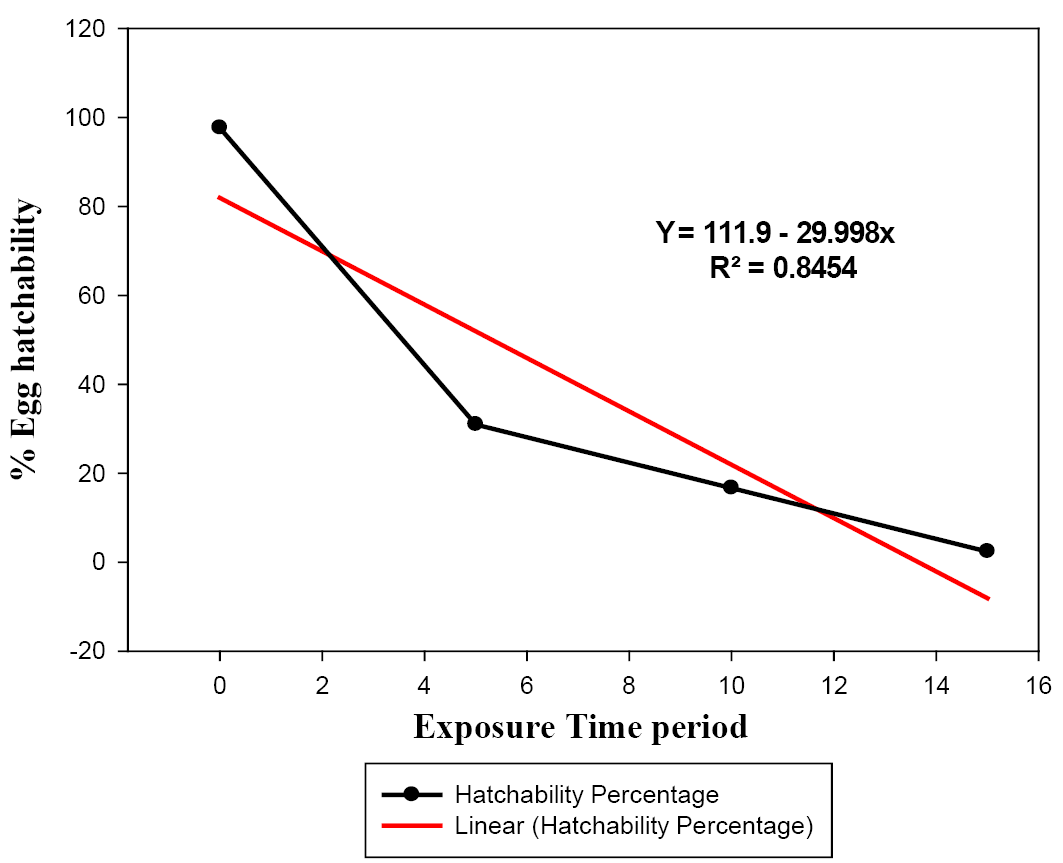
UV radiation’s effect on the hatchability % of E. testudinaria.
References
- Ahmed, N., M. Alam, M. Saeed, H. Ullah, T. Iqbal, K.A. Al-Mutairi and M. Salman. 2021. Botanical insecticides are a non-toxic alternative to conventional pesticides in the control of insects and pests. Glob. Decline Insects, 11: 1-19. https://doi.org/10.5772/intechopen.100416[CrossRef]
- Ahmed, R.G., 2005. Damage pattern as function of various types of radiations. Med. J. Islamic World Acad. Sci., 15(4): 135-147.
- Allahyari, M., A.R. Bandani and M. Habibi-Rezaei. 2010. Subcellular fractionation of midgut cells of the sunn pest Eurygaster integriceps (Hemiptera: Scutelleridae): Enzyme markers of microvillar and perimicrovillar membranes. J. Insect Physiol., 56(7): 710-717. https://doi.org/10.1016/j.jinsphys.2009.12.010[CrossRef]
- Banaszak, A.T. and M.P. Lesser. 2009. Effects of solar ultraviolet radiation on coral reef organisms. Photochem. Photobiol. Sci., 8(9): 1276-1294. https://doi.org/10.1039/b902763g[CrossRef]
- Ben-Yakir, D., Y. Antignus, Y. Offir and Y. Shahak. 2013. Optical manipulations: An advance approach for reducing sucking insect pests. Adv. Technol. Manage. Insect Pests, pp. 249-267. https://doi.org/10.1007/978-94-007-4497-4_12[CrossRef]
- Bhardwaj, V., P. Kumar, S. Verma and R. Jaiwal. 2019. Effect of ultraviolet radiation and some botanicals on development of Callosobruchus. Ann. Entomol., 37(1):
- Coohill, T.P. and J.L. Sagripanti. 2009. Bacterial inactivation by solar ultraviolet radiation compared with sensitivity to 254 nm radiation. Photochem. Photobiol., 85(5): 1043-1052. https://doi.org/10.1111/j.1751-1097.2009.00586.x[CrossRef]
- El-Shennawy, R.M., A.M. Husseen and M.A. Kandil. 2019. Latent effects on adults emergence of Pectinophora gossypiella (Saund.) and Earias insulana (Boisd.), resulted from magnetized pupae. J. Plant Protect Pathol., 10(1): 77-80. https://doi.org/10.21608/jppp.2019.40592[CrossRef]
- Faruki, S.I. and A.R. Khan. 1993. Potency of UV irradiation on Cadra cautella (Walker) (Lepidoptera: Phycitidae) larvae treated with Bacillus thuringiensis var. kurstaki.
- Faruki, S.I., D.R. Das, A.R. Khan and M. Khatun. 2007. Effects of ultraviolet (254nm) irradiation on egg hatching and adult emergence of the flour beetles, Tribolium castaneum, T. confusum and the almond moth, Cadra cautella. J. Insect Sci., 7(1): 36. https://doi.org/10.1673/031.007.3601[CrossRef]
- Fu, P.P., Q. Xia, X. Sun and H. Yu. 2012. Phototoxicity and environmental transformation of polycyclic aromatic hydrocarbons (PAHs) light-induced reactive oxygen species, lipid peroxidation, and DNA damage. J. Environ. Sci. Health, C, 30(1): 1-41. https://doi.org/10.1080/10590501.2012.653887[CrossRef]
- Guerra, A.A., M.T. Ouye and H.R. Bullock. 1968. Effect of ultraviolet irradiation on egg hatch, subsequent larval development, and adult longevity of the tobacco budworm and the bollworm. J. Econ. Entomol., 61(2): 541-542. https://doi.org/10.1093/jee/61.2.541[CrossRef]
- Güven, E., D. Pandır and H. Baş. 2015. UV radiation-induced oxidative stress and DNA damage on Mediterranean flour moth, Ephestia kuehniella Zeller (Lepidoptera: Pyralidae) larvae. Turk. J. Entomol., 39(1): 23-33. https://doi.org/10.16970/ted.06717[CrossRef]
- Hajjar, M.J., N. Ahmed, K.A. Alhudaib and H. Ullah. 2023. Integrated insect pest management techniques for rice. Sustainability, 15(5): 4499. https://doi.org/10.3390/su15054499[CrossRef]
- Heidari, N., A. Sedaratian-Jahromi and M. Ghane-Jahromi. 2016. Possible effects of Ultraviolet ray (UV-C) on biological traits of Callosobruchus maculatus (Col.: Chrysomelidae). J. Stored Prod. Res., 69: 91-98. https://doi.org/10.1016/j.jspr.2016.06.008[CrossRef]
- Ilcin, M. and S. Celik. 2021. The sunn Eurygaster spp. (Hemiptera: Scutelleridae) damage in wheat and the effect of seed amount used on yield by fuzzy logic method. World J. Adv. Res. Rev., 11(1): 239-246. https://doi.org/10.30574/wjarr.2021.11.1.0193[CrossRef]
- Jabbar, A.S., A.S. Mohmed and A.M. Hussein. 2023. Mycosynthesis of silver nanoparticles and evaluation as insecticidal against the sunn pest Eurygaster testudinaria in vitro. In IOP Conf. Ser. Earth Environ. Sci., 1158(7): 072013. IOP Publishing. https://doi.org/10.1088/1755-1315/1158/7/072013[CrossRef]
- Juan, C.A., J.M. Pérez de la Lastra, F.J. Plou and E. Pérez-Lebeña. 2021. The chemistry of reactive oxygen species (ROS) revisited: Outlining their role in biological macromolecules (DNA, lipids and proteins) and induced pathologies. Int. J. Mol. Sci., 22(9). https://doi.org/10.3390/ijms22094642[CrossRef]
- Klingler, M., and G. Bucher. 2022. The red flour beetle T. castaneum: Elaborate genetic toolkit and unbiased large scale RNAi screening to study insect biology and evolution. EvoDevo, 13(1): 14. https://doi.org/10.1186/s13227-022-00201-9[CrossRef]
- Kuhlmann, F. and C. Müller. 2011. Impacts of ultraviolet radiation on interactions between plants and herbivorous insects: A chemo-ecological perspective. Prog. Bot., 72: 305-347. https://doi.org/10.1007/978-3-642-13145-5_12[CrossRef]
- Lah, E.F.C., R.N.A.R. Musa and H.T. Ming. 2012. Effect of germicidal UV-C light (254 nm) on eggs and adult of house dustmites, Dermatophagoides pteronyssinus and Dermatophagoides farinae (Astigmata: Pyroglyhidae). Asian Pac. J. Trop. Biomed., 2(9): 679-683. https://doi.org/10.1016/S2221-1691(12)60209-3[CrossRef]
- McMillan, T.J., E. Leatherman, A. Ridley, J. Shorrocks, S.E. Tobi and J.R. Whiteside. 2008. Cellular effects of long wavelength UV light (UVA) in mammalian cells. J. Pharma. Pharmacol., 60(8): 969-976. https://doi.org/10.1211/jpp.60.8.0004[CrossRef]
- Meng, J.Y., C.Y. Zhang and C.L. Lei. 2010. A proteomic analysis of Helicoverpa armigera adults after exposure to UV light irradiation. J. Insect Physiol., 56(4): 405-411. https://doi.org/10.1016/j.jinsphys.2009.11.015[CrossRef]
- Meyer-Rochow, V.B. and M. Mishra. 2007. Structure and putative function of dark-and light-adapted as well as UV-exposed eyes of the food store pest Psyllipsocus ramburi Sélys-longchamps (Insecta: Psocoptera: Psyllipsocidae). J. Insect Physiol., 53(2): 157-169. https://doi.org/10.1016/j.jinsphys.2006.11.002[CrossRef]
- Mirshekar, A., A. Bakhshi, A.A. Talebi and Y. Fathipour. 2020. Effect of ultra violet irradiation on life table of Mediterranean flour moth, Ephestia kuehniella Zeller (Lepidoptera: Pyralidae). https://doi.org/10.29252/azarinj.024[CrossRef]
- Pattison, D.I. and M.J. Davies. 2006. Actions of ultraviolet light on cellular structures. Cancer: Cell structures, carcinogens and genomic instability, pp. 131-157. https://doi.org/10.1007/3-7643-7378-4_6[CrossRef]
- Schauen, M., H.T. Hornig-Do, S. Schomberg, G. Herrmann and R.J. Wiesner. 2007. Mitochondrial electron transport chain activity is not involved in ultraviolet A (UVA)-induced cell death. Free Radic. Biol. Med., 42(4): 499-509. https://doi.org/10.1016/j.freeradbiomed.2006.11.016[CrossRef]
- Sedaghat, R., A.A. Talebi and S. Moharamipour. 2011. Effect of ultra violet irradiation on egg hatching of Callosobruchus maculatus (F.) (Coleoptera: Bruchidae). IOBC/wprs Bull., 69: 363-368.
- Sharma, M.K. and S.C. Dwivedi. 1997. Investigation on the effects of ultraviolet and infra-red light on the life cycle of Callosobruchus chinensis Linn.
- Tungjitwitayakul, J., T. Suppasat and N. Tatun. 2022. Adverse effects of UV-C irradiation on the morphology of reproductive organs, fecundity, and fertility of the red flour beetle, Tribolium castaneum Herbst (Coleoptera; Tenebrionidae). Polish J. Entomol., 91(2): 56-67. https://doi.org/10.5604/01.3001.0015.8555[CrossRef]
- Yin, W.D., A.A. Hoffmann, X.B. Gu and C.S. Ma. 2018. Behavioral thermoregulation in a small herbivore avoids direct UVB damage. J. Insect Physiol., 107: 276-283. https://doi.org/10.1016/j.jinsphys.2017.12.002[CrossRef]
Services
Article usage statistics
Loading…