
The red flour beetle, Tribolium castaneum (Herbst) (Coleoptera: Tenebrionidae), is a major pest of stored products that causes both quantitative and qualitative losses. Due to risks of insect resistance, health hazards, and environmental pollution with chemical fumigants, ultraviolet-C (UV-C) radiation has emerged as a sustainable alternative for pest management. This study investigated the effects of UV-C exposure duration on the hatchability and incubation period of T. castaneum eggs of one-, two-, and three-day-old. The experiment was arranged in a completely randomized design (CRD) and analyzed using two-way ANOVA. The treatment consisted of five irradiation durations: 0, 2, 4, 8, and 16 min, with 10 samples per treatment with five replicates. The results demonstrate that increasing UV-C exposure duration significantly reduces egg hatchability. A 16-min exposure was sufficient to achieve a 0% hatchability rate in two- and three-day-old eggs. Notably, three-day-old eggs were significantly more vulnerable, showing a drastic drop in hatchability to 4.00% after only 4 min of exposure, and reaching 0.00% hatchability at 8 min. Probit analysis confirmed this susceptibility, identifying three-day-old eggs as the most sensitive group (LT90 of 2.709 minutes), while one-day-old eggs exhibited a 33.3% higher tolerance (relative median potency) at the LT90 level. Furthermore, UV-C radiation had no statistically significant effect on the egg incubation period across all age groups, which remained at approximately 4.55 to 6 days. Morphological observations revealed brown discoloration in exposed eggs, indicating embryonic death. These findings suggest that UV-C radiation effectively suppresses T. castaneum populations by reducing egg hatchability, supporting its application in stored-product pest management.
Special Issue: Regenerative Agriculture for Sustainable Food Production and Environmental Restoration · Volume 42, Issue 1, 19 October 2026 · Open Access
Effect of Ultraviolet-C radiation on Eggs of Tribolium castaneum (Herbst) (Coleoptera: Tenebrionidae)
· · · · · · · ·
Affiliations & Notes ⌄
- 1Study Program of Plant Protection, Department of Plant Pest and Disease, Faculty of Agriculture, Universitas Hasanuddin, Indonesia
- 22Stored-Product Insect Research Group, Department of Plant Pest and Disease, Faculty of Agriculture, Universitas Hasanuddin, Indonesia
- 33Integrated Pest and Disease Management Research Group, Department of Plant Pest and Disease, Faculty of Agriculture, Universitas Hasanuddin, Indonesia
- 44 Senior Consultant, Philippine Rice Research Institute, Philippines
- 55 Pacific
Article Info ⌄
- Journal:
- Sarhad Journal of Agriculture
- Published:
- 19 October 2026
From the article
- A key finding in this study is that older embryos (three-day-old) exhibit significantly higher susceptibility to UV-C radiation than younger ones (one- and two-day-old).
- In conclusion, this laboratory study demonstrates that UV-C radiation effectively suppresses egg hatchability of T. castaneum.
- Notably, embryonic susceptibility significantly increases with age; an 8-minute exposure reduced hatchability to 8.00% and 4.00% in one- and two-day-old eggs, respectively, while completely suppressing it to 0.00% in three-day-old eggs.
Selected from the article's own text.
Abstract
Introduction
Agricultural products, particularly grains and their processed derivatives, play a vital role in meeting global food demands. Food security and safety remain primary international concerns, making the preservation and secure storage of commodities, such as nuts, cereals, and processed foods, crucial for safe distribution and utilization . Nevertheless, post-harvest losses remain a serious problem due to storage pest infestation, which can reach 30–50% and significantly impacts both the quality and quantity of stored yields .
One of the major storage pests is Tribolium castaneum (Herbst), which infests flour products, grains, and their processed materials . Infestation by this pest lowers the nutritional quality, sensory properties, and shelf life of the product ; . Furthermore, T. castaneum infestation is also linked to the depreciation of food substrates due to secondary contamination that accelerates the rate of spoilage . The adult insect can live for approximately 3 years. These beetles become highly productive after one month of age, capable of producing an average of 200–500 eggs throughout their biological life cycle . Such biological characteristics contribute to rapid population growth and make this species difficult to control once infestation is established.
Chemical pesticides such as methyl bromide and phosphine are still the primary methods used in the control of stored-product pests . However, their use poses a number of problems, including insect resistance, risks to human health, increased application costs, and adverse environmental impacts ; ; . Therefore, the search for environmentally friendly, effective, and sustainable control alternatives is becoming increasingly urgent.
One promising alternative is ultraviolet-C (UV-C) radiation. UV-C, with wavelengths ranging from 200 to 280 nm, possesses strong germicidal properties and has been widely utilized to improve food safety and microbial control . The effectiveness of UV-C is primarily associated with photon absorption by nucleic acids (DNA or RNA), resulting in molecular damage that disrupts replication and cellular function . Maximum absorption occurs at approximately 260–265 nm, making UV-C highly effective in inducing DNA damage .
UV-C radiation (254 nm) has been proven to damage DNA and inhibit insect development ; ; . The effects of exposure are extensive, covering physiological and morphological aspects. Physiologically, UV-C affects growth and metabolism, such as a decrease in glucose levels and changes in trehalase enzyme activity in T. castaneum ;. Morphologically, UV-C exposure causes changes in the antennae, reproductive organs, and wings (Tungjitwitayakul et al., 2019, 2022; . In addition to T. castaneum, UV-C has also been extensively studied and applied to control various insect pests, including mosquitoes, flies, and other stored-product pests such as Sitophilus zeamais, Callosobruchus maculatus, Trogoderma granarium, Tribolium confusum, Alphitobius diaperinus, and Cadra cautella ; ; ; ; .
Despite these advances, most previous studies have primarily focused on larval, pupal, and adult stages, whereas studies evaluating the egg stage remain limited. The egg stage represents a critical developmental phase because successful egg survival directly determines subsequent population establishment. More importantly, egg age may influence susceptibility to UV-C because embryonic development progresses rapidly during incubation, leading to changes in egg structure, physiological activity, pigmentation, and embryonic protection mechanisms. These developmental changes may alter UV-C penetration and DNA sensitivity, potentially resulting in different responses among eggs of different ages. However, information regarding the influence of egg age on UV-C susceptibility in T. castaneum is still lacking.
Therefore, this study aimed to evaluate the effects of UV-C irradiation on one-, two, and three-day-old eggs of T. castaneum. The novelty of this study lies in the investigation of age-dependent susceptibility of T. castaneum eggs to UV-C exposure, providing new insights into how embryonic age affects egg vulnerability. The findings are expected to contribute to the development of environmentally friendly and more targeted UV-C-based strategies for stored-product pest management.
Materials and Methods
Sterilization of insect diet
Wheat flour and instant dry yeast were obtained from a commercial supermarket in Makassar City, Indonesia. The wheat flour was manufactured by PT Bogasari Flour Mills, and the instant dry yeast was supplied by Angel Yeast Co., Ltd. Prior to utilization, both materials were subjected to a cold-sterilization procedure involving sequential exposure to freezing at –15 °C for seven days, refrigeration at 5 °C for an additional seven days, and subsequent acclimatization under controlled laboratory conditions (room temperature of 28±2 °C, a relative humidity of 55±5%). Following acclimatization, the sterilized materials were used as diet components for insect rearing and experimental bioassays ; , 2024, 2025; .
Insect rearing
The test insect population of T. castaneum was sourced from a rice storage warehouse in Makassar and has been continuously maintained at the Entomology Laboratory, Department of Plant Pest and Disease, Faculty of Agriculture, Hasanuddin University since 2021. The colony was reared on a substrate consisting of 95% wheat flour and 5% instant dry yeast within glass containers (Ø = 15 cm, height = 17 cm). To ensure adequate gas exchange while preventing escape, the containers were covered with gauze and tissue paper, secured with rubber bands . The insects were maintained at a room temperature of 28±2 °C, a relative humidity of 55±5%, and a photoperiod of 12:12 (L:D) hours.
Egg production and collection
To obtain eggs of uniform age, 100 T. castaneum adults were introduced into a glass jar (Ø = 6.5 cm; height = 7 cm) containing 100 g of wheat flour. After a 24-hour period, the eggs were isolated by sieving the flour through a mesh sieve (Ø = 0.25 mm; No. 60) and carefully examined under a stereo microscope. For each experimental group, 250 eggs were selected. Eggs designated as “one-day-old” were immediately transferred to Petri dishes for UV-C irradiation. Conversely, eggs intended for the two-day and three-day-old treatments were maintained under laboratory conditions until they reached the requisite age, following established protocols for egg age synchronization ; .
UV-C radiation technique on eggs
The T. castaneum eggs were placed on transparent glass Petri dishes (size Ø = 6.5 cm, height = 1.5 cm) and subjected to irradiation from a 4-watt UV-C lamp housed within a specialized irradiation box (dimensions: 45.5 cm length × 25 cm width × 30 cm height) (Figure 1). The vertical distance between the UV-C source and egg samples was standardized at 28 cm. The experiment utilized five distinct irradiation durations of 0, 2, 4, 8, and 16 min. Each treatment used 10 eggs per age group (1, 2, and 3 days) with five replicates, for a total of 50 eggs per combination of age and duration. Thus, each age group used 250 eggs. Post-irradiation, egg hatchability, mortality, and the duration of the incubation period were monitored daily for 10 days using a binocular stereo microscope (Labtron® LSM-D10, Camberley, UK). Morphological changes in the eggs were also observed along with other observations, and representative images were documented using a digital microscope camera (Dino-Lite® Dino-Eye Edge AM7025X, AnMo Electronics Corp., Taipei, Taiwan).
Eggs were considered hatched when first-instar larvae emerged, whereas eggs showing no embryonic development or larval emergence by day 10 after treatment were classified as non-viable (dead). Egg mortality and hatchability were calculated as follows ; .


Statistical analysis
The experimental data were subjected to a two-way analysis of variance (ANOVA) to determine the significance of the treatments. Comparisons of means between treatments were performed using Tukey’s test at a significance level of P < 0.05. To quantify the efficacy of the radiation, probit analysis was employed to calculate the lethal dose values (LT50 and LT90). Furthermore, relative median potency (RMP) was calculated to assess the differences in susceptibility between the various egg age groups. All statistical computations were conducted using IBM® SPSS® Statistics version 25, while graphical representations and bar charts were generated using Microsoft® Excel version 14.0.4760.1000.
Results
Effect of UV-C exposure time on the egg hatchability and mortality
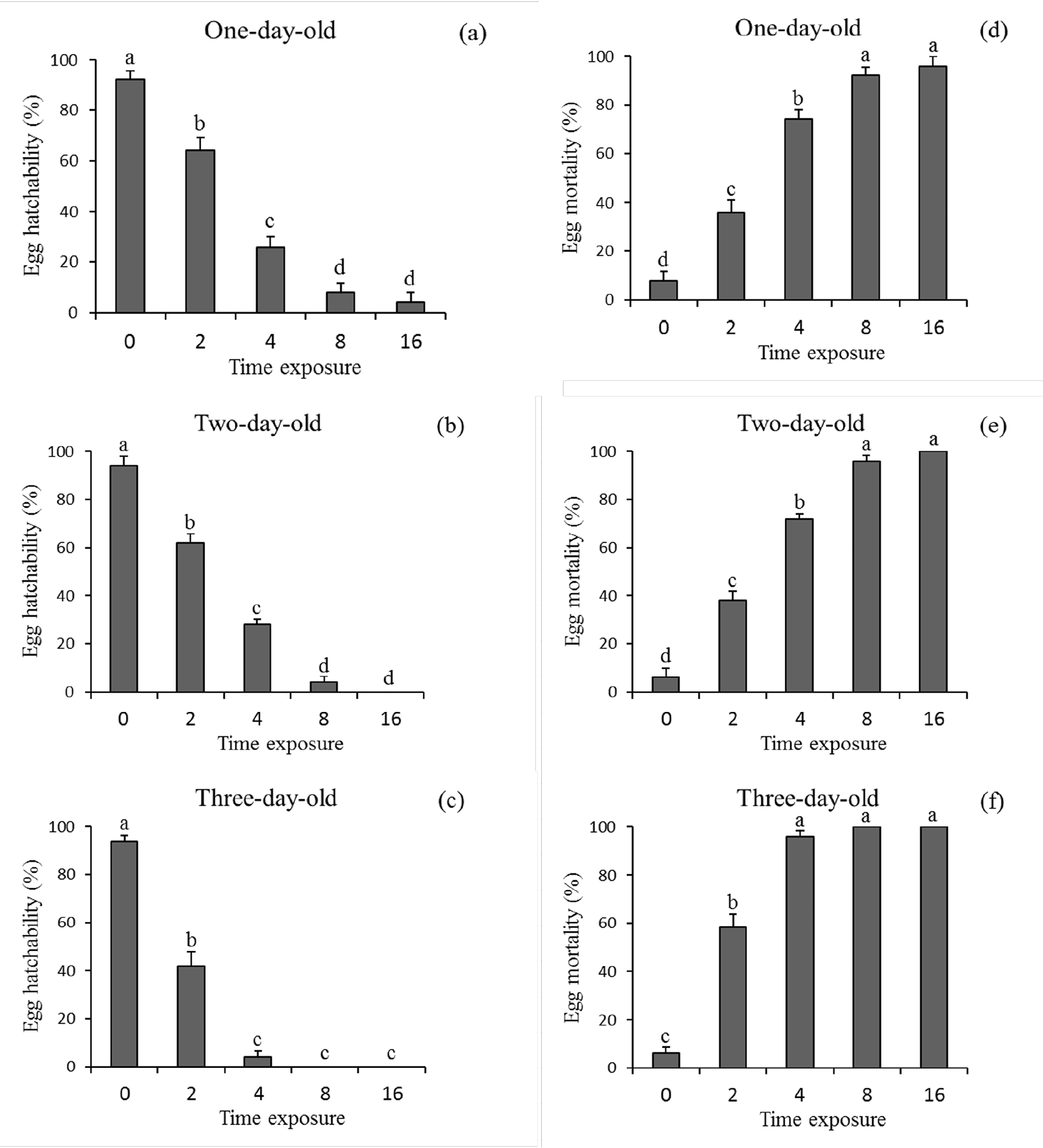
The results demonstrated that the duration of UV-C exposure significantly influenced the hatchability and mortality of T. castaneum eggs across all age groups. For one-day-old eggs, hatchability exhibited significant differences among exposure durations (F4,20 = 84.140, P < 0.01) (Figure 2a). An inverse relationship was observed between exposure duration and hatchability, with a drastic decline recorded at the 8-min mark. Specifically, the highest hatchability was observed in the control group (92.00%), decreasing to 64.00%, 26.00%, 8.00%, and 4.00% for 2, 4, 8, and 16 min of exposure, respectively. Conversely, mortality rates (Figure 2d) increased significantly with exposure time. Lowest mortality in the control (0 min) (8.00%), followed by 2 min (36.00%), 4 min (74.00%), 8 min (92.00%), and 16 min (96.00%).
Two-day-old eggs displayed similar significant trends (F4,20 = 200.350, P < 0.01) (Figure 2b). The decline in hatchability mirrored the pattern of one-day-old eggs: 94.00% in the control, falling to 62.00% (2 min), 28.00% (4 min), 4.00% (8 min), and 0.00% (16 min). The mortality of two-day-old eggs (Figure 2f) also showed an increase, in the control (0 min) (6.00%), followed by 2 min (38.00%), 4 min (72.00%), 8 min (96.00%), and 16 min (100.00%). Similar to the one-day-old eggs, exposure for 8 and 16 min did not differ significantly, with mortality nearly reaching 100%.
In three-day-old eggs, the reduction in hatchability was more rapid and pronounced (F4,20 = 181.957, P < 0.01) (Figure 2c). In three-day-old eggs the effect of reduced hatchability on increased exposure duration was observed more quickly and dramatically. A significant decrease was observed at a shorter duration compared to one and two-day-old eggs. A drastic reduction occurred at the 4-min interval, significantly earlier than in younger eggs. Hatchability plummeted from 94.00% (control) to 42.00% (2 min) and reached 0.00% at both 8 and 16 min. Similarly, the mortality of three-day-old eggs (Figure 2f) also showed a steeper increase compared to one- and two-day-old eggs at the same dose. Lowest mortality in the control (0 min) (6.00%), followed by 2 min (58.00%), 4 min (96.00%), and 8 min and 16 min (100.00%). Exposure for 4, 8, and 16 min did not differ significantly, with mortality nearly reaching 100% at 4 min and achieving completion (100.00%) at both 8 and 16 min.
Analysis shows that three-day-old eggs are notably more susceptible to UV-C radiation than one- and two-day-old eggs. In three-day-old eggs, hatchability decreased drastically to 4.00% (96.00% mortality) at 4 min of exposure and reached 0.00% (100.00% mortality) at 8 min. Meanwhile, in one- and two-day-old eggs exposed for 8 min, egg hatchability remained at 8.00% in one-day-old eggs and 4.00% in two-day-old eggs.
Probit analysis of LT50 and LT90
Probit analysis (Table 1) revealed that both LT50 and LT90 values decreased as the eggs aged, confirming that susceptibility to UV-C increases during embryonic development. One-day-old eggs were the most tolerant, with LT50 and LT90 values of 2.184 and 4.064 minutes, respectively. These values decreased to 2.166 and 3.685 minutes in two-day-old eggs. The highest susceptibility was recorded in three-day-old eggs, which exhibited the lowest lethal duration values (LT50 = 1.776 min; LT90 = 2.709 min).
Relative median potency analysis (RMP) of UV-C exposure between egg age groups
Table 2 presents the Relative Median Potency (RMP) values comparing the tolerance levels of T. castaneum eggs between age groups. At the LT50 level, one-day-old eggs were 0.9% more tolerant than two-day-old eggs and 18.7% more tolerant than three-day-old
Table 1: Probit analysis of LT₅₀ and LT₉₀ values of UV-C exposure on one-, two-, and three-day-old Tribolium castaneum eggs.
|
Age of egg (day(s)-old) |
LT50 |
LT90 |
Slope±SE |
χ2 |
df |
P-value |
||||
|
Estimate |
Lower bound |
Upper bound |
Estimate |
Lower bound |
Upper bound |
|||||
|
One |
2.184 |
1.957 |
2.405 |
4.064 |
3.699 |
4.773 |
4.752±0.495 |
21.965 |
23 |
0.522 |
|
Two |
2.166 |
1.959 |
2.366 |
3.685 |
3.314 |
4.244 |
5.550±0.581 |
18.800 |
23 |
0.713 |
|
Three |
1.776 |
1.610 |
1.937 |
2.709 |
2.454 |
3.089 |
6.984±0.792 |
10.200 |
23 |
0.990 |
Table 2: Relative median potency (RMP) of UV-C exposure at LT50 and LT90 levels among one-, two-, and three-day-old Tribolium castaneum eggs.
|
Comparison (day(s)-old) |
LT50 |
LT90 |
|||
|
RMP |
Interpretation |
RMP |
Interpretation |
||
|
Two vs one |
0.991 |
One day-old eggs were 0.9% more tolerant |
0.907 |
One day-old eggs were 9.3% more tolerant |
|
|
Three vs one |
0.813 |
One day-old eggs were 18.7% more tolerant |
0.667 |
One day-old eggs were 33.3% more tolerant |
|
|
Three vs two |
0.820 |
Two days-old eggs were 18% more tolerant |
0.735 |
Two days-old eggs were 26.5% more tolerant |
|
Table 3: Incubation period of one-, two-, and three-day-old Tribolium castaneum eggs exposed to different durations of UV-C radiation.
|
Time exposure (min) |
Age of egg (day(s)-old) |
F-value |
df |
P-value |
|||||
|
Onens |
Twons |
Threens |
|||||||
|
0ns |
4.76±0.09 |
4.55±0.79 |
4.53±0.14 |
1.214 |
2, 137 |
> 0.05 |
|||
|
2ns |
4.87±0.11 |
4.61±0.10 |
4.52±0.14 |
2.347 |
2, 81 |
> 0.05 |
|||
|
4ns |
4.84±0.15 |
4.78±0.18 |
5.50±0.50 |
1.108 |
2, 26 |
> 0.05 |
|||
|
8ns |
5.25±0.25 |
5.50±0.50 |
– |
1.582 |
1, 4 |
> 0.05 |
|||
|
16ns |
6.00±0.00 |
– |
– |
– |
– |
– |
|||
|
F-value |
2.202 |
2.151 |
1.107 |
||||||
|
df |
4, 92 |
3, 90 |
2, 67 |
||||||
|
P-value |
> 0.05 |
> 0.05 |
> 0.05 |
||||||
Values are presented as mean ± standard error (SE). ns indicates no significant differences in incubation period either among UV-C exposure durations within the same egg age and among egg ages at the same exposure duration (P > 0.05). Dashes (–) indicate no data due to 100% egg mortality.
eggs. This gap widened at the LT90 level, where one-day-old eggs were 9.3% and 33.3% more tolerant than two- and three-day-old eggs, respectively. These results underscore that egg age is a critical factor in UV-C efficacy.
Effect of UV-C exposure time on the incubation period of one-, two-, and three-day-old eggs
The duration of UV-C exposure did not significantly affect the incubation period of T. castaneum eggs across all tested age groups (P > 0.05; Table 3). For one-day-old eggs, the incubation period remained statistically similar among all exposure durations (F4,92 = 2.202, P > 0.05), ranging from 4.76 to 6.00 days. Similarly, no significant differences were observed in two-day-old eggs (F3,90 = 2.151, P > 0.05), with incubation periods ranging from 4.55 to 5.50 days. The 16-min exposure group could not be evaluated due to 100% egg mortality.
Table 4: Two-way ANOVA for the effects of egg age, UV-C exposure duration, and their interaction on Tribolium castaneum egg hatchability.
|
Source of variation |
df |
Mean square |
F-value |
P-value |
|
Egg age (A) |
2 |
876.000 |
15.279 |
< 0.001 |
|
Exposure duration (B) |
4 |
23188.000 |
404.442 |
< 0.001 |
|
Interaction (A × B) |
8 |
216.000 |
3.767 |
0.001 |
|
Error |
60 |
57.333 |
||
|
Total |
75 |
R 2 = 0.965 (adjusted R 2 = 0.957). Significant at P ≤ 0.05.
A similar non-significant trend was recorded in three-day-old eggs (F2,67 = 1.107, P > 0.05), where incubation periods for the groups that successfully hatched (0, 2, and 4 min) ranged closely from 4.52 to 5.50 days. For this age group, the 8 and 16 min exposures were not analyzed due to complete embryonic mortality. These findings demonstrate that while UV-C exposure is highly lethal to the embryos, it does not alter or prolong the incubation period of the surviving eggs.
Interaction analysis of egg age and UV-C exposure duration
A two-way ANOVA was conducted to evaluate the combined effects of egg age and UV-C exposure duration on hatchability (Table 4). The analysis showed a highly significant interaction between egg age and exposure duration (F8,60 = 3.767, P = 0.001). This indicates that the effect of UV-C radiation on suppressing egg hatchability varies significantly depending on the age of the eggs.
Additionally, both individual factors had a highly significant impact on hatchability, including egg age (F2,60 = 15.279, P < 0.001) and exposure duration (F4,60 = 404.442, P < 0.001). The model showed an excellent fit, explaining 96.5% of the total variation in hatchability (R² = 0.965). These results confirm that while younger eggs (one- and two-day-old) are more tolerant to UV-C, older eggs (three-day-old) are much more sensitive and experience a faster drop in hatchability.
Morphological changes in eggs due to UV-C exposure
Discussion
The results of this study demonstrate that UV-C radiation acts as a potent physiological disruptor for T. castaneum eggs, with its efficacy being highly dependent on both exposure duration and embryonic age. The dramatic decline in egg hatchability following increased exposure duration aligns with general response patterns observed in stored-product pests subjected to ultraviolet radiation ; ; . However, the remarkably high efficacy achieved in this experiment, where a mere 8-minute exposure induced complete egg mortality (0% hatchability) in three-day-old eggs. This finding highlights a critical window of embryonic vulnerability during the embryonic development of T. castaneum.
A key finding in this study is that older embryos (three-day-old) exhibit significantly higher susceptibility to UV-C radiation than younger ones (one- and two-day-old). This inverse tolerance pattern can be explained by the shifting dynamics of embryonic organization. In the early stages of development (one-day-old), embryonic cells are pluripotential and not yet specialized. Consequently, superficial damage localized to the egg periphery caused by shallow UV-C penetration does not inherently destroy the primary activation center, allowing uninjured cells to compensate for the damaged tissue . Conversely, as differentiation progresses in older eggs (three-day-old), the embryonic regions become progressively specialized, and different organ fields lose their capacity to replace each other. At this advanced stage, even shallow tissue disruption by UV-C rays is sufficient to compromise vital organogenesis, leading to fatal consequences and catastrophic developmental failure.
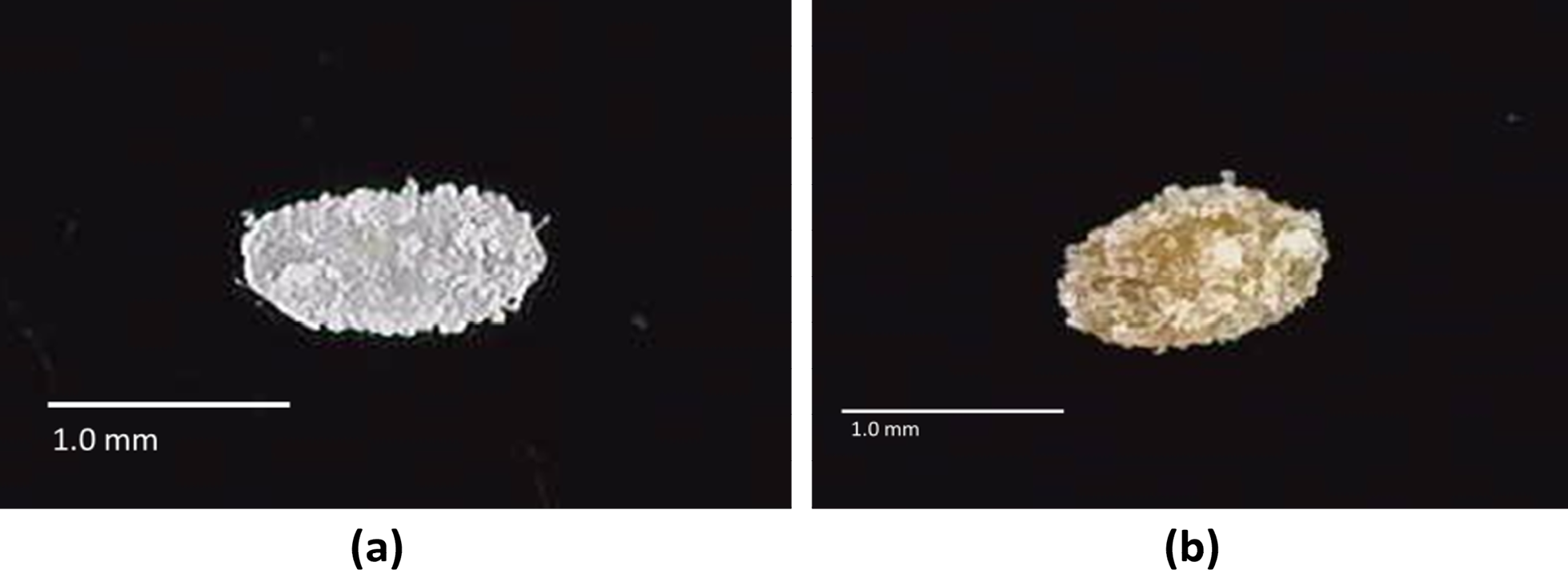
At the molecular level, this catastrophic developmental failure is driven by the specific photochemical properties of UV-C radiation. The absorption of UV-C photons by embryonic DNA induces a process called photodimerization, which binds adjacent pyrimidine bases (thymine or cytosine) on the same DNA strand, generating cyclobutane pyrimidine dimers (CPDs) . In rapidly dividing embryonic cells, these bulky lesions distort the DNA double-helix structure, effectively stalling DNA and RNA polymerases, and halting critical replication and transcription processes. The physical manifestation of this arrested development was clearly confirmed by our morphological observations (Figure 3), which showed a distinct transition from white/transparent control eggs to a brown or tanned coloration in irradiated eggs. This severe discoloration indicates chorion degradation and complete embryonic death rather than standard physiological tanning .
Interestingly, while UV-C radiation proved highly lethal to the embryos, it did not significantly alter the incubation period of the eggs that successfully hatched (Table 3). This statistical stability suggests that the surviving embryos were able to effectively repair the sublethal DNA damage caused by the radiation without experiencing a significant developmental delay. According to Khan et al. (2021), the cellular repair process for radiation-induced damage typically requires time, which can potentially slow down embryonic development. However, our statistical results (P > 0.05) indicate that for the eggs capable of hatching, the low-density damage was resolved efficiently enough to maintain a normal incubation duration, while severe genomic injuries led directly to complete embryonic death.
The high efficacy of UV-C radiation demonstrated in this study on the egg stage provides a crucial advantage for suppressing the overall population dynamics of T. castaneum. Suppressing the insect pest at its earliest life stage prevents subsequent larval emergence and pupal development, thereby breaking the pest’s reproductive cycle before quantitative grain damage can occur. This targeted approach is highly strategic, considering that other life stages of T. castaneum, including larvae, pupae, and adults, are also known to be highly susceptible to ultraviolet radiation treatments ; ; . By confirming that older eggs which are physically closer to hatching into destructive larvae are the most sensitive to UV-C exposure, our findings reinforce the practical value of applying physical radiation as an early-stage intervention tool.
Consequently, UV-C radiation offers a reliable, residue-free alternative to traditional chemical fumigants, directly addressing the modern challenges of insect resistance and environmental pollution in stored-product protection. The ability of short-duration UV-C exposure to achieve absolute lethality in embryos underscores its potential for seamless integration into physical sanitation and prevention protocols within grain warehouses or processing facilities. These findings strongly support the application of targeted UV-C radiation as a sustainable and effective component within integrated pest management (IPM) frameworks aimed at managing T. castaneum populations without compromising food safety.
Conclusions and Recommendations
In conclusion, this laboratory study demonstrates that UV-C radiation effectively suppresses egg hatchability of T. castaneum. Notably, embryonic susceptibility significantly increases with age; an 8-minute exposure reduced hatchability to 8.00% and 4.00% in one- and two-day-old eggs, respectively, while completely suppressing it to 0.00% in three-day-old eggs. Because these findings were obtained under controlled laboratory conditions, further validation under real warehouse scenarios is required to evaluate its practical efficacy as a physical control alternative.
Acknowledgements
We thank the Universitas Hasanuddin from the Penelitian Dosen Pemula Unhas (PDPU) Grant No. 01260/UN4.22/PT.01.03/2025 for financial support.
Novelty Statement
The novelty of this study lies in its comprehensive analysis of the effects of UV-C radiation on T. castaneum eggs based on egg age differences, integrating egg hatchability, mortality, LT50 and LT90 values, and relative median potency (RMP). The results show that the level of egg susceptibility is highly determined by embryo age, with older eggs exhibiting significantly higher sensitivity to UV-C exposure, thereby providing a quantitative basis for optimizing UV-C application at the most vulnerable embryonic stage.
Authors’ Contribution
Nuramaliya Nuramaliya: Conducted the experiments, analyzed the data, managed data curation, prepared the visualizations, and wrote the original draft as well as reviewed and edited the manuscript.
Husaifah Husaifah and Fauzan Fauzan: Participated in conducting the experiments and assisted in data collection.
Wardani Syahrani: Handled the project administration and contributed to the study design and research methodology.
Ravindra Chandra Joshi, Lekhnath Kafle, Ahwiyah Ekawaty Said, and Ito Fernando: Validated the research findings, reviewed, and edited the manuscript.
M. Bayu Mario: Provided guidance throughout the research process, contributed to the conceptualization and methodology, validation and analyzed the data, provided research resources, secured funding, supervised the study, prepared and edited the visualization, wrote, reviewed, and acted as the corresponding author.
All authors read and approved the final manuscript.
Generative AI and AI-assisted technology statement
The authors declare that no generative AI and AI assisted technology was used in the creation of this manuscript.
Conflict of interest
The authors declare that there is no conflict of interests regarding the publication of this article.
Figures
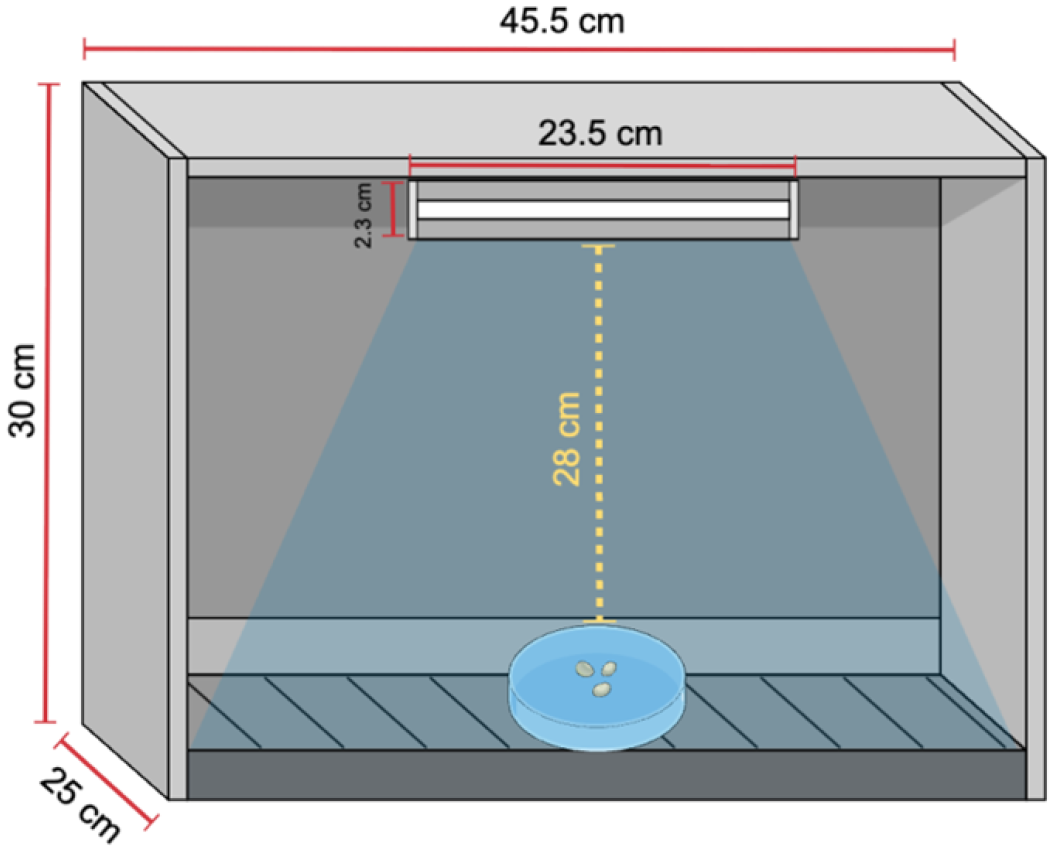
Illustration of a UV-C irradiation box
Percentage of egg hatchability and mortality of Tribolium castaneum at different durations of UV-C exposure. Hatchability is shown for (a) one-, (b) two-, and (c) three-day-old eggs, while mortality is shown for (d) one-, (e) two-, and (f) three-day-old eggs. Bars represent mean values, and error bars indicate standard error (SE).
Morphological changes in Tribolium castaneum eggs induced by UV-C radiation: (a) normal white/transparent egg in the control group, and (b) brown/tanned egg indicating embryonic failure in the UV-C exposed group.
References
- Astuti, L.P., R. Maula, A. Rizali and M.B. Mario. 2019. Effect of five types inert dust to Rhyzopertha dominica (Fabricius) (Coleoptera: Bostrichidae) in stored rice seeds. J. Exp. Life Sci., 9(3): 164–169. https://doi.org/10.21776/ub.jels.2019.009.03.04[CrossRef]
- Astuti, L.P. and M. Mutala’liah. 2020. Host preference of Tribolium castaneum (Herbst) on six kinds of flour. J. Entomol. Indones., 17(3): 149. https://doi.org/10.5994/jei.17.3.149[CrossRef]
- Badmus, H.A., A.A. Sorungbe, H. Ayinde Badmus and A.M. Sulaimon. 2016. Effect of ultraviolet irradiation on egg hatching of tropical warehouse moth (Ephestia cautella), development of its adult and mortality. Int. J. Res. Pharm. Biosci., 3(7): 23–29. https://www.researchgate.net/publication/356067977
- Badran, E.F., T.G. Abedelmaksoud, E.E.A. Elshazly and S.S. Ahmed. 2025. Impact of red flour beetle Tribolium castaneum (Herbst) (Coleoptera: Tenebrionidae) infestation on some quality characteristics of stored wheat flour. J. Plant Prot., 8(2): 173–179.
- Bakhshi, A., A. Asghar Talebi, Y. Fathipour and A. Mirshekar. 2020. Effects of UV radiation on egg hatching population growth and reproductive parameters of Indianmeal moth Plodia interpunctella (Hübner) (Lepidoptera: Pyralidae). Sumerianz J. Agric. Vet., 3(39): 130–142. https://doi.org/10.47752/sjav.39.130.142[CrossRef]
- Chidege, M.Y., P.B. Venkataramana and P.A. Ndakidemi. 2024. Enhancing food grains storage systems through insect pest detection and control measures for maize and beans: Ensuring food security post-COVID-19 Tanzania. Sustain., 16(5): 1767. https://doi.org/10.3390/su16051767[CrossRef]
- Cui, H., Y. Zeng, G.V.P. Reddy, F.G. Gao, Z. Li and Z. Zhao. 2021. UV radiation increases mortality and decreases the antioxidant activity in a tephritid fly. Food Energy Secur., 10(3): 1–8. https://doi.org/10.1002/fes3.297[CrossRef]
- Ehisianya, C., A.G. Stephen and B.N. Onunka. 2022. Development of Tribolium castaneum Herbst (Coleoptera: Tenebrionidae) and damage to selected flours in storage. Niger. Agric. J., 53(2): 193–198.
- Faruki, S.I., D.R. Das, A.R. Khan and M. Khatun. 2007. Effects of ultraviolet (254nm) irradiation on egg hatching and adult emergence of the flour beetles, Tribolium castaneum, T. confusum and the almond moth, Cadra cautella. J. Insect Sci., 7(1): 36. https://doi.org/10.1673/031.007.3601[CrossRef]
- Ghanem, I. and M. Shamma. 2007. Effect of non-ionizing radiation (UVC) on the development of Trogoderma granarium Everts. J. Stored Prod. Res., 43(4): 362–366. https://doi.org/10.1016/j.jspr.2006.09.002[CrossRef]
- Guerrero-Beltrán, J.A. and G.V. Barbosa-Cánovas. 2004. Review: Advantages and limitations on processing foods by UV light. Food Sci. Technol. Int., 10(3): 137–147. https://doi.org/10.1177/1082013204044359[CrossRef]
- Guru, P.N., D. Mridula, A.S. Dukare, B.M. Ghodki, A.U. Paschapur, I. Samal, M. Nikhil Raj, V.K. Padala, M. Rajashekhar and A.R.N.S. Subbanna. 2022. A comprehensive review on advances in storage pest management: Current scenario and future prospects. Front. Sustain. Food Syst., 6: 993341. https://doi.org/10.3389/fsufs.2022.993341[CrossRef]
- Hassan, M.I., M.S. Amer, K.M. Hammad, A. Gabarty and T.A. Selim. 2017. Latent effect of gamma irradiation on reproductive potential and ultrastructure of males’ testes of Culex pipiens (Diptera; Culicidae). J. Radiat. Res. Appl. Sci., 10(1): 44–52. https://doi.org/10.1016/j.jrras.2016.11.003[CrossRef]
- Keszthelyi, S., S. Gibicsar, A. Binder, K. Somfalvi-Tóth and F. Pál-Fám. 2024. Impact of UV-C irradiation on storage pests with different ecological functions and the viability of the treated grains. J. Plant Prot. Res., 64(4): 384–393. https://doi.org/10.24425/jppr.2024.152885[CrossRef]
- Khan, M., A. Ali, S.A. Memon, T.K. Qambrani, G. Khaliq, J. Khan, S. Ahmed, A.H. Abro and S.A. Baloch. 2021. Function of ultraviolet radiation (UV-B) light on the survival of red flour beetle Tribolium castaneum (Herbst) (Coleoptera: Tenebrionidae) and their body fitness. Pak. J. Agric. Res., 34(4): 748–757.
- Kumar, H., M. Panigrahi, S. Chhotaray, V. Bhanuprakash, R. Shandilya, A. Sonwane and B. Bhushan. 2018. Red flour beetle (Tribolium castaneum): From population genetics to functional genomics. Vet. World, 11(8): 1043–1046. https://doi.org/10.14202/vetworld.2018.1043-1046[CrossRef]
- Mahroof, R., B. Subramanyam and P. Flinn. 2005. Reproductive performance of Tribolium castaneum (Coleoptera: Tenebrionidae) exposed to the minimum heat treatment temperature as pupae and adults. J. Econ. Entomol., 98(2): 626–633. https://doi.org/10.1093/jee/98.2.626[CrossRef]
- Mario, M.B., L.P. Astuti, J.L. Hsu and L. Kafle. 2021. Fumigant activity of four plant powders against cowpea weevil, Callosobruchus maculatus (Fabricius) (Coleoptera: Chrysomelidae) in stored adzuki bean. Legume Res., 44(6): 667–672. https://doi.org/10.18805/LR-533[CrossRef]
- Mario, M.B., L.P. Astuti, J.L. Hsu, L. Kafle and I. Fernando. 2023. Bioefficacy of eight different plant powders applied as fumigants against the adzuki bean weevil, Callosobruchus chinensis. Crop Prot., 167: 106200. https://doi.org/10.1016/j.cropro.2023.106200[CrossRef]
- Mario, M.B., W.Y. Patasik, M.R.T. Tang, M. Muhammad, A. Rosyada, A.A. Jamal, Nurwahida, L. Kafle, S.A.M. Abdelgaleil, E.B. Brugman and I. Fernando. 2024. An overview of natural inert dust utilization against stored-product pests as part of integrated pest management. J. Trop. Life Sci., 14(1): 143–154. https://doi.org/10.11594/jtls.14.01.15[CrossRef]
- Mario, M.B., M.Taufik, M. Melina, R.C. Joshi, I. Anshar, P. Paridah, A. Komaini, L. Kafle, S.A.M. Abdelgaleil, E. Brugman and I. Fernando. 2025. Resistance of several Indonesian cereal grain cultivars to the maize weevil, Sitophilus zeamais (Motschulsky) (Coleoptera: Curculionidae). Crop Prot., 190: 107105. https://doi.org/10.1016/j.cropro.2024.107105[CrossRef]
- Mario, M.B., M. Taufik, A. Asra, A. Komaini, I. Anshar, P. Paridah and I. Fernando. 2026. Pairwise host preference of the maize weevil, Sitophilus zeamais among several Indonesian cereal grains. Crop Prot., 107737. https://doi.org/10.1016/j.cropro.2026.107737[CrossRef]
- Munawar, K., A.M. Alahmed and S.M.S. Khalil. 2021. Effects of ultraviolet radiation on Culex quinquefasciatus immature stages. Entomol. Res., 51(3): 111–117. https://doi.org/10.1111/1748-5967.12494[CrossRef]
- Nayak, M.K., G.J. Daglish, T.W. Phillips and P.R. Ebert. 2020. Resistance to the fumigant phosphine and its management in insect pests of stored products: A global perspective. Annu. Rev. Entomol., 65: 333–350. https://doi.org/10.1146/annurev-ento-011019-025047[CrossRef]
- Rastogi, R.P., Richa, A. Kumar, M.B. Tyagi and R.P. Sinha. 2010. Molecular mechanisms of ultraviolet radiation-induced DNA damage and repair. J. Nucleic Acid., 2010: 592980. https://doi.org/10.4061/2010/592980[CrossRef]
- Seidel, F., E. Bock and G. Krause. 1940. Die organisation des insekteneies. Naturwissenschaften., 28(28): 433–446.
- Sorungbe, A.A., H.A. Badmus and A.M. Sulaimon. 2016. Effect of ultraviolet irradiation on egg hatching of tropical warehouse moth (Ephestia cautella), development of its adult and mortality. Int. J. Pharma Bio Sci., 3(7): 23–27.
- Stathas, I.G., A.C. Sakellaridis, M. Papadelli, J. Kapolos, K. Papadimitriou and G.J. Stathas. 2023. The effects of insect infestation on stored agricultural products and the quality of food. Foods, 12(10): 2046. https://doi.org/10.3390/foods12102046[CrossRef]
- Syahrani, W., N. Fadilah, Nurzamran, N. Khalisah, I. Anshar, W.Y. Patasik, S.A.M. Abdelgaleil, L. Kafle and M.B. Mario. 2024. Effectiveness of bagasse and rice straw ashes against postharvest pest, Sitophilus zeamais on maize seed. BIO Web Conf., 96: 02004. https://doi.org/10.1051/bioconf/20249602004[CrossRef]
- Tchonkouang, R.D., A.R. Lima, A.C. Quintino, N.L. Cristofoli and M.C. Vieira. 2023. UV-C Light: A promising preservation technology for vegetable-based nonsolid food products. Foods, 12(17): 1–25. https://doi.org/10.3390/foods12173227[CrossRef]
- Trevisan, A., S. Piovesan, A. Leonardi, M. Bertocco, P. Nicolosi, M.G. Pelizzo and A. Angelini. 2006. Unusual high exposure to ultraviolet-C radiation. Photochem. Photobiol., 82(4): 1077–1079. https://doi.org/10.1562/2005-10-27-ra-728[CrossRef]
- Tudi, M., H. Daniel Ruan, L. Wang, J. Lyu, R. Sadler, D. Connell, R. Al-Mamun, R. Onakpa and D.T. Phung. 2021. Agriculture development, pesticide application and its impact on the environment. Int. J. Environ. Res. Public Health, 18(3): 1112. https://doi.org/10.3390/ijerph18031112[CrossRef]
- Tungjitwitayakul, J., T. Suppasat and N. Tatun. 2022. Adverse effects of UV-C irradiation on the morphology of reproductive organs, fecundity, and fertility of the red flour beetle, Tribolium castaneum herbst (Coleoptera; Tenebrionidae). Pol. J. Entomol., 91(2): 56–67. https://doi.org/10.5604/01.3001.0015.8555[CrossRef]
- Tungjitwitayakul, J., N. Suwannakhon and N. Tatun. 2024. The impact of UV-C radiation on the sugar metabolism of the red flour beetle Tribolium castaneum herbst (coleoptera; tenebrionidae). Int. J. Radiat. Biol., 100(2): 289–295. https://doi.org/10.1080/09553002.2023.2258199[CrossRef]
- Tungjitwitayakul, J., T. Yasanga and N. Tatun. 2019. UV-C radiation during the pupal stage affects morphological changes of wings in Tribolium castaneum (Col; Tenebrionidae). Int. J. Radiat. Biol., 95(9): 1309–1318. https://doi.org/10.1080/09553002.2019.1625492[CrossRef]
- Wu, Y., S. Miao, H. Sun, M. Wang, Y. Ren, L. Wang and Y. Lu. 2025. Impact of UV-C irradiation on the growth and antioxidant responses in Tribolium castaneum. J. Stored Prod. Res., 112: 102636. https://doi.org/10.1016/j.jspr.2025.102636[CrossRef]
- Zhao, S., C. Qiu, S. Xiong and X. Cheng. 2007. A thermal lethal model of rice weevils subjected to microwave irradiation. J. Stored Prod. Res., 43(4): 430–434. https://doi.org/10.1016/j.jspr.2006.12.005[CrossRef]
Services
Article usage statistics
Loading…