
Himalayan griffon (Gyps himalayensis) is one of the three Gyps species of vulture found in the state of Azad Jammu and Kashmir (AJ&K), Pakistan. The Himalayan griffon is a year-round resident in the mountainous areas of the Himalayas, Karakoram, and Hindu Kush ranges. This study presents the first population assessment of wintering Himalayan griffon in Poonch River Mahasheer National Park (PRMNP), AJ&K, Pakistan. Using a 20 km road transect survey, individuals were recorded during peak activity periods. The total number of individuals was calculated by combining observations across six colony sites, and GPS coordinates were used to map their spatial distribution within the park. Overall, 113 individuals were recorded with a mean group size of 19 vultures. These findings provide the first wintering population baseline for the Himalayan griffon in PRMNP and highlight the park’s importance for seasonal vulture conservation in northern Pakistan.
Short Communication · Volume 58, Issue 4, 25 June 2026 · Open Access
Status of the Himalayan Griffon (Gyps himalayensis) in Poonch River Mahasheer National Park, Azad Jammu and Kashmir, Pakistan
· · ·
Affiliations & Notes ⌄
- 1Environmental Science Program, Department of Biological and Environmental Sciences, College of Arts and Sciences, Doha, Qatar 2Snow Leopard Foundation, Islamabad, Pakistan 3Wildlife and Ecosystem Research Cell, Department of Zoology, University of Chitral, Chitral, Pakistan 4Institute of Biological Sciences, Faculty of Science, Universiti Malaya, 50603 Kuala Lumpur, Malaysia * Corresponding author: muntazirtanvi@gmail.com
Article Info ⌄
- Journal:
- Pakistan Journal of Zoology
- Published:
- 25 June 2026

From the article
- During the study period, a total of 113 Himalayan griffon individuals were recorded using the road transect method.
- In Pakistan, the Himalayan griffon breeds in the hilly areas of AJ&K and Khyber Pakhtunkhwa.
- The study area provides a good homing ground for the Himalayan griffon in the winter season.
- This study presents the first baseline assessment of the wintering population of Himalayan griffon in PRMNP, AJ&K, Pakistan.
Selected from the article's own text.
Abstract
Materials and methods
The present study was carried out in the PRMNP (33.555272ºN 73.915990ºE) and a one-km buffer area of the PRMNP (Fig. 1). The PRMNP is located in northern Pakistan , covering an area of approximately 4500 hectares, at an elevation of about 558 meters (m), and falls in two districts (Kotli and Poonch) of AJ&K. The whole stretch of the Poonch River and its tributaries was declared a conservation area primarily because of its two globally threatened fish species, the endangered Mahaseer (Tor putitora) and the critically endangered Kashmir catfish (Glyptothorax kashmirensis) ; . Other protected areas located in the near vicinity of the study area include Pir Lasura and Toli Peer National Parks.
The forest in the study area primarily consists of scrub and pine forest. The dominant plant species found in the area are represented by chir pine (Pinus roxburghii), red kamala (Mallotus philippensis), shisham (Dalbergia sissoo), and hopbush (Dodonaea viscosa). The PRMNP and its buffer area provide habitat to several threatened faunal species. The threatened mammalian species found in the area are represented by the common leopard (Panthera pardus) and the Indian pangolin (Manis crassicaudata). The threatened bird species in the area are defined by the white-rumped vulture (Gyps bengalensis), the Egyptian (Neophron percnopterus), the Himalayan griffon vulture, and the steppe eagle (Aquila nipalensis) (Hagler Bailly Pakistan, 2014).
Surveys were conducted in the study area from 20-28 December 2018. The surveys were conducted in winter because the Himalayan griffon visits this area only in winter and migrates back to the upper elevations (breeding ground) at the onset of summer. Twenty line transects were walked along the road at different points within the study area. Each transect was one km in length, and the minimum distance between two nearest transects was 2.42 km, while the maximum distance was 3.27 km. These distances were determined from GPS measurements during the present study, based on field accessibility and coverage considerations (see for a similar methodological rationale).
The team consisted of one observer and one driver. Observations were made from a vehicle, and the survey method caused minimal disturbance to the vultures . The vehicle was driven at a speed of 20-30 km/h within the study area. A binocular (Nikon 8x42 Binocular) was used to scan the surrounding area along the transect and to improve the detection accuracy. Observations at each site were made early in the morning (0800h-1100h) and in the evening (1500-1800 h), coinciding with peak vulture activity. Vultures observed on the ground, on cliffs, or in flight within 500 m on either side of the transect were identified and recorded . At each site, the GPS location and elevation were also documented. For data processing, the number of individuals recorded at each colony site (Table I) was counted and summed to obtain the total number of Himalayan griffons observed in the study area during the survey period. The GPS coordinates of each site were then used to plot their locations on a map of PRMNP (Fig. 1) to illustrate the spatial distribution of colonies within the park.
Table I. GPS coordinates of the Himalayan griffon colony locations.
| Site | Latitude | Longitude | Location | Elevation (m) | Count |
| 1 | 33.383869 | 73.799792 | Rajdhani | 705 | 8 |
| 2 | 33.413215 | 73.78967 | Degar | 640 | 29 |
| 3 | 33.422227 | 73.846087 | Downstream of Gulpur | 613 | 17 |
| 4 | 33.460996 | 73.852501 | Gulpur | 716 | 20 |
| 5 | 33.46237 | 73.885536 | Barali | 826 | 23 |
| 6 | 33.483858 | 73.878025 | Aghar Colony | 657 | 16 |
| Total | 113 | ||||
Results and discussion
During the study period, a total of 113 Himalayan griffon individuals were recorded using the road transect method. The location of observed individuals was recorded (Table I). Three species of vultures, i.e, white-rumped vulture, Egyptian vulture, and Himalayan griffon are found in the state of AJ&K. Of the 20 road transects surveyed, the Himalayan griffon was observed at six locations. The mean group size observed per transect was 19 vultures. In Pakistan, the Himalayan griffon breeds in the hilly areas of AJ&K and Khyber Pakhtunkhwa. These vultures are year-round residents in these areas; however make short-distance migration in summer and winter between high and low elevation areas ; .
In the study area, they are recorded in winter only. The species may gather in the areas of lower elevation during winter in order to scavenge on the available food, while at higher elevations, food supply becomes limited due to snow cover. Predators such as the common leopard, Asiatic jackal (Canis aureus), and grey wolf (Canis lupus) are also found in the study area. These predators prey on domestic and wild animals (Hagler Bailly Pakistan, 2014), which may in turn provide a food source for the vultures in the form of carcasses . In the summer season, they migrate to the hilly and elevated areas such as Neelum Valley (1500-2300 m) and Haveli (2000-2300 m), where they breed (Siddque and Khan, 2016). We observed the largest group at the Baralai area, consisting of 23 individuals, while the smallest group, comprising 8 individuals, was recorded at Rajdhani (Table I). Himalayan griffon is also found in the adjacent areas of Pir Lasura, Hattian, Haveli, and Neelum Valley in AJ&K (Siddque and Khan, 2016; . Zangi et al. (2019) reported the Himalayan griffon as the most abundant vulture species in Pir Lasura National Park, having a population size of 128, with a range of 7-20 individuals in a roost. Similarly, Siddique and Khan (2016) recorded 80 individuals in Hattian and Muzaffarabad districts. Despite the population decline recorded for the Himalayan griffon, the species has not received sufficient attention from researchers and conservationists .
The Himalayan griffon is a near-threatened vulture species. Population declines recorded for other Gyps vultures in the Indian subcontinent, resulting from NSAID drugs, have also been predicted to cause a decline in the population of the Himalayan griffon (Bird Life International, 2021). In other parts of AJ&K, a decline in their population has correlated with a decline in livestock herds . Since this is the first report on this species from the study area, it is difficult to comment on population growth and changes. However, it provides a baseline for future monitoring of its population.
The study area provides a good homing ground for the Himalayan griffon in the winter season. As a single-season survey, results are preliminary and may not capture inter-annual variability. This initial winter survey confirms PRMNP as an important seasonal habitat for the Himalayan griffon. Long-term monitoring is essential to assess population trends, understand seasonal habitat use, and inform region-specific conservation actions.
Conclusion
This study presents the first baseline assessment of the wintering population of Himalayan griffon in PRMNP, AJ&K, Pakistan. A total of 113 individuals were recorded across six colony sites using road transect surveys, confirming the presence of a seasonally significant population. These findings underscore the importance of PRMNP as a crucial winter habitat for the species, which descends from higher altitudes likely in response to seasonal food availability. Given the species’ Near Threatened status and the increasing threats from veterinary drug use, habitat alteration, and food scarcity, these preliminary results emphasize the need for long-term monitoring and conservation action.
Declarations
Acknowledgement
We acknowledge the financial and logistical support provided by Hagler Bailly Pakistan. We are thankful to the Azad Jammu and Kashmir Fisheries and Wildlife Department for permitting the study and for the cooperation from the management and field staff of PRMNP.
Funding
No funding was received for this study.
Generative AI and AI-assisted technology statement
No generative AI and AI-assisted tools were used in the preparation of this manuscript.
Statement of conflict of interest
The authors have declared no conflict of interest.
Figures
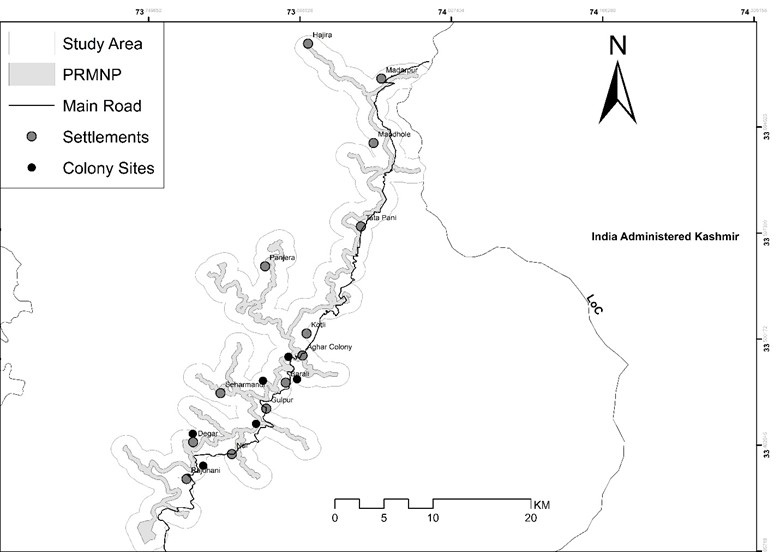
Map of PRMNP showing the six observed colony locations of Himalayan griffon during winter 2018.
References
- Acharya, R., Cuthbert, R., Baral, H.S. and Shah, K.B., 2009. Bird Conserv. Int., 19: 99-107. https://doi.org/10.1017/S0959270908007417[CrossRef]
- Ahmad, S., Bari, F., Kabir, M., Baig, M.A., Khan, T., Khattak, R.H. and Rehman, E.U., 2021. J. Raptor Res., 55: 99-105. https://doi.org/10.3356/0892-1016-55.1.99[CrossRef]
- Armstrong, S., 1993. New Scientist. https://www.newscientist.com/article/mg14018993-800-dining-with-vulture (Accessed 20 May 2025).
- Awan, M.S., Khan, A.A., Qureshi, M.A., Ahmed, K.B. and Murtaza, G., 2004. J. appl. Sci., 4: 250-256. https://doi.org/10.3923/jas.2004.250.256[CrossRef]
- Bhusal, K.P., Dangaura, H.L. and McClure, C.J., 2021. Environ. Chall., 5: 100318. https://doi.org/10.1016/j.envc.2021.100318[CrossRef]
- Bird Life International, 2021. Gyps himalayensis. The IUCN Red List of Threatened Species 2021. https://www.iucnredlist.org/species/22695215/204643889 (Accessed 11 May 2025)
- Brown, C., Zakaria, V., Joubert, A., Rafique, M., Murad, J., King, J., Hughes, J., Cardinale, P. and Alonzo, L., 2018. Sustain. Water Resour. Manag., 5: 1-18. https://doi.org/10.1007/s40899-018-0227-7[CrossRef]
- Cuthbert, R., Green, R.E., Ranade, S., Saravanan, S., Pain, D.J., Prakash, V. and Cunningham, A.A., 2006. Anim. Conserv., 9: 349-354. https://doi.org/10.1111/j.1469-1795.2006.00041.x[CrossRef]
- Ferguson-Lees, J. and Christie, D.A., 2001. Raptors of the world. Christopher Helm, London.
- Gilbert, M., Oaks, J.L., Virani, M.Z., Watson, R.T., Ahmed, S., Chaudhry, M.J.I., Arshad, M., Mahmood, S., Ali, A., Khattak, R.M. and Khan, A.A., 2004. In: Raptors worldwide: Proceedings of the VI World Conference on Birds of Prey and Owls (eds. R.D. Chancellor and B.-U. Meyburg). Budapest, Hungary, 18-23 May 2003. World Working Group on Birds of Prey and Owls, Berlin.
- Grimmett, R., Roberts, T.J. and Inskipp, T., 2008. Birds of Pakistan. Yale University Press, New Haven, Connecticut, United States.
- Hagler Bailly Pakistan, 2014. Environmental and social impact assessment of gulpur hydropower project. Final Report. https://www.adb.org/projects/documents/pakistan-47929-001-1 (Accessed 11 May 2025)
- Kabir, M., Shamas, U., Ahmad, S. and Awan, M.N., 2019. Vulture News., pp. 55-61. https://doi.org/10.4314/vulnew.v77i1.2[CrossRef]
- Kumar, A., Sinha, A. and Kanaujia, A., 2017. Vulture News, pp. 11-17. https://doi.org/10.4314/vulnew.v73i1.2[CrossRef]
- Operation Migration Team, 2021. Himalayan Vulture: The ultimate guide. https://operationmigration.org/himalayan-vulture-the-ultimate-guide/ (Accessed 11 Aug 2025)
- Prakash, V., Galligan, T.H., Chakraborty, S.S., Dave, R., Kulkarni, M.D., Prakash, N., Shringarpure, R. N., Ranade, S.P. and Green, R.E., 2017. Bird Conserv. Int., 29: 55-70. https://doi.org/10.1017/S0959270917000545[CrossRef]
- Praveen, J., Nameer, P.O., Karuthedathu, D., Ramaiah, C., Balakrishnan, B., Rao, K. M., Shurpali, S., Puttaswamaiah, R. and Tavcar, I., 2014. Indian Birds, 9: 19-22.
- Roberts, T.J., 1991. The birds of Pakistan. Volume I: Non-Passeriformes. Oxford University Press, Karachi. Pakistan.
- Siddique, M. and Khan, A.A., 2016. Pakistan J. Zool., 48: 961-968.
- Swan, G.E., Cuthbert, R., Quevedo, M., Green, R.E., Pain, D.J., Bartels, P., Cunningham, A.A., Duncan, N., Meharg, A.A., Oaks, J.L., Parry-Jones, J., Shultz, S., Taggart, M.A., Verdoorn, G. and Volter, K., 2006. Biol. Lett., 2: 279-282. https://doi.org/10.1098/rsbl.2005.0425[CrossRef]
- Wang, W., Gao, X., Zheng, S., Lancuo, Z., Li, Y., Zhu, L., Hou, J., Hai, J., Long, X., Chen, H., Druzyaka, A. and Sharshov, K., 2021. Avian Res., 12: 52. https://doi.org/10.1186/s40657-021-00287-0[CrossRef]
- Waseem, A., 2022. Assessing the distribution status, habitat use and breeding ecology of Himalayan griffon (Gyps himalayensis) in Aharbal-Kausarnag catchment and Hirpora Wildlife Sanctuary, Shopian, Kashmir. PhD thesis, Sher-e-Kashmir University of Agricultural Sciences and Technology of Kashmir, India.
- Zangi, I.U.D., Mahmood, T., Akrim, F. and Nadeem, M.S., 2019. J. Raptor Res., 53: 164-171. https://doi.org/10.3356/JRR-18-18[CrossRef]
Services
Article usage statistics
Loading…