Research Article · Volume 35, Issue 1, 30 April 2020 · Open Access
Spatio-temporal Diversity of Dung Beetles in Selected Locales of Sialkot, Punjab, Pakistan
· · · · ·
Affiliations & Notes ⌄
1Department of Zoology, Faculty of Science, University of Gujrat, Punjab, Pakistan 2Government College Women University, Sialkot, Punjab, Pakistan , Correspondence Author: Mubashar Hussain, dr.mubashar@uog.edu.pk
Results indicated that dung beetle assemblages in the selected locales of Sialkot during May-September, 2016 have shown the association of diversity (species richness, dominance and evenness) mainly with the grazing opportunities for the cattle and availability of cattle dung.
Paracoprid were dominant species with variations in the abundance.
Spatiotemporal distribution indicated that dung beetle assemblages varies greatly during different months within the season.
The results emphasize on the detailed surveys and studies on the introduction of dung beetle species in agricultural landscapes with respect to functional guilds and climatic variations.
Selected from the article's own text.
Abstract
Dung beetles play significant role in the ecosystems by nutrient recycling and waste removal. The study was conducted to explore the distributional patterns of dung beetle assemblages on local scales. The sampling was accomplished by surveying grassy fields, croplands, old dung piles and fresh dung pats from selected localesofSialkot during 2016. Specimens were collected by hand picking and cattle dung baited pitfall traps. Sixteen species representing three guilds i.e. Paracoprid (10 species), Endocoprid (4 species) and Telecoprid (02 species) were recorded. Onitis excavatus (27.68 %)and Onitis crassus (9.59 %)showed maximum relative abundance whereas Helocopris bucephalus (0.15 %) and Onthophagus bonasus (0.15 %)were the least abundant species. A. contaminatus, A. fossor and C. indicus were recorded only in August and September whereas C. pithecius and C. platypus were noted in September only. O. gazella were recorded inJuly, August and September, however, O. castaneous and O. bonasus were not recorded in the month of May, June and August. Maximum abundance was recorded in Mundeke whereas the least abundant site was Malkhanwala. O. excavatus and O. crassus were dominated in the dung pats whereas G. bicallosus was most abundant in cropland areas. Shannon-Wiener diversity index values calculated from different sites indicated variations in species richness (H= 1.72-2.14) and evenness (e^= 0.65-0.85). Similar trend in the values of other diversity indices were observed that indicated better richness and evenness of species. The diversity reported from the Sialkot emphasizes on detailed surveys with respect to feeding guilds, availability of vegetation types and dung preferences need to be explored.
Novelty Statement | The research reported the spatio-temporal diversity of dung beetle assemblages from Sialkot and highlighted the significance of dung beetles in agricultural landscapes as indicator of habitat change.
Introduction
Insects (Arthropoda: Insecta) are the largest and most diverse group within the animal kingdom. Pollinators, predators, parasitoids, herbivores, and decomposers are the most commonly studied functional groups, while Hymenoptera, Coleoptera, and Diptera are the most studied taxa . Coleoptera contributes significantly in the ecosystem services i.e. pollinators, predators and decomposers. Dung beetles (Coleoptera: Scarabaeidae) are involved in decomposition of dung pats . The dung beetle fauna has been studied for ecosystem functioning, as indicators of anthropogenic disturbances and global change (Nichols et al., 2008; . Families of beetles associated with dung decomposition include Hydrophilidae, Histeridae, Staphylinidae, and Scarabaeidae and Geotrupidae. Hybosoridae and Trogidae have also been found more generally associated with the decomposition of carrion and cadavers to occur at dung . Nutrient recycling, soil turnover and seed dispersal are important ecological functions for ecosystem regulation ; . Dung beetles with over 7000 species have worldwide distribution ; . Habitat loss, scarcity of food, cropping patterns, and agricultural practices are major causes of declining trend in dung beetle fauna ; . Environmental degradation has resulted in the changes in the spatio-temporal assemblages of species and may lead to possible local extinctions ; ; ; ; . Diversity and distribution of Dung beetle fauna reported from different parts of Pakistan include eleven species of the genus Onthophagus from Pakistan, fourteen species from Pothohar plateau during 2010-11 , fifty species from Azad Kashmir and Sindh province , eighteen species from Gujrat, Bhimber, Mirpur and Kotli and twenty five species from different locales of district Sialkot during 2014-15 and fifteen species during 2015-2016 were recorded from Jhelum .
To create opportunities for the conservation of dung beetles, we need to improve our understanding of patterns of species diversity under different land-use practices and environmental pressures. This would provide opportunity to use these species assemblages as ecological indicators. The abundance of such species serve as a gauge to measure and interpret environmental change . Thus, extensive work on the diversity and distribution of dung beetles from different habitats of Pakistan need to be conducted. This study was undertaken to explore the diversity, distribution, community structure and relative abundance of dung beetles from selected locales of Sialkot.
Materials and Methods
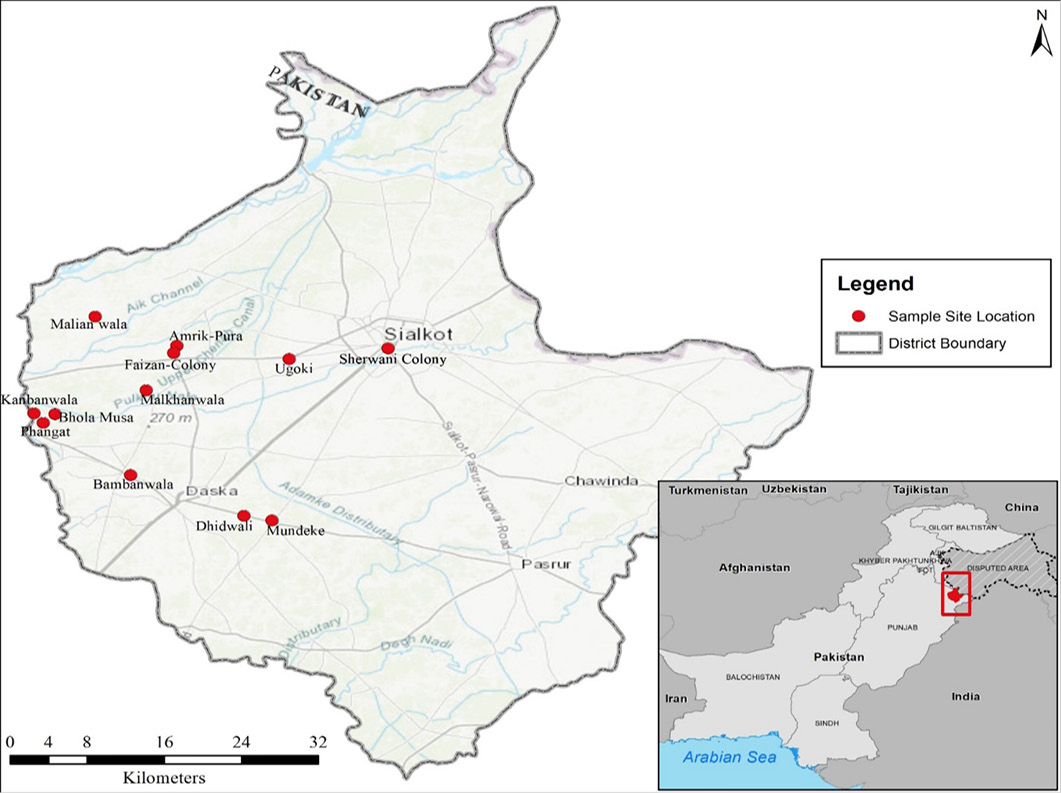
The spatio-temporal diversity and distribution of dung beetle fauna was assessed during 2015-2016 from selected locales of Sialkot, Punjab, Pakistan (Figure 1).
Study area
Sialkot (32°29′33″ N, 74°31′52″ E), a district of the Punjab province situated at its north-east with hot and humid summer and cold winter . Sampling of dung beetles was carried out from the selected locales i.e. Malianwala, Kanbanwala, Ugoki, Dhidwali, Bambanwala, Phangat, Bhola Musa, Malkhanwala, Amrik-Pura, Faizan-Colony, Sherwani-Colony, and Mundeke.
Sampling methods
Sampling was accomplished by collecting dung pats and dung heaps randomly at an interval of two weeks. Fresh cattle dung was collected in a bucket with lid. We also used pitfall traps baited with cattle dung to collect dung beetles. Pitfall traps were placed at interval of 150 m in a 500 m transect . At each site, four traps were placed at an equal distance of 50 m from the center of the square whereas fifth one was placed in the center and traps were left out for 72 hrs . Collection of beetles was carried out by homogenized method: dung pats and traps were drained into the bucket containing water and stirred with the stick. Dung beetles floated on the surface of homogenized mixture .
Killing and preservation of specimens
After collection specimens were preserved in 4% formalin and stored in small vials with proper labelling . Identification of specimens upto species level was accomplished by using identification keys ; ; , .
Data analysis
Relative abundance of species was calculated to compare the abundance of beetle fauna. Shannon- Wiener, Berger–Parker, and alpha diversity indices were calculated by analyzing the data collected from pitfall traps . Shannon-Wiener index (H′) measures the species diversity within the community of an ecosystem . The lowest value is zero (if only one species) and maximum when all species of the sample in consideration have even abundances .
Results and Discussion
Spatial distribution
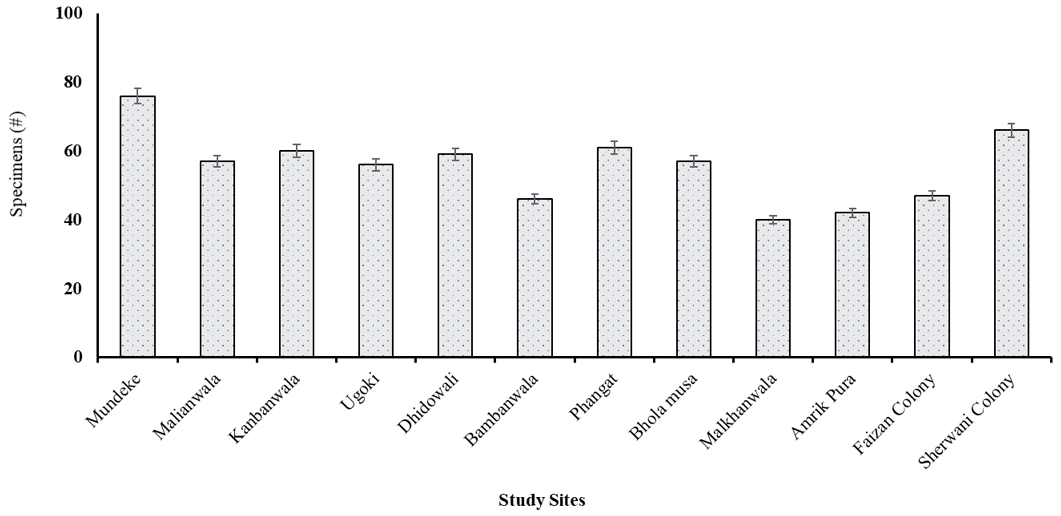
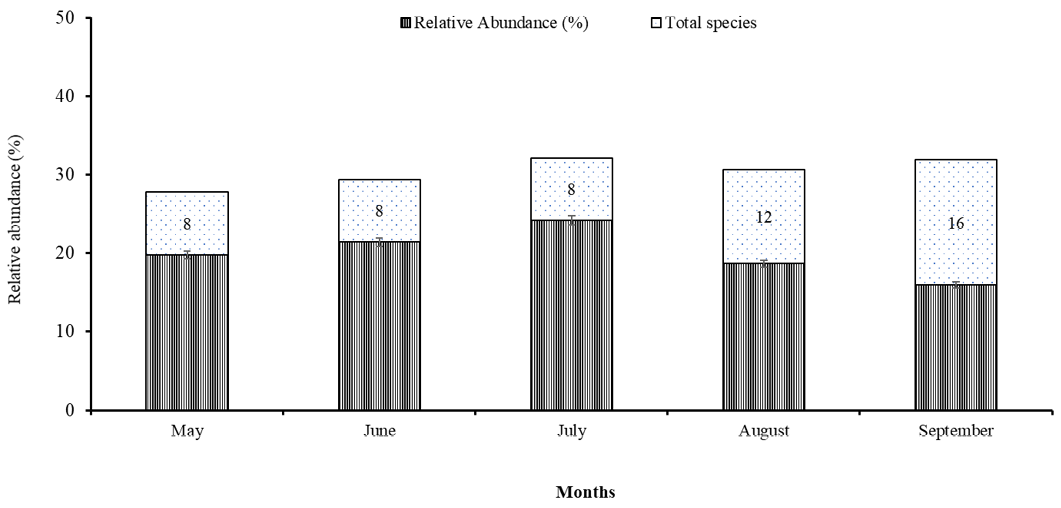
Maximum abundance was recorded in Mundeke whereas the least abundant site was Malkhanwala (Figure 2). O. excavatus and O. crassus were dominant in the pastures whereas G. bicallosus was most abundant in cropland areas. O. singhalensis and O. cinctus were the most common in roadside old dung piles. O. gazella and O. subopacus showed the higher abundance in grassy fields. O. excavatus was recorded from all sites and was the most abundant species (Figure 3).
Species diversity
Data recorded from the study area indicated the presence of 16 species belonging to eight genera, six tribes and two subfamilies (Scarabaeinae and Aphodinae) of the family Scarabaeidae.
Results indicated variations in the relative abundance of species in different tribes i.e. Onitini (59.97 %), Aphodiini (12.89 %), Gymnopleurini (11.24 %) Oniticellini (7.80 %) and Coprini (0.75 %). Onitis (56.22 %) represented by five species was the most abundant genus followed by Aphodius (12.89 %) and Onthophagus (7.35 %) showed significantly higher abundance as compared to other genera. The relative abundance of species showed that O. excavatus (27.29 %), G. bicallosus (11.24 %) and O. crassus (9.60 %) were the most abundant species whereas O. bonasus (0.15 %) and H. bucephalus (0.15 %) were the least abundant species (Table 1).
Guild wise abundance
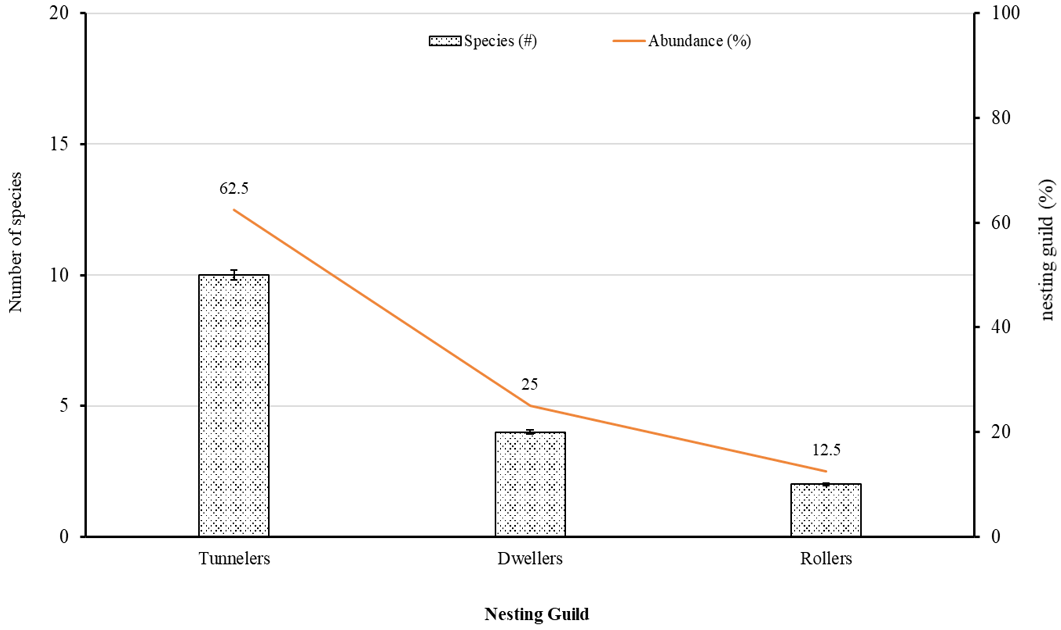
The specimens studied were divided into three functional associations. Out of sixteen species, 10 species were tunnelers (Paracoprid), 4 species were dwellers (Endocoprid) and 02 species were rollers (Telecoprid). Tunnelers were the leading group representing 62.5 % of the species composition on the basis of functional guild. Dwellers shared about 25 % of the recorded guilds whereas rollers were represented by only 12.5 % of the species recorded from all guilds (Figure 4).
Temporal distribution of dung beetles
A. contaminatus, A. fossor and C. indicus were recorded only in August and September whereas C. pithecius and C. platypus were noted in September only. O. gazella were recorded in July, August and September, however, O. castaneous and O. bonasus were not recorded in the month of May, June and August. O. excavatus, O. cinctus, G. bicallosus, O. singhalensis and O. crassus were recorded during May and June 2016 (Table 3).
Species richness and abundance
We calculated the diversity indices for different sites which showed variations in taxa and values of various indices at different sites. Data recorded from different sites showed moderate to high species dominance (Simpson’s indexes between 0.77-0.86). Similarly, variations in the species richness (H: 1.712-2.14), evenness (e: 0.65-0.85), dominance (1-D: 0.77-0.89), Menhinick (0.97-1.76) and Margalef index (1.51-2.73) were recorded from different sites (Table 2).
Discussion
There is dire need to protect and conserve species in the changing land type use, human interventions and the climate change. Biodiversity conservation practices in the changing world demands conserving native biota of a given region . Our study attempts to understand variations in the population structure of
Table 1: Dung beetles (Scarabaeidae; Scarabaeinae) recorded from Sialkot, Punjab, Pakistan during 2016.
Family
Subfamily
Tribe
Genus
Species
Relative Abunda-nce (No.)
Relative Abund-ance (%)
Scarabaeidae
Aphodiinae
Aphodiini
Aphodius
A. fossor
46
06.90
A. contaminatus
40
06.00
Scarabaeinae
Coprini
Catharsius
C. platypus
02
00.30
C. pithecius
02
00.30
Helocopris
H. bucephalus
01
00.15
Gymnopleurini
Gymnopleurus
G. bicallosus
75
11.24
Oniticellini
Oniticellus
O. cinctus
52
07.80
Onitini
Onitis
O. excavatus
182
27.29
O. crassus
64
09.60
O. singhalensis
52
07.80
O. subopacus
40
06.00
O. castaneous
37
05.55
O. bonasus
01
00.14
Cheironitis
C. indicus
25
03.75
Onthophagini
Onthophagus
O. gazella
39
05.85
O. catta
09
01.35
Total
667
100
Table 2: Species diversity dominance, evenness recorded from different sites during 2016.
Mun-deke
Malia-nwala
Kanb-anwala
Ug-oki
Dhid-owali
Bamb-anwala
Pha-ngat
Bhola musa
Malkh-anwala
Amrik Pura
Faizan Colony
Sherwani Colony
Taxa_S
10
10
9
10
10
10
10
9
9
9
11
7
Indivi-duals
67
54
58
53
55
43
56
45
32
38
39
52
Domin-ance _D
0.133
0.1502
0.1314
0.20
0.21
0.1682
0.17
0.2
0.1523
0.2133
0.1308
0.2293
Simp-son _1-D
0.867
0.8498
0.8686
0.79
0.78
0.8318
0.82
0.8
0.8477
0.7867
0.8692
0.7707
Shann-on _H
2.146
2.07
2.088
1.92
1.87
2.014
2.00
1.895
2.038
1.857
2.186
1.712
Evenn-ess _e^H/S
0.8553
0.7926
0.897
0.68
0.65
0.7495
0.73
0.7391
0.8528
0.7115
0.8087
0.7914
Brillo-uin
1.922
1.816
1.861
1.67
1.64
1.722
1.75
1.636
1.697
1.57
1.841
1.521
Menhi-nick
1.222
1.361
1.182
1.37
1.34
1.525
1.33
1.342
1.591
1.46
1.761
0.9707
Marga-lef
2.14
2.256
1.97
2.26
2.24
2.393
2.23
2.102
2.308
2.199
2.73
1.519
Equita-bility _J
0.9321
0.8991
0.9505
0.83
0.81
0.8748
0.86
0.8624
0.9275
0.8451
0.9114
0.8798
Fisher_ alpha
3.255
3.61
2.982
3.64
3.57
4.094
3.54
3.383
4.163
3.725
5.099
2.178
Berger- Parker
0.2239
0.2593
0.1897
0.37
0.4
0.3023
0.32
0.3778
0.2813
0.3947
0.2051
0.4038
dung beetles in sub-agricultural landscapes. Our study has great significance considering that the dung beetles were included on the Red List of Threatened Species and information on the status and tendency of populations of 80 percent of the species in this list is unknown .
The species reported in our study belonged to subfamilies Scarabaeinae and Aphodiinae. Genus Aphodius has been reported from the croplands with relatively higher abundance at different sites. Earlier studies noted that Scarabaeinae was dominant subfamily recorded from all habitats with Aphodius as most abundant species . We collected majority of the beetles during the warmer months (May-September). In an earlier study conducted during (May-September), the variations in the dung beetle distribution has been associated with the temperature . Results indicated that dung beetle assemblages in the selected locales of Sialkot during May-September, 2016 have shown the association of diversity (species richness, dominance and evenness) mainly with the grazing opportunities for the cattle and availability of cattle dung. Similar observations were recorded in an earlier study concluding that the biodiversity mainly depends upon richness of vegetation . Similar results were reported previously
Table 3: Monthwise species distribution at different sites of district Sialkot during 2016.
Mo-nths
Mun-deke
Malia-nwala
Kanb-anwala
Ug-oki
Dhid-owali
Bamb-anwala
Pha-ngat
Bhola musa
Malkh-anwala
Amrik Pura
Faizan Colony
Sher-wani Colony
A. contam-inatus
Aug
✓
✓
✓
✓
x
x
x
x
✓
✓
✓
✓
Sep
✓
✓
✓
✓
✓
x
x
x
x
✓
✓
✓
A. fossor
Aug
✓
✓
✓
✓
✓
✓
x
x
✓
✓
✓
x
Sep
✓
✓
✓
✓
✓
✓
✓
x
x
x
x
x
C. pithe-cius
Sep
x
x
x
x
x
x
x
✓
x
x
✓
x
C. platy-pus
Sep
x
✓
x
x
x
x
x
x
x
x
x
x
C. indi-cus
Aug
x
✓
✓
x
x
✓
✓
x
x
x
x
x
Sep
✓
✓
✓
✓
✓
✓
✓
x
x
x
x
x
G. bical-losus
May
✓
✓
✓
✓
✓
✓
x
x
x
x
x
x
June
✓
✓
✓
x
✓
✓
x
✓
✓
✓
✓
✓
July
✓
✓
x
✓
x
x
✓
✓
✓
x
x
✓
Aug
✓
✓
✓
x
✓
✓
✓
x
x
x
x
x
Sep
x
x
x
x
x
✓
x
x
x
x
x
x
O. cin-ctus
May
✓
✓
x
x
✓
x
✓
✓
x
x
x
✓
June
✓
x
✓
✓
x
x
x
✓
✓
x
✓
x
July
✓
x
x
x
x
✓
✓
x
✓
✓
x
x
Aug
✓
x
x
x
x
x
x
✓
✓
✓
✓
✓
Sep
✓
✓
✓
✓
✓
x
x
✓
✓
✓
✓
✓
O. casta-neous
July
✓
✓
✓
✓
✓
✓
✓
✓
✓
x
✓
✓
Aug
✓
✓
x
x
✓
✓
✓
✓
x
✓
✓
✓
Sep
✓
x
x
x
x
x
x
✓
✓
x
x
✓
O. cras-sus
May
✓
✓
✓
✓
✓
x
✓
✓
✓
x
x
x
June
✓
✓
✓
✓
✓
✓
x
x
x
x
x
x
July
✓
✓
✓
x
✓
✓
✓
✓
x
x
x
x
Aug
✓
✓
✓
✓
x
x
x
x
✓
✓
✓
✓
Sep
x
x
✓
✓
✓
x
x
x
x
✓
✓
✓
O. exca-vatus
May
✓
✓
✓
x
✓
✓
✓
✓
✓
✓
x
x
June
✓
x
✓
✓
✓
✓
✓
✓
✓
✓
✓
✓
July
✓
✓
✓
✓
✓
✓
✓
x
✓
x
✓
✓
Aug
✓
✓
✓
✓
✓
✓
✓
✓
✓
✓
✓
✓
Sep
✓
✓
x
✓
✓
✓
✓
✓
x
✓
✓
✓
O. singha-lensis
May
✓
✓
✓
x
x
✓
✓
x
x
✓
✓
✓
June
x
x
✓
✓
x
x
✓
✓
x
✓
✓
✓
July
✓
x
x
x
✓
✓
✓
✓
✓
✓
✓
✓
Aug
x
x
✓
✓
✓
✓
✓
x
x
✓
x
x
Sep
x
x
x
x
x
x
✓
✓
x
x
x
x
O. subo-pacus
July
✓
✓
x
x
x
✓
✓
✓
✓
x
✓
✓
Aug
✓
x
x
✓
✓
✓
✓
✓
✓
✓
x
x
Sep
x
x
x
x
x
x
x
✓
✓
✓
✓
✓
O. bon-asus
Sep
x
x
x
x
x
x
x
x
x
x
✓
x
O. catta
Aug
x
x
x
x
x
x
✓
x
✓
x
x
x
Sep
x
x
x
x
x
x
✓
✓
x
x
x
x
O. ga-zella
July
✓
✓
✓
x
x
x
x
✓
✓
✓
x
✓
Aug
✓
✓
✓
✓
✓
✓
x
x
x
x
x
✓
Sep
✓
✓
✓
✓
x
x
x
✓
✓
✓
✓
✓
which documented dung beetle faunal status and factors responsible for variations in the population dynamics include vegetation and cattle dung ; ; . We recorded overall trend of decrease in species dominance, richness and abundance at sites where anthropogenic activities were more pronounced than others i.e. Malkhanwala, Amrik Pura and Faizan Colony. At these sites, more anthropogenic interventions were observed as compared to other sites. Dung beetle communities are closely associated with habitats characteristics and variations in the environmental conditions alters species structure. It was observed that animals were restricted in yards and movement of cattle was not frequent at these sites. Type of soil with variable moisture may have also influenced in the activity of beetles. Similarly, effect of other abiotic factors in addition to abundance of mammals may explain the variations in species structure and abundance .
The different indices applied on the data suggested that variations in dung beetle assemblages at different sites existed. These values of diversity indices reflected that local variations in the vegetation cover and associated cattle resulted in the pattern of distribution of communities. Shannon-Wiener diversity index considers both the richness and evenness of species. Whereas evenness is a measure of the relative abundance of different species making up the richness of an area and expresses evenly distribution of the individuals among different species . Referring to Magurran (1988), different diversity indices have advantages and disadvantages i.e. Margalef index also had a good discriminant ability but weighted towards species richness whereas Shannon–Wiener index was influenced more by richness and less by evenness than Simpson index which heavily weighted towards the most abundant species in the sample . The Berger–Parker index showed the almost same character of advantages and disadvantages , 2004). The Barger-Parker and Simpson’s dominance indices and Margalef’s diversity index showed little variations in the species diversity of the dung beetle fauna which may be attributed to the similarity in the vegetation type and quality of environment. In other guild structure studies, demonstrated that tunnelers dominated over dwellers and rollers in selected habitat ; . The abundance of tunnelers in the area may be associated with the availability fresh dung pats of grazing animals. Herbivore dung and clay loam soil type . Conservation through protected areas deems significantly important strategy but not grossly adequate . The conservation strategies to be developed and implemented successfully, scientists need to know how different the impact anthropogenic activities on native biota and associated ecological and evolutionary processes ; .
Conclusion
The study was undertaken to explore the diversity of dung beetles in the agriculture dominated rural landscapes. Sixteen species belonging to different feeding guilds were recorded. Paracoprid were dominant species with variations in the abundance. Onitis, Aphodius and Onthophagus were the most dominant genera whereas O. excavatus and O. crassus were the dominant species. Spatiotemporal distribution indicated that dung beetle assemblages varies greatly during different months within the season. Pastures with frequent cattle movement and low anthropogenic activities inhabit greater diversity and abundance as compared to farmlands with intensive agriculture. The results emphasize on the detailed surveys and studies on the introduction of dung beetle species in agricultural landscapes with respect to functional guilds and climatic variations.
Conflict of interest
The authors declare that there are no potential conflicts of interest associated with this research.
Figures
Figure 1:.
Sampling sites selected in the District Sialkot, Punjab Pakistan.
Figure 2:.
Number of specimens recorded from different sites of Sialkot during 2016.
Figure 3:.
Relative abundance (%) of the most abundant species (O. excavatus) during different months from the study sites sampled during 2016.
Figure 4:.
Number of species based on nesting guild and relative abundance (%) of tunnelers, dwellers and rollers recorded from different sites.
References
Ali, S.M.S., Naeem, M., Baig, F., Shahzad, A. and Zia, A., 2015. New records, distributional notes and species diversity of dung beetles (Coleoptera: Scarabaeidae: Scarabaeinae) from Pothohar Plateau of Punjab, Pakistan. J. Entomol. Zool. Stud., 3: 01-06.
Arellano, L., León-Cortés, J.L. and Halffter, G., 2008. Response of dung beetle assemblages to landscape structure in remnant natural and modified habitats in southern Mexico. Insect Conserv. Divers., 1, 253-262. https://doi.org/10.1111/j.1752-4598.2008.00033.x[CrossRef]
Arrow, G., 1931. The Fauna of British India III, Coprinae. Taylor and Francis, London.
Aslam, M., 2009. Diversity, species richness and evenness of moth fauna of Peshawar. Pak. Entomol., 31: 99-102.
Balthasar, V., 1963. Monographie der Scarabaeidae und Aphodiidae der palaearktischen und orientalischen Region (Coleoptera: Lamellicornia). Band 2, Coprinae. Verlag der tschechoslowakischen Akademie der Wissenschaften. Prag.
Banerjee, M., 2014. Diversity and composition of beetles (order: Coleoptera) of Durgapur, West Bengal, India. Psyche: J. Entomol., 2014: 1-6. https://doi.org/10.1155/2014/792746[CrossRef]
Barlow, J., Louzada, J., Parry, L., Hernández, M.I., Hawes, J., Peres, C.A., Vazde-Mello, F.Z. and Gardner, T.A., 2010. Improving the design and management of forest strips in human-dominated tropical landscapes: a field test on Amazonian dung beetles. J. Appl. Ecol., 47: 779-788. https://doi.org/10.1111/j.1365-2664.2010.01825.x[CrossRef]
Barretto, J.W., Cultid-Medina, C.A. and Escobar, F., 2018. Annual Abundance and Population Structure of Two Dung Beetle Species in a Human-Modified Landscape. Insects, 10: 2. https://doi.org/10.3390/insects10010002[CrossRef]
Chazdon, R.L., Peres, C.A., Dent, D., Sheil, D., Lugo, A.E., Lamb, D., Stork, N.E. and Miller, S.E., 2009.The potential for species conservation in tropical secondary forests. Conserv. Biol., 23: 1406-1417. https://doi.org/10.1111/j.1523-1739.2009.01338.x[CrossRef]
Creedy, T.J. and Mann, D.J., 2011. Identification guide to the Scarabaeinae dung beetles of Cusuco National Park, Honduras. Operation Wallacea, Conserv. Res. through Acad. Partners., Lincolnshire, U. K.
Davis, A.J., Holloway, J.D., Huijbregts, H., Krikken, J., Kirk-Spriggs, A.H. and Sutton, S.L., 2001. Dung beetles as indicators of change in the forests of northern Borneo. J. Appl. Ecol., 38: 593-616. https://doi.org/10.1046/j.1365-2664.2001.00619.x[CrossRef]
De Andrade, R.B., Barlow, J., Louzada, J., Vaz-de-Mello, F.Z., Souza, M., Silveira, J.M. and Cochrane, M.A., 2011. Quantifying responses of dung beetles to fire disturbance in tropical forests: the importance of trapping method and seasonality. PLoS One, 6: e26208. https://doi.org/10.1371/journal.pone.0026208[CrossRef]
Farias, P.M.D. and Hernández, M.I.M., 2017. Dung beetles associated with agroecosystems of southern Brazil: relationship with soil properties. Revista Brasileira de Ciência do Solo, 41: e0160248. https://doi.org/10.1590/18069657rbcs20160248[CrossRef]
Gardner, T.A., Hernández, M.I., Barlow, J. and Peres, C.A., 2008. Understanding the biodiversity consequences of habitat change: the value of secondary and plantation forests for neotropical dung beetles. J. Appl. Ecol., 45: 883-893. https://doi.org/10.1111/j.1365-2664.2008.01454.x[CrossRef]
Ghazanfar, M., Hussain, M., Abbas, Z. and Batool, M., 2017. Diversity, Composition and Distribution of Dung Beetle fauna in Croplands and Pastures of Jhelum, Punjab, Pakistan. Pak. J. Sci., 69: 369-374.
González-Maya, J.F. and Mata-Lorenzen, J., 2008.Dung-beetles (Coleoptera: Scarabeidae) from the Zona Protectora Las Tablas, Talamanca, Costa Rica. Check List, 4: 458-463. https://doi.org/10.15560/4.4.458[CrossRef]
Hanski, I. and Cambefort, Y., 2014. Dung beetle ecology. Princeton University Press.
Hernández, M.I.M. and Vaz-de-Mello, F.Z., 2009.Seasonal and spatial species richness variation of dung beetle (Coleoptera, Scarabaeidae s. str.) in the Atlantic Forest of southeastern Brazil. Rev. Bras. Entomol., 53: 607-613. https://doi.org/10.1590/S0085-56262009000400010[CrossRef]
Houston, W., Feehan, J. and Runko, S., 1982. Methods for harvesting large numbers of dung beetles (Coleoptera: Scarabaeidae). Aust. J. Entomol., 21: 217-219. https://doi.org/10.1111/j.1440-6055.1982.tb01798.x[CrossRef]
Larsen, T.H. and Forsyth, A., 2005. Trap spacing and transect design for dung beetle biodiversity studies 1. Biotropica. J. Biol. Conserv., 37: 322-325. https://doi.org/10.1111/j.1744-7429.2005.00042.x[CrossRef]
Leinster, T. and Cobbold, C.A., 2012. Measuring diversity: the importance of species similarity. Ecology, 93: 477-489. https://doi.org/10.1890/10-2402.1[CrossRef]
Magurran, A.E., 1988. Ecological diversity and its measurement. Princeton University Press, pp. 47-59. https://doi.org/10.1007/978-94-015-7358-0_3[CrossRef]
Nadeau, P., Thibault, M., Horgan, F.G., Michaud, J.-P., Gandiaga, F., Comeau, C. and Moreau, G., 2015. Decaying matters: Coleoptera involved in heterotrophic systems. Beetles Biodivers. Ecol. Role Environ., Nova Sci. Publ., pp. 123-174.
Nasir, A., Hussain, M., Fatima, S., Noureen, N. and Ghazanfar, M., 2016. New faunal records of dung beetles from district Sialkot, Punjab, Pakistan. Bio. Env. Sci., 9: 122-128.
Nichols, E., Gardner, T., Peres, C., Spector, S. and Network, S.R., 2009. Co-declining mammals and dung beetles: an impending ecological cascade. Oikos, 118: 481-487. https://doi.org/10.1111/j.1600-0706.2009.17268.x[CrossRef]
Nichols, E., Spector, S., Louzada, J., Larsen, T., Amezquita, S., Favila, M. and Network, T.S.R., 2008. Ecological functions and ecosystem services provided by Scarabaeinae dung beetles. Biol. Conserv., 141: 1461-1474. https://doi.org/10.1016/j.biocon.2008.04.011[CrossRef]
Noriega, J.A., Hortal, J., Azcárate, F.M., Berg, M.P., Bonada, N., Briones, M.J., Del Toro, I., Goulson, D., Ibanez, S. and Landis, D.A., 2018. Research trends in ecosystem services provided by insects. Basic Appl. Ecol., 26: 8-23. https://doi.org/10.1016/j.baae.2017.09.006[CrossRef]
Noureen, N., Hussain, M., Malik, M.F. and Afsheen. S., 2015. New records of dung beetle fauna from Pakistan. J. Entomol. Zool. Stud., 3: 428-430.
Price, D.L., 2004. Species diversity and seasonal abundance of scarabaeoid dung beetles (Coleoptera: Scarabaeidae, Geotrupidae and Trogidae) attracted to cow dung in central New Jersey. Entomol. Am., 112: 334-348. https://doi.org/10.1664/0028-7199(2004)112[0334:SDASAO]2.0.CO;2[CrossRef]
Rodrigues, A.S., Akcakaya, H.R., Andelman, S.J., Bakarr, M.I., Boitani, L., Brooks, T.M., Chanson, J.S., Fishpool, L.D., Da Fonseca, G.A. and Gaston, K.J., 2004. Global gap analysis: priority regions for expanding the global protected-area network. BioScience, 54: 1092-1100. https://doi.org/10.1641/0006-3568(2004)054[1092:GGAPRF]2.0.CO;2[CrossRef]
Sabu, T.K., Vinod, K. and Vineesh, P., 2006. Guild structure, diversity and succession of dung beetles associated with Indian elephant dung in South Western Ghats forests. J. Insect Sci., 6: 1-12. https://doi.org/10.1673/2006_06_17.1[CrossRef]
Sagar, R. and Singh, J.S., 1999. Species diversity and its measurement. The Bot., 49: 9-16
Sagar, R. and Sharma, G.P., 2012. Measurement of alpha diversity using Simpson index (1/Lamda): the jeopardy. Environ. Skeptics Critics, 1: 23-24.
Siddiqui, H., Zubair, A. and Khatri, I., 2014.Distributional notes and new records for the dung beetles (Coleoptera: Scarabaeidae: Scarabaeinae) of Pakistan. Pak. J. Zool., 46: 295-307.
Silva, P., 2011. Dung beetles (Coleoptera: Scarabaeidae: Scarabaeinae) of two non-native habitats in Bagé, Rio Grande do Sul, Brazil. Zool. Stud., 50: 546-559.
Simmons, L.W. and Ridsdill-Smith, T.J., 2011. Ecology and evolution of dung beetles. John Wiley and Sons. https://doi.org/10.1002/9781444342000[CrossRef]
Tissiani, A. S. d. O., F. Z. Vaz-de-Mello and J. H. Campelo-Júnior, 2017. Dung beetles of Brazilian pastures and key to genera identification (Coleoptera: Scarabaeidae). Pesquisa Agropecuária Brasileira, 52: 401-418. https://doi.org/10.1590/s0100-204x2017000600004[CrossRef]
Vaz-de-Mello, F., Reis, S. and Louzada, J., 2001. Levantamento preliminar das espécies de Scarabaeidae (Insecta: Coleoptera) fimícolas das pastagens da região de Lavras. in Proceedings of the X Congresso da Pós-Graduação da Universidade Federal de Lavras. Anais. Lavras: APG/UFLA, 2001.
Vinod, K. and Sabu, T.K., 2007. Species composition and community structure of dung beetles attracted to dung of gaur and elephant in the moist forests of South Western Ghats. J. Insect Sci.,7: 1-14. https://doi.org/10.1673/031.007.5601[CrossRef]
Yeom, D. and Kim, J.H., 2011. Comparative evaluation of species diversity indices in the natural deciduous forest of Mt. Jeombong, For. Sci. Technol., 7: 68-74. https://doi.org/10.1080/21580103.2011.573940[CrossRef]
Zubair, A. and Ratcliffe, B.C., 2015. New Records of Scarabaeoids (Coleoptera: Scarabaeidae and Lucanidae) from Northern Pakistan. Entomol. News, 125: 43-47. https://doi.org/10.3157/021.125.0109[CrossRef]