
This study reviews the bacterial diversity associated with the gut microbiota of dung beetles, focusing on the microbial ecology, taxonomy, and environmental factors influencing the composition and functionality of these bacterial populations. Dung beetles are among the most diverse organisms, harboring a wide variety of bacterial phyla in their gut. The genetic diversity within these bacteria is astounding, with bacteria possessing 100 times more genes than the host dung beetle. Dung beetles use dung (incomplete diet) for their development and require symbiotic relationships with microorganisms to synthesize and use nutrients. The gut microbiota includes bacterial phyla such as Lactobacillus, Bifidobacterium, Clostridium, Firmicutes, Proteobacteria, Bacteroidetes, Deltaproteobacteria, Betaproteobacteria, Streptomyces, Actinobacteria, with variations linked to diet, geographical location, and beetle species. The gut microbiota plays a crucial role in breaking down complex organic compounds, neutralizing toxins, and supporting the overall ecology of the beetle. This paper examines the bacterial population within dung beetles, focusing on their taxonomy, functionality, and ecological roles. It also explores how these gut bacteria vary based on the beetle’s environment and its symbiotic relationship with them. The bacterial taxa and their metabolic pathways related to dung decomposition, nitrogen fixation, and antimicrobial synthesis show distinct specificity. These findings reinforce the symbiotic relationship between dung beetles and their gut bacteria, contributing to a deeper understanding of microbial diversity and its ecological significance. The study also offers valuable insights with implications for bioconversion, soil management, and the preservation of beneficial microbes.
Review · Volume 70, Issue 2, 8 February 2025 · Open Access
Bacterial Diversity Associated with Dung Beetles: Ecological Perspectives
· · · · ·
Affiliations & Notes ⌄
- 1Department of Zoology, Faculty of Science, University of Gujrat, Punjab, Pakistan. *Correspondence | Mubashar Hussain, Department of Zoology, Faculty of Science, University of Gujrat, Punjab, Pakistan
- 2Email: dr.mubashar@uog.edu.pk
Article Info ⌄
- Journal:
- Biologia (Lahore)
- Published:
- 8 February 2025
From the article
- Dung beetles, with their symbiotic relationships with gut microorganisms, form a complex and ecologically significant system crucial for their survival and ecosystem function.
- Additionally, the variation in gut microbiota across developmental stages and environmental conditions highlights the specified dietary requirements depending upon larval stage, resilience of dung beetles against habitat, and climate variations.
- This review presented the different studies of gut bacteria in scarab beetles and their diversity from a new angle.
- Firmicutes, Proteobacteria, Bacteroidetes, and Actinobacteria are dominant bacterial phyla that differ in different species, diets, and habitats, with specific host distribution showing an important host-microbe interaction.
Selected from the article's own text.
Abstract
Introduction
Dung beetles (Coleoptera: Scarabaeidae) immensely to the ecosystems by providing ecological services such as soil aeration, nutrient recycling, and seed dispersal which ultimately improves environmental health and biodiversity ; . The symbiotic association of dung beetles with microbiota with their gut microbiota helps to address any nutritional deficiencies of a dung-based diet . The microbial communities associated with the gut of various species are involved in organic matter breakdown, and decomposition of dung, thus, ensuring the survival and fitness .
The composition and function of bacterial communities associated with the gut are dependent on the species, environmental factors, and diet of the dung beetles . Ecological significance, taxonomic diversity, functional roles, and environmental dynamics of gut microbiota emphasize on more elaborative studies to understand sustainable impact of microbiota .
Taxonomic and functional diversity of dung beetles
Dung beetles (Coleoptera: Scarabaeidae) have about 8000 species belonging to 12 tribes reported from different landscapes of the globe ; ; ; . Dung beetles are classified into four groups based on their feeding and nesting behaviour: telocoprid (dung rollers), paracoprid (tunnelers), endocoprid (dwellers), and kleptocoprid (which use telocoprid dung balls) ; .
Gut microbiota of dung beetles
The taxonomic composition of gut bacterial communities in beetles have been reported in various studies indicating variations in the assemblages depend on species, dung type, and region ; ; . The bacterial communities of dung beetle are symbiotic and play a vital role in digestion, detoxification of foods, behaviour modulation, and pathogenicity ; ; . The gut of an insect contains more microbial cells than the host cells resulting in more microbial genes (> 100 times) ; Lederberg, 2000). The taxonomic composition of bacterial assemblages depends on life cycle of the dung beetle species. Some bacterial species may be linked with specific developmental stage , and associated with the need for acquiring essential nutrients that are absent in nutrition .
Dung beetles harbor rich and diverse gut bacterial communities to support critical biomasses, nutrient equalization, and digestion . Bacterial community structures vary not only with the dung beetle species but also with changes in gender. For example, microbial communities found within the Onthophagus taurus brood balls resemble the composition found on the male dung beetles, not female dung beetles. The gut bacterial community of Catharsius molossus differs in various developmental stages of the dung beetle. Recent studies have highlighted the significant roles of mutualistic microbes, such as Lactococcus lactis and Enterococcus species, in the gut ecosystem. For instance, Lactococcus lactis has been identified as a core prokaryote in the guts of certain wood-boring beetle larvae, suggesting its potential in food fermentation processes due to its probiotic properties . The gut microbiota of the adult Copris incertus included Enterobacter, Serratia, and Ochrobactrum. In contrast, Parabacteroides and Dysgonomonas were predominantly found in larvae and pupae, while eggs harbored Hydrogenophaga and Nocardioides. The microbial communities varied significantly across the adult and intermediate life stages, including larvae, pupae, and eggs . The dominant genera of bacteria in the gut of Onthophagus taurus are Clostridium, Bacillus, Lactobacillus, Enterococcus, and Bacteroides. Such microbes assist in the degradation of multiple composite matters present in dung, inclusive of cellulose and hemicellulose, which are then metamorphosed to simpler compounds surmountable by the beetle. Microbiota is a complex consortium of microorganisms constituted according to the diet, developmental stage, and other conditions. Developmental effects have also been reported whereby gut bacteria play a role in larval development, as well as the morphology of the adult beetles .
Ecological relationships
Scarab beetles form mutualistic relationships with gut bacteria that aid in regulating metabolism, facilitating nutritional interconversion, and enhancing nutrient assimilation . Symbiotic gut bacteria facilitate the decomposition of dung and hindgut morphology determines the bacterial community composition in association with food type . For instance in O. gazella, microbiota enhanced growth and developmental rate .
Dung is a poor source of nourishment because it lacks some essential amino acids, such as histidine, methionine, tryptophan, and arginine . For the full utilization of nutrients, insects and commensal microorganisms establish a symbiotic interaction, and the complication of bacteria varies among species ; ; Wu et al., 2011). The gut microbiota in dung beetles plays a vital role in the survival, development, and ecological success of dung beetles. Nutrient cycling is enhanced by microbes that are considered mutualism digestion aids of manure ; ; ; . Dung beetle species and associated bacterial gut microbiota has been presented in Table 1. Many scientists have also demonstrated that endogenous microbiotas synthesize a variety of smart compounds to help the host immunity should there be a pathogenic invasion, as well as improved defence machinery in insects ; .
The primary two ecological functions the dung beetles perform together with their gut microorganisms are nitrogen counterpart and mineral. There is also a potential for the ammonifier bacteria so associated with dung beetles to enhance N-mineralization by breaking down dung matter ; ; . Gut microbes of termites utilize nitrogen that is abundantly present in the atmosphere and reduces waste material recycling ; Hongoh et al., 2008; . The metabolically significant compounds generated by the gut microbial load of the insect are assumed to be advantageous for the insect and its symbionts. The process of digestion of cellulose in insects is an example of synergism, the cooperation of specific enzymes that form cellulase complex make it easier to break this material. The cellulolytic enzymes that are found in gut fungi and bacteria include endoglucanases, 3-glucosidases, exoglucanases, and cellobiohydrolases ; . This diet requires specialized bacteria that can break down complex polysaccharides for nutrient extraction. For instance, Holotrichia parallela larvae harbor cellulolytic bacteria such as Clostridium and Cellulomonas which secrete enzymes to help in degrading cellulose and hemicellulose since fibrous plant materials become a rich source of food for the larvae . This is especially because Onthophagus species have been known to change their gut microbiota based on diet. These beetles, whose diet consists primarily of dung, host bacteria such as Clostridia and Firmicutes, which are highly effective at degrading polysaccharides in dung. However, since dung is teeming with microbial bacteria that feed on it, shifting from a dung-based diet to decaying plant matter introduces a new set of bacterial demands for the digestion of plant material . Facultative coprophagous scarab beetles, including those that feed on dung, harbor a genuine community of microorganisms adapted and specialized for decomposing plant material in dung. For instance, the short chain of fatty acids-producing bacterial populations of Scarabaeus sacer dung beetle include bacteria belonging to Lactobacillus, Bifidobacterium, and Clostridium; these bacteria are involved in the fermentation of complex carbohydrates, celluloses in this case, derived from dung (Table 2). Many bacteria found in the gut of dung beetles are responsible for breaking down the cellulose and other complex plant materials into easily assimilable food, which dung beetles. Several factors, including diet, habitat, and environmental conditions influence the diversity of bacteria linked with gut of dung beetles. Some of these bacteria are species from the genera Lactobacillus, Bifidobacterium, and Clostridium that are used in fermenting the fiber components of dung. In Scarabaeus sacer, a dung beetle, the bacterial communities contribute by fermenting cellulose and other polysaccharides with the potential of the beetle extracting nutrients from dung materials that are hard to digest. Disturbances in this mutual relationship, like conventional antimicrobial therapy, may affect the capacity of beetles to break down nutrients and, hence, augment their development and fertility . The bacterial communities associated with the gut of dung beetles depends on various factors such as environment, habitat, biological interactions, feeding habits and food availability (Figure 1).
Table 1: Dung beetle species and their associated bacterial gut microbiota.
| Species | Bacterial communities |
| Copris incertus | 1,699 OTUs and 302 genera |
| Copris tripartitus | Streptomyces sp. |
| Cotinis nitida | Clostridium, Betaproteobacteria, Bacteroidetes, Bacillales, and Deltaproteobacteria |
| Euoniticellus intermedius | Comamonadaceae, Dysgonomonas, Entomoplasmatales, Clostridiaceae,12 OTUs from the Entomoplasmatales group |
| Euoniticellus triangulatus | Enterobacteriaceae |
| Onitis philemon | 12 OTUs |
| Onthophagus taurus | Clostridium, Bacillus, Lactobacillus, Enterococcus, and Bacteroides |
| Thorectes lusitanicus | Proteobacteria, Firmicutes, and Actinobacteria. Gammaproteobacteria |
| Oniticellus cinctus | Firmicutes, Bacteroidetes, Actinobacteria, Aspergillus, Penicillium |
| Catharsius molossus | Lactococcus and Enterococcus |
| Coprina brunneum | Oxalobacteraceae, Rhizobiales, and Porphyromonadaceae |
| Coprina giveni | Oxalobacteraceae, Rhizobiales, and Porphyromonadaceae |
Table 2: Functions of gut bacteria of some species of dung beetle.
| Gut bacteria/ Dung beetle species | Functions |
| Bacteroides/ Onthophagus taurus | Digestion of complex polysaccharides |
| Lactobacillus/ Catharsius molossus | Fermentation and lactic acid production |
| Enterococcus/ Onthophagus gazella | Nitrogen recycling and ammonia assimilation |
| Proteobacteria/ Onthophagus gazella | Detoxification of harmful compounds |
| Firmicutes/ Onthophagus nuchicornis | Enhancing nutrient absorption and energy harvest |
| Bacillus thuringiensis/ Scarab beetles | The majority of gut bacteria had antibacterial activity against Bacillus thuringiensis |
Conclusions and Recommendations
Dung beetles, with their symbiotic relationships with gut microorganisms, form a complex and ecologically significant system crucial for their survival and ecosystem function. The gut microbiota of dung beetles, characterized by bacterial phyla such as Firmicutes, Proteobacteria, Bacteroidetes, and genera like Lactobacillus, Bifidobacterium, and Clostridium, plays a pivotal role in breaking down complex organic compounds, detoxifying toxins, and enhancing nutrient utilization from their dung-based diet. Additionally, the variation in gut microbiota across developmental stages and environmental conditions highlights the specified dietary requirements depending upon larval stage, resilience of dung beetles against habitat, and climate variations. This review presented the different studies of gut bacteria in scarab beetles and their diversity from a new angle. Firmicutes, Proteobacteria, Bacteroidetes, and Actinobacteria are dominant bacterial phyla that differ in different species, diets, and habitats, with specific host distribution showing an important host-microbe interaction.
Acknowledgements
The authors greatly acknowledge the input of MPhil Scholars of the Systematics and Pest Management Lab during the discussion and finalisation of the article.
Novelty Statement
This review highlights the significance of exploring microbial diversity associated with dung decomposition and its ultimate contribution to the distribution and conservation of local biodiversity of dung beetles and associated microbiota.
Author’s Contribution
MH and SK conceived the idea, planned, and prepared the original draft.
AI, UZ, AN, and SHS critically reviewed the manuscript.
Conflict of interest
The authors have declared no conflict of interest.
Figures
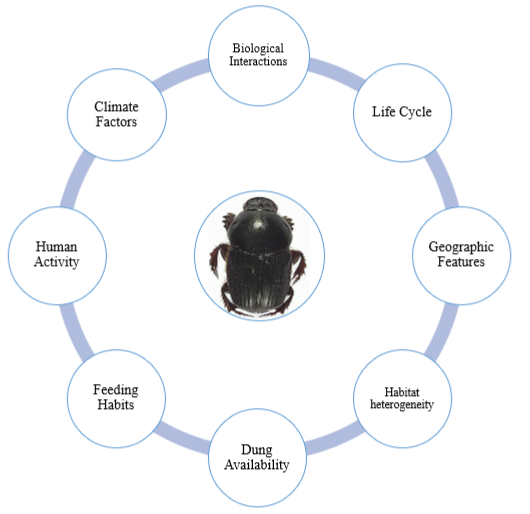
Factors affecting bacterial microbiome associated with the gut of scarab beetles.
References
- Bashir, Z., V.K. Kondapalli, N. Adlakha, A. Sharma, R.K. Bhatnagar, G. Chandel and S.S. Yazdani. 2013. Diversity and functional significance of cellulolytic microbes living in termite, pill-bug and stem-borer guts. Sci. Rep., 3(1): 2558. https://doi.org/10.1038/srep02558[CrossRef]
- Benson, A.K., S.A. Kelly, R. Legge, F. Ma, S.J. Low, J. Kim, M. Zhang, P.L. Oh, D. Nehrenberg and K. Hua. 2010. Individuality in gut microbiota composition is a complex polygenic trait shaped by multiple environmental and host genetic factors. Proc. Natl. Acad. Sci., 107(44): 18933-18938. https://doi.org/10.1073/pnas.1007028107[CrossRef]
- Boucias, D.G., Y. Zhou, S. Huang and N.O. Keyhani. 2018. Microbiota in insect fungal pathology. Appl. Microbiol. Biotechnol., 102: 5873-5888. https://doi.org/10.1007/s00253-018-9089-z[CrossRef]
- Byk, A. and J. Piętka. 2018. Dung beetles and their role in the nature. Edukacja Biol. I Środowiskowa, 1: 17-26. https://doi.org/10.24131/3247.180103[CrossRef]
- Chen, H.Y., C.Y. Wang, B. Zhang, Z. He, R.C. Yang, H.H. Zhang, Q.Q. Hu, Z.Y. Zhao and M. Zhao. 2024. Gut microbiota diversity in a dung beetle (Catharsius molossus) across geographical variations and brood ball-mediated microbial transmission. PLoS One, 19(6): e0304908. https://doi.org/10.1371/journal.pone.0304908[CrossRef]
- Davis, A.L.V., A.V. Frolov, and C.H. Scholtz. 2008. The African dung beetle genera. Protea Book House.
- Douglas, A.E., 2015. Multiorganismal insects: Diversity and function of resident microorganisms. Ann. Rev. Entomol., 60: 17-34. https://doi.org/10.1146/annurev-ento-010814-020822[CrossRef]
- Ebert, K.M., W.G. Arnold, P.R. Ebert and D.J. Merritt. 2021. Hindgut microbiota reflects different digestive strategies in dung beetles (Coleoptera: Scarabaeidae: Scarabaeinae). Appl. Environ. Microbiol., 87(5): e02100-02120. https://doi.org/10.1128/AEM.02100-20[CrossRef]
- French, J., G. Turner and J. Bradbury. 1976. Nitrogen fixation by bacteria from the hindgut of termites. Microbiology, 95(2): 202-206. https://doi.org/10.1099/00221287-95-2-202[CrossRef]
- Gotcha, N., 2022. Dung beetles responses to changing environments; implications on ecosystem service delivery.
- Hajji, H., A. Janati-Idrissi, A.F. Taybi, J.P. Lumaret and Y. Mabrouki. 2024. Contribution of dung beetles to the enrichment of soil with organic matter and nutrients under controlled conditions. Diversity, 16(8): 462. https://doi.org/10.3390/d16080462[CrossRef]
- Halffter, G., V. Cortez, E.J. Gómez, C.M. Rueda, W. Ciares and J.R. Verdú. 2013. A review of subsocial behavior in Scarabaeinae rollers (Insecta: Coleoptera): An evolutionary approach. Sociedad Entomológica Aragonesa México.
- Halffter, G. and W.D. Edmonds. 1982. The nesting behavior of dung beetles (Scarabaeinae). An ecological and evolutive approach.
- Hanski, I. and Y. Cambefort. 1991. Competition in dung beetles. Dung beetle ecology. pp. 305-329. https://doi.org/10.1515/9781400862092.305[CrossRef]
- Hernández, N., J.A. Escudero, Á.S. Millán, B. González-Zorn, J.M. Lobo, J.R. Verdú and M. Suárez. 2015. Culturable aerobic and facultative bacteria from the gut of the polyphagic dung beetle Thorectes lusitanicus. Insect Sci., 22(2): 178-190. https://doi.org/10.1111/1744-7917.12094[CrossRef]
- Holmes, E., J.V. Li, J.R. Marchesi and J.K. Nicholson. 2012. Gut microbiota composition and activity in relation to host metabolic phenotype and disease risk. Cell Metab., 16(5): 559-564. https://doi.org/10.1016/j.cmet.2012.10.007[CrossRef]
- Holter, P. and C.H. Scholtz. 2007. What do dung beetles eat? Ecol. Entomol., 32(6): 690-697. https://doi.org/10.1111/j.1365-2311.2007.00915.x[CrossRef]
- Hongoh, Y., V.K. Sharma, T. Prakash, S. Noda, H. Toh, T.D. Taylor, T. Kudo, Y. Sakaki, A. Toyoda and M. Hattori. 2008. Genome of an endosymbiont coupling N2 fixation to cellulolysis within protist cells in termite gut. Science, 322(5904): 1108-1109. https://doi.org/10.1126/science.1165578[CrossRef]
- Huang, S., P. Sheng and H. Zhang. 2012. Isolation and identification of cellulolytic bacteria from the gut of Holotrichia parallela larvae (Coleoptera: Scarabaeidae). Int. J. Mol. Sci., 13(3): 2563-2577. https://doi.org/10.3390/ijms13032563[CrossRef]
- Hussain, M., M. Kanwal, K. Aftab, M. Khalid, S. Liaqat, T. Iqbal, G. Rahman and M. Umar. 2022. Distribution patterns of dung beetle (Coleoptera: Scarabaeidae) assemblages in croplands and pastures across two climatic zones of Pakistan. Oriental Insects, 56(3): 392-407. https://doi.org/10.1080/00305316.2021.2010617[CrossRef]
- Jácome-Hernández, A., A. Lamelas, D. Desgarennes, C. Huerta, M. Cruz-Rosales and M.E. Favila. 2023. Influence of phylogenetic, environmental, and behavioral factors on the gut bacterial community structure of dung beetles (Scarabaeidae: Scarabaeinae) in a Neotropical Biosphere Reserve. Front. Microbiol., 14: 1224601. https://doi.org/10.3389/fmicb.2023.1224601[CrossRef]
- Kazuhira, Y., K. Hdeaki, K. Takuro and A. Toshiharu. 1991. Nitrogen mineralization and microbial populations in cow dung, dung balls and underlying soil affected by paracoprid dung beetles. Soil Biol. Biochem., 23(7): 649-653. https://doi.org/10.1016/0038-0717(91)90078-X[CrossRef]
- Krishnan, M., C. Bharathiraja, J. Pandiarajan, V.A. Prasanna, J. Rajendhran and P. Gunasekaran. 2014. Insect gut microbiome. An unexploited reserve for biotechnological application. Asian Pac. J. Trop. Biomed., 4: S16-S21. https://doi.org/10.12980/APJTB.4.2014C95[CrossRef]
- Kucuk, R., 2020. Gut bacteria in the holometabola: A review of obligate and facultative symbionts. J. Insect Sci., 20(4): 22. https://doi.org/10.1093/jisesa/ieaa084[CrossRef]
- Kucuk, R.A., B.J. Campbell, N.J. Lyon, E.A. Shelby and M.S. Caterino. 2023. Gut bacteria of adult and larval Cotinis nitida Linnaeus (Coleoptera: Scarabaeidae) demonstrate community differences according to respective life stage and gut region. Front. Microbiol., 14: 1185661. https://doi.org/10.3389/fmicb.2023.1185661[CrossRef]
- Lederberg, J., 2000. Infectious history. Science, 288(5464): 287-293. https://doi.org/10.1126/science.288.5464.287[CrossRef]
- Lee, W.J. and K. Hase. 2014. Gut microbiota–generated metabolites in animal health and disease. Nat. Chem. Biol., 10(6): 416-424. https://doi.org/10.1038/nchembio.1535[CrossRef]
- Lefort, M., T. Glare, D. Bouchon and S. Boyer. 2023. How hindgut microbiota may shape sympatric speciation in an invasive phytophagous scarab. Entomol. Exp. Appl., 171(8): 556-563. https://doi.org/10.1111/eea.13305[CrossRef]
- Macagno, A.L. and A.P. Moczek. 2023. Between-partner concordance of vertically transmitted gut microbiota diminishes reproductive output in the dung beetle Onthophagus taurus. Physiol. Entomol., 48(1): 14-23. https://doi.org/10.1111/phen.12398[CrossRef]
- Mahboob, M. and Q. Tahseen. 2022. Molecular phylogeny and new insight into the stomatal complexity of Fictor platypapillata sp. n. (Diplogastridae: Nematoda) associated with Oniticellus cinctus (Coleoptera: Scarabaeidae). J. Helminthol., 96: e14. https://doi.org/10.1017/S0022149X22000050[CrossRef]
- Mao, Y., X. Yang, H. Yuan and T. Xiong. 2023. Exploring gut microbiota diversity in Catharsius molossus: Influence of dietary conditions on ecosystem functionality. Authorea Preprints. https://doi.org/10.22541/au.169484950.04286665/v1[CrossRef]
- Müller, Z., 1980. Feed from animal wastes: State of knowledge.
- Nichols, E., S. Spector, J. Louzada, T. Larsen, S. Amezquita, M. Favila and T.S.R. Network. 2008. Ecological functions and ecosystem services provided by Scarabaeinae dung beetles. Biol. Conserv., 141(6): 1461-1474. https://doi.org/10.1016/j.biocon.2008.04.011[CrossRef]
- Park, S.H., K. Moon, H.S. Bang, S.H. Kim, D.G. Kim, K.B. Oh, J. Shin and D.C. Oh. 2012. Tripartilactam, a cyclobutane-bearing tricyclic lactam from a Streptomyces sp. in a dung beetle’s brood ball. Organ. Lett., 14(5): 1258-1261. https://doi.org/10.1021/ol300108z[CrossRef]
- Parker, E., 2021. The evolutionary ecology of host-microbiome symbiosis in onthophagus dung beetles. Indiana University.
- Parker, E.S., I.L. Newton and A.P. Moczek. 2020. (My microbiome) would walk 10,000 miles: maintenance and turnover of microbial communities in introduced dung beetles. Microbial Ecol., 80(2): 435-446. https://doi.org/10.1007/s00248-020-01514-9[CrossRef]
- Price, D.L., 2004. Species diversity and seasonal abundance of scarabaeoid dung beetles (Coleoptera: Scarabaeidae, Geotrupidae and Trogidae) attracted to cow dung in central New Jersey. J. N. Y. Entomol. Soc., 112(4): 334-347. https://doi.org/10.1664/0028-7199(2004)112[0334:SDASAO]2.0.CO;2[CrossRef]
- Schwab, D.B., H.E. Riggs, I.L. Newton and A.P. Moczek. 2016. Developmental and ecological benefits of the maternally transmitted microbiota in a dung beetle. Am. Natur., 188(6): 679-692. https://doi.org/10.1086/688926[CrossRef]
- Shan, Y., C. Shu, N. Crickmore, C. Liu, W. Xiang, F. Song and J. Zhang. 2014. Cultivable gut bacteria of scarabs (Coleoptera: Scarabaeidae) inhibit Bacillus thuringiensis multiplication. Environ. Entomol., 43(3): 612-616. https://doi.org/10.1603/EN14028[CrossRef]
- Shukla, S.P., J.G. Sanders, M.J. Byrne and N.E. Pierce. 2016. Gut microbiota of dung beetles correspond to dietary specializations of adults and larvae. Mol. Ecol., 25(24): 6092-6106. https://doi.org/10.1111/mec.13901[CrossRef]
- Suárez-Moo, P., M. Cruz-Rosales, E. Ibarra-Laclette, D. Desgarennes, C. Huerta and A. Lamelas. 2020. Diversity and composition of the gut microbiota in the developmental stages of the dung beetle Copris incertus Say (Coleoptera, Scarabaeidae). Front. Microbiol., 11: 1698. https://doi.org/10.3389/fmicb.2020.01698[CrossRef]
- Suman, J., A. Rakshit, S.D. Ogireddy, S. Singh, C. Gupta and J. Chandrakala. 2022. Microbiome as a key player in sustainable agriculture and human health. Front. Soil Sci., 2: 821589. https://doi.org/10.3389/fsoil.2022.821589[CrossRef]
- Surabhi, K., R. Rangeshwaran, M. Frenita, A. Shylesha, and P. Jagadeesh. 2018. Isolation and characterization of the culturable microbes associated with gut of adult dung beetle Onitis philemon (Fabricius). J. Pharmacogn. Phytochem., 7(2): 1609-1614.
- Tarasov, S., and D. Dimitrov. 2016. Multigene phylogenetic analysis redefines dung beetles relationships and classification (Coleoptera: Scarabaeidae: Scarabaeinae). BMC Evolut. Biol., 16: 1-19. https://doi.org/10.1186/s12862-016-0822-x[CrossRef]
- Thiyonila, B., N.P. Reneeta, M. Kannan, S. Shantkriti and M. Krishnan. 2018. Dung beetle gut microbes: Diversity, metabolic and immunity related roles in host system. Int. J. Innov. Sci., 1: 10.32594.
- Thong-On, A., K. Suzuki, S. Noda, J.-i. Inoue, S. Kajiwara and M. Ohkuma. 2012. Isolation and characterization of anaerobic bacteria for symbiotic recycling of uric acid nitrogen in the gut of various termites. Microbes Environ., 27(2): 186-192. https://doi.org/10.1264/jsme2.ME11325[CrossRef]
- Tonelli, M., 2021. Some considerations on the terminology applied to dung beetle functional groups. Ecol. Entomol., 46(4): 772-776. https://doi.org/10.1111/een.13017[CrossRef]
- Torabian, S., A.J. Leffler and L. Perkins. 2024. Importance of restoration of dung beetles in the maintenance of ecosystem services. Ecol. Solut. Evid., 5(1): e12297. https://doi.org/10.1002/2688-8319.12297[CrossRef]
- Vaheri, M.P., M.E. Vaheri and V.S. Kauppinen. 1979. Formation and release of cellulolytic enzymes during growth of Trichoderma reesei on cellobiose and glycerol. Eur. J. Appl. Microbiol. Biotechnol., 8: 73-80. https://doi.org/10.1007/BF00510268[CrossRef]
- Ventura, M., F. Turroni, C. Canchaya, E.E. Vaughan, P.W. O’Toole and D. van Sinderen. 2009. Microbial diversity in the human intestine and novel insights from metagenomics. https://doi.org/10.2741/3445[CrossRef]
- Wernegreen, J.J., 2012. Strategies of genomic integration within insect-bacterial mutualisms. Biol. Bull., 223(1): 112-122. https://doi.org/10.1086/BBLv223n1p112[CrossRef]
- Wood, T.M., 1985. Properties of cellulolytic enzyme systems. In: Portland Press Ltd. https://doi.org/10.1042/bst0130407[CrossRef]
- Wu, G.D., J. Chen, C. Hoffmann, K. Bittinger, Y.Y. Chen, S.A. Keilbaugh, M. Bewtra, D. Knights, W.A. Walters and R. Knight. 2011. Linking long-term dietary patterns with gut microbial enterotypes. Science, 334(6052): 105-108. https://doi.org/10.1126/science.1208344[CrossRef]
Services
Article usage statistics
Loading…