
While using artificial nest boxes to protect Mandarin duck Aix galericulata in a secondary forest in Northeast China, we found mixed clutches that contained eggs of Mandarin duck and other species over 11 breeding seasons (2004 - 2014). We monitored the frequency of occurrence and the fate of eggs in those nests and recorded fourteen cases of mixed clutches that contained Mandarin duck eggs. Nine cases were classified as successful nest usurpation: in six cases nests of other birds were usurped by Mandarin duck and in three cases nests of Mandarin duck were usurped by other birds. The remaining mixed clutches may be incomplete usurpation. For the nests taken over by Mandarin ducks, all heterospecific eggs were rejected and four clutches were incubated successfully. For the other mixed clutches, none of Mandarin duck eggs were removed, only two eggs were hatched but the ducklings did not survive. Nest usurpation may interfere with normal breeding activities and lead to a reduced breeding success in Mandarin duck and other coexisting bird species, which should be taken into account when providing nest boxes to protect the local population.
Short Communication · Volume 50, Issue 4, 9 July 2018 · Open Access
Nest Usurpation between Mandarin Duck Aix galericulata and Coexisting Bird Species in Nest Boxes in a Secondary Forest, Zuojia Nature Reserve, China
· ·
Affiliations & Notes ⌄
- 1Jilin Provincial Engineering Laboratory of Avian Ecology and Conservation Genetics, School of Life Sciences, Northeast Normal University, Changchun 130024, China , * Corresponding author: wanght402@nenu.edu.cn
Article Info ⌄
- Journal:
- Pakistan Journal of Zoology
- Published:
- 9 July 2018

From the article
- A total of 126 nest boxes containing Mandarin duck eggs were monitored in this study.
- Nine cases of mixed clutches were classified as successful usurpation: six cases were determined as usurpation by Mandarin ducks at nests of other birds; three cases were determined as usurpation by other birds at nests of Mandarin ducks.
- Overlap in nest use occurred between Mandarin ducks and six species of birds (Table I), with six cases of Mandarin duck taking over the interspecific nests, and three cases of the Mandarin duck nests successfully usurped by other species.
- Our observations of nest usurpation suggest that there existed interspecific competition for nest sites between Mandarin duck and six bird species.
Selected from the article's own text.
Abstract
Methods
We monitored nest usurpation by collecting data on mixed clutches laid by both Mandarin ducks and other birds during 11 breeding seasons (2004-2014) at Zuojia Nature Reserve. The reserve runs from the eastern Chang Bai Mountains to the western plain (126°1′-127°2′N, 44°6′-45°5′E). For each breeding season from 2004 onward, 52-103 nest boxes were installed in the reserve with the objective of conserving the population of Mandarin duck. We initially monitored nest boxes every 5-7 days to identify the ones that were occupied, as evidenced by the presence of at least one egg. Active nest boxes were then checked daily to monitor progress. For mixed clutches that contained eggs of Mandarin duck, laying order of eggs of interspecific individuals was recorded. Cases that a female laid in the active clutch of other interspecific bird and eventually incubated the nest were classified as successful nest usurpation. In this study, nests without mixed clutch were defined as not being usurped. During nest visits to mixed clutches, we recorded the number of eggs laid by different species and the hatching success.
Results
A total of 126 nest boxes containing Mandarin duck eggs were monitored in this study. Among them, 14 nests contained both Mandarin duck and heterospecific eggs of six other bird species (Table I). Nine cases of mixed clutches were classified as successful usurpation: six cases were determined as usurpation by Mandarin ducks at nests of other birds; three cases were determined as usurpation by other birds at nests of Mandarin ducks. Four cases of successful usurpation by Mandarin duck occurred in boxes where Mandarin ducks had nested in the previous year. Mandarin ducks that laid eggs in five nests of other bird species did not incubate them, however the intention or the objective of this laying could not be determined.
During the study period, 52.9% (396 out of 749) of nest boxes remained unoccupied and available to be used. For each coexisting species that also used the nest boxes, the number of mixed clutches that contained Mandarin duck eggs ranged from one to fourteen; the number of successful nest usurpation of different species within those mixed clutches ranged from one to nine (Fig. 1).
In the six nests successfully taken over by Mandarin ducks, all heterospecific eggs were removed: four out of six clutches were incubated successfully. As for the eight other mixed clutches, none of Mandarin duck eggs were removed but they did not hatch in seven out of eight clutches. Two Mandarin duck eggs hatched successfully in a common kestrel (Falco tinnunculus) nest, and fledged without parental care.
In two cases of classified successful nest usurpation, the previous nest owners (oriental scops owl Otus sunia and collared scops owl Otus bakkamoena) had been seen perching among branches near their nests during the first few days since the first duck eggs were laid. In the nest that contained one Mandarin duck egg and three Ural owl Strix uralensis eggs, Mandarin duck was found to chase the owl away from nest site before the egg was laid but the nest was eventually incubated by the Ural owl.
Table I.- Fate of eggs in nests containing both Mandarin duck and heterospecific eggs during the 2004–2014 breeding seasons in Zuojia Natural Reserve, northeastern China.
| Species | Year | Number of eggs within nest | Incubated by | Fates of egg1 | ||
| Mandarin duck | Others2 | Mandarin duck | Others2 | |||
| Dollar bird (Eurystomus orientalis) | 2004 | 2* | 4 | Dollar bird | Unhatched | Hatched |
| 2012 | 2* | 4 | Dollar bird | Unhatched | Hatched | |
| 2013s | 3 | 4* | Dollar bird | Unhatched | Hatched | |
| 2013s | 7 | 4* | Dollar bird | Unhatched | Hatched | |
| 2014s | 15 | 2* | Dollar bird | Unhatched | Deserted | |
| Common kestrel (Falco tinnunculus) | 2007s | 9* | 1 | Mandarin duck | Hatched | Rejected |
| 2008 | 2* | 6 | Common Kestrel | Hatched | Hatched | |
| Collared scops owl (Otus lettia) | 2007s | 11* | 4 | Mandarin duck | Hatched | Rejected |
| 2008s | 23* | 1 | Mandarin duck | Deserted | Rejected | |
| Oriental scops owl (Otus sunia) | 2009s | 16* | 2 | Mandarin duck | Hatched | Rejected |
| Ural owl (Strix uralensis) | 2009s | 21* | 1 | Mandarin duck | Unhatched | Unhatched |
| 2011 | 1* | 3 | Ural owl | Unhatched | Hatched | |
| Eurasian jay (Garrulus glandarius) | 2012 | 2* | 8 | Eurasian Jay | Unhatched | Hatched |
| 2012s | 13* | 1 | Mandarin duck | Unhatched | Rejected | |
1Unhatched: eggs did not hatch successfully; hatched: eggs hatched successfully; rejected: eggs were rejected from nests; Deserted: nest was abandoned during incubation period. 2 Other species: Dollar bird, Common Kestrel, Collared scops owl, Oriental scops owl, Ural owl and Eurasian Jay, respectively.* Cases where eggs laid in the clutch of another species. S Cases classified as successful usurpation.
Discussion
Mixed clutches of waterfowl and other birds have occasionally been found in nest boxes. For example, Dawson and Bortolotti (1997) reported an American kestrel Falco sparverius incubating a bufflehead Bucephala albeola egg and four kestrel eggs (the bufflehead and two kestrel chicks fledged); Manlove (1998) found an Eastern screech-owl Megascops asio apparently evicting a nesting wood duck or Carolina duck Aix sponsa), laying on top of the covered duck eggs, and subsequently hatching at least one owlet and one duckling. However, cases that waterfowl incubated mixed clutch are less documented. Overlap in nest use occurred between Mandarin ducks and six species of birds (Table I), with six cases of Mandarin duck taking over the interspecific nests, and three cases of the Mandarin duck nests successfully usurped by other species.
Laying eggs by female birds in the nests of birds of other bird species is termed as brood parasitism ; , 2016a; ; . Unlike brood parasites that lay eggs in other birds’ nests but provide no parental care, nest usurpers incubate their eggs in the nests of other birds . Successfully usurped nests were incubated by the usurpers, hence this cannot be termed as brood parasitism. However, we found five cases of Mandarin ducks that laid in the nests of other species of birds but did not incubate the mixed clutches. Brood parasites, like Mandarin ducks, commonly make “mistakes” by laying eggs in nests of unsuitable hosts ; , thus there is a possibility that the five mixed clutches in our study were caused by accidental laying, where Mandarin ducks failed to recognize that the nests they laid in were not of conspecifics. However, in the study of eiders (genus Somateria), the females were observed to usurp the nests of gulls (Laridae family) but sometimes did not continue their occupation of the gull’s nest, which may be considered as incomplete nest usurpation . This is in line with our study.
Nest usurpation is probably costly for the previous nest owners, because: i) they may have to invest additional energy and time to search for an alternative nest or have to delay reproduction until the nest is vacant again ; ii) they may incur a cost of injury while getting involved with aggressive intruders ; iii) there could be reduction in reproductive output for individuals who lost their nests ; iv) even when intruder did not successfully take over a nest, interspecific interference (i.e., host’s incubating behavior is disturbed by intruders for their perching on the nest or at its entrance, peering inside or entering the nest) could also have severe effect on the breeding success of the victim .
Actively taking over a nest of another species suggests that value of the resource is high enough and deserves to risk costs . In our study, the number of available nest sites was not likely to limit the reproduction of cavity-nesting birds, as more than half of the nest boxes remained unoccupied. Semel and Sherman (2001) reported that returning female wood ducks usually laid again in the previous year’s box, even if another female was already laying there. Similarly, during 2012-2014, two out of 20 banded female Mandarin ducks were found returning to breed in the same nest boxes (unpublished data). This suggests that Mandarin ducks may usurp occupied boxes in which they had nested previously. Four cases of nest usurpation occurred in boxes in which Mandarin ducks had nested during the previous year; however, we could not determine whether the ducks were the same females as these were not banded. Certain desirable quality of a nest site may be preferred by forest birds (e.g. and therefore affect interspecific nest competition . We found that 80.2% (101 out of 126) Mandarin duck nests contained old nest materials of Eurasian red squirrel Sciurus vulgaris, and 92.9% (13 out of 14) nests involved in mixed clutches contained material, which suggested that nests containing squirrel nest material might be preferred to others.
Our observations of nest usurpation suggest that there existed interspecific competition for nest sites between Mandarin duck and six bird species. However, the cognitive mechanisms underlying interspecific nest usurpation, such as the assessment cues and decision rules potential usurpers use, remain unclear and should be further investigated to enhance understanding on nest site supplement for Mandarin duck, as well as other coexisting bird species.
Acknowledgements
We are grateful to Xiang Cui, Mingju E, Lin Wang, Jiangping Yu for their assistance with fieldwork. This work was supported by the National Natural Science Foundation of China (31272331 to HW) and the Fundamental Research Funds for the Central Universities (2412016KJ043). The field study was permitted by National Animal Research Authority in Northeast Normal University, China (approval number: NENU–20080416) and the Forestry Bureau of Jilin Province of China (approval number: [2006]178).
Statement of conflict of interest
Authors have declared no conflict of interest.
Figures
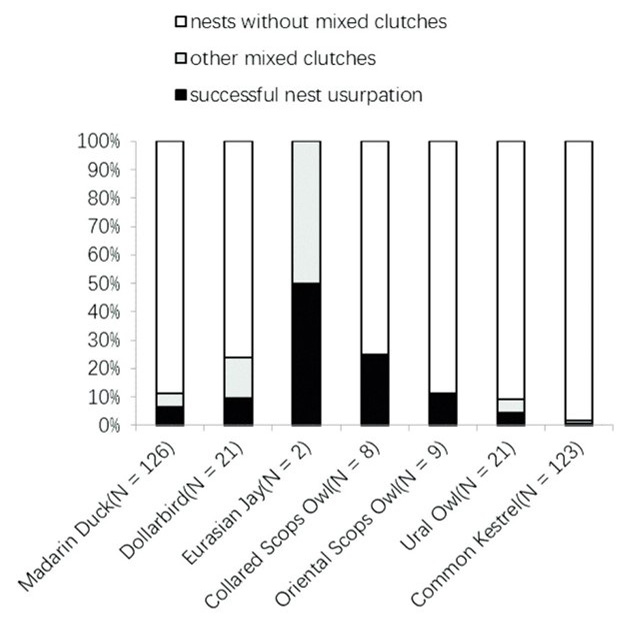
Frequency of nests with successful usurpation, other mixed clutches and nests without mixed clutches in different bird species nesting in the net box.
References
- Arlettaz, R., Schaub, M., Fournier, J., Reichlin, T. S., Sierro, A., Watson, E.M. and Artuso, C., 2011. Wilson J. Ornithol., 119: 110-112. http://www.jstor.org/stable/20455957 (Accessed on July 08, 2017).
- Artuso, C., 2007. Wilson J. Ornithol., 119: 110-112.
- Beissinger, S.R. and Bucher, E.H. (eds.), 1992. In: New World parrots in crisis. Smithsonian Institution Press, Washington, pp. 73-115.
- Dawson, R.D. and Bortolotti, G.R., 1997. Wilson Bull., 109: 732-734.
- Deng, Q.X., Wang, H.T., Yao, D., Wang, X.Y., Mingju, E., Wang, T. and Gao, W., 2011. Wilson J. Ornithol., 123: 479-485. https://doi.org/10.1676/10-144.1[CrossRef]
- Eguchi, K., Yamaguchi, N., Ueda, K. and Noske, R.A., 2013. Emu, 113: 77-83. https://doi.org/10.1071/MU12044[CrossRef]
- Favaloro, N., 1942. Emu, 41: 268-276. https://doi.org/10.1071/MU941268[CrossRef]
- Fournier, M.A., 2000. Waterbirds, 23: 114-116. https://doi.org/10.2307/1522155[CrossRef]
- Frye, G.G. and Rogers, K.K., 2005. Northwest. Nat., 85: 126-128. https://doi.org/10.1898/1051-1733(2005)085[0126:PCUVIK]2.0.CO;2[CrossRef]
- Heinsohn, R., Murphy, S. and Legge, S. 2003. Aust. J. Zool., 51: 81-94. https://doi.org/10.1071/ZO02003[CrossRef]
- Higuchi, H., 1978. J. Jpn. For. Soc., 60: 255-261.
- Ingold, D.J., 1998. Wilson Bull., 110: 218-225.
- IUCN, 2016. The IUCN red list of threatened species 2016. Version 2016. 3.1. http://www.iucnredlist.org (Downloaded on December 30, 2016).
- Kattan, G.H., 1997. Anim. Behav., 53: 647-654. https://doi.org/10.1006/anbe.1996.0339[CrossRef]
- Kear, J., 2005. In: Ducks, geese and swans, Volume 2: Species accounts (Cairinato to Mergus) (ed. J. Kear). Oxford University Press, Oxford, UK, pp. 465-468.
- Lindell, C., 1996. Condor, 98: 464-473. https://doi.org/10.2307/1369560[CrossRef]
- Lõhmus, A., 2003. Biol. Conserv., 110: 1-9. https://doi.org/10.1016/S0006-3207(02)00167-2[CrossRef]
- Lyon, B.E. and Eadie, J.M., 2008. Annu. Rev. Ecol. Evol., 39: 343-363. https://doi.org/10.1146/annurev.ecolsys.39.110707.173354[CrossRef]
- Manlove, C.A., 1998. Alabama Birdl., 43: 10-12.
- Menaa, M., Maazi, M. C., Telailia, S., Saheb, M., Boutabia, L., Chafrour, A. and Houhamdi, M., 2016. Pakistan J. Zool, 48: 1059-1069.
- Meyrom, K., Motro, Y., Leshem, Y., Aviel, S., Izhaki, I., Argyle, F. and Charter, M., 2011. Ardea, 97: 463-467. https://doi.org/10.5253/078.097.0410[CrossRef]
- Michener, G.R., Mclean, I.G., 1996. Anim. Behav., 52: 743-758. https://doi.org/10.1006/anbe.1996.0219[CrossRef]
- Nahid, M.I., Fossy, F., Begum, S., Rskaft, E., and Stokke, B.G., 2016. Avian Res., 7: 174-179. https://doi.org/10.1186/s40657-016-0049-y[CrossRef]
- Newton, I., 1994. Biol. Conserv., 70: 265-276. https://doi.org/10.1016/0006-3207(94)90172-4[CrossRef]
- Perry, P., 1982. Br. Birds, 75: 360-365.
- Petty, S.J., 1992. Ecology of the tawny owl Strix aluco in the spruce forests of Northumberland and Argyll. PhD thesis, Open University, Milton Keynes, UK.
- Pribil, S. and Picman, J., 1991. Condor, 93: 184-185. https://doi.org/10.2307/1368624[CrossRef]
- Prokop, P., 2004. Biologia, 59: 213-217.
- Savard, J.L., 1988. Wildl. Soc. B, 16: 125-132.
- Semel, B. and Sherman, P.W., 2001. Anim. Behav., 61: 787-803. https://doi.org/10.1006/anbe.2000.1657[CrossRef]
- Wang, L., Yang C., Hsu, Y., Antonov, A., Moksnes, A., Røskaft, E., Liang, W. and Stokke, B.G., 2013. Behaviour, 150: 215-223. https://doi.org/10.1163/1568539X-00003046[CrossRef]
- Yang, C., Huang, Q., Wang, L., Jiang, A., Stokke, B., Fossøy, F.G., Tunheim, O.H., Røskaft, E., Liang, W. and Møller, A.P., 2016a. Behav. Ecol., 27: 275-279. https://doi.org/10.1093/beheco/arv226[CrossRef]
- Yang, C., Liang, W., Cai, Y., Shi, S., Takasu, F., Møller, A.P., Antonov, A., Fossøy, F., Moksnes, A., Røskaft, E., Stokke, B.G., 2010. PLoS One, 5: e10816. https://doi.org/10.1371/journal.pone.0010816[CrossRef]
- Yang, C., Wang, L., Liang, W. and Møller, A.P., 2016b. Anim. Behav., 122: 177-181. https://doi.org/10.1016/j.anbehav.2016.10.018[CrossRef]
Services
Article usage statistics
Loading…