Research Article · Volume 35, Issue 1, 29 June 2020 · Open Access
Sero-prevalence of Peste des Petits Ruminant (PPR) Virus in Sheep and Goat Population of Gilgit Baltistan Province of Pakistan
· · · · ·
Affiliations & Notes ⌄
1Department of Zoology, University of the Punjab, Lahore, Pakistan 2Department of Microbiology, University of Veterinary and Animal Sciences, Lahore, Pakistan 3Quality operations laboratory, University of Veterinary and Animal Sciences, Lahore, Pakistan , Corresponding Author: Majeeda Rasheed meri92552@yahoo.com
Out of total samples processed, though the prevalence rate was almost comparable and a non-significant difference was observed for both animal species, it was higher in goat than sheep (46% vs 44%, P> 0.05).
While considering sex-based prevalence of antibodies corresponding to PPR, the occurrence was found to be significant (P < 0.05) again, however, it was higher in female (69.96%) as compared to male (63.92%).
Adult animals with age > 1 year (69.02) as compared to young animals with age 0.05) between the prevalence rate according to season.
The present study also showed that, high prevalence of antibodies was detected from the animals of older than one year of age as compare to younger animals.
Selected from the article's own text.
Abstract
Peste des petits ruminants (PPR) caused by PPR virus (PPRV), is a contagious disease of domestic and wild small ruminants. The disease is endemic in developing countries of African and Asian worlds including Pakistan, where several clinical cases in small ruminants (sheep and goat) have been frequently reported. Despite PPRV is endemic in Pakistan, information on disease serosurveillance of prevailing strains in Gilgit-Balitistan (GB) territory is scarce. Therefore, the current study was designed to assess the seroprevalence of PPRV and to evaluate potential risk factors involved in the transmission of PPR disease in four distinct locations of GB province. We reported occurrence and risk factor analysis of PPR in small ruminants (n=1000) originating from different places in district Gilgit using Hem agglutination Inhibition (HI) test followed by risk analysis through Open-Epi software. Serum samples including goats n=500 and sheep n=500 were collected from different herds situated at Naltar lake, Tattovat, Fairy meadows, Bangle, and Naltar. Overall a comparable prevalence was identified for both goat and sheep (46% vs 44%, P > 0.05). Future studies are necessary to further ascertain the study outcomes and elucidate the molecular epidemiology of prevalent strains in the said geographical locations for better disease control and management interventions.
Novelty Statement | It is the first report from Gilgit-Balitistan which ascertain necessary intervention such as vaccination on mass scale, animal movement control etc for disease management in future.
Introduction
Peste des petits ruminant’s (PPR), also called goat plague or Kata prevalent in domestic and wild animals (Banyard et al., 2015); however, it also has been reported in large animals such as buffalos, cattle and camel. The virus belongs to genus Morbillivirus within family Paramyxoviridae .
The disease is highly infectious and is endemic throughout the Middle East and many Asian regions with significant economic losses . The disease is considered notifiable owing to its economic importance and food security risk. Since it can cross boundaries such as evidenced in countries bordering Pakistan, Afghanistan, Iran, India and China ; ; , It is transboundary in nature. The PPR has been reported by FAO and OIE as class one disease to be eradicated (OIE and FAO, 2015). PPR virus affects sheep, goats and related species, also effect camel from large animals and becoming a highly contagious viral disease. The most important finding of pathological process of PPR can be observed in the respiratory and digestive system. Morbidity and mortality rates also give an idea about the pathogenicity measure of virus. Vaccination is a way to control PPR, required on mass scale; losses can be limited by prevention but for this, a deep knowledge of pathogenesis of disease is very important. Pakistan has an agriculture-based economy. According to Economic survey of Pakistan (GOP, 2017), among the meat-producing animals, goats and sheep are regarded as ‘‘poor-man cow’’, and the need for HALAL meat and its export has increased the importance of these animals. However, the biggest obstacle is the irresistible disease, the lack of a legitimate and the appropriate vaccine. A high cost of rearing is associated with the occurrence of PPR in a herd in China and same could be considered true for similar setting in Pakistan e.g., Gilgit-Baltistan, where a large number of farmers are dependent for their routine livelihood on small ruminant. By seeing highly contagious nature of disease, its burden in affected population and subsequent economic losses, studies elucidating the nature of infection and its prevalent status to devise appropriate interventions is much required.
Materials and Methods
This research was performed to evaluate the rate of occurrence of PPR virus, in small ruminants from different areas in Gilgit Baltistan and included Tattovat, Fairy-Meadow, Naltar Lake and Bangle Naltar. Also, the study analyzed a potential association among a number of risk factors that could predispose occurrence of disease in animals and its subsequent spread in the surrounding susceptible population. The risk factors included animal species, age, gender and season. The study samples were collected during a period of one year from 2016 -2017 and were processed and analyzed at Faisalabad Institute of Research Science and Technology (FIRST), Faisalabad.
Collection of blood samples
The study involved aseptic collection of 1000 blood samples (500 for goat, 500 for sheep), through jugular vein. These samples were collected from animals that were reared under open-house grazing method, exhibited flu like symptoms such as cough, nasal discharge, high temperature and pustules were clinically suspected for PPR. Briefly, the test animal was properly restrained at the spot and the left side of the throat of animal was pressed to find the jugular vein. The neck was shaved to locate the jugular vein position as assess sero-positivity in small ruminants, 1000 samples (500 for goat, 500 for sheep) of blood, collected aseptically through jugular vein of sheep and goats reared under open-house grazing method . The parameter like age of animal, breed, gender and geographical location along with locality was also noted during sampling. Blood samples were transferred to EDTA vacutainers for plasma separation. All samples were properly labeled by placing date and sample ID on the vacutainers. The ID was traced from the data file containing information about the age, breed, gender, locality and geographical location of collected sample. The samples were transferred to research lab of Microbiology, FIRST in ice packs.
Processing for plasma separation
Once reached in the laboratory, the blood samples were processed for plasma separation. The vacutainer was centrifuged at 4000 rpm for 10 minutes at 4 oC . The plasma (supernatant) was separated and aliquots were made in pre-labeled sterile plastic microfuge tubes having capacity of up to 2 ml after that all samples were stored at -20 oC till its further use for serology. A brief history of herd animal health was taken and according to that animals were healthy apparently.
Table 1: Specie wise prevalence of PPR virus in sheep and goat population of Gilgit District, Gilgit-Baltistan, Pakistan.
Results for specie wise prevalence in Gilgit Baltistan area
Specie
Samples
Positive
Negative
df
OR
95% CI
P value
Sheep
500
220
280
1
0.9224
0.7189-1.1834
0.5240
Goat
500
230
270
1
Total
1000
450
550
-
-
-
Table 2: Gender wise prevalence of PPR virus in sheep and goat population of Gilgit district, Gilgit-Baltistan, Pakistan.
Gender
Samples
Positive
Negative
Df
OR
95%CI
P value
Female
526
268
258
1
1.6666
1.2954-2.1441
0.08
Male
474
182
292
1
Total
1000
450
550
-
-
-
-
Table 3: Age wise prevalence of PPR virus in sheep and goat population of Gilgit District, Gilgit-Baltistan, Pakistan.
Age
Samples
Positive
Negative
Df
OR
95% CI
P value
>1 year
552
381
171
1
1.311
1.008-1.7066
0.0431
<1 year
448
282
166
1
Total
1000
663
337
-
-
-
-
Table 4: Season wise prevalence of PPR virus in sheep and goat population of Gilgit district, Gilgit-Baltistan, Pakistan.
Season
Samples
Positive
Negative
Df
OR
95% CI
P value
Summer
242
25
217
1
0.0903
0.0582-0.1399
0.1842
Winter
758
425
333
1
Total
1000
450
550
-
-
-
-
Hemagglutination inhibition assay
The hemagglutination inhibition test was performed to check the sero-positivity of blood samples for corresponding antibodies against PPR as per method taken from , in Microbiology laboratory of FIRST, Pakistan.
Statistical analysis
All the data collected was entered into MS Excel (Mic Co.) computer program and Geometric mean titre (GMT) was calculated as suggested by . An overall analysis was carried out by Chi-square analysis and 95% confidence interval (CI).
Results and Discussion
Since the study employed antibody-based detection of PPR, the findings of the study could be implicated to express current as well as previous exposure of animals to PPR. For this particular purpose, the study used HI for detection of PPRV antibodies and the outcome which falls within the range of 4log2-9log2. Out of total samples processed, though the prevalence rate was almost comparable and a non-significant difference was observed for both animal species, it was higher in goat than sheep (46% vs 44%, P> 0.05). A brief summary of prevalence rate according to location in district Gilgit, is presented in (Table 1). While considering sex-based prevalence of antibodies corresponding to PPR, the occurrence was found to be significant (P < 0.05) again, however, it was higher in female (69.96%) as compared to male (63.92%). Nevertheless, evidenced by the calculated GMT, the amount of antibody titer was higher in male (15.92) than female (14.83) indicating their capacity to generate a strong immune response upon exposure to infection. Adult animals with age > 1 year (69.02) as compared to young animals with age <1 year (62.94%). Further, while the influence of age was analyzed, a high antibody titer was observed for animals greater than one year of age (17.91) as compare to GMT from the animals of less than one year of age (12.85). As influence of season in further dissemination of disease is concerned, there was a non-significant difference (P>0.05) between the prevalence rate according to season. The study shows higher seroprevalence of PPR virus in summer season 72.72% followed by 65.09% in winter, 64.91% in autumn and 61.73% in rainy season. The GMT was found to be higher (20.18) in summer season (Dec-Feb), 14.03 in autumn season (Sep-Nov) and lowest GMT (13.77) during rainy season (Jun-Aug).
The main goals of the present study were to determine the seroprevalance of PPRV in domestic animals in an area near such as Gilgit Baltistan bordering the neighboring countries. As documentation on prevalence and seroprevalance on PPRV are not available from these areas before the present study. The current study has revealed a high seroprevalance of antibodies to PPRV were observed in goats as compared to sheep (Rehman et al., 2011). The findings of the present study are in agreement with previous reports on epidemiological studies of PPRV in domestic small ruminants, in which antibodies to PPRV showed high incidence in goats rather than sheep using various techniques ; . But our study results are contrasting with the findings through another study , who observed a high seropositivity in sheep (51.3%) than the goats (39%) using monoclonal c-ELISA.
The present study also showed that, high prevalence of antibodies was detected from the animals of older than one year of age as compare to younger animals. These findings are in agreement with previous studies from Pakistan, in which PPRV antibodies based prevalence found higher titers in adult animals of 1-2 years and > 2 years rather than < 1 years of age. Similarly, previous report by (Aziz ul Rehman et al., 2016) reported a high antibody revalence of 69.9% in 1-2 y old animals when compared to other age group. Keeping in view of the passive immunity from the vaccinated mother also contributed in the protection of younger animals aged up to 4 months from the disease outbreak from PPRV. Most outbreaks have been observed in humid condition perhaps due to virus survival in low temperature environment, seasonal prevalence is controversial regards incidence of PPRV antibodies because of manage mental practices, environmental, nutritional and socioeconomic conditions, under which animal is kept.
In conclusion, the study provides a preliminary insight towards the presence of PPR infection in small ruminant in Gilgit-Baltistan area. Further studies with a large dataset covering a wide geographical region is much necessary to better elucidate disease control and management strategies.
Conflict of interest
The authors have declared no conflict of interest.
Figures
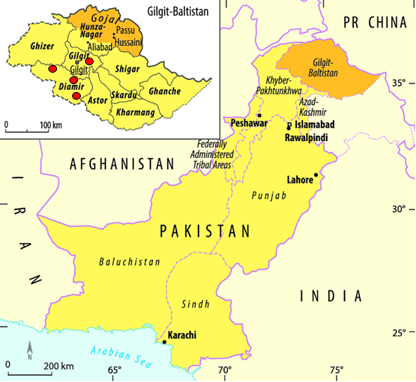
Figure 1:.
A map showing geographical location of Gilgit-Baltistan and sampling sites indicated by red-circles.
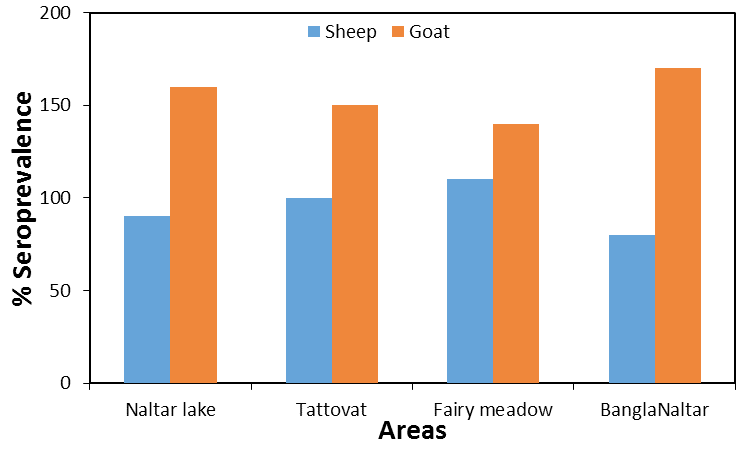
Figure 2:.
A graphical description of prevalence of disease in different areas of Gilgit Baltistan, Pakistan.
References
Abubakar, M., Ashiq, S., Zahoor, A.B., Arshed, M.J. and Banyard, A.C., 2011. Diagnosis and Control Strategies for Peste des Petits Ruminants Virus: Global and Pakistan Perspectives. Pak. Vet. J., 31: 267-274.
Abubakar, M., Zahur, A.B., Afzal, M., Ali, Q. and Gonzales, J., 2017. Peste des Petits Ruminants (PPR) in Pakistan: Analysis of a national level serological data. Small Ruminant Res., 155: 57–65. https://doi.org/10.1016/j.smallrumres.2017.08.017[CrossRef]
Albina, E., Kwiatek, O., Minet, C., Lancelot, R., De Almeida Rs and Libeau, G., 2013. Peste des petits ruminants, the next eradicated animal disease? Vet. Microbiol., 165: 38-44. https://doi.org/10.1016/j.vetmic.2012.12.013[CrossRef]
Anderson, J. and Mckay, J.A., 1994. The detection of antibodies against peste des petits ruminant’s virus in cattle, sheep and goats and the possible implications to rinderpest control programmes. Epid. Infect., 112: 225-231. https://doi.org/10.1017/S0950268800057599[CrossRef]
Anderson, J., Baron, M., Cameron, A., Kock, R., Jones, B., Pfeiffer, D. and Taylor, W., 2011. Rinderpest eradicated; what next? Vet. Rec., 169: 10-11. https://doi.org/10.1136/vr.d4011[CrossRef]
Aziz-ul-Rahman, Yousaf, F., Anwar, N. and Abubakar, M., 2016. Serological Detection of Peste des Petits Ruminants Virus (PPRV) in Sheep and Goats of Muzaffargarh District in South Punjab, Pakistan. Vet. Sci. Res. Rev., 2: 82-88. https://doi.org/10.17582/journal.vsrr/2016.2.3.82.88[CrossRef]
Banyard, A., Parida, C., Satya, Batten, Carrie; Oura, Chris, Kwiatek, Olivier and Genevieve, L., 2010. Global distribution of peste des petits ruminants’ virus and prospects for improved diagnosis and control. J. Virol., 91: 2885–2897. https://doi.org/10.1099/vir.0.025841-0[CrossRef]
Banyard, A.C. and Parida, S., 2015. Molecular Epidemiology of Peste des petits ruminants’ virus. Peste des Petits Ruminants Virus. Springer. pp. 69-93. https://doi.org/10.1007/978-3-662-45165-6_5[CrossRef]
Banyard, A.C. and Parida, S., 2016. Eradicating Peste des petits ruminants - the challenges ahead. Br. J. Virol., 3: 47-52. https://doi.org/10.17582/journal.bjv/2016.3.3s.47.52[CrossRef]
Banyard, A.C., Wang, Z. and Parida, S., 2014. Peste des petits ruminants’ virus, Eastern Asia. Emerg. Infect. Dis., 20: 2176-2178. https://doi.org/10.3201/eid2012.140907[CrossRef]
Brugh, M.A., 1978. A sample method for detecting and analysing serological data. Avian Dis., 22: 362-365. https://doi.org/10.2307/1589552[CrossRef]
Couacy-Hymann, E., Bodjo, C., Danho, T., Libeau, G. and Diallo, A., 2007. Evaluation of the virulence of some strains of Peste-des-petits-ruminants virus (PPRV) in experimentally infected West African dwarf goats. Vet. J., 173: 178-183. https://doi.org/10.1016/j.tvjl.2005.08.020[CrossRef]
Dhar, P., Sreenivasa, B., Barrett, T., Corteyn, M., Singh, R. and Bandyopadhyay, S., 2002. Recent epidemiology of Peste des petits ruminant virus (PPRV). Vet. Microbiol., 88: 153-159. https://doi.org/10.1016/S0378-1135(02)00102-5[CrossRef]
Forsyth, M. and Barrett, T., 1995. Detection and differentiation of rinderpest and Peste des petits ruminants’ viruses in diagnostic and experimental samples by polymerase chain reaction using P and F gene-specific primers. Virus Res., 39: 151-163. https://doi.org/10.1016/0168-1702(95)00076-3[CrossRef]
GOP, 2017. Pakistan Economic Survey. 2016-2017. Economic Advisory Wing, Finance Division, Government of Pakistan, Islamabad.
Khan, H.A., Rahman, S., Khan, A. and Khan, Q.M., 2011. Detection and sequencing of field isolates of Pest Des Petitis Ruminant virus from Punjab province, Pakistan. Pak. J. Life Sci., 11: 212 -217.
Mohebbi, M.R., Masoumeh, H-S., Seyed, H.M. and Sahar, G.K., 2018. Report of an Outbreak of Peste des Petits Ruminants in Iran, Clinical, Epidemiological and Pathological Study. Int. J. Vet. Sci. Res., 4: 1-9. https://doi.org/10.18488/journal.110.2018.41.1.9[CrossRef]
Munir, M., Saeed, A., Abubakar, M., Kanwal, S. and Berg, M., 2015. Molecular characterization of Peste des Petits Ruminants viruses from outbreaks caused by unrestricted movements of small ruminants in Pakistan. Transbound Emerg. Dis., 62: 108-114. https://doi.org/10.1111/tbed.12089[CrossRef]
Office of International Epizootics and Food and Agriculture Organization, 2015. Global strategy for control and eradication of PPR. FAO and OIE International conference for the control and eradication of Peste des petits ruminants (PPR). Abidjan, Cote D. Ivoire. pp. 1- 83.
Ozkul, A., Akca, Y., Alkan, F., Barrett, T., Karaoglu, T., Dagalp, S.B. anderson, J., Yesilbag, K., Cokcaliskan, C., Gencay, A. and Burgu, I., 2002. Prevalence, distribution, and host range of peste des petits ruminants virus. Turkey Emerg. Infect. Dis., 8: 708–712. https://doi.org/10.3201/eid0807.010471[CrossRef]
Rahman, M.A., Shadmin, I., Noor, M., Parvin, R., Chowdhury, E.H. and Islam, M.R., 2011. Peste des petits ruminants virus infection of goats in Bangladesh: Pathological investigation, molecular detection and isolation of the virus. Bangladesh Vet., 28: 1 - 7. https://doi.org/10.3329/bvet.v28i1.8808[CrossRef]
Shaila, M., Shamaki, D., Forsyth, M.A., Diallo, A., Goatley, L., Kitching, R. and Barrett, T., 1996. Geographic distribution and epidemiology of peste des petits ruminant’s viruses. Virus Res., 43: 149-153. https://doi.org/10.1016/0168-1702(96)01312-3[CrossRef]
Wang, Z., Bao, J., Wu, X., Liu, Y., Li, L., Liu, C., Suo, L., Xie, Z., Zhao, W., Zhang, W., Yang, N., Li, J., Wang, S. and Wang, J., 2009. Peste des petites ruminant’s virus in Tibet, China. Emerg. Infect. Dis., 15: 299–301. https://doi.org/10.3201/eid1502.080817[CrossRef]