
Toxoplasmosis is caused by coccidian parasite, Toxoplasma gondii. One third of human population of the world is believed to be infected with T. gondii. Cats serve as final host of Toxoplasma gondii and are the main source of contamination of soil and water. Fecal samples from cats at Pet center of UVAS (Lahore, Pakistan) were screened for coccidian parasites through microscopy examination. DNA was extracted from positive fecal samples for coccidian parasites and a T. gondii PCR was performed. Five sets of primers were designed using PrimerSelect tool for PCR to amplify SAG2 gene 5’ and 3’ regions. Sequences of 5 fragments of SAG2 were annotated and analyzed using DNASTAR Lasergene. After phylogenetic analysis with 3 clonal types and atypical strains, and on the basis of restriction map of HhaI and Sau3AI, our 3 isolates of T. gondii were found more closely linked to a typical strain. This is the first genetic analysis of T. gondii in Pakistan. In order to develop our knowledge about the toxoplasmosis epidemiology, further genotype analyses of T. gondii from animals and man need to be performed in Pakistan.
Research Article · Volume 49, Issue 6, 1 November 2017 · Open Access
Sequence Analysis of SAG2 of Feline Toxoplasma gondii Oocysts in Pakistan
· · · · · · · ·
Affiliations & Notes ⌄
- 1Molecular Parasitology Laboratory Department of Parasitology, University of Veterinary and Animal Sciences, Lahore, Pakistan 2Institute of Biochemistry and Biotechnology, University of Veterinary and Animal Sciences, Lahore, Pakistan 3Department of Clinical Medicine and Surgery, University of Veterinary and Animal Sciences, Lahore, Pakistan , * Corresponding author: imran.rashid@uvas.edu.pk
Article Info ⌄
- Journal:
- Pakistan Journal of Zoology
- Published:
- 1 November 2017

From the article
- This study reveals new information on T. gondii genotype shedding from cat feces in the metropolitan city of Lahore, Pakistan.
- We confirmed the presence of T. gondii oocysts in cats’ feces through PCR, genetically characterized them at SAG2 locus and found diversity for atypical strain.
- We designed 5 primer sets to amplify 5’ and 3’ loci of SAG2 to see the polymorphic changes in the loci.
- Analysis of restriction enzymes at 5’ SAG2 locus (A) and 3’ SAG2 locus (B).
Selected from the article's own text.
Abstract
Introduction
Toxoplasmosis is caused by an intracellular protozoan parasite, Toxoplasma gondii that may result in life-long colonization in animals and humans (Ali et al., 2017; Nicolle and Manceaux; 1909). This protozoa has cosmopolitan distribution and it is the most common human zoonotic infection in many geographic regions of the world . The infection can be acquired by three primary routes: ingestion of tissue cysts in undercooked infected meat; ingestion of food or water contaminated with sporulated oocysts shed in the feces of a cat; and congenitally, across the placenta from the mother to the fetus when she is infected through one of the previous two routes during pregnancy ; . Please mention Remington before Dubey People may acquire infection by accidental intake of oocysts present in environment (soil, water, vegetables and fruits) contaminated with feces defecated by infected felines (definite host) ; ; ; Baldursson and Karanis, 2011; . The role of cats in the contamination of environment with their fecal oocysts has been emphasized by health professional. Feral and owned cats contribute to spread T. gondii to humans and animals, as well as maintaining wildlife reservoirs ; ; . A wide variability of fecal oocysts varying from 3 to 810 million, are shed by cats during 3 to 5 days after initial infection with T. gondii, and the shedding period lasts for a median of 8 days, although it may be as long as 3 weeks , 2001, 2002, 2005). Oocysts may survive for months in soil and water, thereby enhancing the probability of transmission to intermediate hosts such as birds, rodents and humans ; .
The genotyping studies on T. gondii’s led to the description of a clonal population structure with three main lineages, designated as type I, II and III, related to mouse-virulence , 1992; ; . Please rank the references Genotypes not belonging to the three main lineages were found predominant in Brazil where the population structure of Toxoplasma was more complex, with a higher genetic diversity than initially described. These “new” genotypes, or more exactly newly discovered genotypes, were designated, depending on the authors, as atypical, exotic, recombinant, or non-archetypal genotypes .
Several markers like SAG2, SAG3, PK1, BTUB, APICO, GRA6, c22-8, c29-2 and L358 have been used for T. gondii genotyping ; . However, the Surface Antigen 2 (SAG2) marker has been extensively used for strain identification ; ; ; ; ;; ; , b, 2006) into three clonal lineages and atypical strains ; . A preliminary study of the SAG2 gene, using restriction fragment length polymorphism (RFLP) method with HhaI restriction enzyme , found two alleles at this locus, including virulent specific and avirulent specific. Later, researchers developed the SAG2-RFLP marker using two enzymes, HhaI and Sau3AI, in PCR-RFLP that could distinguish the three major genotypes I, II and III .
We have collected fecal samples from cats and identified T. gondii using non-invasive method ; . To the best of our knowledge, sequence analysis of SAG2 of T. gondii fecal oocyst was the pioneer study in Pakistan.
Materials and Methods
Fecal samples screening
Fecal samples from diarrheal cats were collected at Pet center, University of Veterinary and Animal Sciences (UVAS), Lahore, Punjab, Pakistan. The samples were screened microscopically for T. gondii on the same day and preserved in 70% ethanol at -20°C for further analysis.
Oocysts were used for DNA extraction using AxyPrep™ Multisource Genomic DNA mini-Prep kit following manufacturer instructions. Reference DNAs (RH) of Toxoplasma were used as positive samples. Five sets of primers were designed by PrimerSelect program of DNASTAR Lasergene ; (DNAstar, Madison, WI) and used to amplify 5’ and 3’ regions of SAG2 gene (Table I). SAG2 gene was amplified from 5’ and 3’ end by performing polymerase chain reaction (PCR). Amplification was performed in thermo-cycler in a final volume of 20 μl of reaction mixture consisting of 2 μl of each primer (1 pM each), template (100 ng/μl), 10x PCR buffer with MgCl2 (25 mM), dNTPs (2 mM each) and 1 μl of Taq (5 U/μl) polymerase. The protocol for temperature cycling included 5 min at 94°C for initial denaturation, 35 cycles (45 sec of denaturation at 94°C, 1 min at annealing temperature of 64.6°C and 1 min of extension at 72°C). The final extension continued for an additional 10 min. The 3’ locus of SAG2 gene was similarly amplified by this standard PCR with specific primers. Products were electrophoresed in 1.2% agarose gel.
Table I.- Five sets of primer pairs for amplification of 5’ and 3’ regions of Toxoplasma gondii SAG2 gene.
| Locus | Forward (F) and reverse (R) primers used |
| 5’ Locus_171 | F: 5'-AGTGACCCATCTGCGAAGAA-3' R: 5’-TTCTCAAAGACCACGAGCCT-3’ |
| 5’ Locus_242 | F: 5'-TTCTCAAAGACCACGAGCCT-3' R: 5’-TGCACAGACTCGAGGAAGTT-3’ |
| 5’ Locus_211 | F: 5'-CAGTGGCGAAGGTGATGTCT-3' R: 5’-CTCTCACGGGCAAGGTTCTT-3’ |
| 3’ Locus_288 | F: 5'-CTCTCACGGGCAAGGTTCTT-3' R: 5’-CGAAGTTGGTGGTAACGGGA-3’ |
| 3’ Locus_230 | F: 5'-CGCAGTTCTGTTCTCCGAAG-3' R: 5’-AGGAACTTGTTTGCCGACAC-3’ |
Genetic analysis
Before PCR products sequencing, amplified DNA were purified using ethanol precipitation. Briefly, 80% ethanol was added to PCR products and kept in dark for 30 min, followed by centrifugation at 12,000 rpm for 15 min. Pelleted material was air-dried overnight and diluted in distilled water.
The sequencing results were subjected to blast using Basic Local Alignment Search Tool (BLAST) provided by NCBI . Amplified DNA samples were sequenced by Sanger sequencing method at 1st BASE DNA Sequencing Services (Singapore) .
Sequenced fragments of SAG2 were annotated. Restriction enzyme analysis for HhaI and Sau3AI was carried out by using Sequence Builder program of DNASTAR Lasergene. Alignment of sequences were performed using CLUSTAL W to quantify genetic distances among isolates of Type I, II, III and atypical ones found in Genbank as shown in Table II. We used MegAlign program of DNASTAR Lasergene for phylogenetic tree construction and Bootstrapping analysis. The P (uncorrected distance often referred as p-distances or dissimilarity distance) and Jukes–Cantor distances were used to construct a neighbor-joining tree. We applied parsimony method with bootstrapping (1000 replicates) with MegaAlign program. SAG2 gene sequence of Neospora caninum was used as out-group .
Table II.- List of published SAG2 sequences along with their accession numbers.
| Genotype | Accession number | Reference | Strain name |
| Type I | AK317818.1 M33572.1 JX045478 EU053942.1 EU258520 | (Dubey et al., 2008b) | RH RH RH RH RH |
| Type II | AF249697 AF357578 JX045473 JX045474 AB667974 EF585695 EF585696 EU053943.1 EU258521 EU258523 KC928258 KM246841 KM246837 KJ754425.1 KJ754389.1 KJ754409.1 | (Dubey et al., 2008b) (Dubey et al., 2008b) | Beverley LGE96-1 DEG ME49 Tehran TgUgCh2 TgUgCh52 ME49 PTG TgWtdUs4 Pc10 NZfs8825 NZfs8825 G2992316 P1509306 P454205 |
| Type III | AF249698 AF357577 AF357579 AB667973 AB667972.1 AB667975 DQ000461 EF585703 EU053944.1 EU258522 EU258528 KJ754400.1 KJ754396.1 | (Dubey et al., 2008b) (Dubey et al., 2008b) | C56 S48 NED S4 S7 S5 Skunk SAG2 TgUgCh52 VEG CTG TgWtdUs13 P3884739 P3216020 |
| Atypical | AF249696 AF357582 AF357580 AF357581 JX045494 JX045491 JX045492 JX045493 JX045489 JX045472 JX045470 JX045471 EU258519 EU258531 EU258533 EU650329 EU650330 JX045490 | (Dubey et al., 2008b) (Dubey et al., 2008b) (Dubey et al., 2008b) | COUGAR TC751G34 CASTELLS MAS RUB COUG GUYKOE RUB GUYDOS GUYMAT CASTELLS TgCatBr1 MAS TgCgCa1 MAS TgDgCo11 TgCkGh1 TgCkNg1 VAND |
Results
Sequence analysis of T. gondii
Five regions were amplified at 5’ and 3’ loci of SAG2 gene as shown in Figure 1. Five fragments of SAG2 were purified and got sequenced and were annotated. Clustal W analysis and then bootstraping were performed to find genotype comparison of our 3 laboratory isolates from cat fecal samples with published strains of Toxoplasma in GenBank. The 3 isolates of Toxoplasma were found to be more close to atypical strain AF357581 (Fig. 2). Three representative strains of each genotype from type I, II or III was taken after Clustal W analysis. The alignment of our 3 isolates was done with SAG2 sequences from GenBank of SAG2 T. gondii Type I, II and III strains at 5’. Dissimilarities among sequences after comparison at some points were observed (Fig. 3). Thus, it was found that our 3 isolates were near to atypical. Restriction enzyme analyses of Hha1 and Sau3AI were done by using Sequence Builder tool of DNASTAR Lasergene at 5’ and 3’ loci of SAG2 of our 3 isolates with representative isolates of Type I, II and III strains of T. gondii (Table III). Dissimilar pattern of restriction enzymes; Hha1 and Sau3A1 sites were observed in our isolates at 5’ and 3’ loci of SAG2 gene with the representative T. gondii strains of Type I, II and III.
Discussion
This study reveals new information on T. gondii genotype shedding from cat feces in the metropolitan city of Lahore, Pakistan. We confirmed the presence of T. gondii oocysts in cats’ feces through PCR, genetically characterized them at SAG2 locus and found diversity for atypical strain.
SAG2 polymorphic gene has been extensively used solely to characterize Toxoplasma genotype into 3 archetypal types (I, II and III) ; ; ; ; ; ; and atypical or recombinant types ; ; .
We designed 5 primer sets to amplify 5’ and 3’ loci of SAG2 to see the polymorphic changes in the loci. Similarly, the researchers adopted this strategy to amplify separately SAG25’ and 3’ loci for genotyping analysis of Toxoplasma from clinical samples of patients and tissue samples of mice in Iran ; ; .
Previously, most of the studies for genotyping analysis were done through ingestion of oocysts by rodents or from tissue cysts in mammals ; ; . All the tested fecal samples gave correct genotypes at least once for each locus when referenced against blood-derived genotypes .
Table III.- Restriction enzyme analysis of Hha1 and SauA3I. Analysis of restriction enzymes at 5’ SAG2 locus (A) and 3’ SAG2 locus (B).
A.- At 5’SAG2 locus.
| Toxoplasma strains | HhaI position | |||||
| 11 | 12 | 61 | 83 | 167 | 168 | |
| EU053942 (RH) | I | - | - | - | - | I |
| EU053943 (Me49) | - | II | - | - | - | II |
| EU053944 (VEG) | - | - | - | - | III | - |
| UVAS-Toxo-3 | - | - | - | - | - | - |
| UVAS-Toxo-1 | - | - | UVAS-Toxo-1 | UVAS-Toxo-1 | - | - |
| UVAS-Toxo-6 | - | - | UVAS-Toxo-6 | UVAS-Toxo-6 | - | - |
B.- At 3’SAG2 locus.
| Toxoplasma strains | 3 locus | ||||||||||||||
| Sau3A1 | Hhal | ||||||||||||||
| 29 | 58 | 63 | 73 | 107 | 152 | 164 | 165 | 173 | 186 | 198 | 199 | 207 | 120 | ||
| AY895019 (RH) | - | I | - | I | I | - | - | - | - | - | - | - | - | - | |
| EF585695 (TgUgCh2) | II | - | II | - | - | - | - | - | - | - | - | - | - | II | |
| AB667975 (S5) | - | - | - | - | - | III | - | - | - | III | - | - | - | - | |
| UVAS-Toxo-3 | - | - | - | - | - | - | - | UVA S-To xo-3 | - | - | - | UVA S-To xo-3 | - | - | |
| UVAS-Toxo-1 | - | - | - | - | - | - | - | - | UVA S-To xo-1 | - | - | - | UVA S-To xo-1 | - | |
| UVAS-Toxo-6 | - | - | - | - | - | - | UVA S-To xo-6 | - | - | - | UVA S-To xo-6 | - | - | - | |
No study in Pakistan has been carried out to identify the genotype of Toxoplasma strain. The attempt to amplify SAG2 gene was unsuccessful by using the primers described by Howe and Sibley (1995) to amplify 1196 bp product for genotyping analysis. It might be due to the large size of fragment to be amplified. Experiencing the difficulties to optimize PCR on the published primers, we designed 5 sets of primers (Table I) to amplify 5’ and 3’ loci separately and contiguous sequence was constructed for alignment analysis with SAG2 published sequences of archetypal clonal and non-archetypal lineages. The 3 isolates from cat feces in Lahore metropolitan city were atypical. Vaudaux et al. (2010) showed that atypical strains possessed dissimilar sequences due to polymorphism in GRA6 and GRA7 genes that encoded different epitopes identified in Brazilian Toxoplasma isolates in chickens and cats from Santa Isabel .
Different studies showed that the T. gondii population structure consists of three major clonal lineages designated types I, II, and III which are predominant in Europe and North America ; , whereas atypical genotype is dominant in South America and Asia ; , 2008a), some of which were also shown to be highly virulent in mice . T. gondii atypical genotypes were found to be associated with a number of severe cases of toxoplasmosis in immunocompetent individuals . Experimental studies showed that such atypical genotypes can develop when a cat ingests prey infected with T. gondii of more than one clonal Type, followed by sexual recombination in the gut of the cat which can result in progeny representing a mixture of the two parental genotypes ; . It is most likely that these atypical genotypes are the result of sexual recombination in cats . It is obviously similar to the prevalence of atypical strains in different ecological and geographical regions like South America.
Hha1 and Sau3AI were used for PCR-RFLP analyses at SAG2 loci to interpret genotyping studies of Toxoplasma ; ; ; ;; ; . We used Sequence Builder and MegAlign tools of DNASTAR Lasergene to characterize the restriction sites of Hha1 and Sau3AI of our isolates comparing with the representative T. gondii strains of 3 archetypical clonal lineages. Our isolates were atypical strains since dissimilar distribution pattern of restriction enzyme sites of Hha1 and Sau3AI of our isolates (Table III). These results are in comparison with Pena et al. (2006), who found 2.1% of mixed or recombinant T. gondii strains from tissue homogenates of 47 cats. They found dissimilar pattern of restriction digestion of Hha1 and Sau3AI of SAG2 locus as compared to Type I, II and III . Further studies are need to assess the genotype studies of T. gondii in intermediate hosts in humans and animals in Pakistan.
Acknowledgements
This study was funded by Grand Challenges Canada (Grant # S4_0266-01).
Statement of conflict of interest
Authors have declared no conflict of interest.
Figures
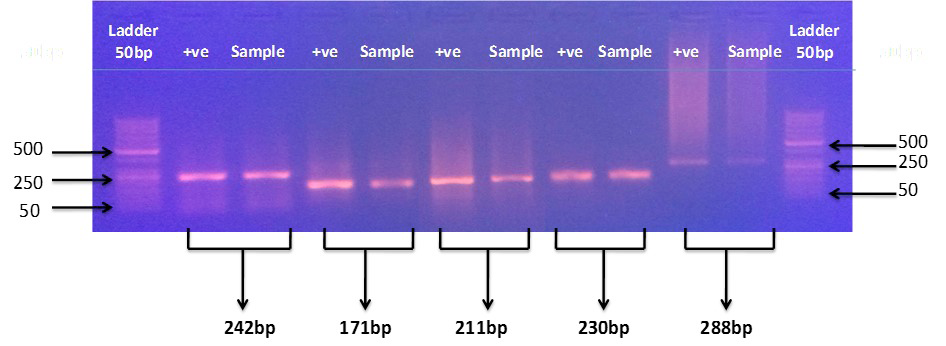
Agarose gel eletrophoresis of SAG2 gene products (242, 171, 211, 230 and 288bp).
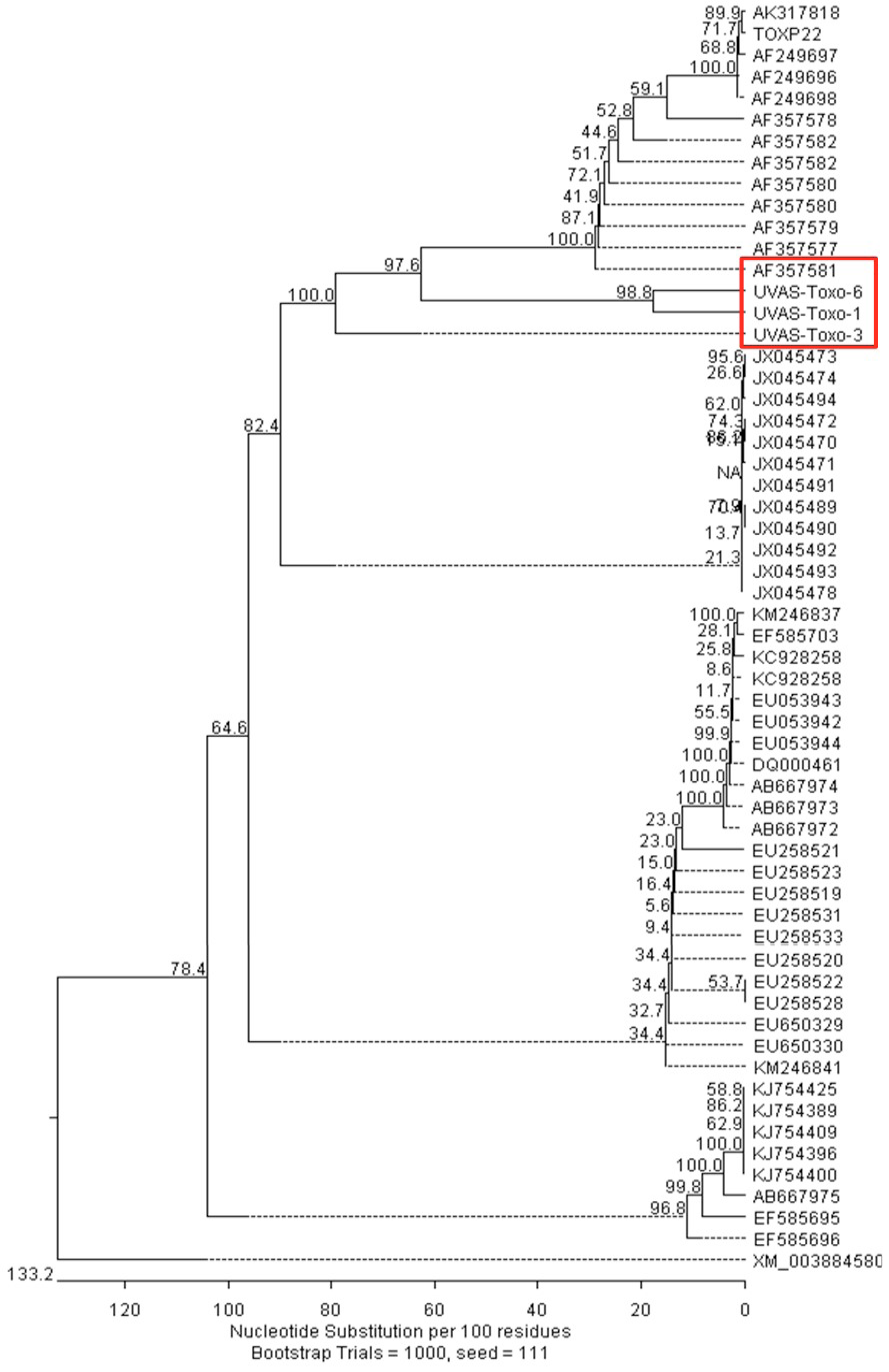
Phylogenetic and bootstrapping analysis of 3 isolates with published archetypal lineages and atypical strains. UVAS-Toxo 1, 3 and 6 are our isolates from cat feces. XM_00384580 is the SAG2 sequence of Neospora caninum served as out-group. AF357581 is the SAG2 sequence of atypical T. gondii strain.
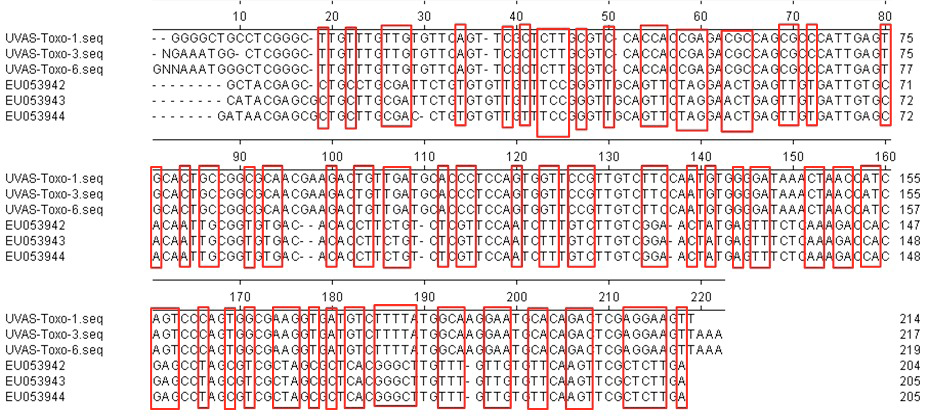
Clustal W alignment of 3 isolates of this study with the representative 3 clonal strains of Type I (EU053942), Type II (EU053943) and Type III (EU053944). Red rectangular marked sequences show dissimilarity of our isolates at 5’ locus of SAG2 with Type I, II and III strains.
References
- Abdel-Hameed, D.M. and Hassanein, O.M., 2008. Genotyping of Toxoplasma gondii strains from female patients with toxoplasmosis. J. Egypt. Soc. Parasitol., 38: 511-520.
- Ahern, K., 1993. DNA Star/LaserGene. Biotechnol. Softw., 10: 6-12.
- Ahmed, M. and Hafiz, A., 1989. Surveillance of toxoplasmosis in different groups. J. Pak. med. Assoc., 39: 183-186.
- Ajzenberg, D., Banuls, A.L., Su, C., Dumetre, A., Demar, M., Carme, B. and Darde, M.L., 2004. Genetic diversity, clonality and sexuality in Toxoplasma gondii. Int. J. Parasitol., 34: 1185-1196. https://doi.org/10.1016/j.ijpara.2004.06.007[CrossRef]
- Ali, A., Khalil, M. and Fawzia, T., 2017. Prevalence of Toxoplasma gondii in women population of Rafha City, Saudi Arabia. Pakistan J. Zool. 49: 1039-1047. http://dx.doi.org/10.17582/journal.pjz/2017.49.3.1039.1047[CrossRef]
- Araujo, J.B., da Silva, A.V., Rosa, R.C., Mattei, R.J., da Silva, R.C., Richini-Pereira, V.B. and Langoni, H., 2010. Isolation and multilocus genotyping of Toxoplasma gondii in seronegative rodents in Brazil. Vet. Parasitol., 174: 328-331. https://doi.org/10.1016/j.vetpar.2010.08.039[CrossRef]
- Asgari, Q., Fekri, M., Monabati, A., Kalantary, M., Mohammadpour, I., Motazedian, M.H. and Sarkari, B., 2013. Molecular genotyping of Toxoplasma gondii in Human spontaneous aborted fetuses in Shiraz, Southern Iran. Iran. J. Publ. Hlth., 42: 620-625.
- Baldursson, S. and Karanis, P., 2011. Waterborne transmission of protozoan parasites: Review of worldwide outbreaks – An update 2004–2010. Water Res., 45: 6603-6614. https://doi.org/10.1016/j.watres.2011.10.013[CrossRef]
- Behzadi, R., Roohvand, F., Razavi, M.R., Hovanessian, A. and Assmar, M., 2003. Genotyping of Toxoplasma gondii strains isolated from patients and mice by PCR-RFLP assay. Iran. J. Biotechnol., 1: 83.
- Beja-Pereira, A., Oliveira, R., Alves, P.C., Schwartz, M.K. and Luikart, G., 2009. Advancing ecological understandings through technological transformations in noninvasive genetics. Mol. Ecol. Resour., 9: 1279-1301. https://doi.org/10.1111/j.1755-0998.2009.02699.x[CrossRef]
- Benenson, M.W., Takafuji, E.T., Lemon, S.M., Greenup, R.L. and Sulzer, A.J., 1982. Oocyst-transmitted toxoplasmosis associated with ingestion of contaminated water. N. Engl. J. Med., 307: 666-669. https://doi.org/10.1056/NEJM198209093071107[CrossRef]
- Boughattas, S., Ayari, K., Sa, T., Aoun, K. and Bouratbine, A., 2014. Survey of the parasite Toxoplasma gondii in human consumed ovine meat in Tunis City. PLoS One, 9: e85044. https://doi.org/10.1371/journal.pone.0085044[CrossRef]
- Burland, T.G., 1999. DNASTAR’s Lasergene sequence analysis software. In: Bioinformatics methods and protocols. Springer, pp. 71-91. https://doi.org/10.1385/1-59259-192-2:71[CrossRef]
- Burrells, A., Bartley, P.M., Zimmer, I.A., Roy, S., Kitchener, A.C., Meredith, A., Wright, S.E., Innes, E.A. and Katzer, F., 2013. Evidence of the three main clonal Toxoplasma gondii lineages from wild mammalian carnivores in the UK. Parasitology, 140: 1768-1776. https://doi.org/10.1017/S0031182013001169[CrossRef]
- Cabral, A.D., Gama, A.R., Sodre, M.M., Savani, E.S., Galvao-Dias, M.A., Jordao, L.R., Maeda, M.M., Yai, L.E., Gennari, S.M. and Pena, H.F., 2013. First isolation and genotyping of Toxoplasma gondii from bats (Mammalia: Chiroptera). Vet. Parasitol., 193: 100-104. https://doi.org/10.1016/j.vetpar.2012.11.015[CrossRef]
- Carme, B., Demar, M., Ajzenberg, D. and Darde, M.L., 2009. Severe acquired toxoplasmosis caused by wild cycle of Toxoplasma gondii, French Guiana. Emerg. Infect. Dis., 15: 656-658. https://doi.org/10.3201/eid1504.081306[CrossRef]
- Coutinho, S.G., Lobo, R. and Dutra, G., 1982. Isolation of Toxoplasma from the soil during an outbreak of toxoplasmosis in a rural area in Brazil. J. Parasitol., 68: 866-868. https://doi.org/10.2307/3280995[CrossRef]
- da Silva, A.V., Pezerico, S.B., de Lima, V.Y., d’Arc Moretti, L., Pinheiro, J.P., Tanaka, E.M., Ribeiro, M.G. and Langoni, H., 2005. Genotyping of Toxoplasma gondii strains isolated from dogs with neurological signs. Vet. Parasitol., 127: 23-27. https://doi.org/10.1016/j.vetpar.2004.08.020[CrossRef]
- Dabritz, H.A., Miller, M.A., Atwill, E.R., Gardner, I.A., Leutenegger, C.M., Melli, A.C. and Conrad, P.A., 2007. Detection of Toxoplasma gondii-like oocysts in cat feces and estimates of the environmental oocyst burden. J. Am. Vet. med. Assoc., 231: 1676-1684. https://doi.org/10.2460/javma.231.11.1676[CrossRef]
- Darde, M.L., 2004. Genetic analysis of the diversity in Toxoplasma gondii. Ann. Ist Super Sanita, 40: 57-63.
- Darde, M.L., 2008. Toxoplasma gondii, “new” genotypes and virulence. Parasite, 15: 366-371. https://doi.org/10.1051/parasite/2008153366[CrossRef]
- Darde, M.L., Bouteille, B. and Pestre-Alexandre, M., 1988. Isoenzymic characterization of seven strains of Toxoplasma gondii by isoelectrofocusing in polyacrylamide gels. Am. J. trop. Med. Hyg., 39: 551-558. https://doi.org/10.4269/ajtmh.1988.39.551[CrossRef]
- Darde, M.L., Bouteille, B. and Pestre-Alexandre, M., 1992. Isoenzyme analysis of 35 Toxoplasma gondii isolates and the biological and epidemiological implications. J. Parasitol., 78: 786-794. https://doi.org/10.2307/3283305[CrossRef]
- Donahoe, S.L., Rose, K. and Slapeta, J., 2014. Multisystemic toxoplasmosis associated with a type II-like Toxoplasma gondii strain in a New Zealand fur seal (Arctocephalus forsteri) from New South Wales, Australia. Vet. Parasitol., 205: 347-353. https://doi.org/10.1016/j.vetpar.2014.07.022[CrossRef]
- Dubey, J.P., 1976. Reshedding of Toxoplasma oocysts by chronically infected cats. Nature, 262: 213-214. https://doi.org/10.1038/262213a0[CrossRef]
- Dubey, J.P., 1994. Toxoplasmosis. J. Am. Vet. med. Assoc., 205: 1593-1598.
- Dubey, J.P., 2001. Oocyst shedding by cats fed isolated bradyzoites and comparison of infectivity of bradyzoites of the VEG strain Toxoplasma gondii to cats and mice. J. Parasitol., 87: 215-219. https://doi.org/10.1645/0022-3395(2001)087[0215:OSBCFI]2.0.CO;2[CrossRef]
- Dubey, J.P., 2002. Tachyzoite-induced life cycle of Toxoplasma gondii in cats. J. Parasitol., 88: 713-717. https://doi.org/10.1645/0022-3395(2002)088[0713:TILCOT]2.0.CO;2[CrossRef]
- Dubey, J.P., 2005. Unexpected oocyst shedding by cats fed Toxoplasma gondii tachyzoites: in vivo stage conversion and strain variation. Vet. Parasitol., 133: 289-298. https://doi.org/10.1016/j.vetpar.2005.06.007[CrossRef]
- Dubey, J.P., Gomez-Marin, J.E., Bedoya, A., Lora, F., Vianna, M.C., Hill, D., Kwok, O.C., Shen, S.K., Marcet, P.L. and Lehmann, T., 2005a. Genetic and biologic characteristics of Toxoplasma gondii isolates in free-range chickens from Colombia, South America. Vet. Parasitol., 134: 67-72. https://doi.org/10.1016/j.vetpar.2005.07.013[CrossRef]
- Dubey, J.P., Huong, L.T., Lawson, B.W., Subekti, D.T., Tassi, P., Cabaj, W., Sundar, N., Velmurugan, G.V., Kwok, O.C. and Su, C., 2008a. Seroprevalence and isolation of Toxoplasma gondii from free-range chickens in Ghana, Indonesia, Italy, Poland and Vietnam. J. Parasitol., 94: 68-71. https://doi.org/10.1645/GE-1362.1[CrossRef]
- Dubey, J.P., Karhemere, S., Dahl, E., Sreekumar, C., Diabate, A., Dabire, K.R., Vianna, M.C., Kwok, O.C. and Lehmann, T., 2005b. First biologic and genetic characterization of Toxoplasma gondii isolates from chickens from Africa (Democratic Republic of Congo, Mali, Burkina Faso, and Kenya). J. Parasitol., 91: 69-72. https://doi.org/10.1645/GE-410R[CrossRef]
- Dubey, J.P., Velmurugan, G.V., Ulrich, V., Gill, J., Carstensen, M., Sundar, N., Kwok, O.C., Thulliez, P., Majumdar, D. and Su, C., 2008b. Transplacental toxoplasmosis in naturally-infected white-tailed deer: Isolation and genetic characterisation of Toxoplasma gondii from foetuses of different gestational ages. Int. J. Parasitol., 38: 1057-1063. https://doi.org/10.1016/j.ijpara.2007.11.010[CrossRef]
- Dubey, J.P., Vianna, M.C., Sousa, S., Canada, N., Meireles, S., Correia da Costa, J.M., Marcet, P.L., Lehmann, T., Darde, M.L. and Thulliez, P., 2006. Characterization of Toxoplasma gondii isolates in free-range chickens from Portugal. J. Parasitol., 92: 184-186. https://doi.org/10.1645/GE-655R.1[CrossRef]
- Dubey, J.P., Zhu, X.Q., Sundar, N., Zhang, H., Kwok, O.C. and Su, C., 2007. Genetic and biologic characterization of Toxoplasma gondii isolates of cats from China. Vet. Parasitol., 145: 352-356. https://doi.org/10.1016/j.vetpar.2006.12.001[CrossRef]
- Elamin, M.H., 2014. Genotyping of Toxoplasma gondii from Rats (Rattus rattus) in Riyadh, Saudi Arabia. Korean J. Parasitol., 52: 257-261. https://doi.org/10.3347/kjp.2014.52.3.257[CrossRef]
- Fallah, E., Hajizadeh, M., Farajnia, S. and Khanmahammadi, M., 2013. SAG2 locus genotyping of Toxoplasma gondii in meat products of East Azerbaijan Province, North West of Iran during 2010-2011. Afri. J. Biotechnol., 10: 13631-13635.
- Fazaeli, A. and Ebrahimzadeh, A., 2007. A new perspective on and re-assessment of SAG2 locus as the tool for genetic analysis of Toxoplasma gondii isolates. Parasitol. Res., 101: 99-104. https://doi.org/10.1007/s00436-006-0449-8[CrossRef]
- Ferreira, I.M., Vidal, J.E., Costa-Silva, T.A., Meira, C.S., Hiramoto, R.M., Penalva de Oliveira, A.C. and Pereira-Chioccola, V.L., 2008. Toxoplasma gondii: genotyping of strains from Brazilian AIDS patients with cerebral toxoplasmosis by multilocus PCR-RFLP markers. Exp. Parasitol., 118: 221-227. https://doi.org/10.1016/j.exppara.2007.08.006[CrossRef]
- Frenkel, J.K., Hassanein, K.M., Hassanein, R.S., Brown, E., Thulliez, P. and Quintero-Nunez, R., 1995. Transmission of Toxoplasma gondii in Panama City, Panama: a five-year prospective cohort study of children, cats, rodents, birds and soil. Am. J. trop. Med. Hyg., 53: 458-468. https://doi.org/10.4269/ajtmh.1995.53.458[CrossRef]
- Frenkel, J.K., Ruiz, A. and Chinchilla, M., 1975. Soil survival of Toxoplasma oocysts in Kansas and Costa Rica. Am. J. trop. Med. Hyg., 24: 439-443. https://doi.org/10.4269/ajtmh.1975.24.439[CrossRef]
- Fuentes, I., Rubio, J.M., Ramirez, C. and Alvar, J., 2001. Genotypic characterization of Toxoplasma gondii strains associated with human toxoplasmosis in Spain: direct analysis from clinical samples. J. clin. Microbiol., 39: 1566-1570. https://doi.org/10.1128/JCM.39.4.1566-1570.2001[CrossRef]
- Fukushima, M., Kakinuma, K. and Kawaguchi, R., 2002. Phylogenetic analysis of Salmonella, Shigella, and Escherichia coli strains on the basis of the gyrB gene sequence. J. clin. Microbiol., 40: 2779-2785. https://doi.org/10.1128/JCM.40.8.2779-2785.2002[CrossRef]
- Gallego, C., Saavedra-Matiz, C. and Gomez-Marin, J.E., 2006. Direct genotyping of animal and human isolates of Toxoplasma gondii from Colombia (South America). Acta Trop., 97: 161-167. https://doi.org/10.1016/j.actatropica.2005.10.001[CrossRef]
- Grigg, M.E., Ganatra, J., Boothroyd, J.C. and Margolis, T.P., 2001. Unusual abundance of atypical strains associated with human ocular toxoplasmosis. J. Infect. Dis., 184: 633-639. https://doi.org/10.1086/322800[CrossRef]
- Herrmann, D.C., Pantchev, N., Vrhovec, M.G., Barutzki, D., Wilking, H., Frohlich, A., Luder, C.G., Conraths, F.J. and Schares, G., 2010. Atypical Toxoplasma gondii genotypes identified in oocysts shed by cats in Germany. Int. J. Parasitol., 40: 285-292. https://doi.org/10.1016/j.ijpara.2009.08.001[CrossRef]
- Honore, S., Couvelard, A., Garin, Y.J., Bedel, C., Henin, D., Darde, M.L. and Derouin, F., 2000. Genotyping of Toxoplasma gondii strains from immunocompromised patients. Pathol. Biol. (Paris), 48: 541-547.
- Howe, D.K., Honore, S., Derouin, F. and Sibley, L.D., 1997. Determination of genotypes of Toxoplasma gondii strains isolated from patients with toxoplasmosis. J. clin. Microbiol., 35: 1411-1414.
- Howe, D.K. and Sibley, L.D., 1995. Toxoplasma gondii comprises three clonal lineages: correlation of parasite genotype with human disease. J. Infect. Dis., 172: 1561-1566. https://doi.org/10.1093/infdis/172.6.1561[CrossRef]
- Karanis, P., Aldeyarbi, H.M., Mirhashemi, M.E. and Khalil, K.M., 2013. The impact of the waterborne transmission of Toxoplasma gondii and analysis efforts for water detection: an overview and update. Environ. Sci. Pollut. Res. Int., 20: 86-99. https://doi.org/10.1007/s11356-012-1177-5[CrossRef]
- Khan, A., Taylor, S., Ajioka, J.W., Rosenthal, B.M. and Sibley, L.D., 2009. Selection at a single locus leads to widespread expansion of Toxoplasma gondii lineages that are virulent in mice. PLoS Genet., 5: e1000404. https://doi.org/10.1371/journal.pgen.1000404[CrossRef]
- Lass, A., Pietkiewicz, H., Szostakowska, B. and Myjak, P., 2012. The first detection of Toxoplasma gondii DNA in environmental fruits and vegetables samples. Eur. J. Clin. Microbiol. Infect. Dis., 31: 1101-1108.
- Lathuilliere, M., Menard, N., Gautier-Hion, A. and Crouau-Roy, B., 2001. Testing the reliability of noninvasive genetic sampling by comparing analyses of blood and fecal samples in Barbary macaques (Macaca sylvanus). Am. J. Primatol., 55: 151-158. https://doi.org/10.1002/ajp.1048[CrossRef]
- Lehmann, T., Blackston, C.R., Parmley, S.F., Remington, J.S. and Dubey, J.P., 2000. Strain typing of Toxoplasma gondii: comparison of antigen-coding and housekeeping genes. J. Parasitol., 86: 960-971. https://doi.org/10.2307/3284807[CrossRef]
- Lehmann, T., Graham, D.H., Dahl, E., Sreekumar, C., Launer, F., Corn, J.L., Gamble, H.R. and Dubey, J.P., 2003. Transmission dynamics of Toxoplasma gondii on a pig farm. Infect. Genet. Evol., 3: 135-141. https://doi.org/10.1016/S1567-1348(03)00067-4[CrossRef]
- Lehmann, T., Marcet, P.L., Graham, D.H., Dahl, E.R. and Dubey, J.P., 2006. Globalization and the population structure of Toxoplasma gondii. Proc. natl. Acad. Sci. U.S.A., 103: 11423-11428. https://doi.org/10.1073/pnas.0601438103[CrossRef]
- Lindstrom, I., Kaddu-Mulindwa, D.H., Kironde, F. and Lindh, J., 2006. Prevalence of latent and reactivated Toxoplasma gondii parasites in HIV-patients from Uganda. Acta Trop., 100: 218-222. https://doi.org/10.1016/j.actatropica.2006.11.002[CrossRef]
- Lindstrom, I., Sundar, N., Lindh, J., Kironde, F., Kabasa, J.D., Kwok, O.C., Dubey, J.P. and Smith, J.E., 2008. Isolation and genotyping of Toxoplasma gondii from Ugandan chickens reveals frequent multiple infections. Parasitology, 135: 39-45. https://doi.org/10.1017/S0031182007003654[CrossRef]
- McGinnis, S. and Madden, T.L., 2004. BLAST: at the core of a powerful and diverse set of sequence analysis tools. Nucl. Acids Res., 32: W20-W25. https://doi.org/10.1093/nar/gkh435[CrossRef]
- Mondragon, R., Howe, D.K., Dubey, J.P. and Sibley, L.D., 1998. Genotypic analysis of Toxoplasma gondii isolates from pigs. J. Parasitol., 84: 639-641. https://doi.org/10.2307/3284743[CrossRef]
- Morales, L.D., Pena, K., Kim, D.J., Lieman, J.H., 2012. SHP-2 and PTP-pest induction during Rb-E2F associated apoptosis. Cell. mol. Biol. Lett., 17: 422-432. https://doi.org/10.2478/s11658-012-0020-9[CrossRef]
- Nicolle, C. and Manceaux, L., 1909. Sur un Protozoaire nouveau du Gondi. Comptes Rendus Acad. Sci., 148: 369-372.
- Owen, M.R. and Trees, A.J., 1999. Genotyping of Toxoplasma gondii associated with abortion in sheep. J. Parasitol., 85: 382-384. https://doi.org/10.2307/3285654[CrossRef]
- Parmley, S.F., Gross, U., Sucharczuk, A., Windeck, T., Sgarlato, G.D. and Remington, J.S., 1994. Two alleles of the gene encoding surface antigen P22 in 25 strains of Toxoplasma gondii. J. Parasitol., 80: 293-301. https://doi.org/10.2307/3283761[CrossRef]
- Pena, H.F., Gennari, S.M., Dubey, J.P. and Su, C., 2008. Population structure and mouse-virulence of Toxoplasma gondii in Brazil. Int. J. Parasitol., 38: 561-569. https://doi.org/10.1016/j.ijpara.2007.09.004[CrossRef]
- Pena, H.F., Soares, R.M., Amaku, M., Dubey, J.P. and Gennari, S.M., 2006. Toxoplasma gondii infection in cats from Sao Paulo state, Brazil: seroprevalence, oocyst shedding, isolation in mice, and biologic and molecular characterization. Res. Vet. Sci., 81: 58-67. https://doi.org/10.1016/j.rvsc.2005.09.007[CrossRef]
- Prince, J.B., Auer, K.L., Huskinson, J., Parmley, S.F., Araujo, F.G. and Remington, J.S., 1990. Cloning, expression, and cDNA sequence of surface antigen P22 from Toxoplasma gondii. Mol. Biochem. Parasitol., 43, 97-106. https://doi.org/10.1016/0166-6851(90)90134-8[CrossRef]
- Remington, J.S., Araujo, F.G. and Desmonts, G., 1985. Recognition of different Toxoplasma antigens by IgM and IgG antibodies in mothers and their congenitally infected newborns. J. Infect. Dis., 152: 1020-1024. https://doi.org/10.1093/infdis/152.5.1020[CrossRef]
- Sabaj, V., Galindo, M., Silva, D., Sandoval, L. and Rodriguez, J.C., 2010. Analysis of Toxoplasma gondii surface antigen 2 gene (SAG2). Relevance of genotype I in clinical toxoplasmosis. Mol. Biol. Rep., 37: 2927-2933. https://doi.org/10.1007/s11033-009-9854-2[CrossRef]
- Saeij, J.P., Boyle, J.P., Coller, S., Taylor, S., Sibley, L.D., Brooke-Powell, E.T., Ajioka, J.W. and Boothroyd, J.C., 2006. Polymorphic secreted kinases are key virulence factors in toxoplasmosis. Science, 314: 1780-1783. https://doi.org/10.1126/science.1133690[CrossRef]
- Scott, P.R., Sargison, N.D. and Wilson, D.J., 2007. The potential for improving welfare standards and productivity in United Kingdom sheep flocks using veterinary flock health plans. Vet. J., 173: 522-531. https://doi.org/10.1016/j.tvjl.2006.02.007[CrossRef]
- Sibley, L.D. and Boothroyd, J.C., 1992. Virulent strains of Toxoplasma gondii comprise a single clonal lineage. Nature, 359: 82-85. https://doi.org/10.1038/359082a0[CrossRef]
- Sreekumar, C., Hill, D.E., Miska, K.B., Vianna, M.C.B., Yan, L., Myers, R.L. and Dubey, J.P., 2005. Genotyping and detection of multiple infections of Toxoplasma gondii using pyrosequencing. Int. J. Parasitol., 35: 991-999. https://doi.org/10.1016/j.ijpara.2005.03.017[CrossRef]
- Su, C., Howe, D.K., Dubey, J.P., Ajioka, J.W. and Sibley, L.D., 2002. Identification of quantitative trait loci controlling acute virulence in Toxoplasma gondii. Proc. natl. Acad. Sci. U.S.A., 99: 10753-10758. https://doi.org/10.1073/pnas.172117099[CrossRef]
- Taberlet, P., Waits, L.P. and Luikart, G., 1999. Noninvasive genetic sampling: look before you leap. Trends Ecol. Evolut., 14: 323-327. https://doi.org/10.1016/S0169-5347(99)01637-7[CrossRef]
- Tavalla, M., Oormazdi, H., Akhlaghi, L., Shojaee, S., Razmjou, E., Hadighi, R. and Meamar, A., 2013. Genotyping of Toxoplasma gondii Isolates from soil samples in Tehran, Iran. Iran. J. Parasitol., 8: 227-233.
- Thompson, J.D., Higgins, D.G., Gibson, T.J., 1994. CLUSTAL W: improving the sensitivity of progressive multiple sequence alignment through sequence weighting, position-specific gap penalties and weight matrix choice. Nucl. Acids Res., 22: 4673-4680. https://doi.org/10.1093/nar/22.22.4673[CrossRef]
- Vaudaux, J.D., Muccioli, C., James, E.R., Silveira, C., Magargal, S.L., Jung, C., Dubey, J.P., Jones, J.L., Doymaz, M.Z., Bruckner, D.A., Belfort, R., Jr., Holland, G.N. and Grigg, M.E., 2010. Identification of an atypical strain of Toxoplasma gondii as the cause of a waterborne outbreak of toxoplasmosis in Santa Isabel do Ivai, Brazil. J. Infect. Dis., 202: 1226-1233. https://doi.org/10.1086/656397[CrossRef]
- Velmurugan, G.V., Dubey, J.P. and Su, C., 2008. Genotyping studies of Toxoplasma gondii isolates from Africa revealed that the archetypal clonal lineages predominate as in North America and Europe. Vet. Parasitol., 155: 314-318. https://doi.org/10.1016/j.vetpar.2008.04.021[CrossRef]
- Vilares, A., Gargate, M.J., Ferreira, I., Martins, S., Julio, C., Waap, H., Angelo, H. and Gomes, J.P., 2014. Isolation and molecular characterization of Toxoplasma gondii isolated from pigeons and stray cats in Lisbon, Portugal. Vet. Parasitol., 205: 506-511. https://doi.org/10.1016/j.vetpar.2014.08.006[CrossRef]
- Wakaguri, H., Suzuki, Y., Sasaki, M., Srivastava, T.P., Vineet, S., Fujiyama, A., Kohara, Y., Sugano, S. and Watanabe, J., 2008. Use of full-length cDNA for genome annotation in apicomplexa parasite. Nucleic Acids Res., 36: D97–D101.
- Wan, Q.H. and Fang, S.G., 2003. Application of species-specific polymerase chain reaction in the forensic identification of tiger species. Foren. Sci. Int., 131: 75-78. https://doi.org/10.1016/S0379-0738(02)00398-5[CrossRef]
- Wang, L., Chen, H., Liu, D., Huo, X., Gao, J., Song, X., Xu, X., Huang, K., Liu, W., Wang, Y., Lu, F., Lun, Z.R., Luo, Q., Wang, X. and Shen, J., 2013. Genotypes and mouse virulence of Toxoplasma gondii isolates from animals and humans in China. PLoS One, 8: e53483. https://doi.org/10.1371/journal.pone.0053483[CrossRef]
- Weigel, R.M., Dubey, J.P., Siegel, A.M., Kitron, U.D., Mannelli, A., Mitchell, M.A., Mateus-Pinilla, N.E., Thulliez, P., Shen, S.K., Kwok, O.C. and Todd, K.S., 1995. Risk factors for transmission of Toxoplasma gondii on swine farms in Illinois. J. Parasitol., 81: 736-741. https://doi.org/10.2307/3283964[CrossRef]
- Wendte, J.M., Gibson, A.K. and Grigg, M.E., 2011. Population genetics of Toxoplasma gondii: new perspectives from parasite genotypes in wildlife. Vet. Parasitol., 182: 96-111. https://doi.org/10.1016/j.vetpar.2011.07.018[CrossRef]
- Xie, H., Zhang, C. and Gao, Z., 2004. Amperometric detection of nucleic acid at femtomolar levels with a nucleic acid/electrochemical activator bilayer on gold electrode. Analyt. Chem., 76: 1611-1617. https://doi.org/10.1021/ac0350965[CrossRef]
- Yan, C., Liang, L.J., Zhang, B.B., Lou, Z.L., Zhang, H.F., Shen, X., Wu, Y.Q., Wang, Z.M., Tang, R.X., Fu, L.L. and Zheng, K.Y., 2014. Prevalence and genotyping of Toxoplasma gondii in naturally-infected synanthropic rats (Rattus norvegicus) and mice (Mus musculus) in eastern China. Parasit. Vect., 7: 591. https://doi.org/10.1186/s13071-014-0591-6[CrossRef]
- Yilmaz, S.M. and Hopkins, S.H., 1972. Effects of different conditions on duration of infectivity of Toxoplasma gondii oocysts. J. Parasitol., 58: 938-939. https://doi.org/10.2307/3286589[CrossRef]
- Zaki, M., 1995. Seroprevalence of Toxoplasma gondii in domestic animals in Pakistan. J. Pak. med. Assoc., 45: 4-5.
- Zardi, O., Gabrielli, G., Balestrieri, A. and Macchia, G., 1967. Serologic data on Toxoplasma infection in certain countries in Asia and Africa. Nuovi. Ann. Ig Microbiol., 18: 491-497.
Services
Article usage statistics
Loading…