
Directional freezing was applied horizontally as well as vertically for separation of bacterial contamination in aqueous systems. After complete freezing, the samples were collected from various sections of the frozen mass and bacterial colonies were counted after proper Gram staining. It was found that more than 90% bacteria were separated along with freezing front and were concentrated in the centre in the case of radial freezing and at the bottom in case of vertical freezing.
Short Communication · Volume 50, Issue 4, 9 July 2018 · Open Access
Separation of Bacterial Contaminations in Aqueous Systems by Directional Freezing
· · · ·
Affiliations & Notes ⌄
- 1Institute of Chemistry, University of the Punjab, Lahore 54590 2School of Physical Sciences, University of the Punjab, Lahore 54590 3Department of Biology, Lahore Garrison University, Lahore , * Corresponding author: waheedjaami@gmail.com
Article Info ⌄
- Journal:
- Pakistan Journal of Zoology
- Published:
- 9 July 2018

From the article
- The radial and vertical freezing performed on different bacterial species i.e. Bacillus, Streptobacillus and Staphylococcus showed that bacteria moved along with freezing front and concentrated in the centre in case of radial freezing and at the bottom when vertical freezing was applied.
- It can be concluded that real water bacterial population has less ability of centralization as compared to the other species because of high concentration and different types of bacteria.
- From these studies it can be safely concluded that bacterial contamination in aqueous systems can be significantly reduced by employing unidirectional slow freezing.
- Both radial and vertical unidirectional freezing are efficiently applicable for separation and removal of bacterial contamination from aqueous systems.
Selected from the article's own text.
Abstract
Material and methods
All the chemicals and reagents including tryptone, yeast extract, agar and sodium chloride, used for growth and staining chemicals for bacterial colonies were of high quality and maximum purity and were purchased from BDH. Doubly deionized and sterilized water was used throughout this research work.
An easy way of bacterial mass identification is carried out in colony form using staining method because colonies of each bacterium differ from other in characteristics i.e. on the basis of shape, colour, and texture etc. .
For preparation of bacterial contaminated samples, the bacteria were grown in L-agar medium ; and L-Broth medium ; ; and then 80 ml of bacterial culture suspended in 400 ml of sterilized water in a glass bowl for observing the effect of directional freezing .
Directional freezing was performed in a circular glass tank having inner diameter of 30 cm and 15 cm depth. The wall of the glass tank was thick enough (about 1cm) to retard rapid cooling. After placing water sample inside the glass tank, the opening and bottom of the glass tank was insulated with one-inch thick polystyrene shield. This covering of tank ensured gradual cooling only from sides. After 24 h of continuous cooling in a freezer of domestic refrigerator, it was observed that bacterial colonies are concentrated in centre of bowl as shown in Figure 1. The frozen mass was taken out from the tank, softly in the form of ice. To monitor the effect of freezing on movement of bacteria quantitatively, aliquots from the centre, middle and side sections of the frozen mass was taken out with the help of a cork borer and transferred into various petri dishes for counting the bacterial colonies.
The synthetic water samples were also investigated by unidirectional downward freezing method. For this purpose, 1 mm thick plastic jar (4 x 20 cm) was employed. The sides of the jar were insulated by the help of a thick insulating tape. After continuous freezing for 24 h, the frozen mass was tapped out of the jar, cut into small pieces of equal length (3 cm) and transferred into different petri dishes. As the ice samples melted to water, they were analysed for counting of bacterial colonies in each petri dish.
To confirm the efficiency of the method, real contaminated water sample was arranged from a local river Ravi (near Lahore, Pakistan). To remove the suspended material the water was filtered twice through ordinary filter paper and then subjected to radial directional freezing.
Results and discussion
The radial and vertical freezing performed on different bacterial species i.e. Bacillus, Streptobacillus and Staphylococcus showed that bacteria moved along with freezing front and concentrated in the centre in case of radial freezing and at the bottom when vertical freezing was applied.
After gradual and directional freezing the concentration of Streptobacillus and Staphylococcus bacteria in different frozen sections was monitored. The results of radial freezing were showed concentration of 95% of the organism in the centre of the bowl. A little contamination was found in the samples taken from midway of the radius of the bowl and almost negligible bacteria was found along the walls of the container.
The experimental results showed that centralization of bacteria occurred significantly in the case real sample as well (Fig. 2). However, the migration of organism was not as efficient as in synthetic samples (with single type of bacteria). This was probably due to massive concentration and diverse bacterial species present in the real sample.
The order of centralization of all the three employed bacterial species was found as follows:
Bacillus > Streptobacillus > Staphylococcus
The difference in movement of bacterial species can be explained on the basis of their masses and the arrangements which they constitute. In case of bacillus, they have single cell arrangement carrying very less mass. Hence bacillus showed unique performance of centralization. Streptobacillus are found in form of small chains which have more mass than bacillus. Therefore showed lesser efficiency for centralization. Staphylococcus exist in the form of clusters having maximum mass as compared to remaining two species, giving less efficacy of centralization. It can be concluded that real water bacterial population has less ability of centralization as compared to the other species because of high concentration and different types of bacteria. The relative efficiency of centralization for the three bacterial species along with real sample has been shown in Figure 3.
Here, we can mention that the concentration of micro-organism, mode of arrangement and mass of bacterial colonies, and the rate of cooling influence the movement of bacterial population significantly. It was observed that more the concentration of bacteria as in the case of Ravi water sample, there will be less efficacy to centralize the population. In addition, it was noted that faster cooling rates do not allow the ice front to push the contaminants so efficiently rather imprison them in solidifying water .
Experiments were conducted with a single species of bacteria’s and with mixture of bacteria’s (Ravi water sample) and in all cases, it was noted that better separation was carried out efficiently at low concentration of bacterial population. This is because when ice is crystallized, the crystals built up by pure water leaving the foreign species in the remaining liquid phase. Many research workers employed freezing process for ccentralizing the different foreign component of solutions . Ice growing from sides has pushed the particles or any other ingredients to the centre because of strong interactions between water molécules themselves in ice.
Actually, In case of radial unidirectional freezing, freezing takes place from sides to the centre. Water as a liquid has no specific geometry of molecules, randomly arranged and can perform three type of motion i.e. rotatory, vibratory and translatory motion. So, liquid water molecules require more area to perform all types of motion. Whereas water as ice has specific hexagonal crystalline geometry and tightly bonded to each other through H-bonding and performing just vibratory motion as molecules are tightly bounded to one another in hexagonal shape. So different foreign substances prefer to live in liquid phase as compared to ice. That is the case, whenever ice crystals start to from, will push the any other substances like gasses, biological materials, dyes, chemicals etc. towards the liquid portion, and the same case we have observed in all our experiments (Fig. 4).
Conclusion
From these studies it can be safely concluded that bacterial contamination in aqueous systems can be significantly reduced by employing unidirectional slow freezing. The method can be especially useful in cold regions. However, the performance of separation depends upon the rate of cooling and concentration of the contaminants. Both radial and vertical unidirectional freezing are efficiently applicable for separation and removal of bacterial contamination from aqueous systems.
Statement of conflicts of interest
Figures
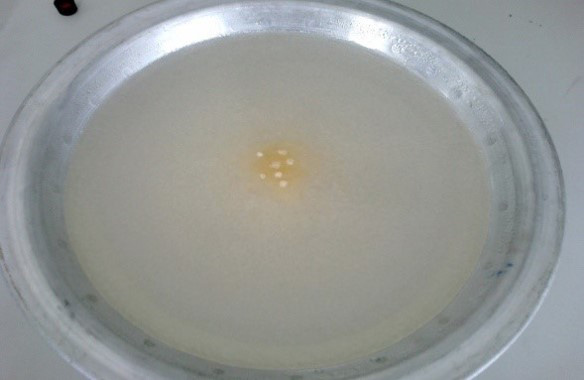
Bacterial colonies concentrated in centre by radial freezing.
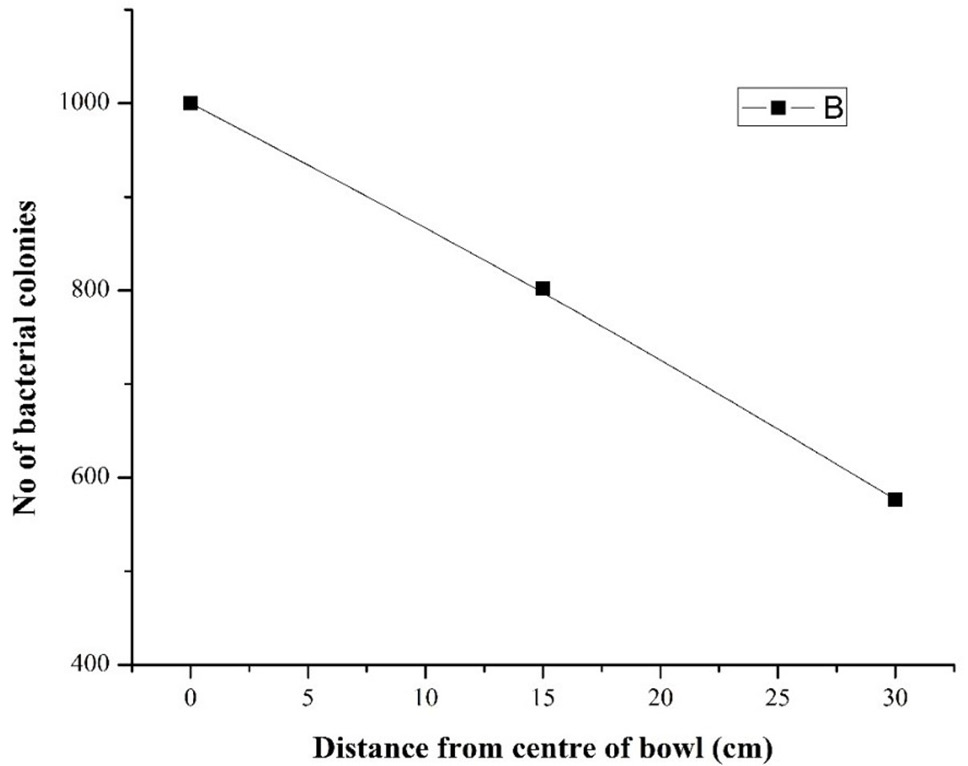
Concentration of bacterial colonies in Ravi water samples taken at different distances from centre of bowl after applying unidirectional radial freezing.
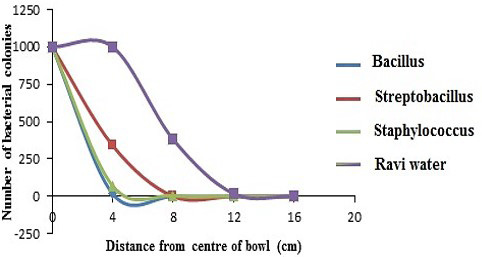
Comparison of centralization of three bacterial species along with Ravi water sample.
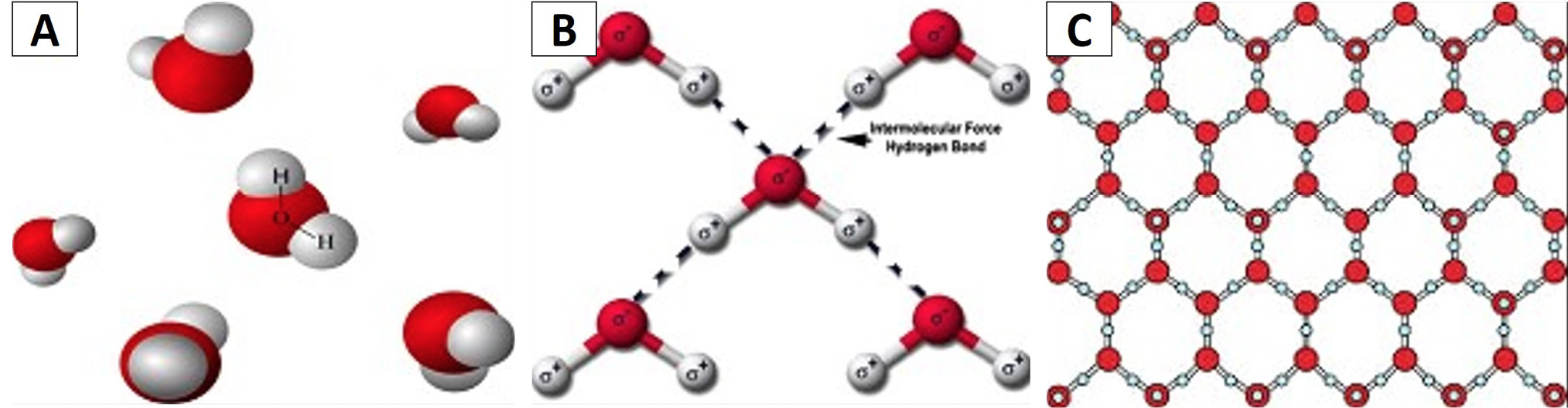
Comparison of interaction in water molecules in vapor (A), liquid (B) and ice state (C).
References
- Ausubel, F.M., Brent, R., Kingston, R.E., Moore, D.D., Seidman, J., Smith, J.A. and Struhl, K., 1992. Short protocols in molecular biology. Greene Pub. Associates, Brooklyn, NY.
- Baker, R.A., 1967. Water Res., 1: 97-113. https://doi.org/10.1016/0043-1354(67)90078-4[CrossRef]
- Cao, E., Chen, Y., Cui, Z. and Foster, P.R., 2003. Biotechnol. Bioengin., 82: 684-690. https://doi.org/10.1002/bit.10612[CrossRef]
- Davey, H.M. and Kell, D.B., 1996. Microbiol. Rev., 60: 641-696.
- Elford, B. and Walter, C., 1972. Cryobiology, 9: 82-100. https://doi.org/10.1016/0011-2240(72)90015-6[CrossRef]
- Elmore, W.W., 1968. Water purification by natural freezing. Master’s thesis, University of Wyoming, Laramie, Wyoming, pp. 98.
- Eriksson, J.H., Hinrichs, W.L., de Jong, G.J., Somsen, G.W. and Frijlink, H.W., 2003. Pharmaceut. Res., 20: 1437-1443. https://doi.org/10.1023/A:1025762328267[CrossRef]
- Gao, W., Habib, M. and Smith, D., 2009. Desalination, 245: 108-119. https://doi.org/10.1016/j.desal.2008.06.013[CrossRef]
- Halde, R., 1980. Water Res., 14: 575-580. https://doi.org/10.1016/0043-1354(80)90115-3[CrossRef]
- Haq, I., Durrani, A.Z., Khan, M.S., Mushtaq, M.H., Ahmad, I., Khan, A. and Ali, M., 2018. Pakistan J. Zool., 50: 381-384. http://dx.doi.org/10.17582/journal.pjz/2018.50.1.sc5[Full text][CrossRef]
- Lennox, E., 1955. Virology, 1: 190-206. https://doi.org/10.1016/0042-6822(55)90016-7[CrossRef]
- Li, X., Li, Z., Ding, Y., Liu, S., Zhao, Z., Luo, L., Pang, H., Li, C., Li, H. and You, X., 2007. Cold Reg. Sci. Technol., 48: 55-63. https://doi.org/10.1016/j.coldregions.2006.09.006[CrossRef]
- Lorain, O., Thiebaud, P., Badorc, E. and Aurelle, Y., 2001. Water Res., 35: 541-547. https://doi.org/10.1016/S0043-1354(00)00287-6[CrossRef]
- Robinson, C., Boxe, C., Guzman, M., Colussi, A. and Hoffmann, M., 2006. J. Phys. Chem. B, 110: 7613-7616. https://doi.org/10.1021/jp061169n[CrossRef]
- Shafique, U., Anwar, J., Munawar, M.A., Zaman, W.U., Rehman, R., Dar, A., Salman, M., Saleem, M., Shahid, N. and Akram, M., 2011. Arabian J. Chem., 9: S47-S53. https://doi.org/10.1016/j.arabjc.2011.02.019[CrossRef]
- Shafique, U., Anwar, J., Rehman, R., Salman, M., Dar, A. and Jamil, N., 2012. J. Hydro-Environ. Res., 6: 221-226.
- Luria, S. and Burrous, J.W., 1957. J. Bacteriol., 74: 461.
- Luria, S., Adams, J. and Ting, R., 1960. Virology, 12: 348-390. https://doi.org/10.1016/0042-6822(60)90161-6[CrossRef]
- Shapiro, J., 1961. Science, 133: 2063-2064. https://doi.org/10.1126/science.133.3470.2063; https://doi.org/10.1126/science.133.3467.1828[CrossRef]
- Uchida, J.Y., Aragaki, M. and Yahata, P., 1986. Mycologia, 78: 587-592. https://doi.org/10.2307/3807770[CrossRef]
- Yamamoto, S.A. and Harris, L.J., 2001. J. Fd. Protec., 64: 1315-1319. https://doi.org/10.4315/0362-028X-64.9.1315[CrossRef]
Cited by 1 article
In journals published by ResearchersLinks.
Services
Article usage statistics
Loading…