
Habitat selection in agricultural landscapes by wild bird species shows their adaptability to maximize their opportunities to benefit from landscape crop production. We assessed seasonal patterns in avian diversity and distribution of agroforestry, urban croplands and rural croplands of Gujrat, Pakistan from April 2017 to March 2019. We randomly positioned three one km transects > 500 m apart at each sampling point in all three study sites. We conducted both morning (0500-0800 hours) and afternoon (1600-1900 hours) surveys, recording all birds seen or heard along transects to a maximum perpendicular distance of 50 m; 0.1 km2 surveyed per transect. In total, we recorded 39 bird species belonging to 20 families and eight orders. We found significant differences in seasonal abundance and species richness related to species’ residential status. Across the survey period, species diversity was greater in winter (October-March; H´= 3.279) than in summer (April-September; H´= 2.987). Spatially, avian diversity was highest in agroforestry (H´ = 4.261), then urban cropland (H´ = 3.746), and lowest in pure croplands (H´ = 2.247). Bird community composition changed significantly across seasons and agricultural systems. Resident species tended to contribute most to intra-seasonal and system community similarities. The avian communities reported from these semi-arid croplands indicate agriculture landscapes provide habitat for both summer visitors and winter visitors. Overall, agroforestry systems support higher richness and diversity than more open, cropland systems.
Research Article · Volume 55, Issue 1, 22 October 2022 · Open Access
Seasonal Diversity and Distribution Patterns of Birds in Agricultural Landscapes of Gujrat, Pakistan
· ·
Affiliations & Notes ⌄
- 1Department of Zoology, Faculty of Science, University of Gujrat, Gujrat, Pakistan 2School of Applied Sciences, The University of South Wales, Pontypridd, UK * Corresponding author: dr.mubashar@uog.edu.pk
Article Info ⌄
- Journal:
- Pakistan Journal of Zoology
- Published:
- 22 October 2022

From the article
- They were also the two main species driving seasonal dissimilarities in community composition (35.4%), with Asian green bee-eater and white wagtail significantly more abundant in the summer (U = 377.5, P = 0.002) and winter (U = 60.5, P < 0.001), respectively.
- Species diversity was highest in agroforestry (H´ = 4.261), then urban cropland (H´ = 3.746), and lowest in rural croplands (H´ = 2.247).
- Bank myna was significantly more abundant in urban croplands (18.9 ± 3.53) than in the other systems (H2 = 51.972, P < 0.001), and more abundant in agroforestry (9.2 ± 2.82) than rural croplands (6.2 ± 1.96; P < 0.01).
- House crow exhibited similar differences (H2 = 31.270, P < 0.001), with urban croplands supporting significantly higher abundances (18.8 ± 5.11) than agroforestry (12.9 ± 4.38) and rural croplands (9.6 ± 3.85; P < 0.01).
Selected from the article's own text.
Abstract
INTRODUCTION
Declines in global biodiversity are associated with a range of drivers, including changes in land use and intensive agriculture ; ; , with agricultural croplands and pastures now covering approximately 38% of the Earth’s total ice-free land . Intensive agriculture, derived by farm mechanization, pesticides and fertilizers usage, is a primary reason for declines in bird species richness and abundance ; global declines in about 60% of bird species listed as globally threatened on the IUCN Red List are due to agriculture intensification . Furthermore, anthropogenic activities directed towards maximizing food production often lead to declines in important ecosystem services ; ; , and often associated with biodiversity ; MEA, 2005; , 2012).
Birds are an important component of agricultural ecosystems; as insectivores, pollinators, scavengers and
seed dispersers help maintain the ecological balance within these landscapes ; . The importance of birds in agricultural landscapes has been well studied with reference to avian ecology ; ; ; conservation ; ; ; , and natural pest control ; ; ; . While there are concerns about economic losses associated with bird activities in agro-ecosystems systems, such as seed predation, this is outweighed by the ecosystem services and economic gains they provide ; ; MEA, 2005; . For example, while around 20% of agricultural production is destroyed by insects each year , enabling natural predators to control these insect populations can increase sustainable agricultural production systems and help improve crop resilience by preventing crop disasters , 2013). Despite this, the demands of an increasing human population , climate change , and land use are major threats to birds in agricultural landscapes.
Since birds are particularly sensitive to environmental change , monitoring and evaluating responses of bird communities, both in time and space, can assist in tracking overall ecosystem health ; , and identify key bird species that contribute to this health . Furthermore, assessing characteristic bird assemblages in croplands and understanding spatio-temporal patterns in their populations in agricultural landscapes is essential for developing effective conservation planning and land-use policy ; , both for biodiversity and local communities, and minimizing their impact on intensive agricultural practices in heterogeneous landscapes . Against this background, our main objectives were to provide a checklist of birds in a selected heterogeneous agro-ecosystem in Gujrat, Pakistan, to quantify spatio-temporal patterns in bird assemblages across different agricultural systems, and to support conservation planning in agricultural landscapes.
MATERIALS AND METHODS
Study area
Gujrat covers 3,192 km2 in the Chaj Doab region of Punjab province, Pakistan (32° and 35° N, 73° 45 °E). It is bordered by Jammu and Kashmir in the northeast, the Chenab River in the southeast, and the Jhelum River in the northwest. The region has a temperate climate, with a relatively short summer of temperatures reaching 45°C and winter temperatures dropping to below 2°C. The Kashmir border has an average annual rainfall of over 100 cm, down to 67 cm for Gujrat. In Gujrat, there are two major cropping seasons: kharif or monsoon crops are grown in summer (e.g. rice, maize, sugarcane, moong, mash, bajra and jowar); while rabi or winter crops, which harvested in the following spring, include wheat, gram, lentil (masoor), tobacco, rapeseed, barley and mustard.
Methods
The study focused on three locations in Gujrat: Hafiz Hayat (32°38′29.55″ N, 74°9′55.58″ E), Qadir colony (32° 37’ 50” N, 74° 4’ 55” E), and Shadiwal (32° 22’ 20” North, 73° 10’ 50”). Based on the specific vegetation cover observed, we categorized three agricultural types in the study landscape: agroforestry, which comprises trees interspersed with cereals and fodder crops; rural croplands, which include cereals, pulses and vegetables, ploughed soil, or cereal stubble of previous crops; and urban croplands, which consist of houses, sheds, crop fragments or gardens, roads and greenhouses.
We randomly positioned three 1 km line transects in each of the three study locations, from which we conducted bird surveys from April 2017 to March 2019. We conducted surveys randomly in mornings (05:00-08:00 h) and afternoons (16:00-19:00 h). We surveyed each transect once in the morning or afternoon each month with two observers walking at an average speed of 2 km/h (36 km surveyed annually per location). We recorded all birds seen or heard along transect lines to a maximum perpendicular distance of 50 m ; ; 0.1 km2 surveyed per transect.
We categorised each bird species by diet and their resident status , 1992; . We calculated species’ seasonal relative abundances and plotted rank abundances as a Whittaker plot. The bird communities were quantified using a suite of analyses in PRIMER v7 , which are described fully therein. Each transect was factorised by month, year and agricultural system, and the abundance data were pre-treated with a square root transformation to down-weight the influence of the most abundant species . A similarity matrix was constructed using the Bray-Curtis coefficient, and a similarity profile test (SIMPROF) was applied to a cluster analysis classification of samples. Sample similarities were ordinated using non-metric multidimensional scaling (nMDS), and tested for differences between bird communities, both spatially and temporally, using a two-way analysis of similarities (ANOSIM). A similarity of percentages analysis (SIMPER) was then conducted to identify the species contributing most to differences in communities across space and time. Differences in abundance of key species (those that contributed > 5% to dissimilarities between bird communities) were tested non-parametrically since species abundances were not normally distributed. A Bonferroni correction was applied to adjust critical values for groups of tests and avoid Type I errors. Community indices were calculated using the DIVERSE function in PRIMER v7 and estimated expected species richness by bootstrapping the species accumulation data. Bird diversity was calculated through Shannon-Wiener and Simpson’s indices.
RESULTS
In total, 39 bird species (17 residents, 14 winter visitors, five irregular visitors, and three summer visitors) representing 20 families and eight orders from April 2017 to March 2019 were recorded (Table I). All are listed globally as least concern. During 2017-18, we observed 6,449 birds (52.4% of observations) comprising 37 species, while in 2018-19 we recorded 5,851 birds (47.6%) belonging to 38 species (Table I). We did not record common starling (Sturnus vulgaris) or rosy starling (Pastor roseus) in 2017-18,
Table I. Temporal relative abundances, guild membership and residential status of bird species recorded in the croplands of Gujrat, Punjab, Pakistan from April 2017 to March 2019.
| S. No. | English / Local name | Scientific name | Feeding habit | Resident status | 2017-18 | 2018-19 | ||
| Winter (%) | Summer (%) | Winter(%) | Summer(%) | |||||
| Order Accipitriformes | ||||||||
| Family: Accipitridae | ||||||||
| 1 | Black kite | Milvus migrans | C | R | 4.44 | 5.28 | 4.8 | 6.3 |
| 2 | Black-winged kite | Elanus caeruleus | C | WV | 0.31 | -- | 0.33 | -- |
| 3 | Shikra | Accipiter badius | C | WV | 0.49 | -- | 0.48 | 0.12 |
| Order Bucerotiformes | ||||||||
| Family: Upupidae | ||||||||
| 4 | Common hoopoe | Upupa epops | I | R | 1.14 | 1.22 | 0.84 | 1.16 |
| Order Charadriiformes | ||||||||
| Family: Charadriidae | ||||||||
| 5 | Red-wattled lapwing | Vanellus indicus | C | R | 3.63 | 3.65 | 2.92 | 3.49 |
| 6 | White-tailed lapwing | Vanellus leucurus | I | SV | -- | 1.25 | -- | 1.32 |
| Order Columbiformes | ||||||||
| Family: Columbidae | ||||||||
| 7 | Eurasian collared-dove | Streptopelia decaocto | O | R | 3.32 | 1.96 | 3.73 | 3.49 |
| 8 | Oriental turtle-dove | Streptopelia orientalis | O | WV | 1.77 | 1.08 | 1.88 | 0.52 |
| 9 | Laughing dove | Spilopelia senegalensis | I | R | 2.09 | 2.06 | 2.42 | 2.93 |
| 10 | Western spotted dove | Spilopelia suratensis | G | IV | 1.55 | 1.02 | 0.39 | 0.88 |
| 11 | Rock dove | Columba livia | G | WV | 2.63 | 3.38 | 0.45 | -- |
| Order Coraciiformes | ||||||||
| Family: Meropidae | ||||||||
| 12 | Asian green bee-eater | Merops orientalis | I | IV | 3.55 | 6.9 | 1.28 | 5.41 |
| 13 | Blue-cheeked bee-eater | Merops persicus | I | SV | 2.4 | 1.52 | 1.28 | 1.44 |
| Family: Coraciidae | ||||||||
| 14 | Indian roller | Coracias benghalensis | I | IV | 0.69 | 1.83 | 1.31 | 1.32 |
| Family: Alcedinidae | ||||||||
| 15 | White-breasted kingfisher | Halcyon smyrnensis | C | R | 1.46 | 1.15 | 0.9 | 1.16 |
| Order Cuculiformes | ||||||||
| Family: Cuculidae | ||||||||
| 16 | Greater coucal | Centropus sinensis | I | IV | 0.34 | 0.34 | 0.57 | 0.08 |
| 17 | Western koel | Eudynamys scolopaceus | O | WV | 0.34 | -- | 0.3 | -- |
| Order Passeriformes | ||||||||
| Corvidae | ||||||||
| 18 | House crow | Corvus splendens | O | R | 6.78 | 8.8 | 6.62 | 10.91 |
| 19 | Rufous treepie | Dendrocitta vagabunda | O | R | 0.49 | -- | 0.9 | 0.48 |
| Family: Cisticolidae | ||||||||
| 20 | Yellow-bellied prinia | Prinia flaviventris | I | WV | 2.06 | -- | 1.94 | 0.36 |
| Family: Dicruridae | ||||||||
| 21 | Black drongo | Dicrurus macrocercus | I | R | 5.44 | 5.85 | 2.98 | 6.09 |
| Continued on next page..... | ||||||||
| S. No. | English / Local name | Scientific name | Feeding habit | Resident status | 2017-18 | 2018-19 | ||
| Winter (%) | Summer (%) | Winter(%) | Summer(%) | |||||
| Family: Laniidae | ||||||||
| 22 | Long-tailed shrike | Lanius schach | I | WV | 1.66 | -- | 1.79 | -- |
| Family: Leiotrichidae | ||||||||
| 23 | Common babbler | Argya caudata | I | R | 4.75 | 4.84 | 3.67 | 3.33 |
| Family: Leiothrichidae | ||||||||
| 24 | Jungle babbler | Turdoides striata | I | R | 3.95 | 4.6 | 3.04 | 3.53 |
| Family: Motacillidae | ||||||||
| 25 | White wagtail | Motacilla alba | I | WV | 5.38 | -- | 4.86 | 1.04 |
| Family: Muscicapidae | ||||||||
| 26 | Brown rockchat | Oenanthe fusca | I | R | 4.35 | 4.4 | 3.07 | 3.01 |
| 27 | Pied bushchat | Saxicola caprata | I | WV | 1.14 | -- | 1.01 | 0.16 |
| 28 | Indian robin | Saxicoloides fulicatus | I | WV | 1.83 | -- | 1.52 | -- |
| Family: Oriolidae | ||||||||
| 29 | Eurasian golden oriole | Oriolus oriolus | I | WV | 0.31 | -- | 0.36 | -- |
| Family: Passeridae | ||||||||
| 30 | House sparrow | Passer domesticus | O | R | 9.42 | 12.89 | 7.79 | 11.07 |
| Family: Phylloscopidae | ||||||||
| 31 | Mountain chiffchaff | Phylloscopus sindianus | I | WV | 0.86 | -- | 0.84 | -- |
| Family: Pycnonotidae | ||||||||
| 32 | Red-vented bulbul | Pycnonotus cafer | I | R | 1.57 | 3.72 | 3.31 | 4.81 |
| Family: Sturnidae | ||||||||
| 33 | Bank myna | Acridotheres ginginianus | O | R | 5.61 | 5.82 | 6.6 | 9.34 |
| 34 | Common myna | Acridotheres tristis | I | R | 7.01 | 8.56 | 8.39 | 8.9 |
| 35 | Common starling | Sturnus vulgaris | O | WV | -- | -- | 7.16 | -- |
| 36 | Rosy starling | Pastor roseus | O | WV | 0.69 | 0.81 | 2.75 | -- |
| Family: Nectariniidae | ||||||||
| 37 | Purple sunbird | Cinnyris asiaticus | N | SV | -- | 3.82 | -- | -- |
| Order Pelecaniformes | ||||||||
| Family: Ardeidae | ||||||||
| 38 | Cattle egret | Bubulcus ibis | I | R | 3.75 | 3.99 | 4.21 | 4.25 |
| 39 | Intermediate egret | Ardea intermedia | I | IV | 2.78 | 3.05 | 3.31 | 3.09 |
Feeding habit: C, carnivore; G, granivore; I, insectivore; O, omnivore; N, nectarivore. Resident status: R, resident; IV, irregular visitor; SV, summer visitor; WV, winter visitor.
nor purple sunbird (Cinnyris asiaticus) in 2018-19. Overall, the most frequently encountered species were house sparrow (Passer domesticus; 10.2% of all encounters), common myna (Acridotheres tristis; 8.2%), house crow (Corvus splendens; 8.1%), bank myna (Acridotheres ginginianus; 6.7%), black kite (Milvus migrans; 5.2%), and black drongo (Dicrurus macrocercus; 5.1%). Of the non-resident species, white wagtail (Motacilla alba) was the most commonly encountered winter visitor (2.9%), Asian green bee-eater (Merops orientalis) the most frequently encountered irregular visitor (4.2%), and blue-cheeked bee-eater (M. persicus) the most commonly recorded summer visitor (1.7%). Of the species recorded, 21 were insectivorous, nine were omnivorous, five carnivorous, two granivorous, and one (purple sunbird) was nectarivorous. There was no difference in the numbers of guild members across the two survey years (χ24 = 3.452, P = 0.514), the four seasons (χ212 = 3.452, P = 0.990; Fig. 1) or three habitats (χ28 = 1.422, P = 1.000; all with a Fisher’s exact test).
In both years, species richness was higher in the winter (Sr2018 = 36, Sr2019 = 37) than summer seasons (Sr2018 = 26, Sr2019= 29; Table II). We found a similar pattern in overall seasonal diversity: winters (H´2017-19= 3.279) and summers (H´2017-18 = 2.987). The presence of black-winged kite (Elanus caeruleus), western koel (Eudynamys scolopaceus), long-tailed shrike (Lanius schach), Indian robin (Saxicoloides fulicatus) and common starling only in winter months, and the addition of white-tailed lapwing (Vanellus leucurus) and purple sunbird in the summer tended to drive these broad community differences. Across seasons and years, species abundances were more evenly distributed in the summer of 2017-18 than in 2018-19 (Table II, Fig. 2).
Table II. Comparative spatio-temporal community indices calculated for the croplands of Gujrat, Punjab, Pakistan from April 2017 to March 2019.
| Community index | 2017-18 | 2018-19 | ||
| Winter | Summer | Winter | Summer | |
| Overall Sr | 36 | 27 | 37 | 29 |
| Number of individuals | 3,494 | 2,955 | 3,351 | 2,494 |
| Dominance (D) | 0.045 | 0.061 | 0.046 | 0.064 |
| Simpson’s (1-D) | 0.955 | 0.939 | 0.954 | 0.936 |
| Shannon’s (H’) | 3.279 | 2.987 | 3.284 | 2.952 |
| Evenness (e^H’/Sr) | 0.738 | 0.762 | 0.721 | 0.660 |
| Sr Agroforestry | 36 | 25 | 37 | 29 |
| Sr Rural croplands | 32 | 25 | 33 | 26 |
| Sr Urban croplands | 31 | 25 | 33 | 27 |
The composition of bird communities was significantly different between months (R = 0.491, P = 0.001) and seasons (R = 0.470, P = 0.001). Summer bird assemblages were 69.6% similar to each other, while winter bird communities were 75.1% similar (Table III). During both seasons, five resident species (house sparrow, house crow, bank and common myna, and black kite) contributed most to these similarities. Asian green bee-eater and white wagtail (Motacilla alba) were the only non-resident species contributing > 5% to community similarities. They were also the two main species driving seasonal dissimilarities in community composition (35.4%), with Asian green bee-eater and white wagtail significantly more abundant in the summer (U = 377.5, P = 0.002) and winter (U = 60.5, P < 0.001), respectively.
Spatially, we recorded all 39 species in agroforestry, 36 species in urban croplands, and 35 species in rural croplands. Black-winged kite was the only species unique to agroforestry, rosy and common starlings were not recorded in urban croplands, while western koel, pied bushchat (Saxicola caprata) and white-tailed lapwing were not recorded in rural croplands. We calculated the bootstrapped expected species richness as 39.2, 36.9 and 35.9 species in agroforestry, urban croplands and rural croplands, respectively. Species diversity was highest in agroforestry (H´ = 4.261), then urban cropland (H´ = 3.746), and lowest in rural croplands (H´ = 2.247). Of the 39 species, 32 appeared most abundant in agroforestry, six most abundant in urban croplands, and one (cattle egret Bubulcus ibis) most abundant in rural croplands (Fig. 3).
The cluster analysis did not identify any discernable clusters based on agricultural system, and all bird community samples were at least 50% similar to each other (Fig. 4). The nMDS ordinated samples based primarily on temporal similarities, and with a reliable representation of these patterns (stress = 0.15; Fig. 5). There were two broad species groups with strong correlations with the ordination. Asian green bee-eater and intermediate egret (Ardea intermedia), both irregular visitors, and white-breasted kingfisher (Halcyon smyrnensis) and laughing dove (Spilopelia senegalensis), both residents, had a strong correlation with the ordination of transitional months between summers and winters. Indian robin, white wagtail, and yellow-bellied prinia (Prinia flaviventris), all winter visitors, were strongly correlated with the ordination and clustering of the winter samples.
The composition of bird communities was significantly different spatially (R = 0.188, P = 0.001), and between all inter-habitat pairwise comparisons. Spatially, bird communities were most similar (80.9%) in the urban cropland landscape, with six key species contributing 48.7% towards these composition similarities (Table III). Agroforestry communities were 79.1% similar, with eight key species contributing 49.9% towards similarities in composition. Rural cropland communities were 74.9% similar, with eight key species contributing 56.2% to similarities in assemblages. Of these species, house sparrow, house crow, common and bank myna, black kite, and black drongo were key contributing species to similarities in all three agricultural systems. Additionally, jungle babbler (Turdoides striata) and red-vented bulbul (Pycnonotus cafer) contributed to community similarities in agroforestry, while cattle egret and common babbler (Argya caudata) contributed to assemblage similarities in the rural croplands.
Table III. Within-season and within habitat SIMPER results, including species contributing ≥ 5% to community similarities.
| Species | Abundance (± standard deviation) | Percentage (%) | ||
| Contribution | Cumulative | |||
| Season and similarity | ||||
| Summer | House sparrow | 4.1 ± 1.10 | 10.6 | 10.6 |
| 69.6% | House crow | 3.7 ± 0.90 | 9.5 | 20.1 |
| Bank myna | 3.2 ± 0.93 | 8.1 | 28.2 | |
| Common myna | 3.4 ± 1.32 | 7.8 | 36.0 | |
| Black drongo | 3.0 ± 0.57 | 7.7 | 43.7 | |
| Black kite | 2.8 ± 0.79 | 7.1 | 50.8 | |
| Jungle babbler | 2.3 ± 0.86 | 5.5 | 56.3 | |
| Red-vented bulbul | 2.4 ± 0.82 | 5.5 | 61.8 | |
| Asian green bee-eater | 2.8 ± 1.37 | 5.4 | 67.2 | |
| Winter | House sparrow | 4.0 ± 0.74 | 7.3 | 7.3 |
| 75.1% | Common myna | 3.8 ± 0.56 | 7.1 | 14.4 |
| House crow | 3.5 ± 0.66 | 6.5 | 20.9 | |
| Bank myna | 3.3 ± 0.86 | 5.8 | 26.7 | |
| Black kite | 2.9 ± 0.48 | 5.5 | 32.2 | |
| White wagtail | 2.9 ± 0.57 | 5.4 | 37.6 | |
| Common babbler | 2.8 ± 0.51 | 5.1 | 42.7 | |
| Habitat and similarity | ||||
| Agroforestry | House sparrow | 4.5 ± 1.18 | 7.9 | 7.9 |
| 79.1% | House crow | 3.5 ± 0.61 | 6.6 | 14.5 |
| Common myna | 3.6 ± 0.97 | 6.3 | 20.8 | |
| Bank myna | 3.0 ± 0.44 | 5.7 | 26.5 | |
| Black kite | 2.9 ± 0.45 | 5.5 | 32.0 | |
| Black drongo | 3.1 ± 0.70 | 5.4 | 37.4 | |
| Jungle babbler | 2.8 ± 0.48 | 5.4 | 42.8 | |
| Red-vented bulbul | 2.7 ± 0.51 | 5.1 | 49.9 | |
| Rural croplands | House sparrow | 3.6 ± 0.73 | 9.6 | 9.6 |
| 74.9% | House crow | 3.0 ± 0.61 | 7.8 | 17.4 |
| Common myna | 3.0 ± 0.89 | 7.4 | 24.8 | |
| Black drongo | 2.7 ± 0.53 | 7.0 | 31.8 | |
| Cattle egret | 3.0 ± 1.04 | 7.0 | 38.8 | |
| Bank myna | 2.5 ± 0.40 | 6.5 | 45.3 | |
| Black kite | 2.4 ± 0.72 | 5.9 | 51.2 | |
| Common babbler | 2.5 ± 0.95 | 5.0 | 56.2 | |
| Urban croplands | Bank myna | 4.3 ± 0.43 | 9.5 | 9.5 |
| 80.9% | House crow | 4.3 ± 0.60 | 9.4 | 18.9 |
| House sparrow | 4.1 ± 0.62 | 8.6 | 27.5 | |
| Common myna | 4.1 ± 0.95 | 8.4 | 35.9 | |
| Black kite | 3.3 ± 0.38 | 7.2 | 43.1 | |
| Black drongo | 2.8 ± 0.56 | 5.6 | 48.7 | |
Table IV. Between-habitat SIMPER results, including species contributing ≥ 5% to community dissimilarities. Species abundances are square-root transformed (for analysis).
| Habitat | Habitat dissimilarity (%) | Species | Abundance (± standard deviation) | Percentage contribution (%) | ||
| 1 | 2 | Habitat 1 | Habitat 2 | |||
| Rural croplands | Urban croplands | 24.5 | Bank myna | 2.5 ± 0.40 | 4.3 ± 0.43 | 7.8 |
| House crow | 3.0 ± 0.61 | 4.3 ± 0.60 | 6.2 | |||
| Brown rockchat | 1.5 ± 1.09 | 2.8 ± 1.30 | 5.9 | |||
| Red-wattled lapwing | 1.2 ± 1.58 | 1.7 ± 0.88 | 5.6 | |||
| Common myna | 3.0 ± 0.89 | 4.1 ± 0.95 | 5.6 | |||
| Agroforestry | Rural croplands | 22.4 | Red-wattled lapwing | 2.0 ± 1.10 | 1.2 ± 1.58 | 5.2 |
| Urban croplands | 21.1 | Bank myna | 3.0 ± 0.45 | 4.3 ± 0.43 | 5.8 | |
Regarding dissimilarities in the three agricultural communities, rural and urban cropland communities were most dissimilar to each other (24.5% community dissimilarity), with five species contributing 31.1% to differences in these assemblages and all more abundant in urban croplands than rural croplands (Table IV). The main species discriminating between community compositions of agroforestry and rural croplands (22.4% dissimilarity) was red-wattled lapwing (Vanellus indicus), which was more abundant in agroforestry (5.2 ± 3.27) than rural croplands (3.9 ± 5.48; untransformed abundances; H2= 4.616, P = 0.099). Agroforestry and urban croplands were the least dissimilar bird communities (21.1%). The abundances of four key discriminating species were significantly different across the three landscapes. Bank myna was significantly more abundant in urban croplands (18.9 ± 3.53) than in the other systems (H2 = 51.972, P < 0.001), and more abundant in agroforestry (9.2 ± 2.82) than rural croplands (6.2 ± 1.96; P < 0.01). House crow exhibited similar differences (H2 = 31.270, P < 0.001), with urban croplands supporting significantly higher abundances (18.8 ± 5.11) than agroforestry (12.9 ± 4.38) and rural croplands (9.6 ± 3.85; P < 0.01). Similarly, common myna was significantly more abundant in urban croplands (17.9 ± 4.80) than in the other landscapes (H2 = 27.577, P < 0.001), and more abundant in agroforestry (13.9 ± 5.29) than rural croplands (9.9 ± 4.31; P = 0.04). The abundance of brown rockchat (Oenanthe fusca) was significantly higher in urban croplands (9.5 ± 5.70) than in rural croplands (3.5 ± 2.95; H2 = 15.746, P < 0.001).
DISCUSSION
Studies on bird communities in agroforestry and agricultural landscapes emphasize the overall negative effects of anthropogenic activities and habitat modification ; ; . We examined the composition of bird assemblages in three agricultural landscapes, each with different levels of management intensity, and spatial and structural complexity. We found that while simple community metrics did not differ greatly temporally or spatially, the composition of these communities did change significantly regarding species presence and their relative abundances.
Six resident species comprised > 43% of total bird abundance, and all of these are associated with more open, drier habitats ; . For example, house sparrows tend to occur in localized populations aggregated around farmyards, with an ecological niche often characterized by an interaction with anthropogenic development and more urbanised environments . Bank myna is commonly associated with drier habitat in modified landscapes, while house crow is associated with anthropogenically-modified habitats throughout its range .
Overall species richness (alpha diversity) and associated diversity metrics were not greatly different across the three agricultural systems, yet agroforestry consistently had the highest bird community measures, and as reported in other agricultural landscapes ; ; . All 39 species recorded in our study were found in agroforestry, compared to the cropland systems, and the majority of these were more abundant in agroforestry too. In addition, the only species we recorded as unique to one habitat, black-winged kite, was in agroforestry, which may reflect the greater tree cover and structural complexity of this particular landscape. Two species (rosy and common starlings) were absent from urban croplands, and three absent from rural croplands (western koel, pied bushchat, white-tailed lapwing), representing a 5.1% and 7.7% loss of total species richness, respectively. Rural croplands appeared to benefit one species, cattle egret, which was the only species most abundant in this system, reflecting its associated with livestock in dry grasslands .
Bird community composition (presence and relative abundance) was affected by agricultural system. We found that season strongly affected assemblage composition in the three different landscapes. This effect appeared to be stronger in the winter than summer, when species richness and diversity were higher, and indicative of more winter visitors (14 species) utilizing these landscapes than summer visitors (three species). Many of these winter visitors undertake seasonal altitudinal migrations in search of food and favourable climatic conditions , 2016), and these agricultural landscapes may provide alternative food sources, especially for insectivores, which were the most numerous winter visitors, and granivores .
Such gradients in landscape modification influence guild representation through resource availability ; ; ; . We found that carnivorous, frugivorous, and herbivorous bird species had lower diversity and abundances in the more intensively managed agricultural areas, while omnivore, insectivores, and granivores had higher diversity and abundances in these systems. Similar guild-agroecosystem trends are reported elsewhere ; ; and attributed to food availability.
Our study is not robust to seasonal climatic fluctuations influencing the presence and relative abundance of visiting species, specifically. For example, Asian green bee-eater was the most frequently recorded irregular visitor, particularly in the summer months, and with higher abundance in 2017-18 than 2018-19. This inter-annual difference could have resulted from the below average precipitation recorded in Punjab in 2017 (Qiaser, 2017) driving greater numbers in agroecosystems that can support insectivorous species .
While agroforestry retained more forest-like structure than the cropland systems, agricultural system did not necessarily affect all those species more associated with open forest habitats, e.g. red-vented bulbul and purple sunbird . The retention of scrub and edge habitats appears to support similar numbers of purple sunbird regardless of underlying agricultural system, perhaps providing sufficient nectar resources for this nomadic species , and while red-vented bulbul were more abundant in agroforestry, this was not significantly different to the other systems.
While it is not known what species richness and abundances undisturbed habitat in this landscape may support, we quantify agroforestry as
the least impactful agricultural system on bird communities in the study area, while acknowledging that this agroecosystem usually supports lower numbers of species than natural forests ; . Agroforestry is the least disturbed of the agricultural systems and subtly, yet significantly, better supports bird communities of agroecosystems compared to the more open, agricultural croplands of Gujrat.
ACKNOWLEDGEMENT
We are greatful to MPhil Scholars of the Department of Zoology, University of Gujrat for their help in collecting field data.
Statement of conflict of interest
The authors have declared no conflict of interest.
Figures
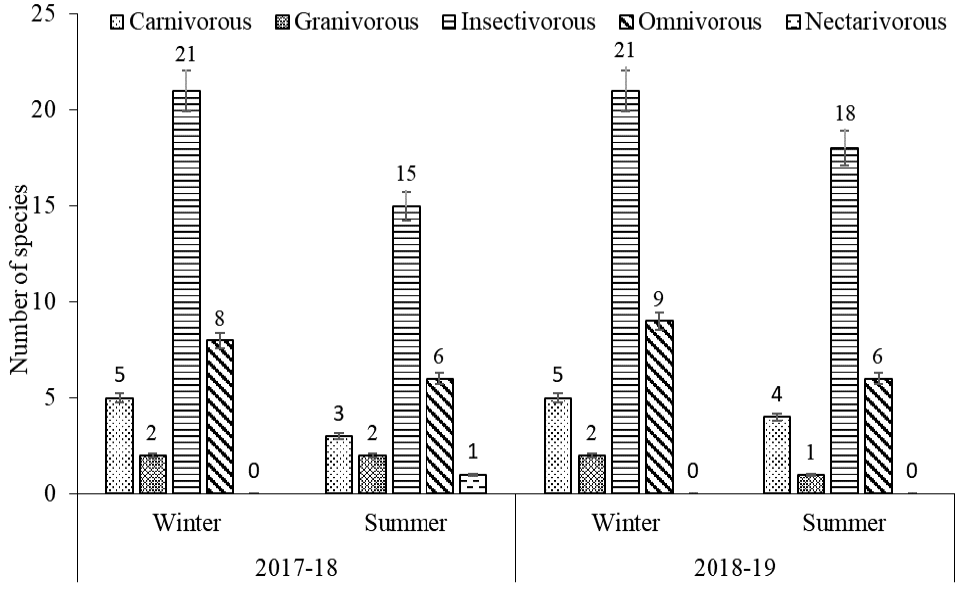
Seasonal species richness (± SE) of feeding guilds in the study area from April 2017 to March 2019.
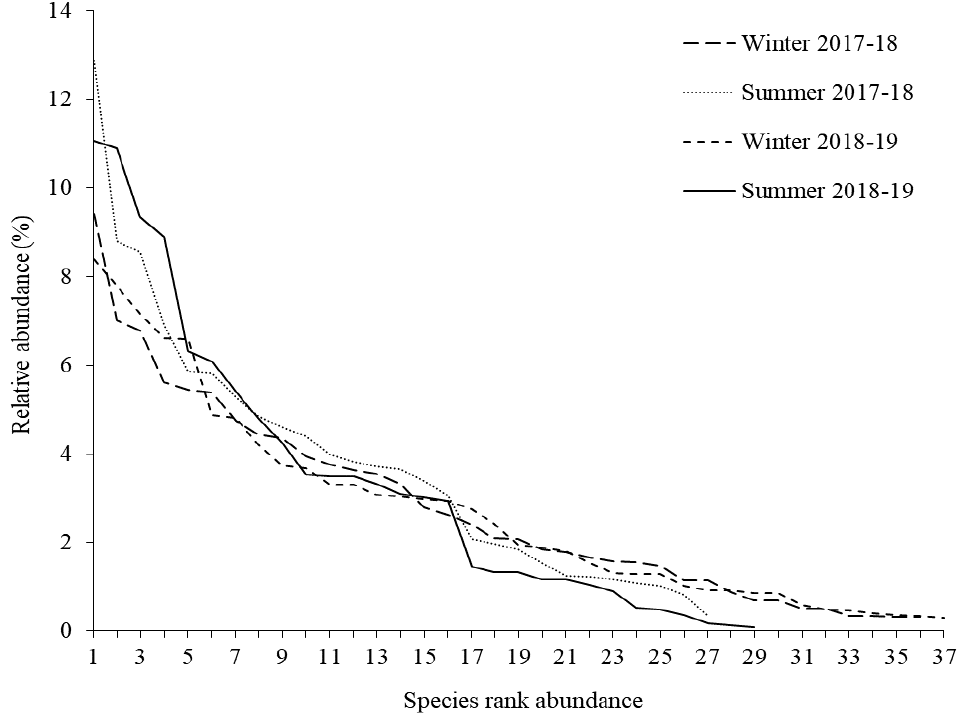
Whittaker plot (rank abundance) of seasonal species’ relative abundances.
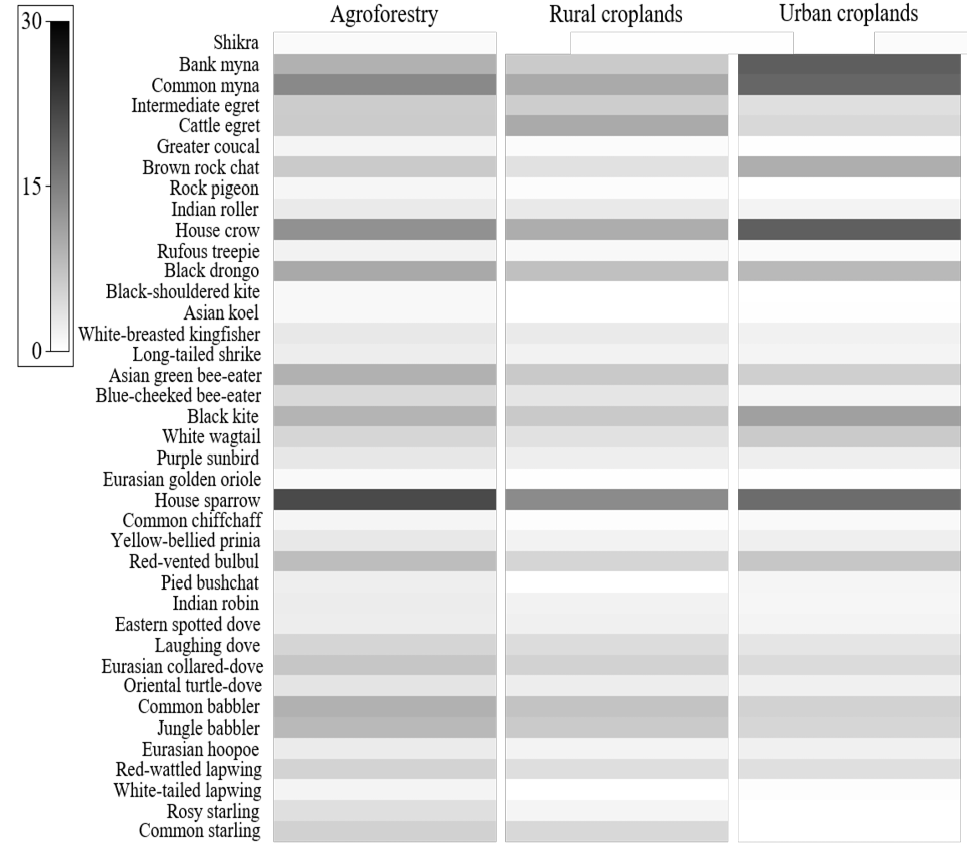
Shade plot of average species abundances from the three different habitat types.
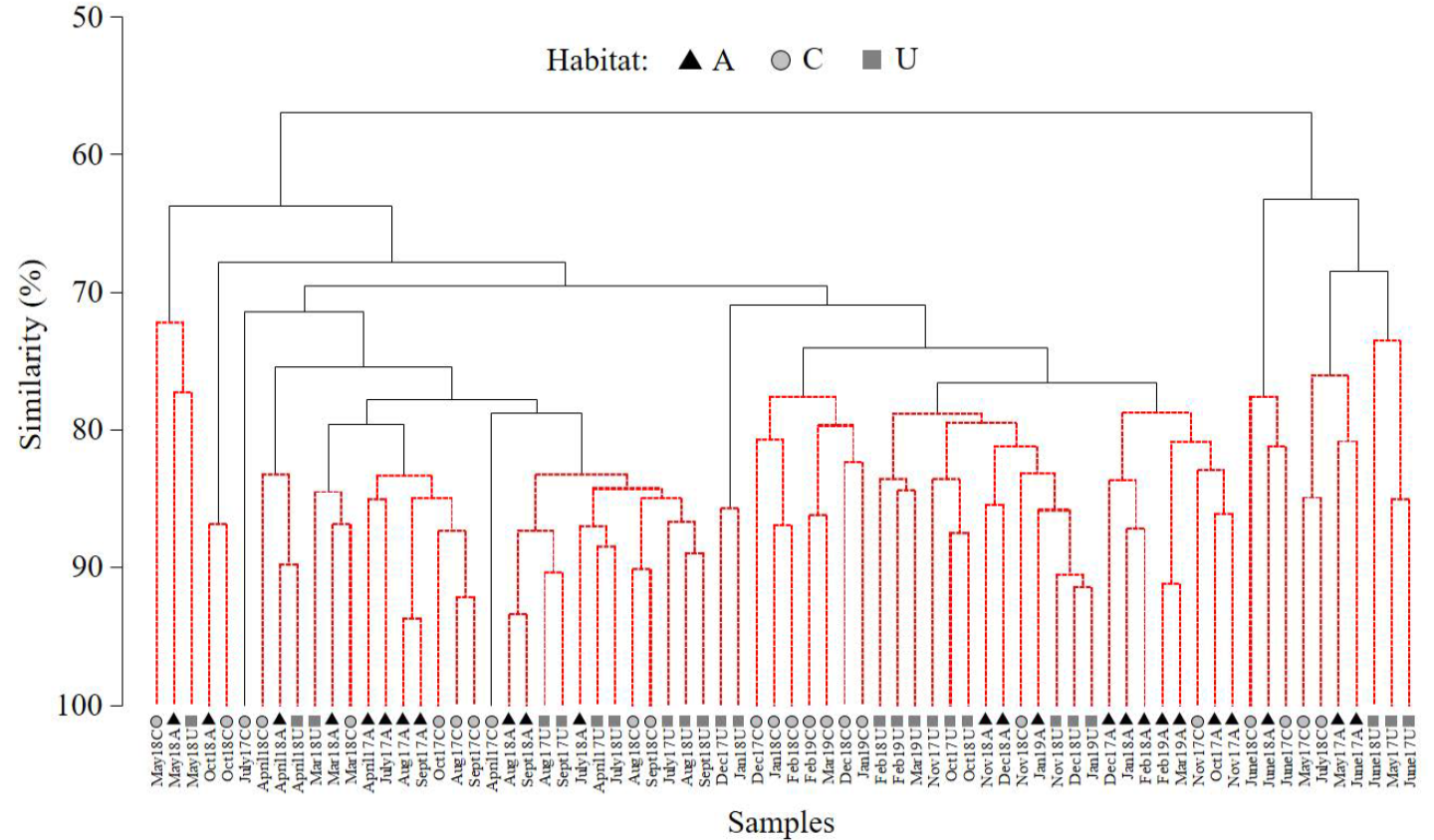
Cluster analysis dendrogram of monthly bird community samples from the three habitats from April 2017 to March 2019. Clusters are based on Bray-Curtis similarities, with distinct sample clusters depicted by black branches.
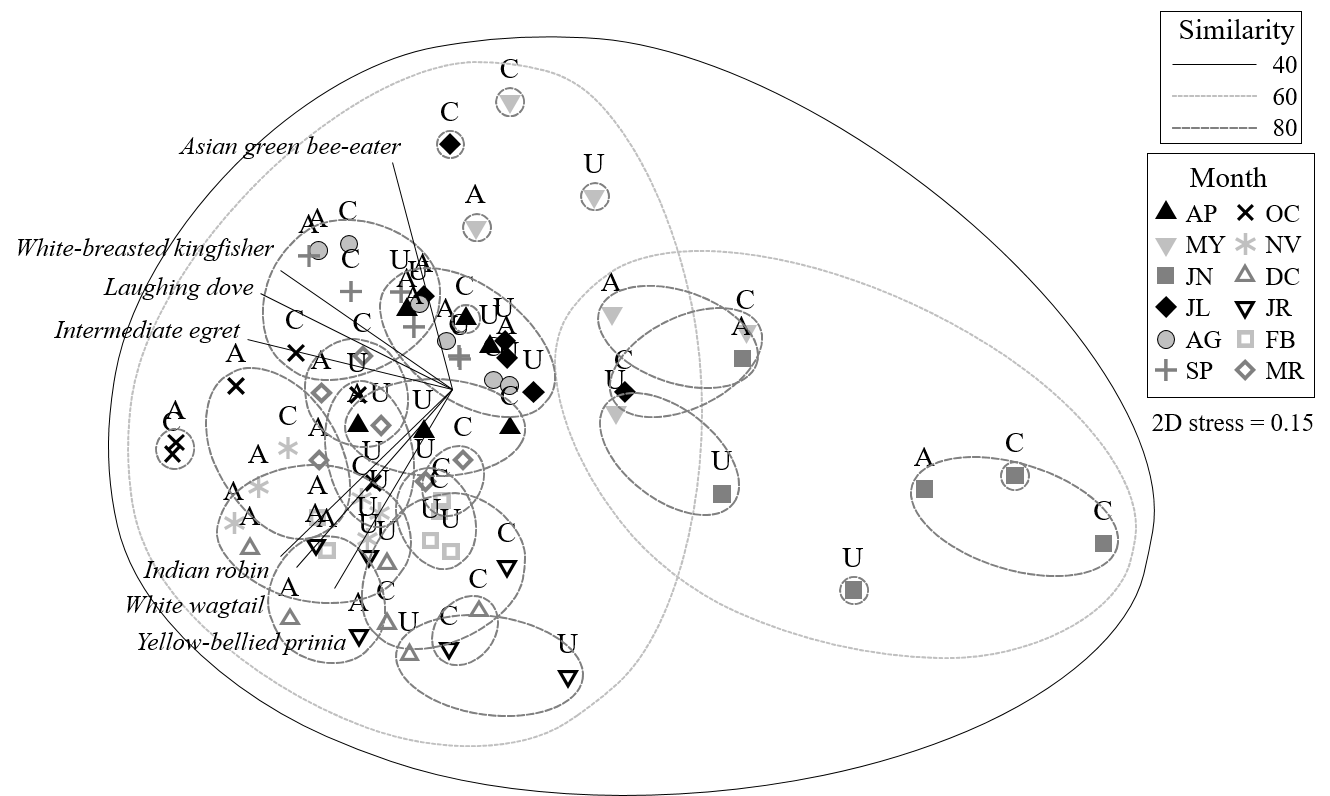
nMDS ordination of monthly bird community samples from the three habitats from April 2017 to March 2019. Samples are circled based on Bray-Curtis similarities of 40, 60 and 80%. Vectors are included for species with strong correlations (rp > 0.70) with the ordination of bird communities.
References
- Anderson, S.H., Kelly, D., Ladley, J.J., Molloy, S. and Terry, J., 2011. Cascading effects of bird functional extinction reduce pollination and plant density. Science, 331: 1068-1071. https://doi.org/10.1126/science.1199092[CrossRef]
- Bael, S.A.V., Philpott, S.M., Greenberg, R., Bichier, P., Barber, N.A., Mooney, K.A. and Gruner, D.S., 2008. Birds as predators in tropical agroforestry systems. Ecology, 89: 928-934. https://doi.org/10.1890/06-1976.1[CrossRef]
- Balmer, D. and Murdoch, D., 2009. Around the region. Sandgrouse, 31: 91-103.
- Bhagwat, S.A., Willis, K.J., Birks, H.J.B. and Whittaker, R.J., 2008. Agroforestry: A refuge for tropical biodiversity? Trends Ecol. Evol., 23: 261-267. https://doi.org/10.1016/j.tree.2008.01.005[CrossRef]
- Bibby, C.J., Burgess, N.D., Hill, D.A. and Mustoe, S., 2000. Bird census techniques. Elsevier.
- Bommarco, R., Kleijn, D. and Potts, S.G., 2013. Ecological intensification: Harnessing ecosystem services for food security. Trends Ecol. Evol., 28: 230-238. https://doi.org/10.1016/j.tree.2012.10.012[CrossRef]
- Bommarco, R., Miranda, F., Bylund, H. and Björkman, C., 2011. Insecticides suppress natural enemies and increase pest damage in cabbage. J. econ. Ent., 104: 782-791. https://doi.org/10.1603/EC10444[CrossRef]
- Bonning, B.C. and Chougule, N.P., 2014. Delivery of intrahemocoelic peptides for insect pest management. Trends Biotechnol., 32: 91-98. https://doi.org/10.1016/j.tibtech.2013.08.001[CrossRef]
- Borad, C., Mukherjee, A. and Parasharya, B., 2001. Damage potential of Indian sarus crane in paddy crop agroecosystem in Kheda district Gujarat, India. Agric. Ecosyst. Environ., 86: 211-215. https://doi.org/10.1016/S0167-8809(00)00275-9[CrossRef]
- Bradford, D.F., Franson, S.E., Neale, A.C., Heggem, D.T., Miller, G.R. and Canterbury, G.E., 1998. Bird species assemblages as indicators of biological integrity in Great Basin rangeland. Environ. Monit. Assess., 49: 1-22. https://doi.org/10.1023/A:1005712405487[CrossRef]
- Brawn, J.D., Robinson, S.K. and Thompson III, F.R., 2001. The role of disturbance in the ecology and conservation of birds. Annu. Rev. Ecol. Syst., 32: 251-276. https://doi.org/10.1146/annurev.ecolsys.32.081501.114031[CrossRef]
- Browder, S.F., Johnson, D.H. and Ball, I., 2002. Assemblages of breeding birds as indicators of grassland condition. Ecol. Indic., 2: 257-270. https://doi.org/10.1016/S1470-160X(02)00060-2[CrossRef]
- Buckland, S.T., Anderson, D.R., Burnham, K.P. and Laake, J.L., 1993. Distance sampling: Estimating abundance of biological populations. Oxford University Press. https://doi.org/10.1007/978-94-011-1572-8[CrossRef]
- Cardinale, B.J., Duffy, J.E., Gonzalez, A., Hooper, D.U., Perrings, C., Venail, P., Narwani, A., Mace, G.M., Tilman, D. and Wardle, D.A., 2012. Biodiversity loss and its impact on humanity. Nature, 486: 59-67. https://doi.org/10.1038/nature11148[CrossRef]
- Cardinale, B.J., Matulich, K.L., Hooper, D.U., Byrnes, J.E., Duffy, E., Gamfeldt, L., Balvanera, P., O’Connor, M.I. and Gonzalez, A., 2011. The functional role of producer diversity in ecosystems. Am. J. Bot., 98: 572-592. https://doi.org/10.3732/ajb.1000364[CrossRef]
- Clarke, K.R. and Gorley, R.N., 2015. PRIMER v7: User Manual/Tutorial. PRIMER-E, Plymouth, UK.
- Clavel, J., Julliard, R. and Devictor, V., 2011. Worldwide decline of specialist species: toward a global functional homogenization? Front. Ecol. Environ., 9: 222-228. https://doi.org/10.1890/080216[CrossRef]
- Devictor, V., Julliard, R., Couvet, D., Lee, A. and Jiguet, F., 2007. Functional homogenization effect of urbanization on bird communities. Conserv. Biol., 21: 741-751. https://doi.org/10.1111/j.1523-1739.2007.00671.x[CrossRef]
- Dhindsa, M.S. and Saini, H.K., 1994. Agricultural ornithology: An Indian perspective. J. Biosci., 19: 391-402. https://doi.org/10.1007/BF02703176[CrossRef]
- Ellis, E.C., Klein Goldewijk, K., Siebert, S., Lightman, D. and Ramankutty, N., 2010. Anthropogenic transformation of the biomes, 1700 to 2000. Glob. Ecol. Biogeogr., 19: 589-606. https://doi.org/10.1111/j.1466-8238.2010.00540.x[CrossRef]
- Fernández-Juricic, E., 2004. Spatial and temporal analysis of the distribution of forest specialists in an urban-fragmented landscape (Madrid, Spain): Implications for local and regional bird conservation. Landsc. Urban Plann., 69: 17-32. https://doi.org/10.1016/j.landurbplan.2003.09.001[CrossRef]
- Foley, J.A., DeFries, R., Asner, G.P., Barford, C., Bonan, G., Carpenter, S.R., Chapin, F.S., Coe, M.T., Daily, G.C., Gibbs, H.K., 2005. Global consequences of land use. Science, 309: 570-574. https://doi.org/10.1126/science.1111772[CrossRef]
- Garcia, D., Zamora, R. and Amico, G.C., 2010. Birds as suppliers of seed dispersal in temperate ecosystems: conservation guidelines from real-world landscapes. Conserv. Biol., 24: 1070-1079. https://doi.org/10.1111/j.1523-1739.2009.01440.x[CrossRef]
- Gibbs, H.K., Ruesch, A.S., Achard, F., Clayton, M.K., Holmgren, P., Ramankutty, N. and Foley, J.A., 2010. Tropical forests were the primary sources of new agricultural land in the 1980s and 1990s. Proc. natl. Acad. Sci., 107: 16732-16737. https://doi.org/10.1073/pnas.0910275107[CrossRef]
- Godfray, H.C.J., Crute, I.R., Haddad, L., Lawrence, D., Muir, J.F., Nisbett, N., Pretty, J., Robinson, S., Toulmin, C. and Whiteley, R. 2010. The future of the global food system. Phil. Trans. R. Soc. B Biol. Sci., 365: 2769-2777. https://doi.org/10.1098/rstb.2010.0180[CrossRef]
- Gragnaniello, S., Fulgione, D., Milone, M., Soppelsa, O., Cacace, P. and Ferrara, L., 2001. Sparrows as possible heavy-metal biomonitors of polluted environments. Bull. environ. Contam. Toxicol., 66: 719-726. https://doi.org/10.1007/s001280068[CrossRef]
- Grimmett, R., Inskipp, C. and Inskipp, T., 2016. Birds of the Indian Subcontinent: India, Pakistan, Sri Lanka, Nepal, Bhutan, Bangladesh and the Maldives. Bloomsbury Publishing.
- Grimmett, R., Roberts, T.J., Inskipp, T. and Byers, C., 2008. Birds of Pakistan. A and C Black.
- Harvey, C.A. and Haber, W.A., 1998. Remnant trees and the conservation of biodiversity in Costa Rican pastures. Agrofor. Syst., 44: 37-68. https://doi.org/10.1023/A:1006122211692[CrossRef]
- Haslem, A. and Bennett, A.F., 2008. Birds in agricultural mosaics: the influence of landscape pattern and countryside heterogeneity. Ecol. Appl., 18: 185-196. https://doi.org/10.1890/07-0692.1[CrossRef]
- Huang, W., Luukkanen, O., Johanson, S., Kaarakka, V., Räisänen, S. and Vihemäki, H., 2002. Agroforestry for biodiversity conservation of nature reserves: functional group identification and analysis. Agrof. Syst., 55: 65-72. https://doi.org/10.1023/A:1020284225155[CrossRef]
- Kale, M., Balfors, B., Mörtberg, U., Bhattacharya, P. and Chakane, S., 2012. Damage to agricultural yield due to farmland birds, present repelling techniques and its impacts: an insight from the Indian perspective. J. Agric. Technol., 8: 49-62.
- Lee, P.F., Ding, T.S., Hsu, F.H. and Geng, S., 2004. Breeding bird species richness in Taiwan: Distribution on gradients of elevation, primary productivity and urbanization. J. Biogeogr., 31: 307-314. https://doi.org/10.1046/j.0305-0270.2003.00988.x[CrossRef]
- Maas, B., Clough, Y. and Tscharntke, T., 2013. Bats and birds increase crop yield in tropical agroforestry landscapes. Ecol. Lett., 16: 1480-1487. https://doi.org/10.1111/ele.12194[CrossRef]
- MacKinnon, J.R., MacKinnon, J., Phillipps, K. and He, F.-q., 2000. A field guide to the birds of China. Oxford University Press.
- Martin, E.A., Reineking, B., Seo, B. and Steffan-Dewenter, I., 2013. Natural enemy interactions constrain pest control in complex agricultural landscapes. Proc. natl. Acad. Sci., 110: 5534-5539. https://doi.org/10.1073/pnas.1215725110[CrossRef]
- Mawdsley, J.R., O’Malley, R. and Ojima, D.S., 2009. A review of climate-change adaptation strategies for wildlife management and biodiversity conservation. Conserv. Biol., 23: 1080-1089. https://doi.org/10.1111/j.1523-1739.2009.01264.x[CrossRef]
- McDonald, J.F., 2009. Calibration of a monocentric city model with mixed land use and congestion. Reg. Sci. Urban Econ., 39: 90-96. https://doi.org/10.1016/j.regsciurbeco.2008.06.005[CrossRef]
- Millennium Ecosystem Assessment (MEA), 2005. Ecosystems and human well-being: Synthesis. Island Press, Washington, DC.
- Mitchell, M.G., Suarez-Castro, A.F., Martinez-Harms, M., Maron, M., McAlpine, C., Gaston, K.J., Johansen, K. and Rhodes, J.R., 2015. Reframing landscape fragmentation’s effects on ecosystem services. Trends Ecol. Evol., 30: 190-198. https://doi.org/10.1016/j.tree.2015.01.011[CrossRef]
- Muñoz-Sáez, A., Perez-Quezada, J.F. and Estades, C.F., 2017. Agricultural landscapes as habitat for birds in central Chile. Rev. Chile. Hist. Natl., 90: 3. https://doi.org/10.1186/s40693-017-0067-0[CrossRef]
- Noble, I.R. and Dirzo, R., 1997. Forests as human-dominated ecosystems. Science, 277: 522-525. https://doi.org/10.1126/science.277.5325.522[CrossRef]
- Norris, K., 2008. Agriculture and biodiversity conservation: Opportunity knocks. Conserv. Lett., 1: 2-11. https://doi.org/10.1111/j.1755-263X.2008.00007.x[CrossRef]
- Pain, D., Gargi, R., Cunningham, A., Jones, A. and Prakash, V., 2004. Mortality of globally threatened Sarus cranes Grus antigon from monocrotophos poisoning in India. Sci. Total Environ., 326: 55-61. https://doi.org/10.1016/j.scitotenv.2003.12.004[CrossRef]
- Pauw, A. and Louw, K., 2012. Urbanization drives a reduction in functional diversity in a guild of nectar-feeding birds. Ecol. Soc., pp. 17. https://doi.org/10.5751/ES-04758-170227[CrossRef]
- Pejchar, L., Pringle, R.M., Ranganathan, J., Zook, J.R., Duran, G., Oviedo, F. and Daily, G.C., 2008. Birds as agents of seed dispersal in a human-dominated landscape in southern Costa Rica. Biol. Conserv., 141: 536-544. https://doi.org/10.1016/j.biocon.2007.11.008[CrossRef]
- Pimm, S.L., 2008. Biodiversity: Climate change or habitat loss, which will kill more species? Curr. Biol., 18: R117-R119. https://doi.org/10.1016/j.cub.2007.11.055[CrossRef]
- Qaiser, G., 2017. Climate of Pakistan 2017. Headquarters Office, Sector H-8/2, Islamabad, Pakistan Meteorological Department. pp. 1-11.
- Rands, M.R., Adams, W.M., Bennun, L., Butchart, S.H., Clements, A., Coomes, D., Entwistle, A., Hodge, I., Kapos, V. and Scharlemann, J.P., 2010. Biodiversity conservation: Challenges beyond 2010. Science, 329: 1298-1303. https://doi.org/10.1126/science.1189138[CrossRef]
- Roberts, T.J., 1991. The birds of Pakistan: Regional studies and non-passeriformes, Volume 1. Oxford University Press, Karachi.
- Roberts, T.J. 1992. The birds of Pakistan: Passeriformes, Volume 2. Oxford University Press, Karachi.
- Sanz, J.J., 2001. Experimentally increased insectivorous bird density results in a reduction of caterpillar density and leaf damage to Pyrenean oak. Ecol. Res., 16: 387-394. https://doi.org/10.1046/j.1440-1703.2001.00403.x[CrossRef]
- Sekercioglu, C.H., 2006. Increasing awareness of avian ecological function. Trends Ecol. Evol., 21: 464-471. https://doi.org/10.1016/j.tree.2006.05.007[CrossRef]
- Şekercioğlu, Ç.H., Primack, R.B. and Wormworth, J., 2012. The effects of climate change on tropical birds. Biol. Conserv., 148: 1-18. https://doi.org/10.1016/j.biocon.2011.10.019[CrossRef]
- Shannon, C.E. and Weaver, W., 1949. The mathematical theory of communication (Urbana, IL. University of illinois Press IL.
- Simpson, E., 1949. Measurement of diversity. Nature, 163: 688. https://doi.org/10.1038/163688a0[CrossRef]
- Sistla, S.A., Roddy, A.B., Williams, N.E., Kramer, D.B., Stevens, K. and Allison, S.D., 2016. Agroforestry practices promote biodiversity and natural resource diversity in Atlantic Nicaragua. PLoS One, pp. 11. https://doi.org/10.1371/journal.pone.0162529[CrossRef]
- Snow, D. and Perrins, C. 1998. The birds of the Western Palearctic. Concise edition, Vols. I and II, Oxford University Press, Oxford.
- Steffan-Dewenter, I., Kessler, M., Barkmann, J., Bos, M.M., Buchori, D., Erasmi, S., Faust, H., Gerold, G., Glenk, K. and Gradstein, S.R., 2007. Tradeoffs between income, biodiversity, and ecosystem functioning during tropical rainforest conversion and agroforestry intensification. Proc. natl. Acad. Sci., 104: 4973-4978. https://doi.org/10.1073/pnas.0608409104[CrossRef]
- Sundar, K.G. and Kittur, S., 2013. Can wetlands maintained for human use also help conserve biodiversity? Landscape-scale patterns of bird use of wetlands in an agricultural landscape in north India. Biol. Conserv., 168: 49-56. https://doi.org/10.1016/j.biocon.2013.09.016[CrossRef]
- Turner, M.G., Donato, D.C. and Romme, W.H., 2013. Consequences of spatial heterogeneity for ecosystem services in changing forest landscapes: priorities for future research. Landsc. Ecol., 28: 1081-1097. https://doi.org/10.1007/s10980-012-9741-4[CrossRef]
- Udawatta, P., Rankoth, R., Jose, L. and Shibu, 2019. Agroforestry and biodiversity. Sustainability, 11: 2879. https://doi.org/10.3390/su11102879[CrossRef]
- Whelan, C.J., Wenny, D.G. and Marquis, R.J., 2008. Ecosystem services provided by birds. Annls N. Y. Acad. Sci., 1134: 25-60. https://doi.org/10.1196/annals.1439.003[CrossRef]
- Whelan, C.J., Wenny, D.G. and Marquis, R.J., 2010. Policy implications of ecosystem services provided by birds. Synesis: J. Sci., Technol., Ethics Policy, 1: T11-20.
- Wu, J., 2013. Landscape sustainability science: Ecosystem services and human well-being in changing landscapes. Landsc. Ecol., 28: 999-1023. https://doi.org/10.1007/s10980-013-9894-9[CrossRef]
Cited by 2 articles
In journals published by ResearchersLinks.
Services
Article usage statistics
Loading…