
ood and shelter availability affect birds in an area, and a decline in bird diversity may affect its function change. Urban residential areas can serve as bird living spaces besides human dwellings since green sections are deduced to support bird activities. Through direct and indirect field observation in such areas, this study aims to determine bird diversity, bird richness, bird evenness rates, and vegetation composition. Data taken covers activity, encounter time, species, quantity, and behavior and is presented in a descriptive analysis. Observations were found and recorded as a result 1 006 bird individuals of 20 species belong to 14 families, with Bondol Peking (Lonchura punctulate Linnaeus, 1758), Cucak Kutilang (Pycnonotus aurigaster Vieillot, 1818) and Burung Gereja (Passer domesticus Linnaeus, 1758) as the most dominant species at 19.38 %, 12.43 %, and 11.93 %, respectively. The diversity index (H’) is 2.59, while the evenness index (E) is 0.86, and the richness index (R) is 2.75. Regarding density, Bondol Peking (19.50) is the most dominant, followed by Cucak Kutilang (12.50) and Burung Gereja (12.00), density in this case is the number of individuals divided by the observation area.. Birds in residential landscapes function as human leftover food control systems, ecosystem protectors, and indicators of environmental change. They assist sustainable agricultural activities in seeding, dispersal, pollinating plants, and controlling pests.
Special Issue: Novel Advances in Agricultural Science and Technology for Sustainable Farming in Tropical Region · Volume 39, Issue 1, 10 April 2025 · Open Access
Bird Diversity in Urban Residential Areas: In Supporting Sustainable Agriculture
· · · · · · ·
Affiliations & Notes ⌄
- 1Departement of Forestry, Universitas Lancang Kuning, Pekanbaru 28265, Indonesia
- 2Department of Animal Science, University of Muhammadiyah Malang, Malang 65144, East Java, Indonesia
- 3Department of Forestry, University of Muhammadiyah Malang, Malang 65144, East Java, Indonesia
- 4Department of Agroecotechnology, Diponegoro University, Semarang 50275, Central Java , Indonesia
- 5Department of Biology, Universitas Nasional, Special Capital Region of Jakarta 12520, Indonesia
- 6Department of Poultry Science, The University of Agriculture Peshawar, Peshawar 25130, Khyber Pakhtunkhwa, Pakistan. , Citation | Hadinoto, H., L. Zalizar, J. Triwanto, E. Ervayenri, E.D. Purbajanti, H. Ruslan, I. Ullah and E. Suhesti. 2025. Bird diversity in urban residential areas: in supporting sustainable agriculture. Sarhad Journal of Agriculture, 39 (Special issue 1): 101-112
Article Info ⌄
- Journal:
- Sarhad Journal of Agriculture
- Published:
- 10 April 2025
From the article
- The study discovered 1 006 bird individuals of 20 species and 14 families.
- The most frequently encountered kinds of bird were Bondol Peking (Lonchura punctulate Linnaeus, 1758), Cucak Kutilang (Pycnonotus aurigaster Vieillot, 1818), and Burung Gereja (Passer domesticus Linnaeus, 1758).
- The diversity index (H’) in Rumbai urban residential areas averages 2.59, while the evenness index (E) is 0.86, and the richness index (R) is 2.75.
Selected from the article's own text.
Abstract
Introduction
Being able to live in natural and artificial environments, the bird is the most commonly encountered wild animal in areas with plants. Having vast areal coverage makes this species a vital natural resource ; as it serves the function as a parameter of areal metamorphosis ; in ecological system harmony ; . Perceptible to interaction among ecosystem elements, it is inevitable that birds support the environmental sustainability cycle by distributing vegetation. Birds for agricultural activities can help control pests and pollinate crops.
A specific locale’s variety of living environments should impinge on its bird diversity ; . As one fulfills certain birds’ needs for living and breeding , different characteristics affect the ranges of birds found ; . It is, therefore, imperative to conserve such areas to protect bird species , and the attempt requires data on habitation, similar individual assemblage, and local situation.
Physical and human resource development has been underway in the capital of Riau province, Pekanbaru. Specifically, in the Umban Sari District of the Rumbai Region, more land has been opened for plantations, business spots, and residences, involving more people. The activity must be effective toward birds’ existence as less and less vegetation remains in their habitats. Birds (and other species of animals) subsist with sufficient food and dwellings , and their decrease in number and variety is often caused by ecological disturbance due to area function changes .
When plants are in their landscapes, residential areas can serve as bird dwellings in addition to homes for humans . Notably, plant diversity supports more bird species . Birds also play an essential role in agricultural activities, such as controlling pests and helping pollinate plants. Land cover changes in Riau Province from 2012 to 2020 were dominated by oil palm plantations and plantation forests, which tended to be homogeneous at 60.79 %, and there was a continuing upward trend . This condition has an impact on bird habitat, which continues to decrease (Aronson et al., 2014). This is thought to affect the diversity of bird species. The presence of diverse birds can help reduce the need for pesticides and increase plant regeneration. Therefore, identifying plant diversity, bird diversity, and bird evenness levels based on vegetation to support sustainable agriculture in residential areas is appointed as the purpose of this study.
Materials and Methods
Conducted in Rumbai Region, Pekanbaru, Riau Province, Indonesia (101o 25’ 12.41’’ E and 0o 34’ 42.61’’ N), the research started in March 2023 and concluded in October 2023. Employing a tally sheet and the map of Pekanbaru to determine habitat types, birds in the area had been observed. Equipment covered a pair of binoculars (Arsson XB821PP 500 X 25, China), camera (Canon EOS 100D DS126191, Taiwan), GPS tracker (Garmin eTrex 10 SEA, Swiss), audio recorder (Sony ICD-PX333, China), timer (Casio G Shock GA 500, Thailand), the guide book of birds and stationery.
Operating line transect , both direct and indirect information on birds’ activity, time of encounter, variant, quantity, and behavior was recorded while moving down the streets of residential areas. Following prearranged tracks, observation time ranges were 6:30 to 8:30 AM and 4:00 to 6:00 PM. This time is the most active time for birds to do daily activities. Observations are made at least three times a week. The focused data were on the activity, name, and quantity of each bird variant found .
Diversity index
Shannon-Wiener diversity index was exercised to assess the bird diversity level as per Equation 1 :
Note: H’ = Shannon-Wiener diversity index; pi = (ni/N); ni = number of i variant; N = total individual; ln = natural logarithm.
The result of H’< 1.5 is considered low diversity, while H’ 1.5 to 3.5 average diversity and H’ = > 3.5 “high diversity.
Evenness index
To define the evenness level of a certain bird variant in a community, the Shannon-Wiener evenness index was utilized as per Equation 2 .
Note: E= evenness index (ranged from 0 to 1), H’= Shannon-Wiener diversity index, S= number of variants, ln= natural logarithm.
The result of 0 < E ≤ 0.4 is considered low evenness, while 0.4 < E ≤ 0.6 is average evenness, and 0.6 < E ≤ 1 is high evenness.
Richness index
To calculate the variety level, the Margalef richness index is applied as per Equation 3 :
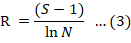
Note: R= Margalef richness index, S= number of variants, N= total individual, ln= natural logarithm.
While R < 2.5 means a low richness level, 2.5 ≤ R < 4 shows an average richness level, and R ≥ 4 represents a high level.
Dominance index
To establish the dominant, subdominant, and rare bird composition, the relative density was verified in regards to Thukral (2010) as per Equation 4 and Equation 5.


A bird species is dominant when the relative density rate is >5 %, subdominant 2 % to 5 %, and rare if it is < 2 %.
Encounter index
The encounter rate of bird species was revealed as per Equation 6 .

The categories are listed in Table 1.
Table 1: Encounter rate of birds as the basis of abundance level determination .
| Category (individual per 10 h observation) | Abundance rate | Abundance level |
| < 0.1 | 1 | Rare |
| 0.1 to 2.0 | 2 | Uncommon |
| 2.1 to 10.0 | 3 | Frequent |
| 10.1 to 40.0 | 4 | Common |
| > 40.0 | 5 | Abundant |
Vegetation data
Types of plants and parts that become food for birds were recorded for the purpose.
Result and Discussion
Birds of a residential area
Overall, 1 006 individuals of 20 species belong to 14 families were detected during observation, as listed in Table 2.
Based on Table 2, the quite dominant bird species are Bondol Peking (Lonchura punctulate Linnaeus, 1758) at 19.38 %, Cucak Kutilang (Pycnonotus aurigaster Vieillot, 1818) at 12.43 %, and Burung Gereja (Passer domesticus Linnaeus, 1758) at 11.93 %. Those species are of the communal type that generally do their group activities. Sufficient vegetation for food and shelter in urban residential areas also allows them to breed ; the birds above and others live in coconut, palm, and bamboo trees. Several nectarine family members also benefit from adequate flowering plants in the area. Cucak Kutilang birds, as insect eaters, will help control plant pests, while Bondol Peking and Burung Gereja help disperse plant seeds . This will support sustainable agricultural activities (Martinez et al., 2021).
Birds in residential landscapes serve as not only protectors of the ecosystem but also indicators of environmental change and assist agricultural activities ; ; . The existence of varied bird species in an urban residential area should be cherished as they contribute to the natural diversity and balance ; . Grain-eating, fruit-eating, and nectar-eating birds support seeding and pollination processes in plants while insect-eating ones help to control human pests and also plant insect. Additionally, birds bring aesthetic value wherever they are. Their feathers come with assorted colors, patterns, and visually enjoyable textures. Their sounds have a calming effect that matches the purpose of a residence. The landscape of a residential area that focuses on the environment is critical to birds’ sustainability and diversity . Among points of consideration are food accessibility and additional food ; , vegetation structure ; , and plant composition .
Table 2: Birds of residential area.
| No | Local name | Binomial nomenclature | Family | Individual | Type of feed | |
| Quantity | % | |||||
| 1 | Bondol Peking | Lonchura punctulate Linnaeus, 1758 | Estrildidae | 195 | 19.38 | Granivore |
| 2 | Cucak Kutilang | Pycnonotus aurigaster Vieillot, 1818 | Pycnonotidae | 125 | 12.43 | Insectivore |
| 3 | Burung Gereja | Passer domesticus Linnaeus, 1758 | Ploceidae | 120 | 11.93 | Granivore |
| 4 | Perkutut Jawa | Geopelia striata Linnaeus, 1766 | Columbidae | 98 | 9.74 | Granivore |
| 5 | Burung Madu Kelapa | Antrheptes malacensis Scopoli, 1786 | Nectariniidae | 75 | 7.46 | Nectarivore |
| 6 | Burung Madu Polos | Antrheptes simplex Müller, 1843 | Nectariniidae | 55 | 5.47 | Nectarivore |
| 7 | Tekukur Biasa | Streptopelia chinensis Scopoli, 1786 | Columbidae | 50 | 4.97 | Granivore |
| 8 | Burung Madu Sriganti | Nectarinia jagularis Linnaeus, 1766 | Nectariniidae | 45 | 4.47 | Nectarivore |
| 9 | Cabai Jawa | Dicacum trchileum Sparrman 1789 | Dicaeidae | 40 | 3.98 | Frugivore |
| 10 | Merbah Cerukcuk | Pycnonotus flavescens Scopoli, 1786 | Pycnonotidae | 40 | 3.98 | Insectivore |
| 11 | Pijantung Kecil | Arachnothera longirostra Latham, 1790 | Nectariniidae | 35 | 3.48 | Nectarivore |
| 12 | Cinenen Kelabu | Orthotomus ruficeps Temminck, 1836 | Silviidae | 32 | 3.18 | Insectivore |
| 13 | Kerak Ungu | Acridotheres javanicus Cabanis, 1851 | Sturnidae | 20 | 1.99 | Insectivore |
| 14 | Prenjak Jawa | Prinia familiaris Horsfield, 1821 | Sylvidae | 20 | 1.99 | Insectivore |
| 15 | Cipoh jantung | Aegithina viridissima Bonaparte, 1850 | Aegithinidae | 15 | 1.49 | Insectivore |
| 16 | Kapasan Kemiri | Lalage nigra Forster, 1781 | Campephagidae | 15 | 1.49 | Insectivore |
| 17 | Gelatik Batu Kelabu | Parus major Linnaeus, 1758 | Paridae | 12 | 1.19 | Granivore |
| 18 | Bondol Haji | Lonchura maja Linnaeus, 1766 | Estrildidae | 8 | 0.80 | Granivore |
| 19 | Wiwik Kelabu | Cacomantis merulinus Scopoli, 1786 | Cuculidae | 4 | 0.40 | Insectivore |
| 20 | Bentet Kelabu | Lanius schach Linnaeus, 1758 | Pachycephalidae | 2 | 0.20 | Insectivore |
| Total | 1 006 | 100 |
| |||
Society should recognize and prevent threats to birds’ existence in an urban residential area, such as habitat loss, pollution, and hunting. Environmentally friendly activities like tree planting and pesticide restriction should help conserve birds , 2018) and maintain urban ecosystem sustainability .
Diversity index, evenness index, and richness index
The data computing results came out with a diversity index (H’) of 2.59, an evenness index (E) of 0.86, and a richness index (R) of 2.75, as detailed in Table 3.
Table 3: Diversity index, evenness index, and richenness index.
| No. | Index type | Value | Category |
| 1 | Diversity index (H') | 2.59 | Currently |
| 2 | Evenness index (E) | 0.86 | High |
| 3 | Richenness index (R) | 2.75 | Currently |
The average diversity index shows that the studied residential areas are good enough for birds to live in. The geographical situation, management intensity, and landscape complexity are essential in expanding bird diversity ; , and the studied areas can meet the requirements. As bird diversity relies on the environment, particularly shade composition and vegetation size ; , shady trees, shrubbery, fruit trees, agricultural plants, decorative plants, and grasses found in the areas support their existence quite satisfactorily.
Residential areas can provide living space for several bird species. Any change in its diversity, particularly in urban/residential areas, is often influenced by urbanization and vegetation coverage ; ; . Protecting and developing varied green open spaces ; for a sustainable urban environment should mitigate bird diversity decline. Knowing bird species diversity in residential areas opens possibilities to conserve their habitats, keep their ecosystem balance , and ensure their sustainability for the sake of the locale ; .
Table 4: Density, dominance, and abundance.
| No. | Local name | Binomial nomenclature | K | KR (%) | Dominance category | Abudance | Abudance value | Sequence scale |
| 1 | Bondol Peking | Lonchura punctulate Linnaeus, 1758 | 19.50 | 19.38 | Dominance | 162.50 | 5 | Abundant |
| 2 | Cucak Kutilang | Pycnonotus aurigaster Vieillot, 1818 | 12.50 | 12.43 | Dominance | 112.50 | 5 | Abundant |
| 3 | Burung Gereja | Passer domesticus Linnaeus, 1758 | 12.00 | 11.93 | Dominance | 100.00 | 5 | Abundant |
| 4 | Perkutut Jawa | Geopelia striata Linnaeus, 1766 | 9.80 | 9.74 | Dominance | 81.67 | 5 | Abundant |
| 5 | Burung Madu Kelapa | Antrheptes malacensis Scopoli, 1786 | 7.50 | 7.46 | Dominance | 62.50 | 5 | Abundant |
| 6 | Burung Madu Polos | Antrheptes simplex Müller, 1843 | 5.50 | 5.47 | Dominance | 45.83 | 5 | Abundant |
| 7 | Tekukur Biasa | Streptopelia chinensis Scopoli, 1786 | 5.00 | 4.97 | Sub dominance | 41.67 | 5 | Abundant |
| 8 | Burung Madu Sriganti | Nectarinia jagularis Linnaeus, 1766 | 4.50 | 4.47 | Sub dominance | 37.50 | 4 | Common |
| 9 | Cabai Jawa | Dicacum trchileum Sparrman 1789 | 4.00 | 3.98 | Sub dominance | 33.33 | 4 | Common |
| 10 | Merbah Cerukcuk | Pycnonotus flavescens Scopoli, 1786 | 4.00 | 3.98 | Sub dominance | 33.33 | 4 | Common |
| 11 | Pijantung Kecil | Arachnothera longirostra Latham, 1790 | 3.50 | 3.48 | Sub dominance | 29.17 | 4 | Common |
| 12 | Cinenen Kelabu | Orthotomus ruficeps Temminck, 1836 | 3.20 | 3.18 | Sub dominance | 26.67 | 4 | Common |
| 13 | Kerak Ungu | Acridotheres javanicus Cabanis, 1851 | 2.00 | 1.99 | Rare | 33.33 | 4 | Common |
| 14 | Prenjak Jawa | Prinia familiaris Horsfield, 1821 | 2.00 | 1.99 | Rare | 16.67 | 4 | Common |
| 15 | Cipoh jantung | Aegithina viridissima Bonaparte, 1850 | 1.50 | 1.49 | Rare | 12.50 | 4 | Common |
| 16 | Kapasan Kemiri | Lalage nigra Forster, 1781 | 1.50 | 1.49 | Rare | 12.50 | 4 | Common |
| 17 | Gelatik Batu Kelabu | Parus major Linnaeus, 1758 | 1.20 | 1.19 | Rare | 10.00 | 4 | Common |
| 18 | Bondol Haji | Lonchura maja Linnaeus, 1766 | 0.80 | 0.80 | Rare | 6.67 | 3 | Frequent |
| 19 | Wiwik Kelabu | Cacomantis merulinus Scopoli, 1786 | 0.40 | 0.40 | Rare | 3.33 | 3 | Frequent |
| 20 | Bentet Kelabu | Lanius schach Linnaeus, 1758 | 0.20 | 0.20 | Rare | 1.67 | 2 | Unsommon |
K= Density; KR= Relative density.
The evenness index is 0.86, meaning the individuals are almost evenly distributed throughout the studied areas. This index informs diversity and ecosystem stability , essential in prioritizing a conservation program. Foods and predators affect the index as food availability invites birds, and certain predators shape birds’ behavior and activity. Regular observation of bird population change should serve as an early warning towards ecosystem alteration, such as green area reduction and predator overgrowth. Although birds natural fluctuation may be a challenge in interpreting the evenness index, it is a valuable insight for sustainable environmental development.
With a richness index of 2.75, the areas are considered safe for birds on average. Factors supporting bird growth, like varied habitats (trees, shrubbery, water) and a balanced ecological system , exist. Bird richness can indicate biodiversity and environmental wellness. Therefore, areas with a high richness index should be prioritized in conservation.
Deforestation, urbanization, and land function change often devastate bird richness as they lose their natural habitats ; ; , while climate change affects bird distribution and migration. Conserving bird habitats in urban areas is critical to recovering their abundance (Aronson et al., 2014) as it defines the environmental wellness of an area , so ecosystem restoration is called for when it is damaged. Motivating the society to actively conserve birds and care for the environment along with the government, related organizations, and researchers should prevent birds from extinction.
Density, dominance, and abundance
Table 4 shows the relatively high density, dominance, and abundance rates of Bondol Peking, Cucak Kutilang, and Burung Gereja in the studied areas.
Table 5: Foods, species, and individuals.
| Type of food | Number of species | % | Number of individulas | % |
| Insectivore | 9 | 45.00 | 273 | 27.14 |
| Granivore | 6 | 30.00 | 483 | 48.01 |
| Nectarivore | 4 | 20.00 | 210 | 20.87 |
| Frugivore | 1 | 5.00 | 40 | 3.98 |
| Total | 20 | 100 | 1 006 | 100 |
Bird density refers to the quantity in an area or habitat over a certain period. Table 5 demonstrates that Bondol Peking has the highest density at 19.50, followed by Cucak Kutilang and Burung Gereja at 12.50 and 12.00, respectively.
Vegetation type, food availability, and dwelling availability determine bird density in an area. Grains, insects, or fruits in a residential area correspond to varied species monitored. Dwellings in trees or buildings are in proportion to bird reproduction and survival. The land function changes in buildings, streets, and parks influence local bird density , and residential areas can drive natural habitat fragmentation toward both density and diversity . Moreover, noise and air pollution in urban areas can affect birds behavior and health. Parks, gardens, and other green spots in a residential area should affect bird diversity positively as they serve as habitat structures like trees, shrubbery, and open spaces .
Bird dominance signifies the proportion of a bird species in the population of a particular area. A highly dominant species tends to excel in quantity and existence. Seven observed species are dominant in the regions studied as they were more frequently seen than the others. Habitat preference, food availability, and dwelling facility determine dominance. Some species are deduced to be dominant when able to adapt to new habitats like gardens or parks and build their nests on trees, stones, or home shades. Bird dominance can be seasonal due to food availability or other environmental factors. Since land management, plant cultivation, and habitat structure changes in a residential area incline bird dominance , regular observation of their population should give further information on population dynamics and species dominance. An ecological study of their behavior and habitat preference should identify dominance factors.
Bird abundance denotes the total quantity of a bird species in a particular habitat. Dominance is closely related to it as the more dominant a species is, the more abundant it likely is. Vegetation diversity affects bird abundance and diversity ; . Issues that may agitate them are communal activities ; , artificial disturbances ; , and noise . However, the abundance of Burung Gereja (Passer domesticus Linnaeus, 1758) seems to be unbothered by passers-by , possibly due to habit .
Urban residential area management concerning bird needs can preserve biological diversity while benefiting society ecologically and aesthetically. Therefore, social conservation, which contributes to a sustainable ecosystem in such an area, should be encouraged so birds can coexist with humans.
Percentages of foods, species, and individuals
Based on food, insectivores and granivores are the dominant families, at 45 % and 30 %, respectively. Regarding individuals, granivores and insectivores are the dominant ones at 48.01 % and 27.14 %. The detailed observation result is provided in Table 5.
Birds obtain their foods from natural sources based on their biological needs, habitats, and seasons. Knowing the right foods should help ensure the availability and adequacy of their population while preserving their natural habitat .
Vegetation
Table 6 lists the plants found in the studied residential areas: forest trees, fruit trees, palms, shrubbery, bamboo, agricultural plants, flowers, and grasses.
Vegetation in urban residential areas provides shelter, food, and dwellings for birds. Trees, shrubbery, and other plants are essential for bird nests ; . Dense, leafy vegetation protects the nest and egg against predators and extreme weather. Most birds need specific vegetation structures for building their nests, such as branches, kindling, and leaves. While a lot of bird species make their nests on tall trees, shrubbery is favored by insect-eating birds. As urbanization and land function change diminish vegetation for bird dwelling , retaining vegetation diversity and bird habitat by planting trees should be feasible. Expanding green space should follow as it is relevant to sustainable ecosystem management.
Vegetation and birds are linked in the food chain, so vegetation conservation in a residential area is a way to save birds ; . Plants produce flowers for nectarines, fruit for frugivores, grain for granivores, and insects for insectivores.
Table 6: Vegetation functions for birds.
| No | Name | Type of vegetation | Bird of food | Food part | Remark |
| 1 | Mahagony | Tree | Insectivore | Insect | Vegetation is for food as well as shelter and mating |
| 2 | Trembesi | Tree | Nectarivore, granivore, insectivore | Nectar, pollen, insect | |
| 3 | Oil Palm | Tree | Insectivore, granivore | Insect.grain | |
| 4 | Rubber | Tree | Insectivore, granivore | Insect.grain | |
| 5 | Avocado | Tree | Nectarivore, insectivore | Nectar, insect | |
| 6 | Melinjo | Tree | Frugivore, insectivore | Friut, insect | |
| 7 | Matoa | Tree | Insectivore, nectarivore | Nectar, Insect | |
| 8 | Jengkol | Tree | Insectivore | Insect | |
| 9 | Durian | Tree | Nectarivore, granivore, insectivore | Nectar, pollen, insect | |
| 10 | Rambutan | Tree | Frugivore, nectarivore, granivore, insectivore | Friut, nectar, pollen, insect | |
| 11 | Manggo | Tree | Frugivore, insectivore, nectarivore | Fruit, insect, nectar | |
| 12 | Water apple | Tree | Frugivore, insectivore, nectarivore | Fruit, insect, nectar | |
| 13 | Guava | Tree | Frugivore, insectivore, nectarivore | Fruit, insect, nectar | |
| 14 | Star Fruit | Tree | Frugivore, insectivore, nectarivore | Fruit, insect, nectar | |
| 15 | Longan | Tree | Frugivore, insectivore, nectarivore | Fruit, insect, nectar | |
| 16 | Cherry | Tree | Frugivore, insectivore, nectarivore | Fruit, insect, nectar | |
| 17 | Soursop | Tree | Frugivore, insectivore, nectarivore | Fruit, insect, nectar | |
| 18 | Jackfruit | Tree | Frugivore, insectivore, nectarivore | Fruit, insect, nectar | |
| 19 | Ketapang | Tree | Insectivore | Insect | |
| 20 | Coconut | Palm | Insectivore, granivore, nectarivore | Nectar, pollen, insect | |
| 21 | Areca Nut | Palem | Insectivore, granivore, nectarivore | Nectar, pollen, insect | |
| 22 | Palm | Palm | Insectivore, granivore, nectarivore | Nectar, pollen, insect | |
| 23 | Bamboo | Bamboo | Insectivore | Insect | |
| 24 | Banana | Horticulture | Frugivore, insectivore, nectarivore | Fruit, insect, nectar | |
| 25 | Papaya | Horticulture | Frugivore, insectivore, nectarivore | Fruit, insect, nectar | |
| 26 | Flowers | Herba | Granivore, insectivore, nectarivore | Grain, insect, nectar | |
| 27 | Grasses | Grass | Granivore, insectivore | Grain, insect |
Furthermore, plants feed other animals. These facts make vegetation in an urban residential area critical for a balanced ecosystem. Invasive plants are a good choice for marginal areas.
Vegetation provides choices of protection for birds . Leafy, shady plants are suitable for hiding from predators and staying away from rain or intense sunlight; some birds can blend with the surrounding plants for their similar colors. Plant reduction makes birds more prone to predation. Conserving vegetation in urban residential areas should support bird survival and benefit humans ; ; .
Vegetation, particularly trees and shrubbery, is a mating place for birds . Tall trees are ideal spots for male birds to perch, interest the females with their chirps, and mark their territories. Perching points play an important role in bird reproduction, which, in the long run, determines an area’s abundance index. If vegetation in a residential area is cut down, bird diversity will drop .
Conclusions and Recommendations
The study discovered 1 006 bird individuals of 20 species and 14 families. The most frequently encountered kinds of bird were Bondol Peking (Lonchura punctulate Linnaeus, 1758), Cucak Kutilang (Pycnonotus aurigaster Vieillot, 1818), and Burung Gereja (Passer domesticus Linnaeus, 1758). The diversity index (H’) in Rumbai urban residential areas averages 2.59, while the evenness index (E) is 0.86, and the richness index (R) is 2.75. Food source vegetation includes but is not limited to forest trees, fruit trees, palms, bamboo, shrubbery, agricultural plants, flowers, and grasses.
Acknowledgement
The authors would like to thank “RP Editage” for providing guidance and assistance in organizing this manuscript.
Novelty Statement
Previous research (Bashan et al., 2020; ; ; has documented the presence of urban birds. However, previous investigations have only focused on people’s perceptions, attitudes, and appreciation of urban birds. The current research shows something new because it identifies bird species in urban residential landscapes for sustainable agriculture. Furthermore, this research found 20 unique bird species that can be used as recommendations for urban bird conservation.
Author’s Contribution
Hadinoto Hadinoto: Conceptualizing and designing research, outlining the contents of the paper, conducting literature searches, collecting data, analyzing data, formatting the manuscript, preparing the manuscript, and revising the manuscript.
Lili Zalizar, Joko Triwanto, and Ervayenri Ervayenri: Supervised the manuscript’s contents literature search and reviewed the manuscript.
Eni Suhesti, Endang Dwi Purbajanti, Hasni Ruslan and Imran Ullah: Conducted literature search and manuscript review.
All authors have read and approved the final manuscript.
Conflict of interest
The authors have declared no conflict of interest.
References
- Aronson, M.F.J., L.A. La Sorte, C.H. Nilon, M. Katti, M.A. Goddard, C.A. Lepczyk, P. S.Warren, N.S.G. Williams, S. Cilliers, B. Clarkson, C. Dobbs, R. Dolan, M. Hedblom, S. Klotz, J.L. Kooijmans, I. Kühn, I. Macgregor, M. Mcdonnell, U. Mörtberg and M. Winter. 2014. A global analysis of the impacts of urbanization on bird and plant diversity reveals key anthropogenic drivers. Biol. Sci., 281(1780). https://doi.org/10.1098/rspb.2013.3330[CrossRef]
- Bashan, D., A. Colléony and A. Shwartz. 2021. Urban versus rural? The effects of residential status on species identification skills and connection to nature. People Nat., 3(2):347–358. https://doi.org/10.1002/pan3.10176[CrossRef]
- Batáry, P., S. Fronczek, C. Normann, C. Scherber and T. Tscharntke. 2014. How do edge effect and tree species diversity change bird diversity and avian nest survival in Germany’s largest deciduous forest? For. Ecol. Manag., 319: 44–50. https://doi.org/10.1016/j.foreco.2014.02.004[CrossRef]
- Batisteli, A.F., M.O. Tanaka and A.L.T. Souza. 2018. Bird functional traits respond to forest structure in riparian areas undergoing active restoration. Diversity, 10(3): 8–11. https://doi.org/10.3390/d10030090[CrossRef]
- Belaire, J.A., L.M. Westphal, C.J. Whelan and E.S. Minor. 2015. Urban residents’ perceptions of birds in the neighborhood: Biodiversity, cultural ecosystem services, and disservices. Condor, 117(2): 192–202. https://doi.org/10.1650/CONDOR-14-128.1[CrossRef]
- Benedetti, Y., F. Morelli, C.T. Callaghan and R. Fuller. 2022. Distribution and protection of avian specialization in Europe. Glob. Ecol. Biogeogr., 31(1): 10–24. https://doi.org/10.1111/geb.13405[CrossRef]
- Beninde, J., M. Veith and A. Hochkirch. 2015. Biodiversity in cities needs space: A meta-analysis of factors determining intra-urban biodiversity variation. Ecol. Lett., 18(6): 581–592. https://doi.org/10.1111/ele.12427[CrossRef]
- Bibby, C., M. Jones and S. Marsden. 2000. Expedition field techniques: Bird surveys. In: (eds. S. Kartikasari and J. Shanaz), 1st ed. BirdLife International-Indonesia Programme, Bogor, Indonesia.
- Callaghan, C.T., R.E. Major, M.B. Lyons, J.M. Martin and R.T. Kingsford. 2018. The effects of local and landscape habitat attributes on bird diversity in urban greenspaces. Ecosphere, 9(7). https://doi.org/10.1002/ecs2.2347[CrossRef]
- Chanate, W., D. Wasan, Y. Pisarut and S.A. Rungtip. 2020. The diversity, population, ecology and conservation status of waterbirds in the wetland of Bangpu nature education center, Thailand. Biodiversitas, 21(8): 3910–3918. https://doi.org/10.13057/biodiv/d210862[CrossRef]
- Ciach, M. and A. Fröhlich. 2017. Habitat type, food resources, noise and light pollution explain the species composition, abundance and stability of a winter bird assemblage in an urban environment. Urban Ecosyst., 20(3): 547–559. https://doi.org/10.1007/s11252-016-0613-6[CrossRef]
- Cox, D.T.C., D.F. Shanahan, H.L. Hudson, K.E. Plummer, G.M. Siriwardena, R.A. Fuller, K. Anderson, S. Hancock and K.J. Gaston. 2017. Doses of neighborhood nature: The benefits for mental health of living with nature. BioScience, 67(2): 147–155. https://doi.org/10.1093/biosci/biw173[CrossRef]
- Cox, D.T.C., H.L. Hudson, K.E. Plummer, G.M. Siriwardena, K. Anderson, S. Hancock, P. Devine-Wright, and K.J. Gaston. 2018. Covariation in urban birds providing cultural services or disservices and people. J. Appl. Ecol., 55(5): 2308–2319. https://doi.org/10.1111/1365-2664.13146[CrossRef]
- Cristaldi, M.A., A.R. Giraudo, V. Arzamendia, G.P. Bellini and J. Claus. 2017. Urbanization impacts on the trophic guild composition of bird communities. J. Nat. Hist., 51(39–40): 2385–2404. https://doi.org/10.1080/00222933.2017.1371803[CrossRef]
- Dallimer, M., K.N. Irvine, A.M. Skinner, Z.G. Davies, J.R. Rouquette, L.L. Maltby, P.H. Warren, P.R. Armsworth and K.J. Gaston. 2012. Biodiversity and the feel-good factor: Understanding associations between self-reported human well-being and species richness. BioScience, 62(1): 47–55. https://doi.org/10.1525/bio.2012.62.1.9[CrossRef]
- Dearborn, D.C. and S. Kark. 2010. Motivations to conserve urban biodiversity. Conserv. Biol., 24(2): 432–440. https://doi.org/10.1111/j.1523-1739.2009.01328.x[CrossRef]
- Dehling, D.M., S.A. Fritz, T. Töpfer, M. Päckert, P. Estler, K. Böhning-Gaese and M. Schleuning. 2014. Functional and phylogenetic diversity and assemblage structure of frugivorous birds along an elevational gradient in the tropical Andes. Ecography, 37(11): 1047–1055. https://doi.org/10.1111/ecog.00623[CrossRef]
- Droz, B., R. Arnoux, T. Bohnenstengel, J. Laesser, R. Spaar, R. Ayé and C.F. Randin. 2019. Moderately urbanized areas as a conservation opportunity for an endangered songbird. Landsc. Urban Plan., 181: 1–9. https://doi.org/10.1016/j.landurbplan.2018.09.011[CrossRef]
- Forestry, K.L.H. 2021. Recalculation of Indonesian land cover 2020. https://www.scribd.com/document/685336655/Rekalkulasi-Penutupan-Lahan-2020
- Fröhlich, A. and M. Ciach. 2018. Noise shapes the distribution pattern of an acoustic predator. Curr. Zool., 64(5): 575–583. https://doi.org/10.1093/cz/zox061[CrossRef]
- Gillings, S., 2019. Bird responses to housing development in intensively managed agricultural landscapes. Urban Ecosyst., 22(6): 1007–1017. https://doi.org/10.1007/s11252-019-00895-1[CrossRef]
- Hadinoto, H. and E. Suhesti. 2017. Species diversity and bird feed in residential complex. IOP Conf. Ser. Earth Environ. Sci., 97(012001): 1–9. https://doi.org/10.1088/1755-1315/97/1/012001[CrossRef]
- Hadinoto, H., L. Zalizar, J. Triwanto, E. Ervayenri, R.H. Setyobudi, M. Chanan, N.T. Waskitho, J.T. Ibrahim, E. Suhesti, N.V. Minh, R. Tonda, S. Satrio and T.A. Pakarti. 2023. Bird diversity, abundance, and evenness rates in ecotone area of Sutan Syarif Hasyim Forest Park, Riau, Indonesia. E3S Web Conf., 374(00014): 1–8. https://doi.org/10.1051/e3sconf/202337400014[CrossRef]
- Hagen, E.O., O. Hagen, J.D. Ibáñez-álamo, O.L. Petchey and K.L. Evans. 2017. Impacts of urban areas and their characteristics on avian functional diversity. Front. Ecol. Evol., 5: 1–15. https://doi.org/10.3389/fevo.2017.00084[CrossRef]
- Harisha, M.N., K.S. Samad and B.B. Hosetti. 2021. Conservation status, feeding guilds, and diversity of birds in Daroji Sloth Bear Sanctuary, Karnataka, India. J. Threat. Taxa, 13(7): 18738–18751. https://doi.org/10.11609/jott.6855.13.7.18738-18751[CrossRef]
- Hedblom, M., E. Heyman, H. Antonsson and B. Gunnarsson. 2014. Bird song diversity influences young people’s appreciation of urban landscapes. Urban For. Urban Green., 13(3): 469–474. https://doi.org/10.1016/j.ufug.2014.04.002[CrossRef]
- Hepburn, L., A.C. Smith, J. Zelenski and L. Fahrig. 2021. Bird diversity unconsciously increases people’s satisfaction with where they live. Land, 10(2): 1–19. https://doi.org/10.3390/land10020153[CrossRef]
- Hoek, Y., G.V. Gaona and K. Martin. 2017. The diversity, distribution and conservation status of the tree-cavity-nesting birds of the world. Divers. Distrib., 23(10): 1120–1131. https://doi.org/10.1111/ddi.12601[CrossRef]
- Huang, Y., Y. Zhao, S. Li and K. von Gadow. 2015. The effects of habitat area, vegetation structure and insect richness on breeding bird populations in Beijing urban parks. Urban For. Urban Green., 14(4): 1027–1039. https://doi.org/10.1016/j.ufug.2015.09.010[CrossRef]
- Jokimäki, J., J. Suhonen, Y. Benedetti, M. Diaz, M.L. Kaisanlahti-Jokimäki, F. Morelli, T. Pérez-Contreras, E. Rubio, P. Sprau, P. Tryjanowski, and J.D. Ibánez-Álamo. 2020. Land-sharing vs. land-sparing urban development modulate predator–prey interactions in Europe. Ecol. Appl., 30(3): 1–14. https://doi.org/10.1002/eap.2049[CrossRef]
- Lepczyk, C.A., M.F.J. Aronson, K.L. Evans, M.A. Goddard, S.B. Lerman and J.S. Macivor. 2017. Biodiversity in the city: Fundamental questions for understanding the ecology of urban green spaces for biodiversity conservation. BioScience, 67(9): 799–807. https://doi.org/10.1093/biosci/bix079[CrossRef]
- Lerman, S.B., D.L. Narango, M.L. Avolio, A.R. Bratt, J.M. Engebretson, P.M. Groffman, S.J. Hall, J.B. Heffernan, S.E. Hobbie, K.L. Larson, D.H. Locke, C. Neill, K.C. Nielson, J.P. Cubino and T.L.E. Trammell. 2021. Residential yard management and landscape cover affect urban bird community diversity across the continental USA. Ecol. Appl., 31(8): e02455. https://doi.org/10.1002/eap.2455[CrossRef]
- Lerman, S.B., K.H. Nislow, D.J. Nowak, S. DeStefano, D.I. King and D.T. Jones-Farrand. 2014. Using urban forest assessment tools to model bird habitat potential. Landsc. Urban Plant., 122: 29–40. https://doi.org/10.1016/j.landurbplan.2013.10.006[CrossRef]
- Lerman, S.B., V.K. Turner and C. Bang. 2012. Homeowner associations as a vehicle for promoting native urban biodiversity. Ecol. Soc., 17(4). https://doi.org/10.5751/ES-05175-170445[CrossRef]
- Lešo, P., R. Kropil and L. Kajtoch. 2019. Effects of forest management on bird assemblages in oak-dominated stands of the Western Carpathians– refuges for rare species. For. Ecol. Manage., 453: 117620. https://doi.org/10.1016/j.foreco.2019.117620[CrossRef]
- Luck, G.W., A. Carter and L. Smallbone. 2013. Changes in bird functional diversity across multiple land uses: Interpretations of functional redundancy depend on functional group identity. PLoS One, 8(5). https://doi.org/10.1371/journal.pone.0063671[CrossRef]
- Luck, G.W., L.T. Smallbone and K.J. Sheffield. 2013. Environmental and socio-economic factors related to urban bird communities. Aust. Ecol., 38(1): 111–120. https://doi.org/10.1111/j.1442-9993.2012.02383.x[CrossRef]
- MacGregor, F.I., J. Quesada, J.G.H. Lee and P.J. Yeh. 2017. Invader alert: House Sparrow densities across three agricultural-urban landscapes. Avian Conserv. Ecol., 12(2). https://doi.org/10.5751/ACE-01082-120211[CrossRef]
- Machar, I., K. Poprach, L. Praus and L. Úradníček. 2021. Floodplain forests and urban parks-a brief comparison of bird diversity. J. Landsc. Ecol., 14(3): 1–11. https://doi.org/10.2478/jlecol-2021-0015[CrossRef]
- MacKinnon, J., K. Phillipps and B.V. Balen. 2010. A field guide to teh birds of Sumatera, Java, Bali, and Borneo. In: (eds. S. Sumadipura and A. Kartikasari); 1st ed. BirdLife International-Indonesia Programme, Bogor, Indonesia.
- Martínez, N.C., P.J. Rey, A.J. Manzaneda, D. García, R. Tarifa and J.L. Molina. 2021. Insectivorous birds are not effective pest control agents in olive groves. Basic Appl. Ecol., 56: 270–280. https://doi.org/10.1016/j.baae.2021.08.006[CrossRef]
- Morelli, F., Y. Benedetti, T. Su, B. Zhou, D. Moravec, P. Šímová and W. Liang. 2017. Taxonomic diversity, functional diversity and evolutionary uniqueness in bird communities of Beijing’s urban parks: Effects of land use and vegetation structure. Urban For. Urban Green., 23: 84–92. https://doi.org/10.1016/j.ufug.2017.03.009[CrossRef]
- Namood, E.S., F. Kishwar, A. Tahir and M.A. Ullah. 2021. Capitalizing trees for carbon sequestration as a co-benefit of biophilic urbanism. Proc. Pak. Acad. Sci. B, 58(4): 5–15. https://doi.org/10.53560/PPASB(58-4)671[CrossRef]
- Nooten, S.S., P. Schultheiss, J. Wright, C. Macdonald, B.K. Singh, J.M. Cook and S.A. Power. 2018. What shapes plant and animal diversity on urban golf courses? Urban Ecosyst., 21(3): 565–576. https://doi.org/10.1007/s11252-017-0728-4[CrossRef]
- Nowak, D.J. and E.J. Greenfield. 2012. Tree and impervious cover change in U.S. cities. Urban For. Urban Green., 11(1): 21–30. https://doi.org/10.1016/j.ufug.2011.11.005[CrossRef]
- Pei, N., C. Wang, J. Jin, B. Jia, B. Chen, G. Qie, E. Qiu, L. Gu, R. Sun, J. Li, C. Zhang, S. Jiang and Z. Zhang. 2018. Long-term afforestation efforts increase bird species diversity in Beijing, China. Urban For. Urban Green., 29: 88–95. https://doi.org/10.1016/j.ufug.2017.11.007[CrossRef]
- Pellissier, V., M. Cohen, A. Boulay and P. Clergeau. 2012. Birds are also sensitive to landscape composition and configuration within the city centre. Landsc. Urban Plan., 104(2): 181–188. https://doi.org/10.1016/j.landurbplan.2011.10.011[CrossRef]
- Pena, J.C.C., F. Martello, M.C. Ribeiro, R.A. Armitage, R.J. Young and M. Rodrigues. 2017. Street trees reduce the negative effects of urbanization on birds. PLoS One, 12(3): 1–19. https://doi.org/10.1371/journal.pone.0174484[CrossRef]
- Perillo, A., L.G. Mazzoni, L.F. Passos, V.D.L.R. Goulart, C. Duca and R.J. Young. 2017. Anthropogenic noise reduces bird species richness and diversity in urban parks. Ibis, 159(3): 638–646. https://doi.org/10.1111/ibi.12481[CrossRef]
- Proppe, D.S., C.B. Sturdy and C.C.S. Clair. 2013. Anthropogenic noise decreases urban songbird diversity and may contribute to homogenization. Glob. Change Biol., 19(4): 1075–1084. https://doi.org/10.1111/gcb.12098[CrossRef]
- Redlich, S., E.A. Martin, B. Wende and I.S. Dewenter. 2018. Landscape heterogeneity rather than crop diversity mediates bird diversity in agricultural landscapes. PLoS One, 13(8): 1–14. https://doi.org/10.1371/journal.pone.0200438[CrossRef]
- Sekercioglu, C.H., 2012. Bird functional diversity and ecosystem services in tropical forests, agroforests and agricultural areas. J. Ornithol., 153(Suppl. 1): 153–161. https://doi.org/10.1007/s10336-012-0869-4[CrossRef]
- Şekercioĝlu, C.H., R.E. Primack and J. Wormworth. 2012. The effects of climate change on tropical birds. Biol. Conserv., 148(1): 1–18. https://doi.org/10.1016/j.biocon.2011.10.019[CrossRef]
- Shah, S.B. and H.P. Sharma. 2022. Bird diversity and factors affecting bird abundance at Dullu Municipality, Dailekh, Nepal. Biodiversitas, 23(3): 1535–1545. https://doi.org/10.13057/biodiv/d230343[CrossRef]
- Skórka, P., K. Sierpowska, A. Haidt, L. Myczko, A. Ekner-Grzyb, Z.M. Rosin, Z. Kwiecinski, J. Suchodolska, V. Takacs, L. Jankowiak, O. Wasielewski, A. Graclik, A.J. Krawczyk, A. Kasprzak, P. Szwajkowski, P. Wylegała, A.W. Malecha, T. Mizera and P. Tryjanowski. 2016. Habitat preferences of two sparrow species are modified by abundances of other birds in an urban environment. Curr. Zool., 62(4): 357–368. https://doi.org/10.1093/cz/zow069[CrossRef]
- Thukral, A.K., 2010. Measurement of diversity in characterization of biological communities. Information theory and optimisation techniques in scientific research, pp. 89–98. https://www.researchgate.net/publication/256456615
- Tryjanowski, P., F. Morelli, P. Mikula, A. Krištín, P. Indykiewicz, G. Grzywaczewski, J. Kronenberg and L. Jerzak. 2017. Bird diversity in urban green space: A large-scale analysis of differences between parks and cemeteries in Central Europe. Urban For. Urban Green., 27: 264–271. https://doi.org/10.1016/j.ufug.2017.08.014[CrossRef]
- Tryjanowski, P., P. Skórka, T.H. Sparks, W. Biaduń, T. Brauze, T. Hetmański, R. Martyka, P. Indykiewicz, L. Myczko, P. Kunysz, P. Kawa, S. Czyż, P. Czechowski, M. Polakowski, P. Zduniak, L. Jerzak, T. Janiszewski, A. Goławski, L. Duduś and D. Wysocki. 2015. Urban and rural habitats differ in number and type of bird feeders and in bird species consuming supplementary food. Environ. Sci. Pollut. Res., 22(19): 15097–15103. https://doi.org/10.1007/s11356-015-4723-0[CrossRef]
- Tu, H.M., M.W. Fan and J.C.J Ko. 2020. Different habitat types affect bird richness and evenness. Sci. Rep., 10(1): 1–10. https://doi.org/10.1038/s41598-020-58202-4[CrossRef]
- Vale, M.M., L. Tourinho, M.L. Lorini, H. Rajão and M.S.L. Figueiredo. 2018. Endemic birds of the Atlantic Forest: traits, conservation status, and patterns of biodiversity. J. Field Ornithol., 89(3): 193–206. https://doi.org/10.1111/jofo.12256[CrossRef]
- Van, D.H.Y., G.V. Gaona and K. Martin. 2017. The diversity, distribution and conservation status of the tree-cavity-nesting birds of the world. Divers. Distrib., 23(10): 1120–1131. https://doi.org/10.1111/ddi.12601[CrossRef]
- Villaseñor, N.R., L.A. Chiang, H.J. Hernández and M.A.H. Escobar. 2020. Vacant lands as refuges for native birds: An opportunity for biodiversity conservation in cities. Urban For. Urban Green., 49: 126632. https://doi.org/10.1016/j.ufug.2020.126632[CrossRef]
- Vijay, V., S.L. Pimm, C.N. Jenkins and S.J. Smith. 2016. The impacts of oil palm on recent deforestation and biodiversity loss. PLoS ONE, 11(7): 1–19. https://doi.org/10.1371/journal.pone.0159668[CrossRef]
- Wood, E., A. Harsant, M. Dallimer, A.C. de Chavez, R.R.C. McEachan and C. Hassall. 2018. Not all green space is created equal: Biodiversity predicts psychological restorative benefits from urban green space. Front. Psychol., 9: 1–13. https://doi.org/10.3389/fpsyg.2018.02320[CrossRef]
- Xie, S., F. Lu, L. Cao, W. Zhou and Z. Ouyang. 2016. Multi-scale factors influencing the characteristics of avian communities in urban parks across Beijing during the breeding season. Sci. Rep., 6: 1–9. https://doi.org/10.1038/srep29350[CrossRef]
- Xie, S., X. Wang, W. Zhou, T. Wu, Y. Qian, F. Lu, C. Gong, H. Zhao and Z. Ouyang. 2020. The effects of residential greenspace on avian Biodiversity in Beijing. Glob. Ecol. Conserv., 24: e01223. https://doi.org/10.1016/j.gecco.2020.e01223[CrossRef]
- Xu, X., Y. Xie, K. Qi, Z. Luo and X. Wang. 2018. Detecting the response of bird communities and biodiversity to habitat loss and fragmentation due to urbanization. Sci. Total Environ., 624: 1561–1576. https://doi.org/10.1016/j.scitotenv.2017.12.143[CrossRef]
- Yang, X., X. Tan, C. Chen and Y. Wang. 2020. The influence of urban park characteristics on bird diversity in Nanjing, China. Avian Res., 11(1): 1–9. https://doi.org/10.1186/s40657-020-00234-5[CrossRef]
- Zhou, D. and L.M. Chu. 2012. How would size, age, human disturbance, and vegetation structure affect bird communities of urban parks in different seasons? J. Ornithol., 153(4): 1101–1112. https://doi.org/10.1007/s10336-012-0839-x[CrossRef]
- Zivanovic, A.J. and G.W. Luck. 2016. Social and environmental factors drive variation in plant and bird communities across urban greenspace in Sydney, Australia. J. Environ. Manage., 169: 210–222. https://doi.org/10.1016/j.jenvman.2015.11.052[CrossRef]
- Żmihorski, M., G. Hebda, S. Eggers, J. Månsson, T. Abrahamsson, D. Czeszczewik, W. Walankiewicz and G. Mikusiński. 2019. Early post-fire bird community in European boreal forest: Comparing salvage-logged with non-intervention areas. Glob. Ecol. Conserv., 18. https://doi.org/10.1016/j.gecco.2019.e00636[CrossRef]
Services
Article usage statistics
Loading…