
Diamondback moth (Plutella xylostella) is the most destructive pest on Brassicaceae plants family around the world. The present study investigated the feeding selection behavior of diamondback moth larvae with an approach to the acetone extract effects of Salvia Miltiorrhiza Bunge (SMB). It was found that acetone extracts of Salviami ltiorrhiza Bunge (SIB) represented by cryptotanshinone and dihydrotanshinone had lethal effect on diamondback moth larvae, and the correlation coefficient was 0.972. Through further antifeedant test, it was found that diamondback moth larvae had obvious antifeedant behavior to acetone extracts of SIB represented by cryptotanshinone and dihydrotanshinone, and the correlation coefficient was -0.915. By further observing the influence of acetone extract of SIB on the feeding selection behavior of diamondback moth larvae, it was found that diamondback moth larvae had obvious avoidance behavior towards acetone extract of SIB. Therefore, it can be considered that acetone extract of SIB can affect the feeding behavior of diamondback moth insects because of its biological effects such as dihydrotanshinone and cryptotanshinone. This effect is firstly fatal to diamondback moth larvae after feeding, and may also cause antifeedant and aversion of diamondback moth larvae.
Research Article · Volume 56, Issue 2, 16 January 2024 · Open Access
Effect of Acetone Extract of Salvia miltiorrhiza Bunge on Feeding Selection Behavior of Diamondback Moth Larvae
Affiliations & Notes ⌄
- 1College of Resources and Environment, Shanxi Agricultural University, Jinzhong, 030801, China * Corresponding author: yangguangyixia023@163.com
Article Info ⌄
- Journal:
- Pakistan Journal of Zoology
- Published:
- 16 January 2024

From the article
- The correlation coefficient in the observation group at 25 min was 0.7800, indicating that the concentration of acetone extract of SIB affected the feeding selection of P. xylostella larvae.
- By comparing the slopes of the three observation groups, it was found that the selection efficiency of P. xylostella larvae for the leaf disc treated by acetone extract of SIB showed an increasing trend with the extension of observation time.
- The results indicated that acetone extract of SIB had not only lethal effect on P. xylostella larvae, but also obvious antifeedant effect.
- However, there is a clear trend that P. xylostella larvae would select the leaf disc treated with lower concentration of the extract in the comparative selection, and would continue to choose the leaf disc treated with lower concentration of the extract until selecting the blank leaf disc for feeding.
Selected from the article's own text.
Abstract
INTRODUCTION
Excessive use of chemical pesticides has endangered the health of living organisms, especially humans, has polluted the environment, and has also increased pest resistance. Diamondback moth is one of the most important pests of the cruciferous family, which is almost resistant to a variety of pesticides in the world (Reddy et al., 2004). Increasing the level of pest resistance has led to large-scale insecticides overuse and increased consumption, which has led to disruptions in the environment and human health (Yi et al., 2007). For this reason, the use of integrated pest control strategy has received much attention to control this insect, in which, natural enemies and control of the desired insect are key factors (Guan-soon, 1990; Talekar and Shelton, 1993).
The relationship between plants and insects is always manifested in various behaviors related to feeding, and scholars from all sides often take the initiative to take the ecological relationship of insect feeding behavior as a main concern when studying and looking for various ecological pest control technologies (Wang et al., 2018; Zhang, 2010). The feeding behavior of insects refers to the ingestion of food by insects and a series of activities related to it. Generally, the feeding behavior of individuals of the same species shows both the similarity of populations and the specific fixed pattern of species (Tian et al., 2018). The feeding behavior of phytophagous insects establishes the relationship between plants and insects, including a series of activities such as orientation, tropism, identification and feeding (Wang et al., 2014; Liu et al., 2020; Hsiao et al., 1985). Insects’ choice of feeding on a certain plant is determined by the need of nutrition metabolism and special substances in the body (Zhou et al., 2004; Qin and Wang, 2001), and is also affected by the secondary metabolites of plants (Du and Yan, 1994), environmental changes and food pollution (Wu and Jin, 1993). Many researchers pay attention to the insect’s feeding selection behavior. Some scholars have discovered the insects’ tendency to some plants (Zhang et al., 2007) and their antifeedant (Yang et al., 2015; Li et al., 2005) by observing and summarizing the ecological changes of this behavior, and have developed biological control techniques such as attractants and antifeedant, which affect the insect population development and inhibit the pests from feeding (Feng et al., 2021). Many plant secondary metabolites achieve the goal of protecting plants by influencing the feeding selection of insects, which has become the main research content of plant-derived insect inhibitors.
Recent studies have confirmed that the root of SIB, a medicinal plant, is rich in fat-soluble ketones such as dihydrotanshinone and cryptotanshinone, which can inhibit acetylcholin esterase to some extent (Zhao and Yang, 1999; Min et al., 2004; Li et al., 2003; Jin and Hu, 2007), destroy acetylcholine hydrolysis, lead to runaway electron transmission between synapses, interfere with nerve conduction of insects, and have the potential to inhibit pest population. When studying the lethal effect of SIB fat-soluble tanshinone on diamondback moth larvae, the author found that the lethal effect of this kind of substances on diamondback moth larvae did not meet the good expectations. Based on the experimental observation, it was found that diamondback moth larvae seemed to have the behavior of avoiding antifeedant for these fat-soluble tanshinones. In this paper, the effects of acetone extract of SIB on the feeding behavior of diamondback moth larvae were observed by liquid-plate method (Ren et al., 2004), and the theoretical possibility of fat-soluble tanshinones represented by acetone extract of SIB as antifeedant was summarized from different angles such as feeding amount and directional feeding selection.
MATERIALS AND METHODS
Experimental materials
Diamondback moth larvae used in this experiment is a successive generation of diamondback moth reared in laboratory without contact with chemicals. The method was improved with reference to Zhu Jiusheng (Han et al., 2007).
Salviami ltiorrhiza Bunge (SIB), purchased from Hebei Qixin Chinese Medicine Granules and Pieces Co., Ltd., was appraised by Wang Yuqing, a teacher from Agricultural College of Shanxi Agricultural University.
Reagents and equipment
Methanol (Chromatographically pure Tianjin Concord Technology Co., Ltd.), anhydrous ethanol (analytically pure, Sinopharm Group), analytically pure acetone, cryptotanshinone (national drug standard substance), and dihydrotanshinone (Tianjin Yifang Technology Co., Ltd.) were used in the experiment.
The main instrument used were electronic balance (BSA2235, Sartorius Scientific Instrument (Beijing) Co., Ltd.), BSXT-02 Soxhlet extractor (Shanghai Xinweng Scientific Instrument Co., Ltd.), RE-52AA rotary evaporator (Shanghai Yarong Biochemical Instrument Factory), SPX-300B-G microcomputer illumination incubator (Shanghai Boxun Medical Biological Instrument Corp.), GZX-9246 digital display blower drying cabinet (Shanghai Boxun Medical Biological Instrument Corp.), plant tissue pulverizer, Agilent Technologies 1200 series high-performance liquid chromatograph (Agilent Technologies Inc.), SephadexG-100 chromatographic column, etc.
Preparation of acetone extract from SIB and analysis of its effective components
The crude extract of SIB was obtained by Soxhlet method. Radix Salviae Miltiorrhizae powder (sg) wrapped with qualitative filter paper, was put in the extraction cylinder. 300ml methanol was added in round bottom flask. The experiment was determined 50℃. Ethanol and acetone were used as extraction agents to complete the extraction procedure. The crude extracts prepared by various extractants are evaporated by rotation at 30℃ and dissolved in acetone to obtain acetone extract solution to be tested.
For HPLC analysis of SIB extract, five 5ml of methanol was added to the dihydrotanshinone standard sample to obtain the mother liquor with the concentration of 1mg/ml. It was filtered and diluted by a factor of 25, 50, 100, 200 and 400, respectively to obtain the concentration gradient and the constant volume operation of 20ml, 10ml, 5ml, 2.5ml and 1.25ml, respectively. The dihydrotanshinone standard samples were prepared as shown in Table I.
Table I. Preparation of cryptotanshinone and dihydrtanshinone standard samples.
| Dihydrtanshinone | Cryptotanshinone | ||
| Volume | Concentration | Volume | Concentration |
| 16ml | 25μg/ml | 20ml | 25μg/ml |
| 8ml | 50μg/ml | 10ml | 50μg/ml |
| 4ml | 100μg/ml | 5ml | 100μg/ml |
| 2ml | 200μg/ml | 2.5ml | 200μg/ml |
| 1ml | 400μg/ml | 1.25ml | 400μg/ml |
For chromatographic analysis, the mobile phase was methanol: water (3:1). Flow rate of 1.0 mL/min, column temperature of 30℃, column pressure of 100~400 bar, detection wavelength of 270 nm, injection volume of 10 µL, time of 15 min and interval of 20 min. The samples were injected in sequence, and injection wash was placed at the 100th bottle. The peak time of the sample was observed. The conditions of standard curve and sample analysis were the same. Dilute the Salviami ltiorrhiza Bunge extract by a factor of 5, 10, 15 and 20 respectively (Table II).
Table II. Salvia extract dilution ratio.
| No. | 1 | 2 | 3 | 4 | 5 | 6 |
| Stock solution (ml) | 10 | 2 | 1 | 0.67 | 0.5 | 0 |
| Distilled water (ml) | 0 | 8 | 9 | 9.33 | 9.5 | 10 |
| Dilution ratio | 0 | 5 | 10 | 15 | 20 | - |
Effects of acetone extract of SIB on mortality of Plutella xylostella larvae
Fresh cabbage leaves, cut into leafdiscs (5cm diameter) were soaked in diluted (by a factor of 5, 10, 15 and 20) SIB extract for 10s and then placed in conical flask containing the microcomputer illumination incubator at (24±1)℃, with relative humidity of 50% and illumination L∥D=12h∥12h. Dead larvae were recorded at 12h, 24h and 48h. This experiment was run in triplicate.
Determining antifeedant effect of acetone crude extract of SIB on P. xylostella larvae
Fresh cabbage leaves, cut into leafdiscs (1.5cm diameter), washed and air dried were soaked in different SIB extracts for 10 min and then placed in agat Petri dish (25g of agat into 250 ml of diluted water), 5 dishes in each plate.
Then instar larvae of P. xylostella, starved for 4 h, were washed in each petri dish. These Petri dishes were inclubated in illumination incubator at (24±1℃), with relative humidity of 50% and illumination L∥D=12h∥12h.The feeding area of leaves were measured after 24h according to the formula.

Effect of acetone extract of SIB on feeding selection behavior of P. xylostella larvae
Test preparation: Preparation of the concentration gradient solution of acetone crude extract of Salviami ltiorrhiza Bunge. Dilute the acetone extract of Salviami ltiorrhiza Bungeby a factor of 100%, 75%, 50% and 25%, respectively to obtain test solution, as shown in the following Table III. Then, prepare10% acetone solution, and set it as blank control group CK.
Table III. Salvia extract dilution ratio.
| No. | 1 | 2 | 3 | 4 | CK |
| Stock solution (mL) | 1.344 | 1.008 | 0.672 | 0.336 | 1m Lacetone |
| Distilled water(mL) | 8.656 | 8.992 | 9.328 | 9.664 | 9 |
| Constant volume (mL) | 10 | 10 | 10 | 10 | 10 |
Five round cabbage leaves (diameter of 2.5 cm) were placed on the agar culture dish in the form of Pentagon. One dish was coated with 10% ketone as the control. The other dishes were coated with four concentrations of SIB for 10 min.
Ten third instar larvae of P. xylostella without starvation were placed at the center of pentagon in a Petri dish to observe the feeding selectionof P. xylostella larvae. The number of larvae on five dishes was recorded every 5min. The feeding selection rate was calculated as follows:

Statistical analysis
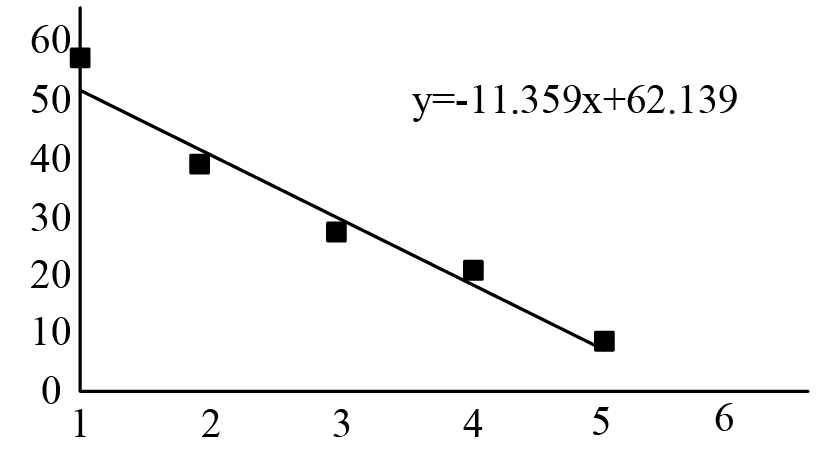
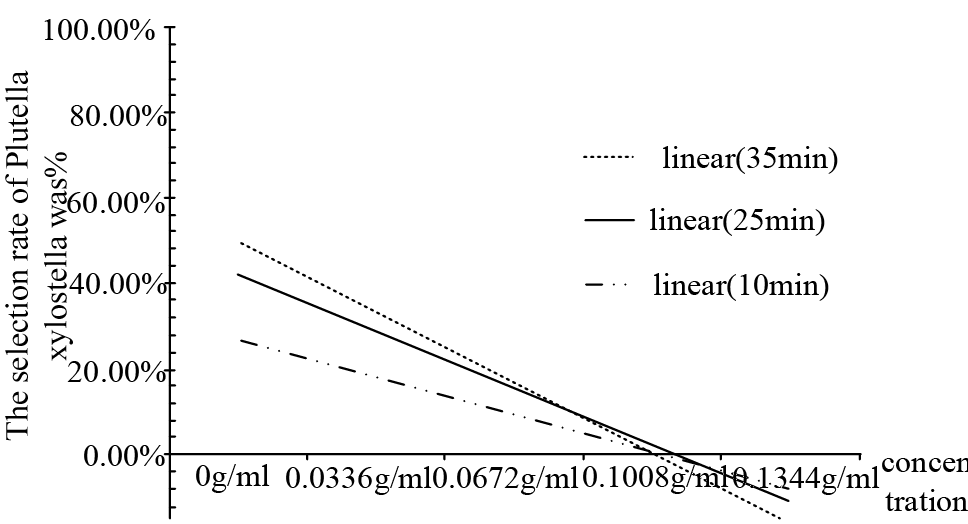
The data related to the experiment were processed and analyzed by SPSS 22.0 and Excel. The correlation between the factors was analyzed by one-way ANOVA, and the significance was tested by F. When p<0.05, it was considered to be significant. Antifeedant rate analysis of Plutella xylostella larvae was shown in Figure 1. The selection speed at three groups of times was shown in Figure 2.
RESULTS
Analysis of acetone crude extract of SIB
The quantitative analysis by HPLC showed that the three extracts of SIB contained dihydrotanshinone and cryptotanshinone. The acetone sample had an extract concentration significantly higher than that of the other two reagents and the best extraction effect. The order of extraction efficiency is acetone > ethanol > methanol. Therefore, acetone extract of Salviami ltiorrhiza Bunge was selected as fat-soluble tanshinone for the following biological tests. The standard curve was used to basically determine their concentration as shown in Table IV and Table V.
Toxicity of SIB on P. xylostella larvae
The mortality of P. xylostella larvae fed with the solution of acetone extract of SIB increased significantly. However, the mortality of the P. xylostella larvae fed with the solution diluted by a factor of 15 and 20had no significant difference compared with that of the control group. The correlation coefficient analysis showed that the mortality of P. xylostella larvae after 48h was correlated with the dilution factor of acetone extract of SIB, and the correlation coefficient was R=0.972. According to single factor variance analysis and F test, F=31.586> F(1, 3)0.05 =18.51. Thus, the relationship between the increase of P. xylostella larvae mortality and the decrease of dilution factor of acetone extract of SIB was significantly different at the level of 0.05.
Antifeedant effect of SIB
Excel linear regression analysis showed that there was a negative linear regression relationship between the concentration of SIB extract and the average feeding rate of P. xylostella larvae. The regression equation is y = -11.359x+62.139. According to the statistical data of SPSS software and the correlation coefficient analysis, the effects of different concentrations of SIB extract on the feeding of P. xylostella larvae were negatively correlated. The correlation coefficient is R=-0.915. After one-way ANOVA and F test, it was found that F=81.947>F0.05 (5, 10)= 3.326. Therefore, the correlation between the concentration of SIB extract and the feeding rate of P. xylostella larvae was significantly different at the level of 0.05.
Feeding selection rate of P. xylostella larvae linear
According to the result records and mathematical model analysis (Table VI), it can be concluded that the concentration is the main factor affecting the feeding selectionof P. xylostella larvae. In sufficient time, most of the larvae accumulated in CK group, and the leaf discs treated with high concentration of acetone extract of SIB were rarely selected.
Table IV. Implicit tanshinone comparison.
| Reagent | Concentration (μg/ml) | Peak area | Average concentration (μg/ml) | Average peak value | Significant difference | |
| Methyl alcohol | 1 | 71.99 | 3184.68 | 71.56 | 3157.65 | A |
| 2 | 73.59 | 3251.56 | ||||
| 3 | 69.10 | 3063.74 | ||||
| Ethyl alcohol | 1 | 328.63 | 13922.81 | 284.11 | 11128.65 | B |
| 2 | 287.07 | 12183.81 | ||||
| 3 | 236.63 | 10073.50 | ||||
| Acetone | 1 | 521.66 | 21999.18 | 556.36 | 24176.81 | C |
| 2 | 560.90 | 23640.58 | ||||
| 3 | 586.53 | 24713.05 | ||||
Table V. 2 h tanshinone comparison.
| Reagent | Concentration (ug/ml) | Peak area | Average concentration (ug/ml) | Average peak value | Significant difference | |
| Methyl alcohol | 1 | 66.41 | 1935.72 | 65.89 | 1900.16 | A |
| 2 | 63.72 | 1749.54 | ||||
| 3 | 67.55 | 2015.21 | ||||
| Ethyl alcohol | 1 | 171.08 | 9190.11 | 170.45 | 9146.71 | B |
| 2 | 168.40 | 9004.57 | ||||
| 3 | 171.88 | 9245.47 | ||||
| Acetone | 1 | 230.63 | 13317.75 | 222.93 | 12784.21 | C |
| 2 | 212.75 | 12078.71 | ||||
| 3 | 225.41 | 12956.15 | ||||
Note: P<0.01 indicated significant difference.
Table VI. Results of relevant data.
| Time | Correlation | Slope |
| 10 min | 0.7189 a | -0.0867 a |
| 25 min | 0.7800 b | -0.1333 b |
| 35 min | 0.7288 a | -0.1633 c |
Table VI shows that each observation group showed that with the increase of the concentration of acetone extract of SIB, the feeding selection rate of P. xylostella larvae for the leaf disc treated by the extract decreased, showing a certain negative correlation. The correlation coefficient in the observation group at 25 min was 0.7800, indicating that the concentration of acetone extract of SIB affected the feeding selection of P. xylostella larvae. Comparing the correlation of each observation group, the correlation at 25 min, R=0.7800, is the best, followed by R=0.7288 at 35 min. The correlation at 10 min, R=0.7189, is significantly lower than the former two. When there was enough selection time, the concentration of acetone extract of SIB had a significant impact on the feeding selection of P. xylostella larvae. By comparing the slopes of the three observation groups, it was found that the selection efficiency of P. xylostella larvae for the leaf disc treated by acetone extract of SIB showed an increasing trend with the extension of observation time. The slope at 35 min was -0.1633, which was significantly higher than that at 25min (-0.1333). The difference was more significant than that at 10min (-0.0867). It can be seen that the selection of P. xylostella larvae for the leaf disc treated by acetone extract of SIB did not happen in time, but took a certain time. And the selection efficiency of P. xylostella larvae would be obvious after a long selection time.
DISCUSSION
According to the analysis of the test results, it can be confirmed that cryptotanshinone and dihydrotanshinone contained in acetone extract of SIB are a kind of lethal substances to P. xylostella larvae. Therefore, when P. xylostella larvae ate cabbage leaf disc treated with acetone extract of SIB, the lethal effect increased with the increase of extract concentration, showing a certain linear correlation with a correlation coefficient of 0.972. However, during the self-test, it was also observed that P. xylostella larvae showed obvious refusal to the treated leaf disc, and the feeding efficiency of P. xylostella larvae for the treated leaf disc also decreased with the increase of the concentration of acetone extract of SIB, showing a negative correlation with a correlation coefficient of-0.915. The results indicated that acetone extract of SIB had not only lethal effect on P. xylostella larvae, but also obvious antifeedant effect. The effect of acetone extract of SIB on the feeding selectionof P. xylostella larvae was further observed. When the discs treated with acetone extracts of SIB with four concentration gradients were equidistant from the blank trays in the same culture dish, it could be observed that the feeding selection process of P. xylostella larvae was not achieved overnight, but lasted a period of time. However, there is a clear trend that P. xylostella larvae would select the leaf disc treated with lower concentration of the extract in the comparative selection, and would continue to choose the leaf disc treated with lower concentration of the extract until selecting the blank leaf disc for feeding.
According to the observation at 15 min, 25 min and 35 min, it was found that the distribution rate of P. xylostella larvae decreased with the increase of acetone extract concentration of SIB, showing a negative correlation. Furthermore, the slope of the distribution curve increased with time. According to the observation at 35 min, the larger the slope was, the more and more quickly the P. xylostella larvae accumulated to the empty treatment group. The trend of this feeding selection would also become more obvious as time prolonged.
CONCLUSIONS
Based on the analysis, the acetone extract of SIB can affect the feeding behavior of P. xylostella larvae because of substances with biological effects such as dihydrotanshinone and cryptotanshinone, which is firstly fatal to P. xylostella larvae after feeding, and may also cause antifeedant and evasive effects on P. xylostella larvae.
Statement of conflict of interest
The authors have declared no conflict of interes.
Figures
Antifeedant rate analysis of P. xylostella larvae.
Selection speed at three groups of times.
References
- At the beginning of the experiment, all P. xylostella larvae were scattered on leaf discs treated with acetone extracts of SIB at different concentrations for selective feeding. After a certain period of time, some larvae moved to the leaf disc treated with acetone extract of SIB with low concentration. After a certain period of time, most larvae accumulated on the control group without acetone extract of SIB for selective feeding. A few P. xylostella larvae gave up their choice and avoided the leaf discs. By comparing and analyzing correlation coefficient, the bilateral P value of the correlation coefficient test was less than 0.05. Thus, it can be considered that the negative correlation between the two variables is statistically significant. When larvae select five concentration gradients at the same time, their choice behaviors are compared. With the decrease of concentration, the selection rate of P. xylostella larvae showed an increasing trend. Moreover, the slope of each regression equation is equivalent to the efficiency of larval selection. The longer the time is, the more obvious the effect of larval selection is.
Services
Article usage statistics
Loading…