
To investigate the pattern of reproduction of the Norway rat, Rattus norvegicus in urban areas of Rawalpindi city, Pakistan, live trapping of commensal rodents was carried out from May 2011 through April 2012. A total of 100 rats (R. norvegicus = 65, Rattus rattus = 35) were trapped during 720 trap nights @ 0.13 captures per night and the trap success was 13.88%. Maximum captures of the Norway rats were recorded during summer (n = 33), followed by winter (n = 13), autumn (n = 12) and the least number was recorded during spring (n = 7). A non-significant difference between numbers of captured individuals of both the sexes was recorded. Adult population of the Norway rat dominated the juvenile during all the seasons of the year. Data on the body weight reflected that the males were heavier than the females in all the four seasons of the year; the heaviest males were observed during the winter season. Reproductive activity revealed that the males were recorded reproductively active throughout the year while more than 50% specimens of females were recorded inactive throughout the year; yet lactating and pregnant females, and scars in the oviduct were recorded throughout the year indicating that Norway rat reproduces the year around in the urban environment of Rawalpindi, Pakistan.
Short Communication · Volume 49, Issue 3, 26 May 2017 · Open Access
Reproductive Patterns of the Norway Rat (Rattus norvegicus) in Urban Rawalpindi, Pakistan
· · · ·
Affiliations & Notes ⌄
- 1Department of Zoology, PMAS Arid Agriculture University, Rawalpindi, Pakistan 2Vertebrate Pest Control Institute, Southern Zone - Agricultural Research Centre, Pakistan Agricultural Research Council, Karachi University Campus, Karachi, Pakistan , * Corresponding author: mushtaq@uaar.edu.pk
Article Info ⌄
- Journal:
- Pakistan Journal of Zoology
- Published:
- 26 May 2017

From the article
- When the body weight was compared between the sexes in all the seasons (Fig. 3), it was recorded that males were heavier than the females in all the four seasons of the year; the heaviest males were observed during the winter season.
- Reproductive activity revealed that the in case of the female Norway rats (Fig. 5A), more than 50% females were recorded inactive throughout the year; yet lactating, pregnant and scars in the oviduct were recorded throughout the year indicating that Norway rat reproduces all the year around.
- Male Norway rats were recorded active throughout the year, indicated by the scrotal testes in majority of the males (Fig. 5B).
- The findings of our study indicated that Norway rat reproduces in the area throughout the year; yet minimum number of capturing was recorded during the spring season (February to April), as well as more than 60% of the females were reproductively inactive during this season.
Selected from the article's own text.
Abstract
Materials and methods
This study was conducted between May 2011 to April 2012 in urban areas of Rawalpindi city (33º 36’ NL, 73º 04’ E), Pakistan. Norway rats were live trapped using locally available cage traps (42 cm x 15 cm x 15 cm), which were baited with fresh vegetables and fruits. A total of 60 traps
Table I.- Summary of trapping of commensal rodents from Rawalpindi city during different seasons of 2011-12.
| Season | No. of trap nights (no. of structures x no. of traps set x number of nights) | Rodents captured | Captures per night | Trap success (%) | ||
| Rattus norvegicus | Rattus attus | Total | ||||
| Summer | 10 x 6 x 3 = 180 | 33 | 07 | 40 | 0.22 | 22.22 |
| Autumn | 10 x 6 x 3 = 180 | 12 | 13 | 25 | 0.13 | 13.88 |
| Winter | 10 x 6 x 3 = 180 | 13 | 07 | 20 | 0.11 | 11.11 |
| Spring | 10 x 6 x 3 = 180 | 7 | 08 | 15 | 0.08 | 08.33 |
| Overall | 40 x 6 x 3 = 720 | 65 | 35 | 100 | 0.13 | 13.88 |
were set in 10 houses and in shops during each season, i.e., summer (May–July), autumn (August–October), winter (November–January) and spring (February–April) for three consecutive nights. Traps were set in the evening (between 6–8 pm) and collected early in the next morning (between 5–7 am.). The trapped specimens were brought to the laboratory, were sexed and standard morphological measurements, viz., head and body length, tail length, ear length, hind foot length and total body weight were recorded (Fig. 1), following Alpin et al. (2003). In order to access the reproductive activity anaesthetised specimens were dissected and different external and internal reproductive characteristics were recorded. In case of females, the specimens were categorised into four categories, i.e., reproductively inactive, presence of placental scars, pregnant and lactating. A female was considered as lactating when its teats were raised and lacked fur around their base. The external condition of vagina was classified as closed (imperforated) or open (perforated). The uterine horns were dissected and were classified as follow: (1) very short and thin, with an insufficient blood supply- indicated the typical state of juvenile female, (2) thick, with abundant blood supply and embryo present, typical condition of pregnant female (3) elongated, with thin walls without embryos; with placental scars appearing as large discolorations of uterine wall- typical condition of female in period immediately after delivery. Males with swallow testes were indicated as reproductively active, while regressed state of testes showed the reproductive inactive state. The position of testes was recorded, i.e. whether the testes were abdominal or descended into the scrotum. When the testes were located in abdomen, it indicated the juvenile male while the specimens having scrotal testes were considered as adult. Statistical calculations were performed using computer software Microsoft Excel 2007. Mean values and standard error of mean of various parameters were calculated. The chi-square test was applied to determine the sex frequencies during different seasons, using a 5 percent level of significance .
Results and discussion
Results on the trapping of commensal rodents from Rawalpindi city indicated that a total of 100 rats were trapped during 720 trap nights @ 0.13 captures per night and the trap success was 13.88% (Table I). A total of 65 specimens of Norway rats (R. norvegicus) were captured. In addition to the Norway rats, 35 specimens of the house rat, Rattus rattus were also captured in the trapping campaign; however, they were not included in the study on reproductive pattern. Maximum trapping success of the Norway rat was achieved in the summer season (n = 33), followed by winter (n = 13), autumn (n = 12) and the least trapping was recorded in the spring season (n = 7). As regards the sex wise distribution of the Norway rat population of the area, chi-square test showed a non-significant difference between the sexes (χ2 = 0.02 , df = 1, P < 0.05). When the sex ratio was compared between the seasons (Fig. 2), it was revealed that the female population was significantly higher than male (χ2 = 3.66, df = 1, P > 0.05) during the summer season, while the male population was significantly higher than the females during the winter season (χ2 = 7.00, df = 1, P > 0.05). There was non-significant difference during the autumn (χ2 = 1.33, df = 1, P < 0.05) and spring (χ2 = 0.00, df = 1, P < 0.05) seasons. It might be that the male population was not larger in winter and that males were more aggressive and venturing out and were then trapped. As regards the relative abundance of adult specimens in the trapped Norway rat (Fig. 3), it was revealed that adult population dominated during all the seasons (89.2%) while the juveniles were 10.8%. When the body weight was compared between the sexes in all the seasons (Fig. 3), it was recorded that males were heavier than the females in all the four seasons of the year; the heaviest males were observed during the winter season. Having a view on the relationship between the body weight and the body length (Fig. 4), it was revealed that the heaviest males (n = 6) were between 259–299 g body weight, which were having 229.16 mm average body length. Similarly, maximum females (n = 7) were in the 177–217 g body weight class, which were having 203.57 mm average body length.
Reproductive activity revealed that the in case of the female Norway rats (Fig. 5A), more than 50% females were recorded inactive throughout the year; yet lactating, pregnant and scars in the oviduct were recorded throughout the year indicating that Norway rat reproduces all the year around. Male Norway rats were recorded active throughout the year, indicated by the scrotal testes in majority of the males (Fig. 5B). The 100% males were having the scrotal testes during the autumn and spring seasons, indicating the activity in males.
Seasonal variation in the population abundance of the Norway rat has been frequently reported in different types of indoor environments from various parts of the world ; ; ; ; . In Rawalpindi urban area, these fluctuations can be attributed to the environmental conditions. Recently the Norway rat has invaded the present study area and has become established in the area, where its relative abundance was recorded non-significantly different to the house rat . The findings of our study indicated that Norway rat reproduces in the area throughout the year; yet minimum number of capturing was recorded during the spring season (February to April), as well as more than 60% of the females were reproductively inactive during this season. It is therefore suggested that the control programme against this urban pest species will be more effective, if carried out during spring months.
Statement of conflict of interest
Authors have declared no conflict of interest.
Figures
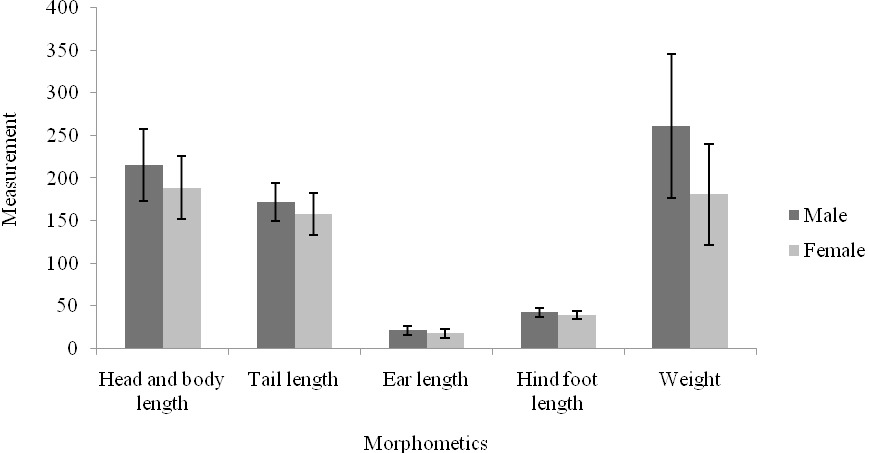
Morphometrics (mean ± SE, linear measurements in mm, while weight in gms) of the adult Norway rat, R. norvegicus trapped from urban areas of Rawalpindi, during 2011-12.
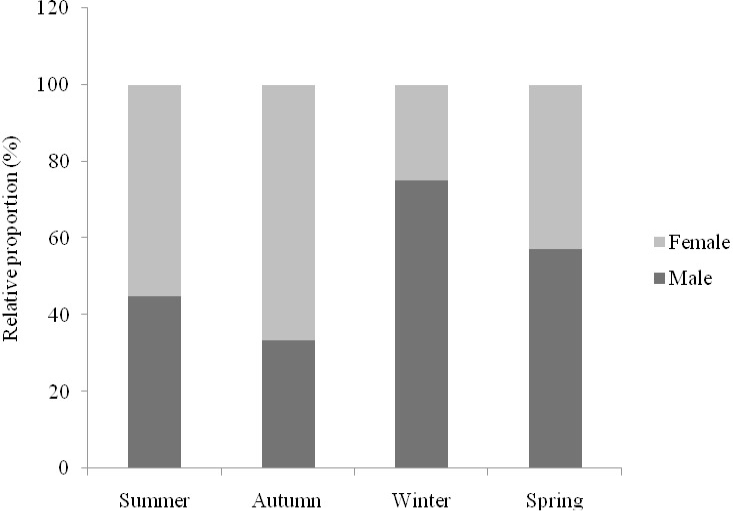
Sex wise proportion (%) of the population of Norway rat, trapped from urban areas of Rawalpindi, during different seasons of 2011-12.
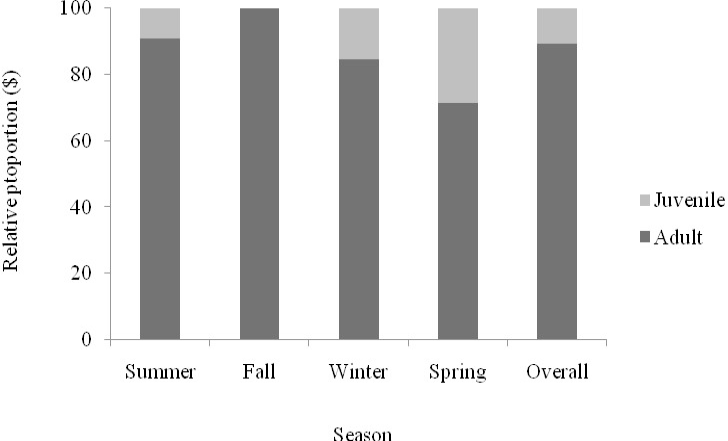
Relative proportion (%) of adults / juveniles of the Norway rat, trapped from urban areas of Rawalpindi, during different seasons of 2011-12.
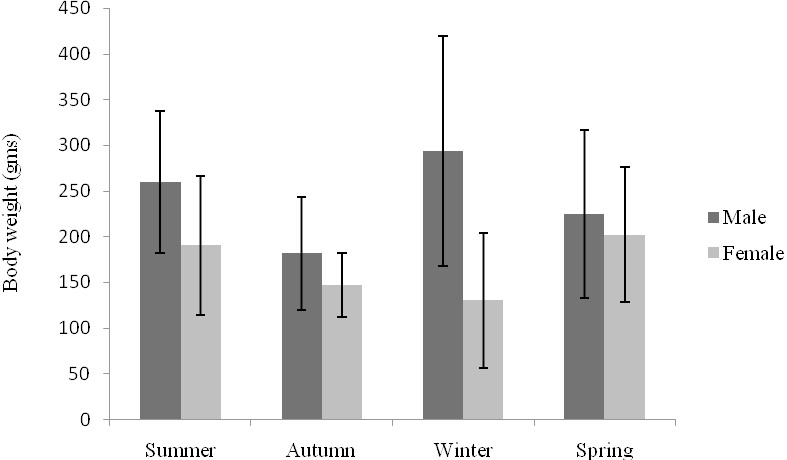
Seasonal changes in the body weight (mean ± SE) of the Norway rat, trapped from urban areas of Rawalpindi, during 2011-12.
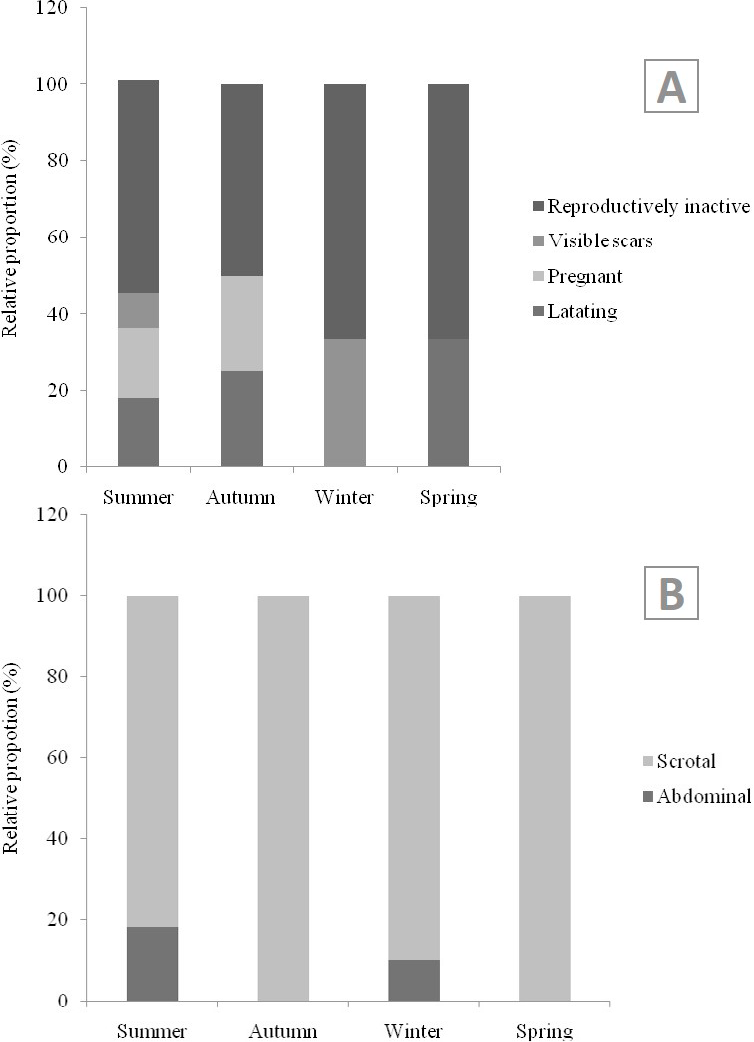
Reproductive activity of the female (A), and male (B) Norway rat, trapped from urban areas of Rawalpindi, during different seasons of 2011-12.
References
- Aplin, K.P., Brpwn, P.R., Jacobs, J. Krebs, C.J. and Singleton, G.R., 2003. Field methods for rodent studies in Asia and the Indo-Pacific. ACIAR Monograph No. 100, pp. 223.
- Brooks, J. E., Ahamd, E., Hussain, I., Munir, S. and Khan, A. A. (eds.) 1990. A training manual on vertebrate pest management. dsxUSAID/DWRC/PARC, Islamabad, Pakistan, pp. 206.
- Castellarini, F. and Polop, J., 2002. Aust. Ecol., 27: 273–283. https://doi.org/10.1046/j.1442-9993.2002.01178.x[CrossRef]
- Castillo, E., Priotto, J., Ambrioso, A. M., Provensal, M.C., Pini, N., Morales, M.A., Steinmann, A. and Polop, J.J., 2003. Int. Biodet. Biodeg., 52: 135-141. https://doi.org/10.1016/S0964-8305(03)00033-7[CrossRef]
- Cavia, R., Cueto, G.R. and Saurez, O.V., 2009. Land Urb. Plan., 90: 11-19.
- Childs, J.E., Glass, A.G. and Leduc, J.W., 1991. Bull. Soc. Vector Ecol., 16: 245-255.
- Gomez, V.I.E. and Busch, M., 2007. Mammal. Biol., 72: 364-371. https://doi.org/10.1016/j.mambio.2006.09.002[CrossRef]
- Lambpropoulos, A.S., Fine, J.B., Perbeck, A., Torres, D., Glass, G.E., McHugh, P. and Dorsey, E.A., 1999. Environ. Hlth., 61: 12-17.
- Mushtaq, M., Kayani, A.R., Nadeem, M.S. and Beg, M.A., 2014. Pakistan J. Zool., 46: 1585–1589.
- Pocock, M.J.O., Searle, J.B. and White, P.L., 2004. J. Anim. Ecol., 73: 878-888. https://doi.org/10.1111/j.0021-8790.2004.00863.x[CrossRef]
- Roberts, T.J., 1997. Mammals of Pakistan. Oxford University Press, Karachi. pp. 525.
- Taber, R.D. and Macdonald, S.R., 1992. J. Mammal., 53: 513-528.
- Steel, R.G.D. and Torrie, I.H., 1980. Principles and procedures of statistics. McGraw Hill, New York, pp. 481.
- Vadell, M.V., Cavia, R. and Saurez, O.V., 2010. Int. J. Pest Manage., 56: 327-336. https://doi.org/10.1080/09670874.2010.499479[CrossRef]
- Villa, B.C., Whisson, D.A. and Sanchez-Cordero, V., 1997. Anals Inst. Biol. Univ. Nac. Auton. Mexico, Ser. Zool., 68: 165-172.
- Wu, S., Lin, Y.T.K. and Yu, H.T., 2006. Zool. Stud., 45: 467-474.
- Zareef, S., Nasim, S., Kalsoom, S., Jabeen, F., Javed, Z., Nadeem, S., M. and Beg, M.A., 2009. Pakistan J. Zool., 41: 415-416.
Services
Article usage statistics
Loading…