
A key to the 20 tribes and 22 genera of Tettigonioidea is provided, with figures, from Pakistan.
Short Communication · Volume 49, Issue 3, 26 May 2017 · Open Access
Key to the Tribes and Genera of Tettigonioidea (Orthoptera) of Pakistan
· ·
Affiliations & Notes ⌄
- 1Department of Zoology, University of Sindh, Jamshoro, Pakistan , * Corresponding author: riffatumer@hotmail.com
Article Info ⌄
- Journal:
- Pakistan Journal of Zoology
- Published:
- 26 May 2017

From the article
- A key to the 20 tribes and 22 genera of Tettigonioidea is provided, with figures, from Pakistan.
- Genera in this key are grouped by tribe, and some of these are based on the following structures: body size, pronotum, fastigium, cerci, subgenitalplate, and shape of ovipositor.
- Ovipositor short, less than 1.5 times as long as pronotum (Fig. 2a) Phaneroptera.
- Ovipositor curves slightly upwards and crenulated at apex (Fig. 2l) Decticus.
Selected from the article's own text.
Abstract
KEY TO TETTIGONIOIDEA TRIBES AND GENERA FROM PAKISTAN
The characters given in the key will separate the Pakistan genera but not necessarily the tribes from a wider distribution. Genera in this key are grouped by tribe, and some of these are based on the following structures: body size, pronotum, fastigium, cerci, subgenitalplate, and shape of ovipositor.
1. Size large (38 mm), head short and rounded in appearance
2
-- Size (approx. 29 mm) head short, rounded face flattened
Sathrophyllia
2. Pronotum pronounced with or without tubercle (Fig. 1a)
Cymatomerini
-- Pronotum flat without tubercle (Fig. 1b) 3
3. Fastigium wide and triangular, Trigonocorypha
-- Fastigium of vertex narrow and conical Hexacentrus
4. Cerci long and curved (Fig. 3e) Phaneropterini
-- Cercilong, strongly curved, pointed apically 5
5. Ovipositor short, less than 1.5 times as long as pronotum (Fig. 2a) Phaneroptera
-- Ovipositor not shorter than 2.2 times long as pronotum (Fig. 2b) Holochlorini
6. Subgenital plate of male with deep bifurcation (Fig. 3a)
Letanaeini
-- Subgenital plate of male not deeply bifurcate, having lobes (Fig. 3b) Ducetini
7. Pronotum smooth, flat behind the lateral lobes (Fig. 1e)
8
-- Pronotum not smooth, lateral carinae serrated and straight (Fig. 1b) Trigonocoryphini
8. Ovipositor short, wide, strongly curved with rough lateral surface (Fig. 2b) Holochlora
-- Ovipositor relatively narrow, bent almost semi-circularly upwards (Fig. 2c) Ducetia
9. Pronotum with conspicuous but not deep humeral notches (Fig. 1c) 10
-- Pronotum with shallow humeral notches on lateral lobes (Fig. 1d) 11
10. Cerci long, thin, curved (Fig. 3f) Letana
-- Cerci not long, flattened, truncate, short, andthick (Fig. 3g) 13
11. Ovipositor lamelliform (Fig. 2d) Tylopsini (Tylopsis)
-- Ovipositor sickle-shaped (Fig. 2e) Isopserini (Isopsera)
12. Wings short (5mm), dark brown Drymadusini
-- Wings large (32mm), green 18
13. Subgenital plate longer, wide, with excised apex (Fig. 3d) Calopterusa
-- Subgenital plate shorter, wide without excised apex (Fig. 3c) Iranusa
14. Wingsdark brown or dark gray in coloration 15
-- Wings brownin coloration 16
15. Size large (21mm), body brown, ovipositor slightly curved ventrally, obliquely slanting on dorsal side of apex. Prothorax with two long slender spines ventrally between forelegs, tegmina without distinct dots
Gampsocleidini
-- Size small (11.5 mm), body gray, ovipositor curved dorsally. Prothorax without spines ventrally, tegmina with dots Platycieidini
16. Pronotum with rudimentary lateral carinae. Pronotum not wrinkled dorsally (Fig. 1f) Platycleis
-- Pronotum having caudal margin angular, lateral carinae parallel; surface lacking median carina (Fig. 1g) 17
17. Ovipositor sword-shaped and curved upwards, dorsal and ventral margins smooth, apex acute (Fig. 2f)
Glyphontini
-- Ovipositor slightly curved ventrally, obliquely slanting on dorsal side of apex (Fig. 2g) Gampsocleis
18. Pronotum smooth without lateral carinae (Fig. 1h)
Tettigonini
-- Pronotum not smooth having rudimentary lateral carinae (Fig. 1i) Eupholidoptera
19. Ovipositor narrow, strongly compressed laterally (Fig. 2h) Pholidopterini
-- Ovipositor long extending upto end of tegmina (Fig. 2i)
Tettigonia
20. Vertex of head produced to form a tapering cone between antennal bases, notched below, extending beyond basal antennal segments Copiphorini
-- Vertex of head not extending beyond basal antennal segment; produced as rounded tubercle with concave sides, not notched beneath Conocephalini
21. Ovipositor long and straight (Fig. 2j) Euconocephalus
-- Ovipositor sword-shaped, firm, and smooth (Fig. 2k)
Conocephalus
22. Fastigium of vertex narrow, conical, apex acute. 23
-- Fastigium of vertex rounded or truncates Mecopodini
23. Cerci without denticles (Fig. 3h) Hexacentrini
-- Cerci with denticles (Fig. 3i) 24
24. Ovipositor curves slightly upwards and crenulated at apex (Fig. 2l) Decticus
-- Ovipositor robust, elongate, sometime incurved (Fig. 2m) Mecopoda
25. Pronotum dorsally convex, with well-marked median carina (Fig. 1j) Decticini
-- Pronotum flat dorsally, with humeral sinus (Fig. 1k)
Afromecopoda
26. Fastigium of vertex conical, narrower than scapus, furrowed dorsally and separated by step-like incision
Himertulini (Himertula)
-- Fastigium of vertex inversely ovoid, dorsal apex distinctly narrower than vertex fastigium, usually separated from vertex fastigium by a rather large gap
Glyphonotus
Acknowledgements
This study was funded by Higher Education Commission Islamabad Pakistan under Indigenous Ph.D Fellowship programme Phase-II and Pakistan Science Foundation, Islamabad under grant # PSF /Res/ S-SU/ Bio (423).
Statement of conflict of interest
Authors have declared no conflict of interest.
Figures
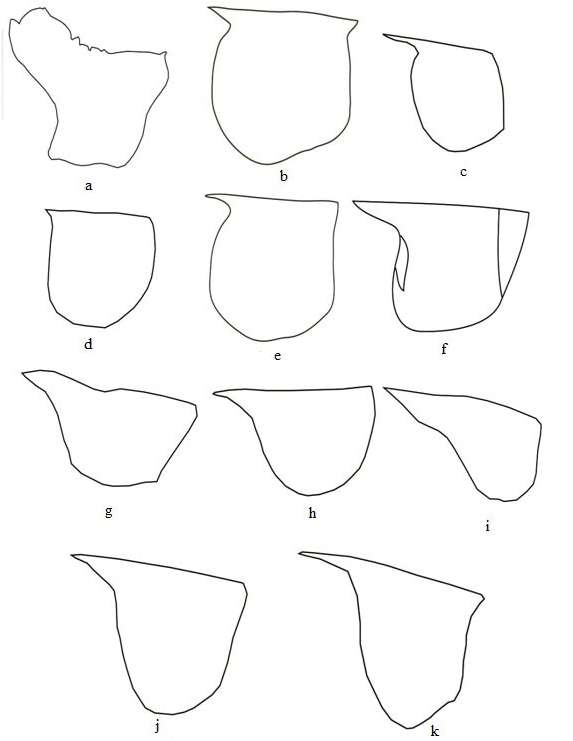
Pronotum lateral views; a, Sathrophylia rugosa; b, Trigonocorypha unicolor; c, Letana bulbosa; d, Tylopsis lillifolia; e, Holochlora japonica; f, Playcleis intermdia; g, Glyphonotus sinesis; h, Tettigonia caudata; I, Eupholidoptera karatolosi; j, Decticus albifrons; k, Afromecopoda monroviana.
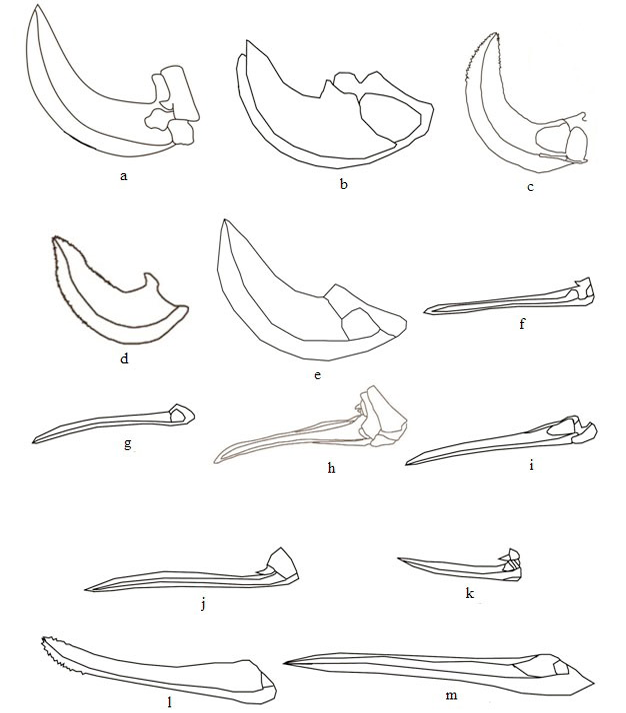
Ovipositor lateral views: a, Phaneroptera roseata; b, Holochlora japonica; c, Ducetia japonica; d, Tylopsis lillifolia; e, Isopsera spinosa; f, Glyphonotus sinesis; g, Gampsocleis akbari; h, Eupholidoptera karatolosi; i, Tettigonia caudate; j, Euconocephalus incertus; k, Conocephalus maculates; l, Decticus albifrons; m, Mecopoda platyphoea.
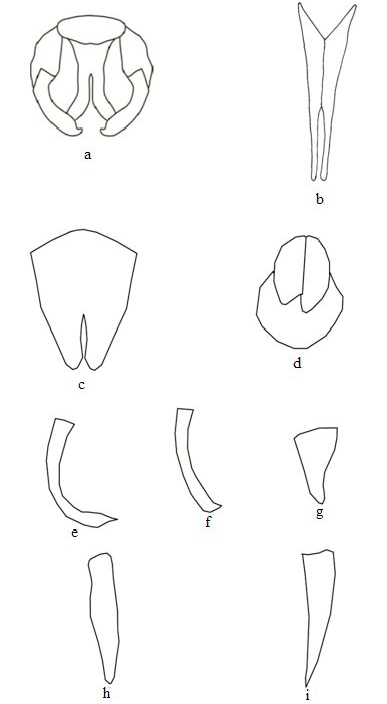
Subgenital plate (a-d) and Cerci (e-i); a, Letana rufonotata; b, Ducetia japonica; c, Iranusa grisea; d, Calopterusa balucha; e, Phaneroptera gracilis; f, Letana rufonotata; g, Calopterusa balucha; h, Hexacentrus unicolor; I, Decticus verrucivorous.
References
- Andreeva, E., 2003. Proc. Histor. Mus. Blag., 3: 91-94, Blagoevgrad [in Bulgarian].
- Bader, A.K and Massa, B. 2001. J. Orth. Res. 10: 25-37. https://doi.org/10.1665/1082-6467(2001)010[0025:TOFJWD]2.0.CO;2[CrossRef]
- Bei-Bienko, G.Y., 1965. Fauna of the USSR Tettigonioidea (Orthoptera), volume 2, pp. 360.
- Bisby, F.A., Roskov, Y.R., Ruggiero, M.A., Orrell, T.M., Paglinawan, L.E., Brewer, P.W., Baily, N.J. and Hertum, V.J., 2007. Species 2000 & ITIS Catalogue of Life: 2007 Annual Check list. Reading, U.K. Available from: http:// www.Catalogueoflife.org/ annual-checklist/2007(Date of access June 2007).
- Brunner von Wattenwyl, C., 1878. Monographie der Phaneropteriden. Brockhaus, Wien, pp. 401.
- Brunner von Wattenwyl, C., 1893. Ann. Mus. Civ. Nat. Genova Ciacomo Doria. 33: 1-230.
- Brunner von Wattenwyl, C., 1895. Monographie der Pseudophylliden K.K. Zool. Bot. Ges, Wien, pp. 282.
- Ciplak, B., 2000. Ent. News, 111: 299-306.
- Ciplak, B., 2003. Biodiver. Conser. Klu. Acad. Publ. Nether.12: 47-64.
- Ingrisch, S., 1990. Spixiana, 13:149-182.
- Ingrisch, S. and Shishodia, M.S., 1998. Bull. Soc. Ent. Suisse, 71: 355-373.
- Ingrisch, S., 2002. Ent. Basil., 24: 123–159.
- Jago, N.D., 1997. In: The bionomics of grasshoppers, Katydids and their Kin (eds. S.K. Gangwere, M.C. Mulalirangen and M. Muralirangen), CAB International. Oxford, pp. 443-480.
- Naskrecki, P., 2001. Encycl. Biodiv., 3: 247-266. https://doi.org/10.1016/B0-12-226865-2/00140-1[CrossRef]
- Panhwar, W.A., Riffat, S., Wagan, M.S. and Santosh, K., 2013. Int. J. Adv. Res., 1: 679-682.
- Panhwar, W.A., Riffat, S., Wagan, M.S., Khatari, I. and Santosh, K., 2014. Pakistan J. Zool., 46: 203-213.
- Ragge, D.R., 1956. Proc. zool. Soc. London, 127: 205-283. https://doi.org/10.1111/j.1096-3642.1956.tb00471.x[CrossRef]
- Ragge, D.R., 1961. Bull. Br. Mus. nat. Hist (Ent.), 10: 171-208.
- Retdenbacher, J., 1891. Verh. zool. bot. Ges. Wien, 41: 315-362.
- Riffat, S. and Wagan, M.S., 2007. Pakistan J. Zool., 39: 321-325.
- Riffat, S. and Wagan, M.S., 2012. Pakistan J. Zool., 44: 43-51.
- Riffat, S., Panhwar, W.A. and Wagan, M., 2013. Pakistan J. Ent., 28: 113-116.
- Riffat, S., Panhwar, W.A., Wagan, M.S and Khatri, I., 2014. Zoo Keys, 466: 1–11. https://doi.org/10.3897/zookeys.466.8423[CrossRef]
- Riffat, S., Panhwar, W.A. and Wagan, M.S., 2015. Pakistan J. Zool., 47: 1361-1364.
- Samways, M.J., 1989. Environ. Conserv., 16: 217-226. https://doi.org/10.1017/S0376892900009814[CrossRef]
- Stal, C., 1874. Recensio orthopterorum. Revue critique des Orthoptèresdécrits par Linné, De Geer et Thunberg. 2. Norstedt and Soner, Stockholum, pp. 121.
- Uvarov, B., 1942. Trans. Am. Ent. Soc., 67: 303-373.
- Wagan, M.S., 2008. Proc. Pakistan Congr. Zool., 28: 69 (Abstract).
Services
Article usage statistics
Loading…