Research Article · Volume 14, Issue 11, 10 October 2026 · Open Access
Protein Utilization in Thin-Tailed Lambs Fed Diets Containing Different Levels of Fermented Melon (Cucumis melo L.) Straw
· · · ·
Affiliations & Notes ⌄
1Department of Animal Science, Faculty of Animal and Agricultural Sciences, Diponegoro University, Semarang, Central Java, Indonesia. *Correspondence | Limbang Kustiawan Nuswantara, Department of Animal Science, Faculty of Animal and Agricultural Sciences, Diponegoro University, Semarang, Central Java, Indonesia Email: limbang.kn@gmail.com,
The inclusion of fermented melon straw (FMS) at levels of up to 20% in the diet did not negatively affect feed intake, nutrient digestibility, rumen fermentation characteristics, nitrogen utilization, or microbial protein synthesis in Thin-Tailed lambs (TTL).
The 10% FMS inclusion level showed the best numerical performance compared with the other treatments.
Therefore, under the conditions of the present study, FMS may serve as an alternative fibrous feed resource at inclusion levels of up to 20% of the total diet, corresponding to replacement of up to 50% of the original odot grass component.
Selected from the article's own text.
Abstract
This study is the first to evaluate fermented melon straw (FMS; Cucumis melo L.) as a partial substitute for odot grass in Thin-Tailed lambs using an integrated assessment of protein utilization. Eighteen male lambs with an initial body weight of 17.15 ± 0.84 kg were randomly assigned to three diets (n = 6): T0: 60% concentrate + 40% odot grass; T1: 60% concentrate + 30% odot grass + 10% FMS; and T2: 60% concentrate + 20% odot grass + 20% FMS, corresponding to 0, 25, and 50% replacement of the original odot grass component, respectively. FMS substitution did not significantly affect dry matter intake (P = 0.429), dry matter digestibility (P = 0.293), crude protein digestibility (P = 0.310), ruminal NH3 concentration (P = 0.159), nitrogen retention (P = 0.201), blood urea concentration (P = 0.336), and microbial protein synthesis (P = 0.262). Crude protein intake increased numerically from 111.59 g/day in T0 to 114.27 and 114.05 g/day in T1 and T2, respectively, without a significant treatment effect (P = 0.090). The 10% FMS inclusion level showed a more favorable numerical pattern across several protein utilization parameters, although differences were not statistically significant. Under the conditions of this study, FMS may serve as a locally available alternative fibrous feed resource for smallholder farmers in Indonesia at inclusion levels of up to 20% of the total diet.
Keywords | Cucumis melo L., Fermented melon straw, Protein utilization, Thin-Tailed lambs, Microbial protein synthesis
INTRODUCTION
The livestock sector plays a strategic role in providing high quality animal protein to meet the nutritional demands of the growing population. Among the various livestock commodities, lambs represent a promising species for further development because of their high reproductive performance and rapid population growth . In Indonesia, the indigenous Thin-Tailed lambs (TTL) are the predominant breed raised by smallholder farmers due to their excellent adaptability to tropical environments and their ability to efficiently utilize locally available forage resources.
Nutrition is one of the most important factors influencing livestock productivity . Adequate nutrient intake through balanced diets is essential for supporting growth, health, and production performance in lambs . However, the limited availability of high-quality forage, particularly during the dry season, remains a major constraint to lambs production in Indonesia. Consequently, agricultural by-products have attracted increasing attention as alternative feed resources because of their wide availability, relatively low cost, and potential contribution to sustainable livestock production . One such by-product is melon straw, which is generated in large quantities from melon cultivation. Indonesia produced approximately 117,794 tons of melon (Cucumis melo L.) in 2023, with a harvested area of 7,039 ha (Ministry of Agriculture, 2024). Wen et al. (2022) reported that melon cultivation generated approximately 3.12 tons of residual biomass per hectare, highlighting the potential of melon crop residues as an alternative fibrous feed resource for ruminants. The utilization of these residues as livestock feed may help reduce feeding costs ; and contribute to more sustainable agricultural waste management .
Melon straw (Cucumis melo L.) consists primarily of stems and leaves remaining after fruit harvest and has the potential as an alternative fibrous feed resource for ruminants. Previous studies have reported that melon crop residues contain appreciable crude protein but also substantial structural fiber, which may limit their nutritional utilization . As with other crop residues, the presence of lignocellulosic components, particularly cellulose, hemicellulose, and lignin, can restrict microbial access to potentially digestible nutrients. Fermentation was selected in the present study as a biological pre-treatment because microbial activity can modify the fibrous components and nutritional characteristics of agricultural residues ; . This approach was considered suitable for processing melon straw, which contains substantial structural fiber that may limit its nutritional utilization. The use of a commercial fermentation starter in sealed drums provided a practical method for processing the straw before drying and milling it for incorporation into the experimental diets. Fermentation was therefore selected to explore the potential of biologically processed melon straw as an alternative fibrous feed resource for ruminants. In the present study, the analyzed melon straw showed changes in chemical composition following fermentation. Crude protein increased from 12.15 to 13.38% of DM, whereas crude fiber decreased from 29.58 to 28.82%. The structural fiber fractions also decreased, with NDF declining from 30.85 to 28.42%, ADF from 22.84 to 20.65%, and lignin from 6.80 to 5.33% of DM (Table 1). Although the changes in crude protein and crude fiber were modest, the concurrent decreases in NDF, ADF, and lignin indicated changes in the structural fiber composition of the analyzed material. These compositional observations provided a basis for evaluating fermented melon straw as an alternative fibrous feed ingredient in the experimental diets.
Efficient protein utilization in ruminants depends on the coordinated supply of rumen-degradable nitrogen and fermentable energy, which supports microbial growth and microbial protein synthesis . When this balance is inadequate, a greater proportion of dietary nitrogen may be lost through fecal and urinary excretion, thereby reducing nitrogen-use efficiency and increasing environmental nitrogen losses . These relationships indicate that evaluating an alternative forage source should extend beyond nutrient intake and digestibility to include indicators of ruminal nitrogen availability, systemic urea metabolism, nitrogen excretion and retention, and microbial protein synthesis.
Khayyal et al. (2020) evaluated unfermented cantaloupe vines hay as a partial substitute for clover hay in growing lamb diets, focusing on nutrient intake and digestibility, ruminal fermentation characteristics, blood parameters, growth performance, and economic efficiency. In contrast, the present study evaluated fermented melon straw as a partial substitute for odot grass in Thin-Tailed lambs. In addition to nutrient intake and digestibility, ruminal ammonia concentration, and blood urea concentration, the present study examined nitrogen absorption, fecal and urinary nitrogen excretion, nitrogen retention, urinary purine derivatives, microbial nitrogen, and microbial protein synthesis. These measurements provide a more integrated assessment of nitrogen utilization and microbial protein supply in lambs fed diets containing fermented melon straw. Therefore, the present study aimed to evaluate the effects of different dietary inclusion levels of fermented melon straw on protein utilization and nitrogen retention while partially replacing odot grass.
MATERIALS AND METHODS
Experimental design, diets and animals
The study was conducted from August to December 2024 at the Research Farm of the Faculty of Animal and Agricultural Sciences, Diponegoro University, Semarang, Indonesia. The experimental procedures were approved by the Research Ethics Committee of the Faculty of Animal and Agricultural Sciences, Diponegoro University (Approval No. 62-07/A-15/KEP-FPP).
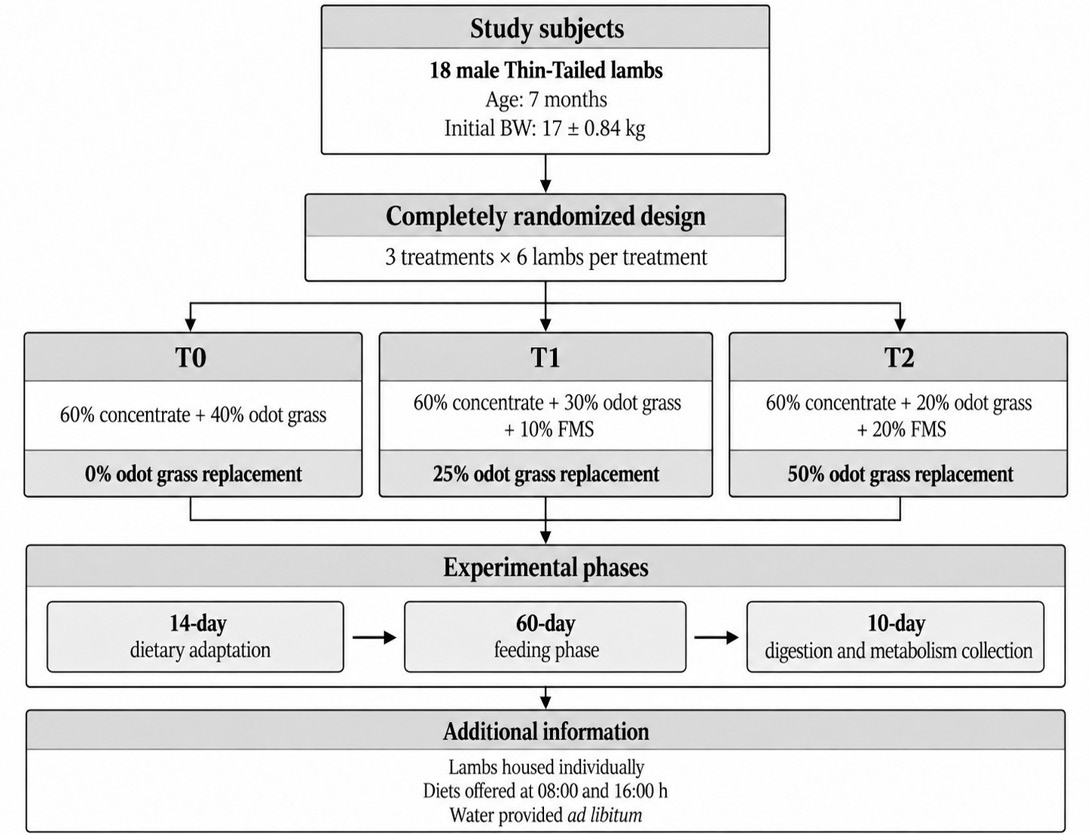
A schematic overview of the experimental design, dietary treatments, and experimental phases is presented in Figure 1. The experiment was conducted using a completely randomized design with three dietary treatments and six replications. Eighteen male Thin-Tailed lambs, aged approximately 7 months, with an average initial body weight of 17.15 ± 0.84 kg, were used in the study. Lambs of similar age and initial body weight were randomly allocated to three dietary treatments, with six lambs assigned to each treatment. Each lamb was housed individually and served as an experimental unit. The feed consisted of odot grass
and fermented melon straw (FMS) as roughage, and a concentrate composed of rice bran, soybean dregs, coconut meal, cassava pulp, pollard, corn gluten feed, molasses and mineral mixture. The treatment T0 (60% concentrate + 40% odot grass), T1 (60% concentrate + 30% odot grass + 10% FMS) and T2 (60% concentrate + 20% odot grass + 20% FMS). The nutritional composition of the experimental diets is presented in Table 2. The experimental procedure consisted of three consecutive phases: a 14-day dietary adaptation phase, a 60-day feeding phase, and a 10-day digestion and metabolism collection phase. Lambs were placed in individual cages with separate feeders and water containers. Animals in each group were fed on one of the experimental rations, which were offered twice daily at 8:00 a.m. and 4:00 p.m., while water was freely offered throughout the day.
Fermented melon straw preparation
Melon straw was obtained from Farm Hill, Solo, Central Java, Indonesia, and chopped into 2–3 cm pieces. Before fermentation, the moisture content of the material was adjusted to approximately 60%. Starbio, a commercial probiotic fermentation starter previously described as containing microorganisms with proteolytic, cellulolytic, lignolytic, and lipolytic activities , was applied at 0.6% of the melon-straw dry matter weight. The starter was sprinkled onto the chopped straw and mixed thoroughly to ensure uniform distribution. The treated melon straw was then placed in a fermentation drum. The drum opening was covered with thick plastic before closure, and the lid was equipped with a rubber seal and locking mechanism to minimize air entry and promote anaerobic fermentation conditions. Fermentation was carried out at ambient temperature for 21 days. At the end of the 21-day fermentation period, the fermented melon straw was qualitatively assessed based on the development of a characteristic fermented aroma and the absence of visible fungal growth. These observations were used as a preliminary assessment of the fermented material before further processing. The material was subsequently dried and ground using a hammer mill to obtain fermented melon straw (FMS) meal for inclusion in the experimental diets. The chemical composition of the melon straw was analyzed before and after fermentation. Crude protein increased from 12.15 to 13.38% of DM, whereas crude fiber decreased from 29.58 to 28.82%, NDF from 30.85 to 28.42%, ADF from 22.84 to 20.65%, and lignin from 6.80 to 5.33% of DM (Table 1).
Table 1: Chemical composition of melon straw before and after fermentation (% of DM).
Parameter
Unfermented melon straw
Fermented melon straw
Crude protein
12.15
13.38
Crude fiber
29.58
28.82
NDF
30.85
28.42
ADF
22.84
20.65
Lignin
6.80
5.33
DM = dry matter; CP = crude protein; CF = crude fiber; NDF = neutral detergent fiber; ADF = acid detergent fiber. All chemical-composition values are expressed on a dry matter basis.
Table 2: Chemical composition of the experimental diets.
Nutrient
T0
T1
T2
Dry matter (% as-fed)
86.26
86.15
87.11
Ash (% DM)
11.70
13.22
14.47
Crude protein (% DM)
13.89
14.02
14.13
Ether extract (% DM)
4.45
4.40
4.36
Crude fiber (% DM)
20.60
20.67
20.74
NFE (% DM)
49.36
47.69
46.30
TDN (% DM)
67.93
67.69
67.49
T0 = 60% concentrate + 40% odot grass; T1 = 60% concentrate + 30% odot grass + 10% fermented melon straw (FMS); T2 = 60% concentrate + 20% odot grass + 20% FMS. DM = dry matter; CP = crude protein; EE = ether extract; CF = crude fiber; NFE = nitrogen-free extract; TDN = total digestible nutrients. Dry matter content is expressed on an as-fed basis, whereas all other chemical-composition values are expressed on a dry matter basis. NFE was calculated according to Tillman et al. (1998), and TDN was calculated according to Sutardi (2001).
Data collection and analysis
During the feeding trial treatment, feed intakes and refusals were recorded daily for the calculation of average daily feed intake. Digestive and metabolic test were conducted for 10 days. Feces were collected using a plastic mesh placed at the bottom of the pens, while urine was collected through a funnel into a plastic container containing 10% H₂SO₄ to maintain the final pH below 3. Feces and urine were weighed daily and 10% of total was collected as a representative sample. At the end, samples were pooled and homogenized for each animal. Feed and feces samples were analyzed for dry matter (DM), crude protein (CP), crude fiber (CF), ether extract (EE), and ash according to AOAC (2007). Feed intake and fecal nutrient output were used to estimate the apparent nutrient digestibility following the equations proposed by Tillman et al. (1991).
Urinary nitrogen content was determined using the Kjeldahl method, employing the same analytical procedure used for feed and fecal samples. Nitrogen balance was subsequently calculated using the following equations:
N intake (g/day) = Dry matter intake × dietary N concentration
Fecal N excretion (g/day) = fecal dry matter output × fecal N concentration
Urinary N excretion (g/day) = urinary N concentration × total daily amount of urine
N absorbed (g/day) = N intake − fecal N excretion
N retention (g/day)= N intake − (fecal N excretion + urinary N excretion)
N digestibility (%) = (N intake (g/day) -fecal N excretion (g/day) )/(N intake (g/day) ) × 100%
N retention (% of N intake) = (N retention (g/day) )/(N intake (g/day) ) × 100%
N retention (% of absorbed N) = (N retention (g/day) )/(N absorbed (g/day) ) × 100%
At the end of the feeding trial treatment, blood samples were collected from the jugular vein before morning feeding. The plasma samples were obtained after centrifugation (10 min at 3000 rpm) and stored at −80 ◦C until analysis. The plasma samples were analyzed for blood urea concentrations using Berthelot method .
Rumen fluid was collected from all 18 lambs 3 hours after the morning feeding using an oral stomach tube.
To minimize potential saliva contamination, the first 100 mL of aspirated rumen fluid was discarded, and the subsequent 80 mL was retained for analysis. The samples were immediately filtered through four layers of gauze and transferred into centrifuge tubes. Ruminal ammonia concentration was subsequently determined using the Conway microdiffusion method .
Microbial protein synthesis was estimated from purine derivatives. Urine samples collected from each animal were analyzed for purine derivatives (allantoin, xanthine, hypoxanthine, and uric acid) using spectrophotometry. Absorbance was measured at a wavelength of 522 nm using a spectrophotometer. Microbial protein synthesis was estimated using equations from Chen and Gomes (1995), based on absorbed purines (X) calculated from total urinary purine derivative excretion (Y):
Y = 0.84X + (0.15W0.75e -0.25X)
Where Y is total urinary purine derivative excretion (mmol/day), X is absorbed purines (mmol/day), W is the body weight of the lamb (kg), W0.75 represents metabolic body weight (kg0.75), and e is the base of the natural logarithm. The coefficient 0.84 represents the urinary recovery of absorbed purines, whereas the term 0.15W0.75e -0.25X accounts for the endogenous contribution to urinary purine derivative excretion. Absorbed purines (X) were obtained by numerically solving the equation using the total daily urinary purine derivative excretion (Y) and the body weight (W) of each lamb.
Statistical analysis
Data were analyzed using Analysis of variance (ANOVA) using the F-test at the 5% significance level (α = 0.05). Before performing ANOVA, the normality of model residuals was assessed using the Shapiro–Wilk test, and homogeneity of variance among treatments was evaluated using Levene’s test. Further analysis was conducted using Duncan’s Multiple Range Test if significant differences were found . The statistical model was:
Yij = μ + τi + εij
where i denotes dietary treatment (T0, T1, or T2), j denotes the individual lamb within each treatment, Yij is the observation from animal j assigned to treatment i, μ is the overall mean, τi is the fixed effect of dietary treatment, and εij is the residual random error.
RESULT AND DISSCUSION
Nutrient intake and digestibility
Dry matter intake was not significantly affected by dietary substitution with fermented melon straw (P = 0.429; η2 = 0.107). DMI averaged 803.35 g/day in T0, increased numerically to 815.06 g/day in T1, and remained close to the control value in T2 at 807.16 g/day (Table 3). The limited variation in DMI among treatments may partly be associated with the narrow ranges observed for several dietary components, including dry matter (86.15–87.11%), crude protein (13.89–14.13% DM), crude fiber (20.60–20.74% DM), and ether extract (4.36–4.45% DM). Although dietary ash increased from 11.70% in T0 to 14.47% DM in T2, this increase was not accompanied by a statistically detectable difference in DMI. In addition, the tested FMS inclusion levels (10% and 20% of the total diet) may not have been sufficient to produce a statistically detectable change in DMI under the conditions of the present study.
Dietary nutrient composition is an important factor associated with voluntary feed intake in ruminants. Woodmartin et al. (2024) reported that changes in forage composition were accompanied by changes in dry matter intake in sheep, indicating that forage nutrient characteristics can influence feed consumption. In the present study, the relatively narrow ranges in DM, CP, CF, and EE may have contributed to the limited variation in DMI among treatments. Consistent with the present findings, Khayyal et al. (2020) reported no significant differences in dry matter intake when cantaloupe vines hay replaced 25% and 50% of the forage component in growing lamb diets. These replacement proportions are comparable to T1 and T2 in the present study, which replaced 25% and 50% of the original odot grass component, respectively. Overall, inclusion of FMS at the tested levels did not produce a statistically detectable reduction in dry matter intake.
Crude protein intake was not significantly affected by dietary substitution with fermented melon straw (P = 0.090; η² = 0.275). CPI averaged 111.59 g/day in T0, increased numerically to 114.27 g/day in T1, and remained at a similar numerical level in T2 at 114.05 g/day (Table 3). The numerical increase in CPI in the FMS-containing diets occurred together with the relatively small variation in DMI and the narrow range of dietary crude protein concentration, which increased from 13.89% DM in T0 to 14.02% and 14.13% DM in T1 and T2, respectively. Because crude protein intake is determined by both the amount of feed consumed and the protein concentration of the diet, these two factors may have contributed to the limited variation in CPI among treatments. Ríos-Rincón et al. (2014) reported that crude protein intake is closely associated with dry matter intake and dietary crude protein concentration, while Sileshi et al. (2021) also showed that nutrient intake is influenced by dietary nutrient composition. In the present study, the relatively narrow range of dietary CP concentration, together with the absence of a statistically detectable treatment effect on DMI, was consistent with the limited variation in CPI. Although CPI was numerically higher in T1 and T2 than in T0, the treatment effect was not statistically significant. These modest numerical increases were not accompanied by statistically detectable changes in crude protein digestibility, nitrogen retention, or microbial protein synthesis. Nevertheless, with six lambs per treatment, the precision for detecting modest between-treatment
Table 3: Nutrient intake and digestibility in Thin-Tailed lambs fed diets containing different levels of fermented melon straw.
Parameter
T0 mean ± SD (95% CI)
T1 mean ± SD (95%CI)
T2 mean ± SD (95% CI)
F(2,15)
P
η²
DMI (g/day)
803.35 ± 13.21 (789.49–817.21)
815.06 ± 17.83 (796.35–833.77)
807.16 ± 14.98 (791.44–822.89)
0.896
0.429
0.107
CPI (g/day)
111.59 ± 1.83 (109.66–113.51)
114.27 ± 2.50 (111.65–116.90)
114.05 ± 2.12 (111.83–116.27)
2.841
0.090
0.275
DMD (%)
62.64 ± 5.12 (57.26–68.02)
65.15 ± 6.18 (58.66–71.64)
60.29 ± 3.89 (56.21–64.38)
1.333
0.293
0.151
CPD (%)
71.37 ± 4.59 (66.55–76.18)
72.98 ± 5.22 (67.50–78.46)
68.87 ± 3.53 (65.17–72.58)
1.268
0.310
0.145
Values are mean ± SD (n = 6), with 95% confidence intervals. DMI = dry matter intake; CPI = crude protein intake; DMD = dry matter digestibility; CPD = crude protein digestibility; η² = eta-squared effect size.
differences was limited, and studies with larger sample sizes would provide greater statistical precision in evaluating such differences. Overall, partial replacement of odot grass with FMS at the tested levels did not produce a statistically detectable alteration in crude protein intake.
Dry matter digestibility represents the efficiency of feed utilization, as it reflects the proportion of dietary nutrients that can be digested and utilized by the animal. In the present study, dry matter digestibility was not significantly affected by dietary substitution with fermented melon straw (P = 0.293; η² = 0.151). DMD averaged 62.64% in T0, increased numerically to 65.15% in T1, and decreased to 60.29% in T2 (Table 3). Although T1 showed the highest numerical DMD, the overall treatment effect was not statistically significant. The limited variation in DMD may partly be associated with the narrow ranges of several dietary components, particularly crude protein (13.89–14.13% DM), crude fiber (20.60–20.74% DM), and ether extract (4.36–4.45% DM), together with the absence of a statistically detectable difference in dry matter intake among treatments. Tillman et al. (1998) stated that dry matter digestibility is influenced by dietary composition, nutrient content, and rumen microbial activity. In the present study, inclusion of FMS at 10% of the total diet did not result in a numerical reduction in DMD relative to the control, whereas DMD declined numerically at the 20% inclusion level. This lower numerical value in T2 occurred alongside an increase in dietary ash from 11.70% in T0 to 14.47% DM in T2, indicating a corresponding reduction in the proportion of organic matter in the diet. The increase in ash also partly accounted for the decrease in nitrogen-free extract, which was calculated by difference from the other proximate components. These changes in dietary composition may have contributed to the numerical DMD response in T2, although their individual effects on digestibility cannot be established from the present data. Overall, the results indicate that partial replacement of odot grass with FMS did not produce a statistically detectable effect on dry matter digestibility at the tested inclusion levels.
The nutritional value of dietary protein depends not only on its concentration in the diet but also on the proportion that can be digested and utilized by the animal. Crude protein digestibility was not significantly affected by dietary substitution with fermented melon straw (P = 0.310; η² = 0.145). CPD averaged 71.37% in T0, increased numerically to 72.98% in T1, and decreased to 68.87% in T2, with T1 showing the highest numerical value (Table 3). Although this pattern indicates some variation in protein digestibility among treatments, the overall treatment effect was not statistically significant. The limited treatment effect on CPD may partly be associated with the narrow range of dietary crude protein concentration, which varied from 13.89% to 14.13% DM, together with the absence of a statistically detectable difference in crude protein intake. Dietary protein provides nitrogen for rumen microorganisms and contributes to the protein available for digestion and utilization by the animal . In addition, an appropriate ruminal environment supports nutrient digestion and absorption . In the present study, ruminal NH3 concentration also did not differ significantly among treatments, indicating that the inclusion of FMS did not produce a statistically detectable alteration in ruminal ammonia availability at the tested levels. The numerical CPD response was also broadly consistent with the pattern observed for dry matter digestibility, with both variables reaching their highest numerical values in T1 and declining in T2. This suggests that the 10% FMS inclusion level did not reduce protein digestibility relative to the control, whereas the lower numerical value at 20% inclusion was not sufficient to establish a significant treatment effect. The similar numerical patterns of DMD and CPD may reflect a common response to changes in dietary composition, although a biological effect of FMS inclusion on digestibility cannot be established from the present results. Further studies with larger sample sizes would provide greater statistical precision in evaluating whether this numerical pattern represents a reproducible treatment response. Overall, partial replacement of odot grass with FMS did not produce a statistically detectable effect on crude protein digestibility.
Ammonia Concentration (NH3)
Ruminal NH3 concentration was not significantly affected by dietary substitution with fermented melon straw (P = 0.159; η² = 0.217). NH3 concentration averaged 6.51 mM in T0, increased numerically to 7.06 mM in T1, and decreased to 5.59 mM in T2 (Table 4). Therefore, the response showed a rise at the 10% FMS inclusion level followed by a decline at 20% inclusion, rather than a progressive response with increasing FMS. Despite this numerical pattern, the overall treatment effect was not statistically significant. Ruminal NH3 concentration is influenced by dietary protein supply and the extent of protein degradation in the rumen. Holik et al. (2019) identified dietary protein content as an important factor affecting ruminal NH3 concentration, while Saro et al. (2020) associated ruminal ammonia production with dietary protein content and crude protein intake. Protein degradability and solubility can also influence the release of ammonia during ruminal fermentation ; ; . In the present study, dietary crude protein varied within a narrow range of 13.89–14.13% DM, and crude protein intake ranged from 111.59 g/day to 114.27 g/day, which may have contributed to the limited overall variation in ruminal NH3 concentration. Dietary protein is degraded to peptides and amino acids and subsequently deaminated to release ammonia, which represents an important inorganic nitrogen source for rumen microorganisms . The NH3 concentrations observed in the present study (5.59–7.06 mM) were within the range of 2.94–17.06 mM reported by Stern and Hoover (1979) as sufficient to support rumen microbial activity. The lower numerical NH3 concentration in T2 may reflect changes in ruminal nitrogen release or utilization at the 20% FMS inclusion level. However, ruminal NH3 concentration alone cannot distinguish between reduced protein degradation and changes in microbial ammonia utilization or absorption. Therefore, although the numerical response differed among treatments, partial replacement of odot grass with FMS did not produce a statistically detectable effect on ruminal NH3 concentration at the tested inclusion levels.
Nitrogen balance
Nitrogen retention was not significantly affected by dietary substitution with fermented melon straw (P = 0.201; η² = 0.193). Nitrogen retention averaged 9.01 g/day in T0, increased numerically to 9.82 g/day in T1, and decreased to 8.59 g/day in T2 (Table 5). T1 also showed the lowest numerical fecal N excretion (4.94 g/day) and urinary N excretion (3.52 g/day), together with the highest numerical N absorption (13.35 g/day). From a nitrogen utilization perspective, the combination of slightly higher N intake and lower fecal and urinary N losses in T1 was consistent with its higher numerical N absorption and retention. This pattern may have biological relevance,
Table 4: Ruminal ammonia, blood urea, purine derivatives, microbial nitrogen, and microbial protein synthesis in Thin-Tailed lambs.
Parameter
T0 mean ± SD (95% CI)
T1 mean ± SD (95% CI)
T2 mean ± SD (95% CI)
F(2,15)
P
η²
Ruminal parameter
NH3 (mM)
6.51 ± 1.23 (5.22–7.79)
7.06 ± 0.95 (6.06–8.05)
5.59 ± 1.53 (3.98–7.20)
2.081
0.159
0.217
Blood parameter
Urea (mg/dL)
36.65 ± 4.32 (32.12–41.18)
34.95 ± 3.38 (31.41–38.49)
38.72 ± 4.96 (33.52–43.92)
1.173
0.336
0.135
Purine derivatives
Allantoin (mmol/L)
1.402 ± 0.076 (1.323–1.481)
1.433 ± 0.059 (1.371–1.495)
1.369 ± 0.085 (1.280–1.458)
1.139
0.346
0.132
Uric acid (mmol/L)
0.123 ± 0.024 (0.097–0.148)
0.133 ± 0.027 (0.105–0.161)
0.111 ± 0.013 (0.098–0.125)
1.461
0.263
0.163
Xanthine-hypoxanthine (mmol/L)
0.024 ± 0.010 (0.013–0.034)
0.030 ± 0.007 (0.022–0.037)
0.019 ± 0.008 (0.011–0.028)
2.114
0.155
0.220
Total purine derivatives (mmol/L)
1.548 ± 0.107 (1.436–1.661)
1.596 ± 0.091 (1.500–1.691)
1.500 ± 0.105 (1.390–1.609)
1.356
0.288
0.153
Microbial N (g N/day)
1.187 ± 0.172 (1.006–1.368)
1.281 ± 0.202 (1.069–1.493)
1.120 ± 0.097 (1.019–1.222)
1.465
0.262
0.163
Microbial protein synthesis (g/day)
7.417 ± 1.077 (6.286–8.547)
8.005 ± 1.263 (6.680–9.331)
7.002 ± 0.605 (6.368–7.637)
1.465
0.262
0.163
Values are mean ± SD (n = 6), with 95% confidence intervals. NH3 = ammonia; N = nitrogen; η² = eta-squared effect size.
Table 5: Nitrogen balance in Thin-Tailed lambs fed diets containing different levels of fermented melon straw.
Parameter
T0 mean ± SD (95% CI)
T1 mean ± SD (95% CI)
T2 mean ± SD (95% CI)
F(2,15)
P
η²
N intake (g/day)
17.85 ± 0.29 (17.55–18.16)
18.28 ± 0.40 (17.86–18.70)
18.25 ± 0.34 (17.89–18.60)
2.841
0.090
0.275
Fecal N excretion (g/day)
5.12 ± 0.87 (4.21–6.03)
4.94 ± 0.96 (3.93–5.94)
5.68 ± 0.63 (5.01–6.34)
1.294
0.303
0.147
Urinary N excretion (g/day)
3.73 ± 0.51 (3.19–4.27)
3.52 ± 0.15 (3.37–3.67)
3.98 ± 0.52 (3.43–4.53)
1.708
0.215
0.185
N absorbed (g/day)
12.74 ± 0.73 (11.97–13.50)
13.35 ± 1.03 (12.26–14.43)
12.57 ± 0.74 (11.80–13.34)
1.407
0.275
0.158
N digestibility (%)
71.37 ± 4.59 (66.55–76.18)
72.98 ± 5.22 (67.50–78.46)
68.87 ± 3.53 (65.17–72.58)
1.268
0.310
0.145
N retention (g/day)
9.01 ± 1.18 (7.77–10.24)
9.82 ± 1.15 (8.62–11.03)
8.59 ± 1.12 (7.41–9.77)
1.791
0.201
0.193
N retention (% of N intake)
50.47 ± 6.76 (43.38–57.57)
53.72 ± 5.92 (47.51–59.93)
47.06 ± 5.90 (40.87–53.26)
1.724
0.212
0.187
N retention (% of absorbed N)
70.50 ± 5.47
(64.76–76.24)
73.44 ± 2.93
(70.37–76.51)
68.14 ± 5.41
(62.46–73.82)
1.873
0.188
0.200
Values are mean ± SD (n = 6), with 95% confidence intervals. N = nitrogen; η² = eta-squared effect size.
although the observed differences were not sufficient to establish a statistically significant improvement in nitrogen utilization. Therefore, although the overall treatment effects were not statistically significant, the 10% FMS inclusion level showed a relatively favorable numerical pattern across several nitrogen-balance variables.
Nitrogen balance represents the difference between dietary nitrogen intake and nitrogen losses through feces and urine . In the present study, N intake varied only slightly among treatments, averaging 17.85, 18.28, and 18.25 g/day in T0, T1, and T2, respectively (Table 5). Apparent N digestibility was numerically highest in T1 (72.98%), which coincided with the lowest fecal N excretion and the highest N absorption. Dietary protein intake and digestibility influence the amount of nitrogen available for absorption and subsequent utilization by the animal ; . Da Silva Aguiar et al. (2023) further reported that crude protein digestibility is closely related to the amount of absorbed nitrogen available for metabolic use, while Zhang et al. (2024) demonstrated that dietary crude protein characteristics are closely associated with nitrogen absorption and nitrogen losses in sheep. Fecal nitrogen losses are also influenced by dietary nitrogen supply and the extent of nutrient digestion ; .
Urinary N excretion followed a similar numerical pattern, decreasing from 3.73 g/day in T0 to 3.52 g/day in T1 before increasing to 3.98 g/day in T2 (Table 5). Nitrogen utilization in ruminants depends on the coordination between dietary nitrogen supply, microbial utilization of nitrogen in the rumen, and subsequent utilization of absorbed protein by the animal . Efficient synchronization between dietary nitrogen and fermentable energy can enhance microbial capture of nitrogen and reduce nitrogen losses . In the present study, the lower numerical urinary N excretion in T1 occurred together with the highest numerical ruminal NH3 concentration, microbial N, and microbial protein synthesis. These concurrent responses were consistent with the overall numerical pattern of nitrogen utilization observed at the 10% FMS inclusion level.
Nitrogen retention expressed relative to N intake was also numerically highest in T1, with values of 50.47, 53.72, and 47.06% in T0, T1, and T2, respectively (Table 5). A similar pattern was observed when N retention was expressed relative to absorbed N, reaching 70.50, 73.44, and 68.14%, respectively. Although these indices were not significantly affected by dietary treatment, their numerical responses were consistent with the higher N absorption and retention observed in T1. Overall, inclusion of FMS at 10% of the total diet was associated with a relatively favorable numerical pattern of nitrogen utilization, whereas this response was not maintained at the 20% inclusion level.
Blood urea
Blood urea concentration was not significantly affected by dietary substitution with fermented melon straw (P = 0.336; η² = 0.135). Blood urea concentration averaged 36.65 mg/dL in T0, decreased numerically to 34.95 mg/dL in T1, and increased to 38.72 mg/dL in T2 (Table 4). Despite this numerical variation, the overall treatment effect was not statistically significant. The absence of a statistically detectable treatment effect on blood urea may partly be associated with the relatively narrow range of dietary crude protein concentration and crude protein intake among treatments. During ruminal fermentation, ammonia that is generated from protein degradation can be absorbed across the rumen wall and transported to the liver, where it is converted into urea . Dietary protein intake is therefore an important factor influencing circulating urea concentration and subsequent nitrogen recycling or excretion ; . In the present study, crude protein concentration ranged from 13.89 to 14.13% DM and crude protein intake from 111.59 to 114.27 g/day, while ruminal NH3 concentration also did not differ significantly among treatments. The blood urea concentrations observed in the present study (34.95–38.72 mg/dL) were within the range reported by Saro et al. (2020), who observed blood urea concentrations of 33.3–41.3 mg/dL in Assaf lambs. Along with the absence of statistically significant treatment effects on crude protein intake and ruminal NH3 concentration, these results indicate that partial replacement of odot grass with FMS did not produce a statistically detectable alteration in blood urea concentration at the tested inclusion levels
Microbial protein synthesis
Microbial protein synthesis was not significantly affected by dietary substitution with fermented melon straw (P = 0.262; η² = 0.163). Microbial protein synthesis averaged 7.417 g/day in T0, increased numerically to 8.005 g/day in T1, and decreased to 7.002 g/day in T2 (Table 4). Therefore, T1 showed the highest numerical MPS among treatments. Microbial N followed the same numerical pattern, averaging 1.187, 1.281, and 1.120 g N/day in T0, T1, and T2, respectively.
The limited variation in microbial protein synthesis among treatments may partly be associated with the relatively similar crude protein (CP) content of the experimental diets. Dietary protein characteristics influence ruminal nitrogen availability and microbial protein synthesis ; . Since ammonia nitrogen (NH3-N) serves as an important inorganic nitrogen source for microbial amino acid biosynthesis, adequate nitrogen availability is essential for microbial protein synthesis . In the present study, dietary crude protein concentration varied within a narrow range of 13.89–14.13% DM, while ruminal NH3 concentrations remained within the range considered sufficient to support rumen microbial activity. These conditions may have contributed to the limited variation in microbial protein synthesis among treatments. In addition to nitrogen availability, fermentable energy is required to support microbial growth and the incorporation of nitrogen into microbial biomass . In the present study, the proportion of concentrate was maintained at 60% across treatments, while dietary TDN ranged from 67.49 to 67.93% DM. These relatively narrow differences in dietary energy value suggest that the tested diets may have provided broadly similar energy supplies, which could also have contributed to the limited variation in MPS. Norrapoke et al. (2022) also reported that the availability of dietary nitrogen and soluble carbohydrates plays an important role in supporting microbial protein synthesis.
Purine derivatives were also not significantly affected by dietary treatment (Table 4). Allantoin (P = 0.346; η² = 0.132), uric acid (P = 0.263; η² = 0.163), and xanthine-hypoxanthine (P = 0.155; η² = 0.220) showed no statistically significant treatment effects. Total purine derivatives averaged 1.548, 1.596, and 1.500 mmol/L in T0, T1, and T2, respectively (P = 0.288; η² = 0.153). Similar to microbial N and MPS, all measured purine derivative fractions showed their highest numerical values in T1 and lower values in T2.
Purine derivatives, including allantoin, uric acid, xanthine, and hypoxanthine, are products of purine metabolism and are commonly used as indirect indicators for estimating microbial protein synthesis in ruminants . Following intestinal digestion, microbial nucleic acids are degraded into purine bases, which are subsequently metabolized and excreted in urine as purine derivatives ; . In the present study, the numerical increase in total purine derivatives in T1, followed by a decrease in T2, corresponded with the numerical pattern observed for microbial N and MPS. This consistent numerical pattern may reflect differences in microbial protein supply among treatments, with T1 showing the highest numerical value. However, the observed differences were not statistically significant and do not establish a treatment effect on microbial protein synthesis. Dietary nitrogen availability is also important for microbial growth and the synthesis of microbial nucleic acids . Cai et al. (2025) likewise reported a relationship between dietary nitrogen supply, microbial protein synthesis, and urinary purine derivative excretion in lambs.
The findings indicate that fermented melon straw (FMS) has potential as an alternative fibrous feed resource for smallholder lamb production in Indonesia, particularly as a partial substitute for odot grass. Under the conditions of the present study, FMS inclusion at up to 20% of the total diet, corresponding to replacement of 50% of the original odot grass component, did not produce statistically detectable changes in the measured protein-utilization parameters. Melon straw is an agricultural residue generated after melon harvest and may be accessible to farmers in melon-producing areas. Its use as feed could provide an additional option for utilizing locally available agricultural residues. However, the cost-effectiveness of FMS inclusion would depend on the costs of collecting, processing, fermenting, drying, and storing the straw relative to the forage it replaces. Because feed production costs and the availability of melon straw were not directly evaluated in the present study, further assessment is needed to determine the economic feasibility and practical supply of FMS for smallholder farmers.
The absence of statistically significant treatment effects is relevant to the objective of evaluating FMS as a partial substitute for odot grass rather than as a means of improving protein utilization. Under the conditions of the present study, replacing up to 50% of the original odot grass component with FMS did not produce statistically detectable changes in the measured parameters, supporting its potential as an alternative fibrous feed resource in Thin-Tailed lamb diets. However, the sample size of six lambs per treatment limited the precision for detecting modest differences among diets.
The findings of the present study should be interpreted within the scope of the experimental conditions. The study was conducted using male Thin-Tailed lambs over an 84-day experimental period, including adaptation, feeding, and collection phases. Therefore, the responses observed may not be directly generalizable to other sheep breeds, age groups, or production conditions. In addition, the study focused on protein-utilization parameters and did not evaluate the long-term effects of FMS inclusion on growth performance, animal health, or productivity. Future studies should evaluate FMS inclusion levels above 20% of the total diet and investigate the effects of longer feeding periods on nutrient utilization and animal performance. Further research should also assess growth performance and carcass characteristics to determine the broader applicability of FMS as a partial substitute for odot grass in lamb diets.
CONCLUSION
The inclusion of fermented melon straw (FMS) at levels of up to 20% in the diet did not negatively affect feed intake, nutrient digestibility, rumen fermentation characteristics, nitrogen utilization, or microbial protein synthesis in Thin-Tailed lambs (TTL). The 10% FMS inclusion level showed the best numerical performance compared with the other treatments. Therefore, under the conditions of the present study, FMS may serve as an alternative fibrous feed resource at inclusion levels of up to 20% of the total diet, corresponding to replacement of up to 50% of the original odot grass component.
ACKNOWLEDGEMENTS
The authors would like to thank the Faculty of Animal and Agricultural Sciences, Diponegoro University, for funding and providing facilities in the research enclosure and nutrition and feed science laboratory during the research.
NOVELTY STATEMENT
This is the first study to comprehensively evaluate fermented melon straw (Cucumis melo L.) as a partial substitute for odot grass in Thin-Tailed lamb diets through an integrated assessment of nutrient intake and digestibility, ruminal ammonia, blood urea, nitrogen balance, urinary purine derivatives, and microbial protein synthesis. The results demonstrate that fermented melon straw can replace up to 50% of the original odot grass component, equivalent to 20% of the total diet, without adversely affecting the measured protein-utilization parameters.
AUTHOR’S CONTRIBUTION
Ridho Aziz Waluyo contributed to the conceptualization, execution of the experiment, data collection and analysis, writing of the original draft and revision of the manuscript. Limbang Kustiawan Nuswantara contributed to the conceptualization of the study, resources, supervision, project administration, critical review and validation of the manuscript. Marry Christiyanto contributed to the conceptualization of the study, resources, supervision, critical review and validation of the manuscript. Joelal Achmadi and Nuruliarizki Shinta Pandupuspitasari contributed to the resources and supervision. All authors read, reviewed, and approved the final version of the manuscript.
Generative AI and AI assisted technology statement
The authors declare that no generative AI and AI assisted technology was used in the creation of this manuscript.
Conflict of interest
The authors declare that there is no conflict of interest regarding the publication of this article.
Figures
Figure 1:.
Schematic overview of the experimental design, dietary treatments, and experimental phases.
References
AOAC (2007). Association of Official Analytical Chemists. Official Method of Analysis (18th Ed.). Washington, DC, USA.
Belanche A, Martín-García I, Jiménez E, Jonsson NN, Yañez-Ruiz DR (2021). A novel ammoniation treatment of barley as a strategy to optimize rumen pH, feed degradability and microbial protein synthesis in sheep. J. Sci. Food Agric., 101(13): 5541-5549. https://doi.org/10.1002/jsfa.11205[CrossRef]
Bomfim MAD, Rodrigues M, Oliveira TS (2024). Evaluation of different ratios of neutral detergent-soluble carbohydrate fractions on performance, ingestive behavior, and nitrogen balance in dairy goats. Trop. Anim. Health Prod., 56: 159. https://doi.org/10.1007/s11250-024-04014-x[CrossRef]
Cai Y, Zou J, Zhou Y, Yang J, Wang C, Mao H (2025). Nitrogen utilization and ruminal microbiota of Hu lambs in response to varying dietary metabolizable protein levels. Animals. 15(14): 1-19. https://doi.org/10.3390/ani15142147[CrossRef]
Castillo-Lopez E, Domingues-Ordonez MG (2019). Factors affecting the ruminal microbial composition and methods to determine microbial protein yield. Rev. Mex. De Cienc. Pecuarias, 10(1):120–48. https://doi.org/10.22319/rmcp.v10i1.4547[CrossRef]
Chen XB, Gomes MJ (1995). Evaluation of a decision support system for predicting microbial protein supply to ruminants. In Recent Advances in Animal Nutrition: Proc. Ninth Biennial Conf. Armidale NSW Aust.., 9: 161–180.
Conway, E.F. and E. O’Mally (1957). Micro diffusion methods. Ammonia and urea using buffered absorbents. Biochem. J., 36: 655-661. https://doi.org/10.1042/bj0360655[CrossRef]
da Silva Aguiar F, Bezerra LR, Cordão MA, Cavalcante ITR, de Oliveira JPF, do Nascimento RR, de Souza BB, Oliveira RL, Pereira ES, Filho JMP (2023). Effects of increasing levels of total tannins on intake, digestibility, and balance of nitrogen, water, and energy in Hair Lambs. Animals, 13(15):2497. https://doi.org/10.3390/ani13152497[CrossRef]
Deng J, Wang L, Zheng C, Gao Z, Li Z, Su R, Chen W, Lv X, Sun W (2025). Effects of different additives on the quality of rice straw haylage, ruminal fermentation parameters and methane production in Hu sheep. Animals, 15(24):3573. https://doi.org/10.3390/ani15243573[CrossRef]
Deng KD, Ma T, Jiang CG, Tu Y, Zhang NF, Liu J, Zhao YG, Xu GS, Diao QY (2020). Requirements of metabolizable protein by Dorper x thin-tailed Han crossbred ewe lambs. J. Anim. Physiol. Anim. Nutr., 104: 831–837. https://doi.org/10.1111/jpn.13342[CrossRef]
Duncan, DB (1955). Multiple ranges and multiple F-Test. Biometrics, 11: 1-42. https://doi.org/10.2307/3001478[CrossRef]
Guimarães LJ, Zundt M, Tsujiguchi MP, Giotto FM, Barbosa MJ, Grandis FA, Silva IG, Pereira MCS, Ribeiro ELA (2023). The use of condensed tannin in lambs diet alters the rumen protozoa population without affecting growth performance. Small Ruminant Res., 229: 107122. https://doi.org/10.1016/j.smallrumres.2023.107122[CrossRef]
Holik YLA, Abdullah L, Karti PDMH (2019). Nutrient silage evaluation of new sorghum (Sorghum Bicolor) cultivation with addition of legum Indigofera sp. at different levels. J. Ilmu Nutrisi dan Teknologi Pakan, 17(2): 38-46. https://doi.org/10.29244/jintp.17.2.38-46[CrossRef]
Hu L, Su H, Pu Z, Yang S, Ma Y, Rehemujiang H, Xu G (2025). Effects of ten types of diets on nitrogen balance and excretion of purine derivatives. Bio Web Conf., 182:01014. https://doi.org/10.1051/bioconf/202518201014[CrossRef]
Huang L, Zhu Y, Wang Q, Zhu A, Liu Z, Wang Y, Allen DT, Li L (2021). Assessment of the effects of straw burning bans in China: Emissions, air quality, and health impacts. Sci. Total Environ., 789:147935. https://doi.org/10.1016/j.scitotenv.2021.147935[CrossRef]
Hurley MA, Lewis E, Beecher M, Garry B, Fleming C, Boland T, Hennessy D (2021). Dry matter intake and in vivo digestibility of grass-only and grass-white clover in individually housed sheep in spring, summer and autumn. Animals, 11(2):306. https://doi.org/10.3390/ani11020306[CrossRef]
Jin, D, Zhao SG, Zheng N, Bu DP, Beckers Y, Wang JQ (2018). Urea nitrogen induces changes in rumen microbial and host metabolic profiles in dairy cows. Livestock sci., 210 : 104-110. https://doi.org/10.1016/j.livsci.2018.02.011[CrossRef]
Khattab IM, Anele UY (2021). Dry matter intake, digestibility, nitrogen utilization and fermentation characteristics of sheep fed Atriplex hay-based diet supplemented with discarded dates as a replacement for barley grain. J. Anim. Physiol. Anim. Nutr., 106(2):229-238. https://doi.org/10.1111/jpn.13577[CrossRef]
Khayyal AA, Phillip YL, Khir AA, Mahgoub AAS, Abdel-Salam O (2020). Effect of feeding rations containing cantaloupe (Cucumis melo L.) vines hay on performance of growing lambs. J. Nutr. Feeds, 23 (3): 397- 407. https://doi.org/10.21608/ejnf.2020.148122[CrossRef]
Lima J, Ingabire W, Roehe R, Dewhurst RJ (2023). Estimating microbial protein synthesis in the rumen-can ‘Omics’ methods provide new insights into a long-standing question?. Vet. Sci., 10(12): 679. https://doi.org/10.3390/vetsci10120679[CrossRef]
Lv X, Cui K, Qi M, Wang S, Diao Q, Zhang N (2020). Ruminal microbiota and fermentation in response to dietary protein and energy levels in Weaned lambs. Animals, 10(1): 109. https://doi.org/10.3390/ani10010109[CrossRef]
Mahboobi Z, Karimi N, Jahanbakhshi A (2023). Estimation of microbial protein synthesis in the rumen of growing lambs based on the purine derivative and the dietary forage to concentrate ratio. J. Adv. Vet. Anim. Res., 10(3): 385-394. https://doi.org/10.5455/javar.2023.j691[CrossRef]
Ministry of Agriculture (2024). Angka Tetap Hortikultura Tahun 2023. Directorate General of Horticulture, Ministry of Agriculture, Jakarta, Indonesia.
Mora-Luna RE, Herrera-Angulo AM, Siqueira MCB, Conceição MGd, Chagas JCC, Monteiro CCF, Véras ASC, Carvalho FFR, Ferreira MA (2022). Spineless cactus plus urea and Tifton-85 hay: maximizing the digestible organic matter intake, ruminal fermentation and nitrogen utilization of wethers in semi-arid regions. Animals, 12(401): 1-16. https://doi.org/10.3390/ani12030401[CrossRef]
Najmuddin M, Nasich M (2019). Thin-tailed ewe productivity in Sedan Village, Sedan District, Rembang Regency. J. Trop. Anim. Prod., 20 (1): 76-83. https://doi.org/10.21776/ub.jtapro.2019.020.01.10[CrossRef]
Noersidiq A, Marlida Y, Zain M, Kasim A, Agustin DF (2018). The effect of bioprocess technology in oil palm trunk on chemical composition and in-vitro fermentation characteristics. Asian J. Microbiol. Biotechnol. Environ. Sci., 20: S102–S108.
Norrapoke T, Pongjongmit T, Foiklang S (2022). Effect of urea and molasses fermented cassava pulp on rumen fermentation, microbial population and microbial protein synthesis in beef cattle. J. Appl. Anim. Res., 50(1): 187-191. https://doi.org/10.1080/09712119.2022.2051518[CrossRef]
Owens FN, Bergen WG (1983). Nitrogen metabolism of ruminant animals: historical perspective, current understanding and future implications. J. Anim. Sci., 57(2):498-518.
Pazla R, Antonius A, Ikhlas Z, Jayanegara A, Ardani LR, Hadiatry MC, Jumjunidang J, Budiyanti T, Firsoni F, Ardinal A, Iswari K, Febrina D, Ratni E (2025). The potential of tannin from Sonneratia alba fruit in defaunation of rumen protozoa and reducing methane gas production: An approach to increase livestock digestive efficiency. Czech J. Anim. Sci., 70(6):223-233. https://doi.org/10.17221/130/2024-CJAS[CrossRef]
Ren N, Zhang X, Hao X, Dong Y, Wang X, Zhang J (2023). Effect of dietary inclusion of riboflavin on growth, nutrient digestibility and ruminal fermentation in Hu lambs. Animals, 13(26): 1-10. https://doi.org/10.3390/ani13010026[CrossRef]
Richterich R, Kuffer H (1973). Die Bestimmung des Harnstoffs in Plasma und Serum (Urease/Berthelot-Methode) mit dem Greiner Electronic Selective Analyzer GSA II. Z. fur kiln. Chem. und kiln. Biochem., 11(12):553-564. https://doi.org/10.1515/cclm.1973.11.12.553[CrossRef]
Ríos-Rincón FG, Estrada-Angulo A, Plascencia A, López-Soto MA, Castro-Pérez BI, Portillo-Loera JJ, Robles-Estrada JC, Calderón-Cortes JF, Dávila-Ramos H (2014). Influence of protein and energy level in finishing diets for feedlot hair lambs: growth performance, dietary energetics and carcass characteristics. Asian Australasian. J. Anim. Sci., 27(1): 55-61. https://doi.org/10.5713/ajas.2013.13307[CrossRef]
Salami SA, Luciano G, O’Grady MN, Biondi L, Newbold CJ, Kerry JP, Priolo A (2019). Sustainability of feeding plant by-products: A review of the implications for ruminant meat production. Anim. Feed Sci. Technol., 251: 37–55. https://doi.org/10.1016/j.anifeedsci.2019.02.006[CrossRef]
Saro C, Mateo J, Caro I, Carballo DE, Fernández M, Valdés C, Bodas R, Giráldez FJ (2020). Effect of dietary crude protein on animal performance, blood biochemistry profile, ruminal fermentation parameters and carcass and meat quality of heavy fattening Assaf Lambs. Animals, 10(11):2177. https://doi.org/10.3390/ani10112177[CrossRef]
Semaun R, Novieta ID, Abdullah M (2016). Analysis of protein and crude fibre of corn cob as livestock feed alternatives with different of long fermentation. Jurnal Galung Tropika, 5(2): 71-79. https://doi.org/10.31850/jgt.v5i2.164[CrossRef]
Sileshi G, Mitiku E, Mengistu U, Adugna T, Fekede F (2021). Effects of dietary energy and protein levels on nutrient intake, digestibility, and body weight change in Hararghe highland and Afar sheep breeds of Ethiopia. J. Adv. Vet. Anim. Res., 8(2): 185-194. https://doi.org/10.5455/javar.2021.h501[CrossRef]
Stern MD, Hoover WH (1979). Methods for determination and factors affecting rumen microbial synthesis. J. Anim. Sci., 49: 1590-1603. https://doi.org/10.2527/jas1979.4961590x[CrossRef]
Sufyan A, Ahmad N, Shahzad F, Embaby MG, AbuGhazaleh A, Khan NA (2022). Improving the nutritional value and digestibility of wheat straw, rice straw, and corn cob through solid state fermentation using different Pleurotus species. J. Sci. Food Agric., 102(6): 2445–2453. https://doi.org/10.1002/jsfa.11584[CrossRef]
Sutardi T (2001). Revitalisasi peternakan sapi perah melalui penggunaan ransum berbasis limbah perkebunan dan suplementasi mineral organik. Laporan Akhir RUT VIII 1. Kantor Menteri Negara Riset dan Teknologi dan LIPI, Bogor, Indonesia.
Tan P, Liu H, Zhao J, Gu X, Wei X, Zhang X, Ma N, Johnston LJ, Bai Y, Zhang W, Nie C, Ma X (2021). Amino acids metabolism by rumen microorganisms: Nutrition and ecology strategies to reduce nitrogen emissions from the inside to the outside. Sci. Total Environ., 800:149596. https://doi.org/10.1016/j.scitotenv.2021.149596[CrossRef]
Tillman AD, Hartadi H, Reksohadiprodjo S, Lebdosoekojo S (1991). Ilmu Makanan Ternak Dasar. Gadjah Mada Univ. Press, Yogyakarta, Indonesia.
Tillman AD, Hartadi H, Reksohadiprodjo S, Prawirokusumo S, Lebdosoekojo S (1998). Ilmu Makanan Ternak Dasar. Edisi ke-5. Gadjah Mada University Press, Yogyakarta.
Wen M, Yang S, Huo L, He P, Xu X, Wang C, Zhang Y, Zhou W (2022). Estimating nutrient uptake requirements for melon based on the QUEFTS model. Agronomy. 12(1):207. https://doi.org/10.3390/agronomy12010207[CrossRef]
Woodmartin S, Creighton P, Boland TM, Farrell L, Claffey N, McGovern F (2024). The inclusion of companion forages in the diet alongside perennial ryegrass increased dry matter intake and organic matter digestibility in sheep. Animal, 18(5): 101150. https://doi.org/10.1016/j.animal.2024.101150[CrossRef]
Wu J, Zhang X, Wang M, Zhou C, Jiao J, Tan Z (2022). Enhancing metabolic efficiency through optimizing metabolizable protein profile in a time progressive manner with weaned goats as a model: involvement of gut microbiota. Microbiol. Spectr., 10(2): e0254521. https://doi.org/10.1128/spectrum.02545-21[CrossRef]
Zang Y, Zhu J, Zhong X, Thapa A, Zhu A, You P, Wang M (2026). Impact of dietary rumen degradable protein level on growth performance, rumen fermentation, and nitrogen utilization in growing Hu sheep. Transl. Anim. Sci., 10(1): 1-9. https://doi.org/10.1093/tas/txag011[CrossRef]
Zhang Z, Shahzad K, Shen S, Dai R, Lu Y, Lu Z, Li C, Chen Y, Qi R, Gao P, Yang Q, Wang M (2022). Altering dietary soluble protein levels with decreasing crude protein may be a potential strategy to improve nitrogen efficiency in Hu sheep based on rumen micro biome and metabolomics. Front. Nutr., 8:815358. https://doi.org/10.3389/fnut.2021.815358[CrossRef]
Zhang Z, Sun Y, Zhong X, Zhu J, Yang S, Gu Y, Yu X, Lu Y, Lu Z, Sun X, Wang M (2024). Dietary crude protein and protein solubility manipulation enhances intestinal nitrogen absorption and mitigates reactive nitrogen emissions through gut microbiota and metabolome reprogramming in sheep. Anim. Nutr., 18: 57-71. https://doi.org/10.1016/j.aninu.2024.04.003[CrossRef]
Zhao X, Khan M, Mushtaq M, Ni X, Danzeng B, Yang H, Ali S, Farid SK, Quan G (2025). Influence of dietary protein levels on metabolism of nitrogen, phosphorus, and calcium in a Chinese indigenous sheep (Ovis aries). Trop. Anim. Health Prod., 57:308. https://doi.org/10.1007/s11250-025-04561-x[CrossRef]
Zheng W, Duan H, Cao L, Mao S, Shen J (2024). Acid-base properties of non-protein nitrogen affect nutrients intake, rumen fermentation and antioxidant capacity of fattening Hu sheep. Front. Vet. Sci., 11: 1381871. https://doi.org/10.3389/fvets.2024.1381871[CrossRef]