Research Article · Volume 14, Issue 11, 13 October 2026 · Open Access
Cloning and Expression of Alpha- and Beta-Toxin Genes of Clostridium perfringens Associated with Chicken Necrotic Enteritis
· · · · · · · · ·
Affiliations & Notes ⌄
1University of Agriculture and Forestry, Hue University, Hue, 49000, Vietnam
2Institute of Biotechnology, Hue University, Hue, 49000, Vietnam
3QueenLabs Biotechnology One Member Company, Hue, 49000, Vietnam
4University of Education, Hue University, Hue 49000, Vietnam. *Correspondence | Hoang Tan Quang and Huynh Van Chuong, Institute of Biotechnology, Hue University, Hue, 49000, Vietnam
Clostridium perfringens is an important bacterial pathogen associated with enteric diseases in poultry, including avian necrotic enteritis (NE). Among its toxin-associated proteins, α-toxin (CPA) and β-toxin (CPB), encoded by the cpa and cpb genes, respectively, represent well-characterized and have been investigated as targets for specific antibody responses. In the present study, selected antigenic regions of cpa and cpb were therefore cloned and expressed to produce recombinant CPA and CPB proteins as defined antigens for the subsequent production of specific anti-CPA and anti-CPB antibodies. The cpa and cpb fragments, corresponding to 372 and 507 bp, respectively, were amplified from a NE-causing C. perfringens isolate obtained in Hue City, Vietnam, and cloned into the pET200/D-TOPO expression vector for heterologous expression in Escherichia coli BL21 Star™ (DE3). Expression of the truncated constructs generated recombinant proteins with apparent molecular masses of approximately 17.3 kDa for CPA and 23 kDa for CPB, consistent with their predicted sizes. BCA quantification revealed concentrations of purified recombinant CPA and CPB preparations reached approximately 1,000 and 800 µg/mL, respectively. ELISA using an anti-6×His antibody confirmed the presence of the recombinant fusion proteins in both soluble and insoluble fractions, the proteins were purified and retained the His tag. These findings demonstrate the successful production of recombinant CPA and CPB fragments from a NE-causing C. perfringens isolate and provide candidate antigen preparations for subsequent studies of their antigenicity, immunogenicity, and potential protective effects.
The poultry industry is one of the fastest-growing sectors of global livestock production and plays a pivotal role in food security by supplying high-quality animal protein in the form of meat and eggs ; . Despite this remarkable growth, infectious diseases continue to represent a major constraint to sustainable poultry production, resulting in substantial economic losses and reduced production efficiency. Among bacterial diseases affecting broiler chickens, necrotic enteritis (NE), associated with Clostridium perfringens, remains one of the most economically important enteric diseases worldwide. Infection with C. perfringens damages the intestinal mucosa, impairs nutrient absorption, reduces growth performance and feed conversion efficiency, and, in severe outbreaks, increases flock mortality .
Clostridium perfringens is a spore-forming, commensal, ubiquitous bacterium that is present in the gastrointestinal tract of healthy humans and animals. This bacterium produces up to 18 toxins . The species is classified into seven toxinotypes (A-G) according to the toxins that the bacterium produces: alpha, beta, epsilon, or iota . Each of these toxinotypes is associated with a myriad of different, frequently fatal, illnesses that affect a range of farm animals and humans. Alpha, beta, and epsilon toxins are the main causes of disease. Vaccinations that generate neutralizing antibodies are the most common prophylactic measures that are currently in use .
The progressive restriction of in-feed antibiotics in many countries has accelerated the development of alternative approaches to NE prevention and control. These include probiotics, bacteriophages, microbial metabolites, phytogenic compounds, and recombinant antigens. Among these strategies, recombinant antigen technology has attracted increasing attention because it enables the production of highly specific and safe immunogens without handling pathogenic microorganisms . Moreover, recombinant proteins can be produced on a large scale using established expression systems, providing a promising platform for the development of next-generation vaccines and immunodiagnostic reagents against C. perfringens infection.
Among the diverse virulence factors produced by C. perfringens, toxins are considered key determinants contributing to intestinal damage and disease development in poultry. Based on toxin production profiles, C. perfringens strains associated with NE are mainly classified into toxinotypes A and C, which produce α-toxin (CPA) and, in the case of type C strains, β-toxin (CPB). These toxins have attracted considerable attention as potential targets for vaccine development and immunological studies due to their biological activities and association with host tissue injury ; . Although NetB is now recognized as the primary virulence factor causing NE in poultry, targeting alpha and beta toxins remains a crucial strategy for comprehensive disease control. Unlike the plasmid-borne netB gene, which is present only in specific populations, the cpa gene is chromosomally located and highly conserved across all C. perfringens types (A through G) , making it a stable and broad-spectrum target. In Vietnam, C. perfringens strains cotaining cpa or cpb genes are prevalent, so anti-CPA anf anti-CPB antibodies are useful for chicken protection from C. perfringens .
The cpa gene encodes CPA, a zinc-dependent phospholipase C enzyme that is conserved among C. perfringens strains. CPA possesses membrane-disrupting activity through its phospholipase and sphingomyelinase functions, which contribute to cellular damage and inflammatory responses during infection. Although CPA has historically been regarded as an important virulence-associated factor of C. perfringens, subsequent studies using mutant strains have suggested that its contribution to NE pathogenesis may depend on bacterial strain background and host conditions. Nevertheless, CPA remains an important immunological target because of its high conservation and toxinogenic characteristics ; . In contrast, CPB is a highly potent pore-forming toxin primarily associated with C. perfringens type B and C strains. CPB disrupts cellular membrane integrity by forming transmembrane pores, leading to ion imbalance, cellular dysfunction, and tissue damage. Because CPB is strongly associated with severe enteric diseases and exhibits high immunogenic potential, it has been considered a promising candidate for recombinant antigen production and vaccine-related investigations .
Recombinant production of toxin proteins provides several advantages over conventional toxin preparation, including improved biosafety, controlled antigen composition, high reproducibility, and potential scalability for vaccine development. Moreover, recombinant antigens allow the study of specific immune responses against individual toxin components without the safety concerns associated with using whole bacterial cells or native toxins . The heterologous expression and characterization of recombinant CPA and CPB proteins represent important steps toward developing effective immunoprophylactic strategies against C. perfringens-associated diseases in poultry ; ; ; . Therefore, this study aimed to clone, express, and purify the recombinant CPA and CPB proteins in the E. coli expression system; to provide antigens for future production of anti-CPA and anti-CPB antibodies.
MATERIALS AND METHODS
Materials
The C. perfringens strains containing cpa or cpb genes were isolated from chicken facal in Hue city, Vietnam in 2024 . The cpa or cpb genes were amplfied, cloned into pGEM/T-Easy vector (pGEM/cpa or pGEM/cpb), confirmed by Sanger sequencing and stored in the Laboratory of Immunology and Vaccine, Institute of Biotechnology, Hue University, Vietnam.
Table 1: Specific primers for coding sequence of cpa/b genes.
Primers
Sequences
PCR product (bp)
cpa
Forward: 5’- CACCTATGCAGCAAAGGTAACTTTA
Reverse: 5’- GTTTTCTGGCTTATAAGCATC
376
cpb
Forward: 5’- CACCGATAGTATTCCTAAAAATAC
Reverse: 5’- AGCTAGCCTGGAATAGACTTGTC
511
T7
Forward 5’- TAATACGACTCACTATAGGG -3’
Reverse: 5’- TAGTTATTGCTCAGCGGTGG -3’
~570 for cpa and ~710 for cpb
*The forward primers contain the CACC sequence at the 5’end, will base pair with the GTCC overhang sequence in pET200/D-TOPO vector.
Cloning cpa/cpb into expression vector
The recombinant pGEM/cpa or pGEM/cpb vectors were used as a template in PCR amplification with specific primers (Table 1). The PCR component consisted of 0.5 µL PhusionTM High-Fidelity DNA Polymerase (2 U/µL, ThermoFisher Scientific, USA), 10 µL 5× PhusionTM HF Buffer, 1 µL 10 mM dNTPs, 20 pmol each primer, 1.5 µL DMSO, 3.6 µL of vector, and distilled water to a final volume of 50 µL. PCR was performed using the following conditions: 98°C for 30 s, 30 cycles of 98°C for 10 s, 55°C for 30 s, and 72°C for 60 s, followed by a final extension at 72°C for 7 min (TC-32 Mini Thermal Cycler Benchmark, USA). PCR products were confirmed by electrophoresis at 70V for 35 min in a 1% agarose gel (TAE 1X), stained with 6× GelGreen Loading Buffer with Tricolor (ABT, Vietnam) using GeneRulerTM 1 kb DNA Ladder (ThermoFisher Scientific, USA).
The PCR products were purified using the QIAquick® PCR Purification Kit (Qiagen, Hilden, Germany), and then cloned into the pET200/D-TOPO vector (Invitrogen, USA). The pET200/D-TOPO vector containing an approximately 3.0 kDa tag fusion protein, including polyhistidine (6×His) region, Xpress™ epitope (Asp-Leu-Tyr-Asp-Asp-Asp-Asp-Lys) and EK recognition site (Asp-Asp-Asp-Asp-Lys). Composition of the ligation reaction consisted of 1 µL vector, 1 µL salt solution, 2 µL PCR product (8 ng), and 2 µL distilled water, which were mixed well and incubated at 23oC for 5 min. The recombinant vectors were transferred into competent Escherichia coli TOP10 cells using the heat-shock method. Competent cells were transferred to 200 µL SOC medium. Then, 800 µL of LB medium (1% tryptone, 0,5% yeast extract, 1% NaCl) was added, and shaking at 37°C for 60 min. Cells were plated on solid LB medium supplemented with 50 μg/mL kanamycin at 37°C overnight, and recombinant cells were selected by PCR with gene-specific and T7 primers (Table 1). Three colonies per gene were screened with manufacturer’s standard single colony PCR protocol.
E. coli cells carrying the recombinant vector were then inoculated into 5 mL of LB broth supplemented with 50 µg/mL kanamycin, and then DNA plasmids were isolated using the PureLink® Quick Plasmid DNA Miniprep Kit (Invitrogen, USA). Recombinant vectors were confirmed by Sanger sequencing, then transformed into competent E. coli BL21 StarTM (DE3) cells (3 µL recombinant vector + 50 µL cells + 200 µL SOC medium) using the heat-shock method. Transformation cells were subcultured on solid LB medium supplemented with 50 μg/mL kanamycin and confirmed by direct colony PCR as described above.
Expression of the cpa and cpb gene in E. coli
The E. coli BL21(DE3) cells containing the recombinant vectors with the coding sequence of CPA or CPB fragments were grown in a 100-mL Erlenmeyer flask containing 10 mL LB medium with 50 μg/mL kanamycin at 37°C to the OD600 of approximately 0.8. Then, isopropyl β-D-thiogalactopyranoside (IPTG) was added to a final concentration of 0.5 mM to induce recombinant protein expression for 8 h. The cells were collected by centrifugation at 15000 rpm for 10 min. Cell pellets were resuspended in TNE extraction buffer (50 mM Tris- HCl (pH 7.5), 100 mM NaCl, and 2 mM EDTA) supplemented with 1% Triton X-100 and 1.0 µg/mL lysozyme; lysed by sonication in ice at 40 Hz for 5 min (Ultrasonic cell disruptor UCD-150, China). Total soluble protein in supernatant was harvested by centrifuging at 15000 rpm at 4°C for 15 min. The remaining insoluble residues were washed five times with 20 mM Tris-HCl, 2% Triton X-100 (pH 8,0) buffer, and once with 20 mM Tris-HCl (pH 8,0) buffer; dissolved in 20 mM Tris-HCl, 4 M Guanidine HCl (pH 8,0) solution; refolded in refolding buffer (20 mM Tris-HCl, 2 M urea, 10% sucrose, 0,1% Tween-80, pH 8,0) for 1 h on ice; and obtained by centrifuging .
Expression of recombinant CPA or CPB proteins was checked by SDS-PAGE on a 12% (w/v) polyacrylamide gel at 80V. The gel was then stained with Coomassie Blue R-250 for 1 h and destained for 2 h to detect protein samples. The protein molecular weight was analyzed with a protein marker 10-170 kDa Wide Range Protein Molecular Weight Marker (BioBase, China).
Antigen purification and determination
The recombinant CPA and CPB were purified by Immobilized Metal Affinity Chromatography (IMAC) using the ProBond™ Purification System (K85001, Thermo Fisher Scientific, USA), which is based on the specific interaction between the 6×His tag of the fusion protein and Ni²⁺ ions immobilized on the affinity chromatography resin using the manufacturer’s standard protocol. The eight eluted fractions obtained after purification (1 mL/fragment) were subjected to SDS-PAGE analysis to evaluate the purity and determine the molecular weight of the recombinant protein.
To verify the presence of the recombinant proteins carrying the 6×His tag, a direct ELISA was performed using an anti-6×His tag monoclonal antibody. Purified protein samples were immobilized onto ELISA plates and incubated with the primary antibody specific for the 6×His epitope (ab18184, Abcam, UK) using the standard protocol. Antibody binding was subsequently detected using an enzyme-mediated colorimetric reaction with Tetramethylbenzidine (N301, Thermo Scientific, USA) as a substrate, allowing specific identification of the recombinant 6×His-CPA and 6×His-CPB fusion proteins. The concentration of purified fusion proteins was calculated using the BSA standard curves (y= −3×10⁻⁷x² + 0,0018x + 0,0042, R²= 0.9997).
RESULTS AND DISCUSSION
Cloning cpa and cpb gene into pET200/D-TOPO vector
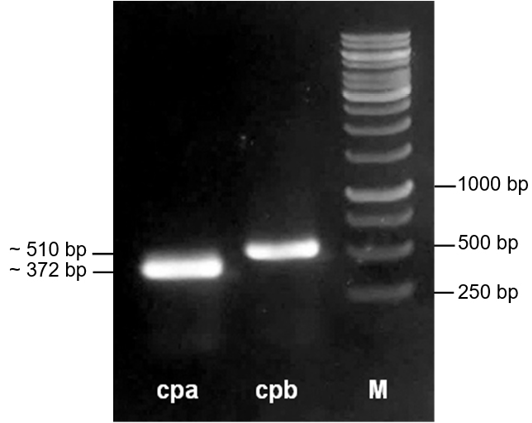
The recombinant plasmids pGEM/cpa and pGEM/cpb were used as templates for PCR amplification of the cpa and cpb genes, respectively. The cpa and cpb gene fragments were amplified by PCR using Phusion High-Fidelity DNA Polymerase (HF) with the gene-specific primer pairs. The results showed a single, distinct DNA band of high intensity with the expected size for each target gene in a 1% agarose gel. The amplified cpa fragment was approximately 370 bp in length, including the four additional CACC nucleotides at the 5′ end of the forward primer, which was consistent with the expected size of 372 bp. Likewise, the amplified cpb fragment was approximately 510 bp, in agreement with the predicted size of 507 bp. These results indicate that the PCR amplification was highly specific and the expected bands were obtained (Figure 1).
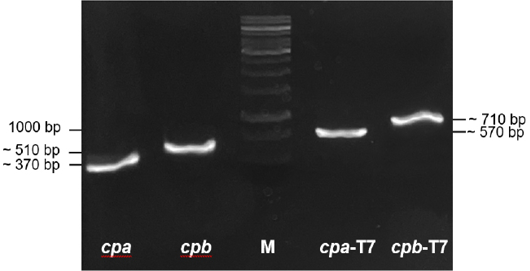
Purified PCR products were cloned into pET200/D-TOPO vector and transformed into E. coli TOP10 cells. After growing overnight on solid LB agar with kanamycin, transformed colonies were confirmed by direct PCR with specific and T7 primers (Figure 2). The correct sequences of cpa and cpb were confirmed by Sanger sequencing. Thus, cpa and cpb genes were successfully cloned into pET200/D-TOPO vector, the recombinant expression vector was named pET200/cpa and pET200/cpb. The pET200/cpa and pET200/cpb vectors were isolated from recombinant cells and confirmed by PCR and then transformed into competent E. coli BL21(DE3) cells; transformed colonies for each gene were randomly selected and confirmed by direct PCR. These colonies were used for CPA and CPB expression.
CPA and CPB expression
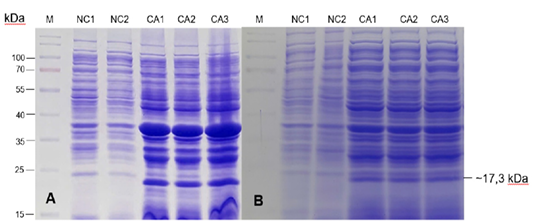
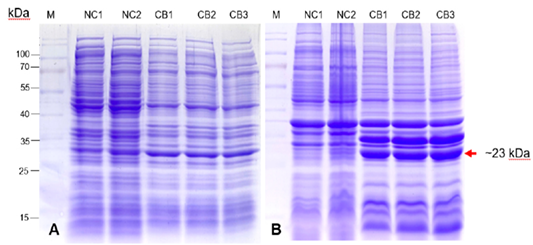
SDS–PAGE analysis revealed a prominent protein band at approximately 17 kDa in IPTG-induced E. coli BL21(DE3) cells harboring the recombinant pET200/cpa plasmid, corresponding to the predicted molecular weight of 17.3 kDa, including the 3.0-kDa fusion tag encoded by the pET200/D-TOPO vector. Similarly, a distinct protein band of approximately 23 kDa was detected in induced cells carrying pET200/cpb, consistent with the predicted molecular weight of approximately 23 kDa. These protein bands were absent in the negative control (Figures 3, 4).
These results demonstrate that the cpa and cpb gene fragments derived from C. perfringens causing necrotic enteritis in chickens were successfully expressed in E. coli BL21(DE3). The recombinant proteins are partially soluble, which is advantageous for subsequent purification.
Purification of CPA and CPB
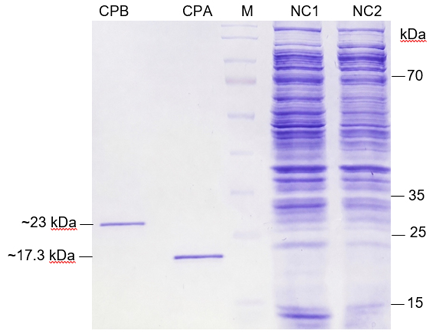
Following successful expression of the recombinant CPA and CPB proteins in Escherichia coli BL21(DE3), the proteins were purified by immobilized metal affinity chromatography (IMAC) and quantified by BCA assay. As analyzed by polyacrylamide gel electrophoresis of the second elution fragment, an extra protein band with a molecular weight of approximately 17.3 kDa (CPA) or 23 kDa (CPB) was observed in the solube form in transformed E. coli cells compared to negative controls (Figure 5). Thus, it can be seen that proteins with molecular weights corresponding to CPA and CPB harboring 6×His tag were present in E. coli BL21(DE3) cells. The purified proteins show single bands, indicating good purity for downstream immunological characterization.
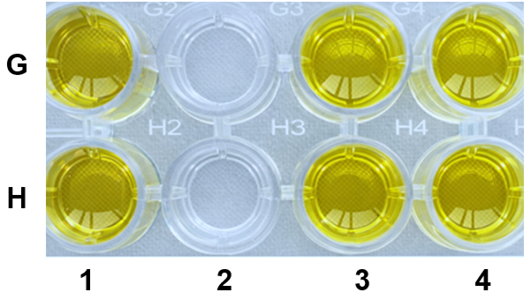
As shown in Figure 6, a distinct yellow color developed in wells coated with purified 6×His-CPA (well G3 and H3) and 6×His-CPB (well G4 and H4), indicating specific recognition of the recombinant proteins by the anti-6×His antibody. In contrast, no color development was observed in the negative control well lacking coated antigen (well G2 and H2), indicating the absence of detectable nonspecific binding or background interference. BCA analysis showed that the purified recombinant CPA and CPB preparations reached concentrations of approximately 1,000 and 800 µg/mL, respectively.
Recombinant CPA and CPB have been widely investigated as potential antigens for the development of vaccines against diseases caused by C. perfringens. Previous studies have provided evidence that recombinant CPA and CPB-derived antigens can induce antigen-specific immune responses, although the degree of protection against C. perfringens-associated disease varies among experimental models. Cooper et al. (2009) reported partial protection following immunization with recombinant α-toxin, whereas other studies have questioned whether α-toxin alone is sufficient for protection against necrotic enteritis, particularly because α-toxin-deficient C. perfringens strains can remain capable of inducing intestinal lesions. Thus, α-toxin is likely to represent one component of a broader protective antigen repertoire rather than a sole determinant of immunity. Similarly, Valipouri et al. (2022) demonstrated promising protective effects of recombinant α-toxin in an experimental challenge model, but the available evidence is insufficient to establish its suitability as a stand-alone commercial vaccine antigen. For CPB, the selection of residues 143–311 in the present study was supported by Rodrigues et al. (2021), who demonstrated favorable expression, solubility, antigenicity, and induction of neutralizing antibodies for this C-terminal domain. Collectively, these findings support the use of defined recombinant toxin regions as candidate antigens while emphasizing the need for multi-antigen strategies and further in vivo validation.
Previous publications also show that recombinant CPA and CPB have been produced in several E. coli expression systems, including pET28-derived vectors, pET22b(+), pBET7 and pTIG-Trx ; . Full-length CPA generally appears around ~42-43 kDa in some expression systems, whereas reported values around 27 kDa have also been obtained depending on the construct and expression system ; . For CPB, full-length recombinant proteins have commonly been reported in the ~34-40 kDa range ; Rodrigues et al., 2021). In contrast, truncated immunogenic domains such as CPA-C247-370 and CPB-C143-311 are substantially smaller and have been investigated to improve solubility and safety .
In the present study, the recombinant CPA and CPB proteins were designed to contain selected antigenic regions, corresponding to CPA-C247-370 and CPB-C143-311, respectively, together with the fusion tag derived from the expression vector. Therefore, the relatively lower molecular weight observed for 6×His-CPA (approximately 17 kDa) and 6×His-CPB (approximately 23 kDa) compared with those reported for recombinant full-length toxins are consistent with the shorter constructs used in this study. This design was intended to retain antigenically relevant regions while excluding non-essential sequences. In addition, no evidence of a glycosylation-associated increase in molecular weight was observed for either recombinant protein. This observation is consistent with previous studies of recombinant CPA and CPB produced in E. coli expression systems, as well as with a study specifically examining the C-terminal region of CPA, in which no glycosylated forms were detected even when the protein was expressed in a eukaryotic baculovirus system capable of post-translational glycosylation .
These findings support the use of selected antigenic regions rather than complete toxin molecules for recombinant vaccine development. In this context, the relatively low molecular masses of the recombinant CPA and CPB proteins obtained in the present study are consistent with the deliberate exclusion of non-essential regions and the retention of selected antigenic determinants in the designed constructs.
CONCLUSION
Our experiments demonstrated the successful production of recombinant 6× His-CPA and 6× His-CPB fusion proteins in E. coli BL21(DE3). The antigens were present in both soluble and inclusion body fractions. Direct ELISA confirmed that the purified proteins retained an intact 6× His tag and were specifically recognized by the anti-6× His antibody, supporting their suitability for subsequent immunological applications, including the production of anti-CPA and anti-CPB antibodies and evaluation of their protective efficacy against C. perfringens infection in chickens.
ACKNOWLEDGMENT
The research was funded by the project through Contract No. 01/HD-KHCN dated February 20, 2024 between the Ministry of Agriculture and Rural Development (now the Ministry of Agriculture and Environment) and the Institute of Biotechnology, Hue University.
Novelty Statement
The recombinant CPA and CPB were expressed in E. coli BL21(DE3) using pET200/D-TOPO vector and can be used for production of CPA and CPB-specific IgY antibodies from egg yolk, supporting further investigation of their potential applications in Clostridium detection and biological control.
AUTHOR’S CONTRIBUTION
HVC, NXH: Conceptualization, supervision, validation, review and editing. HTQ, TQD: Conceptualization, data curation, formal analysis, visualization, writing original, and draft preparation. NDTK, HNH, TDYV, NTO, TTT: Methodology, data curation. NDH: Data curation, review and editing. All authors have read and approved the final manuscript.
Generative AI and AI-assisted technology statement
The authors declare that generative AI tools were used solely to assist in language translation, editing and improving the clarity of the manuscript. All scientific content, interpretation, and conclusions were developed independently by the authors. The authors take full responsibility for the accuracy, integrity, and originality of the work.
Conflict of interest
The authors have declared no conflict of interest.
Figures
Figure 1:.
PCR products of cpa and cpb genes in 1% agarose gel. M. DNA standard size (GeneRulerTM 1 kb DNA Ladder, ThermoFisher Scientific, USA).
Figure 2:.
PCR confirmation of cpa and cpb gene in pET200/ D-TOPO vector. M. DNA standard size (GeneRulerTM 1 kb DNA Ladder, ThermoFisher Scientific, USA).
Figure 3:.
Polyacrylamide gel electrophoresis of total protein from E. coli BL21/CPA cells. M: Protein marker (BioBase, China). A: inclusion body, B. soluble protein. NC1. Transformed E. coli BL21(DE3) without IPTG induction. NC2. Non-transformed E. coli BL21(DE3) with IPTG induction. CA1-CA3: three different colonies containing pET200/cpa plasmid.
Figure 4:.
Polyacrylamide gel electrophoresis of total protein from E. coli BL21/CPB cells. M: Protein marker (BioBase, China). A: soluble protein, B. inclusion body. NC1. Transformed E. coli BL21(DE3) without IPTG induction. NC2. Non-transformed E. coli BL21(DE3) with IPTG induction. CB1-CB3: three different colonies containing pET200/cpb plasmid.
Figure 5:.
SDS-PAGE of purificated CPA and CPB. M: Protein marker (BioBase, China). CPA and CPB: purified CPA and CPB. NC1. Transformed E. coli BL21(DE3) without IPTG induction. NC2. Non-transformed E. coli BL21(DE3) with IPTG induction.
Figure 6:.
Direct ELISA of CPA and CPB. H1, H1: positive control (6×His-STN from Salmonella); G2, H2: Negative control (non antigen); G3, H3: recombinant CPA (10 µg/mL); G4, H4: recombinant CPB (10 µg/mL).
References
Abd El-Hack ME, El-Saadony MT, Elbestawy AR, El-Shall NA, Saad AM, Salem HM, El-Tahan AM, Khafaga AF, Taha AE, AbuQamar SF, El-Tarabily KA (2022). Necrotic enteritis in broiler chickens: Disease characteristics and prevention using organic antibiotic alternatives: A comprehensive review. Poult. Sci., 101(2): 101590. https://doi.org/10.1016/j.psj.2021.101590[CrossRef]
Bakhshi F, Pilehchian LR, Eimani BG (2016). Enhanced expression of recombinant beta toxin of Clostridium perfringens type B using a commercially available Escherichia coli strain. Onderstepoort J. Vet. Res., 83(1): a1136. https://doi.org/10.4102/ojvr.v83i1.1136[CrossRef]
Beyzay F, Hosseini ZA, Soudi S (2017). Alpha alumina nanoparticle conjugation to cysteine peptidase A and B: An efficient method for autophagy Induction. Avicenna J. Med. Biotech., 9(2): 71-81.
Birhanu M, Asrie K, Woldegiorgiss W, Alemu S, Kebede F, Don N, Cuc N, Unger F, Dessie T (2021). Poultry production, marketing and consumption in Vietnam: A review of literature.
Cooper KK, Trinh HT, Songer JG (2009). Immunization with recombinant alpha toxin partially protects broiler chicks against experimental challenge with Clostridium perfringens. Vet. Microbiol., 133(1-2): 92-97. https://doi.org/10.1016/j.vetmic.2008.06.001[CrossRef]
Fathima S, Hakeem WGA, Shanmugasundaram R, Selvaraj RK (2022). Necrotic enteritis in broiler chickens: A review on the pathogen, pathogenesis, and prevention. Microorganisms, 10(10). https://doi.org/10.3390/microorganisms10101958[CrossRef]
Ferreira MRA, Moreira GMSG, Cunha CEP, Mendonça M, Salvarani FM, Moreira ÂN, Conceição FR (2016). Recombinant alpha, beta, and epsilon toxins of Clostridium perfringens: Production strategies and applications as veterinary vaccines. Toxins, 8(11): 340. https://doi.org/10.3390/toxins8110340[CrossRef]
Forti K, Cagiola M, Pellegrini M, Anzalone L, Di Paolo A, Corneli S, Severi G, De Giuseppe A (2020). Generation of recombinant baculovirus expressing atoxic C-terminal CPA toxin of Clostridium perfringens and production of specific antibodies. BMC Biotechnol., 20(1): 7. https://doi.org/10.1186/s12896-019-0597-4[CrossRef]
Keyburn AL, Sheedy SA, Ford ME, Williamson MM, Awad MM, Rood JI, Moore RJ (2006). Alpha-toxin of Clostridium perfringens is not an essential virulence factor in necrotic enteritis in chickens. Infect. Immun., 74(11): 6496-6500. https://doi.org/10.1128/IAI.00806-06[CrossRef]
Khuong NDT, Hoa NX, Chuong HV, Vi TDY, Ha HN, Hung NB (2026). Detection of the cpb gene in Clostridium perfringens isolated from chickens with necrotic enteritis in Hue City. Hue Univ. J. Sci. Agric. Rural Dev., 135: 71-80.
Maynard-Smith M, Ahern H, McGlashan J, Nugent P, Ling R, Denton H, Coxon R, Landon J, Roberts A, Shone C (2014). Recombinant antigens based on toxins A and B of Clostridium difficile that evoke a potent toxin-neutralising immune response. Vaccine, 32(6): 700-705. https://doi.org/10.1016/j.vaccine.2013.11.099[CrossRef]
Nassar FS (2026). Strategic role of poultry production sciences in shaping the future of global food security and strengthen sustainability. Poult. Sci., 105(5): 106617. https://doi.org/10.1016/j.psj.2026.106617[CrossRef]
Rodrigues RR, Ferreira MR, Donassolo RA, Ferreira Alves ML, Motta JF, Junior CM, Salvarani FM, Moreira AN, Conceicao FR (2021). Evaluation of the expression and immunogenicity of four versions of recombinant Clostridium perfringens beta toxin designed by bioinformatics tools. Anaerobe, 69: 102326. https://doi.org/10.1016/j.anaerobe.2021.102326[CrossRef]
Rood JI, Adams V, Lacey J, Lyras D, McClane BA, Melville SB, Moore RJ, Popoff MR, Sarker MR, Songer JG, Uzal FA, Van Immerseel F (2018). Expansion of the Clostridium perfringens toxin-based typing scheme. Anaerobe, 53: 5-10. https://doi.org/10.1016/j.anaerobe.2018.04.011[CrossRef]
Thuy NT, Lan DTB, Quan LV, Long PT (2021). Cloning and expression of P42 antigen encoding gene from Mycoplasma hyopneumoniae in Escherichia coli (BL21). J. Vet. Sci. Technol., 9: 5-12.
Valipouri AR, Rahimi S, Karkhane AA, Torshizi MAK, Mobarez AM, Grimes JL (2022). Immunization of broiler chickens with recombinant alpha-toxin protein for protection against necrotic enteritis. J. Appl. Poultr. Res., 31(4): 100299. https://doi.org/10.1016/j.japr.2022.100299[CrossRef]
Xu CB, Xu CL, Zhao ZJ (2006). Expression of alpha-toxin gene of Clostridium perfringens type A and its primary immunological protective function. Acta Microbiol. Sinica, 46(4): 624-628.
Zhao Y, Kang L, Gao S, Zhou Y, Su L, Xin W, Su Y, Wang J (2011). Expression and purification of functional Clostridium perfringens alpha and epsilon toxins in Escherichia coli. Protein Express. Purif., 77(2): 207-213. https://doi.org/10.1016/j.pep.2011.02.001[CrossRef]