
This study was carried out to determine the efficacy of lipase and emulsifier + lipase in broilers reared on energy diluted diet. Five hundred and twenty birds were divided into 8 treatments groups with 5 replicates of 13 birds in each. Total 8 diets viz., PC (Positive control), NC1 (Negative control 1; 75 Kcal/kg reduced energy), NC1L (NC1 + lipase at 0.015%), NC1LB (NC1 + lipase at 0.015% + bile acids at 0.05%), NC2 (Negative control 2; 150 Kcal/kg reduced energy), NC2L (NC2 + lipase at 0.015%), NC2LB (NC2 + lipase at 0.015% + bile acids at 0.05%) and NC2 (2LB) (NC2 + 2x (lipase at 0.03% + bile acids at 0.1%)) were formulated. Weight gain, feed intake (FI), protien efficiency ratio (PER), energy efficiency ratio (EER), mortality percentage and food conversion ratio (FCR) were similar (P > 0.05) by addition of lipase and bile acids in energy diluted diets during starter phase in broiler chicks. However, birds of NC1L group had higher European production efficiency factor (EPEF) than other treatments. Weight gain, PER, EER and EPEF were higher (P < 0.05) in birds of NC1LB group and lower (P < 0.05) in birds of NC2 and NC2L group. However, FCR was better (P < 0.05) in birds of NC1LB and NC2 (2LB) group and birds of NC2 group had poor (P < 0.05) FCR. Villus height of ilium and villus surface area was higher (P < 0.05) in birds of NC1LB and lower (P < 0.05) villus height and less (P < 0.05) villus surface area were recorded in NC2 group. In conclusion addition of lipase and bile acids as emulsifier in combination form had improved production efficiency and increased villous surface area in broilers reared on 75 kcal reduced energy diet.
Research Article · Volume 55, Issue 5, 28 July 2023 · Open Access
Production Efficiency, Nutrient Utilization and Intestinal Histology of Broilers Fed on Energy Diluted Diet Supplemented with Lipase and Bile Acids
· · · · · ·
Affiliations & Notes ⌄
- 1Institute of Animal and Dairy Sciences, University of Agriculture, Faisalabad 38040, Pakistan 2Faculty of Science and Technology, Virtual University of Pakistan, 54000, Pakistan 3Polaris Life Sciences (Pvt) Ltd, Pakistan * Corresponding author: shaukat.ali@uaf.edu.pk
Article Info ⌄
- Journal:
- Pakistan Journal of Zoology
- Published:
- 28 July 2023

Abstract
INTRODUCTION
Energy is a main nutrient of diet, which is necessary for proper growth and functioning of body . Energy content of broilers diet is increased by the use of lipids in their diet . Digestibility of fat in broilers body is limited due to limited digestive ability by birds, although it compromises the function of promoting growth . Poor breakdown and absorption of lipids have been observed in broiler chickens during early age . Use of fat at higher level in broilers diet reduces other nutrient intake resulting in poor growth. Production of pancreatic lipase and bile acids is low at early age of birds due to immature development of GIT track . Fat utilization is not efficient in broilers due to less lipase activity until its reach optimum level between 40 to 56 d of age . Therefore, it is very important to improve fat utilization in broilers for better utilization of fat.
Fat utilization in broiler chickens is improved by using lecithin and lysolecithin as emulsifier for decades . Bile acids are being used as a dietary emulsifier in poultry production . Utilization of bile acids during early stage in chicks has more potential to improve fat breakdown and absorption than older ones . Exogenous lipase also improves the physiological capacity of GIT track in poultry. Lipase production is widespread among yeasts having different properties. Using Yarrowia lipolytica lipase improved FCR and had no adverse effect on feed intake for 42 days’ period . Addition of dietary lipase in broilers fed low-fat diet resulted in a better response on growth performance and fat utilization . Meat quality and health status of broilers were also improved with supplementing emulsifier or multi-enzyme . Feeding low energy diets to broiler chickens resulted in reduced performance but supplementing emulsifier (bile acids) or lipase in reduced energy diets alleviated the negative effects. Therefore, this study was planned to evaluate the effect of lipase and bile acids on growth performance, nutrient utilization and intestinal histology in a reduced energy diet.
MATERIALS AND METHODS
The present study was carried out at Research House, Animal Nutrition Center, University of Agriculture, Faisalabad with prior approval from the Board of Advanced Studies and Research of the University of Agriculture, Faisalabad via letter no. 15497-500.
House preparation
House was cleaned, disinfected and fumigated to reduce the infectious count. The experimental trial was conducted under all hygienic and standard conditions.
Experimental birds and diet
In this experiment, five hundred and twenty (520) day-old birds were divided into 8 treatments with 5 replicates of 13 birds each. Bile acid as emulsifier was selected from the second experiment for this experiment. Efficacy of lipase and combination of emulsifier and lipase was studied at 75 and 150 kcal/kg reduced energy diets. Eight diets; PC (positive control), NC1 (negative control 1), NC1L (NC1 + Lipase at 0.015%), NC1LB (NC1 + lipase at 0.015% + bile acids at 0.05%), NC2 (negative control 2), NC2L (NC2 + Lipase at 0.015%), NC2LB (NC2 + lipase at 0.015% + bile acids at 0.05%) and NC2 (2LB) (NC2 + 2x (Lipase at 0.03% + bile acids at 0.1%)) were formulated (Tables I and II). Bile acids contain hyocholic acid, chenodeoxycholic acid and hyodeoxycholic acid. Birds were vaccinated with ND+IB (day 1), IBD (day 8), IBD (day 18) and ND (day 25) vaccine.
Data collection on growth performance
Data on the growth parameters were recorded weekly using following formulas.
Feed intake = Feed offered – Feed refused
FCR = Feed intake (g) / Weight gain (g)
Protein efficiency ratio (PER) = Weight gain / Protein intake
Table I. Ingredient composition of experimental diets.
| Ingredients | Starter (1-21 days) | Finisher (22-35 days) | ||||
| PC (Recommended energy)1 | NC1 (75 kcal RE)2 | NC2 (150 kcal RE)3 | PC (Recommended energy)1 | NC1 (75 kcal RE) 2 | NC2 (150 kcal RE)3 | |
| Corn | 52.38 | 54.03 | 54.86 | 55.79 | 57.61 | 59.44 |
| Soybean meal 45% | 38.94 | 38.63 | 38.40 | 34.60 | 34.27 | 33.93 |
| Molasses | 0.00 | 0.00 | 0.89 | 0.00 | 0.00 | 0.00 |
| Vegetable oil | 3.78 | 2.33 | 1.00 | 6.12 | 4.62 | 3.12 |
| Calcium carbonate | 0.90 | 0.91 | 0.89 | 0.73 | 0.73 | 0.73 |
| DCP | 2.16 | 2.16 | 2.16 | 1.75 | 1.75 | 1.75 |
| Sodium chloride | 0.39 | 0.47 | 0.37 | 0.32 | 0.32 | 0.32 |
| Sodium biocarbonate | 0.31 | 0.31 | 0.26 | 0.04 | 0.04 | 0.04 |
| DL-methionine | 0.37 | 0.37 | 0.37 | 0.26 | 0.26 | 0.26 |
| L-Lysine sulphate | 0.35 | 0.36 | 0.37 | 0.08 | 0.09 | 0.10 |
| L-Threonine | 0.11 | 0.11 | 0.11 | 0.00 | 0.00 | 0.00 |
| Vitamin premix* | 0.15 | 0.15 | 0.15 | 0.15 | 0.15 | 0.15 |
| Mineral premix** | 0.15 | 0.15 | 0.15 | 0.15 | 0.15 | 0.15 |
| Phytase | 0.01 | 0.01 | 0.01 | 0.01 | 0.01 | 0.01 |
| Total | 100.00 | 100.00 | 100.00 | 100.00 | 100.00 | 100.00 |
*Vitamins premix provides 10000 IU Vitamin A, 5 mg Riboflavin, 12 mg Ca Pantothenate, 2.2 mg thiamin, 1.55 mg Folic acid, 44 mg nicotinic acid, 2.2 mg Vitamin B6, 12.1 μg Vitamin B12, 250 mg Choline chloride, 0.11 mg d-biotin, 1100 IU Vitamin D3, 11.0 IU Vitamin E, 1.1 mg Vitamin K per kg of diet. **Mineral premix provides 30 mg Fe, 50 mg Zn, 5 mg Cu, 60 mg Mn, 0.1 mg Co, 0.3mg I and 1 mg Se per kg of diet. 1PC (positive control), 2NC1 (negative control 1), NC1L (NC1 + Lipase at 0.015%), NC1LB (NC1 + lipase at 0.015% + bile acids at 0.05%), 3NC2 (negative control 2), NC2L (NC2 + Lipase at 0.015%), NC2LB (NC2 + lipase at 0.015% + bile acids at 0.05%) and NC2 (2LB) (NC2 + 2x (Lipase at 0.03% + bile acids at 0.1%)).
Table II. Nutrient composition of experimental diets.
| Starter (1-21 days) | Finisher (22-35 days) | |||||
| PC (Recommended energy)1 | NC1 (75 kcal RE)2 | NC2 (150 kcal RE)3 | PC (Recommended energy) 1 | NC1 (75 kcal RE) 2 | NC2 (150 kcal RE)3 | |
| Nutrient (Calculated) | ||||||
| ME | 3000 | 2925 | 2850 | 3200 | 3125 | 3050 |
| Crude protein | 22.00 | 22.00 | 22.00 | 20.00 | 20.00 | 20.00 |
| Ether extarct | 5.98 | 4.60 | 3.30 | 8.39 | 6.96 | 5.52 |
| Crude fiber | 2.94 | 2.96 | 2.99 | 2.80 | 2.82 | 2.84 |
| Ash | 4.91 | 4.99 | 4.96 | 4.34 | 4.33 | 4.32 |
| Calcium | 0.96 | 0.96 | 0.96 | 0.79 | 0.79 | 0.79 |
| Av. P | 0.48 | 0.48 | 0.48 | 0.40 | 0.40 | 0.40 |
| Sodium | 0.25 | 0.28 | 0.24 | 0.15 | 0.15 | 0.15 |
| Potassium | 0.88 | 0.88 | 0.91 | 0.81 | 0.81 | 0.81 |
| Chlorine | 0.30 | 0.35 | 0.30 | 0.26 | 0.26 | 0.26 |
| DEB | 250 | 250 | 250 | 200 | 200 | 200 |
| Dig methionine | 0.67 | 0.67 | 0.67 | 0.54 | 0.54 | 0.54 |
| Dig Met + Cys | 0.95 | 0.95 | 0.95 | 0.80 | 0.80 | 0.80 |
| Dig lysine | 1.28 | 1.28 | 1.28 | 1.03 | 1.03 | 1.03 |
| Dig threonine | 0.86 | 0.86 | 0.86 | 0.69 | 0.69 | 0.69 |
| Dig arginine | 1.40 | 1.40 | 1.40 | 1.28 | 1.28 | 1.28 |
| Dig tryptophan | 0.25 | 0.25 | 0.25 | 0.23 | 0.23 | 0.23 |
| Dig valine | 0.92 | 0.92 | 0.92 | 0.85 | 0.85 | 0.85 |
| Dig histidine | 0.53 | 0.53 | 0.53 | 0.49 | 0.49 | 0.49 |
| Dig leucine | 1.70 | 1.70 | 1.70 | 1.59 | 1.60 | 1.60 |
| Dig isoleucine | 0.86 | 0.86 | 0.86 | 0.79 | 0.79 | 0.78 |
| Nutrients (Analyzed) | ||||||
| Dry matter | 89.58 | 89.12 | 88.86 | 90.30 | 90.5 | 90.69 |
| Crude protein | 21.28 | 22.10 | 22.09 | 20.3 | 19.79 | 19.95 |
| Ether extract | 5.87 | 5.29 | 5.13 | 7.81 | 7.03 | 6.46 |
1PC (positive control), 2NC1 (negative control 1), NC1L (NC1 + Lipase at 0.015%), NC1LB (NC1 + lipase at 0.015% + bile acids at 0.05%), 3NC2 (negative control 2), NC2L (NC2 + Lipase at 0.015%), NC2LB (NC2 + lipase at 0.015% + bile acids at 0.05%) and NC2 (2LB) (NC2 + 2x (Lipase at 0.03% + bile acids at 0.1%)). ME, Metabolisable energy.
Energy efficiency ratio (EER) = Weight gain / energy intake × 100
European Production Efficiency Factors (EPEF) = Livability/FCR× live weight (kg)/Age (days) × 100 .
Intestinal histology
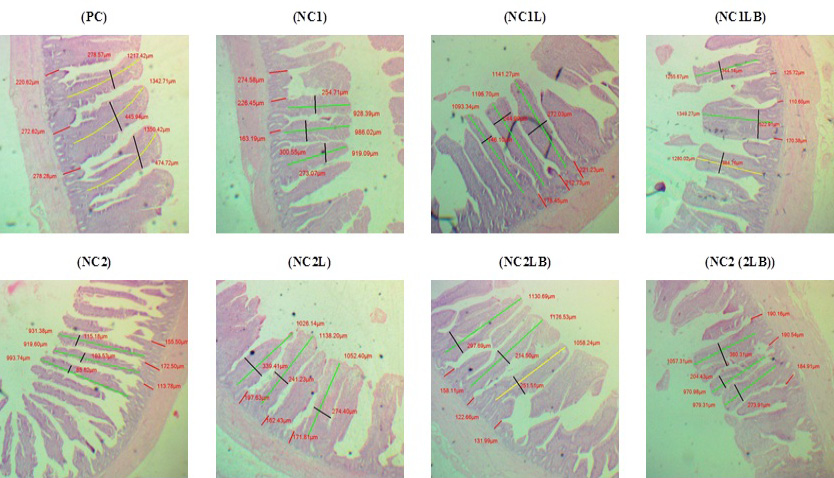
Ilium specimens (after slaughtering of birds) were collected and kept in 10% neutral buffered formalin solution for 24 h, then implanted in paraffin and segmented at 4 μm. By using an image analysis software (ToupView 3.7) the following parameters were measured: (i) villus height (VH), (ii) villus width (VW), (iii) Crypt depth (CD) (iv) VH/VW, (v) VH/CD, (vi) villus Surface Area (mm2) is calculated by multiplying 2π (VH) x (VW/2) .
Statistical analysis
Data were subjected to analysis using analysis of variance by completely randomized design with the help of Minitab 17. Tukey’s test was used to compare mean .
RESULTS
Growth performance
Starter phases
Weight gain, FI, PER, EER, mortality percentage and FCR were similar (P > 0.05) by addition of lipase and bile acids in energy diluted diets during starter phase in broiler chicks. However, birds of NC1L group had greater (P < 0.05) EPEF than other treatments (Table III).
Finisher Phase
Weight gain, PER, EER and EPEF were higher in birds of NC1LB group and lower (P < 0.05) in birds of NC2 and NC2L group. However, FCR was improved (P < 0.05) in birds of NC1LB and NC2 (2LB) group and birds of NC2 group had poor (P < 0.05) FCR (Table IV). Mortality percentage was higher in birds of NC2 group.
Intestinal histology
Table III. Growth performance and nutrient utilization in broilers from 1 to 21 days.
| Treatments | Feed intake (g) | Weight gain (g) | FCR | PER | EER | EPEF | Mortality (%) |
| PC | 1595 | 1035 | 1.54 | 3.1 | 2.2 | 334ab | 0.0 |
| NC1 | 1526 | 1040 | 1.47 | 3.0 | 2.3 | 346ab | 1.4 |
| NC1 + Lipase | 1579 | 1069 | 1.48 | 3.1 | 2.3 | 358a | 0.0 |
| NC1 + bile acids + Lipase | 1600 | 1013 | 1.58 | 2.9 | 2.1 | 309b | 3.0 |
| NC2 | 1658 | 1044 | 1.59 | 2.8 | 2.1 | 321ab | 1.5 |
| NC2 + Lipase | 1524 | 999 | 1.53 | 3.0 | 2.2 | 325ab | 0.0 |
| NC2 + bile acids + Lipase | 1612 | 1005 | 1.61 | 2.9 | 2.1 | 312b | 0.0 |
| NC2 + 2x (bile acids + Lipase) | 1558 | 1004 | 1.55 | 2.9 | 2.2 | 312b | 3.1 |
| SEM | 36.2 | 16.3 | 0.03 | 0.06 | 0.04 | 9.22 | 1.19 |
| P-Value | 0.184 | 0.052 | 0.036 | 0.015 | 0.034 | 0.005 | 0.296 |
SEM, Standard error of the mean; P > 0.05 (Non-Significant); P < 0.05 (Significant); a-b values of superscript different in column differ significantly. PER, Protein efficiency ratio; EER, Energy efficiency ratio; EPEF, European production efficiency factor; PC, recommended energy; NC1, 75 kcal.kg low than recommended energy; NC2, 150 kcal.kg low than recommended energy.
Table IV. Growth performance and nutrient utilization in broilers from 22 to 35 days.
| Treatments | Feed Intake (g) | Weight gain (g) | FCR | PER | EER | EPEF | Mortality (%) |
| PC | 1694 | 1027ab | 1.65ab | 3.0ab | 1.9ab | 441abc | 1.4 |
| NC1 | 1757 | 979ab | 1.81ab | 2.9ab | 1.8ab | 394abc | 0.0 |
| NC1 + Lipase | 1784 | 1052ab | 1.70ab | 2.9ab | 1.8ab | 434abc | 2.9 |
| NC1 + bile acids + Lipase | 1783 | 1134a | 1.58b | 3.3a | 2.0a | 522a | 0.0 |
| NC2 | 1815 | 918b | 1.99a | 2.5b | 1.6b | 318c | 4.4 |
| NC2 + Lipase | 1750 | 965b | 1.82ab | 2.8ab | 1.7ab | 381abc | 0.0 |
| NC2 + bile acids + Lipase | 1802 | 972ab | 1.85ab | 2.7ab | 1.7ab | 377bc | 0.0 |
| NC2 + 2x (bile acids + Lipase) | 1696 | 1052ab | 1.62b | 3.2a | 1.9ab | 470ab | 0.0 |
| SEM | 58.1 | 35.6 | 0.08 | 0.13 | 0.08 | 31.4 | 1.52 |
| P-Value | 0.742 | 0.006 | 0.011 | 0.006 | 0.016 | 0.003 | 0.311 |
SEM, Standard error of the mean; P > 0.05 (Non-Significant); P < 0.05 (Significant); a-c values of superscript different in column differ significantly. PER, Protein efficiency ratio; EER, Energy efficiency ratio; EPEF, European production efficiency factor; PC, recommended energy; NC1, 75 kcal.kg low than recommended energy; NC2, 150 kcal.kg low than recommended energy.
Table V. Ilium histology of broiler birds.
| Treatments | VH (µm) | VW (µm) | CD (µm) | VH:CD | VH:VW | Villus surface area (mm2) |
| PC | 1226.1ab | 294.5 | 248.0a | 5.3b | 5.3 | 1.15ab |
| NC1 | 947.3ef | 193.2 | 140.9b | 8.2a | 5.4 | 0.57bc |
| NC1 + Lipase | 1055.7cde | 190.9 | 188.0ab | 5.9ab | 6.0 | 0.63abc |
| NC1 + Bile acids + Lipase | 1261.6a | 301.8 | 184.8ab | 7.4ab | 5.3 | 1.22a |
| NC2 | 934.2f | 189.4 | 185.8ab | 5.2b | 5.9 | 0.55c |
| NC2 + Lipase | 1009.2def | 224.0 | 206.3ab | 5.0b | 4.9 | 0.71abc |
| NC2 + Bile acids + Lipase | 1134.5bc | 263.0 | 199.0ab | 6.2ab | 4.4 | 0.94abc |
| NC2 + 2x (Bile acids + Lipase) | 1124.3bcd | 302.5 | 254.2a | 4.6b | 4.3 | 1.09abc |
| SEM | 26.5 | 33.0 | 19.9 | 0.64 | 0.71 | 0.13 |
| P-Value | 0.001 | 0.029 | 0.004 | 0.002 | 0.618 | 0.001 |
SEM, Standard error of the mean; P > 0.05 (Non-Significant); P < 0.05 (Significant); a-b values of superscript different in column differ significantly. PC, Recommended energy; NC1, 75 kcal.kg low than recommended energy; NC2, 150 kcal.kg low than recommended energy
DISCUSSION
Weight gain was higher (P < 0.05) in birds of NC1L and NC1LB and lower (P < 0.05) in birds of NC2 and LC2L groups. This might be due to that bile acid and Lipase increase the energy value of oil used in this experiment. Results are in line with the Kamran et al. (2020) who concluded that use of polyglycerol polyricinoleate at 0.025, 0.035 and 0.045% in soy oil based diet had improved weight gain and FCR in broilers. Liu et al. (2020) reported that weight gain and FCR were improved in birds receiving 97% de-oiled lecithin in basal diet than control group. Allahyari-Bake and Jahanian (2017) observed that addition of emulsifier in broilers diet containing soy-free fatty acids had higher (P < 0.05) feed intake and improved (P < 0.05) weight gain than control. Also, use of 0.1% emulsifier in broilers diet had improved FCR as compared to 0 and 0.05% inclusion of emulsifier, while, feed consumption and body weight were not affected . Results are in consistent with the outcome of Hu et al. (2018) who revealed that the use of 0.03% lipase in broilers fed lower energy diet had improved (P < 0.05) FCR, however, body weight gain was not affected (P > 0.05). Soya lecithin (50% of oil in basal diet) and lipase (100000 IU/ton) had higher (P < 0.05) weight gain, feed consumption and better FCR . Maisonnier et al. (2003) showed that the addition of 0.3% bile salts had better (P<0.05) body weight gain (440 vs 399 g) during 7-21 days in broiler chickens. However, Al-Marzooqi and Leeson (2000) evaluated the different levels of supplementary lipase enzyme (0, 0.37%, 0.75%, 1.12%) and reported that with increasing level of lipase enzyme, FCR was improved (P<0.05).
In contrast, Wang et al. (2018) tested the effect of dietary lipase supplementation of three levels of lipase enzyme (0, 4U/g and 6U/g) on broilers and concluded that lipase did not have any effect on growth rate and final BW in broilers during 42 days. Nazir (2014) tested the effect of dietary supplementation of three levels of bile acids (0, 0.03% and 0.06%) on broilers and concluded that bile acids did not affect growth rate in broilers during 35 days. Lipase addition at 0.02% did not influence the production performance of broilers fed different sources of oil (beef tallow and canola oil) .
Villus height and villus surface area were higher (P < 0.05) in birds of NC1LB, whereas, lower villus height and villus surface area were recorded in NC2 group. Villus width, VH:CD and VH:VW were not affected by lipase alone or in combination with bile acid in energy diluted diet. This might be due to that bile acid reduces the destruction of intestinal villi results in increased surface area and absorption of nutrient when fed with lipase. Results are in according with the outcome of Hu et al. (2018) who concluded that addition of lipase had higher (P < 0.05) villus height and VH:CD in broilers reared to 100 kcal/kg reduce energy diet. Brautigan et al. (2017) who showed that addition of lyso-lecithin.in broilers diet increased villus height and width of jejunum of broilers. Chen et al. (2014) showed that lipase at 9,000 U/kg feed had higher (P < 0.05) VH, VH:CD and reduced CD in small intestine. Results are not in line with the Lai et al. (2018) who showed that addition of bile acid in broilers diet had no effect on hematological parameters of small intestine. Zosangpuii et al. (2015) reported that emulsifier (glycerol polyethylene glycol ricinoleate: GPGR) at 0.04% had no effect on villi length of duodenum, jejunum and ilium because to low level of emulsifier used in broilers diet.
CONCLUSION
It can be concluded that birds fed 75 and 150 kcal/kg reduced energy diet had lower growth performance, however, addition of lipase and bile acids as emulsifier in combination form had improved production efficiency, nutrient utilization and intestinal histology in broilers reared on 75 kcal reduced energy diet.
ACKNOWLEDGMENTS
The authors acknowledge the fellowship provided by the Higher Education Commission Pakistan (HEC) to Muhammad Shoaib under the framework of HEC Indigenous PhD Fellowship Program.
Statement of conflict of interest
The authors have declared no conflict of interest.
Figures
References
- Abudabos, A.M., 2014. Effect of fat source, energy level and enzyme supplementation and their interactions on broiler performance. S. Afr. J. Anim. Sci., 44: 280-287. https://doi.org/10.4314/sajas.v44i3.10[CrossRef]
- Al-Marzooqi, W. and Leeson, S., 2000. Effect of dietary lipase enzyme on gut morphology, gastric motility, and long-term performance of broiler chicks. Poult. Sci., 79: 956–960. https://doi.org/10.1093/ps/79.7.956[CrossRef]
- Allahyari-Bake, S. and Jahanian, R., 2017. Effects of dietary fat source and supplemental lysophosphatidylcholine on performance, immune responses, and ileal nutrient digestibility in broilers fed corn/soybean meal or corn/wheat/soybean meal based diets. Poult. Sci., 96: 1149-1158. https://doi.org/10.3382/ps/pew330[CrossRef]
- Alzawqari, M., Moghaddam, H.N., Kermanshahi, H. and Raji, A., 2011. The effect of desiccated ox bile supplementation on performance, fat digestibility, gut morphology and blood chemistry of broiler chickens fed tallow diets. J. appl. Anim. Res., 39: 169-174. https://doi.org/10.1080/09712119.2011.580999[CrossRef]
- Brautigan, D.L., Li, R., Kubicka, E., Turner, S.D., Garcia, J.S., Weintraut, M.L. and Wong, E.A., 2017. Lysolecithin as feed additive enhances collagen expression and villus length in the jejunum of broiler chickens. Poult. Sci., 96: 2889–2898. https://doi.org/10.3382/ps/pex078[CrossRef]
- Chen, S.Y., Liu, Z.X., He, Y.D., Chu, C. and Wang, M.Q., 2014. Effect of coated lipase supplementation on growth, digestion and intestinal morphology in weaning piglets. J. Anim. Vet. Adv., 13: 1093-1097.
- Cho, J.H., Zhao, P. and Kim, I.H., 2012. Effects of emulsifier and multi-enzyme in different energy densitydiet on growth performance, blood profiles, and relative organ weight in broiler chickens. J. agric. Sci., 4: 161-168. https://doi.org/10.5539/jas.v4n10p161[CrossRef]
- Classen, H.L., 2017. Diet energy and feed intake in chickens. Anim. Feed Sci. Technol., 233: 13-21. https://doi.org/10.1016/j.anifeedsci.2016.03.004[CrossRef]
- Hu, Y.D., Lan, D., Zhu, Y., Pang, H.Z., Mu, X.P. and Hu, X.F., 2018. Effect of diets with different energy and lipase levels on performance, digestibility and carcass trait in broilers. Asian-Aust. J. Anim. Sci., 31: 1275-1284. https://doi.org/10.5713/ajas.17.0755[CrossRef]
- Kamran, J., Mehmood, S., Mahmud, A., and Saima, 2020. Effect of fat sources and emulsifier levels in broiler diets on performance, nutrient digestibility, and carcass parameters. Braz. J. Poult. Sci., 22: 1-10. https://doi.org/10.1590/1806-9061-2019-1158[CrossRef]
- Kamran, Z., Sarwar, M., Nisa, M., Nadeem, M.A., Mahmood, S., Babar, M.E. and Ahmed, S., 2008. Effect of low-protein diets having constant energy-to-protein ratio on performance and carcass characteristics of broiler chickens from one to thirty-five days of age. Poult. Sci., 87: 468–474. https://doi.org/10.3382/ps.2007-00180[CrossRef]
- Lai, W., Cao, A., Li, J., Zhang, W. and Zhang, L., 2018. Effect of high dose of bile acids supplementation in broiler feed on growth performance, clinical blood metabolites and organ development. J. appl. Poult. Res., 27: 532-539. https://doi.org/10.3382/japr/pfy040[CrossRef]
- Liu, X., Yoon, S.B. and Kim, I.H., 2020. Growth performance, nutrient digestibility, blood profiles, excreta microbial counts, meat quality and organ weight on broilers fed with de-oiled lecithin emulsifier. Animal, 10: 1-12. https://doi.org/10.3390/ani10030478[CrossRef]
- Maisonnier, S., Gomez, J., Brée, A., Berri, C., Baéza, E. and Carré, B., 2003. Effects of microflora status, dietary bile salts and guar gum on lipid digestibility, intestinal bile salts, and histomorphology in broiler chickens. Poult. Sci., 82: 805-814. https://doi.org/10.1093/ps/82.5.805[CrossRef]
- Marcu, A., Vacaru, I., Gabi, D., Liliana, P.C., Marcu, A., Marioara, N., Ioan, P., Dorel, D., Bartolomeu, K. and Cosmin, M., 2013. The influence of genetics on economic efficiency of broiler chickens growth. Anim. Sci. Biotechnol., 46: 339-346.
- Meng, X., Slominski, B.A. and Guenter, W., 2004. The effect of fat type, carbohydrase, and lipase addition on growth performance and nutrient utilization of young broilers fed wheat-based diets. Poult. Sci., 83: 1718-1727. https://doi.org/10.1093/ps/83.10.1718[CrossRef]
- Mohammadigheisar, M., Kim, H.S. and Kim, I.H., 2018. Effect of inclusion of lysolecithin or multi-enzyme in low energy diet of broiler chickens. J. appl. Anim. Res., 46: 1198-1201. https://doi.org/10.1080/09712119.2018.1484358[CrossRef]
- Nagargoje, S.B., Dhumal, M., Nikam, M. and Khose, K., 2016. Effect of crude soy lecithin with or without lipase on performance and carcass traits, meat keeping quality and economics of broiler chicken. Int. J. Livest. Res., 6: 46-46. https://doi.org/10.5455/ijlr.20161218124154[CrossRef]
- Nazir, M.A., 2014. Effect of an emulsifier (Actifier®) on growth perforamnce, nutrient digestibility and carcass characteristics in commercial broilers. M.Sc. (Hons.) thesis. Univ. Agric. Faisalabad, Pakistan.
- Pantaya, D., Widayanti, A., Jadmiko, P. and Utami, M.M.D., 2020. Effect of bile acid supplementation in broiler feed on performance, carcass, cholesterol, triglycerides and blood glucose. Environ. Earth Sci., 411: 1-7. https://doi.org/10.1088/1755-1315/411/1/012041[CrossRef]
- Parsaie, S., Shariatmadari, F., Zamiri, M. and Khajeh, K., 2007. Influence of wheat-based diets supplemented with xylanase, bile acid and antibiotics on performance, digestive tract measurements and gut morphology of broilers compared with a maize-based diet. Br. Poult. Sci., 48: 594-600. https://doi.org/10.1080/00071660701615788[CrossRef]
- Ravindran, V., Tancharoenrat, P., Zaefarian, F. and Ravindran, G., 2016. Fats in poultry nutrition: Digestive physiology and factors influencing their utilisation. Anim. Feed Sci. Technol., 213: 1-21. https://doi.org/10.1016/j.anifeedsci.2016.01.012[CrossRef]
- Sakamoto, K., Hirose, H., Onizuka, A., Hayashi, M., Futamura, N., Kawamura, Y. and Ezaki, T., 2000. Quantitative study of changes in intestinal morphology and mucus gel on total parenteral nutrition in rats. J. Surg. Res., 94: 99-106. https://doi.org/10.1006/jsre.2000.5937[CrossRef]
- Siyal, F.A., El-Hack, M.E.A., Alagawany, M., Wang, C., Wan, X., He, J., Wang, M., Zhang, L., Zhong, X., Wang, T. and Dhama, K., 2017. Effect of soy lecithin on growth performance, nutrient digestibility and hepatic antioxidant parameters of broiler chickens. Int. J. Pharmacol., 13: 396-402. https://doi.org/10.3923/ijp.2017.396.402[CrossRef]
- Steel, R.G.D., Torrie, J.H. and Dickie, D.A., 1997. Principles and procedures of statistics. A biometric approach, 3rd edition, McGraw-Hill Book Publishing Company, Toronto, Canada.
- Wang, Y., Yan, J., Zhang, X. and Han, B., 2018. Tolerance properties and growth performance assessment of Yarrowia lipolytic lipase in broilers. J. appl. Anim. Res., 46: 486-491. https://doi.org/10.1080/09712119.2017.1340298[CrossRef]
- Zosangpuii, Patra, A.K. and Samanta, G., 2015. Inclusion of an emulsifier to the diets containing different sources of fats on performances of Khaki Campbell ducks. Iran. J. Vet. Res., 16: 156–160.
Services
Article usage statistics
Loading…