
This study aimed to examine effects of three different fermented soybean meals (FSBM1, FSBM2 and FSBM3) on lipid digestion status, including plasma lipid level, liver and muscle lipid contents, bile acid (BA) concentration, lipase activity, and lipid apparent digestibility coefficient (ADC) in pompano. The FSBM1 was produced by fermentation of defatted soybean meal (SBM) with Bacillus subtilis B3. The FSBM2 and FSBM3 were commercially available products, which were produced by fermentation of SBM with Lactobacillus spp. Five diets were formulated and denoted as FMD (fish meal-based diet), SBMD (SBM-based diet), FSBM1D (FSBM1-based diet), FSBM2D (FSBM2-based diet) and FSBM3D (FSBM3-based diet). Each diet was fed twice daily to three groups of juvenile pompano (20 fish/group, 36 g/fish) for 4 weeks. The results showed that the plasma total cholesterol level, liver lipid content, intestinal total BA concentration, intestinal lipase activity, and lipid ADC were significantly higher in the FSBM1D and FSBM3D groups than the SBMD group (P < 0.05). These parameters tended to increase in the FSBM2D group as compared to the SBMD group, although the differences were not significant. All the FSBM dietary groups had significantly lower tissue lipid contents, gallbladder and intestinal total BA concentrations, intestinal lipase activities, and lipid ADCs than fish fed FMD (P < 0.05). The findings of the present study indicated that fermentation of SBM was beneficial to lipid digestion in pompano, and suggested that dietary inclusion of FSBM1 and FSBM3 might improve growth performance of pompano fish fed SBM-based diets.
Research Article · Volume 54, Issue 3, 19 February 2022 · Open Access
Effects of Dietary Fermented Soybean Meals on Tissue Lipid Level, Bile Acid Concentration, Lipase Activity and Lipid Digestibility in Pompano Fish (Trachinotus blochii)
· · ·
Affiliations & Notes ⌄
- 1Department of Science Education, Faculty of Education, VNU University of Education, Caugiay 11310, Hanoi 10000, Vietnam 2National Broodstock Center for Mariculture Species, Catba 05406, Haiphong 04000, Vietnam 3Faculty of Fisheries, Vietnam National University of Agriculture, Gialam 12406, Hanoi 10000, Vietnam 4Department of Human and Animal Physiology, Faculty of Biology, Hanoi National University of Education, Caugiay 11310, Hanoi 10000, Vietnam * Corresponding author: hungnp@hnue.edu.vn
Article Info ⌄
- Journal:
- Pakistan Journal of Zoology
- Published:
- 19 February 2022

From the article
- On the other hand, plasma total cholesterol level, liver lipid content, intestinal BA concentration, intestinal lipase activity, and lipid ADC were significantly higher in fish fed FSBM1D and FSBM3D than SBMD.
- Despite the fact that no significant differences in the gallbladder total BA concentrations and gallbladder weights before feeding were found among the treatments, the intestinal total BA concentrations of fish fed FSBM1D and FSBM3D were significantly higher than those of fish fed SBMD at 3 h after feeding.
- In conclusion, SBM fermentation (FSBM1 and FSBM3/ESP500®) increased plasma total cholesterol and triglyceride levels, elevated intestinal BA concentration and lipase activity, and improved lipid ADC in pompano.
- The positive effects of SBM fermentation on lipid digestion in the present study suggested that dietary inclusion of FSBM1 and FSBM3 might improve growth performance of pompano fish fed SBM-based diets.
Selected from the article's own text.
Abstract
INTRODUCTION
Fish meal (FM), which contains a high protein level, is commonly produced from sardine, anchovy, and menhaden. This feedstuff is an important protein source for aquafeeds, however, the limited supply of FM and global expansion of the aquaculture industry have led to an increasing requirement for alternative ingredients to replace FM . Soybean meal (SBM), which is produced by defatting soybean with solvents, is considered a promising alternative to FM because of its relatively high protein content and reasonable price l . Nevertheless, anti-nutritiona factors (ANFs) in SBM, such as trypsin inhibitors, β-conglycinin, glycinin, stachyose, raffinose, lectins, saponins, and phytate, reportedly reduce growth performance and nutrient digestion in aquatic animals ; ; . Therefore, to increase the practicability of using SBM in aquafeeds, it is necessary to eliminate such ANFs in SBM.
Fermentation has been suggested to effectively reduce ANFs in SBM. Refstie et al. (2005) have revealed that fermentation decreases trypsin inhibitors, soy antigens, and oligosaccharides, in SBM. The antigenic proteins in SBM, such as β-conglycinin and glycinin, can be broken down into smaller peptides by fermentation and this increases nutrient digestion and absorption ; ; . Moreover, improvements of body physiological conditions, feed utilization and growth performance in some fish species, such as hybrid striped bass Morone chrysops × Morone saxatilis , yellowtail Seriola quinqueradiata , black sea bream Acanthopagrus schlegeli , Florida pompano Trachinotus carolinus , yellow croaker Larimichthys crocea , rainbow trout Oncorhynchus mykiss and largemouth bass Micropterus salmoides , have been reported when the fish were fed fermented SBM (FSBM) as compared to SBM.
Pompano Trachinotus blochii (Lacepède, 1801) is a carnivorous marine fish species and one of the economically important mariculture species because of its relatively rapid growth rate and high market demand . In a previous study, we found that feeding pompano with a SBM-based diet resulted in hypocholesterolemia, low bile acid (BA) level, and poor dietary lipid digestion, and the ANFs in SBM were suggested to be the factors causing these abnormalities . Fermentation reportedly reduces ANFs in SBM, therefore, it was hypothesized that inclusion of FSBM in diets would improve dietary lipid digestion. Thus, the current study aimed to examine effects of FSBM on plasma lipid level, liver and muscle lipid contents, BA concentration, lipase activity, and lipid apparent digestibility coefficient (ADC) in pompano.
MATERIALS AND METHODS
Soybean meals
Commercial defatted SBM (crude protein content [CP], 49%) and three different FSBMs (fermented SBM 1, FSBM1; fermented SBM 2, FSBM2; fermented SBM 3, FSBM3) were used in this study. The FSBM1 (CP, 50%) was produced using the method described by Nguyen et al. (2018). The FSBM2 was a commercial product (product name, Biotide®; CP, 50.5%) produced by Total Nutrition Technologies Co., Ltd. (Yung Kang, Tainan, Taiwan) using Lactobacillus spp. The FSBM3 was also a commercial product (product name, ESP500®; CP, 50%) produced by Ever shining Ingredient Co., Ltd. (Bangkhuntain, Bangkok, Thailand) using Lactobacillus spp. The exact production processes of the FSBM2 and FSBM3 have not been disclosed.
Experimental diets
Five diets were formulated with FM (CP, 64%), SBM, FSBM1, FSBM2 and FSBM3 as main dietary protein sources (Table I). The diets were denoted as follows: FMD (FM-based diet, the positive control), SBMD (SBM-based diet, the negative control), FSBM1D (FSBM1-based diet), FSBM2D (FSBM2-based diet) and FSBM3D (FSBM3-based diet). Because the methionine content of SBM was insufficient, this amino acid was supplemented in the SBMD, FSBM1D, FSBM2D and FSBM3D at the level of 5 g/kg diet, as described in previous studies , 2017). All of the experimental diets were added with chromium oxide (5 g/kg diet) as a marker to estimate lipid ADC. All of the ingredients were mixed with a mixer for 15 min, then water was added to produce a stiff dough. Finally, the dough was pelleted using a pellet mill and stored at -20°C until use.
Table I. Formulation and proximate composition of the experimental diets.
| FMD | SBMD | FSBM1D | FSBM2D | FSBM3D | |
| Ingredients (g/kg) | |||||
| Fish meal | 600 | 300 | 300 | 300 | 300 |
| SBM1 | 0 | 440 | 0 | 0 | 0 |
| FSBM12 | 0 | 0 | 430 | 0 | 0 |
| FSBM23 | 0 | 0 | 0 | 425 | 0 |
| FSBM34 | 0 | 0 | 0 | 0 | 430 |
| Corn gluten meal | 80 | 60 | 60 | 60 | 60 |
| Wheat flour | 150 | 65 | 65 | 65 | 65 |
| Cellulose | 70 | 0 | 10 | 15 | 10 |
| Pollock liver oil | 65 | 95 | 95 | 95 | 95 |
| Vitamin and mineral mixture5 | 15 | 15 | 15 | 15 | 15 |
| DL-methionine | 0 | 5 | 5 | 5 | 5 |
| CMC-Na6 | 15 | 15 | 15 | 15 | 15 |
| Chromium oxide | 5 | 5 | 5 | 5 | 5 |
| Proximate composition (dry matter basis, g/kg) | |||||
| Crude protein | 453 | 452 | 454 | 455 | 453 |
| Crude lipid | 126 | 124 | 123 | 125 | 123 |
| Ash | 121 | 103 | 107 | 106 | 109 |
1, De-hulled SBM, Bresur S.A., Corrientes, Buenos Aires, Argentina; 2, SBM fermented by B. subtilis B3 as described by Nguyen et al. (2018); 3, Biotide®, Total Nutrition Technologies Co., Ltd., Yung Kang, Tainan, Taiwan; 4, ESP500®, Evershining Ingredient Co., Ltd., Bangkhuntain, Bangkok, Thailand; 5, Vitamin and mineral mixture (IU or mg/kg mixture): thiamine HNO3, 1030; riboflavin, 3070; pyridoxine HCl, 1390; cyanocobalamin, 8.1; vitamin C (L-ascorbate-2-monophosphate), 18100; vitamin A acetate, 485000; vitamin D3 (cholecalciferol), 172000; vitamin E (DL-α-tocopherol acetate, 7010; vitamin K3 (menadione sodium bisulfite), 1850; folic acid, 550; nicotinamide, 5200; D-calcium pantothenate, 4250; D-biotin, 16.5; inositol, 15400; ZnSO4, 2700; MnSO4, 1730; CuSO4, 1310; FeSO4, 6250; CoSO4, 156; potassium iodide, 175; sodium selenate, 38.1; 6, Sodium carboxymethyl cellulose.
Fish rearing conditions
The experiment was conducted at The National Broodstock Center for Mariculture Species (Catba, Haiphong, Vietnam). Twenty pompano juveniles (initial body weight 36 g) were allocated to each of the 15 circular tanks (500-l holding capacity), resulting in triplicate tanks per treatment. The fish were fed the experimental diets to satiation twice daily (09:00 am and 16:00 pm), for 4 weeks. Dissolved oxygen concentration and water temperature were monitored daily, which ranged between 5.5 and 7.2 ppm and between 24.3 and 29.1°C, respectively.
Sample collection
At the end of the experiment, all fish were fasted for 24 h before blood sampling. Five fish in each tank were randomly netted and blood samples were collected from the caudal vein. Plasma was then separated from blood cells by centrifugation (10,000 rpm for 10 min) and used for quantifications of lipids. These five fish were then returned to the original tanks for fecal collection. For collecting feces, each tank was directly connected to a decantation chamber as described by Kaushik et al. (2004). All fish continued to be given the tested diets, and fecal samples were collected through the chamber for five consecutive days. The feces from each tank were pooled and used for lipid ADC determination. After fecal collection, the all fish were starved for 24 h, then five fish from each tank were weighed individually and dissected to collect pyloric caeca, gallbladder, liver, and dorsal muscle. The pyloric caeca was used for lipase activity analysis. The liver and muscle were analyzed for total lipid content. Gallbladder weight (with bile) was determined as a percentage of the total body weight, then bile juice was stored for quantification of total BA level. Finally, the remaining fish continued to be fed the tested diets, then six fish from each tank were dissected at 3 h after feeding to take anterior intestinal digesta (ID) for determinations of lipase activity and total BA concentration. In each tank, the dissected fish were divided into two groups (three fish in each group), and the ID samples from the three fish were pooled. The intestinal tract was sectioned as described in a previous study and the anterior ID were collected from the whole straight region. All samples were stored at -20°C until analysis.
Analytical methods
Plasma lipid components were quantified using commercial assay kits (total cholesterol, MAK043; triglyceride, TR0100; phospholipid, MAK122; non-esterified fatty acid, 11383175001; Sigma-Aldrich Corp., St. Louis, MO, USA). BAs were extracted from the freeze-dried anterior ID with 90% ethanol, followed by methanol: chloroform (1:1, v/v), using the method reported by Setchell et al. (1983). The BA extract from the digesta and bile juice were used for quantification of total BA concentration with a commercial assay kit (MAK309, Sigma-Aldrich Corp., St. Louis, MO, USA). Lipase was extracted from freeze-dried ID and pyloric caeca by homogenization into eight and four volumes (v/w) of ice-cold distilled water, respectively . The homogenates were then centrifuged at 15,000 rpm for 15 min. The supernatants were further diluted 10-fold with ice-cold distilled water for use in the lipase activity assay as crude enzyme extracts. Lipase activity was measured with the method described by Murashita et al. (2007). Using this method, lipase activity in the ID was measured under two analytical conditions, with and without external sodium deoxycholate added to the buffer in order to examine whether bile acids and lipase were sufficient in fish intestine. Total lipid content in muscle and liver were quantified gravimetrically after extraction with methanol: chloroform (1:2, v/v), using a method described previously . The proximate compositions of the experimental diets and feces, and the digestibility marker (Cr2O3) were determined in accordance with the standard methods of the Association of Official Analytical Chemists . Lipid ADC (%) = 100 × [100 - Cr2O3 in diet (%)/Cr2O3 in feces (%) × lipid in feces (%)/lipid in diet (%)].
Statistical analysis
Data were analyzed using one-way analysis of variance. The Tukey-Kramer test was performed to assess statistical differences between groups, and significance was based on a 5% level of probability.
RESULTS
Plasma lipid levels
As shown in Table II, total cholesterol and triglyceride levels were significantly lower in fish fed SBMD than those fed FMD group (P < 0.05). These lipids tended to increase in fish fed FSBM-based diets as compared to those fed SBMD, and the significant difference in total cholesterol level was detected among the FSBM1D, FSBM3D, and SBMD groups (P < 0.05). There were no significant differences in total cholesterol levels among fish fed FSBM1D, FSBM3D, and FMD or triglyceride levels among fish fed FSBM-based diets and FMD. The experimental diets had no influence on plasma phospholipid and NEFA among the treatment groups.
Total lipid contents in the liver and muscle
As presented in Figure 1, total lipid contents in both the liver and muscle of fish fed SBMD were significantly lower than those of fish fed FMD (P < 0.05). The liver lipid content was increased in fish fed FSBM-based diets in comparison with SBMD, and significant differences were observed among the FSBM1D, FSBM3D and SBMD groups (P < 0.05). There were no significant differences in muscle total lipid contents among fish fed FSBM-based diets and FMD.
Table II. Plasma lipid levels of pompano fed the experimental diet1.
| Dietary groups | Total cholesterol (mg/dl) | Triglycerides (mg/dl) | Phospholipids (mg/dl) | NEFA2 (mEq/l) |
| FMD | 295.2±18.8c | 184.1±12.3b | 621.5±42.2 | 0.60±0.13 |
| SBMD | 226.5±13.7a | 143.4±10.6a | 578.3±30.6 | 0.42±0.08 |
| FSBM1D | 268.3±16.7bc | 171.5±14.4ab | 601.7±45.7 | 0.51±0.09 |
| FSBM2D | 252.2±11.4ab | 159.2±9.1ab | 585.2±27.6 | 0.45±0.06 |
| FSBM3D | 273.5±17.2bc | 166.7±12.6ab | 604.7±37.2 | 0.47±0.11 |
1, Values are presented as the mean ± standard deviation (n = 15). The values with different superscripts in the same column are significantly different (P < 0.05); 2, Non-esterified fatty acids.
Gallbladder weight and total BA concentrations in the gallbladder and intestine
As shown in Table III, the tested diets did not alter gallbladder weight (with bile) of the experimental fish. Feeding the fish with SBMD and FSBM-based diets resulted in significantly lower gallbladder total BA concentration than FMD (P < 0.05). There were no statistical differences in gallbladder total BA concentration among the SBMD and FSBM dietary groups, however, the FSBM1D and FSBM3D groups had significantly higher total BA concentrations in anterior ID than the SBMD group (P < 0.05).
Table III. Gallbladder weight and total BA concentration of pompano fed the experimental diets1.
| Dietary groups | Gallbladder weight (% body weight) | Total BA level in the gallbladder (mmol/l) | Total BA level in the anterior ID (μmol/g) |
| FMD | 0.25 ± 0.024 | 317.4 ± 26.2b | 151.1 ± 14.5c |
| SBMD | 0.23 ± 0.018 | 236.8 ± 21.5a | 73.8 ± 8.7a |
| FSBM1D | 0.24 ± 0.020 | 252.6 ± 18.6a | 115.4 ± 10.2b |
| FSBM2D | 0.24 ± 0.017 | 244.1 ± 14.8a | 97.9 ± 8.2ab |
| FSBM3D | 0.25 ± 0.022 | 260.3 ± 20.1a | 112.5 ± 11.7b |
1, Values are presented as the mean ± standard deviation (gallbladder, n = 15; anterior ID, n = 6). The values with different superscripts in the same column are significantly different (P < 0.05).
Lipase activities in the pyloric caeca and anterior intestine
The lipase activities in the pyloric caeca and anterior ID are presented in Figure 2. There were no significant differences in pyloric caeca lipase activity among the treatments (Fig. 2A). However, lipase activities in anterior ID of fish fed SBMD in both analysis conditions were the lowest among the dietary groups (Fig. 2B). The intestinal lipase activity was increased in fish fed FSBM-based diets as compared to SBMD, and the significant differences were observed among the FSBM1D, FSBM3D and SBM groups (P < 0.05). With external deoxycholate, no significant differences in intestinal lipase activity were observed among fish fed FSBM1D, FSBM3D, and FMD. However, without external deoxycholate, intestinal lipase activity was significantly lower in the FSBM dietary groups than FMD group (P < 0.05).
Lipid ADC
As shown in Figure 3, lipid ADC was significantly lower in fish fed SBMD than FMD (P < 0.05). The lipid ADC was increased in the FSBM dietary groups as compared to the SBMD group, and significant differences were detected among fish fed FSBM1D, FSBM3D, and SBMD (P < 0.05). However, lipid ADCs of the FSBM dietary groups were significantly lower than that of the FMD group.
DISCUSSION
In the present study, fish fed SBMD resulted in significantly lower lipid ADC than FMD. Moreover, plasma total cholesterol and triglyceride levels, liver lipid content, intestinal BA concentration, and intestinal lipase activity were also decreased in fish fed SBMD. These results supported earlier reports of Atlantic salmon Salmo salar , rainbow trout , , and yellowtail (Nguyen et al., 2011a, 2017), where SBM-based diets reduced lipid digestion. On the other hand, plasma total cholesterol level, liver lipid content, intestinal BA concentration, intestinal lipase activity, and lipid ADC were significantly higher in fish fed FSBM1D and FSBM3D than SBMD. These results suggested that fermentation of SBM might be beneficial to lipid digestion and absorption in pompano fed SBM-based diets.
BAs and lipase play critical roles in lipid digestion. BAs emulsify lipid droplets and activate lipase, while lipase breaks down lipid molecules into separated components, which are ready for being absorbed ; . In the present study, fish fed FSBM1D and FSBM3D had significantly higher intestinal total BA concentrations and lipase activities than fish fed SBMD, suggesting that the higher lipid ADCs in the FSBM1D and FSBM3D groups might be due to the improvements of BA concentration and lipase activity. BAs are synthesized in the liver and stored in the gallbladder, then secreted into the intestine after meal . Despite the fact that no significant differences in the gallbladder total BA concentrations and gallbladder weights before feeding were found among the treatments, the intestinal total BA concentrations of fish fed FSBM1D and FSBM3D were significantly higher than those of fish fed SBMD at 3 h after feeding. These results indicate that BA secretion in the FSBM1D and FSBM3D groups was better than the SBMD group. This positive effect of SBM fermentation is in agreement with our previous finding in yellowtail, where a FSBM diet increased BA secretion . Although BA secretion was improved by SBM fermentation, fish fed FSBM-based diets had lower BA concentrations in the anterior intestine and gallbladder than fish fed FMD. In carnivorous fish, BAs mainly conjugate with taurine to form taurochenodeoxycholic acid and taurocholic acid before being stored in the gallbladder . Although taurine is essential for BA synthesis in carnivorous fish, however, its content in SBM is relatively low . Therefore, the inferior BA concentrations in fish fed FSBM-based diets as compared to fish fed FMD might be due to an insufficient taurine supply for synthesis of conjugated BAs, and this suggested that taurine supplementation in FSBM-based diets might effectively improve lipid digestion and growth performance of fish.
In carnivorous fish, the pancreas is embedded surrounding the pyloric caeca and produces digestive enzymes, which are secreted into the intestine . Therefore, falls and rises in enzyme activities in pyloric caeca/pancreatic tissue reflects the secretion and accumulation of enzymes in the pancreas, respectively. In the present study, pancreatic lipase activity did not differ among the treatments. Nevertheless, intestinal lipase activity was significantly lower in fish fed SBMD as compared to FMD in both analysis conditions, with and without the external sodium deoxycholate added to the assay medium. These results indicated that lipase secretion was inhibited in fish fed SBMD, and both intestinal BAs and lipase were insufficient in the SBMD group. On the other hand, fish fed FSBM-based diets increased intestinal lipase activity in comparison with SBMD. Moreover, when the external sodium deoxycholate was supplemented to the assay medium, intestinal lipase activities of the FSBM1D and FSBM3D groups were comparable to that of the FMD group. These results implied that pancreatic lipase secretion might not be inhibited in fish fed FSBM1D and FSBM3D.
Some ANFs in SBM reportedly inhibit digestive physiology in carnivorous fish, including reductions of BAs and enzyme activities. High molecular weight fractions of soybean protein reduce BA concentration and lipid digestion in yellowtail (Nguyen et al., 2011a). Soya antigenic proteins, such as β-conglycinin and glycinin, reduce digestive enzyme activities and nutrient digestion in turbot , b). In addition, an alcohol extract from SBM, which contains oligosaccharides, soya lectins, and soya saponins, has been known to inhibit secretions of BAs and pancreatic enzymes into the intestine of yellowtail (Nguyen et al., 2011b, 2017) and reduce lipid ADC in Atlantic salmon ; . Fermentation reportedly decreases ANFs in SBM, such as trypsin inhibitors, β-conglycinin, glycinin, and oligosaccharides, and this increases nutrient digestion and absorption ; ; ; ; . Thus, in the current study, reductions of such ANFs through the fermentation process might be the factor responsible for the increased intestinal BA concentration and lipase activity, thereby the lipid ADC in FSBM1D- and FSBM3D-fed fish. Bacteria belonging to genera Lactobacillus and Bacillus are commonly used for fermentation of SBM, and FSBMs processed with these microorganisms have been reported to improve growth performance and feed utilization in fish ; ; ; ; ; . In the present study, the FSBM1 was produced by SBM fermentation with B. subtilis B3, while both the FSBM2 and FSBM3 were processed with Lactobacillus spp. However, the FSBM2D did not improve BA concentration, lipase activity, and lipid ADC of fish, although it slightly increased these parameters in comparison with SBMD. It has been reported that improvements in feed utilization and growth performance of fish fed FSBM are attained to not only the microorganisms used for fermentation but also fermentation conditions ; . Therefore, the higher BA concentrations, lipase activities, and lipid ADCs of fish fed FSBM1D and FSBM3D rather than FSBM2D could be attributable to different bacterial strains and different fermentation processes. The positive effects of FSBM1 and FSBM3 on lipid digestion in the current study suggested that fermentation of SBM with B. subtilis B3 and Lactobacillus spp. (ESP500®) might be beneficial to growth performance of pompano fish fed SBM-based diets.
CONCLUSION
In conclusion, SBM fermentation (FSBM1 and FSBM3/ESP500®) increased plasma total cholesterol and triglyceride levels, elevated intestinal BA concentration and lipase activity, and improved lipid ADC in pompano. The positive effects of SBM fermentation on lipid digestion in the present study suggested that dietary inclusion of FSBM1 and FSBM3 might improve growth performance of pompano fish fed SBM-based diets.
ACKNOWLEDGEMENTS
We are grateful to the staff members of The National Broodstock Center for Mariculture Species (Catba, Haiphong, Vietnam) for their supports during experiments. We thank MSc. Trung Thanh Nguyen (Research Institute for Aquaculture No. 2, Vietnam) for his critical support and valuable suggestion. The authors also thank Ms. Anh Phuong Nguyen (Hanoi National University of Education, Vietnam) for her technical assistance during fish sampling.
Statement of conflict of interest
The authors have declared no conflict of interest.
Figures
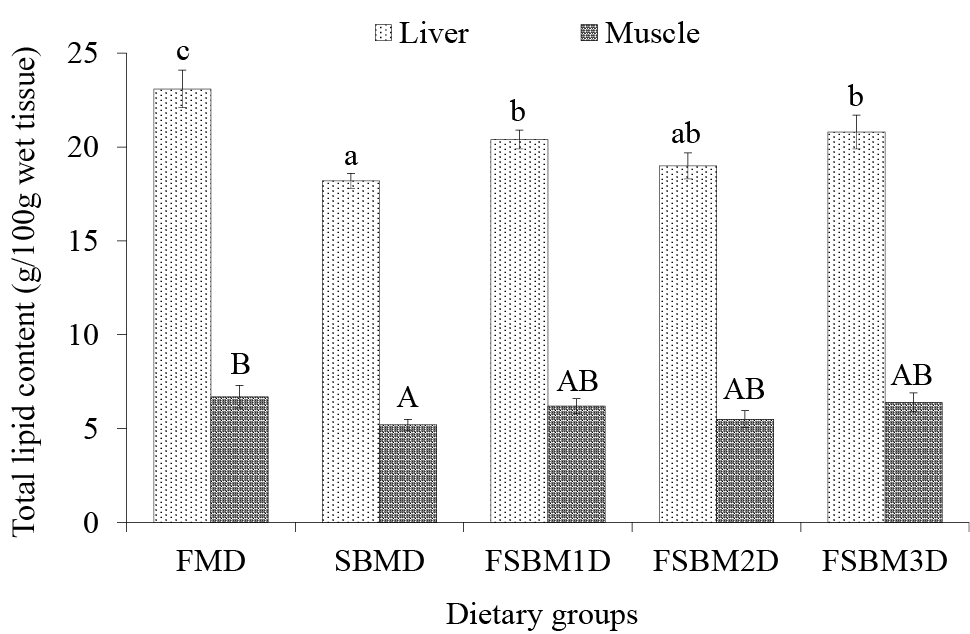
Total lipid contents in the liver and muscle of pompano fed the experimental diets (n = 15). Bars with different superscripts within each tissue are significantly different (P < 0.05).
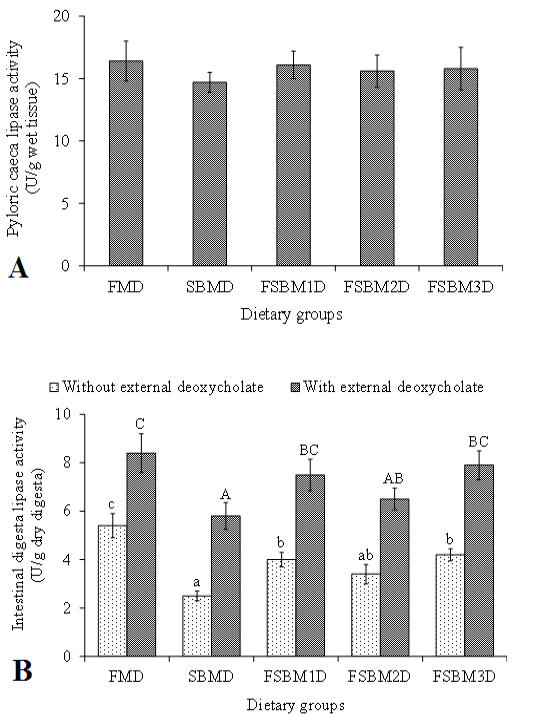
Lipase activity in the pyloric caeca and anterior ID of pompano fed the experimental diets. (A) Lipase activity in the pyloric caeca. (B) Lipase activity in the anterior ID. Values are presented as the mean ± standard deviation (pyloric caeca, n = 15; ID, n = 6). Bars with different superscripts within each analysis condition are significantly different (P < 0.05).
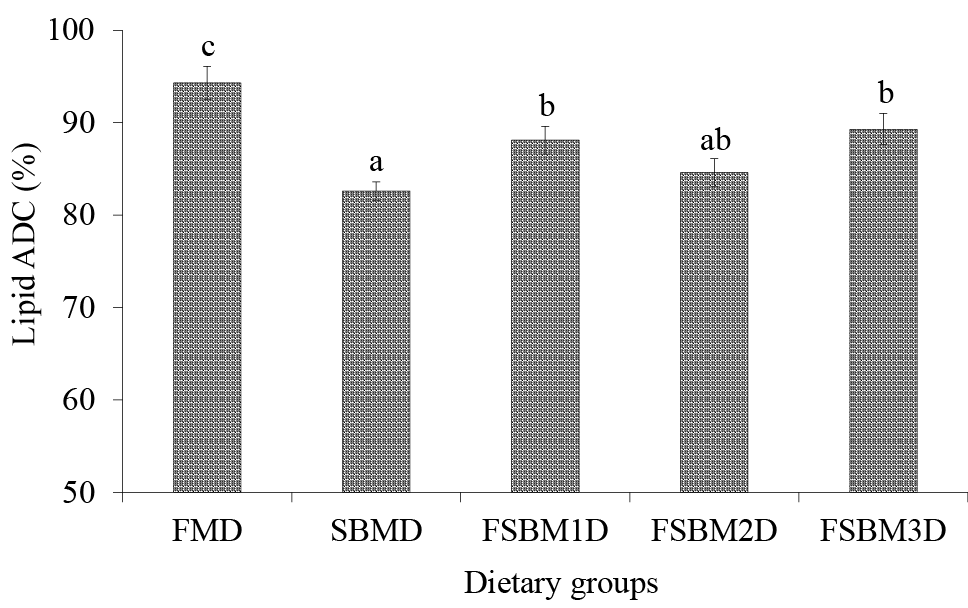
Lipid ADC of pompano fed the experimental diets. Values are presented as the mean±standard deviation of three replicates. Bars with different superscripts are significantly different (P < 0.05).
References
- AOAC, 2005. Official methods of analysis: 18th edn. Association of Official Analytical Chemists (AOAC). Gaithersburg, MD, USA.
- Azarm, H.M. and Lee, S.M., 2014. Effects of partial substitution of dietary fish meal by fermented soybean meal on growth performance, amino acid and biochemical parameters of juvenile black sea bream Acanthopagrus schlegeli. Aquacul. Res., 45: 994–1003. https://doi.org/10.1111/are.12040[CrossRef]
- Bauer, E., Jakob, S. and Mosenthin, R., 2005. Principles of physiology of lipid digestion. Asian Australas. J. Anim. Sci., 18: 282–295. https://doi.org/10.5713/ajas.2005.282[CrossRef]
- Chikwati, E.M., Venold, F.F., Penn, M.H., Rohloff, J., Refstie, S., Guttvik, A., Hillestad, M. and Krogdahl, A., 2012. Interaction of soyasaponins with plant ingredients in diets for Atlantic salmon, Salmo salar L. Br. J. Nutr., 107: 1570–1590. https://doi.org/10.1017/S0007114511004892[CrossRef]
- Choi, D.G, He, M., Fang, H., Wang, X.L., Li, X. Q. and Leng, X.J., 2020. Replacement of fish meal with two fermented soybean meals in diets for rainbow trout (Oncorhynchus mykiss). Aquacul. Nutr., 26: 37–46. https://doi.org/10.1111/anu.12965[CrossRef]
- Fange, R. and Grove, D., 1979. Digestion. In: Fish physiology (eds. W.S. Hoar, D.J. Randall and J.R. Brett). Academic press, New York, NY, USA. pp. 161–260. https://doi.org/10.1016/S1546-5098(08)60027-8[CrossRef]
- Feng, J., Liu, X., Xu, Z., Lu, Y. and Liu, Y., 2007. The effect of Aspergillus oryzae fermented soybean meal on growth performance, digestibility of dietary components and activities of intestinal enzymes in weaned piglets. Anim. Feed Sci. Technol., 134: 295–303. https://doi.org/10.1016/j.anifeedsci.2006.10.004[CrossRef]
- Folch, J., Lees, M. and Stanley, G.H.S., 1957. A simple method for the isolation and purification of total lipids from animal tissues. J. biol. Chem., 226: 497–509. https://www.jbc.org/content/226/1/497.full.pdf, https://doi.org/10.1016/S0021-9258(18)64849-5[CrossRef]
- Francis, G., Makkar, H.P. and Becker, K., 2001. Anti-nutritional factors present in plant-derived alternate fish feed ingredients and their effects in fish. Aquaculture, 199: 197–227. https://doi.org/10.1016/S0044-8486(01)00526-9[CrossRef]
- Goto, T., Ui, T., Une, M., Kuramoto, T., Kihira, K. and Hoshita, T., 1996. Bile salt composition and distribution of D-cysteinolic acid conjugated bile salts in fish. Fish. Sci., 64: 606–609. https://doi.org/10.2331/fishsci.62.606[CrossRef]
- He, M., Li, X., Poolsawat, L., Guo, Z., Yao, W., Zhang, C. and Leng, X., 2020. Effects of fish meal replaced by fermented soybean meal on growth performance, intestinal histology and microbiota of largemouth bass (Micropterus salmoides). Aquacul. Nutr., 26: 1058–1071. https://doi.org/10.1111/anu.13064[CrossRef]
- Hong, K.J., Lee, C.H. and Kim, S.W., 2004. Aspergillus oryzae GB-107 fermentation improves nutritional quality of food soybeans and feed soybean meals. J. Med. Fd., 7: 430–434. https://doi.org/10.1089/jmf.2004.7.430[CrossRef]
- Iwashita, Y., Yamamoto T., Furuita H., Sugita T. and Suzuki N., 2008. Influence of certain soybean antinutritional factors supplemented to a casein-based semipurified diet on intestinal and liver morphology in fingerling rainbow trout Oncorhynchus mykiss. Fish. Sci., 74: 1075–1082. https://doi.org/10.1111/j.1444-2906.2008.01627.x[CrossRef]
- Kapoor, D., Dayal, R. and Ponniah, A.G., 2002. Fish biodiversity of India. National Bureau of Fish Genetic Resources, Lucknow, UP, India.
- Kaushik, S.J., Coves, D., Dutto, G. and Blanc, D., 2004. Almost total replacement of fish meal by plant protein sources in the diet of a marine teleost, the European seabass, Dicentrarchus labrax. Aquaculture, 230: 391–404. https://doi.org/10.1016/S0044-8486(03)00422-8[CrossRef]
- Li, Y., Hu, H., Liu, J., Yang, P., Zhang, Y., Ai, Q., Xu, W., Zhang, W. and Mai, K., 2017a. Dietary soya allergen β-conglycinin induces intestinal inflammatory reactions, serum-specific antibody response and growth reduction in a carnivorous fish species, turbot Scophthalmus maximus L. Aquacul. Res., 48: 4022–4037. https://doi.org/10.1111/are.13224[CrossRef]
- Li, Y., Yang, P., Zhang, Y., Ai, Q., Xu, W., Zhang, W., Zhang, Y., Hu, H., Liu, J. and Mai, K., 2017b. Effects of dietary glycinin on the growth performance, digestion, intestinal morphology and bacterial community of juvenile turbot, Scophthalmus maximus L. Aquaculture, 479: 125–133. https://doi.org/10.1016/j.aquaculture.2017.05.008[CrossRef]
- Matsunari, H., Iwashita, Y., Suzuki, N., Saito, T., Akimoto, A., Okamatsu, K., Sugita, T. and Yamamoto, T., 2010. Influence of fermented soybean meal-based diet on the biliary bile status and intestinal morphology in rainbow trout Oncorhynchus mykiss. Aquacul. Sci., 58: 243–252.
- Murashita, K., Fukada, H., Hosokawa, H. and Masumoto, T., 2007. Changes in cholecystokinin and peptide Y gene expression with feeding in yellowtail (Seriola quinqueradiata): Relation to pancreatic exocrine regulation. Comp. Biochem. Physiol. B, 146: 318–325. https://doi.org/10.1016/j.cbpb.2006.11.009[CrossRef]
- Murashita, K., Fukada, H., Ronnestad, I., Kurokawa, T. and Masumoto, T., 2008. Nutrient control of release of pancreatic enzymes in yellowtail (Seriola quinqueradiata): Involvement of CCK and PY in the regulatory loop. Comp. Biochem. Physiol. A, 150: 438–443. https://doi.org/10.1016/j.cbpa.2008.05.003[CrossRef]
- Nguyen, H.P., Dinh, M.N., Dinh, H.G. and Nguyen, P.A., 2019. Growth performance and lipid digestion in some carnivorous fish fed with soybean meal. In: The first national conference on ichthyology in Vietnam (eds. H.D. Nguyen, X.H. Nguyen and V.P. Vo). Science and Technics Publishing House, Hanoi, Vietnam. pp. 76–83.
- Nguyen, H.P., Khaoian, P., Fukada, H., Nakamori, T., Furuta, H. and Masumoto, T., 2011a. Effects of different soybean proteins on lipid digestion and growth of yellowtail Seriola quinqueradiata. Fish. Sci., 77: 357–365. https://doi.org/10.1007/s12562-011-0338-7[CrossRef]
- Nguyen, H.P., Khaoian, P., Furutani, T., Nagano, J., Fukada, H. and Masumoto, T., 2011b. Effects of alcohol extract from soybean meal on pancreatic digestive enzyme and bile acid secretion in yellowtail Seriola quinqueradiata. Aquacul. Sci., 59: 465–472.
- Nguyen, H.P., Khaoian, P., Furutani, T., Nagano, J., Fukada, H. and Masumoto, T., 2017. Effects of alcohol extract of defatted soybean meal on growth performance and digestive physiology of yellowtail Seriola quinqueradiata. Fish. Sci., 83: 99–106. https://doi.org/10.1007/s12562-016-1049-x[CrossRef]
- Nguyen, H.P., Khaoian, P., Nagano, J., Fukada, H., Suzuki, N. and Masumoto, T., 2013. Feeding fermented soybean meal diet supplemented with taurine to yellowtail Seriola quinqueradiata affects growth performance and lipid digestion. Aquac. Res., 46: 1101–1110. https://doi.org/10.1111/are.12267[CrossRef]
- Nguyen, T.T., Nguyen, V.N., Tran, V.K., Le, H.D.T.M., Nguyen, T.T.H, Tran, T.H.N., Le, T.N.B., Vo, T.C.T. and Nguyen, T.N.T., 2018. Optimizing fermentation conditions for soybean meal and the changes in intestine morphology as soybean meal is substituted for fish meal in white leg shrimp (Litopenaeus vannamei) diet (in Vietnamese with English abstract). J. Mekong Fish., 11: 43–58.
- Novriadi, R., Rhodes, M., Powell, M., Hanson, T. and Davis, D.A., 2018. Effects of soybean meal replacement with fermented soybean meal on growth, serum biochemistry and morphological condition of liver and distal intestine of Florida pompano Trachinotus carolinus. Aquac. Nutr., 24: 1066–1075. https://doi.org/10.1111/anu.12645[CrossRef]
- Olli, J.J. and Krogdahl, A., 1995. Alcohol soluble components of soybeans seem to reduce fat digestibility in fish-meal-based diets for Atlantic salmon, Salmo salar L. Aquacul. Res., 26: 831–835. https://doi.org/10.1111/j.1365-2109.1995.tb00876.x[CrossRef]
- Olsen, R.L. and Hasan, M.R., 2012. A limited supply of fishmeal: Impact on future increases in global aquaculture production. Trends Fd. Sci. Technol., 27: 120–128. https://doi.org/10.1016/j.tifs.2012.06.003[CrossRef]
- Pouton, W.C. and Embletona, K.J., 1997. Structure and function of gastro-intestinal lipases. Adv. Drug Deliv. Rev., 25: 15–32. https://doi.org/10.1016/S0169-409X(96)00488-7[CrossRef]
- Refstie, S., Sahlstrom, S., Brathen, E., Baeverfjord, G. and Krogedal, P., 2005. Lactic acid fermentation eliminates indigestible carbohydrates and antinutritional factors in soybean meal for Atlantic salmon (Salmo salar). Aquaculture, 246: 331–345. https://doi.org/10.1016/j.aquaculture.2005.01.001[CrossRef]
- Refstie, S., Storebakken, T. and Roem, A.J., 1998. Feed consumption and conversion in Atlantic salmon (Salmo salar) fed diets with fish meal, extracted soybean meal or soybean meal with reduced content of oligosaccharides, trypsin inhibitors, lectins and soya antigens. Aquaculture, 162: 301–312. https://doi.org/10.1016/S0044-8486(98)00222-1[CrossRef]
- Rimmer, M.A., 2008. Regional review on existing major mariculture species and farming technologies. In: FAO/NACA regional workshop (eds. A. Lovatelli, M.J. Phillips, J.R. Arthur and K.Y. Yamanoto). The future of mariculture: A regional approach for responsible development in the Asia-Pacific region. Food and Agriculture Organization of the United Nations, Rome, Italy. pp. 105–125. http://www.fao.org/3/a-i0202e.pdf
- Romarheim, O.H., Skrede, A., Penn, M., Mydland, L.T., Krogdahl, A. and Storebakken, T., 2008. Lipid digestibility, bile drainage and development of morphological intestinal changes in rainbow trout (Oncorhynchus mykiss) fed diets containing defatted soybean meal. Aquaculture, 274: 329–338. https://doi.org/10.1016/j.aquaculture.2007.11.035[CrossRef]
- Rombensoa, A., Crousea, C. and Trushenskia, J., 2013. Comparison of traditional and fermented soybean meals as alternatives to fish meal in hybrid striped bass feeds. N. Am. J. Aquacul., 75: 197–204. https://doi.org/10.1080/15222055.2012.756440[CrossRef]
- Setchell, K.D.R., Lawson, A.M., Tanida, N. and Sjovall, J., 1983. General methods for the analysis of metabolic profiles of bile acids and related compounds in feces. J. Lipid Res., 24: 1085–1100. https://www.jlr.org/content/24/8/1085.full.pdf+html https://doi.org/10.1016/S0022-2275(20)37923-2[CrossRef]
- Shiu, Y.L., Hsieh, S.L., Guei, W.C., Tsai, Y.T., Chiu, C.H. and Liu, C.H., 2015. Using Bacillus subtilis E20-fermented soybean meal as replacement for fish meal in the diet of orange-spotted grouper (Epinephelus coioides, Hamilton). Aquacul. Res., 46: 1403–1416. https://doi.org/10.1111/are.12294[CrossRef]
- Storebakken, T., Refstie, S. and Ruyter, B., 2000. Soy products as fat and protein sources in fish feeds for intensive aquaculture. In: Soy in animal nutrition (ed. J.K. Drackley). Federation of Animal Science Societies, Savoy, IL, USA. pp. 127–170.
- Tuchweber, B., Yousef, I.M., Ferland, G. and Perea, A., 1996. Nutrition and bile formation. Nutr. Res., 16: 1041–1080. https://doi.org/10.1016/0271-5317(96)00104-2[CrossRef]
- Wang, P., Zhou, Q., Feng, J., He, J.J., Lou, Y. and Zhu, J., 2019. Effect of dietary fermented soybean meal on growth, intestinal morphology and microbiota in juvenile large yellow croaker, Larimichthys crocea. Aquacul. Res., 50: 748–757. https://doi.org/10.1111/are.13929[CrossRef]
- Yamamoto, T., Akimoto, A., Kishi, S., Unuma, T. and Akiyama, T., 1998. Apparent and true availabilities of amino acids from several protein sources for fingerling rainbow trout, common carp and red sea bream. Fish Sci., 64: 448–458. https://doi.org/10.2331/fishsci.64.448[CrossRef]
- Yamamoto, T., Iwashita, Y., Matsunari, H., Sugita, T., Furuita, H., Akimoto, A., Okamatsu, K. and Suzuki, N., 2010. Influence of fermentation conditions for soybean meal in a non-fish meal diet on the growth performance and physiological condition of rainbow trout Oncorhynchus mykiss. Aquaculture, 309: 173–180. https://doi.org/10.1016/j.aquaculture.2010.09.021[CrossRef]
- Zhuo, L.C., Liu, K. and Lin, Y.H., 2016. Apparent digestibility of soybean meal and Lactobacillus spp. fermented soybean meal in diets of grouper, Epinephelus coioides. Aquacul. Res., 47: 1009–1012. https://doi.org/10.1111/are.12543[CrossRef]
Cited by 1 article
In journals published by ResearchersLinks.
Services
Article usage statistics
Loading…