
Chitosan has a coating-forming ability and antibacterial activity, whilst tea polyphenols (TPs) have antibacterial and potent antioxidant activities. The present study aims to explore the effects of water-soluble chitosan (WSC)-based coatings alone (10 g/L of WSC; treatment-1) or combined with TPs (1 g/L of TPs + 10 g/L of WSC; treatment-2) on the preservation of hairtail (Trichiurus lepturus) at 4 °C for 12 days. All treatments significantly inhibited bacterial growth, total volatile basic nitrogen content, pH value increases, total colour difference value increases and sensory deterioration of hairtail during refrigeration. Moreover, treatment-2 exhibited higher efficiency than treatment-1. Therefore, WSC-based coatings incorporated with TPs could be a potential method to inhibit the quality deterioration of hairtail.
Short Communication · Volume 57, Issue 6, 15 November 2025 · Open Access
Preservation of Hairtail (Trichiurus lepturus) Using Water Soluble Chitosan Based Coatings Combined with Tea Polyphenols
· · ·
Affiliations & Notes ⌄
- 1Jiangsu Key Laboratory of Marine Bioresources and Environment/Jiangsu Key Laboratory of Marine Biotechnology, Jiangsu Ocean University, Haizhou, China 2Co-Innovation Center of Jiangsu Marine Bio-industry Technology, Haizhou, China * Corresponding author: lx2567546020lx@163.com, wushengjun008@163.com
Article Info ⌄
- Journal:
- Pakistan Journal of Zoology
- Published:
- 15 November 2025

From the article
- However, the pH values of hairtails in the treatment-1 and treatment-2 groups were significantly lower than those of treatment groups during refrigeration (Fig. 1C).
- The difference between (treatment-1/treatment-2) for ∆E values increased during refrigeration.
- WSC-based coatings incorporated with TPs effectively suppressed microbial growth, the increase in pH values and TVB-N values and the deterioration in the sensory quality of hairtails during refrigeration.
- Based on the TVC, TVB-N and overall likeness score, treatment with WSC-based coatings incorporated with TPs extended the shelf life of hairtails at least 6 days.
Selected from the article's own text.
Abstract
Materials and methods
Fresh hairtails with an average body weight of 600±23 g were obtained from an aquatic marketplace in Lianyungang, China. Water soluble chitosan (WSC) with a 57.2% degree of deacetylation and 38 × 103 Da of molecular weight was purchased from Shanghai Yuanye Biotech. Co., Ltd., China. TPs with a purity ≥ 990 g/kg were purchased from Xinxin Biotechnology Co., Ltd., Jining, China.
The dipping solutions of WSC and tea polyphenols were as follows: control (not treated with WSC or TPs), treatment-1 (10 g/L of WSC) and treatment-2 (1 g/L of tea polyphenols + 10 g/L of WSC) ; . The fresh hairtails were decapitated, finned, gutted and severed, obtaining a uniform size of 5 cm × 3 cm. A total of 600 hairtail fillets were randomly and equally assigned to three groups. The hairtail fillets were immersed in the corresponding dipping solutions at 4 °C for 1 h. Afterwards, surface impregnation solution was drained at 4 °C, and then the hairtail fillets were refrigerated at 4 °C for 12 days.
Microbial growth in hairtail fillets was measured according to the plate count agar method . Six hairtail fillet samples were used to determine the number of microorganisms. The total colony was recorded and expressed as log colony-forming unit (CFU)/g.
Six hairtail fillet samples were used to determine TVB-V in accordance with the acid-base titration methods of Huang et al. (2012) and pH by using a pH meter (PH400EX, Hangzhou Meinite Automation Instrument Co., Ltd., China) in accordance with a previously reported method . The colour was recorded using a colorimeter (CS-100A, Minolta Co., Ltd., Japan). The colour parameters were L* (brightness), a* (red/green) and b* (yellow/blue). The total colour difference (∆E) of the hairtail fillets was calculated in accordance with Equation 1.

where ∆L*, ∆a* and ∆b* indicate the differences amongst the lightness, red/green and yellow/blue of the sample and standard, respectively.
For sensory evaluation 12 trained research workers (2 h for each training, six times in total session) majoring in food technology. The products tested were safe for consumption. Six hairtail fillets were subjected to steaming for 5 min and then sensory evaluation, and the 1–9 description hedonic scale was used to evaluate the overall likeness score .
All experiments were replicated six times. All data were expressed as mean ± standard error. One-way analysis of variance and Tukey Kramer multi-range test were used for statistical analysis of all data.
Results and discussion
Figure 1 shows the effect of WSC- based coatings incorporated with TPs on TVC, TVB-N, pH, colour and overlikeness of hairtail during refrigeration. The initial TVC values in hairtails in control group, treatment-1 group and treatment-2 group were 3.1, 2.6 and 2.2 CFU/g. The differences in initial TVC values in hairtails amongst the control, treatment-1 and treatment-2 groups could be due to the antibacterial activity of WSC-based coatings (Liu et al., 2009) and TPs . The TVC in hairtails in control improved and exceeded the first-class national standard maximum value of TVC (4.0 CFU/g) after 4 days. The TVC in hairtails in treatment-1 group improved steadily during refrigeration and exceeded the first-class national standard maximum value of TVC (4.0 CFU/g) after 8 days. Nevertheless, the TVC in hairtails in treatment-2 group increased slowly during refrigeration and did not exceed the first-class national standard maximum value of TVC after 12 days.
The TVB-N lsevel is positively related to the growth of spoilage microorganism and the activities of endogenous enzymes; thus, TVB-N is an indicator of food spoilage . The TVB-N value of hairtails in the control increased sharply during refrigeration (P < 0.05) and exceeded the first-class national standard maximum value of TVB-N (13 mg/100 g) after 4 days (Fig. 1B). The TVB-N in hairtails of the treatment-1 group increased steadily during refrigeration and exceeded the first-class national standard maximum value of TVB-N after 8 days of refrigeration. However, the TVB-N in hairtails of the treatment-2 group increased slowly during refrigeration and still did not exceed the first-class national standard maximum value of TVB-N after 12 days of refrigeration. The results indicated that WSC-based coatings incorporated with TPs effectively suppressed TVB-N formation; this effect could be due to the antibacterial activity of WSC-based coatings and TPs as well as the antioxidant activity of TPs . Similar to TVC, the difference between treatment-1 and treatment-2 and the ratio of treatment-1/treatment-2 for TVB-N did not change until day 6 but improved from day 8. If the results on treatment 2 were due to the additive effects of WSC and TPs, then the difference between treatment-1 and treatment-2 could be because of the antioxidant activity and antibacterial activity of TPs ; .
Spoilage bacteria produce many enzymes that are responsible for the decomposition of proteins, leading to the increase in TVB-N and pH. Therefore, pH is an indicator of food spoilage . The initial pH value of hairtails in all groups was 7.31 ± 0.27 mg/100 g (Fig. 1C). However, the pH values of hairtails in the treatment-1 and treatment-2 groups were significantly lower than those of treatment groups during refrigeration (Fig. 1C). This difference could also be because of the antibacterial activity of WSC and TPs . The pH values of hairtails in control, treatment-1 and treatment-2 increased from 7.31 ± 0.27 to 9.1 ± 0.42, 8.2 ± 0.33 and 7.7± 0.0.31, respectively, after 12 days of refrigeration (Fig. 1C). The difference in pH value between treatment-1 and treatment-2 did not change until day 6 but improved from day 8. However, the ratio of treatment-1/treatment-2 was maintained at the same level during 12 days of refrigeration.
The surface of fresh fish skin is silver gray and glossy. But the spoiled hairtail has a layer of yellow substance attached to its silver luster due to lipid oxidation. Therefore, colour is another indicator of food spoilage. The ∆E values of hairtails in all groups increased steadily during refrigeration (Fig. 1D). However, the ∆E values of hairtails in treatment groups group were lower than those of treatment groups during refrigeration (Fig. 1D). This could also be due to the antibacterial activity of the antibacterial activity of WSC and TPs as well as the antioxidant activity of TPs . The difference between (treatment-1/treatment-2) for ∆E values increased during refrigeration. The difference between treatment-1 and treatment-2 groups first as for pH could be due to the antioxidant activity and antibacterial activity of TPs ; , if the results on treatment-2 were due to synergistic effects of WSC and TPs.
Figure 1E presents the effects of WSC-based coatings incorporated with TPs on the sensory quality of hairtails during refrigeration. The overall likeness scores of steamed hairtails were evaluated at 0, 2, 4, 6, 8, 10 and 12 days during refrigeration. No evident differences in the initial overall likeness scores were observed amongst all groups. After 6 days of refrigeration, the overall likeness score of hairtails in the control group decreased to unacceptable levels (overall likeness score of 5.0). However, after 12 days of refrigeration, the overall likeness score of hairtails in the treatment-2 group maintained acceptable levels. The high sensory qualities of the treated hairtails could be related to the antibacterial activity of WSC and TPs as well as the antioxidant activity of TPs .
Conclusion
WSC-based coatings incorporated with TPs effectively suppressed microbial growth, the increase in pH values and TVB-N values and the deterioration in the sensory quality of hairtails during refrigeration. Based on the TVC, TVB-N and overall likeness score, treatment with WSC-based coatings incorporated with TPs extended the shelf life of hairtails at least 6 days. The results indicated that WSC-based coatings incorporated with TPs might be a practical way to inhibit spoilage of hairtails with extended shelf life.
Declarations
Acknowledgments
This research was supported by a project funded by the Priority Academic Program Development (PAPD) of Jiangsu Higher Education Institutions.
Statement of conflict of interest
The authors have declared no conflict of interest.
Figures
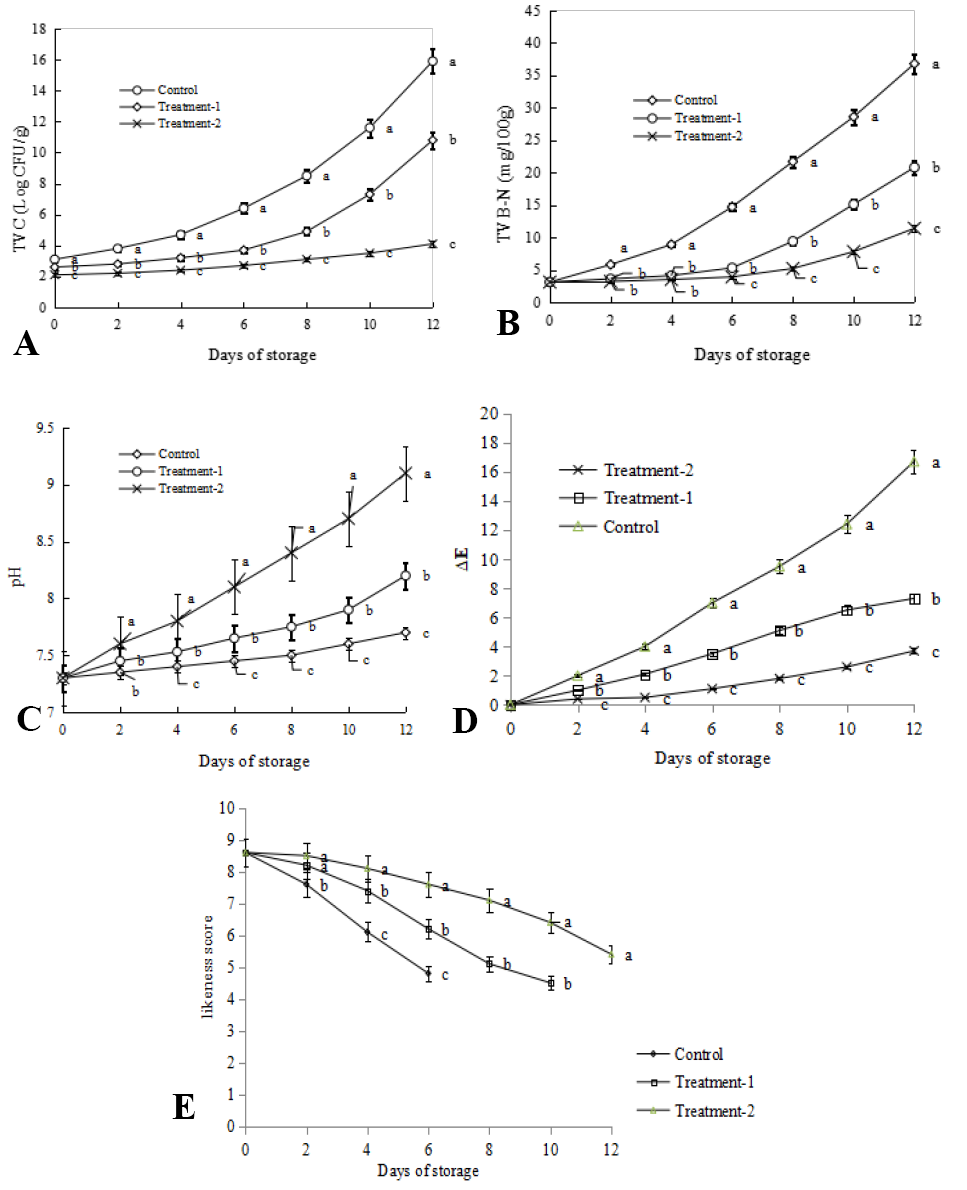
Effect of WSC- based coatings incorporated with TPs on total viable count (A), TVB-N content (B), pH (C), colour (D), and overall likeness (E) of hairtail (Trichiurus lepturus) during refrigeration. Control: purified water; treatment-1: 1% WSC; treatment-2: 0.1% tea polyphenols + 1% WSC. Values are the mean ± SE (n = 6). Vertical bars represent standard error.The difference between the values labelled with different alphabets at the same storage duration was statistically significant (P < 0.05, Tukey-Kramer’s multiple range test).
References
- Abdelhady, E.M., Mostafa, N.Y., El-Magd, M.A. and Kirrella, G.A., 2023. Pakistan J. Zool., 55: 2295-2302. https://doi.org/10.17582/journal.pjz/20220315170358[Full text][CrossRef]
- Alzahani, F. and El-Magd, M.A., 2024. Pakistan J. Zool., 56: 523-531. https://doi.org/10.17582/journal.pjz/20220407050442[Full text][CrossRef]
- Duan, J.Y., Cherian, G. and Zhao, Y.Y., 2010. Fd. Chem., 119: 524–532. https://doi.org/10.1016/j.foodchem.2009.06.055[CrossRef]
- Huang, J., Chen, Q., Qiu, M. and Li, S., 2012. J. Fd. Sci., 77: C491-C496.
- Jabbin, H., Arshad, A.M., Mehmood, N., Hassan, W., Shah, S.Z.H. and Siddique, F., 2023. Pakistan J. Zool., 55: 371-377. https://doi.org/10.17582/journal.pjz/20190519170504[Full text][CrossRef]
- Li, F.H., Wu, S.J. and Xu, B., 2021. LWT-Fd. Sci. Technol., 147: 111595. https://doi.org/10.1016/j.lwt.2021.111595[CrossRef]
- Li, M., Wang, W., Fang, W. and Li, Y., 2013. J. Fd. Prot., 76: 1377-1383. https://doi.org/10.4315/0362-028X.JFP-12-516[CrossRef]
- Luan, L.L., Fu, S.L., Yuan, C.H., Ishimura, G., Chen, S.G., Chen, J.C. and Hu, Y.Q., 2017. Int. J. Fd. Prop., 20(sup1): S992-S1000. https://doi.org/10.1080/10942912.2017.1325903[CrossRef]
- Memon, K.H., Liu, Q., Kalhoro, M. Ali., Chang, M.S., Baochao, L., Memon, A.M., Hyder, S. and Tabassum, S., 2016. Pakistan J. Zool., 48: 829-837.
- Moran, H.B.T., Turley, J.L., Andersson, M. and Lavelle, E.C., 2018. Biomaterials, 184: 1-9. https://doi.org/10.1016/j.biomaterials.2018.08.054[CrossRef]
- Niu, M., Liu, X.G., Dai, J.M., Jia, H.S., Wei, L.Q. and Xu, B.S., 2009. Carbohydr. Polym., 78: 54-59.
- Panhwar, S.K., Dong, Z.Y., Gao, T.X., Ping, Wang, P, Zhiqiang, Han, Z.Q., Wang, Z.M. and Wang, Y., 2018. Pakistan J. Zool., 50: 1-5. https://doi.org/10.17582/journal.pjz/2018.50.1.1.5[CrossRef]
- Ruiz-Rico, M., Sancenon, F. and Barat, J.M., 2023. LWT Fd. Sci. Technol., 173: 114373. https://doi.org/10.1016/j.lwt.2022.114373[CrossRef]
- Semedo T.W.P., Dong, S.Y., Jin, W.Y., Yang, Y.H., Han, K.N., Zha, F.C., Zhao, Y.H. and Zeng, M.Y., 2018. Fd. Res. Int., 103: 390-397. https://doi.org/10.1016/j.foodres.2017.10.063[CrossRef]
- Sun, P., Chen, Q., Fu, C.H., Xu, Y., Sun, R.L., Li, J.C., Yu, H.Q., Zhang, C., Liu, Y., Ye, Z.J., Tian, Y.J. and Heino, M., 2020. Fish. Oceanogr., 29: 470-483. https://doi.org/10.1111/fog.12490[CrossRef]
- Xin, K.Q., Liang, J., Tian, K., Yu, Q.L., Tang, D.F. and Han, L., 2023. LWT Fd. Sci. Technol., 173: 114277. https://doi.org/10.1016/j.lwt.2022.114277[CrossRef]
- Yan, Z.M., Zhong, Y.Z., Duan, Y.H., Chen, Q.H. and Li, F.N., 2020. Anim. Nutr., 6: 115-123. https://doi.org/10.1016/j.aninu.2020.01.001[CrossRef]
- Yang, C., Lu, J.H., Xu, M.T., Shi, X.C., Song, Z.W., Chen, T.M., Herrera-Balandrano, D.D., Zhang, Y.J., Laborda, P., Shahriar, M. and Wang, S.Y., 2022. LWT Fd. Sci. Technol., 163: 2022. https://doi.org/10.1016/j.lwt.2022.113551[CrossRef]
- Yang, H., Y., Li, Q.Y., Yang, L. L., Sun, T., Li, X. P., Zhou, B. and Li, J.R., 2020. Int. J. Fd. Sci. Tech., 55: 3542-3552. https://doi.org/10.1111/ijfs.14687[CrossRef]
- Zhang, H.X., Zheng, Y. and Li, R.M., 2022. Fd. Chem., 390: 133206. https://doi.org/10.1016/j.foodchem.2022.133206[CrossRef]
Services
Article usage statistics
Loading…