
Plants offer cultural and scenic beauty, which has enriched urban environments throughout history. Although green spaces are crucial for the entire population, researchers have conducted little research on them in Ecuador. Therefore, our study characterized the green spaces in Portoviejo by identifying the plant species used and exploring any potential connection between their characteristics and usage criteria. We adopted 337 inventories using the Braun-Blanquet phytosociological methodology in public and private green spaces. Experts from the botanical garden of the Universidad Técnica de Manabí and various specialized databases helped us identify the plant species found in our research. Additionally, we obtained supplementary information about the species, including their potential value for use, growth habits, and reproduction methods. Likewise, the structural components relate to the type and nature of the area (public or private). We used multivariate statistical methods to analyze the metadata. Our findings revealed that at least 192 species are predominantly tree species in Portoviejo’s green spaces. However, groundcover species (Stenotaphrum secundatum, Dichondra repens, and Arachis pintoi) receive the most attention. Beyond their landscape use, we also found a relationship between species characteristics and their purpose (ornamental, medicinal, or productive).
Specail Issue: Memories of the Agricultural and Livestock Area of the VI CCIUTM, Ecuador · Volume 39, Issue 2, 16 October 2026 · Open Access
Plant Diversity and Characterization of Urban Green Spaces in Portoviejo, ManabÃ-Ecuador
· · ·
Affiliations & Notes ⌄
- 1Agronomy Career, Faculty of Agricultural Engineering, Universidad Técnica de Manabí, Km 13 vía Portoviejo-Santa Ana, Lodana, Ecuador
- 2Department of Agricultural Sciences, Faculty of Agricultural Engineering, Universidad Técnica de Manabí, Km 13 vía Portoviejo-Santa Ana, Lodana, Ecuador, 131302
- 3Laboratory of Agroecosystems Functioning and Climate Change – FAGROCLIM, Departamento de Ciencias Agronómicas. Facultad de Ingeniería Agronómica. Universidad Técnica de Manabí. Km 15 vía Portoviejo-Santa Ana. Lodana, 131302. Ecuador. Gema Damaris Meza-Ibarra and Cristhofer Yandry Valle-Carreño contributed equally to this work
Article Info ⌄
- Journal:
- Sarhad Journal of Agriculture
- Published:
- 16 October 2026

From the article
- The second component (CP2) separated, on the one hand, those characteristics of the species related to public green spaces and, on the other, those strongly associated with private spaces.
- In general, at least 192 species are used in the green areas of Portoviejo, with a predominance of arboreal species.
- In a few cases, species preferences were influenced by the size of the green area, though notable relationships were observed between species characteristics and their location.
- The predominance of tree species suggests their importance in providing shade and ecosystem services, while the prevalence of groundcover plants like S. secundatum highlights their role in soil stabilization, erosion control, and low-maintenance landscaping.
Selected from the article's own text.
Abstract
Introduction
Since ancient times, plants have been an important element for the subsistence of human beings, covering some basic needs such as food, health, and recreation . The world’s urban population increased from 2.3 billion in 1994 to 3.9 billion in 2014 and is likely to rise to 6.3 billion by 2050 (OUN, 2014). In America, countries such as Argentina and Brazil concentrate a considerable number of inhabitants and widespread urban and peri-urban agriculture (FAO, 2014). The evolution of the human race is closely linked to the geographical environment, the product of constant human-nature interaction. As a result of social development, man has progressively transformed his environment, giving each territory a particular aspect .
Although ornamental plants, as well as their flowers, are promising segments of agroindustry at the socioeconomic level in their different structural, vegetative, eco-environmental, and landscape approaches, the expansion of these plants is related to the optime socioeconomic situation and increased consumption in a locality or region . Urban green spaces offer multiple ecological and social benefits, including climate regulation, improved air quality, and psychological well-being ; . Cities such as Singapore and New York have integrated these spaces into their sustainability strategies, demonstrating their positive impact on quality of life .
In Ecuador, Quito (the capital of the country) is the city with the highest number of green spaces by the number of inhabitants, having an Urban Green Index (IVU) of 21.6 m2 per inhabitant, which is higher than the international parameter of 9 m2 described by the World Health Organization (WHO) . In other Ecuadorian cities such as Portoviejo (capital of the province of Manabí, this IVU can vary. Its urban area has 412,879 m2, equivalent to 2.40 m2 per inhabitant, and 35,417 m2 of net coverage of trees, tantamount to 4.92 m2 per inhabitant .
Few studies on green spaces and their importance for the population have been conducted in Ecuador, especially on the coast. Concerning Portoviejo, during its last five years, the city has experienced positive changes in the urban landscaping component, with the creation and reactivation of new green areas to serve citizens. Despite this, the diversity and quantity of species planted in public and private areas of this city are unknown . So far, only one forest inventory has been carried out in Portoviejo, finding 30 species of forest importance belonging to 14 families of vascular plants .
The ways to establish ornamental plants in urbanized cities comprise different eco-environmental attributes, landscape beautification, and humanistic and socioeconomic contributions. Portoviejo has constantly modified its landscape composition in different areas, carrying out regenerations in both municipal parks and private gardens. These green areas could mitigate negative impacts such as stronger sun waves, generating a localized microclimate favorable for pedestrians and recreational spaces, or the reduction of industrial pollution caused by the increase of vehicles in the city by emanating gases such as nitrous oxide, carbon monoxide or carbon dioxide (Ortega et al., 2020).
Given the scarce information about the landscape composition located in public and private sectors of the city of Portoviejo, at the level of species, the number of plants by genus or species, or total green area covered, we carried out this quantitative and qualitative analysis, to obtain information on the ornamental flora located in the different municipal parks and private green areas of the Portoviejo urban area, Manabí, Ecuador.
Materials and Methods
Location of the study area
Our research was carried out in the urban area of Portoviejo city, the capital of the province of Manabí, Ecuador, located in the central part of the Ecuadorian coast (1º03’16.0 south latitude and 80º27’16.0 west longitude) (Figure 1).
Collection of information from green areas
The different green areas and gardens of Portoviejo were analyzed during the last quarter of 2021, totaling 337 inventories. Sampling sites were selected based on accessibility, representativeness of urban green spaces, and the distinction between public and private areas. Public spaces included parks, plazas, and roadside vegetation, while private spaces encompassed residential gardens and institutional green areas (e.g., university campuses, schools, and private businesses). The selection of private areas depended on permission from property owners.
After selecting the study area, data on plant species were obtained using the KoBoCollect application. Each questionnaire contained information related to geographic location, inventory code, plot area, and plant species identification. The scale proposed by Braun-Blanquet (1979) with modifications was used to determine species characteristics as companions, incidental, and dominant. The scale consisted fo: r = one or a few individuals of the species; + = higher number of individuals, very less coverage; 1 = less than 5% coverage; 2 = 5 – 25% coverage; 3 = 25 – 50% coverage; 4 = 50 – 75% coverage, 5 = 75 – 100% coverage.
Each plant species was identified with the assistance of experts from the botanical garden of the Technical University of Manabí. Experts conducted in-field identification and cross-referenced findings with international taxonomic databases, including The World Flora Online (WFO), the International Plant Name Index (IPNI), and Tropicos (Missouri Botanical Garden). When species identification was uncertain, samples were collected and examined under controlled conditions.
In each inventory, potential value or use (cultural, medicinal, ornamental, and productive), growth habit (tree, shrub, herbaceous, palm, ground cover, and climber), and propagation methods (layering, tubers, division, cuttings, stolon, leaf segment or adventitious bud, and seeds) were added. Likewise, during the inventory, the green spaces of the city were categorized by constructive elements associated with the species (access to people with reduced mobility, sidewalks, seats, monuments, lights, lagoons or similar, litter bins, playgrounds, roads, and exercise area), and area nature (public and private).
Statistical analysis
To explore the relationships between the presence/absence of species with site parameters (public and private) and species characteristics, a principal component analysis (PCA) was performed on the Infostat software updated on 29-09-2020 . Additionally, a chord diagram was used to graphically represent the similarities and relationships between the group of species and the information recorded in the inventory (potential use value, growth habit, propagation methods, and the relationship with some constructive element). R software (R Core Team, 2020) and the circle package were used .
Results and Discussion
The floristic composition in the green areas and gardens analyzed in Portoviejo was differentiated, finding that 23 and 77% of the inventories carried out were in private and public areas, respectively. One hundred ninety-two plant species belonging to 170 genera and 72 families were identified (Table 1). The diversity found in our work is higher when compared to that of other investigations like that of Cevallos et al. (2014). They found 74 herbaceous and woody ornamental species belonging to 32 families in urban and rural parks and certain avenues of historical importance in Cuenca (a city located in The Andes), Ecuador. Likewise, the plant diversity of Portoviejo would be greater than that found in other cities of the same province as Jipijapa (13 species belonging to 10 families of vascular plants; , and even Portoviejo itself (30 forest species belonging to 14 families of vascular plants; . On the other hand, in green areas of other cities such as Medellín (located in Valle de Aburrá, in the Andes), Colombia, Vélez and Herrera (2015) found a diversity of 198 species. To explain these differences, we could formulate two hypotheses: (1) the diversity of species in coastal areas of Ecuador may be limited to forest flora, which could restrict the overall number of species in urban green spaces, and (2) as altitude increases, the number of species tends to decrease .
Additionally, we found in our study that some species are used in public and private areas but with preferences. In this regard, of the 192 species registered, 63% are used in green areas of public nature, and 66% are planted in private areas, without
Table 1: Families, genera and species used in green areas and gardens in the city of Portoviejo, Manabí, Ecuador.
|
Family |
Genus |
Scientific name |
|
Acanthaceae |
Asystasia |
Asystasia gangetica (L.) T. Anderson |
|
Pachystachys |
Pachystachys lutea Nees |
|
|
Pseuderanthemum |
Pseuderanthemum carruthersii var. atropurpureum (W. Bull) Fosberg |
|
|
Ruellia |
Ruellia simplex C. Wright |
|
|
Amaranthaceae |
Iresine |
Iresine herbstii Hook. |
|
Amaryllidaceae |
Hymenocallis |
Hymenocallis littoralis (Jacq.) Salisb. |
|
Anacardiaceae |
Anacardium |
Anacardium occidentale L. |
|
Mangifera |
Mangifera indica L. |
|
|
Spondias |
Spondias mombin L |
|
|
Spondias purpurea L |
||
|
Annonaceae |
Annona |
Annona cherimola Mill. |
|
Annona muricata L. |
||
|
Annona reticulata L. |
||
|
Cananga |
Cananga odorata (Lam.) Hook. f. & Thomson |
|
|
Apocynaceae |
Allamanda |
Allamanda cathartica L. |
|
Catharanthus |
Catharanthus sp. |
|
|
Nerium |
Nerium oleander L. |
|
|
Plumeria |
Plumeria rubra L |
|
|
Thevetia |
Thevetia peruviana (Pers.) K. Schum. |
|
|
Araceae |
Aglaonema |
Aglaonema commutatum var. commutatum |
|
Anthurium |
Anthurium sp. |
|
|
Caladium |
Caladium bicolor (Aiton) Vent. |
|
|
Dieffenbachia |
Dieffenbachia sp. |
|
|
Dieffenbachia seguine (Jacq.) Schott |
||
|
Philodendron |
Philodendron andreanum Devansaye ex Buchet & Guillaumin |
|
|
Syngonium |
Syngonium sp. |
|
|
Araliaceae |
Plerandra |
Plerandra elegantissima (Veitch ex Mast.) Lowry, G.M. Plunkett & Frodin |
|
Schefflera |
Schefflera sp. |
|
|
Arecaceae |
Caryota |
Caryota urens L |
|
Chamaedorea |
Chamaedorea elegans Mart. |
|
|
Cocos |
Cocos nucifera L. |
|
|
Cyrtostachys |
Cyrtostachys renda Blume |
|
|
Dypsis |
Dypsis lutescens (H. Wendl.) Beentje & J. Dransf. |
|
|
Elaeis |
Elaeis oleifera (Kunth) Cortés |
|
|
Licuala |
Licuala grandis H. Wendl. ex Linden |
|
|
Phoenix |
Phoenix roebelenii O’Brien |
|
|
Pritchardia |
Pritchardia sp. |
|
|
Ravenala |
Ravenala madagascariensis Sonn. |
|
|
Rhapis |
Rhapis excelsa (Thunb.) A. Henry |
|
|
Roystonea |
Roystonea regia (Kunth) O.F. Cook |
|
|
Spathiphyllum |
Spathiphyllum wallisii Regel |
|
|
Syagrus |
Syagrus romanzoffiana Cham |
|
|
Thrinax |
Thrinax radiata Lodd. ex Schult. & Schult. f. |
|
|
Veitchia |
Veitchia merrilli (Becc.) H.E. Moore |
|
|
Washingtonia |
Washingtonia robusta H. Wendl. |
|
|
Table continues to next page...... |
||
|
Family |
Genus |
Scientific name |
|
Asparagaceae |
Chlorophytum |
Chlorophytum comosum (Thunb.) Jacques |
|
Cordyline |
Cordyline terminalis (L.) Kunth |
|
|
Cordyline fruticosa L. |
||
|
Dracaena |
Dracaena massangeana Rodigas |
|
|
Sansevieria |
Sansevieria trifasciata Prain |
|
|
Asphodelaceae |
Aloe |
Aloe vera (L.) Burm. f. |
|
Asteraceae |
Ageratum |
Ageratum conyzoides L. |
|
Helianthus |
Helianthus annuus L. |
|
|
Zinnia |
Zinnia peruviana (L.) L. |
|
|
Bignoniaceae |
Handroanthus |
Handroanthus heptaphyllus (Vell.) Mattos |
|
Jacaranda |
Jacaranda sp. |
|
|
Kigelia |
Kigelia africana (Lam.) Benth. |
|
|
Spathodea |
Spathodea campanulata P. Beauv. |
|
|
Tabebuia |
Tabebuia aurea Silva Manso |
|
|
Tabebuia chrysantha (Jacq.) G. Nicholson |
||
|
Tabebuia rosea (Bertol.) DC. |
||
|
Bromeliaceae |
Ananas |
Ananas comosus L. |
|
Bromelia |
Bromelia sp. |
|
|
Burceraceae |
Bursera |
Bursera graveolens Kunth |
|
Cactaceae |
Opuntia |
Opuntia humifusa (Raf.) Raf. |
|
Opuntia microdasys (Lehm.) Pfeiff. |
||
|
Calophyllaceae |
Mammea |
Mammea americana L. |
|
Cannaceae |
Canna |
Canna indica L |
|
Caricaceae |
Carica |
Carica papaya L. |
|
Combretaceae |
Bucida |
Bucida buceras L. |
|
Terminalia |
Terminalia catappa L. |
|
|
Commelinaceae |
Setcreasea |
Setcreasea purpurea Boom |
|
Tradescantia |
Tradescantia pallida (Rose) D.R. Hunt |
|
|
Tradescantia spathacea Sw. |
||
|
Convolvulaceae |
Dichondra |
Dichondra repens Forst. & Forst. |
|
Crassulaceae |
Bryophyllum |
Bryophyllum pinnatum (Lam.) Oken |
|
Crassula |
Crassula ovata (Mill.) Druce |
|
|
Kalanchoe |
Kalanchoe pinnata (Lam.) Pers. |
|
|
Sedum |
Sedum japonicum Siebold ex Miq. |
|
|
Cucurbitaceae |
Citrullus |
Citrullus lanatus L. |
|
Cupressaceae |
Cupressus |
Cupressus macrocarpa Hartw. ex Gordon |
|
Cupressus senpevirens Hartw. ex Gordon |
||
|
Platycladus |
Platycladus orientalis (L.) Franco |
|
|
Cycadaceae |
Carex |
Carex oshimensis fo. variegata Hid. Takah. |
|
Cycas |
Cycas revoluta Thunb. |
|
|
Cyperus |
Cyperus alterniflorus R. BR |
|
|
Cyperus papyrus L |
||
|
Equisetaceae |
Equisetum |
Equisetum hyemale L. |
|
Table continues to next page...... |
||
|
Family |
Genus |
Scientific name |
|
Euphorbiaceae |
Acalypha |
Acalypha wilkesiana Müll. Arg. |
|
Cnidoscolus |
Cnidoscolus aconitifolius (Mill.) I.M. Johnst. |
|
|
Codiaeum |
Codiaeum variegatum (L.) Rumph. ex A. Juss. |
|
|
Euphorbia |
Euphorbia milii Des Moul. |
|
|
Euphorbia pulcherrima Willd. ex Klotzsch |
||
|
Hevea |
Hevea brasiliensis (Willd. ex A. Juss.) Müll. Arg. |
|
|
Jatropha |
Jatropha curcas L. |
|
|
Fabaceae |
Albizia |
Albizia guachapele (Kunth) Dugand |
|
Arachis |
Arachis hypogaea L. |
|
|
Arachis pintoi Krapov. & W.C. Greg |
||
|
Caesalpinia |
Caesalpinia glabrata Kunth |
|
|
Cassia |
Cassia fistula L |
|
|
Delonix |
Delonix regia (Bojer ex Hook.) Raf. |
|
|
Erythrina |
Erythrina caffra Thunb |
|
|
Inga |
Inga edulis Mart. |
|
|
Pithecellobium |
Pithecellobium excelsum (Kunth) Mart. |
|
|
Prosopis |
Prosopis pallida L |
|
|
Samanea |
Samanea saman (Jacq.) Merr. |
|
|
Schizolobium |
Schizolobium parahyba (Vell.) S.F. Blake |
|
|
Senna |
Senna siamea (Lam.) H.S. Irwin & Barneby |
|
|
Tamarindus |
Tamarindus indica L. |
|
|
Gesneriaceae |
Episcia |
Episcia cupreata (Hook.) Hanst. |
|
Gloxinia |
Gloxinia sp |
|
|
Heliconiaceae |
Heliconia |
Heliconia acuminiata Rich |
|
Iridaceae |
Eleutherine |
Eleutherine bulbosa (Mill.) Urb. |
|
Lamiaceae |
Hyptis |
Hyptis sp. |
|
Mentha |
Mentha spicatae L. |
|
|
Ocimum |
Ocimum basilicum L. |
|
|
Ocimum basilicum var. basilicum |
||
|
Solenostemon |
Solenostemon bojeri (Benth.) Guillaumet & Cornet |
|
|
Lauraceae |
Persea |
Persea americana Mill. |
|
Liliaceae |
Lilium |
Lilium sp. |
|
Limiaceae |
Plectranthus |
Plectranthus amboinicus (Lour.) Spreng) |
|
Plectranthus sp. |
||
|
Lythraceae |
Punica |
Punica granatum L. |
|
Malpighiaceae |
Malpighia |
Malpighia emarginata DC. |
|
Malvaceae |
Cavanillesia |
Cavanillesia platanifolia (Bonpl.) Kunth |
|
Ceiba |
Ceiba trischistandra (A. Gray) Bakh. |
|
|
Guazuma |
Guazuma ulmifolia Lam. |
|
|
Hibiscus |
Hibiscus rosa-sinensis L. |
|
|
Theobroma |
Theobroma cacao L. |
|
|
Marantaceae |
Calathea |
Calathea ornata (Lindl.) Körn. |
|
Meliaceae |
Azadirachta |
Azadirachta indica A. Juss. |
|
Swietenia |
Swietenia macrophylla King. |
|
|
Moraceae |
Artocarpus |
Artocarpus altilis (Parkinson) Fosberg |
|
Ficus |
Ficus benjamina fo. warringiana Barrett |
|
|
Ficus benjamina L. |
||
|
Ficus carica L. |
||
|
Table continues to next page...... |
||
|
Family |
Genus |
Scientific name |
|
Moringaceae |
Moringa |
Moringa oleifera Lam |
|
Muntingiaceae |
Muntingia |
Muntingia calabura L |
|
Musaceae |
Musa |
Musa sp |
|
Myrtaceae |
Eugenia |
Eugenia stipitata McVaugh |
|
Pimenta |
Pimenta racemosa (Mill.) J.W. Moore |
|
|
Psidium |
Psidium guajava L. |
|
|
Syzygium |
Syzygium jambos (L.) Alston |
|
|
Nelumbonaceae |
Nelumbo |
Nelumbo sp |
|
Nephrolepidaceae |
Nephrolepis |
Nephrolepis cordifolia (L.) C. Presl |
|
Nyctaginaceae |
Bougainvillea |
Bougainvillea sp. |
|
Nymphaeaceae |
Nenufar |
Nenufar Hayn ex Petermann |
|
Oxalidaceae |
Averrhoa |
Averrhoa carambola L. |
|
Oxalis |
Oxalis triangularis A. St.-Hil. |
|
|
Pandanaceae |
Pandanus |
Pandanus utilis Bory |
|
Phyllanthaceae |
Phyllanthus |
Phyllanthus sp. |
|
Phyllanthus acidus (L.) Skeels |
||
|
Plantaginaceae |
Plantago |
Plantago major L. |
|
Russelia |
Russelia equisetiformis Schltdl. & Cham. |
|
|
Plumbaginaceae |
Plumbago |
Plumbago caerulea Kunth |
|
Poaceae |
Arundo |
Arundo donax L. |
|
Cymbopogon |
Cymbopogon citratus (DC.) Stapf |
|
|
Cynodon |
Cynodon dactylon (L.) Pers. |
|
|
Phyllostachys |
Phyllostachys aurea Carrière ex Rivière & C. Rivière |
|
|
Stenotaphrum |
Stenotaphrum secundatum var. Secundatum Walter. |
|
|
Polemoniaceae |
Phlox |
Phlox drummondii Hook. |
|
Polygonaceae |
Triplaris |
Triplaris cumingiana Fisch. & C.A. Mey. |
|
Polypodiaceae |
Phymatosorus |
Phymatosorus scolopendria (Burm. f.) Pic. Serm. |
|
Platycerium |
Platycerium bifurcatum (Cav.) C. Chr. |
|
|
Pontederiaceae |
Eichhornia |
Eichhornia azurea (Sw.) Kunth |
|
Portulacaceae |
Portulaca |
Portulaca sp. |
|
Rhamnaceae |
Ziziphus |
Ziziphus thyrsiflora Benth. |
|
Rosaceae |
Rosa |
Rosa canina L |
|
Rosa sp. |
||
|
Rubiaceae |
Ixora |
Ixora coccinea L. |
|
Morinda |
Morinda citrifolia L |
|
|
Mussaenda |
Mussaenda erythrophylla Schumach. & Thonn. |
|
|
Psychotria |
Psychotria insularum A. Gray |
|
|
Rutaceae |
Citrus |
Citrus aurantifoliaL. |
|
Citrus limetta Risso |
||
|
Citrus sp. |
||
|
Citrus x sinensis |
||
|
Murraya |
Murraya paniculata (L.) Jack |
|
|
Swinglea |
Swinglea glutinosa (Blanco) Merr. |
|
|
Salicaceae |
Salix |
Salix babylonica L. |
|
Sapotaceae |
Chrysophyllum |
Chrysophyllum cainito L |
|
Pouteria |
Pouteria sapota (Jacq.) H.E. Moore & Stearn |
|
|
Scrophulariaceae |
Leucophyllum |
Leucophyllum frutescens (Berland.) I.M. Johnst. |
|
Table continues to next page...... |
||
|
Family |
Genus |
Scientific name |
|
Solanaceae |
Capsicum |
Capsicum frutescens L |
|
Datura |
Datura stramonium var. tatula (L.) Torr. |
|
|
Solanum |
Solanum dulcamara L. |
|
|
Urticaceae |
Cecropia |
Cecropia peltata L |
|
Verbenaceae |
Duranta |
Duranta repens L. |
|
Lantana |
Lantana sp. |
|
|
Vitex |
Vitex gigantea Kunth |
|
|
Zingiberaceae |
Alpinia |
Alpinia purpurata (Vieill.) K. Schum. |
|
Curcuma |
Curcuma longa L. |
|
|
72 |
170 |
192 |
this meaning the exclusivity of use in this type of area. Although S. secundatum was founded in both typologies, this species is mainly established in public areas. This pattern suggests that groundcover species play an essential role in urban green space design, particularly in areas requiring high durability and low maintenance . Based on this, the literature mentions that the differences found in the floristic composition of cities or countries could be associated with the preferences of their inhabitants and are also related to the social and economic environment.
Concerning the total vegetation coverage calculated according to Braun-Blanquet, we found that the 20 species with the highest combined value of abundance and cover were S. secundatum, D. repens, C variegatum, C. fruticosa, I. coccinea, A. wilkesiana, D. repens, Schefflera sp., A. pintoi, A. guachapele, H. acuminiata, M. indica, B. buceras, S. macrophylla, T. indica, Bougainvillea sp., P. excelsum, R. regia, Rosa sp. and V. merrilli (Figure 2).
Although S. secundatum is considered an invasive species by the Centre for Agriculture and Biosciences International , this perennial herb is used frequently as a grass by inhibiting the growth of many weed species, rapidly covering the entire area ; ; . Its extensive use in public spaces aligns with findings in cities like Guayaquil, Ecuador , where it has been favored due to its resistance to biotic and abiotic stress factors. This characteristic, together with its growth in a wide range of soil pH (from 4.5 to 8.5) and its tolerance to shade, make S. secundatum to be used in spaces where luminosity is difficult due to tree and shrub species with which it shares the niche , as in the case of the public green areas of Portoviejo. Here, such as in other regions, it seems that the S. secundatum grass provides a landscape and ecological value , providing recreational spaces to the population together with the diversity of herbaceous plants, vines, ground covers, shrubs, and trees that present a natural delight .
The second and third species with the highest total coverage values were D. repens and C. variegatum. The first species is recommended as a cover plant for landscaping due to its high potential for adaptation to different climates and soil conditions ; . Meanwhile, the second has ease of propagation and establishment in the nursery , water use efficiency (Lixin and Li, 2020) and could be recommended as a bioindicator of poor air quality in urban regions .
A special case is a fact of found fruit species such as mango (M. indica) and tamarind (T. indica) established in green spaces. Both species have been reported previously as the most frequent tree species in La Rotonda Park, Portoviejo . The presence of edible tree species in urban green spaces aligns with findings in cities where multifunctionality is prioritized in landscape planning, integrating food security with ecological and aesthetic functions .
Concerning mango, several varieties are grown and consumed in the province of Manabí, which, despite not being a center of origin of the species, for many years, local or native ecotypes have been selected, adapted to the conditions of these areas and with particular characteristics . Mango is one of the most consumed foods in Portoviejo and the Province of Manabí (Hernández-Gallardo et al., 2020). In the case of tamarind, this tree species is cultivated in areas where production systems include scattered trees, mainly for local Ecuadorian consumption, and a greater diversity of genotypes can be found in the province of Manabí, compared to others like Loja and Guayas . In this sense, Acar et al. (2007) mention that the preference of plants for green areas could not have traditional ornamentation purposes but include some features that provide benefits, such as producing fruits for consumption.
Regarding the percentages of species in green areas of Portoviejo classified according to the propagation method, we found that 62% of the species used have sexual propagation (seed). In a lesser proportion, those are multiplied by asexual methods (Figure 3A). For example, S. secundatum (species with higher coverage) is usually multiplied by cuttings or division, while C. variegatum and D. repens, C. fruticosa, Schefflera sp., A. wilkesiana, and Bougainvillea sp. are multiplied usually by cuttings. In the same way, most of the tree and palm species such as A. guachapele, A. indica, M. indica, B. buceras, S. macrophylla, P. roebelenii, and R. regia, among others, are usually multiplied by seed. This fact could be related to the abundance of tree and shrub species recorded in this study, which are multiplied by seed (Van der Burg et al., 2014).
In this same sense, a significant number of tree species (44%), some herbaceous (29%), and other shrubs (27%) were registered according to their growth habit. Figure 3B shows the relationships between the 20 species with the highest coverage and the growth habits recorded in this study. Many of these species, unlike others such as palm trees, ground cover, and climbing species, are not so used, except for S. secundatum which, in addition to resisting high temperatures, has characteristics that allow it to have an advantage at the time of its maintenance in the green areas where it is established . This fact would prevent the crop from presenting problems of overheating and regulate the ambient temperature of the place . On the other hand, the fact that tree species are used in green areas agrees with what was stated by Morales-Cerdas et al. (2018) and Reyes-Paecke and Meza (2011), who found that wooded spaces were numerous in Heredia, Costa
Rica, and in Santiago de Chile, Chile, respectively. To these findings is added that of Castillo-Ruperti et al. (2022), who found M. indica, A. guachapele, T. indica, P. dulce, and A. indica, like the most abundant species in two parks in the city of Portoviejo. Either way, the situation does not always turn out this way. For example, in 48-square urban green areas and gardens in St. Petersburg, Russia, total plant diversity is practically nil, and tree species diversity is greater than or approximately equal to the number of shrub species .
About the constructive elements (Figure 3C), 85% of the species that appear in the inventories are used on walks or roads, and 35% are used in areas with sidewalks and curbs. S. secundatum, D. repens, I. coccinea, P. roebelenii, and C. varigatum stood out, the last two being together with M. indica, C. fruticosa, T. indica, T. rosea, D. regia, and C. revoluta as species that are also used in exercise areas. The greater use of S. secundatum in areas destined for exercise areas and sidewalks or curbs would be related to the fact that this is a ground cover species that is resistant to damage (trampling), protects the soil from erosion, and plays a landscape function . This species, which has been dispersed by man worldwide, is also appreciated for its physical appearance and tolerance to drought, being able to be established under trees in different urban areas and parks . The versatility of the species also seems to be important. For example, S. secundatum reproduces and sows easily, being able to use square or rectangular pieces, and cuttings using fragments with knots and stolons at 6 to 12 inches per row .
Among the species that have some landscape use values (94%) are S. secundatum, D. repens, C. varigatum, I. coccinea, P. roebelenii, R. regia, C. fruticosa, and Bougainvillea sp. which are distinguished by their decorative value, the shape or structure of the whole plant or its tissues . In this aspect, our study allows us to establish that several endemic species are used in green areas of Portoviejo city (mostly tree habit, such as M. calabura, C. trischistandra, P pallida, C. glabrata, among others. In this regard, Andrade et al. (2021) mention that Ecuador, within its natural heritage, has approximately 18,000 species of vascular plants; of these, 4,500 species are endemic, finding a total of 254 of them in green areas, parks, and private gardens of the city of Quito, capital of Ecuador. These authors recommend using native flora in green areas for easy maintenance, adaptability, and resistance to pests and diseases. On the other hand, among the species with a purely productive use value (26.04%) M. indica, T. indica, A. muricata, and C. nucifera were found (Figure 3D). In general, parks, gardens, or urban green areas with a good index of tree species with potential for productive use can serve as habitats for fauna, genotype conservation, and shade, contributing to the quality of life of people, fauna, and flora (Chávez and Galmiche, 2009).
Although most plant species are used regardless of the size of the area, there are some preferences. For example, P. sapota, C. frutescens, and L. grandis usually are used in large areas ranging from 3000 to 4500 m2. Likewise, S. babilonica usually was found in areas between 2500 and 3500 m2. H. brasiliensis, Nelumbo sp., T. radiata, A. indica, Phyllantus sp., A. donax, C. papyrus, R. simplex, E azurea, A. occidentale, and Phyllanthus sp. were found in smaller proportions in areas between 1500 and 2500 m2. In this regard, it is possible to mention that a larger size of the area allows a higher diversity and richness of plant species and fauna and favors the regulation of natural disasters, floods caused by the accumulation of rainwater, and provides a high soil permeability and infiltration capacity . Additionally, green spaces in cities provide significant ecosystem services and depending on plant formations, allow air filtration and offer food sources and places of passage or refuge for the fauna .
Principal component analysis (PCA), considering species characteristics versus the nature of the green area (Figure 4), explained 100% of the total variability of the observations. The first component (CP1) separated the characteristics of species into two groups. The first relates to the nature of the green area, and another, whose elements do not necessarily have a relationship with the environment. The second component (CP2) separated, on the one hand, those characteristics of the species related to public green spaces and, on the other, those strongly associated with private spaces. In general, ornamental, food, and medicinal species can be found in private landscaped zones in small areas . Meanwhile, in green spaces of public nature, tree or shrub species that can be multiplied by seeds or cuttings can be found. For example, in different parts of Guayaquil, Ecuador, there is a predominance of S. saman (woody species) and I. coccinea (small shrub), which are used as vegetation cover (mitigates the sun’s rays) and landscape attractiveness, respectively, apart from the fact that both have resistance to biotic and abiotic factors .
Concerning principal component analysis (PCA) for species characteristics versus building elements (Figure 5), both components explain 95% of the total variability of observations. The first component (CP1) separates the species characteristics into two groups: a group that in some way is related to the constructive elements present in a green area and another whose elements do not necessarily have a type of relationship with this environment. The second component (CP2) reveals that all species with landscape use value (ornamental) are related to all constructive elements but much more with pavement areas, seats, playgrounds, walks or roads. Concerning shrub species that multiply by cuttings, these were mainly located in areas with structures, monuments, sidewalks, and curbs. Similarly, species that can multiply by seeds, such as tree species, are preferred for use in playgrounds and exercise areas, even near litter bins. Possibly, the establishment of these species would reduce high temperatures inside bins, which would avoid slow decomposition and foul odors . Green public spaces comprise different ways of implementing levels of diversity within different intra-urban areas associated with inhabitants, contributing to plant resilience through environmental inputs and maintaining plant abundance . The growing urbanization and high disintegration of the natural environment highlight the importance of urban green spaces for the conservation of biodiversity in cities such as Portoviejo.
Conclusions and Recommendations
In general, at least 192 species are used in the green areas of Portoviejo, with a predominance of arboreal species. However, the most frequently used species are groundcover plants. Although most species in this study propagate asexually, some of the most utilized are usually multiplied by cuttings or division. A large proportion of the recorded species have landscape use value, while a smaller percentage serve productive purposes. Similarly, some species are predominantly found along walkways or roads, but depending on their characteristics, they may also be associated with other constructive elements. In a few cases, species preferences were influenced by the size of the green area, though notable relationships were observed between species characteristics and their location. For example, plants with medicinal and productive value were more frequently found in private green spaces, whereas shrubs and trees were more common in public green areas. The species with the highest abundance and coverage in Portoviejo is S. secundatum, which provides ground cover, creates recreational spaces for the population, and enhances the aesthetic harmony of urban greenery.
The findings of this study offer valuable insights for urban sustainability and policymaking, particularly in the strategic selection of plant species for public and private green spaces. The predominance of tree species suggests their importance in providing shade and ecosystem services, while the prevalence of groundcover plants like S. secundatum highlights their role in soil stabilization, erosion control, and low-maintenance landscaping. These results could inform municipal green space management, guiding decisions on species selection for maximizing biodiversity, recreational benefits, and climate resilience in urban planning.
Future research should focus on long-term monitoring of plant diversity in Portoviejo, evaluating how species composition evolves in response to environmental changes and urban expansion. Additionally, exploring the ecological functions of these species, such as their contribution to carbon sequestration, air quality improvement, and urban microclimate regulation, could further enhance our understanding of their role in sustainable urban ecosystems. Comparative studies with other cities in similar climatic regions would also provide a broader perspective on urban biodiversity conservation strategies.
Acknowledgements
We sincerely appreciate the support of the Faculty of Agricultural Engineering and the Technical University of Manabí in conducting this work. We also extend our gratitude to the staff of the Botanical Garden, especially Juan Manuel Moreira Castro, for his valuable assistance with taxonomic identification. Finally, we thank FAGROCLIM and the Endangered Species Conservation Program of the Faculty of Agricultural Engineering at the Technical University of Manabí for their support and contribution.
Novelty Statement
In addition to determining the number of plant species used in gardens and urban green areas of Portoviejo, this research also explores the relationships that may exist between the characteristics of the species and the place where they are planted, which indirectly represents a selection criterion. In this way, it was possible to establish, among other things, that in private areas, species with productive and medicinal value are usually used, while in public areas, tree and shrub species that multiply through seeds are preferred.
Authors’ Contribution
Gema Damaris Meza-Ibarra and Cristhofer Yandry Valle-Carreño: Collect the data and wrote the first draft of the manuscript.
Felipe R. Garcés-Fiallos: Contributed data or analysis tools, wrote the paper, review and editing.
Carlos A. Salas-Macías: Conceived and designed the analysis, performed the analysis, review and editing.
Conflict of interest
We confirm that this manuscript has not been published elsewhere and is not under consideration by another journal. All authors have approved the manuscript and agree with submission to Sarhad Journal of Agriculture (SJA). We have read and have abided by the statement ethical standards for manuscripts submitted to Sarhad Journal of Agriculture (SJA). The authors have no conflict to interested to declare.
Figures
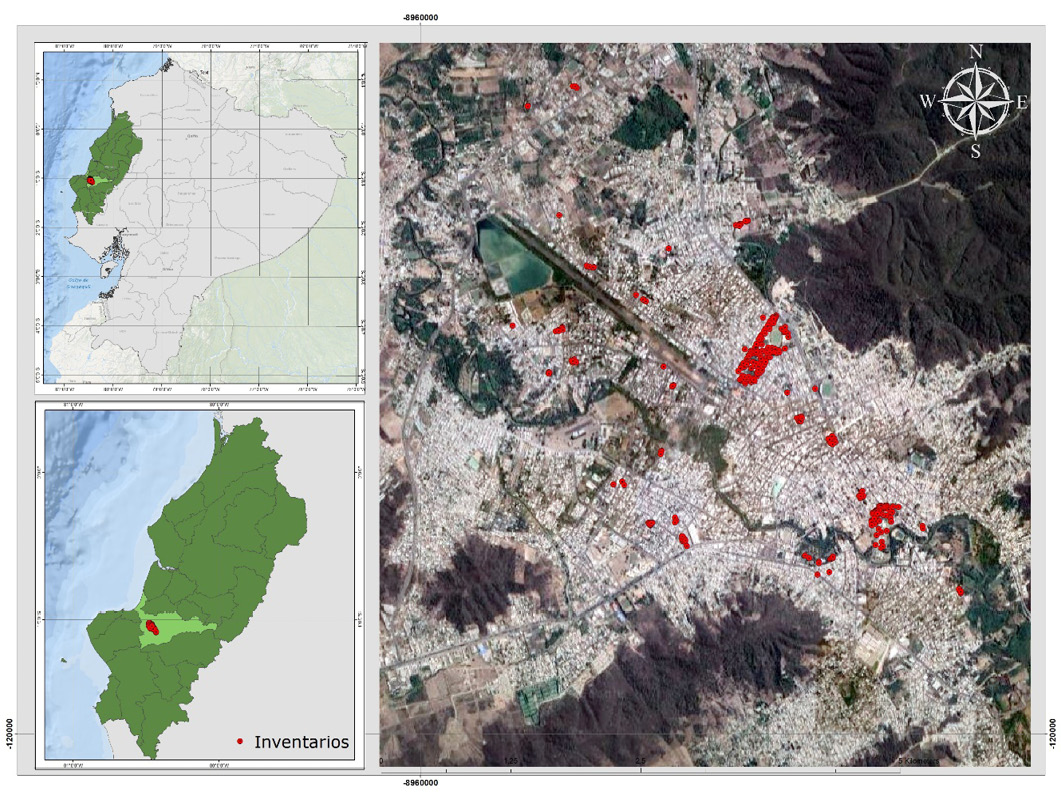
Location of the inventories to determine diversity of plants and gardens in the city of Portoviejo, Manabí, Ecuador.
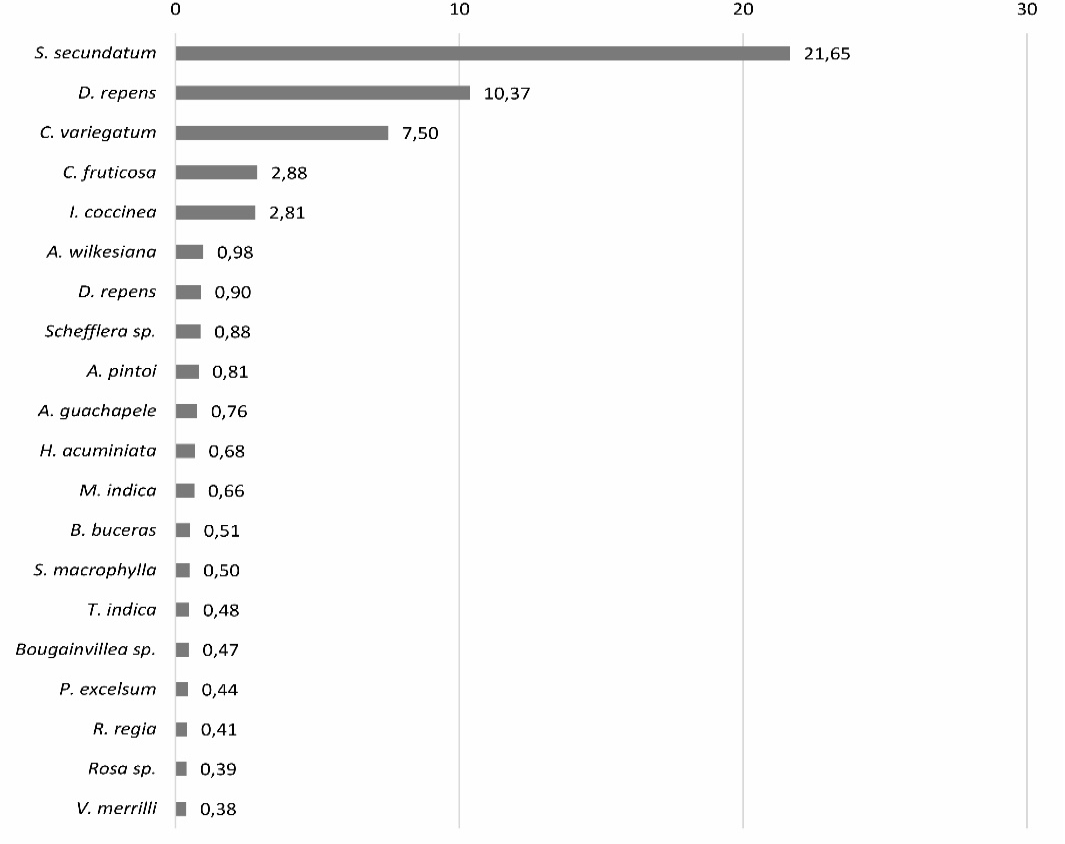
List of the 20 species with the highest total cover values calculated according to the Braun Blanquet methodology in green areas and
gardens in the city of Portoviejo, Manabí, Ecuador.
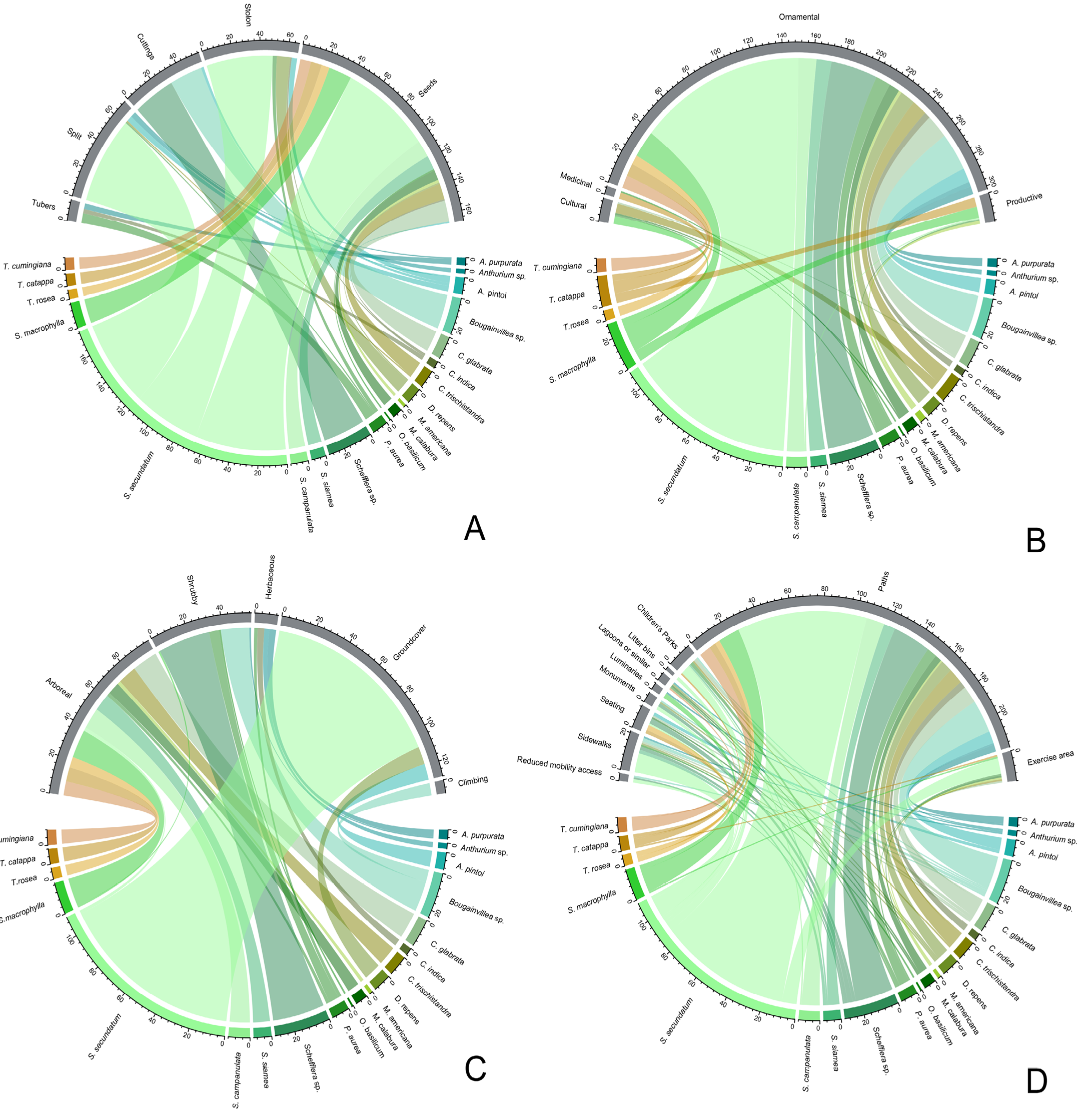
Main species used in green areas and gardens in the city of Portoviejo, Manabí, Ecuador, and their relationship with propagation
methods (A), growth habit (B), constructive element (C), and potential use (D).
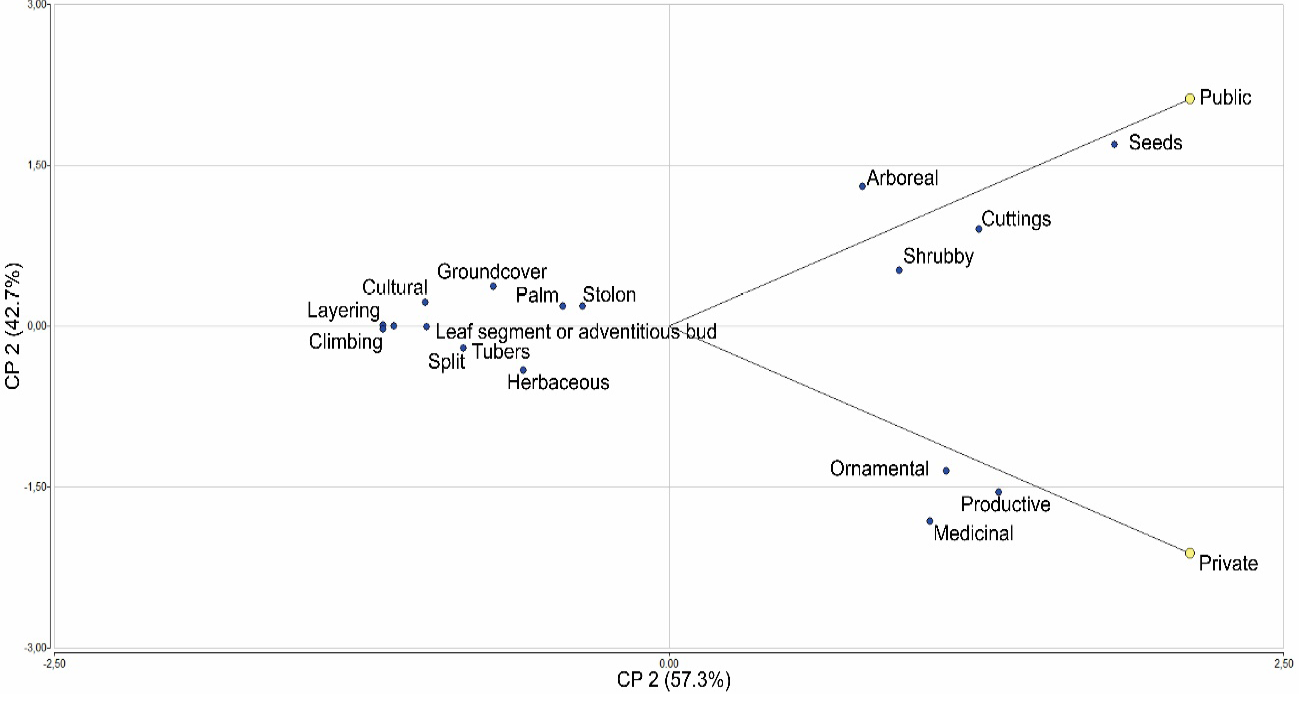
PCA for species characteristics versus the nature of the green area, in green areas and gardens in the city of Portoviejo, Manabí,
Ecuador.
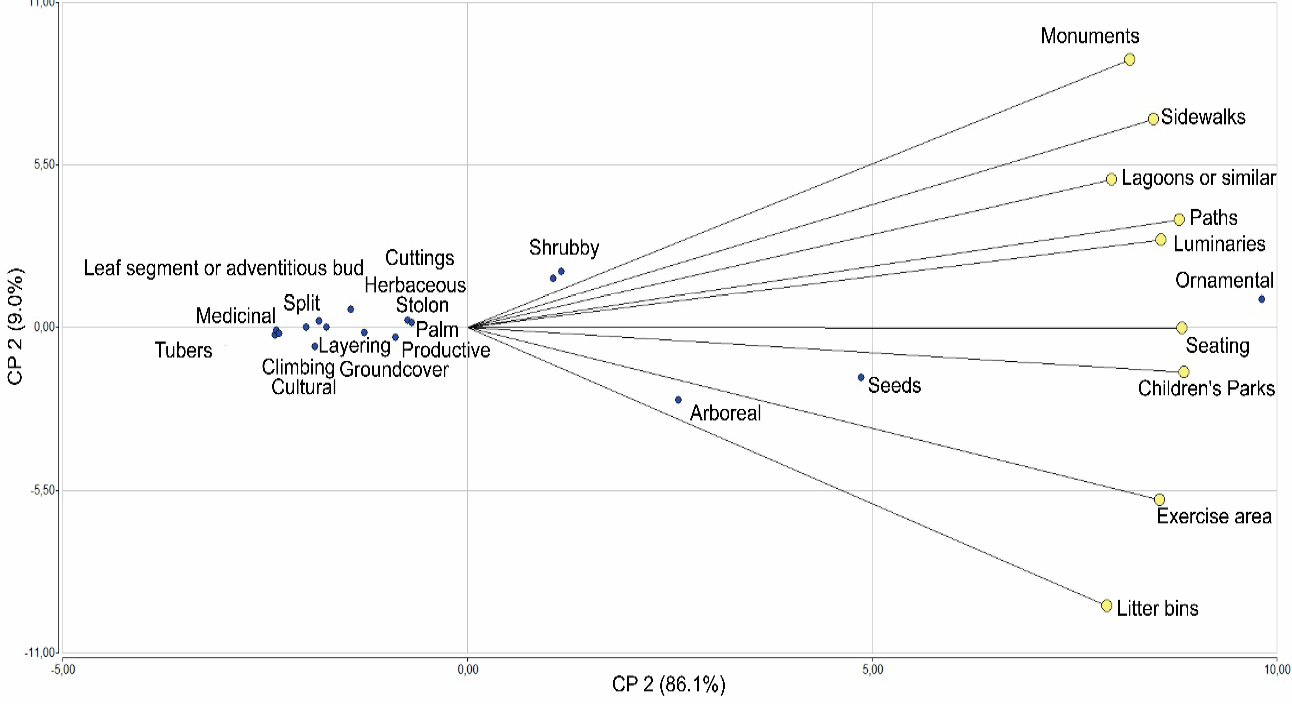
PCA for species characteristics versus construction elements. in green areas and gardens in the city of Portoviejo, Manabí, Ecuador.
References
- Acar, C., H. Acar and E. Eroğlu. 2007. Evaluation of ornamental plant resources to urban biodiversity and cultural changing: A case study of residential landscapes in Trabzon city (Turkey). Build. Environ., 42(1): 218-229. https://doi.org/10.1016/j.buildenv.2005.08.030[CrossRef]
- Alcaraz, F., M. Clemente, J. Barreña and R. Álvarez. 1999. Manual de teoría y práctica de Geobotánica. ICE Universidad de Murcia y Diego Marín. Murcia.
- Amaral, G.C., L.D.S. Brito, R.C. Avelino, J.V. da Silva Júnior and M.Z. Beckmann-Cavalcante. 2012. Seedlings production of Duranta repens L. using cuttings process. Revista de Ciências agrárias. 35(1): 134-142. http://www.scielo.mec.pt/pdf/rca/v35n1/v35n1a13.pdf
- Andrade, J.C., J. Cruz-Cárdenas and N.H. Oleas. 2021. Uso de especies nativas como plantas ornamentales en el Distrito Metropolitano de Quito. Cienci América, 10(2): 99-122. https://doi.org/10.33210/ca.v10i2.378[CrossRef]
- Braun-Blanquet, J., 1979. Fitosociología. Bases para el estudio de comunidades vegetales. Ed. Blume. Madrid.
- Busey, P., M.D. Casler and R.R. Duncan. 2003. St. Augustinegrass, Stenotaphrum secundatum (Walt.) Kuntze. Biology, breeding, and genetics of turfgrasses. John Wiley and Sons, Inc., Hoboken, New Jersey, pp. 309-330.
- Cabrera-Verdesoto, C.A., C.J. Ponce-Macías, C. Cantos-Cevallos, J.J Morán Morán and R.P. Cabrera-Verdezoto. 2020. Áreas verdes y arbolado en la zona urbana del cantón Jipijapa. Ciencia Y Tecnología. 13(2): 47–53. https://doi.org/10.18779/cyt.v13i2.392[CrossRef]
- Cabrera-Verdesoto, CA., L.E. Macías-Cedeño, K.A. Mieles-Segura, A. Jiménez-González and T.O. Manrique-Tóala. 2022. Áreas verdes y arbolado en la zona urbana del cantón Portoviejo, provincia de Manabí, Ecuador. Siembra, 9(1): e3380. https://doi.org/10.29166/siembra.v9i1.3380[CrossRef]
- Castillo-Ruperti, R.J., B. Rodríguez-Guerrero and K. Bravo-Meza. 2022. Fijación de carbono (CO2) del arbolado en los parques La Rotonda y La Madre, Manabí, Ecuador. Yachasun, 6(10): 8-21. https://doi.org/10.46296/yc.v6i10.0141[CrossRef]
- Cevallos, A., P. González, M. Asanza, D. Neill, D. Gutiérrez and L. Martínez. 2014. Flora de parques y avenidas de Latacunga. UTCiencia Ciencia y Tecnol. Servicio Del Pueblo. 1(1): 20-31.
- Chávez-García, E. and A. Galmiche-Tejeda. 2009. Mujer y agroecosistema: El papel del género en el manejo del huerto familiar en una comunidad del Plan Chontalpa, Tabasco, México. Rev. Bras. De Agroecol., 4(2).
- Di Rienzo, J.A., F. Casanoves, M.G. Balzarini, L. Gonzalez, M. Tablada and C.W. Robledo. 2020. InfoStat. Statistical software. Grupo Infostat FCA UNC, Córdoba, Argentina.
- FAO, 2014. Ciudades más Verdes en América Latina y el Caribe. Un informe de la FAO sobre la Agricultura Urbana y Periurbana en la Región y la agricultura. Organización de las Naciones Unidas para la Alimentación. Roma.
- Gabriel-Ortega, J., C. Castro, M. Manobanda, F. Ayón and P. López. 2017. Descripción morfológica y organoléptica de frutos de mango (Mangifera indica L.) cultivados en el cantón Jipijapa en Ecuador. J. Selva Andina Res. Soc., 8(2):145-154. https://doi.org/10.36610/j.jsars.2017.080200145[CrossRef]
- Gilman, E.F., 1999. Codiaeum variegatum. Florida Cooperative Extension Service, Institute of Food and Agricultural Sciences, University of Florida, USA.
- Gu, Z., L. Gu, R. Eils, M. Schlesner and B. Brors. 2014. Circlize implements and enhances circular visualization in R. Bioinformatics, 30: 2811-2812. https://doi.org/10.1093/bioinformatics/btu393[CrossRef]
- Hernández-Gallardo, D., R. Arencibia-Moreno, D. Linares-Girela, D.C. Murillo-Plúa, J.J. Bosques-Cotelo and M. Linares-Manrique. 2021. Condición nutricional y hábitos alimentarios en estudiantes universitarios de Manabí, Ecuador. Rev. Esp. Nutr. Comun., 27(1). https://dialnet.unirioja.es/servlet/articulo?codigo=7855078&orden=0&info=link
- Howell, C., 2008. Consolidated list of environmental weeds in New Zealand. DOC Research and Development Series, No.292. New Zealand.
- INEC, 2012. Índice Verde Urbano 2012. INEC. Quito.
- Junqueira A.H. and M. Peetz. 2017. Brazilian consumption of flowers and ornamental plants: Habits, practices, and trends. Ornament. Hortic., 23(2): 178-184. https://doi.org/10.14295/oh.v23i2.1070[CrossRef]
- Kendal, D., K.J. Williams and N.S. Williams. 2012. Plant traits link people’s plant preferences to the composition of their gardens. Landsc. Urban Plann., 105(1-2): 34-42. https://doi.org/10.1016/j.landurbplan.2011.11.023[CrossRef]
- Knapp, S., I. Kühn, V. Mosbrugger and S. Klotz. 2008. Do protected areas in urban and rural landscapes differ in species diversity? Biodiv. Conserv., 17(7): 1595-1612. https://doi.org/10.1007/s10531-008-9369-5[CrossRef]
- Lixin, W. and T. Li. 2010. Studies on the photosynthetic characteristics of 2 kinds of colorful plants. J. Anhui Agric. Sci., 38(2): 715-717.
- Maldonado, A., M. Ortiz and R. Dorado. 2004. Preparados galénicos e imágenes de plantas medicinales: una alternativa para promotores de salud en la reserva de la biósfera Sierra de Huautla. México. Centro de Educación Ambiental e Investigación Sierra de Huautla. México.
- McDonald, R.I., 2009. Ecosystem service demand and supply along the urban-to-rural gradient. J. Conserv. Plan., 5(5): 1-14.
- Melnichuk, I., T. Trubacheva, G. Tsymbal and T. Dvatsatova. 2020. To the analysis of qualitative indicators of plant vitality in assessing the value of urban green spaces. IOP Conf. Ser. Earth Environ. Sci., 574(1): 012052. https://doi.org/10.1088/1755-1315/574/1/012052[CrossRef]
- Monje, R., 2006. Manejo de céspedes con bajo consumo de agua. Jardinería y floricultura, Consejería de Agricultura y Pesca, Sevilla, España.
- Morales-Cerdas, V., L.P. Castro, M.R. Vargas and T.B. Rojas. 2018. Environmental indicators of urban green areas for management in two cities of Costa Rica. Rev. Biol. Trop., 66(4): 1421-1435. https://doi.org/10.15517/rbt.v66i4.32258[CrossRef]
- Odusanya, T.I., C.O. Owolabi, O.M. Olosunde, G.J. Bodunde and J.N. Odedina. 2020. Propagation and seedling growth of some species used as ornamental hedges in landscape design. Ornament. Hortic., 25(4): 383-389. https://doi.org/10.1590/2447-536x.v25i4.2053[CrossRef]
- Ogunkunle, C., S. Oyedeji, I.F. Adeniran, K.S. Olorunmaiye and P.O. Fatoba. 2019. Thuja occidentalis and Duranta repens as indicators of urban air pollution in industrialized areas of southwest Nigeria. Agric. Conspect. Sci., 84(2): 193-202.
- ONU, 2014. La situación demográfica en el mundo, 2014. Informe conciso. Departamento de asuntos económicos y sociales. División de población. Nueva York, Estados Unidos.
- Ortega-Bravo, B.H., O.V. Briones-Ordóñez, L.M. Campoverde-Tabara and N.P. Ríos-Mera. 2020. Espacios verdes que caracterizan el paisaje natural del Campus Central de la UTM en la Ciudad de Portoviejo. Polo del Conocimiento. 5(5): 333-344.
- Padilla, I. and M. Asanza. 2001. Árboles y arbustos de Quito. Herbario Nacional del Ecuador. Quito, Ecuador.
- Popay, I., 2022. Stenotaphrum secundatum (buffalo grass). CABI Compendium.
- R Core Team, 2020. R: A language and environment for statistical computing. R Foundation for Statistical Computing, Vienna Austria. URL https://www.R-project.org/.
- Rendón-Correa, A. and R. Fernández-Nava. 2007. Plantas con potencial uso ornamental del estado de Morelos, México. Polibotánica, (23): 121-165. https://www.scielo.org.mx/scielo.php?script=sci_arttext&pid=S1405-27682007000100121
- Reyes-Paecke, S. and L. Meza. 2011. Residential gardens of Santiago, Chile: extent, distribution and vegetation cover. Rev. Chilena Hist. Nat., 84(4): 581-592. https://doi.org/10.4067/S0716-078X2011000400010[CrossRef]
- Robbins, P., A. Polderman and T. Birkenholtz. 2001. Lawns and toxins: An ecology of the city. Cities, 18(6): 369-380. https://doi.org/10.1016/S0264-2751(01)00029-4[CrossRef]
- Rodríguez, R., 2007. Un acercamiento al paisaje urbano. Arquitect. Urbanismo, 28(3): 28-31.
- Rosenzweig, M.L., 1995. Species diversity in space and time. Cambridge University Press. https://doi.org/10.1017/CBO9780511623387[CrossRef]
- Sarmiento, L., I. Pérez-Almeida, B. Díaz, H. Álvarez and W. Viera. 2017. Molecular marker-based characterization of Ecuadorian dry forest tamarind plus trees. Bioagro, 29(3): 153-162. https://ve.scielo.org/scielo.php?script=sci_arttext&pid=S1316-33612017000300001
- Sauer, J.D., 1972. Revision of Stenotaphrum (Gramineae: Paniceae) with attention to its historical geography. Brittonia, 24(2): 202-222. https://doi.org/10.2307/2805871[CrossRef]
- Smith, R.M., K. Thompson, J.G. Hodgson, P.H. Warren and K.J. Gaston. 2006. Urban domestic gardens (IX): composition and richness of the vascular plant flora, and implications for native biodiversity. Biol. Conserv., 129(3): 312-322. https://doi.org/10.1016/j.biocon.2005.10.045[CrossRef]
- Smith, R.M., K.J. Gaston, P.H. Warren, K. Thompson. 2005. Urban domestic gardens (V): relationships between landcover composition, housing and landscape. Landsc. Ecol., 20: 235–253. https://doi.org/10.1007/s10980-004-3160-0[CrossRef]
- Sorensen, M., V. Barzett, K. Keipi and J. Williams. 1998. Manejo de las áreas verdes urbanas: documentos de buenas prácticas. Banco Interamericano de Desarrollo, No. ENV–109, Washington. https://doi.org/10.18235/0010248[CrossRef]
- Tan, P.Y., J. Wang and A. Sia. 2013. Perspectives on five decades of the urban greening of Singapore. Cities, 32: 24-32. https://doi.org/10.1016/j.cities.2013.02.001[CrossRef]
- Trenholm, L., M. Schiavon, J. Unruh, T. Shaddox, K. Kenworthy, C.F. Balerdi and H. Mayer. 2021. La Grama St. Augustine Para Patios De Florida: EP552/ENH1288, 9/2021. Environ. Hortic. Dep., 2021(5). https://doi.org/10.32473/edis-ep552-2021[CrossRef]
- Tzoulas, K., K. Korpela, S. Venn, V. Yli-Pelkonen, A. Kaźmierczak, J. Niemela and P. James. 2007. Promoting ecosystem and human health in urban areas using green infrastructure: A literature review. Landsc. Urban Plann., 81(3): 167-178. https://doi.org/10.1016/j.landurbplan.2007.02.001[CrossRef]
- Van der Burg, J., J. De Freitas and D. Debrot. 2014. Seed germination methods for native Caribbean trees and shrubs. with emphasis on species relevant for Bonaire. Plant Research International, part of Wageningen UR, Business Unit Agrosystems Research, Report 551. Wageningen Campus, Droevendaalsesteeg 1, Wageningen, The Netherlands.
- Vélez, L. and M. Herrera. 2015. Jardines ornamentales urbanos contemporáneos: Transnacionalización, paisajismo y biodiversidad. Un estudio exploratorio en Medellín, Colombia. Rev. Fac. Nacional Agron. Medellín, 68(1): 7557-7568. https://doi.org/10.15446/rfnam.v68n1.47844[CrossRef]
- Wolch, J.R., J. Byrne and J.P. Newell. 2014. Urban green space, public health, and environmental justice: The challenge of making cities just green enough. Landsc. Urban Plann., 125: 234-244. https://doi.org/10.1016/j.landurbplan.2014.01.017[CrossRef]
- Zambrano-Jaime, T., P. Peñafiel-Villarreal and O. Quiñonez-Loor. 2020. Análisis de la Diversidad de la Avifauna en Tres Parques Urbanos de Guayaquil. Investigatio. 13: 25-40. https://doi.org/10.31095/investigatio.2020.13.3[CrossRef]
Services
Article usage statistics
Loading…