
A total of 67 samples of Ropalida brevita were collected from District Abbottabad, Pakistan during 2011 to 2013. Species was confirmed by taxonomic key, which are belonging to subfamily of Polistinae. Phylogenetic tree were reconstructed using 12 SrRNA (12S) gene showing homology of 73% compared with gene bank data while on the basis of cytochrome oxidase 1 (Co1) gene 93% homology were recorded. It was concluded that Co1 gene is more reliable than 12S rRNA gene for confirmation of R. brevita position in the Vespidae family.
Short Communication · Volume 49, Issue 4, 30 July 2017 · Open Access
Phylogenetic Reconstruction of Ropalida brevita (Vespidae: Polistinae) using 12S rRNA and Cytochrome Oxidase 1 (Co1) Genes
· · · ·
Affiliations & Notes ⌄
- 1Department of Zoology, Hazara University, Mansehra-21300, Pakistan 2National Insect Museum, Department of Plant and Environmental Protection, NARC, Islamabad, Pakistan 3Department of Genetics, Hazara University, Mansehra-21300, Pakistan 4Division of Invertebrate Zoology, Richard Gilder Graduate School, American Museum of Natural History, New York NY-10024, USA , * Corresponding author: muzafarphd@hotmail.com
Article Info ⌄
- Journal:
- Pakistan Journal of Zoology
- Published:
- 30 July 2017

From the article
- The results also show the genetic diversity of Ropalida brevita in the tree with 0.116 on 12S rRNA, while 0.067 on Co1 locus (Fig. 2).
- Ropalida brevita was collected from three localities Ayubia, Havelian and Kakul of Abbottabad district and identified at species level representing first time reported from Abbottabad belonging from genus Ropalidii, Subfamily Polistinae, family Vespidae.
- Genus Polistes Latrielle is the only genus under tribe Polistinii with its 200 species worldwide.
- So this study confirms that this oriental region is the origin source from where these species evolved.
Selected from the article's own text.
Abstract
Materials and methods
Wasp collection were carried out during the active season of 2011 to 2013 from district Abbottabad by aerial net from fields, gardens and other vegetation and preserved in 95% ethanol. Specimens were identified up to species level with the help of stereoscope (Labomet CZM4-4X) by running them through keys (i.e. ; . Isolation of DNA from dried wasps was carried out by using Qiagen kit with spin columns with modification in the procedure provided by the company.
The isolated DNA was used as template and 12s and Cytochrome oxidase (Co1) primers were used for amplification of target gene. The PCR results were verified on agarose gel. Data was analyzed by software “DNAMAN” version 5.2.2.0.
Results and discussion
Collected samples were identified up to species level with help of available literature. Results of the PCR amplified product for 12S rRNA with 430bp whereas Co1 locus shows 650bp. Homology during the comparison of Ropalida brevita species using 12S rRNA gene and Cytochrome oxidase 1 (Co1) showing their position in the homology tree was constructed, where it showing its position in subfamily Polistinae 93% on Co1, 77% on 12SrRNA locus with clear position of the genera Ropalidii from Polistes (Fig. 1). The results also show the genetic diversity of Ropalida brevita in the tree with 0.116 on 12S rRNA, while 0.067 on Co1 locus (Fig. 2).
Ropalida brevita was collected from three localities Ayubia, Havelian and Kakul of Abbottabad district and identified at species level representing first time reported from Abbottabad belonging from genus Ropalidii, Subfamily Polistinae, family Vespidae. The species of subfamily Polistinae mostly found in tropical regions, cosmopolitan in distribution with more than 900 species under 29 genera world-wide ; . Genus Polistes Latrielle is the only genus under tribe Polistinii with its 200 species worldwide. It is Palearctic and Afrotropical genus but also occurs in Oriental Region. Polistes gallicus, was reported by Das and Gupta (1989) from Pakistan and India. Gusenleitner (2007) reported this species from Jaglot and Ghizar valley. Later, Aziz (2008) and Mahmood et al. (2012) reported this species from Skardu; while, Faiz (2012) reported this specie from Gilgit (Jaglot, Jalal Abad), Ghizer and Hunza-Nagar. According to Santos et al. (2014), Polistes first evolved in Southeast Asia and 2nd that dispersal to the New World occurred only once, and 3rd that long-term monogyny evolved as an adaptation to overwintering in a temperate climate. So this study confirms that this oriental region is the origin source from where these species evolved.
Acknowledgements
Authors are thankful to National Insect Museum, NARC Pakistan and American Museum of Natural History New York, USA for providing Lab facilities.
Statement of conflict of interest
Authors have declared no conflict of interest.
Figures
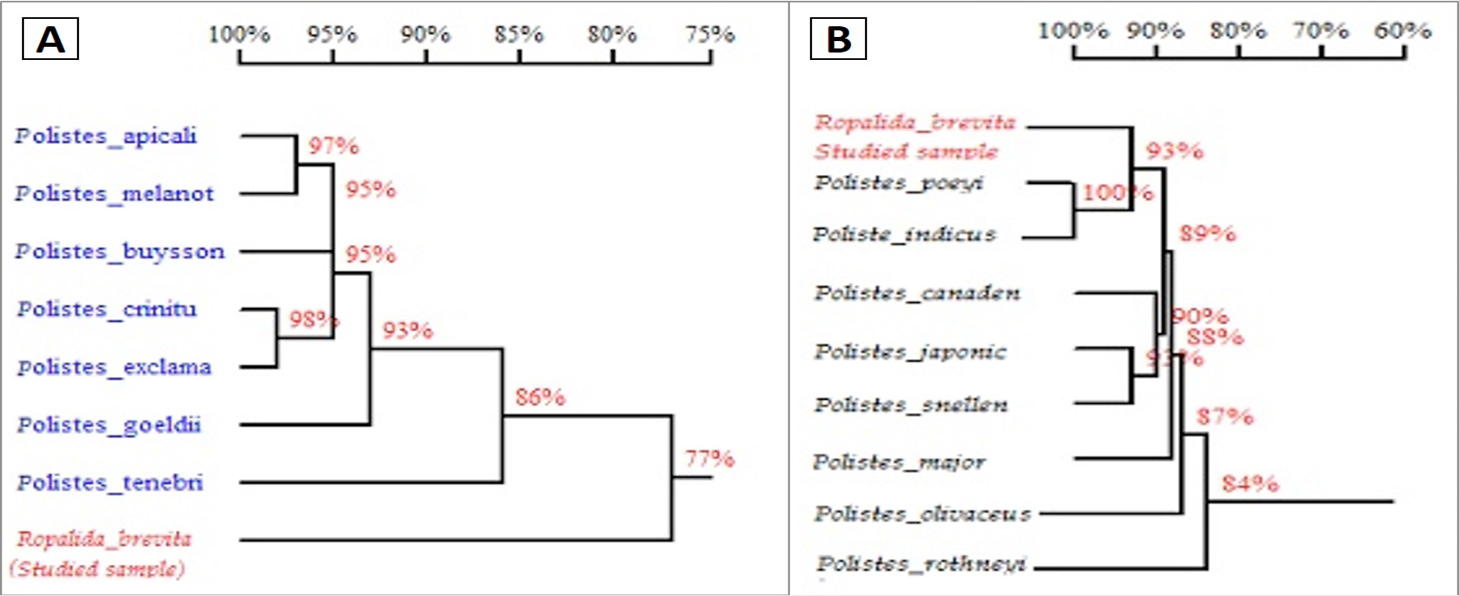
Homolgy tree based on partial sequences of 12SrRNA locus (A) and cytochrome oxidase (Co1) gene (B) by using DNAMAN software version 5.2.2.
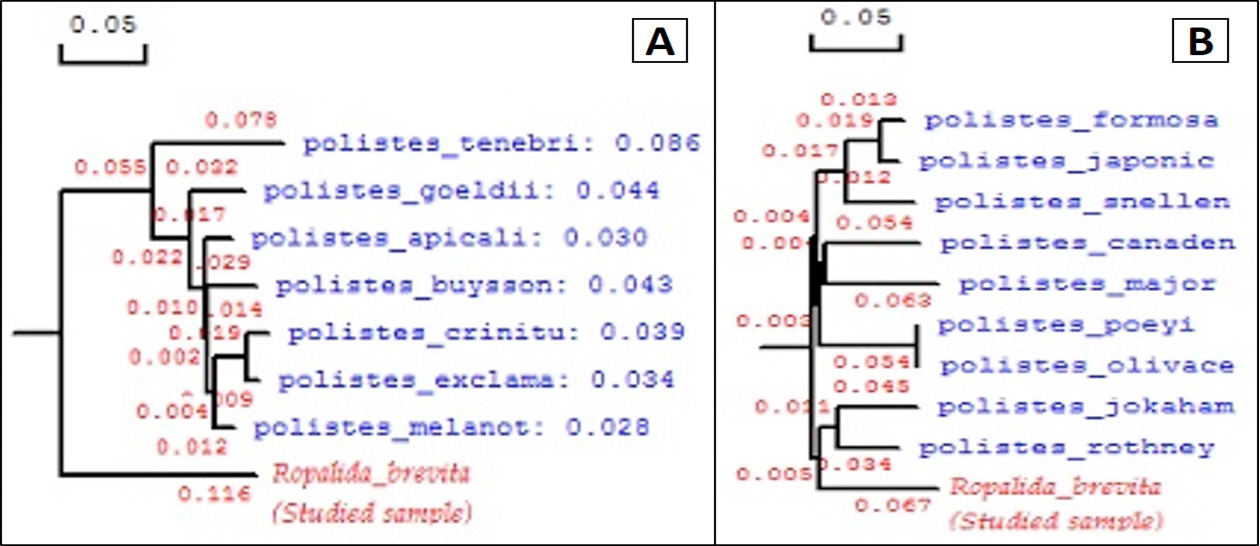
DNA sequences analysis of Ropalida brevita for 12S rRNA locus (A) and cytochrome oxidase (Co1) gene (B) aligned with other species of subfamily Polistinae.
References
- Abbasi, R., Pashaei, R.S. and Ebrahimi, E., 2006. New record for the fauna of Vespid wasps of Iran, Proceedings of 17th Iranian Plant Protection Congress, pp. 1-62.
- Aziz, A., 2008. Vespidae (Hymenoptera) of NWFP, Pakistan. M.Sc. thesis, Khyber Pakhtunkhwa Agricultural University, Peshawar, Pakistan, pp. 1-42.
- Bodlah, I., Naeem, M., Khan, M.R., Bodlah, M.A. and Akhter, T., 2012. Pakistan J. Zool., 44: 759-764.
- Carpenter, J.M., 2003. Ent. Sci., 6: 183-192. https://doi.org/10.1046/j.1343-8786.2003.00016.x[CrossRef]
- Carpenter, J.M. and Rasnitsyn, A.P., 1990. Psyche Camb. Mass., 97: 1-20. https://doi.org/10.1155/1990/67312[CrossRef]
- Chaudhry, G.U., Chaudhry, M.I. and Khan, S.M., 1966. Survey of insect fauna of forests of Pakistan. Pakistan Forest Institute, Peshawer, pp. 1-167.
- Das, B.P. and Gupta, V.K., 1989. Orient. Insect. Monogr., 11: 1-292.
- Dubatolov, V.V. and Milko, D.A., 2004. Ent. Sci., 7: 63-71. https://doi.org/10.1111/j.1479-8298.2003.00042.x[CrossRef]
- Dvorak, L., 2007. Linzer biol. Beitr., 39: 51-55
- Ebrahimi, E. and Carpenter, J.M., 2008. Zootaxa, 1785: 1-42.
- Faiz, A., 2012. Wasp fauna (Hymenoptera: Vespidae) of Gilgit-Baltistan. M. Phil thesis, Department of Plant and Environmental Protection, PARC, Institute of Advanced Studies in Agriculture, Khyber Pakhtunkhwa Agricultural University, Peshawar, Pakistan, pp. 1-65.
- Fateryga, A.V., 2009. Ent. Rev., 9: 698-705.
- Goulet, H. and Huber, J.T., 1993. Hymenoptera of the world: An identification guide to the families. Canada Communication Group, Ottawa, pp. 1-668.
- Grinfeld, E.K., 1977. Ent. Obozr., 56: 34-42.
- Gusenleitner, J., 2006. Linzer biol. Beitr., 38: 1295-305.
- Gusenleitner, J., 2007. Linzer biol. Beitr., 39: 969-972.
- Gusenleitner, J., 2008. Linzer biol. Beitr., 40: 1495-503.
- Hunt, J.H., Brown, P.A., Sago, K.M. and Kerker, J.A., 1991. J. Kansas ent. Soc., 64: 127-130.
- Kojima, J., Kishore, L., Nguyen, L.T.P. and Fuki, S., 2007. Ent. Sci., 10: 373-393. https://doi.org/10.1111/j.1479-8298.2007.00237.x[CrossRef]
- Mahmood, K., Ullah, M., Aziz, A., Hasan, S.A. and Inayatullah, M., 2012. Zootaxa, 3318: 26-50.
- Perveen, F. and Shah, M., 2013. Int. J. Insect Sci., 5: 1-8. https://doi.org/10.4137/IJIS.S10737[CrossRef]
- Richter, M.R., 1990. Ecology, 71: 1018-1030. https://doi.org/10.2307/1937370[CrossRef]
- Santos, B.F., Paynea, A., Kurt, M.P. and Carpenter, J.M., 2014. Cladistics, 31: 535–549. https://doi.org/10.1111/cla.12103[CrossRef]
- Shah, M., Khan, M.S., Rafi, M.A. and Mehmood, S.A., 2013. Int. J. Biosci., 3: 80-86. https://doi.org/10.12692/ijb/3.3.108-114[CrossRef]
- Shah, M., 2015. Biosystematics of wasps species (Hymenoptera: Vespidae) of Hazara Region, Khyber Pakhtunkwa, Pakistan. Ph.D thesis, Department of Zoology, Hazara University Mansehra, Pakistan, pp. 1-142.
- Siddiqui, J.A., Bodlah, I., Carpenter, J.M., Naeem, M., Ahmad, M. and Bodlah, M.A., 2015. Zootaxa, 3914: 501-524. https://doi.org/10.11646/zootaxa.3914.5.1[CrossRef]
- van der Vecht, J., 1966. Zool. Verh., 82: 1-42.
- Walton, G.M. and Reid, G.M., 1976. N.Z. Beekeep., 38: 26-30.
Services
Article usage statistics
Loading…