Research Article · Volume 14, Issue 10, 23 September 2026 · Open Access
Phenotypic and Morphometric Characterization of Local Pig Breeds (Sus scrofa domesticus) in Côte d’Ivoire
· · ·
Affiliations & Notes ⌄
1Laboratoire de Biologie et Cytologie Animale UFR Sciences de la Nature-Université Nangui Abrogoua, 02 BP 801 Abidjan 02, Côte d’Ivoire
2Laboratoire d’Amélioration Génétique et Bioressources UFR Sciences de la Nature-Université Nangui Abrogoua, 02 BP 801 Abidjan 02, Côte d’Ivoire. *Correspondence | Yao Koffi Narcisse Konan, Laboratoire de Biologie et Cytologie Animale UFR Sciences de la Nature-Université Nangui Abrogoua, 02 BP 801 Abidjan 02, Côte d’Ivoire
The absence of a significant difference in the proportions of males and females between Agnéby-Tiassa and Iffou suggests similar herd management practices in both regions.
The morphometric analyses show that for certain morphometric parameters, pigs from Iffou exhibit significantly higher values compared to pigs found in Agnéby-Tiassa.
Local pigs in Côte d’Ivoire exhibit significant phenotypic and morphometric variability, influenced by region, sex, and their interaction.
While some typical characteristics of local African pigs are preserved, the diversity of coat colors and hair texture indicates crossbreeding pressure with exotic breeds.
Selected from the article's own text.
Abstract
Local pig populations in Côte d’Ivoire remain poorly documented despite their importance to smallholder farming systems. This study provides the first formal phenotypic and morphometric characterization of local pigs from two agro-ecological regions: Agnéby-Tiassa (southern forest zone) and Iffou (central-eastern transition zone). A total of 324 pigs at least 12 months old (261 females, 63 males) were examined, and 155 individuals were measured for 10 morphometric traits following FAO guidelines. Coat color varied considerably, with solid coats being most common (64.85% in Agnéby-Tiassa, 54.72% in Iffou). Ears were predominantly semi horizontal (71.52% in Agnéby-Tiassa, 76.73% in Iffou), and all pigs exhibited straight tails. Two-way ANOVA revealed significant regional differences, with pigs from Iffou being heavier (25.55 ± 12.60 kg vs. 22.40 ± 13.17 kg) and having greater body length (61.70 ± 13.17 cm vs. 52.49 ± 10.67 cm) than those from Agnéby-Tiassa. Sex also significantly influenced most parameters (P < 0.001), with females showing higher values. Multivariate analyses, including principal component analysis (PCA), hierarchical ascending classification (HAC), and discriminant function analysis (DFA), identified three distinct morphotypes correlated with geographic area, though considerable overlap existed between groups. Live weight, body length, and chest girth were the most discriminating parameters. Despite phenotypic variability structured by region and sex, local pigs show signs of crossbreeding while preserving several typical traits. Therefore, molecular characterization is needed to guide conservation and genetic improvement strategies.
Keywords | Sus scrofa domesticus, Local pig, Morphometry, Phenotype, Animal genetic resources, Morphotypes
INTRODUCTION
The characterization of animal genetic resources is the set of processes capable of providing historical, phenotypic, and molecular information concerning a given animal population (FAO, 2013). Furthermore, characterization is the preliminary work that enables informed decisions to be made regarding the value (conservation and improvement) of a livestock resource for its optimal use by current and future generations. The objective of the genetic characterization of an animal resource is to gain a thorough understanding of it for feeding and breeding programs aimed at sustainable use . Livestock genetic resources play a critical role in food security and rural livelihoods across sub-Saharan Africa. Among these, local pig populations are particularly valued for their adaptability to harsh environments, tolerance of low-quality feed, and disease resistance (FAO, 2013). In Côte d’Ivoire, pigs are an important component of smallholder farming systems, providing both income and a source of animal protein. Despite their importance, however, the phenotypic characteristics of Ivorian local pig populations have never been formally described. While several studies have characterised local pig populations in neighboring West African countries including Benin ; , Burkina Faso , Ghana ; , and Nigeria no equivalent baseline data exist for Côte d’Ivoire. This knowledge gap is problematic for several reasons. First, without basic phenotypic descriptions, it is impossible to monitor genetic erosion or identify populations of conservation value. Second, breeding programs cannot be rationally designed without understanding the existing phenotypic diversity. Understanding the phenotypic characteristics of local pigs is also important for improving production. While local pigs are reported to have relatively low growth rates and small mature body sizes compared to commercial breeds ; ; ; FAO, 2013), they are valued by many farmers for their hardiness, low purchase price, adaptability to local conditions, and ability to utilise agricultural waste and foraged plants ; . However, these assertions have not been systematically documented in Côte d’Ivoire, and the specific adaptive traits of local populations remain unexplored. This lack of information on local pig breeds could be explained by the fact that local pig production is based primarily on a traditional, family-run farming system where herd management relies on two methods: free-range and confinement. Moreover, this production method strongly influences the performance of these animals . The overarching aim of this work is to generate reference data for conservation planning, guide breeding strategies, and promote further investigation into the genetics and productivity of indigenous Ivorian pigs, in response to the mounting pressure exerted by crossbreeding with commercial breeds. Specifically, it aims to describe the phenotypic characteristics of local pigs in the Agnéby-Tiassa and Iffou regions, measure and compare ten morphometric traits between the two regions and identify distinct morphotypes within the local pig population using multivariate analyses.
MATERIALS AND METHODS
Study area
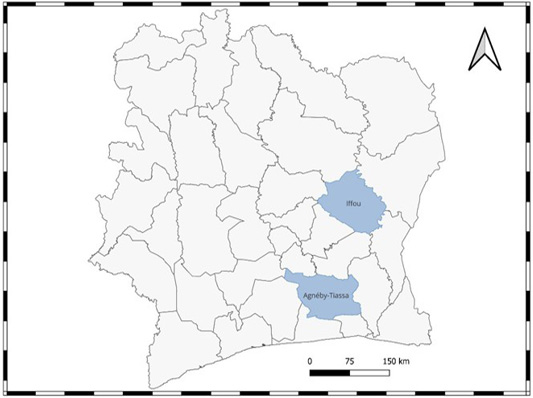
The study was conducted in two regions of Côte d’Ivoire selected for their contrasting agro-ecological characteristics (Figure 1).
Agnéby-Tiassa, located in the southern forest zone approximately 35 km north of Abidjan (5°30’-6°00’N, 4°00’-4°30’W). The region experiences a humid tropical climate (Attiéen type) characterized by mean annual temperatures of 25-27 °C and annual rainfall of 1,500-2,000 mm, with a bimodal distribution (two rainy seasons). The vegetation is predominantly dense tropical forest, and the main agricultural activities include cocoa, coffee, oil palm, and food crop production.
Iffou, located in the central-eastern transition zone 235 km from Abidjan (7°15’00”N, 3°52’00”W). The region experiences a hot and humid tropical climate (Baouléan type) with mean annual temperatures of 26-28°C and annual rainfall of 1,200-1,500 mm, with a unimodal distribution (one rainy season). The vegetation is a mosaic of forest and savanna, and agricultural activities include yam, cassava, maize, and cotton production.
These two regions were selected because they represent distinct agro-ecological conditions that might influence pig morphology, and because they have significant local pig populations. Within each region, villages with substantial pig populations were purposively selected based on consultations with local agricultural extension officers.
Biological and technical materials
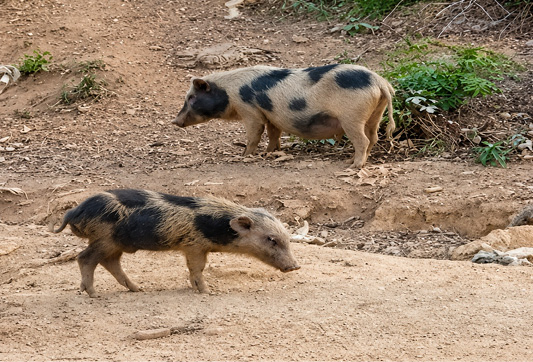
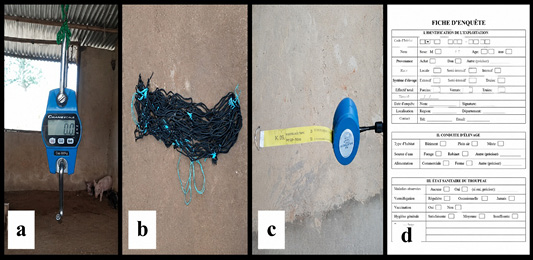
The biological material consisted of 324 local breed pigs, aged at least 12 months (Figure 2), of which 155 individuals (78 from Agnéby-Tiassa and 77 from Iffou) were captured and measured selected from 12 villages (7 villages in Iffou and 5 villages in Agnéby-Tiassa). The technical equipment (Figure 3) comprised a 300 kg capacity digital scale with 0.05 kg precision for weighing the animals, a net to restrain the animals during weighing, and a measuring tape for morphometry characterization. In addition, a data collection sheet was used to collect information from the sampled farmers.
Materials and Methods
Data collection was based on the Food and Agriculture Organization of the United Nations protocol for the phenotypic characterization of animal genetic resources (FAO, 2013).
Sampling strategy
A preliminary survey was first carried out in order to identify or locate the areas where pigs are found. Indeed, due to conflicts between livestock farmers and crop farmers over the damage caused by stray pigs, several villages have decimated their local pig populations. Furthermore, during this process, we met with the farmers to arrange for the animals to be enclosed if they had such facilities for the purpose of taking measurements, since most of the animals are free-roaming. Thus, using a survey form, animals from twelve villages including 7 villages in the Iffou region, with 11 animals per village, and 5 villages in the Agnéby-Tiassa region, with 15 animals per village were described and measured. Within each village, pigs were selected using a stratified random sampling method, based on the following criteria: (1) being at least 12 months old, (2) being in apparent good health, (3) showing no visible deformities or injuries, and (4) being representative of the local pig population as described by the farmers. Farmers were asked to pen their free-range pigs so that measurements could be taken, and only pigs from cooperating farms were included. The sample size, ranging from 11 to 15 animals per village, was determined on the basis of FAO Guidelines (2013), which recommend at least 10 to 15 animals per sampling unit for phenotypic characterization, with a sex ratio of one (01) male to ten (10) females. A total of 324 local pigs aged at least 12 months were examined to determine their qualitative traits (coat colour, ear type, tail type, coat characteristics). Of these, 155 animals (78 from Agnéby-Tiassa, 77 from Iffou) were randomly selected for detailed morphometric measurements. The sample comprised 32 males and 123 females. The assessment was carried out in consultation with local breeders, who also provided information on the animals’ approximate age based on their recollections. However, precise dates of birth were not available for most of the animals, and age was not used as a covariate in the statistical analyses, which constitutes a significant limitation.
Phenotypic parameters
In the case of phenotypic traits, the pigs were described on the basis of direct observation. The qualitative phenotypic characteristics described were related to hair (curly, straight, short, long, dense, sparse), the shape of the snout (long and thin, short and cylindrical), the pattern of the coat (solid, piebald, spotted), the color of the coat (white, black, dark red, light red, fawn, grey), the profile of the head (concave, straight and convex), the type of ear (drooping, semi-erect, erect), the orientation of the ear (forward, backward, upward), the ear shape (measure the length or categorize it as large, medium, or small), the type of skin (smooth, wrinkled), the type of tail (straight, twisted), the backline (straight, swayback, concave).
Morphometric measurements
The body measurements were obtained using a Animal Weigh Tape. The data collection process was conducted in accordance with the procedures outlined by (FAO, 2013). The animals were maintained in a standing position on all fours throughout the duration of the measurements. The aforementioned measurements were conducted by the same operator on all animals. The body measurements were body weight (animal’s weight on the scale, without fasting), body length (linear distance from the shoulder tip to the tail base), head length (linear distance from the snout tip to the back of the skull), snout length (distance from the nose tip to the eye level), snout circumference (snout circumference measured at its widest point), tail length (distance from the tail base to its tip), ear length (distance from the ear base to its tip), chest girth (chest circumference measured just behind the forelegs), and height at withers (height from the ground to the top of the shoulders).
Statistical analyses
The collected data were stored in Excel files to form a database for statistical analyses. Using Excel, XLSTAT and R version 4.5.0 software, basic statistical parameters such as the arithmetic mean, standard deviation (SD), minimum (Min), and maximum (Max) values were calculated to describe the morphometric characteristics of the sampled pigs. A Shapiro-Wilk normality test was first performed to verify whether the samples followed a normal distribution. A two-way analysis of variance (ANOVA) with region, sex, and their interaction as fixed effects was performed to compare populations between locations and sexes . The mathematical model is as follows:
Y = μ + Rᵢ + Sⱼ + RSᵢⱼ + εᵢⱼₖ
Where; Yijk: the measure of pig k, region i and sex j; μ: the value of the overall mean; Ri: fxed effect of region i (Agnéby-Tiassa and Iffou); Sj: fxed effect of sex j (male and female); RSij: interaction between region i and sex j of the animal; εijk: random residual effec
Post-hoc comparisons were conducted using Tukey’s HSD test for pairwise differences (indicated by superscript letters a, b, c in the tables).
Bonferroni correction
For the 30 variables tested simultaneously, the Bonferroni-corrected significance level was set at α = 0.00167 (0.05/30). In the results, * indicates P < 0.05, ** indicates P < 0.001, and *** indicates P < 0.0001. Effects that remained significant after Bonferroni correction are indicated in the tables.
Multivariate statistical analyses such as principal component analysis (PCA), hierarchical ascending classification (HAC), and discriminant factor analysis (DFA) were also carried out. According to Ramousse et al. (1996), factorial methods are designed to measure the similarity between individuals or variables, to group them according to these similarities, to order them in a reduced space in order to highlight structures, to establish relationships between data sets, and to test these relationships.
RESULTS
Qualitative traits
Proportion of animals sampled by sex
Analysis of phenotypic parameters revealed a clear dominance of females in the total population, with 261 females against 63 males, representing 80.56% females in the two study areas (Table 1).
Coat color and hair characteristics
The results concerning coat-related characteristics are recorded in Table 2. The solid type predominates in the overall population with 61.42%, followed by the spotted type (33.02%) and the piebald type (5.56%). However, a slight inter-zone difference was noted (64.85% in Agnéby-Tiassa compared to 57.86% in Iffou). The spotted pattern is more frequent in Iffou (35.22%) than in Agnéby-Tiassa (30.91%). Regarding coat color, white is the most represented with 44.27% of the total population, followed by black (16.10%), white with black spots (14.86%), and light brown with black spots (6.81%). Other colors are less common, with frequencies ranging from 0.31% to 5.26%. The appearance of the hairs revealed marked heterogeneity between the two regions. In Agnéby-Tiassa, straight, short, and sparse hair is predominant (47.88%), while in Iffou, straight, long, and dense hair predominates (37.74%). The total population shows a relatively balanced distribution among the four categories: long and dense (34.26%), short and sparse (32.72%), long and sparse (16.98%), and short and dense (16.05%).
Table 1: Proportion of animals according to sex.
Parameter
Variables
Agnéby- Tiassa
Iffou
Agnéby- Tiassa + Iffou
N
(%)
N
(%)
N
(%)
Sex
Female
133
80.61
128
80.50
261
80.56
Male
32
19.39
31
19.50
63
19.44
Head and ear characteristics
The phenotypic characteristics related to the head are presented in Table 3. The head profile is predominantly straight, representing 78.40% of the animals, while the convex profile is found in only 21.60% of the population. The shape of the snout also showed notable inter-zone differences. The long, cyclo-conical snout is dominant in the Agnéby-Tiassa region (66.67%), while in the Iffou region, the short, cyclo-conical snout prevails (44.65%). In the population as a whole, the long, cyclo-conical snout remains the most common (54.01%), followed by the short, cyclo-conical snout (33.02%) and the long, slender snout (12.96%). Regarding the ears, all animals in the study had erect ears (100%), and the orientation of these ears was predominantly semi-horizontal (74.07%), while backward and upward orientations were less frequent (16.36% and 9.57%, respectively). The most common ear shape was the small shape (73.15%), with the medium shape representing 26.85% of the animals.
Backline and tail type
The characteristics of the backline and tail type are recorded in Table 4. The backline is predominantly straight (83.02% of animals), with a swayback shape observed in 14.81% of cases and a concave shape in only 2.16% of cases, and only in the Iffou region. The tail type is uniform, with all animals (100%) having a straight tail.
Table 2: Coat patterns, coat colors and hair appearance of sampled local breed pigs.
Table 4: Backline and tail type of sampled local breed pigs.
Parameters
Variables
Agnéby- Tiassa
Iffou
Agnéby-Tiassa + Iffou
N
(%)
N
(%)
N
(%)
Backline
Straight
144
87.27
125
78.62
269
83.02
Swayback
21
12.73
27
16.98
48
14.81
Concave
0
0.00
7
4.40
7
2.16
Tail type
Straight
165
100
159
100
324
100
Morphometric parameters
Summary statistics for morphometric variables across all animals
Table 5 presents the summary statistics for morphometric variables across all animals. The coefficients of variation (CV) ranged from 6% for teat number to 40% for body weight, indicating substantial variability in the population. Body weight showed the greatest variability (CV= 40%), reflecting the broad range of animal sizes in the sample. Given that age was not controlled for, much of this variability may be attributable to age differences rather than true population heterogeneity.
Effect of region, sex and sex–region interaction on the morphological parameters of local pigs
The results of the morphometric data are presented in the Table 6. Using a two-factor ANOVA, the effects of region, sex and their interaction (region × sex) on ten phenotypic traits of local pigs from Agnéby-Tiassa (southern forest zone) and Iffou (central-eastern transition zone) were assessed. To control for Type I error inflation associated with multiple comparisons, the Bonferroni correction was applied. The corrected significance threshold was set at α = 0.05/30 = 0.0167.
Table 5: Summary statistics and coefficients of variation.
Parameters
N
Average ±SD
Min
Max
CV (%)
BW (kg)
155
22.81±9.11
14
56
40
BL (cm)
155
56.94±12.82
43
80
22
HL (cm)
155
24.32 ± 3.27
17
31
13
SL (cm)
155
12.38 ± 1.84
8
17
15
SC (cm)
155
22.46 ± 3.23
15
30
14
TL (cm)
155
21.03 ± 4.47
10
32
21
EL (cm)
155
9.09 ± 1.38
6
12
15
CG (cm)
155
63.71 ± 9.96
50
98
16
HW (cm)
155
39.10 ± 5.70
28
58
14
Nbr teats
155
10.14 ± 0.65
8
12
6
BW: Body weight; BL: body length; HL: head length; SL: snout length; SC: snout circumference; TL: tail length; EL: ear length; CG: chest girth; HW: height at the withers; Nbr teats: number of teats; N: total effect; SD: standard deviation; Min: minimum; Max: maximum; CV: coefficient of variation.
After adjustment, body weight (BW) showed significant effects for region (p = 0.0006), sex (p < 0.0003) and their interaction (p < 0.0003), with females from Iffou being the heaviest (27.39 ± 13.3 kg) and males from both regions the lightest (15.41–16.48 kg), indicating strong sexual dimorphism and regional variations. Similarly, body length (BL) proved to be highly significant for all three factors (p < 0.0003), with females from Iffou having the greatest length (62.92 ± 12.3 cm) and males from Agnéby-Tiassa the shortest (45.40 ± 7.57 cm). In contrast, height at the withers (HW) showed no significant regional effect after correction (p = 0.120), although sex (p = 0.003) and the interaction (p = 0.006) remained significant, with females (24.14–25.33 cm) consistently being larger than males (22.42–22.80 cm) in both regions. Snout length (SL) showed no significant effects related to region (p = 0.129), sex (p = 0.069) or interaction (p = 0.063). Snout circumference (SC), however, was significantly influenced by region (p = 0.003), sex (p = 0.006) and interaction (p < 0.0003), with the highest value recorded in males from Iffou (26.7 ± 2.85 cm) and the lowest in females from Agnéby-Tiassa (21.85 ± 2.68 cm). Tail length (TL) showed highly significant effects for all three factors (p < 0.0003), with animals from Iffou having significantly longer tails (23.06–23.3 cm) than those from Agnéby-Tiassa, as well as a complex interaction in which the difference between the sexes was reversed from one region to another. Ear length (EL) was significantly influenced by region (p = 0.009), sex (p = 0.003) and interaction (p < 0.0003), with females from Iffou having the longest ears (9.68 ± 1.32 cm) and males from Iffou the shortest (8.08 ± 1.07 cm). Chest girth (CG) showed significant effects for sex (p < 0.0003) and interaction (p < 0.0003), but the effect of region was not significant after correction (p = 0.078), with females (63.67–67.25 cm) having larger circumferences than males (56.50–56.80 cm) in both regions. Similarly, height at the withers (HW) was significantly influenced by sex (p < 0.0003) and the interaction (p < 0.003), whilst the effect of region was not significant (p = 0.144), with females (38.88–41.28 cm) being taller than males (34.75–36.10 cm) regardless of region. Finally, the number of teats in all groups was not influenced by region, sex or their interaction.
Table 6: Effect of the interaction of sex and environment on the morphological parameters of local breed pigs.
Agnéby-Tiassa
Iffou
Parameters
Females
Males
Females
Males
Pr(>F)
Average ±SD
Average ±SD
Average ±SD
Average ±SD
Region
Sex
Region*sex
Sig
BW (kg)
21.47 ± 7.07 b
16.48 ± 1.14 c
27.39 ± 13.3 a
15.41 ± 2.49 c
0.0006
< 0.0003
< 0.0003
***
BL (cm)
54.76 ± 13.67 b
45.40 ± 7.57 c
62.92 ± 12.3 a
54.83 ± 8.45 b
< 0.0003
< 0.0003
< 0.0003
***
HL (cm)
24.14 ± 3.44 b
22.80 ± 3.03 c
25.33 ± 3.07 a
22.42 ± 2.26 c
0.120
0.003
0.006
**
SL (cm)
12.17 ± 1.92 b
11.85 ± 1.88 c
12.89 ± 1.69 a
11.58 ± 1.66 c
0.129
0.069
0.063
NS
SC (cm)
21.85 ± 2.68 c
21.10 ± 3.34 c
23.78 ± 3.32 a
22,05 ± 2,82b
0.003
0.006
< 0.0003
***
TL (cm)
22.4 ± 4.95 b
17.20 ± 3.06 c
23.06 ± 3.38 a
23.3 ± 3.59 b
< 0.0003
< 0.0003
< 0.0003
***
EL (cm)
8.84 ± 1.35 b
8.55 ± 0.90 b
9.68 ± 1.32 a
8.08 ± 1.07 b
0.009
0.003
< 0.0003
***
CG (cm)
63.67 ± 8.71 b
56.80 ± 5.47 c
67.25 ± 11.08 a
56.50 ± 4.14 c
0.078
< 0.0003
< 0.0003
***
HW (cm)
41.28 ± 6.67 a
36.10 ± 3.49 c
38.88 ± 4.19 b
34.75 ± 5.14 c
0.144
< 0.0003
< 0.003
**
Nbr teats
10.35 ± 1.02 a
10.0 ± 0.0 a
10.0 ± 0.0 a
10.0 ± 0.0 a
0.018
0.492
0.030
NS
BW: Body weight; BL: body length; HL: head length; SL: snout length; SC: snout circumference; TL: tail length; EL: ear length; CG: chest girth; HW: height at the withers; Nbr teats: number of teats; SD: standard deviation; ***: p < 0,001; **:0.001 ≤ p-value < 0.01; *:0.01≤ p-value <0.05; NS = not significant (Bonferroni-corrected threshold α = 0.0167). Different superscript letters (a, b, c) within each row indicate significant pairwise differences (p < 0.0167).
Overall, the application of the Bonferroni correction proved essential, as several effects that appeared significant in the raw analyses particularly for region on the HL, CG and HW parameters were no longer significant after adjustment, highlighting the importance of rigorous correction for multiple tests in morphometric studies.
Structure of the morphological parameters of the studied local pigs using Principal Component Analysis (PCA)
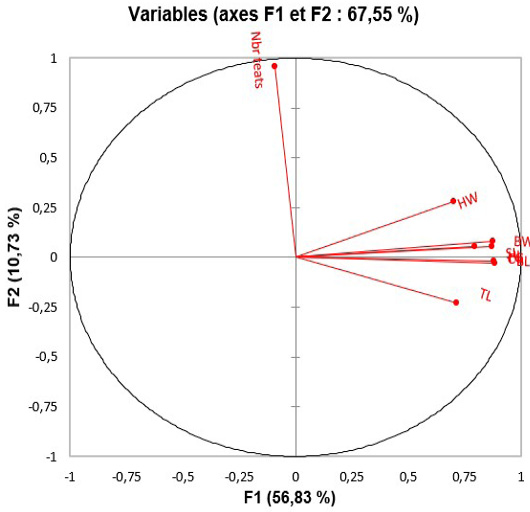
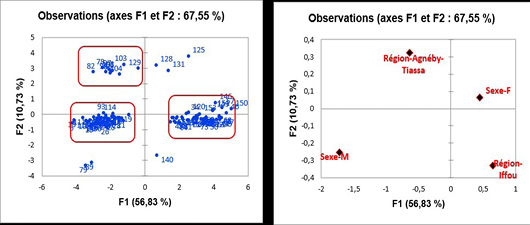
Factor axes with eigenvalues greater than or equal to 1 contribute to the variability of the parameters. Consequently, axes 1 and 2, which account for the largest proportion of the variability (67.55%), were selected for further analysis (Table 7). Moreover, the correlations between the variables and the axes (contributions, cos²) were examined in order to identify the axes that best explain the variability of the parameters (Table 8). Axis 1 explains 56.83% of the total variability and axis 2, 10.73%. Furthermore, the correlation diagram (Figure 4) showed that the parameters studied are positively correlated with the factor axes. Morphological parameters such as live weight, body length, head length, snout circumference, tail length, ear length, chest girth and height at the withers are correlated with one another and with Axis 1 (Figure 4). By contrast, the number of teats is independent of the other parameters and shows a positive correlation with axis 2 (Figure 4). Furthermore, several morphological parameters are strongly correlated with one another: weight and length; weight and chest girth; body length and head length; body length and chest girth; and chest girth and head length.
Distribution of sampled local pig populations
Figure 5 presents the distribution of the sampled populations in factorial planes 1 and 2 according to region and sex. This population projection showed that the populations of the Agnéby-Tiassa region are clearly distinct from the populations of the Iffou region. The animals from Iffou are correlated with axis 1, and individuals from Agnéby-Tiassa are correlated with axis 2. Furthermore, the projection of the populations of the two regions onto the factorial plane revealed three distinct groups. Female individuals positively correlated with axis 1 exhibited higher values for the morphological parameters studied.
Table 7: Contribution of the factorial axes of principal component analysis to the variability of the morphological characteristics of local pigs.
F1
F2
F3
F4
F5
F6
F7
F8
9
F10
Eigen value
5.68
1.07
0.78
0.71
0.54
0.48
0.34
0.23
0.10
0.06
Variability (%)
56.83
10.73
7.84
7.09
5.39
4.79
3.44
2.28
1.03
59
Cumulative %
56.83
67.55
75.40
82.49
87.87
92.66
96.10
98.38
99.41
1000
Table 8: Squares of the cosines (cos2) of the variables.
F1
F2
F3
F4
F5
F6
F7
F8
F9
F10
BW (kg)
0,7775
0,0008
0,0285
0,0325
0,0354
0,0014
0,0605
0,0150
0,0483
0,0000
BL (cm)
0,7765
0,0004
0,0093
0,0125
0,0055
0,0113
0,0085
0,1760
0,0000
0,0001
HL (cm)
0,7675
0,0062
0,1303
0,0413
0,0031
0,0153
0,0002
0,0009
0,0003
0,0350
SL (cm)
0,6329
0,0027
0,2307
0,0647
0,0005
0,0393
0,0026
0,0028
0,0000
0,0236
SC (cm)
0,4736
0,0003
0,1268
0,1957
0,0208
0,1140
0,0685
0,0001
0,0001
0,0001
TL (cm)
0,5098
0,0519
0,0178
0,0138
0,2659
0,1235
0,0073
0,0097
0,0001
0,0002
EL (cm)
0,4881
0,0107
0,0322
0,1835
0,0913
0,1706
0,0196
0,0033
0,0006
0,0001
CG (cm)
0,7593
0,0028
0,0663
0,0068
0,0738
0,0005
0,0248
0,0150
0,0507
0,0001
HW (cm)
0,4894
0,0774
0,1424
0,1367
0,0079
0,0000
0,1387
0,0046
0,0027
0,0001
Nbr teats
0,0080
0,9194
0,0000
0,0215
0,0344
0,0030
0,0131
0,0004
0,0000
0,0001
Structure of sampled local pig populations using Hierarchical Ascending Classification (HAC)
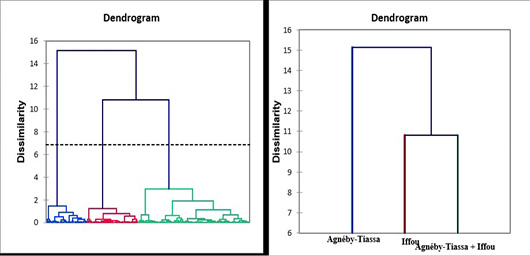
The hierarchical ascending classification (HAC) shown in Figure 6 was applied to 10 morphological parameters describing local pigs from the Agnéby-Tiassa and Iffou regions. HAC using Ward’s linkage and Euclidean distance identified three distinct clusters. Class 1 consists of 85 individuals from Agnéby-Tiassa and Iffou with an intermediate morphology (mean weight = 16.2 kg, body length = 58 cm). Class 2 consists almost exclusively of 31 individuals from Agnéby-Tiassa, characterized by a small morphology (mean weight = 17.1 kg, body length = 39 cm). Class 3 comprises 39 individuals from Iffou, characterized by a large conformation (mean weight = 35.4 kg, body length = 72 cm) (Table 9).
Morphotype relationships of population classes using discriminant factor analysis (DFA)
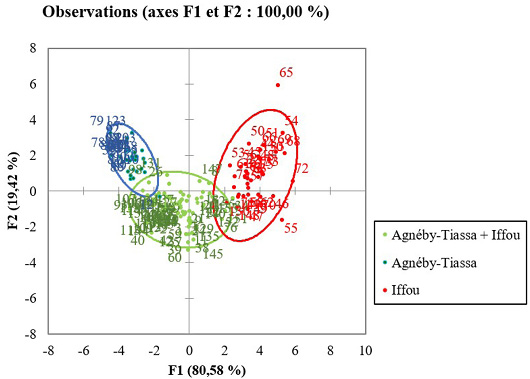
Discriminant Factor Analysis (DFA) applied to all populations divided into 3 classes is represented by Figure 7. The analysis shows that these three morphological classes are very significantly different (P < 0.0001). A single discriminant axis (F1) summarizes 80.58% of the information, contrasting small stature (class 2) with large stature (class 3) according to Table 10. The DFA also ranked the parameters that best discriminate between the classes (Table 11) in descending order of discriminant power (F). Discrimination is primarily based on weight, body length, chest girth, and geographic area. Class 2 (light-weight, small individuals), representing the population of Agnéby-Tiassa, is clearly separated from class 3 (population of Iffou), comprising heavy and tall individuals, along the discriminant axis (F1). Class 1 (Agnéby-Tiassa + Iffou) occupies an intermediate position, slightly offset on the discriminant axis (F2). However, the DFA analysis, using the 10 continuous variables as predictors and the three HAC classes as grouping variables, yielded excellent discriminatory power, with a classification accuracy of 96.77% on the original data. However, the accuracy obtained via cross-validation (using the ‘leave-one-out’ method) was 87.3%, indicating some overfitting (Table 12). Mahalanobis distances confirm this hierarchy. The distance between class 2 and class 3 is 49.25 (extremely distant populations), the distance between classes 1 and 2 is 14.97 (distant populations), and the distance between classes 1 and 3 is 21.88 (very distant populations) on Table 13.
Table 9: Characteristics of the three morphotypes and intra- and inter-class variance.
Classes
1 (Agnéby- Tiassa + Iffou)
2 (Agnéby- Tiassa)
3 (Iffou)
BW (kg)
16.2
17.1
35.4
BL (cm)
58
39
72
HL (cm)
25
23
27
SL (cm)
13
12
14
Variables
SC (cm)
23
20
25
TL (cm)
20
18
26
EL (cm)
10
8
12
CG (cm)
59
60
76
HW (cm)
42
36
43
Nbr teats
10
10
10
Variance
Intraclass
44.79
Interclass
55.21
Table 10: Eigenvalues and percentage of discrimination.
Axis
Eigen values
Discrimination (%)
Cumulative (%)
F1
5.8665
80.58
85.8
F2
1.4137
19.42
100
Table 11: Discriminatory power of the morphological parameters studied.
Parameters
F1
F2
Value (λ)
F(ddl=2,152)
p value
Discriminatory power
BW
872
336
0.285
191,069
<0.0001
Very high
BL
864
-257
0.324
158,707
< 0.0001
Very high
CG
640
059
0.549
62,322
< 0.0001
High
TL
540
063
0.617
47,262
< 0.0001
High
HL
600
266
0.648
41,251
< 0.0001
Moderate to high
SC
666
-083
0.651
4741
< 0.0001
Moderate to high
EL
599
221
0.665
38,295
< 0.0001
Moderate
SL
688
280
0.748
25.54
< 0.0001
Moderate
HW
408
-251
0.821
16,544
< 0.0001
Low to moderate
Nbr teats
-198
117
0.958
3,299
0.04
Weak
Table 12: Comparison of training and cross-validation performance.
Metric
Training (%)
LOOCV (%)
Difference (pp)
Interpretation
Accuracy
96.77
87.30
9.47
Moderate overfitting
Kappa
94.64
82.50
12.14
Decreased agreement
Table 12: Mahalanobis distances between classes.
Class pair
Distance
P-value
Class 1 – Class 2
14.97
<0.001
Class 1 – Class 3
21.88
<0.001
Class 2 – Class 3
49.25
<0.001
DISCUSSION
This study aimed to characterize local pigs (Sus scrofa domesticus) phenotypically and morphometrically in Côte d’Ivoire, specifically in two distinct regions (Agnéby-Tiassa and Iffou). The results obtained highlight significant phenotypic variability as well as a significant influence of region and sex on morphometric parameters.
The sex distribution is dominated by a high proportion of females (80.56%) in both areas. The clear dominance of females in the total population is consistent with observations made in Benin (Djimenou et al., 2018; , as well as in Uganda . This female predominance is typical of traditional farming and is explained by the preferential use of females for breeding, while males are often castrated or sold young for consumption . The absence of a significant difference in the proportions of males and females between Agnéby-Tiassa and Iffou suggests similar herd management practices in both regions.
Phenotypically, regarding coat pattern, the solid color type predominates in both areas, but it is more frequent in Agnéby-Tiassa (64.85%) than in Iffou (57.86%). Conversely, the spotted pattern is more prevalent in Iffou (35.22% versus 30.91%). Variations in coat pattern according to geographic area have also been observed in southern Benin . Detailed analysis of coat colors reveals an even more pronounced difference. White is the predominant color in both areas, but its frequency is higher in Agnéby-Tiassa (46.67%) than in Iffou (41.77%). Black is also more frequent in Agnéby-Tiassa (18.18% versus 13.92% in Iffou). In contrast, the white coat with black spots is much more frequent in Iffou (22.78%) than in Agnéby-Tiassa (7.27%). These observations differ from those reported in southern Benin, with a predominance of black (28%) and white (20%) coats , in Zimbabwe with a clear dominance of black (61.8%) followed by white with black spots (26.5%) according to Halimani et al. (2012), and in Ghana with a dominance of black (67.48%) in previous studies . However, similar observations with a predominance of white coats have been reported in Cameroon and in Burkina Faso . The observed diversity of coat colors suggests a pig population marked by crossbreeding with exotic breeds ; ; . Furthermore, the high proportion of white coats in both areas deviates from the classic description of the local African pig, whose black coat is considered a criterion of purity . This proportion of white coats is consistent with the widespread influence of crossbreeding with improved Large White breeds, as reported in Benin . Hair type is the parameter where the difference between the two regions is most striking. Stiff, short, and sparse hair is by far the most common in Agnéby-Tiassa (47.88%), while in Iffou, stiff, long, and dense hair predominates (37.74%). The marked heterogeneity in hair type between the two areas can be explained by climatic and genetic differences ; . Furthermore, it has been found that purebred local pigs have long, dense hair, while crossbreds with Pietrain pigs have short, sparse hair . Thus, the dominance of short, sparse hair in Agnéby-Tiassa could indicate a more pronounced influence of crossbreeding with exotic breeds in this area, as also suggested by studies conducted in Burkina Faso . The uniformity of certain traits, such as erect ears (100%), a straight tail (100%), and a predominantly straight head profile (78.40%), with a slightly higher proportion in the Iffou region (83.02% versus 73.94% in Agnéby-Tiassa), confirms that the studied population retains traits typical of the local African pig ; . A convex profile is sometimes observed but remains a minority (21.60%). Conversely, the complete absence of the concave profile, characteristic of improved breeds in our sample, is a strong indicator that, despite the signs of crossbreeding observed in the coat and hair, the local genetic background remains predominant with regard to cranial morphology . The shape of the snout also shows a clear divergence. The long, cyclo-conical snout is by far the most common in Agnéby-Tiassa (66.67%), while in Iffou, the short, cyclo-conical snout is almost as frequent (44.65%) as the long snout (46.54%). The long, thin snout is less common in both areas (12.96%). Agbokounou et al (2016) describe the snout of the local pig as generally long and cylindrical-conical, while noting the existence of short-snout strains, such as the Mukota breed in Zimbabwe. The presence of long, thin snouts, although less common, may indicate the influence of crossbreeding, as observed in Liberia and in Burkina Faso . The animals have small ears oriented in a semi-horizontal manner ; . The backline is straight in the vast majority of animals in both areas (83.02%) with a higher frequency in Agnéby-Tiassa (87.27% vs. 78.62%). The swayback shape is slightly more frequent in Iffou (16.98% vs. 12.73% in Agnéby-Tiassa). The concave shape is absent in Agnéby-Tiassa and present in 4.40% of animals in Iffou. The predominance of a straight back is characteristic of local breeds . The presence of a swayback or concave back, although less common, is more pronounced in Iffou. These back shapes are often associated with deformities or conformational defects that may result from nutritional deficiencies, developmental problems, or the genetic influence of improved breeds . Tail type is uniform in both areas, with all animals having a straight tail. This monomorphic trait is a reliable phenotypic marker of the local African pig . The absence of a corkscrew tail, common in improved breeds, confirms the persistence of the local genetic background for this trait.
At the morphometric level, the results of the analyses reveal variability in parameters within the sampled population and a significant influence of region and sex on these parameters. The morphometric analyses show that for certain morphometric parameters, pigs from Iffou exhibit significantly higher values compared to pigs found in Agnéby-Tiassa. These parameters include live weight (25.55 ± 14.6 kg vs. 22.4 ± 6.59 kg), body length (61.70 ± 12.6 cm vs. 52.49 ± 13.17 cm), and chest girth (65.51 ± 11.09 cm vs. 61.91 ± 8.34 cm). Similar observations have been reported in Burkina Faso and Nigeria ; . This inter-zone difference can be attributed to distinct husbandry practices (feeding, management) or to local genetic differences. Moreover, similar morphometric variations have been observed in Benin according to agro-ecological areas, with larger pigs in depression and fishing areas . In addition, apart from the number of teats, sex had a highly significant effect on all the morphometric parameters studied. Females exhibited higher values compared to males. The significant effect of sex on most of the morphometric parameters studied, with females showing higher values than males, is also reported by several authors ; . This sexual dimorphism is classic in local pigs and is explained by natural and human selection favoring females for reproduction . This phenotypic variability has also been reported in southern Africa and in Uganda .
Multivariate analysis (PCA, HCA, DFA) identified three distinct morphotypes, correlated with regions of origin. Class 1 (intermediate) contained over half the sample, suggesting that the ‘intermediate’ morphotype is the most common. Classes 2 (small) and 3 (large) represent extremes of the size continuum. The relatively low proportion of between-class variance (55%) and the high within-class variance (45%) suggest that the morphotypes may not represent discrete genetic groups but rather points along a continuous distribution of body size. Three morphotypes were also identified in southern Benin, based on size . A similar structure of local pig populations has been reported in southern and eastern Africa ; . Furthermore, in addition to confirming the three morphotypes, DFA reveals the most discriminating parameters: body weight, body length, chest girth, and tail length.
This phenotypic study has several limitations. First, the sample was strongly female-biased (80%, with only 63 males). Indeed, this proportion is typical of traditional farming systems, where males are sold at a certain weight, which limits the power to detect sex-specific effects. In addition, the exact age of the animals was not controlled by the farmers, as the animals are mostly free-ranging, and this could influence morphometric traits independently of region or sex. Furthermore, the observational design does not allow causal relationships to be established (e.g., crossbreeding leading to white coats). Finally, inferences about crossbreeding rely solely on phenotypic markers (coat color, hair type). Consequently, these interpretations should be confirmed by molecular analyses.
CONCLUSION
Local pigs in Côte d’Ivoire exhibit significant phenotypic and morphometric variability, influenced by region, sex, and their interaction. This structure suggests local population differentiation, likely linked to husbandry practices and limited exchanges between regions. While some typical characteristics of local African pigs are preserved, the diversity of coat colors and hair texture indicates crossbreeding pressure with exotic breeds. The preservation of these local genetic resources in the face of the spread of exotic breeds is crucial. Moreover, the high phenotypic variability observed, combined with the presence of adaptive traits (dense hair), gives this population significant potential for genetic improvement and conservation. However, any improvement strategy must be accompanied by in situ conservation measures. This involves supporting farmers of local pig breeds through extension services, access to markets and recognition of the value of local genetic resources. Participatory breeding programmes should also be established, involving farmers in setting breeding objectives that balance productivity with the preservation of adaptive traits. Finally, the characterisation of genetic diversity through molecular studies is necessary to assess this diversity, population structure and the extent of cross-breeding.
ACKNOWLEDGEMENT
The authors wish to thank Nangui Abrogoua University, through its Doctoral School (ED-STE), for including this topic in the catalog of doctoral research themes. They also thank the administrative and traditional authorities of the Agnéby-Tiassa and Iffou regions for facilitating access to the data collection sites. Finally, they extend their deepest gratitude to the herders who generously allowed us to handle their animals free of charge.
NOVELTY STATEMENT
Characterizing a livestock resource is the first step in understanding it. This allows for informed decisions regarding its preservation and/or improvement. In Côte d’Ivoire, there is no specific data or scientific research on local purebred pigs. Therefore, this work represents a first step in supporting local pig breeds and a foundation for future research.
AUTHOR’S CONTRIBUTION
ALN defined the research topic, supervised and corrected the entire work. The methodological approach, investigation, data collection, and writing were carried out by YKNK. WIY and KAMN were responsible for the statistical analyses. All authors have read and approved the final version of the work.
Animal-ethics approval
The study was conducted with the verbal consent of the farmers, who were informed about the study objectives and agreed to allow their animals to be measured. Formal ethical approval was not obtained because Nangui Abrogoua University does not currently have a functioning Institutional Review Board (IRB) or ethics committee for animal research. However, the study was conducted in accordance with internationally accepted principles for animal welfare. Animal handling was minimised and done in the presence of owners, using gentle restraint techniques to reduce stress. No invasive procedures were performed. The authors acknowledge that the absence of formal ethical review is a limitation and recommend that future studies seek approval from national veterinary authorities or other relevant bodies.
Funding
This research received no specific grant from any funding agency in the public, commercial, or not-for-profit sectors.
Generative AI and AI assisted technology statement
Generative AI such as DeepSeek was used exclusively for language correction and stylistic improvement tasks. The authors have verified and corrected all AI outputs and assume full responsibility for the accuracy and integrity of the final scientific content.
Conflict of interest
The authors have declared no conflict of interest.
Figures
Figure 1:.
Study area, the Agnéby-Tiassa region and the Iffou region (Konan, 2025).
Figure 2:.
Local breed pigs sus scrofa domesticus (Konan, 2025).
Figure 3:.
Technical equipment used (a: electronic scale, b: net, c: measuring tape, d: data collection sheet).
Figure 4:.
Morphological parameter correlation circle.
Figure 5:.
Distribution of populations in the factorial plane 1 and 2 according to region and sex.
Figure 6:.
Dendrogram of the population structure of sampled local breed pigs.
Figure 7:.
Position of the populations in the discriminant factorial plane 1 and 2.
References
Adeola AC, Oseni SO, Omitogun OG (2013). Morphological characterization of indigenous and crossbred pigs in rural and peri-urban areas of southwestern Nigeria. Open J. Anim. Sci., 3(3): 230-235. https://doi.org/10.4236/ojas.2013.33034[CrossRef]
Adjei OD, Osei-Amponsah R, Ahunu BK (2015). Characterization of local pig production systems in Ghana. Bull. Anim. Health Prod. Afr., 63(4): 337-342.
Agbokounou AM, Ahounou GS, Abdou IY, Mensah GA, Koutinhouin B, Hornick J-L (2016). Caractéristiques de l’élevage du porc local d’Afrique. J. Anim. Plant Sci., 30(1): 4701-4713.
Agbokounou AM, Ahounou GS, Karim I, Mensah GA, Koutinhouin B, Hornick L (2016). Ethnologie et potentialités du porc local d’Afrique. J. Anim. Plant Sci., 29(3): 4665-4677.
Audrey TS, Manjeli Y, Meutchieye F (2021). The Bankim pigs: A native Cameroonian breed assessed by biometric characteristics. Genet. Biodivers. J., 5(1): 101-111. https://doi.org/10.46325/gabj.v5i1.174[CrossRef]
Bankole CB, Dotché IO, Ahounou SG, Dahouda M, Abdou Karim IY, Senou M (2025). Phenotypic and morphometric characterization of local, improved and Pietrain stress-negative pigs and the products of their crossbreeding in Benin. Adv. Anim. Vet. Sci., 13(1): 146-156. https://doi.org/10.17582/journal.aavs/2025/13.1.146.156[Full text][CrossRef]
Brou GKG, Adou CFD, Meniga M, Soro RY (2020). Characterization of pig farms in the department of Korhogo. J. Appl. Sci. Environ. Stud., 3(3): 3-198.
Djimènou D (2019). Caractérisation génétique et proposition d’un programme d’amélioration génétique des porcs locaux élevés au Sud du Bénin. (PhD thesis). Thèse de doctorat en Zootechnie, Génétique et Amélioration des Ressources Animales. Université d’Abomey-Calavi, République du Bénin, p. 136.
Djimènou D, Adoukonou-Sagbadja H, Chrysostome C, Koudande OD (2018). Caractérisation phénotypique des porcs locaux (Sus scrofa domesticus) au Sud du Bénin. J. Anim. Plant Sci., 37(1): 5956-5975.
FAO (2013). Phenotypic characterization of animal genetic resources. FAO Guidelines on Animal Production and Health No. 11. Rome.
Halimani TE, Muchadeyi FC, Dzama K, Chimonyo M (2012). Some insights into the phenotypic and genetic diversity of indigenous pigs in southern Africa. S. Afr. J. Anim. Sci., 42(5): 507-510. https://doi.org/10.4314/sajas.v42i5.13[CrossRef]
Kampire J, Kiwanuka GN, Kagoro-Rugunda G (2023). Phenotypic and production characteristics of locally adapted pig ecotypes in South-Western Agro-ecological Zone, Uganda. Int. J. Livest. Prod., 14(4): 84-95. https://doi.org/10.5897/IJLP2023.0834[CrossRef]
Karnuah AB, Osei-Amponsah R, Dunga G, Wennah A, Wiles WT, Boettcher P (2018). Phenotypic characterization of pigs and their production system in Liberia. Int. J. Livest. Prod., 9(7): 175-183.
King BM (2010). Analysis of Variance. Int. Encycl. Educ., https://doi.org/10.1016/B978-0-08-044894-7.01306-3[CrossRef]
Kouthinhouin GB, Youssao AKI, Toleba SS, Kpodekon TM, Ahounou GS, Bonou AG, Bessanvi J (2009). Effet du mode d’élevage sur la prolificité des truies de race locale du Bénin et la viabilité de leurs porcelets, de la naissance au sevrage. Int. J. Biol. Chem. Sci., 3(4): 819-829. https://doi.org/10.4314/ijbcs.v3i4.47188[CrossRef]
Logtene YM, Koussou MO, Nguertoum EA, Tama ACN, Lakouetene T, Awa DN, Mal HEM (2009). Caractéristiques et performances des élevages porcins urbains et périurbains des savanes d’Afrique centrale: cas des villes de Garoua, Pala et Bangui. African Savannas in Development: Innovating for Sustainability, Apr 2009, Garoua, Cameroon. cirad-00472029.
Nonfon WR (2005). La filière de production du porc local au Bénin: l’amélioration de sa productivité par l’alimentation. PhD thesis, University Faculty of Agronomic Sciences of Gembloux, Belgium, pp. 236.
Osei-Amponsah R, Kayang BB, Naazie A (2014). Phenotypic characterisation of local pigs in Ghana. J. Anim. Sci., 92(4): 1523-1530
Ossebi W, Ayssiwede SB, Nimbona F, Malou R, Djettin AE, Diop M, Missohou A (2019). Analyse zootechnique et économique des systèmes d’élevage de porcs en Casamance (Sénégal). Rev. Élev. Méd. Vét. Pays Trop., 72(1): 13-22. https://doi.org/10.19182/remvt.31258[CrossRef]
Ramousse R, Le Berre M, Le Guelte L (1996). Introduction aux statistiques. https://www.cons-dev.org/elearning/stat/index.html (accessed 18 June 2025).
Tapsoba ASR, Akounda B, Traore GF, Sawadogo SE, Yougbare B, Pinde S, Sanou M, Tamboura HH, Soudre A, Bayala B (2023). Caractérisation morphologique du porc de race locale du Burkina Faso. Sci. Nat. Appl., 42(2): 151-170.
Youssao A, Koutinhouin G, Kpodekon T, Bonou A, Adjakpa A, Ahounou G, Mourot J (2009). Performances zootechniques et aptitudes bouchères des porcs locaux au Sud du Bénin. Bull. Anim. Health Prod. Afr., 57(1): 73-87. https://doi.org/10.4314/bahpa.v57i1.44053[CrossRef]
Youssao AI, Koutinhouin GB, Kpodekon TM, Bonou AG, Adjakpa A, Dotcho CDG, Atodjinou FTR (2008). Production porcine et ressources génétiques locales en zone périurbaine de Cotonou et d’Abomey-Calavi au Bénin. Rev. Élev. Méd. Vét. Pays Trop., 61(3-4): 235-243. https://doi.org/10.19182/remvt.9995[CrossRef]