
In this study, solid state fermentation of potato peels were done by Aspergillus niger for the production of α–amylase. The crude enzyme produced was further characterized. The results showed that enzyme had an optimum pH of 6.0 and stable in range of 4.0-6.0. Optimum temperature of enzyme was 40oC and attained 96% activity at 40oC for 70min. Metal profile showed that α-amylase activity was enhanced in the presence of Ca2+, Cs1+, Mn2+ and Co2+, whereas inhibited in the presence of Na1+, Mg2+, Ag1+ and Cu2+. Enzyme kinetics revealed that crude enzyme exhibit Km and Vmax of 3.00 mg/ml and 1000.0 µM/g using soluble starch as substrate. These results speculated that it could be used for various industrial exploration.
Research Article · Volume 33, Issue 1, 6 May 2018 · Open Access
Partial Characterization of α-amylase Produced from Aspergillus niger using Potato Peel as Substrate
· · · ·
Affiliations & Notes ⌄
- 1Department of Botany, Government College University, Lahore, Pakistan 2Department of Biotechnology, University of the Sargodha, Sargodha, Pakistan 3Food & Biotechnology Research Center, Pakistan Council of Scientific & Industrial Research (PCSIR) Laboratories Complex, Ferozpure Road, Lahore, Pakistan. , *Corresponding author Dr. Muhammad Nadeem, mnadeempk@yahoo.com
Article Info ⌄
- Journal:
- Punjab University Journal of Zoology
- Published:
- 6 May 2018
From the article
- A significant enzyme activity can be obtained by utilizing potato peel, an agro-residue, as a substrate for SSF.
- Maximum α-amylase activity was obtained at pH 6, 40°C substrate concentration 1% incubation period 10 minutes, the enzyme activity was enhanced by Ca2+, Cs1+, Mn2+ and Co2+, whereas inhibited by Na1+, Mg2+, Ag1+ and Cu2+.
Selected from the article's own text.
Abstract
Introduction
Alpha amylase (endo-1,4-α-D-glucan glucanohydrolyase E.C 3.2.1.1) is an extra cellular enzyme. It produces ultimately a large number of products i.e. maltose and glucose sub units by splitting up 1,4-α-D-glucosidic bonds randomly which are present among consecutive molecules of glucose in straight amylose chain ; ; . Alpha amylases are widely used in various industries such as baking, brewing, confectionary, sugar (i.e. fructose and glucose), paper coating, alcohol, pharmaceutical, textile, syrup industries, starch, detergents, digestive aids, and for treatment of sewage ; ; . Alpha amylases are wide spread in occurrence which can be obtained by different resources e.g. microorganisms, animals and plants etc. However, fungi and bacteria are used for commercial production of amylases ; , because of a few advantages i.e. reliability, less time and space, low cost required for enzyme production, ease of manipulation and economical bulk production capacity ; .
Aspergillus niger is a fungus which is prevalent in nature and belongs to genus Aspergillus. It is usually found as saprophytes growing on stored grain, dead leaves, and other decaying vegetation. It looks as very dark brown patches or carbon black. Aspergillus niger, dominates in solid state fermentation, is a very vital group of microorganisms. It posses some very special properties such as good tolerance to less availability of water and capacity to spread over and to enter inside the solid substrate, therefore, it is extensively grown and used in food industry for making many enzymes such as α-amylases, amyloglucosidases, cellulases, lactase and acid proteases ; . In recent years solid state fermentation (SSF), where the fungus is grown on moist solid substrate, has been utilized increasingly for the production of α-amylase because of numerous benefits e.g. less capital investment, simple technique, marginal end product inhibition, superior and high volumetric productivity, less catabolite repression, low energy requirement, requirement of simple equipment for fermentation, better product recovery and less water output ; .
The cost of α-amylase production is dependent on the cost of the substrate used during SSF. For the cost effective production of alpha amylases, several researchers considered the use of easily available and inexpensive food and agro wastes such as, wheat bran, potato peel, wheat straw, rice straw, rice husk, and sugarcane bagasse, banana waste and waste of coffee as substrate for α-amylase production ; . Potatoes are peeled in various processed food industries and are used for the production of different foodstuffs such as chips, fries and mashed potatoes etc. ; . The potato peel is considered as waste, discarded and allowed to rot, so it creates many pollution and disposal problems. Therefore, for cost effective production of enzyme, potato peel should be used as a cheap source of substrate because it also include adequate amount of nutrients like protein and carbohydrates, which are essential for the growth of microorganisms . The objective of present work is to characterize crude α-amylase from Aspergillus niger using potato peel as substrate.
Material and Methods
Sample collection
In the present study, potato peel was selected as substrate for α-amylase production. It was collected from Lays, Pepsi-cola International (Pvt) Ltd, Lahore, Pakistan.
Microorganism
Aspergillus niger was obtained from the Microbiology Laboratory, Food & Biotechnology Research Center, Pakistan Council of Scientific & Industrial Research Laboratories Complex, Lahore. The fungus was grown on slants of potato dextrose agar (PDA) for five days before storage, and maintained at 4°C on PDA.
Inoculum preparation
Five days old PDA slant culture full of fungal spores were taken and ten ml of sterilized distilled water was added. Under sterilized conditions, spore clusters were broken with the help of an inoculum needle and homogenized suspension of spores were prepared and used as an inoculum source.
Fermentation technique
Twenty gram of raw potato peel was weighed in 250 ml Erlenmeyer flask and hydrated with 2 ml of salt solution comprising (g/l) MgSO4 2, KH2PO4 10, MnSO4 0.5 and NaCl 2. The material was mixed thoroughly, cotton plugged and sterilized at 121°C, 15lb psi for 15 min. After sterilization, the cooled media was inoculated with one milliliter spore suspension of Aspergillus niger and incubated at 30°C for 5 days.
Extraction of crude enzyme
In each of above flasks, 50 ml of citrate buffer (pH 5) was poured and shaken vigorously in a rotary shaker for 1 hour at 200 rpm. Then the fermentation mixture was filtered and centrifugation was taken place for 15 min at 4°C at 8,000 rpm. The supernatant (crude enzyme) was filtered and used to measure activity of crude enzyme.
Determination of amylase activity
Amylase activity was measured by method as described by Okolo et al. (1995). Reaction mixture containing 1 ml of enzyme extract and 1 ml of substrate (i.e. 1% soluble starch solution) was taken in test tube and incubated for 30 min at 50°C. After that reaction was stopped by adding 3ml of DNS reagent and boiled for 10 min. The reaction mixture was allowed to cool at room temperature and absorbance was measured by spectrophotometer at 540nm . One unit (IU) α-amylase activity was defined as the amount of enzyme that releases 1 µg of maltose per minute under the standard reaction conditions.
Characterization of α-amylase
Characterization of the crude enzyme was conducted by studying the effect of different parameters such as incubation time (10-100 min), incubation temperature (20-100°C), substrate concentration (0.25-2%), pH (4-9) of reaction mixture and metal ions (Na+1, Ca2+, Mg2+, Mn2+, Zn2+, Fe2+, Cu2+, Ag1+, Cs1+ & Co2+) on α-amylase activity.
Statistical analysis
All the data obtained from different experiments were analyzed statistically by SPSS software. ANOVA test was used at p < 0.05 significance level.
Results and Discussion
Effect of incubation period
Alpha amylase activity was performed at different incubation periods (10, 20, 30, 40, 50, 60, 70, 80, 90 & 100 min) and it was observed that enzyme was optimally active (2779.49 U/g) for 10 minute of incubation but subsequently, there was gradual decline in enzyme activity (Figure 1). Similar results were reported by Kanwal et al. (2004). Maximum activity for α-amylase at five minutes incubation of reaction mixture has been reported earlier ; .
Effect of temperature on activity and stability
Effect of different temperatures i.e. 20, 30, 40, 50, 60, 70, 80, 90 & 100°C of reaction mixture on activity of α-amylase was evaluated. Maximum enzyme activity (2947.08 U/g) was gained at 40°C, whereas, the activity of enzyme showed a declining trend with the increase or decrease in temperature (Figure 2). Thermostability of the enzyme was checked by incubating crude enzyme solution at various temperature for different time period. Results showed that enzyme was stable at temperature 40oC for 70min attaining 96 % enzyme activity. As the temperature gradually increased, the enzyme activity become decreased with the passage of time. Ayansina and Owoseni (2010) showed same results for Aspergillus flavus. Maximum α-amylase activity was reported for Aspergillus spp. and Aspergillus niger at 45°C ; . Greatest activity for amylase was obtained at incubation temperature of 30°C ; ; , 50°C ; and even 60°C .
Effect of pH on activity and stability
The incubation of enzyme-substrate reaction mixture was carried out at various pH values such as 4, 5, 6, 7, 8 & 9. At pH 6, maximum enzyme activity (2895.02 U/g) was noted and the activity of enzyme was decreased, due to increase or decrease of pH from the optimum value (Figure 3). Enzyme stability was also assessed by pre-incubating enzyme at various pH buffers and enzyme was found stable in pH range of 4-6. Avwioroko et al. (2015) reported that Aspergillus spp. related with cassava spoilage produced α-amylase which showed optimum activity within pH range of 4-5. Alpha amylase indicated excellent activity at about pH 6 ; ; . It was studied in previous literature that α-amylase was best active at pH 6.8 , pH 5 , pH 7 , pH 7 and pH 5.6 , respectively.
Kinetics of crude α-amylase
Enzyme activity was investigated with different concentrations of substrate (soluble starch) i.e. 2.5, 5.0, 7.5, 10.0, 12.5, 15.0, 17.5 & 20.0 mg/ml. It was noted that enzyme was optimally active (3014.30 U/g) at 10.0mg/ml soluble starch, subsequently it remained nearly constant (fig 4). Kinetic constants like Km and Vmax was calculated through Line-Weaver Burk plot. The crude enzyme had Km value of 3.00 mg/ml and Vmax of 1000.0 µM/g using soluble starch as substrate. Banerjee and Gosh (2017) reported Km and Vmax of 0.387 mg.ml-1 and 35.03 U µl-1 min-1, for glucoamylase using soluble starch respectively. Crude α-amylase produced from Aspergillus sp. exhibit maximum Vmax of 10 U/mg protein and Km in range of 0.37 -1.25%w/v . α-amylase produced from Aspergillus oryzae had Km and Vmax of 1.4 mg ml-1 and 37.037 U ml-1 respectively .
Effect of metal ions
The study of different metal ions exhibited that enzyme activity was enhanced by Ca2+, Zn2+, Cs1+, Co2+, Mn2+and Fe2+, whereas, inhibited by Na+1, Mg2+, Ag1+, Cu2+ (Figure 5). α-amylase activity was improved due to Mn2+, Ca2+, and Fe2+ ions and inhibited due to Mg2+, Na+1, Cu2+, Hg2+, Ag1+ ions has been observed by many workers ; ; ; . Wang et al. (2018) reported that most of the cloned α-amylase were Ca2+ independent. α-amylases produced from Aspergillus spp. grown on degrading cassava were slightly stimulated by Mg2+ and Na+, moderately activated by Fe3+ and Ca2+, whereas strongly activated by potassium ion K+ .
Conclusion
In the current research work, the results presented that potato peel could be used as a good substrate in fermentation media for microbial growth as it contains all the essential nutrients. A significant enzyme activity can be obtained by utilizing potato peel, an agro-residue, as a substrate for SSF. Maximum α-amylase activity was obtained at pH 6, 40°C substrate concentration 1% incubation period 10 minutes, the enzyme activity was enhanced by Ca2+, Cs1+, Mn2+ and Co2+, whereas inhibited by Na1+, Mg2+, Ag1+ and Cu2+.
Figures
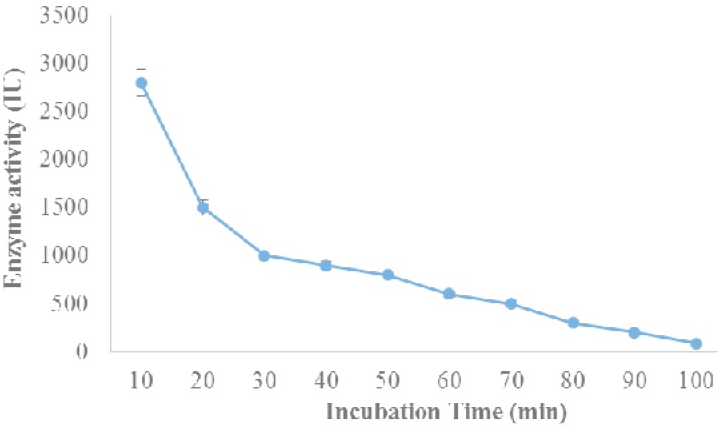
Optimum incubation period for α-amylase activity (LSD 5%= 92.63).
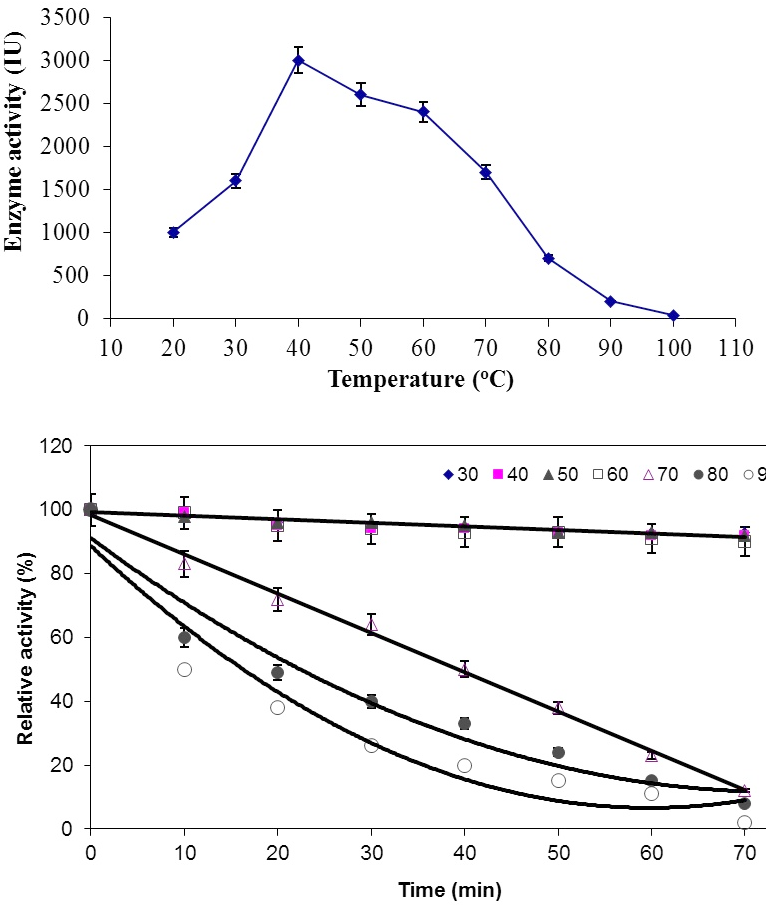
Optimum incubation temperature for α-amylase activity (LSD 5%= 125.66).
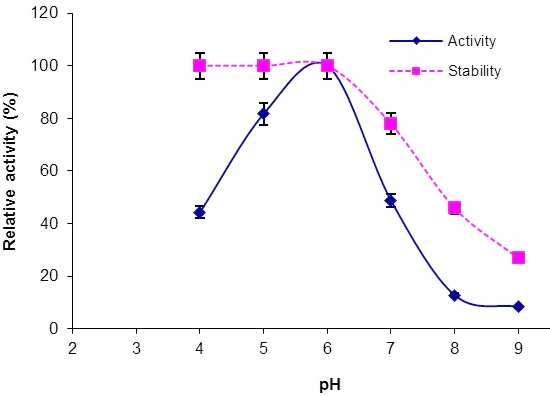
Effect of pH on α-amylase activity and stability (LSD 5%= 156.06).
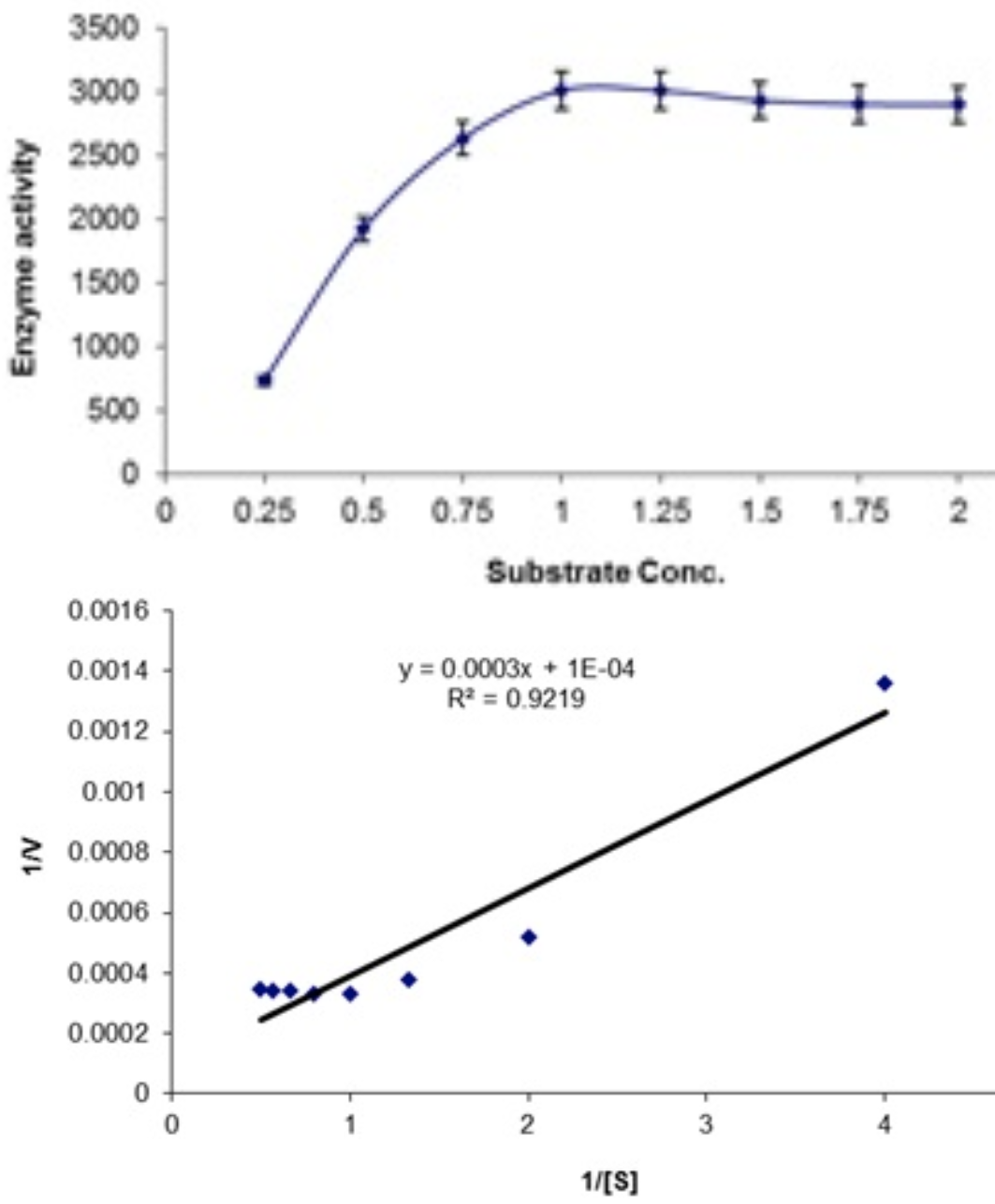
Effect of substrate concentrations on α-amylase activity.
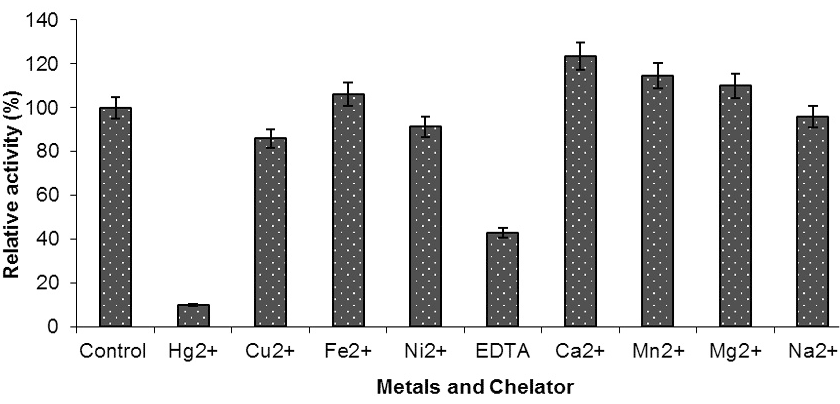
Effect of different metal ions and chelator on α-amylase activity.
References
- Ajao, A.T., Abdullah, H.J., Atere, T.G. and Kolawole, O.M., 2009. Studies on the biodegradation and utilization of selected tuber wastes by Penicillium expansum. Biosci. Res. Commun., 21: 221-227.
- Alva, S., Anupama, J., Savla, J., Chiu, Y.Y., Vyshali, P. Shruti, M., Yogeetha, B.S., Bhavya, D., Purvi, J., Ruchi, K., Kumudini, B.S. and Varalakshmi, K.N., 2007. Production and characterization of fungal amylase enzyme isolated from Aspergillus sp. JGI 12 in solid-state culture. Afr. J. Biotechnol., 6: 576-581.
- Avwioroko, O.J., Tonukari, N.J. and Asagba, S.O., 2015. Biochemical characterization of rude α-Amylase of Aspergillus spp. associated with the spoilage of cassava (Manihot esculenta) tubers and processed products in Nigeria. Adv. Biochem., 3: 15-23. https://doi.org/10.11648/j.ab.20150301.14[CrossRef]
- Ayansina, A.DV. and Owoseni, A.A., 2010. Studies on amylolytic enzyme synthesized by Aspergillus flavus associated with mouldy bread. Pak. J. Nutr., 9: 434-437. https://doi.org/10.3923/pjn.2010.434.437[CrossRef]
- Banarjee, S. and Gosh, U. 2017. Production and characterization of glucoamylase by Aspergillus niger. Appl. Food Biotechnol., 4:19-26.
- Burhan, A., Nisa, U., Gokhan, C., Omer, C., Ashabil, A. and Osman, G., 2003. Enzymatic properties of a novel thermostable, thermophilic, alkaline and chelator resistant amylase from an alkaliphilic Bacillus sp. isolate ANT-6. Process Biochem., 38: 1397-1403. https://doi.org/10.1016/S0032-9592(03)00037-2[CrossRef]
- Dhanya, G., Madhavan, N.K., Swetha, S. and Pandey, A., 2009. Immobilized bacterial alpha amylases for effective hydrolysis of raw starch and soluble starch. Food Res. Int. 42: 436-442. https://doi.org/10.1016/j.foodres.2009.02.008[CrossRef]
- Elaiyaraja, C., Senthil, V., Ayyavoo, M. and Ramu, S., 2016. Amylase activity of Bacillus amyloliquefaciens and Aspergillus niger from agro industrial wastes by solid state fermentation. Int. J. Zoo. Applied Biosci., 1: 268-282.
- El-Safey, E.M. and Ammar, M.S., 2004. Purification and characterization of α-amylase isolated from Aspergillus flavus var columnaris. Ass. Univ. Bull. Environ. Res., 7: 93-100.
- Erdal, S. and Taskin, M., 2010. Production of α-amylase by Penicillium expansum MT-1 in olid-state fermentation using waste Loquat (Eriobotrya japonica Lindley) kernels as substrate. Romanian Biotechnol. Lett., 15: 5342-5350.
- Gangadharan, D., Sivaramakrishnan, S., Nampoothiri, K.M. and Pandey, A., 2006. Solid culturing of Bacillus amyloliquefaciens for alpha amylase production. Food Technol. Biotechnol., 44: 269-274.
- Kanti., A. 2016. Effect of nitrogen addition on the α-Amylase production by Aspergillus niger, Rhizopus oligosporus and Neurospora crassa in media contained Sargassum and Rice seed on solid state fermentation. J. Biol. Indonesia, 12: 249-256.
- Kanwal, B., Zia, M.A., Yasin, M., Rahman, K. and Shiekh, M.A., 2004. Purification and characterization of α-amylase from apple (Malus pumila). Int. J. Agri. Biol., 6: 233-236.
- Khan, J.A. and Yadav, S.K., 2011. Production of alpha amylase by Aspergillus niger using cheaper substrate employed solid state fermentation. Int. J. Plant Anim. Environ. Sci., 1: 100-108.
- Kunamneni, A., Permaul, K. and Singh, S., 2005. Amylase production in solid state fermentation by the thermophilic fungus Thermomyces lanuginosus. J. Biosci. Bioeng., 100: 168-171. https://doi.org/10.1263/jbb.100.168[CrossRef]
- Lokeswari, N. 2010. Statistical optimization of experimental variables associated with roduction of alpha amylases by bacillus subtilis using banana agroresidual wastes in solid-state fermentation. Rasayan J. Chem., 3: 172-178.
- Lowry, O.H., Rosenbough, H.I., Fair, A.L. and Randall, R.I., 1951. Protein measurement with the folin phenol reagent. J. Biol. Chem., 193: 265-275.
- Mahmood, S., Shahid, M.G., Nadeem, M., Irfan, M. and Syed, Q., 2016. Production and optimization of α-amylase from Aspergillus niger using potato peel as substrate. Pak. J. Biotechnol., 13: 101-109.
- Mahmood, S. and Rahman, S.R., 2008. Production and partial characterization of extracellular α-amylase by Trichoderma viride. Bangladesh J. Microbiol., 25: 99-103.
- Manpreet, S., Sawraj, S., Sachin, D., Pankaj, S. and Banerjee, U.C., 2005. Influence of process parameters on the production of metabolites in solid-state fermentation. Malalaysian J. Microbiol., 1: 1-9.
- Mathew, J.J., Vazhacharickal, P.J., Sajeshkumar, N.K. and Ashokan, A., 2016. Amylase production by Aspergillus niger through submerged fermentation using starchy food byproducts as substrate. Int. J. Herbal Med., 4: 34-40.
- Mathew, J.J., Vazhacharickal, P.J., Sajeshkumar, N.K. and John, N.K., 2016. Comparative study of the activity of amylase produced by Aspergillus niger through solid state fermentation (SSF) using various starchy materials. Indian J. Plant Sci., 5: 79-90.
- Miller, G.L. 1959. Use of dinitrosalicyclic acid reagent for determination of reducing sugar. Anal. Chem., 31: 426-429. https://doi.org/10.1021/ac60147a030[CrossRef]
- Murthy, P.S., Naidu, M.M. and Srinivas, P., 2009. Production of α-amylase under solid-state ermentation utilizing coffee waste. J. Chem. Technol. Biotechnol., 84: 1246-1249. https://doi.org/10.1002/jctb.2142[CrossRef]
- Nouadri, T., Meraihi, Z., Shahrazed, D. and Leila, Z., 2010. Purification and characterization of the α-amylase isolated from Penicillium camemberti PL21. Afr. J. Biochem. Res., 4: 155-162.
- Obafemi, Y.D., Ajayi, A.A., Olasehinde, G.I., Atolagbe O.M. and Onibokun, E.A., 2018. Screening and partial purification of amylase from Aspergillus niger isolated from deteriorated tomato (Lycopersicon esculentum mill.) fruits. Afr. J. Cln. Exper. Microbiol., 19: 47-57. https://doi.org/10.4314/ajcem.v19i1.7[CrossRef]
- Okolo, B.N., Ezeogu, L.I. and Mba, C.N., 1995. Production of raw starch digestive amylase by Aspergillus niger grown on native starch sources. J. Sci. Food Agri., 69: 109-115. https://doi.org/10.1002/jsfa.2740690117[CrossRef]
- Patel, A.K., Nampoothiri, K.M., Ramachandran, S., Szakacs, G. and Pandey, A., 2005. Partial purification and characterization of the α-amylase produced by Aspergillus oryzae using spent-brewing grains. Ind. J. Biotechnol., 4: 336-341.
- Ramachandran, S., Patel, A.K., Nampoothiri, K.M., Francis, F., Nagy, V., Szakacs, G. and Pandey, A., 2004. Coconut oil cake - a potential raw material for the production of α-amylase. Biores. Technol., 93: 169-174. https://doi.org/10.1016/j.biortech.2003.10.021[CrossRef]
- Saleem, A. and Ebrahim, M.K.H., 2014. Production of amylase by fungi isolated from legume seeds collected in Almadinah Almunawwarah, Saudi Arabia. J. Taibah Univ. Sci., 8: 90-97. https://doi.org/10.1016/j.jtusci.2013.09.002[CrossRef]
- Schieber, A., Marleny, D. and Saldana, A., 2009. Potato peels: A source of nutritionally and pharmacologically interesting compounds - A review. Food 3, Global Sci. Books, Special Issue 2, pp. 23-29.
- Shah, I.J., Gami, P.N., Shukla, R.M., Acharya, D.K. 2014. Optimization for α-amylase production by Aspergillus oryzae using submerged fermentation technology. Basic Res. J. Microbiol., 1: 01-10
- Shukla, J. and Kar, R., 2006. Potato peel as a solid substrate for thermostable α-amylase production by thermophilic Bacillus isolates. World J. Microbiol. Biotechnol., 22: 417-422. https://doi.org/10.1007/s11274-005-9049-5[CrossRef]
- Simair, A.A., Qureshi, A.S., Khushk, I., Ali, C.H., Lashari, S., Bhutto, M.A., Mangrio, G.S. and Lu, C., 2017. Production and partial characterization of α-amylase enzyme from Bacillus sp. BCC 01-50 and potential applications. Bio. Med. Res. Int., 2017: 1-9 https://doi.org/10.1155/2017/9173040[CrossRef]
- Singh, A.M., Latha, B.V., Chethankumar, M. and Kumar, B.Y.S., 2016. A comparative study on fungal (Aspergillus niger) amylase and elephant foot yam (Amorphophallus campanulatus) amylase with yam starch as substrate. Int. J. Applied Res., 2: 1006-1010.
- Sivaramakrishnan, S., Gangadharan, D., Nampoothiri, K.M., Soccol, C.R. and Pandey, A., 2007. Alpha amylase production by Aspergillus oryzae employing solid-state fermentation. J. Sci. indust. Res., 66: 621-626.
- Sivaramakrishnan, S., Gangadharan, D., Nampoothiri, K.M., Soccol, C.R. and Pandey, A., 2006. α-amylases from microbial sources - an overv
- iew on recent developments. Food Technol. Biotechnol., 44: 173-184.
- Sundarram, A. and Murthy, T.P.K., 2014. α-Amylase production and applications: A Review: J. Applied Environ. Microbiol., 2: 166-175.
- Tiwari, K.L., Jadhav, S.K. and Fatima, A., 2007. Culture conditions for the production of thermostable amylase by Penicillium rugulosum. Globle J. Biotechnol. Biochem., 2: 21-24.
- Varalakshmi, K.N., Kumudini, B.S., Nandini, B.N., Solomon, J., Suhas, R., Mahesh, B. and Kavitha, A.P., 2009. Production and characterization of α- amylase from Aspergillus niger JGI 24 isolated in Banglore. Polish J. Microbiol., 58: 29- 36.
- Veerapagu, M., Jeya, K.R. and Sankaranarayanan, A., 2016. Screening and production of fungal amylase from Aspergillus sp by SSF. J. Global Biosci., 5: 4443-4450.
- Wang, S., Lin, C., Liu, Y., Shen, Z., Jeyaseelan, J. and Qin, W., 2016. Characterization of a starch-hydrolyzing α-amylase produced by Aspergillus niger WLB42 mutated by ethyl methanesulfonate treatment. Int. J. Biochem. Mol. Biol., 7:1-10.
- Wang, J., Li, Y. and Lu, F., 2018. Molecular cloning and biochemical characterization of an α-amylase family from Aspergillus niger. Elect. J. Biotechnol., 32: 55–62 https://doi.org/10.1016/j.ejbt.2018.01.004[CrossRef]
- Xu, H., Sun, L., Zhao, D., Zhang, B., Shi, Y. and Wu, Y., 2008. Production of α-amylase by Aspergillus oryzae in solid state fermentation using spent brewing grains as substrate. J. Sci. Food Agric., 88: 529-535. https://doi.org/10.1002/jsfa.3118[CrossRef]
- Yahya, S., Jahangir, S., Shaukat, S.S., Sohail, M. and Khan, S.A., 2016. Production optimization by using placket-burman design and partial characterization of amylase from Aspergillus tubingensis 1. Pak. J. Bot., 48: 2557-2561.
Services
Article usage statistics
Loading…