
The âº-amylases are primary industrial amylases with the expected global market to grow at a CAGR (Compound Annual Growth rate) of 7 % during 2021-2028. Due to widespread industrial applications, alpha-amylases are of continuous research focus. The present work depicts the enhanced alpha amylase bioproduction by Bacillus subtilis by optimizing the solid state fermentation (SSF) parameters. In this context, the fermentation rate for optimal alpha-amylase production was optimized using a solid substrate, wheat bran. Optimal enzyme production (2.1±0.15 U/ml) was achieved with 48 hours fermentation period. A considerable increase in enzyme activity (4.5±0.031 U/ml) was observed when diluent with initial pH of 7 was used. Among different carbon sources (maltose, glucose, starch, galactose, arabinose and sucrose) best results were obtained with soluble starch. Alpha-amylase production is sensitive to the supply of nitrogen sources. In this context, both inorganic and organic nitrogen sources, were evaluated. Optimal enzyme production was obtained with diluent supplemented with NaNO3 (0.25%) and peptone (0.25%) as inorganic and organic sources, respectively. Among the different metal ions evaluated, Ca2+ gave the maximum activity of alpha-amylase (25.4± 0.73 U/ml).
Research Article · Volume 8, Issue 2, 12 December 2022 · Open Access
Optimization of Process Parameters for the Enhanced Biosynthesis of âº-Amylase by Bacillus subtilis
· · · ·
Affiliations & Notes ⌄
- 1Institue of Industrial Biotechnology, Government College University, Lahore, Pakistan
- 2Department of Biotechnology, Virtual University of Pakistan. *Correspondence | Uzma Hameed, Institue of Industrial Biotechnology, Government College University, Lahore, Pakistan
- 3Email: uzmahameed@gmail.com, uzmahameed@gcu.edu.pk
Article Info ⌄
- Journal:
- Journal of Innovative Sciences
- Published:
- 12 December 2022
From the article
- The cultural conditions and nutritional necessities of Bacillus subtilis for the optimal biosynthesis of alpha-amylase via SSF are optimized successfully.
- The optimal amylase bioproduction was attained when the fermentation was carried out for 48 h at 37ºC using 10 g wheat bran.
- Alpha amylase production was improved by using the diluent having pH 7.
Selected from the article's own text.
Abstract
1. Introduction
Starch is an important macromolecule and the main source of carbohydrates in food. Chemically, it is a glucose polymer with amylose and amylopectin as structural components. Amylose, which makes up approximately 20% of starch, is made up of linear alpha-1, 4 linked glucose units. Whereas, amylopectin is a highly branched glucose polymer with alpha-1, 4 linked residues and alpha-1, 6 linkage at the branching point. It makes up about 80% of starch. Starch hydrolysis is a key process in many industries that is carried out preferably by amylases ; ; ; . Amylases are categorized into beta amylases with EC (Enzyme Commission number) 3.2.1.2, glucoamylases (EC: 3.2.1.3) and alpha amylases with (EC: 3.2.1.1). Alpha amylases break down alpha-1, 4-glycosidic linkages, thus, resulting in the conversion of glycogen and starch and related polysaccharides into a range of products from monosaccharides (glucose) to low molecular weight oligosaccharides including maltose and maltotriose units, maltodextrin derivatives or cyclodextrins ; .
Starch hydrolyzing enzymes i.e., amylases are considered to be quite versatile and have numerous biotechnological applications. Alpha-amylases are the major shareholder in the world market occupying 25-30% of the market (Chavez-Camarill et al., 2022; . It has extensive applications in textile, paper, animal feeds, environment, biofuel, detergent and clinical., health care, pharmaceutical and most importantly the food processing industry ; ; ; ; Chavez-Camarill et al., 2022; ; .
Alpha-amylases are produced naturally in plants, insects, animals, and microorganisms . However, enzymes obtained from microbes (bacterial sources) have significant industrial applications ; ; ; . Members of genus Bacillus such as B. subtilis, B. circulans, B. amyloliquefaciens, B. megaterium, B. stearothermophilus, and B. licheniformis are the leading producer of commercial alpha-amylases ; ; . The rod-shaped B. subtilis (hay bacillus) is a catalase-positive and gram-positive soil bacterium. It is capable of producing a rigid, protective endospore which allows it to tolerate unusual environmental conditions. It produces thermostable enzymes that decrease the risk of contamination and exhibit increased the diffusion rate in reaction ; ; .
Two main fermentation setups are SmF (Submerged fermentation) and SSF (solid-state fermentation) which are utilized for alpha-amylase production. SmF has long been used for enzymes production because the different reaction parameters such as pH, temperature, aeration, moisture and oxygen transfer are easily controlled in SmF ; ; ; . Yet, many researchers prefer SSF for enzyme production ; . SSF has the natural advantages of high volumetric productivity, better product recovery, reduced level of catabolite repression, low capital investment, less usage of water, and the utilization of agricultural industrial wastes which reduces pollution problems and less effluent generation. Moreover, SSF also resembles the native habitat of microorganisms and thus, is a preferable choice for the growth of fungal, yeast and bacteria as well as the biosynthesis of valuable products , 2000; ; ; .
The development of a successful fermentation process is directly dependent on the optimization of fermentation conditions. Thus, much attention has been shifted towards the optimization of culture medium as it is one of the main strategies for achieving maximum enzyme yield. Enzyme yield is also dependent on microbial strain, incubation time, cultivation technique, optimal pH and temperature, nutrients and cultivation temperature . As these conditions and requirements vary from strain to strain so, it is crucial to optimize these process parameters to evaluate the amylase-producing potential of the individual strains.
Pakistan has a wide range of agricultural resources such as rice straw, rice husk, soybean meal, wheat straw and wheat bran, etc. which have tremendous potential as a solid substrate for commercially significant enzymes bioproduction. Therefore, the present project is focused on optimizing batch fermentation parameters of B. subtilis for the utilization of the locally available and cheap substrate to synthesize alpha-amylase via SSF.
2. Materials and Methods
2.1 Bacterial strains
Bacillus subtilis was obtained from stock culture of PCSIR labs, Lahore and was maintained on the nutrient agar medium.
2.2 Solid state fermentation (SSF)
2.2.1 Inoculum preparation
Overnight grown inoculum of B. subtilis (at 37°C and 200 rpms) in nutrient broth (pH 6.8) was used.
2.3 SSF technique
The batch fermentation was carried out in a 250 ml flask for the bioproduction of alpha-amylase. Diluent (10 ml) was transferred into the flask containing wheat bran (10 g), was mixed well and sterilized using an autoclave at 121 ºC and lbs/in2 for 15 minutes. Inoculated the flasks aseptically with 1.0 ml of vegetative inoculum after cooling to 30 ºC and incubated at 37+1 ºC for two days. All the Experiments were run in duplicate.
Diluent composition: (%, w/v) glucose 0.5, (NH)2SO4 0.25, Urea 0.25 and KH2PO4 0.5 pH 6.5.
2.4 Enzyme extraction
Distilled water (50 ml) was added to each flask after an incubation period of 48 h followed by rotation on a rotary shaker for 2 h set at 150 rpm and 37+1ºC. The slurry was filtered and centrifuged at 4ºC at 8000 rpm for 10 minutes to separate fermented substrate, spores, cell mass, and small particles. The supernatant obtained was for enzyme assay.
2.5 Enzyme analysis
For analysis of alpha-amylase was performed by Rick and Stegbauer’s Method (1974). The reaction mixture containing 0.5 ml of extracted enzyme and 0.5 ml of starch solution (1.0% solution prepared in acetate buffer of pH 5.0) was incubated for 30 minutes at 50°C. Reducing sugar estimation was carried out by the dinitrosalicylic acid (DNS) method after Miller (1959) using a standard curve of maltose.
One enzyme unit is the protein amount which in 10 minutes hydrolyses 1.0 μM reducing sugar (maltose) from 1.0% Lintner’s soluble starch per min per ml under standard assay conditions.
2.6 Statistical analysis
Computer software Costat was used for statistical analysis of the results of all the experiments that were run in duplicate.
3. Results and Discussion
3.1 Time course study for the bioproduction of alpha-amylase
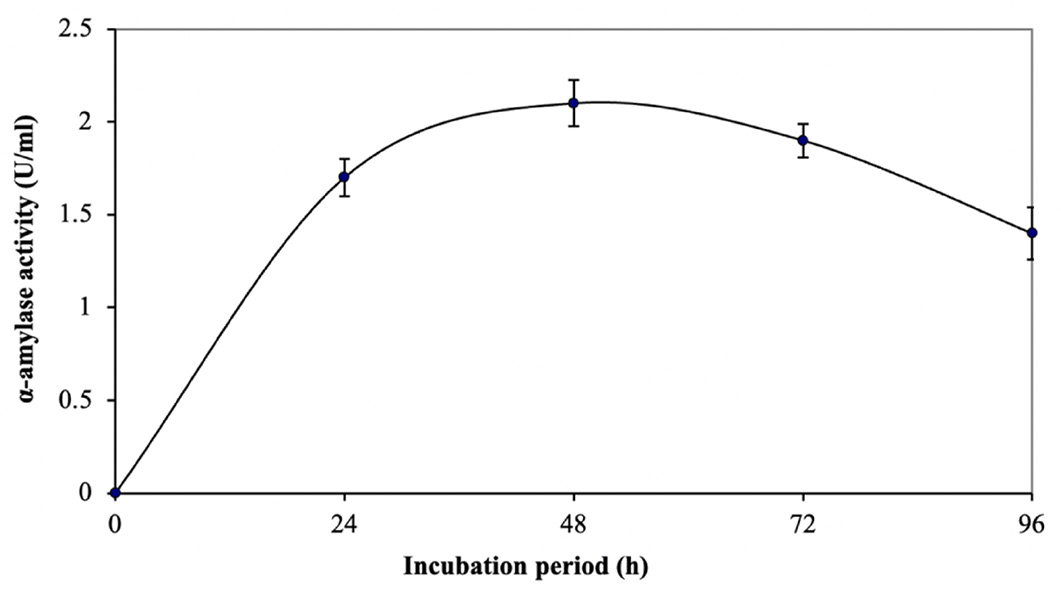
Optimizing incubation time is quite critical for the optimal growth of bacterial culture . The alpha-amylase production takes place only in cells in which normal cellular multiplication no longer occurs ; . Therefore, a research study consisting of 24-96 hours was carried out for alpha-amylase production by B. subtilis. As shown in Figure 1, enzyme productivity increased with increasing incubation time while the maximum productivity (2.1±0.15 U/ml) was obtained at an incubation time of 48 hours after inoculation. This is because B. subtilis enters the stationary phase after 48 hours and produce maximum alpha-amylase. After 48h of incubation, a rapid decrease in alpha-amylase production was observed due to nutrient depletion and accumulation of metabolites and toxic substances in the fermented bran ; . These findings are similar to the work of other researchers ; . Hence, the incubation period of 48 hours was considered optimal for alpha-amylase production by B. subtilis.
3.2 Selection of diluent’s initial pH of diluent for the bioproduction of alpha-amylase
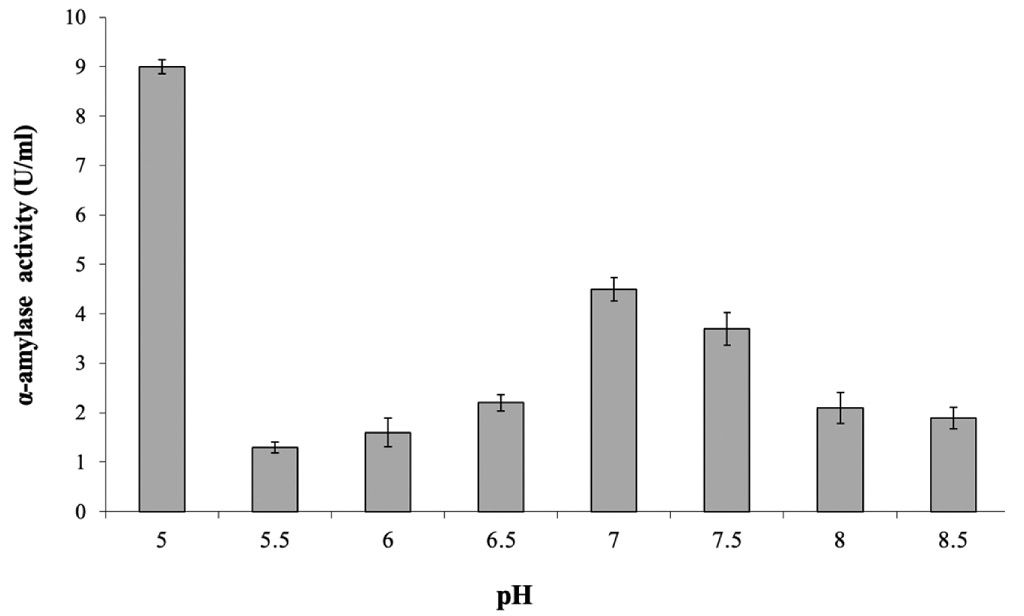
Figure 2 shows the effect of the diluent pH (5.5-8.5) on alpha-amylase bioproduction by B. subtilis. It was noted that with increasing pH, alpha-amylase production increased gradually. The maximum enzyme production (4.5±0.31 U/ml) was obtained at neutral pH. Further increase in pH declined the enzyme production by B. subtilis. It is because the optimum pH requirement for the growth of bacteria is neutral pH (7). At acidic pH, enzyme activity was less because it resulted in poor bacterial growth. Similar findings are reported by others as well ; ; .
3.3 Selection of carbon sources for the bioproduction of alpha-amylase
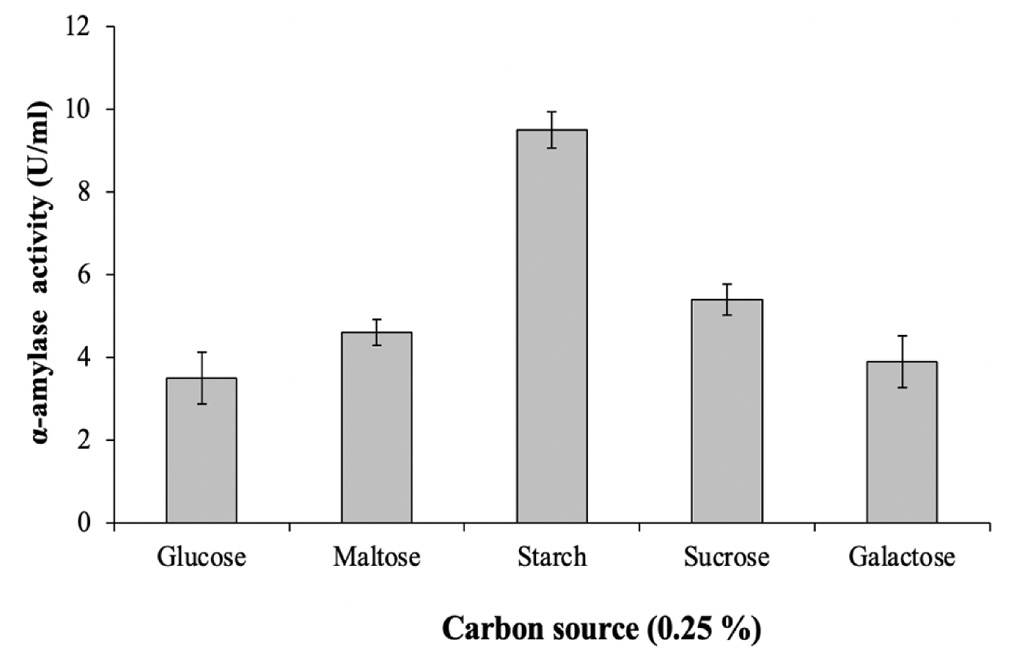
In addition to the cultivation method, alpha-amylase production is greatly affected by essential nutrients among which carbon source is most noticeable. In the present work different mono and polysaccharides; glucose, soluble starch, maltose, sucrose and arabinose were used for optimal alpha-amylase production by B. subtilis (Figure 3) and the maximum production of alpha-amylase (9.5±0.43 U/ml) was obtained with soluble starch (0.25%, w/v). It is because starch as the substrate of alpha-amylase is the best inducer. Similar results are reported by Rajagopalan et al. (2010). However, glucose and arabinose gave the least production i.e., 3.5±0.6 and 3.1±0.23 U/ml, respectively. While contradictory results are reported by Anto et al. (2006) who discussed maximum amylase production in the glucose-supplemented culture medium.
3.4 Selection of nitrogen sources for the bioproduction of alpha-amylase
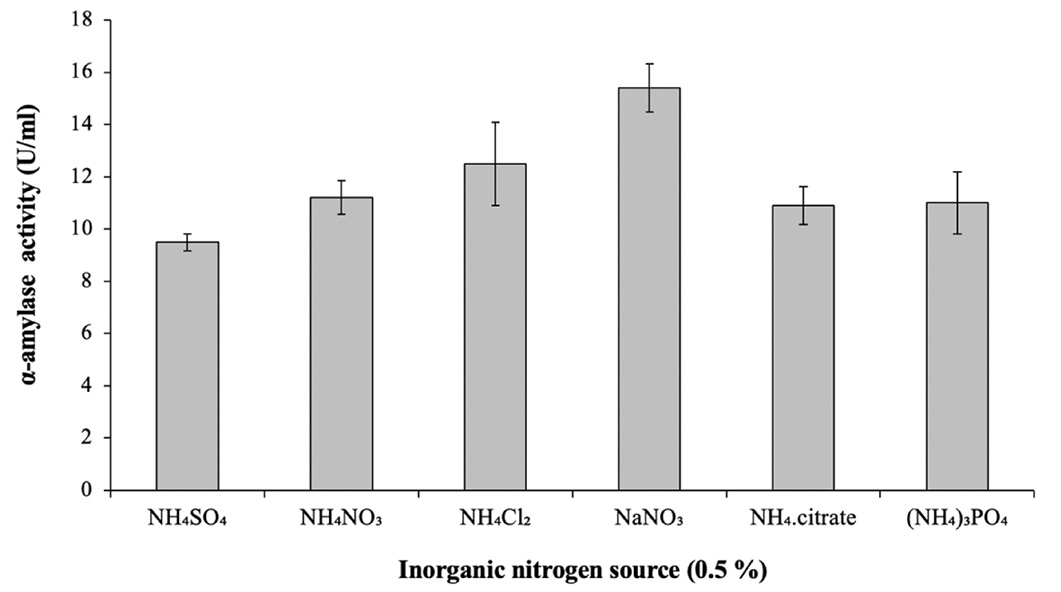
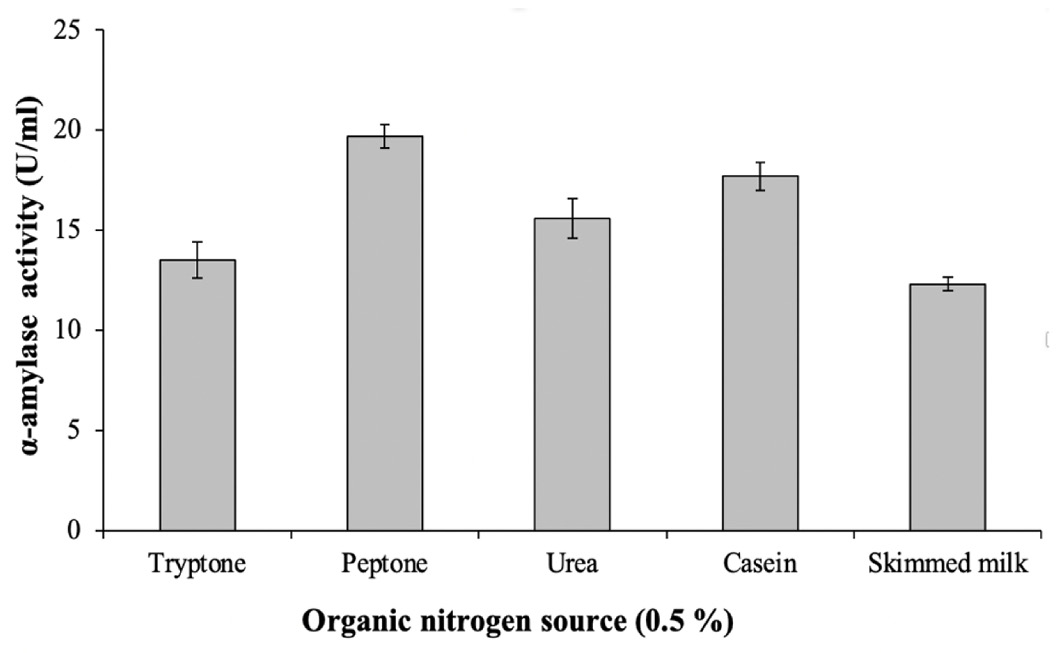
Nitrogen sources (organic and inorganic) are known to enhance alpha-amylase production in SSF system (Pederson and Nielson, 2000). Figure 4 depicts the effect of various inorganic nitrogen sources i.e., ammonium citrate, (NH4)2SO4, NH4SO4, NH4NO3, NH4Cl2 and NaNO3 on the production of alpha-amylase (Figure 4). The maximum enzyme production (15.4±0.92 U/ml) was achieved when the diluent was supplemented with NaNO3. On the contrary, Aiyer (2004) reported different findings; optimal alpha-amylase production using NH4Cl2 as an inorganic nitrogen source. Five organic nitrogen sources (Tryptone, peptone, urea, casein and skimmed milk) were also tested for alpha-amylase fermentation (Figure 5). Among all of them, peptone gave maximum enzyme production (19.7±1.2 U/ml). On the contrary, another study reported a marginal rise in the bioproduction of alpha-amylase with the addition of peptone .
3.5 Effect of metal ions on the bioproduction of alpha-amylase
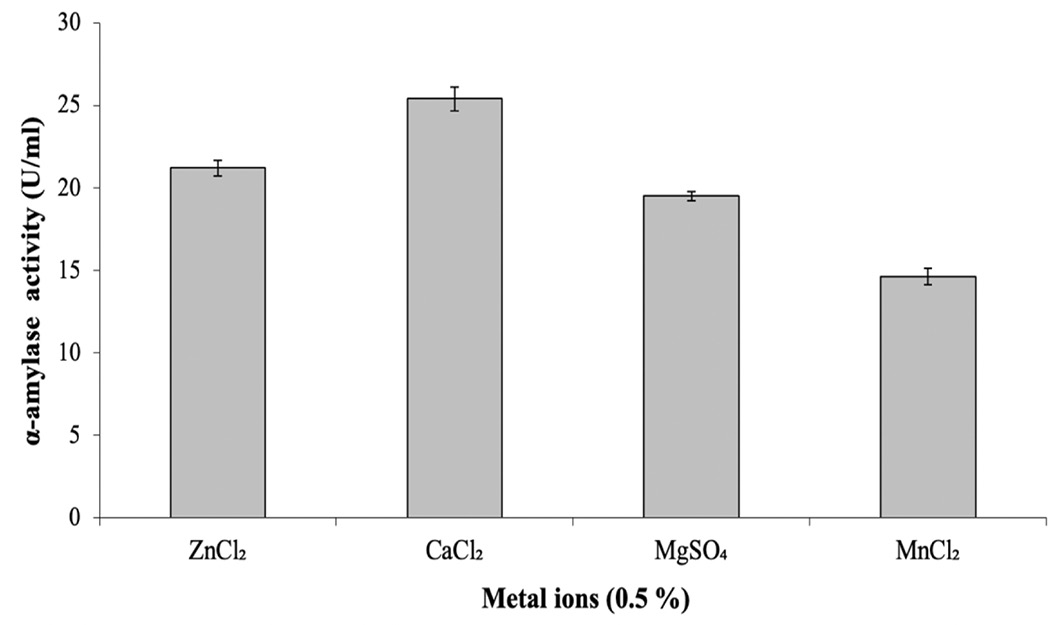
The effect of four different metal ions on alpha-amylase production was studied (Figure 6). In this context, diluent was supplemented with ZnCl2, CaCl2, MgSO4 and MnCl2 individually. The enzyme production was maximum (25.4± 0.73 U/ml) when CaCl2 (0.5 %) was added to the diluent. It is due to the reason that Ca2+ ions are essential for the activity and stability of alpha-amylases . Similar findings are also described by others ; .
Conclusions and Recommendations
The cultural conditions and nutritional necessities of Bacillus subtilis for the optimal biosynthesis of alpha-amylase via SSF are optimized successfully. The optimal amylase bioproduction was attained when the fermentation was carried out for 48 h at 37ºC using 10 g wheat bran. Alpha amylase production was improved by using the diluent having pH 7. Maximum alpha-amylase production (25.4±0.73 U/ml) was achieved when diluent was supplemented (%, w/v) with soluble starch 0.25, NH4NO3, peptone 0.25 and CaCl2 0.5. However, the production of alpha-amylase can be further improved by mutation prior to scale-up studies.
Acknowledgments
We acknowledge PCSIR, Laboratories, Lahore for providing the bacterial strain and facilities.
Novelty Statement
we have reported the optimized conditions for the alpha-amylase biosynthesis by B. subtilis that resulted in a 12.1-fold (1109.5% increase) in enzyme productivity.
Author’s Contribution
UH, AL, MAK: Design of design, experimental work, data analysis and manuscript writing.
MA: Manuscript preparation.
IH: Approval of the experiment design.
Conflict of interest
The authors have declared no conflict of interest.
Figures
References
- Aiyer, P.V., 2004. Effect of C:N ratio on alpha amylase production by Bacillus licheniformis SPT 27. African Journal of Biotechnology, 3(10): 519-522. https://doi.org/10.5897/AJB2004.000-2103[CrossRef]
- Al-Dhabi, N.A., Esmail, G.A., Ghilan, A.M., Arasu, M.V., Duraipandiyan, V, and Ponmurugan, K., 2020. Isolation and purification of starch hydrolysing amylase from Streptomyces sp. Al-Dhabi-46 obtained from the Jazan region of Saudi Arabia with industrial applications. Journal of King Saud University, Science, 32(1):1226-1232. https://doi.org/10.1016/j.jksus.2019.11.018[CrossRef]
- Anto, H., Trivedi, U., and Patel, K., 2006. Alpha amylase production by Bacillus cereus MTCC 1305 Using Solid-State Fermentation. Food Technology and Biotechnology, 44(2): 241-245.
- Balakrishnan, M., Jeevarathinam, G., Kumar, S.K.S., Muniraj, I. and Uthand, S., 2021. Optimization and scale-up of α-amylase production by Aspergillus oryzae using solid-state fermentation of edible oil cakes. BMC Biotechnology, 21: 33. https://doi.org/10.1186/s12896-021-00686-7[CrossRef]
- Chamber, R., Haddaoui, E., Petitglatran, M.F., Lindy, O., and Sarvas, M., 1999. Bacillus subtilis α-amylase. The rate limiting step of secretion is growth phase independent. FEMS Microbiology Letters, 173(1): 127-131. https://doi.org/10.1111/j.1574-6968.1999.tb13493.x[CrossRef]
- Chavez-Camarillo, G.M., Lopez-Nunez, P.V., Jimenez-Nava, R.A., Aranda-Garcia, E, and Cristiani-Urbina, E., 2022. Production of extracellular α-amylase by single-stage steady-state continuous cultures of Candida wangnamkhiaoensis in an airlift bioreactor. PLoS One, 17(3): e0264734. https://doi.org/10.1371/journal.pone.0264734[CrossRef]
- Chimata, M.K., Sasidhar, P., and Challa, S., 2010. Production of extracellular amylase from agricultural residues by a newly isolated Aspergillus species in solid state fermentation. African Journal of Biotechnology, 9(32): 5162-5169.
- Chorfa, N., Nlandu, H., Belkacemi, K., and Hamoudi, S., 2022. Physical and enzymatic hydrolysis modifications of potato starch granules. Polymers (Basel), 14(10): 2027. https://doi.org/10.3390/polym14102027[CrossRef]
- Couto, S.R., and Sanroman, M.A., 2006. Application of solid-state fermentation to food industry. A review. Journal of Food Engineering. 76(3): 291-302. https://doi.org/10.1016/j.jfoodeng.2005.05.022[CrossRef]
- Fuentes-Zaragoza, E., Riquelme-Navarrete, M.J., Sanchez-Zapata, E., and Perez-Alvarez, J.A., 2010. Resistant starch as functional ingredient: A review. Food Research International, 43(4): 931-942. https://doi.org/10.1016/j.foodres.2010.02.004[CrossRef]
- Gan, T., and Evers, B.M., 2022. Sabiston textbook of surgery, 25th edition, Elsevier Inc. Chapter 50, pp. 1240-1300.
- Gangadharan, D., Sivaramakrishnan, S., Nampoothiri, K.M, and Pandey, A., 2006. Solid culturing of Bacillus amyloliquefaciens for alpha-amylase production. Food Technololgy and Biotechnology, 44(2): 269–274.
- Gangadharan, D., Sivaramakrishnan, S., Nampoothiri, K.M., Sukumaran, R.K., and Pandey, A., 2008. Response surface methodology for the optimization of alpha amylase production by Bacillus amyloliquefaciens. Bioresource Technology, 99: 4597-4602. https://doi.org/10.1016/j.biortech.2007.07.028[CrossRef]
- Gavrilescu, M. and Chisti, Y., 2005. Biotechnology-a sustainable alternative for chemical industry. Biotechnology Advances, 23: 471-499. https://doi.org/10.1016/j.biotechadv.2005.03.004[CrossRef]
- Ghorai, S., Banik, S.P., Verma, D., Chowdhury, S., Mukherjee, S, and Khowala, S., 2009. Fungal biotechnology in food and feed processing. Food Research International, 42: 577–587. https://doi.org/10.1016/j.foodres.2009.02.019[CrossRef]
- Gupta, R., Gigras, P., Mohapatra, H., Goswami, V.K., and Chauhan, B., 2003. Microbial α-amylases: A biotechnological perspective. Process Biochemistry, 38: 1599-1616. https://doi.org/10.1016/S0032-9592(03)00053-0[CrossRef]
- Hallol, M., Helmy, O., Shawky, A-E, El-Batal, A. and Ramadan, M., 2022. Optimization of Alpha-amylase production by a local Bacillus paramycoides isolate and immobilization on chitosan-loaded barium ferrite nanoparticles. Fermentation, 8(5): 241. https://doi.org/10.3390/fermentation8050241[CrossRef]
- Haq, I.U., Shamim, N., Ashraf, H., Ali, S., and Qadeer, M.A., 2005. Effect of surfactants on the biosynthesis of alpha amylase by Bacillus subtilis GCBM-25. Pakistan Journal of Botany, 37(2): 373-379.
- Hashemi, M., Razavi, S.H., Shojaosadati, S.A., Mousavi, S.M., Khajeh, K., and Safari, M., 2010. Development of a solid-state fermentation process for production of an alpha amylase with potentially interesting properties. Journal of Bioscience and Bioengineering, 110(3): 333-337. https://doi.org/10.1016/j.jbiosc.2010.03.005[CrossRef]
- Kandra, L., 2003. α-Amylases of medical and industrial importance. Journal of Molecular Structure (Theochem), 666-667: 487-498. https://doi.org/10.1016/j.theochem.2003.08.073[CrossRef]
- Kokab, S., Asghar, M., Rehman, K., Asad, M.J., and Adedyo, O., 2003. Bio-processing of banana peel for α-amylase production by Bacillus subtilis. International Journal of Agriculture and Biology, 5(1): 36–39.
- Konsoula, Z., and Liakopouloukyriakides, M., 2007. Co-production of α-amylase and α-galactosidase by Bacillus subtilis in complex organic substrates. Bioresource Technology, 98(1): 150–157. https://doi.org/10.1016/j.biortech.2005.11.001[CrossRef]
- Luang-In, V., Yotchaisarn, M., Saengha, W., Udomwong, P., Deeseenthum, S., and Maneewan, K., 2019. Isolation and identification of amylase-producing bacteria from soil in Nasinuan community forest, Maha Sarakham, Thailand. Biomedical and Pharmacology Journal, 12(3). https://doi.org/10.13005/bpj/1735[CrossRef]
- Lulko, T., Veening, J.W., Buist, G., Smits, W.K., Blom, E.J., Beekman, A.C., Bron, S. and Kuipers, O.P., 2007. Production and secretion stress caused by overexpression of heterologous α-amylase leads to inhibition of sporulation and a rolonged motile phase in Bacillus subtilis. Applied and Environmental Microbiology, 73(3): 5354-5362. https://doi.org/10.1128/AEM.00472-07[CrossRef]
- Madigan, M., and Martinko, J., 2005. Brock biology of microorganisms: 11th edn. NJ, USA.
- Miller, G.L., 1959. Use of dinitrosalicylic acid reagent for determination of reducing sugar. Analytical Chemistry, 31: 426-428. https://doi.org/10.1021/ac60147a030[CrossRef]
- Nomura, M., Moruo, B., and Akabor, S., 1956. Studies on alpha amylase fermentation by Bacillus subtilis. Journal of Biochemistry, 31: 143-147. https://doi.org/10.1093/oxfordjournals.jbchem.a126615[CrossRef]
- Pandey, A., Nigam, P., Soccol, C.R., Soccol, V.T., Singh, D., and Mohan, R., 2000. Advances in microbial amylases. Biotechnology and Applied Biochemistry, 31: 135-152. https://doi.org/10.1042/BA19990073[CrossRef]
- Pandey, A., Selvakumar, P., Soccol, C.R., and Nigam, P., 1999. Solid-state fermentation for the production of industrial enzymes. Bioresource Techology, 77(1): 149-162.
- Pant, G., Prakash, A., Pavani, J.V.P., Bera, S., Deviram, G.V.N.S., Kumar, A., Panchpuri, M., and Prasuna, R.G., 2015. Production, optimization and partial purification of protease from Bacillus subtilis. Journal of Taibah University for Science, 9(1): 50–55. https://doi.org/10.1016/j.jtusci.2014.04.010[CrossRef]
- Pedersen, H., and Nielsen. J., 2000. The influence of nitrogen sources on the alpha amylase productivity of Aspergillus oryzae in continuous cultures. Applied Microbiology and Biotechnology, 53: 278–281. https://doi.org/10.1007/s002530050021[CrossRef]
- Peixoto, S.C., Jorge, J.A., Terenzi, H.F., Lourdes, M.D., and Polizeli, T.M., 2003. Rhizopus microsporus var. rhizopodiformis: A thermotolerant fungus with potential for production of thermostable amylases. International Microbiology, 6: 269–273. https://doi.org/10.1007/s10123-003-0140-1[CrossRef]
- Prakash, O., and Jaiswal, N., 2009. Alpha-Amylase: An ideal representative of thermostable enzymes. Applied Biochemistry and Biotechlogy, 160(8): 2401-2414. https://doi.org/10.1007/s12010-009-8735-4[CrossRef]
- Rajagopalan, G., and Krishnan, C., 2008. α-amylase production from catabolite depressed Bacillus subtilis KCC103 utilizing sugarcane bagasse hydrolysate. Bioresource. Technology, 99(8): 3044-3050. https://doi.org/10.1016/j.biortech.2007.06.001[CrossRef]
- Rajagopalan, G., and Krishnan, C., 2010. Hyper-production of α-amylase from agro residual medium with high-glucose in SSF using catabolite derepressed Bacillus subtilis KCC103. Journal of Basic Microbiology, 50: 336–343. https://doi.org/10.1002/jobm.200900199[CrossRef]
- Reddy, A.S., Jharat, R., and Byrne, N., 2003. Purification and properties of amylase from-A review. Journal of Food Biochemistry, 21: 281-302.
- Riaz, N., Haq, I.U., and Qadeer, M.A., 2003. Characterization of α-Amylase by Bacillus subtilis. International Journal of Agriculture and Biology, 5(3): 249–252.
- Rick, W. and Stegbauer, H.P., 1974. α-amylase of reducing groups. In. H.V. Bergmeyer (ed), Methods of Enzymatic Analysis, 2nd edn. pp. 885-890. Academic Press, New York
- Singhania, R.R., Patel, A.K., Soccol, C.R., and Pandey, A., 2009. Recent advances in solid-state fermentation. Biochemical Engineering Journal, 44(1): 13-18. https://doi.org/10.1016/j.bej.2008.10.019[CrossRef]
- Sivaramakrishnan, S., Gangadharan, D., Madhavan, K., Nampoothiri, K.M., Soccol, C.R., and Pandey, A., 2006. α-Amylases from Microbial Sources. Food Technology and Biotechnology, 44(2): 173–184.
- Syu, M.J., and Chen, Y.H., 1997. A study on the amylase fermentation performed by Bacillus amyloliquefaciens. Chemical Engineering Journal, 65: 237-247. https://doi.org/10.1016/S1385-8947(97)00020-X[CrossRef]
- Tanyildizi, M.S., Ozer, D., and Elibol, M., 2005. Optimization of α-amylase production by Bacillus sp. using response surface methodology. Process Biochemistry, 40: 2291–2296. https://doi.org/10.1016/j.procbio.2004.06.018[CrossRef]
- Tanyildizi, M.S., Ozer, D., and Elibol, M., 2007. Production of bacterial α-amylase by B. amyloliquefaciens under solid substrate fermentation. Biochemical Engineering Journal, 37: 294-297. https://doi.org/10.1016/j.bej.2007.05.009[CrossRef]
- Wang, Y., Ral, J.P., Saulnier, L., and Kansou, K., 2022. How Does starch structure impact amylolysis? Review of current strategies for starch digestibility study. Foods, 11(9): 1223. https://doi.org/10.3390/foods11091223[CrossRef]
- Yamaguchi, K., Nagata, Y., and Maruo, B., 1974. Isolation of mutants defective in alpha amylase from Bacillus subtilis. Journal of Bacteriology, 119(2): 416-424. https://doi.org/10.1128/jb.119.2.416-424.1974[CrossRef]
Services
Article usage statistics
Loading…