
Reptiles, like amphibians, are considered an important indicator of the ecosystems health. They are sensitive to changes in their habitat and are used as model animals to understand ecology. Although some work has been carried out on documentation of the squamate fauna of Pakistan, very little or no attention has been given to assessing the environmental variables influencing their geographic distribution, occupancy, and habitat association. We, therefore, conducted the present study to model occupancy and detection probability of Acanthodactylus cantoris (Indian fringe-fingered lizard) and Eutropis dissimilis (striped grass skink) and examine site (substrate, canopy cover, distance to nearest wetland) and survey covariates (time of the survey and shrub cover) affecting their occupancy and detection probability in 24 sites of Southern Khyber Pakhtunkhwa, Pakistan. We carried out field surveys from March to May 2023 to collect data on the presence of the species. We ran 32 candidate occupancy models using a package unmarked in R. The top-ranked model estimated that the detection probability of Acanthodactylus cantoris was 0.51 ± 0.06 (95% CI 0.38- 0.64), while that of Eutropis dissimilis was 0.36 ± 0.08 (95% CI 0.22- 0.54). The model did not include the effect of any observation covariates (i.e. time of survey or shrub cover > or < 25%). The top-ranked model for the occupancy of Acanthodactylus cantoris yielded an estimate of 0.75± 0.04 (95% CI 0.006 - 0.89), while Eutropis dissimilis yielded an estimate of 0.68± 0.12 (95% CI 0.16- 0.88). The model included the effect (non-significant) of substrate only. The best-fit models for both studied species passed the goodness of fit tests (P > 0.05). We suggest carrying out more robust studies incorporating more sites and effects of other survey covariates such as season, observer, and temperature.
Research Article · Volume 57, Issue 5, 12 August 2025 · Open Access
Occupancy Patterns of Acanthodactylus cantoris and Eutropis dissimilis in Khyber Pakhtunkhwa, Pakistan
· · · · · ·
Affiliations & Notes ⌄
- 1Department of Zoology, Kohat University of Science and Technology, Kohat, Khyber Pakhtunkhwa, Pakistan 2Herpetology lab, Department of Zoology, Wildlife, and Fisheries, PMAS-Arid Agriculture University, Rawalpindi, Pakistan 3Guangdong Key Laboratory of Animal Conservation and Resource Utilization, Guangdong Public Laboratory of Wild Animal Conservation and Utilization Institute of Zoology, Guangdong Academy of Sciences, Guangzhou, China 4Department of Zoology, University of Peshawar, Peshawar, K
Article Info ⌄
- Journal:
- Pakistan Journal of Zoology
- Published:
- 12 August 2025

From the article
- The top-ranked model estimated that the detection probability of Acanthodactylus cantoris was 0.51± 0.06 (95% CI 0.38- 0.64).
- The model included the effect (non-significant) of substrate only (Tables I, II).
- The top-ranked model for the occupancy of Eutropis dissimilis yielded an estimate of 0.68± 0.12 (95% CI 0.16- 0.88).
- The present study reports findings on factors affecting occupancy and detection probability of a ground-dwelling lacertid Acanthodactylus cantoris and a skink Eutropis dissimilis.
Selected from the article's own text.
Abstract
INTRODUCTION
With over 6000 species, lizards are a diverse group of reptiles belonging to the Order Squamata (Class: Reptilia) and can be found in various habitats worldwide except Antarctica . They play a crucial role in ecological systems, contribute significantly to biodiversity , and are essential components of food webs, serving as both predators and prey, thus influencing population dynamics and energy flow within ecosystems . In recent decades, a rapid decline in reptilian populations has been reported with at least 1829 out of 10,196 species (21.1%) declared threatened globally due to several threats such as pollution, habitat destruction, and invasive species . Being ectothermic animals, reptiles are particularly susceptible to the impacts of climate change .
Khan (2006) reported 195 reptilian species (23 families) from Pakistan, of which 38 species are endemic. There are 14 species of lizards in the Lacertidae and 17 species in the family Scincidae. The Indian fringe-fingered lizard (Acanthodactylus cantoris), family Lacertidae (Supplementary Fig. 1A) is a diurnal, ground-dwelling, medium-sized lizard . It is widely distributed in the southern regions of Khyber Pakhtunkhwa, Thar, Cholistan, Nara, Chagai, and Kharan deserts ; . The striped grass skink (Eutropis dissimilis), family Scincidae (Supplementary Fig. 1B) is a diurnal, lives in wide, wet grasslands, and also reaches the tilled ground . In Pakistan, it is distributed in the Dera Ismail Khan region, along the delta of the Indus River and the salt range ; . The two species have been assessed as the least concern globally ; .
Studying occupancy is essential for lizards because it can provide valuable insights into their habitat requirements, distribution patterns, and conservation needs, allowing researchers to identify critical habitat elements, evaluate the impact of habitat loss or fragmentation, and assess the effectiveness of conservation measures, thus fostering a comprehensive understanding that guides more informed and targeted lizard conservation efforts ; ; ; . Since its inception, the occupancy analysis has been widely used in conservation ecology. The analysis has been used to model the occupancy, detection probability, and habitat preference of various reptiles, especially lizards ; ; ; . Data on the habitat and phylogeny of species Saara hardwickii (Indian Spiny-tailed lizard), Eremias cholistanica (Cholistan Desert Lacerta), Heremites septemtaeniatus (Golden Grass Mabuya) were provided by Ali et al. (2020), Masroor et al. (2020, 2021). Some work on the squamate fauna of Southern Khyber Pakhtunkhwa , Sheikh Buddin National Park , Cholistan Desert and Margalla Hills National Park is available. Balouch et al. (2022) examined the effect of landscape composition on the movements of the oriental garden lizard Calotes versicolor in agricultural landscapes of north-central Pakistan. Balouch et al. (2016) reported Eutropis dissimilis as common in the croplands of District Chakwal, Punjab, Pakistan.
However, various aspects of the natural history of several lizard species require research in Pakistan. The current study was, therefore, designed to examine factors affecting occupancy and the detection probabilities of two lizard species viz., Indian fringe-fingered lizard and striped grass skink in southern parts of Khyber Pakhtunkhwa, Pakistan. The findings are expected to expand existing knowledge about the reptilian fauna of the province, contribute new data on the occurrence of these species concerning habitat and site variables, and could be used to develop survey techniques for future population monitoring and abundance assessment for these and similar species.
MATERIALS AND METHODS
Study area
The present study was conducted in the southern part (Districts Kohat, Karak, Hangu, Bannu, Lakki Marwat, Tank, and Dera Ismail Khan) of the Province of Khyber Pakhtunkhwa (KP), Pakistan (Fig. 1). The study area lies between 840 to 174m elevation and covers an area of 24,217 km2. The latitude and longitude are 33°35_31°51 and 71°26_70°54. The study area features the same climate throughout i.e. semi-arid hot summers and mild winters. The area experienced little monsoon rain in July and August. The minimum and maximum temperature was 5°C and 45°C, respectively. The annual rainfall ranges between 250-300 mm ; .
The study area features a blend of temperate and sub-tropical vegetation. The dominant vegetation consists of Vachellia modesta, Artemisia maritima, Monotheca buxifolia, Adhatoda vasica, Dodonaea viscosa, Lannea coromandelica, Withania coagulans, Eleusine compressa, Chrysopogon aucheri, Cymbopogon jwrancusa, and Saccharum spontaneum. The major crops of the area include maize, rice, wheat, millet, and orchards including guava, mango, apple and peach ; ; .
Survey methods
We conducted field surveys from March 2023 to May 2023 at 24 sites (Fig. 1). The sites were randomly selected based on the available information about the two-lizard species’ habitat and distribution ; . Each selected site was visited on three occasions with a one-month interval between each visit, to gather data on the presence/absence of the lizard species, the site covariates (substrate, canopy cover, shrub cover, distance to wetlands), and observation covariates (time). At each site, 2-3 transects (length= 500 m, width= 50 m) were laid out randomly. The transects were determined based on habitat distribution if a wetland was present then we selected three transects, if not then two, and walked at a steady slow speed to gather data on the aforementioned variables. The sighted species were identified using Khan (2006). The substrate was coded as 1 for sandy and 0 for clay, 1 if the canopy covers >25 % and 0 if < 25%, 1 if shrub covers >25 % and 0 if < 25%, 1 if a wetland was situated within 50 m and 0 if > 50 m and time was recorded as morning (7:00 am-10:00 am), noon (10:00 am-1:00 pm), and afternoon (1:00 pm-4:00 pm).
Statistical analysis
We ran a full model (~time+ shrub, ~ substrate+ canopy+ wetland) to examine the effect of these observations (time and shrub cover) on detection and site covariates (substrate, canopy cover, and presence of a wetland within 50 m) on occupancy of Acanthodactylus cantoris and Eutropis dissimilis using package “unmarked” ; . We used the dredge function of the package “MuMIn” and used AICc to rank the models obtained. The model with the lowest AICc was considered the best-fit model. We used three goodness of fit tests to perform model evaluation: Sum of squared errors, Pearson’s Chi-squared, and Freeman-Tukey Chi-squared test (P> 0.05 shows good fit) ; . All analyses were performed in R. 4.3.1 (R Core Team, 2020).
RESULTS AND DISCUSSION
We detected Acanthodactylus cantoris in 28 out of 72 (38%) sampling occasions during the study period in the selected sites of southern Khyber Pakhtunkhwa. The top-ranked model estimated that the detection probability of Acanthodactylus cantoris was 0.51± 0.06 (95% CI 0.38- 0.64). The model did not include the effect of any observation covariates (time of survey or shrub cover > or < 25%) (Tables I, II). The naïve occupancy, assuming perfect detection, and the proportion of area occupied by Acanthodactylus cantoris, accounting for imperfect detection, was 0.75. The top-ranked model for the occupancy of Acanthodactylus cantoris yielded an estimate of 0.75± 0.04 (95% CI 0.006 – 0.89). The model included the effect (non-significant) of substrate only (Tables I, II). The occupancy was higher on the clay substrate (0.99± 0.001).
Table I. Comparison of candidate models for the occupancy model for the Indian fringe-fingered lizard (Acanthodactylus cantoris) and striped grass skink (Eutropis dissimilis). Only the top five models for each species are given.
| Model | Parameters | logLik | AICc | ΔAICc | Weight | |
| Acanthodactylus cantoris | ||||||
| 11 | psi(substrate) p() | 5 | -27.485 | 68.3 | 0.00 | 4.93 |
| 12 | psi(substrate) p(shrub 25%) | 6 | -26.718 | 70.4 | 2.07 | 0.175 |
| 15 | psi(substrate+ canopy 25%) p() | 6 | -27.108 | 71.2 | 2.85 | 0.118 |
| 27 | psi(substrate+ wetland within 50m) p() | 6 | -27.146 | 71.2 | 2.93 | 0.114 |
| 16 | psi(substrate+ canopy 25%) p(shrub 25%) | 7 | -26.350 | 73.7 | 5.40 | 0.033 |
| Eutropis dissimilis | ||||||
| 9 | psi(substrate) p() | 3 | -38.489 | 84.2 | 0.00 | 0.253 |
| 1 | psi() p() | 2 | -40.248 | 85.1 | 0.89 | 0.162 |
| 13 | psi(substrate+ canopy 25%) p() | 4 | -38.090 | 86.3 | 2.11 | 0.088 |
| 10 | psi(substrate) p(shrub 25%) | 4 | -38.387 | 86.9 | 2.70 | 0.065 |
| 25 | psi(substrate+ wetland within 50m) p() | 4 | -38.446 | 87.0 | 2.82 | 0.062 |
AICc, akaike information criterion corrected for small samples; ΔAICc, the difference in AICc values between the given model and the model that is most likely to have generated the data (i.e. the one with the lowest AICc).
Table II. Parameter estimates from the top-ranked (based on AICc) for the occupancy model for the Indian fringe-fingered lizard (Acanthodactylus cantoris) and striped grass skink (Eutropis dissimilis).
| Species | Parameter | Estimate | SE | Z | P |
| Acanthodactylus cantoris | Intercept | -1.65 | 1.11 | -1.49 | 0.136 |
| Substrate | 11.75 | 37.94 | 0.31 | 0.757 | |
| Eutropis dissimilis | Intercept | 7.97 | 30.7 | 0.260 | 0.795 |
| Substrate | -7.76 | 30.7 | -0.253 | 0.800 |
SE, Standard error; P, level of significance.
We detected Eutropis dissimilis in 18 out of 72 (25%) sampling occasions. The top-ranked model estimated that the detection probability of Eutropis dissimilis was 0.36± 0.08 (95% CI 0.22- 0.54). The model did not include the effect of any observation covariates (time of survey or shrub cover 25%) (Tables I, II). The naïve occupancy, assuming perfect detection, was 0.54 while the proportion of area occupied by Eutropis dissimilis, accounting for imperfect detection, was 0.68. The top-ranked model for the occupancy of Eutropis dissimilis yielded an estimate of 0.68± 0.12 (95% CI 0.16- 0.88). The model included the effect (non-significant) of substrate only (Tables I, II). The occupancy was higher on the clay substrate (0.99±0.01). The best-fit models for both studied species passed the goodness of fit tests (P > 0.05).
The present study reports findings on factors affecting occupancy and detection probability of a ground-dwelling lacertid Acanthodactylus cantoris and a skink Eutropis dissimilis. Shehzad et al. (2023) recorded Acanthodactylus cantoris along the sandy patches of the river and dunes in southern Khyber Pakhtunkhwa. Balouch et al. (2016) reported Eutropis dissimilis as common from the croplands of District Chakwal, Punjab, Pakistan.
No similar work is available on these two species; however, habitat association of other reptilian species from elsewhere in the world has been studied. Previously available studies, the Eastern spiny-tailed gecko (Strophurus intermedius) in topographically different landscapes in south-eastern Australia , reported the null model as the best-fit model. While some previously available studies ; ; ; . show that the best-fit model had effects of covariates. Our findings show that the two studied species are widespread in the study area. Research on population size, distribution, trends, life history, ecology, and threat assessment of Eutropis dissimilis is lacking . Our study has filled this gap.
Declarations
Acknowledgment
We would like to acknowledge the kind assistance received from Kohat University of Science and Technology (KUST) and PMAS-Arid Agriculture University Rawalpindi. The facilities and resources provided by these institutions greatly facilitated the execution of this research.
Funding
This research project is partially supported by IDEA WILD (IDEA WILD is a 501(c)(3) non-profit organization)
Supplementary material
There is supplementary material associated with this article. Access the material online at: https://dx.doi.org/10.17582/journal.pjz/20240219171021
Statement of conflict of interest
The authors have declared no conflict of interest.
Figures
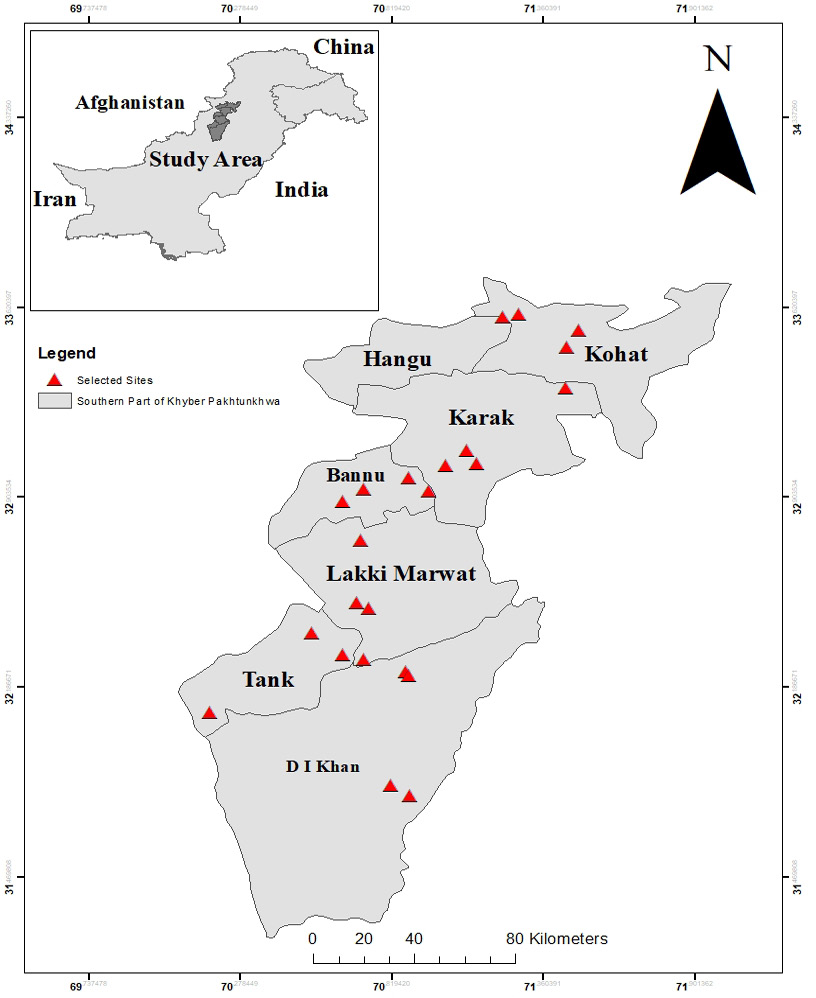
Map of the study area (Kohat, Karak, Hangu, Bannu, Lakki Marwat, Tank, and Dera Ismail Khan Districts, Khyber Pakhtunkhwa, Pakistan) showing locations of the selected sampling sites.
References
- Adil, S., Ijaz, S., Aslam, H., Kanwal, R. and Afsheen, S., 2020. Diversity of amphibians and 191 reptiles in Daphar Forest Sanctuary, district Mandi Bahauddin. Pakistan. J. Wildl. Ecol., 4: 15-26. https://doi.org/10.33411/IJIST/2022040307[CrossRef]
- Ali, W., Javid, A., Hussain, A., Bukhari, S.M. and Hussain, S., 2021. Preliminary assessment of the diversity and habitat preferences of herpetofauna in Cholistan Desert, Pakistan. Russ. J. Herpetol., 28: 375-379. https://doi.org/10.30906/1026-2296-2021-28-6-375-379[CrossRef]
- Ali, W., Javid, A., Hussain, S., Hussain, A. and Bukhari, S.M., 2020. Morphological variations, distribution, and population estimation of indian spiny-tailed lizard (Uromastyx hardwickii Gray, 1827) from District Bahawalnagar, Punjab, Pakistan. Asian Herpetol. Res., 11: 257-262. https://doi.org/10.16373/j.cnki.ahr.190047[CrossRef]
- Balouch, S., Driscoll, D., Naseer, A., Rais, M. and Doherty, T.J.A.C., 2022. Impacts of land cover on reptile movement and habitat use in farming landscapes. Anim. Conserv., 25: 837-848. https://doi.org/10.1111/acv.12789[CrossRef]
- Balouch, S., Rais, M., Hussain, I. and Akram, A., 2016. Squamate diversity in different croplands of district Chakwal, Punjab, Pakistan. J. King Saud Univ. Sci., 28: 255-260. https://doi.org/10.1016/j.jksus.2016.01.003[CrossRef]
- Barton, K., 2023. MuMIn: Multi-model inference. R package version 1.47.5. https://cran.rproject.org/web/ packages/MuMIn/MuMIn.pdf. Accessed July 2023.
- Biber, M.F., Voskamp, A., Hof, C.J.G.E. and Biogeography, 2023. Potential effects of future climate change on global reptile distributions and diversity. Global Ecol. Biogeogr., 32: 519-534. https://doi.org/10.1111/geb.13646[CrossRef]
- Cox, N., Young, B.E., Bowles, P., Fernandez, M., Marin, J., Rapacciuolo, G. and Hilton-Taylor, C., 2022. A global reptile assessment highlights the shared conservation needs of tetrapods. Nature, 605: 285-290. https://doi.org/10.1038/s41586-022-04664-7[CrossRef]
- Devarajan, K., Morelli, T.L. and Tenan, S., 2020. Multi-species occupancy models: Review, roadmap, and recommendations. Ecography, 43: 1612-1624. https://doi.org/10.1111/ecog.04957[CrossRef]
- Dibner, R.R., Doak, D.F. and Murphy, M., 2017. Discrepancies in occupancy and abundance approach to identifying and protecting habitat for an at risk species. Ecol. Evol., 7: 5692-5702. https://doi.org/10.1002/ece3.3131[CrossRef]
- Einoder, L.D., Southwell, D.M., Lahoz-Monfort, J.J., Gillespie, G.R., Fisher, A. and Wintle, B.A.J.P.O., 2018. Occupancy and detectability modeling of vertebrates in northern Australia using multiple sampling methods. PLoS One, 13: e0203304. https://doi.org/10.1371/journal.pone.0203304[CrossRef]
- Fiske, I. and Chandler, R., 2011. Unmarked: An R package for fitting hierarchical models of wildlife occurrence and abundance. J. Statist. Softw., 43: 1-23. https://doi.org/10.18637/jss.v043.i10[CrossRef]
- Hamid, H.N., Rais, M., Arif, M. and Noor, R., 2021. Amphibians and reptiles of Sheikh Baddin National Park, Khyber Pakhtunkhwa: Diversity, threats and conservation prospects. Pakistan J. Zool., 53: 785. https://doi.org/10.17582/journal.pjz/20190826180828[Full text][CrossRef]
- Hussain, S., Hussain, S. and Hanif, M., 2013. Climate change scenarios and possible adaptation measures, Chitral and DIK districts of KPK, Pakistan. Intercooper. Pakistan, pp. 22. https://doi.org/10.13140/RG.2.1.3123.7849[CrossRef]
- Kamran, S., Khan, S.M., Ahmad, Z., Ur Rahman, A., Iqbal, M., Manan, F. and Ullah, S., 2020. The role of graveyards in species conservation and beta diversity: A vegetation appraisal of sacred habitats from Bannu, Pakistan. J. For. Res., 31: 1147-1158. https://doi.org/10.1007/s11676-019-00893-1[CrossRef]
- Kellner, K.F., Smith, A.D., Royle, J.A., Kéry, M., Belant, J.L. and Chandler, R.B., 2023. The unmarked R package: Twelve years of advances in occurrence and abundance modeling in ecology. Methods Ecol. Evol., 14:1408-1415. https://doi.org/10.1111/2041-210X.14123[CrossRef]
- Khan, A.N., 2013. Analysis of 2010 flood causes, nature, and magnitude in the Khyber Pakhtunkhwa, Pakistan. Natl. Hazards, 66: 887-904. https://doi.org/10.1007/s11069-012-0528-3[CrossRef]
- Khan, F.K., 1991. Geography of Pakistan: Environment, people and economy. Oxford University Press.
- Khan, M.S., 1999. Herpetology of habitat types of Pakistan. Pakistan J. Zool., 31: 275-289.
- Khan, M.S., 2006. Amphibians and reptiles of Pakistan. Krieger Publishing Company Malabar, Florida, USA.
- Khan, S.N., Ali, R., Khan, S., Norin, S., Rooman, M., Akbar, N.U. and Ali, I., 2021. Cystic echinococcosis: An emerging zoonosis in southern regions of Khyber Pakhtunkhwa, Pakistan. BMC Vet. Res., 17: 1-11. https://doi.org/10.1186/s12917-021-02830-z[CrossRef]
- MacKenzie, D.I. and Bailey, L.L.J.J.O.A., Biological and Statistics, E., 2004. Assessing the fit of site-occupancy models. J. agric. biol.environ. Stat., 9: 300-318. https://doi.org/10.1198/108571104X3361[CrossRef]
- MacKenzie, D.I., Nichols, J.D., Hines, J.E., Knutson, M.G. and Franklin, A.B.J.E., 2003. Estimating site occupancy, colonization, and local extinction when a species is detected imperfectly. Ecology, 84: 2200-2207. https://doi.org/10.1890/02-3090[CrossRef]
- MacKenzie, D.I., Nichols, J.D., Royle, J.A., Pollock, K.H., Bailey, L. and Hines, J.E., 2017. Occupancy estimation and modeling: Inferring patterns and dynamics of species occurrence. Elsevier. https://doi.org/10.1016/B978-0-12-407197-1.00019-3[CrossRef]
- Masroor, R., 2011. An annotated checklist of amphibians and reptiles of Margalla Hills National Park, Pakistan. Pakistan J. Zool., 43: 1041-1048.
- Masroor, R., Idrees, M., Khisroon, M., Jamal, Q. and Jablonski, D.J.Z., 2021. Out of the blue: The first record of the genus Heremites Gray, 1845 (Squamata, Scincidae) from Pakistan. Zookeys, 1039: 123. https://doi.org/10.3897/zookeys.1039.64146[CrossRef]
- Masroor, R., Khisroon, M., Khan, M.A. and Jablonski, D.J.Z., 2020. A new species of Eremias (Squamata: Lacertidae) from the arid mountains of Pakistan. Zootaxa, pp. 4786-4781. https://doi.org/10.11646/zootaxa.4786.1.8[CrossRef]
- Michael, D.R., Ikin, K., Crane, M., Okada, S. and Lindenmayer, D.B., 2017. Scale-dependent occupancy patterns in reptiles across topographically different landscapes. Echography, 40: 415-424. https://doi.org/10.1111/ecog.02199[CrossRef]
- Minton, S.A., 1966. A contribution to the herpetology of West Pakistan. Bull. Am. nat. Hist., 134: Article 2. http://hdl.handle.net/2246/1129
- Oliveira, J.C., Ferreguetti, Á.C., de Castro, T.M. and Rocha, C.F.D., 2021. Factors affecting the abundance and occurrence of a threatened whiptail lizard endemic to the sandy coastal plains of Brazil. S. Am. J. Herpetol., 21: 25-33. https://doi.org/10.2994/SAJH-D-19-00122.1[CrossRef]
- Papenfuss, T. and Litvinchuk, S., 2021. Acanthodactylus cantoris. The IUCN red list of threatened species 2021: e.T21220771A21220775. https://doi.org/10.1073/pnas.0806080105[CrossRef]
- Papenfuss, T., Litvinchuk, S., Mohapatra, P., Giri, V. and Srinivasulu, C., 2021. Eutropis dissimilis. The IUCN red list of threatened species 2021: e.T194835A2364888.
- Prugh, L.R., Hodges, K.E., Sinclair, A.R. and Brashares, J., 2008. Effect of habitat area and isolation on fragmented animal populations. Proc. natl. Acad. Sci., 105: 2077020775.
- Shehzad, M., Ullah, F., Khan, S.N., Majid, A., Rais, M., Khan, M.A. and Khan, S., 2023. Squamate Fauna of Southern Khyber Pakhtunkhwa (Tank and Lakki Marwat Districts), Pakistan. https://doi.org/10.17582/journal.pjz/20230330190305[Full text][CrossRef]
- Sindaco, R., Jeremčenko, V.K., Venchi, A. and Grieco, C., 2008. The reptiles of the western palearctic: Annotated checklist and distributional atlas of the turtles, crocodiles, amphisbaenians and lizards of Europe, North Africa, Middle East and Central Asia (Vol. 1): Edizioni Belvedere Latina. ISBN : 9788889504147
- Tan, W., Herrel, A. and Rödder, D., 2023. A global analysis of habitat fragmentation research in reptiles and amphibians: What have we done so far? Biodiv. Conserv., 32: 439-468. https://doi.org/10.1007/s10531-022-02530-6[CrossRef]
- R Core Team, J.C., 2020. R: A language and environment for statistical computing, R foundation for statistical. https://www.gbif.org/tool/81287/r-a-language-and-environment-for-statistical-computing
- Turner, H., Griffiths, R.A., Outerbridge, M.E. and Garcia, G., 2023. Dynamic occupancy modeling to determine the status of a critically endangered lizard. Oryx, pp. 1-7. https://doi.org/10.1017/S0030605321000843[CrossRef]
- Uetz, P., Koo, M.S., Aguilar, R., Brings, E., Catenazzi, A., Chang, A.T. and Wake, D., 2021. A quarter century of reptile and amphibian databases. Herpetol. Rev., 52: 246-255.
- Ullah, M., Mehmood, S., Ali, M., Bussmann, R.W., Aldosari, A., Khan, R.A. and Shah, M.A.R., 2019. An ethnopharmacological study of plants used for treatment of diabetes in the Southern and Tribal regions of Khyber Pakhtunkhwa province, Pakistan. Ethnobot. Res. Appl., 18: 1-20. https://doi.org/10.32859/era.18.8.1-20[CrossRef]
- Ullah, S., Khan, M.R., Shah, N.A., Shah, S.A., Majid, M. and Farooq, M.A., 2014. Ethnomedicinal plant use value in the Lakki Marwat District of Pakistan. J. Ethnopharmacol., 158: 412-422. https://doi.org/10.1016/j.jep.2014.09.048[CrossRef]
- Vitt, L.J., 2021. Lizards of the world: Natural history and taxon accounts. Ichthyol. Herpetol., 109: 656-661. https://doi.org/10.1643/t2021014[CrossRef]
- Vyas, R., 2012. A contribution to the herpetology of Northern Pakistan: The amphibians and reptiles of Margalla Hills National Park and Surrounding Regions by Rafaqat Masroor. J. Threat. Taxa, 4: 2670-2672. https://doi.org/10.11609/JoTT.o3218.2670-2[CrossRef]
- Zeng, Z.G., Bi, J.H., Li, S.R., Chen, S.Y., Pike, D.A., Gao, Y. and Du, W.G., 2014. Effects of habitat alteration on lizard community and food web structure in a desert steppe ecosystem. Biol. Conserv., 179: 86-92. https://doi.org/10.1016/j.biocon.2014.09.011[CrossRef]
Supplementary material
Services
Article usage statistics
Loading…