Research Article · Volume 41, Issue 1, 22 May 2026 · Open Access
N-acyl Homoserine Lactone Mediated Quorum Sensing System and Extracellular Enzymatic Activities in Marine Bacterium Pseudoalteromonas sp. HKC005
· · ·
Affiliations & Notes ⌄
1Institute of Microbiology, University of Sindh, Jamshoro (76080), Pakistan 2School of Food Engineering Yantai Key Laboratory of Nanoscience and Nanotechnology for prepared food, Ludong University, Yantai, Shandong, 264025, China 3Institute of Biotechnology and Genetic Engineering (IBGE) (76080), University of Sindh, Jamshoro, Pakistan Corresponding author: Caili Zhang ncuskzhangcaili@163.com
This work has revealed the molecular identification of the bacterial strain HKC005 as Pseudoalteromonas sp. isolated from marine water of Arabian Sea, Karachi, Pakistan.
Moreover, three different AHLs, C6, C8 and C10 were identified in HKC005.
Selected from the article's own text.
Abstract
Quorum sensing indicates stimulus and response mechanism involved in coordinating gene expression and is correlated to population density. Bacterial cells assess the population density by distinguishing the produced autoinducers also called signaling molecules from same or adjacent cells. The present study was carried out to profile one of the quorum sensing autoinducers, i.e., N-acyl homoserine lactone, and its influence on production of gelatinase and alginate lyase in marine bacterium Pseudoalteromonas sp. HKC005. The bacterium was identified based on 16S rRNA analysis using PCR technique. Chromobacterium violaceum CV026 was employed as a biosensor, while GC-MS was used to identify AHL molecules. The molecular identification based on NCBI database blast results revealed the best homology with Pseudoalteromonas species (GenBank number, PP662665). Screening of HKC005 bacterial strain for the production of AHL signaling molecules showed strong positive reactions with CV026 biosensor inducing purple color. Moreover, GC-MS results revealed the identification of three different types of AHLs, i.e., C6-HSL, C8-HSL and C10-HSL in Pseudoalteromonas sp. HKC005. Enzymatic analysis indicated the production of both gelatinase and alginate lyase enzymes by HKC005. Significantly, the gelatinase activity of the strain HKC005 was critically reduced by the QS inhibitor protein. While no such effect was observed on alginate lyase activity. This study shows that AHL-based-quorum sensing system may involve in regulating gelatine activity in marine bacterium Pseudoalteromonas sp. HKC005. The presence of QS in marine bacteria indicates the importance in biogeochemical cycling of marine environment.
Novelty Statement | This study characterizes Pseudoalteromonas sp. HKC005, isolated from the coastal waters of the Arabian Sea (Karachi, Pakistan), as a significant producer of three specific N-acyl homoserine lactones (C6, C8, and C10) involved in bacterial signaling.
Introduction
Pseudoalteromonas species are Gram-negative bacteria in the family of Pseudoalteromonadaceae of the Gammaproteobacteria. The genus Pseudoalteromonas was separated from the genus Alteromonas in 1995 . Pseudoaltermonas species are considered as aerobic, rod-shaped and motile bacteria. Several extracellular products including enzymes have been reported to be produced by these bacteria ; . Pseudoalteromonas marine bacteria play a pivotal role in nutrient cycling . The production of exoenzymes has been reported at high cell density and it is speculated that the regulation of these products might be modulated by quorum sensing (QS) mechanism .
QS mediated signaling molecules are reported to express certain genes corresponding to high cell density . Several types of QS signaling molecules have been reported in bacteria, among these N-acyl homoserine lactones (AHLs) are widely secreted by the Gram-negative bacterial group ; ; . The inhibition of QS mechanism in bacteria by several proteins is generally referred to as quorum quenching (QQ) . QS inhibitor proteins are classified into three important categories such as AHL acylase (amidohydrolysis), AHL lactonase (lactone hydrolysis) and AHL oxidase-reductase (oxido-reduction) . Among lactonase group, AiiA enzyme produced from Bacillus sp. has been found as a major QQ enzyme that degrade different types of AHLs ; . QS bacteria are commonly found in marine environments with threshold concentrations associated with complex organic aggregates .
Generally, the production of various extracellular enzymes by marine microbes is essential for the hydrolysis of nutrient-rich large complex aggregates and responsible for mediating the process of fueling nutrients to other free-living organisms in marine environment. Marine microbes are characterized with higher enzymatic activities in seawater . Marine bacterial isolates are reported to use QS system in regulation of wide variety of extracellular enzymes, which play critical role in degradation of marine particles with a significant impact on biogeochemical cycling particularly carbon cycle . Gelatinase and alginate lyase are produced from different sources, including marine algae, molluscs, marine or terrestrial bacteria, and fungi ; . Enzymatic activities carried out by marine microbes are deemed as valuable tools for hydrolysis of complex nutrient rich aggregates, leading to the release and transmission of nutrients to other marine communities.
In this study, AHL mediated QS signaling molecules were profiled in Pseudoalteromonas sp. HKC005 isolated from marine water of Arabian Sea, Karachi, Pakistan. Moreover, the study also probed the impact of AHL signaling molecules and QS inhibitor protein on gelatinase and alginate lyase activities. The presence of AHL producing Pseudoalteromonas bacteria focuses the need to investigate their role in marine environment.
Materials and Methods
Isolation and identification of a bacterial strain
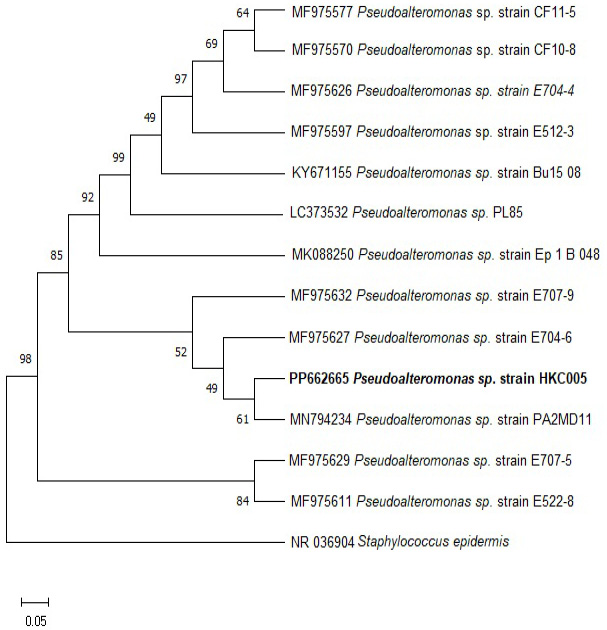
Pseudoalteromonas sp. HKC005 was isolated and pure cultured from marine waters of Arabian Sea, Karachi, Pakistan using Zobell marine agar medium 2216 (Himedia). The identification of the bacterial strain was done based on Gram’s staining reaction and certain biochemical tests followed by 16S rRNA analysis using PCR technique (GenBank number, PP662665) as per method described by Dahri et al. (2023). Briefly, the extraction of DNA was conducted using a commercial kit, according to the manufacturer’s protocol (Thermo Fisher). The 16S rRNA gene from bacterial DNA was amplified using primers 785F-5’ (GGA TTA GAT ACC CTG GTA) 3’ forward and 907R-5’ (CCG TCA ATT CMT TTR AGT TT) 3’reverse. The obtained DNA sequence was compared to the GenBank database using BLAST search (www.ncbi.nlm.nih.gov) to identify possible matches. Moreover, MEGA version 11 was used to generate a phylogenetic tree through the neighbor joining method (Figure 1).
Screening of Pseudoalteromonas sp. for AHL production
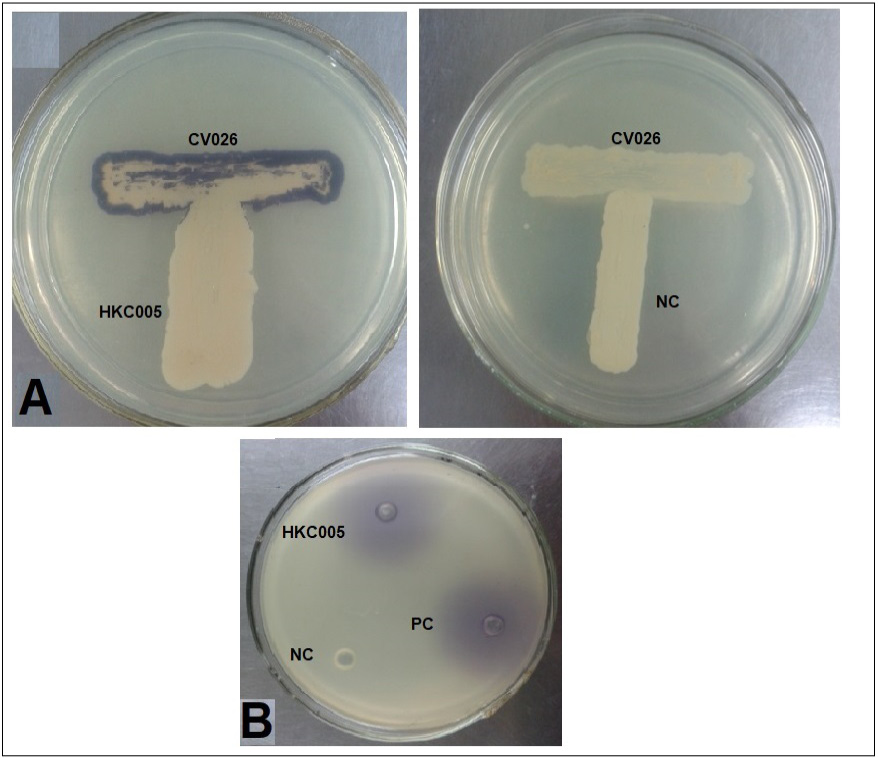
Primarily, AHL production in Pseudoalteromonas sp. HKC005 was investigated using Chromobacterium violaceum CV026 in cross-feeding and well-diffusion bioassays. In cross-feeding assay, the test bacterial strain was streaked on LB agar plate in conjunction with the AHL-detecting biosensor strain ; Jatt, 2021). The inoculated culture plate was incubated at 28 ºC for 24 to 48 h and visualized for purple color produced by CV026 as the AHL molecules produced by the candidate strain.
Further, sterile supernatants of the bacterial strain including positive (C6-HSL) and negative control (sterile supernatant of the known AHL negative bacterial strain) were applied for well diffusion bioassay. LB-agar plate seeded with CV026 was punched for wells of 6 mm in diameter and subsequently were inoculated with sterile supernatants (65 µL) in addition to positive and negative control into each well, respectively. The agar plate was incubated at 28 ºC for 24-48 h and the diameter of the AHL-induced zones recorded as indication of positivity ; ; .
Extraction of AHL molecules
The bacterial strain HKC005 was cultured separately in 100 mL of LB nutrient broth at 28 ºC for 24-36 h. The cell suspension was spun at 12,000 rpm for 10 min. After centrifugation, the cell free supernatants were mixed with equal volume of ethyl acetate ; . The extracted material was evaporated to dryness using Rotatory evaporator, and the dried material was reconstituted in 1.0 mL of methanol and stored at -20 ºC until further analysis.
Gas chromatography-mass spectrometry (GC-MS)
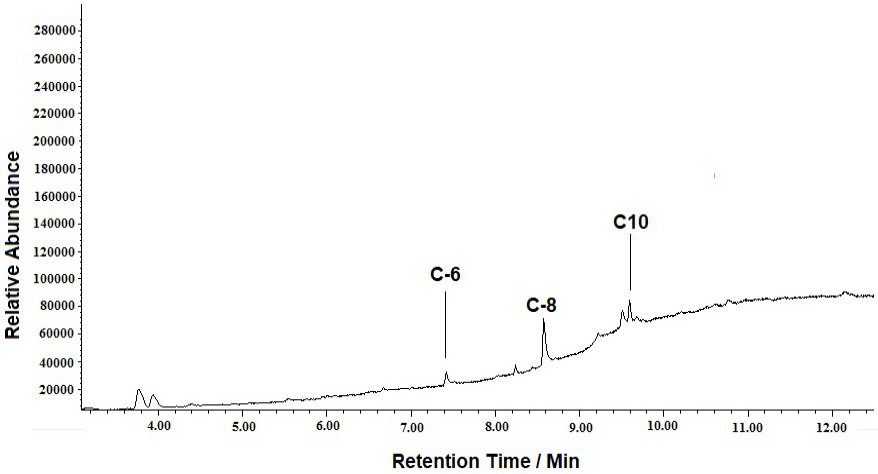
GC-system 6890N linked to mass detector Agilent-5973 was used to analyze the extract of HKC005 bacterial strain. HP-5 MS-column with 30 m x0.25 mm ID and 0.25 µm film thickness. The temperature of the oven was raised from 150 oC (3min hold) to 280 ºC at a rate of 15 ºC min-1. A carrier gas (pure helium) was employed at the flow rate of 0.8 mL min-1. The GC injector temperature was adjusted to 200 ºC, and the transfer line set to 280 ºC, electron energy was 70 eV and the mass-spectrometer temperature source was set to 230 ºC. Subsequently, one µL of culture extract or AHL standards was loaded in splitless mode (60s valve time). The mass-spectrometer was operated at a single ion monitoring mode at m/z 143 . The identification of the AHL molecules produced by HKC005 was carried out by comparing mass spectra and retention times against standards.
Extracellular hydrolytic enzyme production
Pseudoalteromonas sp. HKC005 bacterial strain was screened for the production of gelatinase and alginate lyase enzymes using agar plate enzymatic assays. Further, quantification of the enzymatic activities (U/mL) was achieved using the methods described below. Each enzymatic experiment was replicated a minimum of three times in triplicate form of samples.
Gelatinase activity
Gelatinase activity was confirmed on nutrient agar plate supplemented with 0.4% gelatin (w / v) . After incubation, the plate was treated with 15% mercuric chloride in 20% HCl (v / v). A clear zone was suggestive of gelatin hydrolysis. The quantitative assay for gelatinase activity was performed according to Tran and Nagano (2002). One unit of gelatinase activity was defined as the amount of gelatinase required to liberate 1 µg of leucine per mL/minute under assay conditions.
Alginate lyase activity
Agar plate containing 0.5% (w/v) sodium alginate was used to investigate alginate lyase production. After incubation for 3-4 days at 28 ºC, the plate was swamped with Lugol’s iodine solution (5.0 mL) to observe clear zone around the bacterial colonies . The alginate lyase activity assay was observed according to Somogyi’s protocol . A single unit of enzyme catalysis was specified as the quantity of enzyme needed for production of 1 µmol of reducing sugar per minute.
Influence of QS inhibitor protein on enzymatic activities
A possible role of AHLs in regulating exoenzyme production in HKC005 bacterium was investigated by inoculating an overnight culture into 100 mL of 2216 broth bottles supplemented with 10 µM of different AHLs such as C4, 3OC6, C6, C8, C10 and C12 HSL respectively, along with 0.1% ethanol (final concentration) as control . Moreover, Additionally, quorum quenching AiiA protein (20 µL ml -1) was added to the growth culture of the test strain to investigate its influence on enzymatic activity . All the culture bottles were placed in incubator with shaking (200 rpm) at 28 ºC. Growth was analyzed at OD600, and the culture was centrifuged for obtaining the supernatants applied for the enzymatic activities.
To investigate a possible effect of AHL mediated QS signaling molecules on gelatinase and alginate lyase activities, QS inhibitor protein was added in growth medium to disrupt QS system in HKC005. The inhibition of QS was confirmed by CV026. The enzymatic activities with inhibited QS system were compared with control with QS system in HKC005.
Results and Discussion
Isolation and identification of HKC005
Primarily identification based on Gram’s staining reaction and certain biochemical tests confirmed HKC005 as Gram-negative, aerobic, rod-shaped, motile and non-spore-forming bacterium. Furthermore, the 16S rRNA blast results showed the identity of marine bacterial strain as Pseudoalteromonas sp. HKC005 with NCBI-GenBank accession number PP662665. The bacterial strain belonged to the class of Gammaproteobacteria. A phylogenetic tree generated for HKC005 based on the obtained 16S rRNA gene sequences exhibited a highest degree of similarity to gene sequences of the genus Pseudoalteromonas sp. (Figure 1).
Screening of Pseudoalteromonas sp. HKC005 for AHL production
The screening results by agar plate and well-diffusion assays with the reporter system C. violaceum CV026 revealed positive reactions for AHLs in HKC005 by the development of purple violacein formation (Figure 2). Further, GC-MS examination of the culture extract of HKC005 showed three different peaks that were identified as C6, C8 and C10-HSL (Figure 3).
Extracellular hydrolytic enzyme activity and effect of QS inhibitor protein
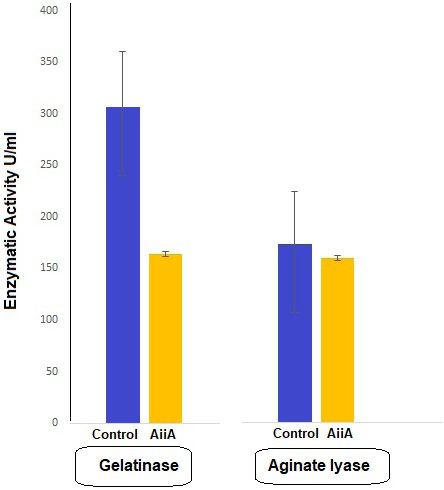
Qualitative screening for the enzymatic analysis with agar plate assays revealed that Pseudoalteromonas sp. showed highly positive reactions for both gelatinase and alginate lyase activities. Moreover, the influence of QS inhibitor protein on growth and enzymatic activities (gelatinase and alginate lyase), was investigated by supplementing QS inhibitor protein with growth medium of the test bacterial strain. As a result, QS inhibitor (AiiA) protein showed a notable reduction particularly of the gelatinase activity in HKC005 as compared to control (Figure 4). However, no such effect of inhibition was observed in alginate lyase enzyme.
Large numbers of bacterial species use QS to coordinate several biological functions in response to threshold concentrations of QS molecules . Bacterial populations use different chemical molecules as communication signals, among which AHLs are frequently produced by Gram-negative bacteria . Marine bacterial communities have been reported to play a crucial part in breaking down of large organic particles by enhancing QS-regulated extracellular hydrolytic enzyme activities .
In this study, Pseudoalteromonas sp. strain HKC005 isolated from marine water of Arabian Sea, Karachi, Pakistan, was screened for the production and identification of AHL mediated QS signaling molecules. Moreover, a possible influence of AHL mediated QS in regulation of certain exoenzymes was also monitored. AHL production was investigated using C. violaceum CV026 reporter strain. Moreover, AHL molecules were further identified using GC-MS analysis.
AHL producer bacterial genera mostly belong to Alpha (α), Beta (β) and Gamma (γ) Proteobacteria ; . Pseudoalteromonas species are widely distributed in marine environment and produce a wide variety of biological substances including highly important enzymes. However, knowledge about role of QS in these bacteria is very limited. The model QS system in Pseudoalteromonas bacteria is represented by the luminescence (lux) genes, i.e., luxR and luxI, of V. fischeri . Previously, Pseudoalteromonas sp. 520P1 was shown to induce 3-oxo-C8-HSL and C14-HSL QS signaling molecules (Wang et al., 2011), and Pseudoalteromonas sp. NJ6-1 was reported to produce only single C8-HSL signaling molecule . Here, we provide the identification of three different AHL molecules (C6, C8 and C10-HSL), produced by Pseudoalteromonas sp. HKC005 (Figure 2).
Enzymatic analysis revealed that HKC005 bacterial strain produced both gelatinase and alginate lyase enzymes. Generally, the production of extracellular enzymes by marine bacteria has a great value in disintegration of large complex organic aggregates in ocean. AHL autoinducers have been shown to enhance the production of various enzymes i.e., phosphatase, lipase and amido-peptidase enzymes ; . In the present study, AiiA protein influenced the enzymatic activities produced by Pseudoalteromonas sp. HKC005. Interestingly, AiiA protein was highly effective in the reducing the production of extracellular gelatinase (Figure 4). The results of this study reveal that the biosynthesis of extracellular gelatinase in Pseudoalteromonas sp. HKC005 possibly regulated by the AHL mediated QS system. Indeed, gelatin is often regarded as an ideal carbon and nitrogen source , and there is a large-scale production of extracellular gelatinase in marine bacteria. Moreover, alginate lyases produced by several types of bacterial species are critical in alginolytic activities . Certainly, gelatin and alginate lyase hydrolysis are known as important processes for the global carbon sources. Consequently, the identification of QS-regulated extracellular hydrolytic enzymes in the bacterial species studied here indicates a high value of these enzymes in marine environment and may play a vital role in processing large organic particles in Ocean environment.
Conclusions and Recommendations
This work has revealed the molecular identification of the bacterial strain HKC005 as Pseudoalteromonas sp. isolated from marine water of Arabian Sea, Karachi, Pakistan. Moreover, three different AHLs, C6, C8 and C10 were identified in HKC005. Furthermore, QS inhibitor protein remarkably reduced the gelatinase activity. QS systems investigated in bacterial populations inhabiting natural marine environment might be responsible for the hydrolysis of the carbon rich marine organic compounds.
Declarations
Acknowledgements
We are highly thankful to Department of Maritime Sciences, Bahria University, Karachi (75260), Pakistan for a great support in collection of marine water samples.
Generative AI and AI-assisted technology statement
The authors declare that no generative AI and AI assisted technology was used in the creation of this manuscript.
Conflict of interest
The authors have declared no conflict of interest.
Figures
Figure 1:.
A phylogenetic tree was constructed for the marine isolate HKC005 using neighbor joining method, based on gene sequence blasted at NCBI GenBank database. Staphylococcus epidermidis (NR036904) was used as an outgroup.
Figure 2:.
AHL production by Pseudoalteromonas sp. HKC005 in cross-feeding and well-diffusion bioassays with C. violaceum CV026 reporter strain. Lane “A” indicates the presence of AHLs in sterile supernatants of HKC005 bacterial strain in well diffusion bioassay, whereas “NC” shows a negative control and C6 is a synthetic AHL standard indicating positive control. Lane-B shows AHL production by HKC005 in cross-feeding bioassay, where CV026 clearly shows the production of purple color in response of AHLs production by the HKC005 bacterial strain. “NC” indicates a negative control, where CV026 did not produce any purple color due to absence of AHLs.
Figure 3:.
GC-MS chromatogram in SIM mode at m/z 143 of Pseudoalteromonas sp. strain HKC005 culture extract.
Figure 4:.
Influence of quorum-sensing inhibitor protein on gelatinase, alginate lyase, in sterile culture supernatants of Pseudoalteromonas sp. strain HKC005.
References
Acet, Ö., Erdönmez, D., Acet, B.Ö. and Odabaşı, M., 2021. N-acyl homoserine lactone molecules assisted quorum sensing: Effects consequences and monitoring of bacteria talking in real life. Arch. Microbiol., 203: 3739-3749. https://doi.org/10.1007/s00203-021-02381-9[CrossRef]
Annie, F. and Shanta, N., 2010. Sponge-associated bacteria of Lakshadweep coral reefs, India: Resource for extracellular hydrolytic enzymes. Adv. Biosci. Biotechnol., 1: 330-337. https://doi.org/10.4236/abb.2010.14043[CrossRef]
Bai, F., Han, Y., Chen, J. and Zhang, X.H., 2008. Disruption of quorum sensing in vibrio harveyi by the AiiA protein of Bacillus thuringiensis. Aquaculture, 274: 36-40. https://doi.org/10.1016/j.aquaculture.2007.11.024[CrossRef]
Balan, S.S., Nethaji, R., Sankar, S. and Jayalakshmi, S., 2012. Production of gelatinase enzyme from Bacillus spp isolated from the sediment sample of Porto Novo Coastal sites. Asian Pacific J. Trop.Biomed., 2(3): S1811-S1816.
Christiaen, S.E., Brackman, G., Nelis, H.J. and Coenye, T., 2011. Isolation and identification of quorum quenching bacteria from environmental samples. J. Microbiol. Meth., 87: 213-219. https://doi.org/10.1016/j.mimet.2011.08.002[CrossRef]
Chu, W., Zhou, S., Zhu, W. and Zhuang, X., 2014. Quorum quenching bacteria Bacillus sp. QSI-1 protect zebrafish (Danio rerio) from Aeromonas hydrophilia infection. Sci. Rep., 4: 5446. https://doi.org/10.1038/srep05446[CrossRef]
Dahri, A.S., Zamir, Y., Jatt, A.N., Tunio, S.A., Qureshi, A.S., Memon, S.B. and Abbassi, S.M., 2023. Investigation of N-acyl homoserine lactone-based quorum-sensing system and aliginate lyase activity in marine bacterial species of Grimontia marina AS01 and Alteromonas macleodii AS02. Pak. J. Sci., 74: 7-11. https://doi.org/10.57041/pjs.v74i1-1.905[CrossRef]
Dang, H.T., Komatsu, S., Masuda, H. and Enomoto, K., 2017. Characterization of LuxI and LuxR protein homologs of N-acylhomoserine lactone-dependent quorum sensing system in Pseudoalteromonas sp. 520P1. Mar. Biotechnol., 19: 1-10. https://doi.org/10.1007/s10126-016-9726-4[CrossRef]
Dong, Y.H., Xu, J.L., Li, X.Z. and Zhang, L.H., 2000. AiiA, an enzyme that inactivates the acylhomoserine lactone quorum-sensing signal and attenuates the virulence of Erwinia carotovora. Proc. Natl. Acad. Sci., 97: 3526-3531. https://doi.org/10.1073/pnas.97.7.3526[CrossRef]
Gram, L., Grossart, H., Schlingloff, A. and Kiorboe, T., 2002. Possible quorum sensing in marine snow bacteria: Production of acylated homoserine lactones by Roseobacter strains isolated from marine snow. Appl. Environ. Microbiol., 68: 4111-4115. https://doi.org/10.1128/AEM.68.8.4111-4116.2002[CrossRef]
Jangid, K., Kong, R., Patole, M.S. and Shouche, Y.S., 2007. luxRI homologs are universally present in the genus Aeromonas. BMC Microb., 7: 93. https://doi.org/10.1186/1471-2180-7-93[CrossRef]
Jatt, A.N., 2021. Influence of exogenous AHLs and Quorum Quenching AiiA protein on the production of cellulase enzyme in marine snow associated bacterium, Citrobacter freundii B1. Pakistan J. Zool., 53: 827-833 https://doi.org/10.17582/journal.pjz/20200305130330[Full text][CrossRef]
Jatt, A.N., Qureshi, A.S. and Dahri, A.S., 2023. Acyl homoserine lactone-based quorum sensing and its role in regulation of extracellular hydrolytic enzymes in marine snow associated bacteria. Pakistan J. Zool., 57: 451-564. https://doi.org/10.17582/journal.pjz/20230118140133[Full text][CrossRef]
Jatt, A.N., Tang, K.H., Liu, J., Zhang, Z. and Zhang, X.H., 2015. Quorum sensing in marine snow and its possible influence on production of extracellular hydrolytic enzymes in marine snow bacterium Pantoea ananatis B9. FEMS Microbiol. Ecol., 91: 1-14. https://doi.org/10.1093/femsec/fiu030[CrossRef]
Kastbjerg, V.G., Nielsen, K.F., Dalsgaard, I., Rasch, M., Bruhn, J.B., Givskov, M. and Gram, L., 2007. Profiling acylated homoserine lactones in Yersinia ruckeri and influence of exogenous acyl homoserine lactones and known quorum‐sensing inhibitors on protease production. J. Appl. Microbiol., 102: 363-374.
Li, J.W., Dong, S., Song, J., Li, C.B., Chen, X.L., Xie, B.B. and Zhang, Y.Z., 2011. Purification and characterization of a bifunctional alginate lyase from Pseudoalteromonas sp. SM0524. Mar. Drugs, 9: 109-123. https://doi.org/10.3390/md9010109[CrossRef]
Li, S., Wu, S., Ren, Y., Meng, Q., Yin, J. and Yu, Z., 2022. Characterization of differentiated autoregulation of LuxI/LuxR-type quorum sensing system in Pseudoalteromonas. Biochem. Biophys. Res. Commun., 590: 177-183. https://doi.org/10.1016/j.bbrc.2021.12.107[CrossRef]
Lim, Y.L., Ee, R., Yin, W.F. and Chan, K.G., 2014. Quorum sensing activity of Aeromonas caviae strain YL12, a bacterium isolated from compost. Sensors, 14: 7026-7040. https://doi.org/10.3390/s140407026[CrossRef]
Manefield, M. and Turner, S.L., 2002. Quorum sensing in context: out of molecular biology and into microbial ecology. Microbiology, 148: 3762-3764. https://doi.org/10.1099/00221287-148-12-3762[CrossRef]
Myszka, K. and Czaczyk, K., 2012. N-acyl homoserine lactones (AHLs) as phenotype control factors produced by Gram-negative bacteria in natural ecosystems. Pol. J. Environ. Stud., 21: 15-21.
Ravn, L., Christensen, A.B., Molin, S., Givskov, M. and Gram, L., 2001. Methods for detecting acylated homoserine lactones produced by Gram-negative bacteria and their application in studies of AHL-production kinetics. J. Microbiol. Meth., 44: 239-251. https://doi.org/10.1016/S0167-7012(01)00217-2[CrossRef]
Somogyi, M., 1952. Notes on sugar determination. J. Biol. Chem., 195: 19-23. https://doi.org/10.1016/S0021-9258(19)50870-5[CrossRef]
Tran, L.H. and Nagano, H., 2002. Isolation and characterization of Bacillus subtilis CN2 and its collagenase production. J. Fd. Sci., 67: 1184-1187. https://doi.org/10.1111/j.1365-2621.2002.tb09474.x[CrossRef]
Wang, J., Quan, C., Wang, X., Zhao, P. and Fan, S., 2011. Extraction, purification and identification of bacterial signal molecules based on N-acyl homoserine lactones. Microb. Biotech., 4: 479-490. https://doi.org/10.1111/j.1751-7915.2010.00197.x[CrossRef]
Xu, F., Cha, Q.Q., Zhang, Y.Z. and Chen, X.L., 2021. Degradation and utilization of alginate by marine Pseudoalteromonas: A review. Appl. Environ. Microbiol., 87: e00368-21. https://doi.org/10.1128/AEM.00368-21[CrossRef]
Yu, Z., Yu, D., Mao, Y., Zhang, M., Ding, M., Zhang, J. and Yin, J., 2019. Identification and characterization of a LuxI/R-type quorum sensing system in Pseudoalteromonas. Res. Microbiol., 170: 243-255. https://doi.org/10.1016/j.resmic.2019.07.001[CrossRef]
Zhang, C., Zhu, S., Jatt, A.N. and Zeng, M., 2016. Characterization of N-acyl homoserine lactones (AHLs) producing bacteria isolated from vacuum-packaged refrigerated turbot (Scophthalmus maximus) and possible influence of exogenous AHLs on bacterial phenotype. J. Gen. Appl. Microbiol., 62: 60-67. https://doi.org/10.2323/jgam.62.60[CrossRef]