
The Western Pacific is characterized by high species diversity; however, limited studies have been carried out in the past, particularly in biology, on the Western Pacific Seamount Region owing to its unique geography. Therefore, carrying out species diversity studies in this region is important and necessary. In this study, 15 dominant zooplankton species (Pleuromamma robusta, Nannocalanus minor, Haloptilus longicornis, Corycaeus speciosus, Scolecithrix danae, Euchaeta rimana, Chelophyes appendiculata, Bassia bassensis, Eudoxoides mitra, Abylopsis eschscholtzi, Abylopsis tetragona, Sagitta enflata, Sagitta pacifica, Paraconchoecia oblonga, Thalia democratica) collected from eight stations in the Pacific Seamount Region were microscopically photographed, morphologically described. Their geographical distribution and ecological habits were analysed. This study aimed to provide a scientific basis and reference for more in-depth future studies on the composition, distribution, origin, dispersal, zonation, and geographic characteristics of marine species in the Western Pacific Seamount Region.
Research Article · Volume 58, Issue 6, 30 September 2026 · Open Access
Morphology and Geographic Distribution of Dominant Zooplankton Species in the Western Pacific Seamount Region
· · · · · ·
Affiliations & Notes ⌄
- 1Third Institute of Oceanography, Ministry of Natural Resources, Fujian, China * Corresponding author: xingbpeng@gmail.com
Article Info ⌄
- Journal:
- Pakistan Journal of Zoology
- Published:
- 30 September 2026

From the article
- We analyzed the zooplankton samples obtained from eight stations and identified a total of 221 species of zooplankton identified, with copepods and jellyfish being overwhelmingly dominant.
- This study underscores the significance of understanding zooplankton diversity and distribution in the western Pacific, revealing critical insights into marine ecosystem dynamics.
- By documenting the morphological and ecological characteristics of key species, the research highlights the complex interplay between zooplankton and their environment.
Selected from the article's own text.
Abstract
Introduction
The Western Pacific Region is the global center of marine biogenesis ; , as the highest species diversity of many marine taxa occurs in this region ; ; . Therefore, the conservation and study of species diversity in this region are important and necessary ; .
Fragile seamount ecosystems have been greatly threatened by the increased attention given to various natural resources in the region and increased human activities. It is therefore imperative that the natural seamount environment should be protected. However, seamounts have been considerably under-sampled on a global scale . Fewer than 500 seamounts have been surveyed; even less is known about the Northwestern Pacific seamounts . China has limited seamount research regarding biology. To deepen the study of deep-sea ecosystems, we first need to strengthen our basic understanding of seamount biology, including discovering new species, investigating species diversity and endemic species levels, and comparing differences with the biota of non-seamounts.
Zooplankton are a major contributor to secondary productivity in marine ecosystems. Understanding the abundance and composition of this taxon is fundamental to understanding marine ecosystems . Zooplankton are diverse, numerous, and widely distributed. They are an important link in the marine food chain, especially for material and energy . They play a vital role in assessing and protecting marine biodiversity and studying the impact of climate change and human activities on marine ecosystems. In this study, zooplankton samples from eight stations (Table I) in the Western Pacific Seamount Region (13.0101°–23.7602°N, 134.8271°–162.3081°E) were analyzed indoors. Fifteen dominant species were then selected for morphological characterization and geographical distribution and were microscopically photographed in terms of their morphological characteristics, to improve the knowledge of the taxonomy, biodiversity, and their interrelationship with the environment in the Western Pacific Seamount Region, and provide a scientific basis for the environmental management of seamount ecosystems.
Table I. List of sample numbers, station name, coordinates and sampling water level.
|
No. |
Station |
Latitude °N |
Longitude °E |
Sampling water level |
|
1 |
E1801-BP01 |
23.7602 °N |
134.8271°E |
200 m |
|
2 |
E1802-BP1 |
23.6607 °N |
158.3875°E |
205 m |
|
3 |
E1803-BP1 |
22.1219 °N |
159.3749°E |
200 m |
|
4 |
E1803-BP2-1 |
22.6205 °N |
159.4668°E |
200 m |
|
5 |
E1804-BP |
23.1864°N |
162.3081°E |
200 m |
|
6 |
E1805-BP |
19.5813°N |
157.8852°E |
220 m |
|
7 |
E1809-BP |
15.1532°N |
157.7522°E |
230 m |
|
8 |
E1810-BP |
13.0101°N |
157.1335°E |
210 m |
MATERIALS AND METHODS
Eight stations were sampled in the region studied (13.0101°–23.7602°N, 134.8271°– 162.3081°E) from 6 August to 8 October 2018. The zooplankton samples were obtained from stations using a plankton net (50 cm mouth-diameter, 145 cm net length, 0.505 mm mesh). All samples were preserved in 5% formaldehyde. The samples were dissected and analyzed in the laboratory using a Leica M205 A dissecting microscope and photographed using an Imager. M2 microscope. For identification, the following literature was used ; ; ; ; .
Zooplankton dominance (Y) was calculated using the following equation: Y= ni/N fi; where ni is the number of individuals of species i; fi is the frequency of occurrence of species i in the stations; N is the sum of the number of individuals in the samples.
Results and Discussion
We analyzed the zooplankton samples obtained from eight stations and identified a total of 221 species of zooplankton identified, with copepods and jellyfish being overwhelmingly dominant. Of the zooplankton for which species have been recorded, there are 15 dominant species, including six copepod species, namely, Pleuromamma robusta, Nannocalanus minor, Haloptilus longicornis, Corycaeus speciosus, Scolecithrix danae, and Euchaeta rimana; five jellyfish species (Table II), namely, Chelophyes appendiculata, Bassia bassensis, Eudoxoides mitra, Abylopsis eschscholtzi, and Abylopsis tetragona; two Chaetognatha species, namely, Sagitta enflata and Sagitta pacifica; and one species each of ostracod and tunicate, namely, Paraconchoecia oblonga and Thalia democratica, respectively (Table III). We photographed the morphological characteristics of these dominant species under a microscope, accompanied by their morphological descriptions and geographical distribution, to provide a scientific basis and reference for more in-depth future studies on the composition, distribution, origin, dispersal, zonation, and geographic characteristics of marine species in the Western Pacific Seamount Region.
Table I. List and taxonomic position of the 15 Dominant species.
|
ARTHROPODA |
||
|
Subclass Copepoda Milne Edwards,1840 |
||
|
Order Calanoida Sars,1903 |
||
|
Family Calanidae Dana,1846 |
||
|
Genus Nannocalanus Sars,1925 |
||
|
1 N. minor (Claus,1863) |
||
|
Family Metridinidae Sars,1902 |
||
|
Genus Pleuromamma Gesbrecht, 1889 |
||
|
2 P. robusta (Dahl, 1893) |
||
|
Family Augaptilidae Sars, 1905 |
||
|
Genus Haloptilus Giesbrecht, 1898 |
||
|
3 H. longicornis (Claus, 1863) |
||
|
Family Scolecithricidae Gisbrecht, 1892 |
||
|
Genus Scolecithrix Brady, 1883 |
||
|
4 S. danae (Lubbock, 1856) |
||
|
Family Euchaetidae Giesbrecht, 1892 |
||
|
Genus Euchaeta Philippi, 1843 |
||
|
5 E. rimana Bradford, 1974 |
||
|
Order Poecilostomatoida Thorell,1859 |
||
|
Family Corycaeidae Dana, 1852 |
||
|
Genus Corycaeus Dana, 1849 |
||
|
6 C. speciosus Dana, 1849 |
||
|
CNIDARIA |
||
|
Superclass Hydrozoa Owen, 1843 |
||
|
Class Hydroidomedusa Claus, 1877 |
||
|
Subclass Siphonophorae Eschscholtz, 1829 |
||
|
Order Calycophorae Leuckart, 1854 |
||
|
Family Diphyidae Quoy and Gaimard, 1827 |
||
|
Subfamily Diphyinae Moser, 1925 |
||
|
Genus Chelophyes Totton, 1932 |
||
|
7 C. appendiculata (Eschscholtz, 1829) |
||
|
Continues on next page...... |
||
|
Genus Eudoxoides Huxley, 1859 |
||
|
8 E. mitra (Huxley, 1859) |
||
|
Family Abylidae L. Agassiz, 1862 |
||
|
Subfamily Abylopsinae Totton, 1954 |
||
|
Genus Bassia L. Agassiz, 1862 |
||
|
9 B. bassensis (Quoy and Gaimard, 1833) |
||
|
Genus Abylopsis Chun, 1888 |
||
|
10 A. eschscholtzi (Huxley, 1859) |
||
|
11 A. tetragona (Otto, 1823) |
||
|
CHAETOGNATHA |
||
|
Class Sagittoidea Quoy & Gaimard, 1827 |
||
|
Order Aphragmophora Tokioka, 1965 |
||
|
Family Sagittidea Claus & Grobben, 1905 |
||
|
Genus Sagitta Quoy & Gaimard, 1827 |
||
|
12 S. enflata Grassi, 1881 |
||
|
13 S. pacifica Tokioka, 1940 |
||
|
ARTHROPODA |
||
|
Class Ostracoda Latreille, 1802 |
||
|
Order Halocyprida Dana, 1853 |
||
|
Sub-order Halocypridina Dana, 1853 |
||
|
Family Halocyprididae Dana, 1849 |
||
|
Sub-family Conchoeciinae Claus, 1890 |
||
|
Genus Paraconchoecia Claus, 1980 |
||
|
14 Paraconchoecia oblonga Claus, 1890 |
||
|
CHORDATA (UROCHORDATA) |
||
|
Class Thaliacea Van der Haeven, 1850 |
||
|
Order Hemimyaria Herdman |
||
|
Family Salpidae Lahille, 1888 |
||
|
Genus Thalia Blumenbach, 1798 |
||
|
15 Thalia democratica Forskål, 1775 |
||
Table III. Position distribution of dominant zooplankton groups and corresponding figure numbers.
|
Groups/Species names |
Figs. |
Stations |
|||||||
|
1 |
2 |
3 |
4 |
5 |
6 |
7 |
8 |
||
|
Copepoda |
|||||||||
|
Pleuromamma robusta |
1a, b |
√ |
√ |
√ |
√ |
√ |
√ |
√ |
|
|
Nannocalanus minor |
1c, d |
√ |
√ |
√ |
√ |
√ |
√ |
√ |
|
|
Haloptilus longicornis |
1e, f, g |
√ |
√ |
√ |
√ |
√ |
√ |
√ |
|
|
Corycaeusspeciosus |
2a, b, c |
√ |
√ |
√ |
√ |
√ |
√ |
||
|
Scolecithrix danae |
2f, g |
√ |
√ |
√ |
√ |
√ |
√ |
√ |
|
|
Euchaeta rimana |
2d, e |
√ |
√ |
√ |
√ |
√ |
√ |
||
|
Hydroidomedusa |
|||||||||
|
Chelophyes appendiculata |
3a, b, c |
√ |
√ |
√ |
√ |
√ |
√ |
√ |
√ |
|
Bassia bassensis |
3g, h, i |
√ |
√ |
√ |
√ |
√ |
√ |
√ |
|
|
Eudoxoides mitra |
3d, e, f |
√ |
√ |
√ |
√ |
√ |
√ |
√ |
√ |
|
Abylopsis eschscholtzi |
4a, b |
√ |
√ |
√ |
√ |
√ |
√ |
√ |
√ |
|
Abylopsis tetragona |
4c, d, e |
√ |
√ |
√ |
√ |
√ |
|||
|
Chaetognatha |
|||||||||
|
Sagitta enflata |
5a |
√ |
√ |
√ |
√ |
√ |
√ |
√ |
√ |
|
Sagitta pacifica |
5b |
√ |
√ |
√ |
√ |
√ |
√ |
√ |
|
|
Ostracoda |
|||||||||
|
Paraconchoecia oblonga |
5c |
√ |
√ |
√ |
√ |
√ |
√ |
√ |
|
|
Thaliacea |
|||||||||
|
Thalia democratica |
5d |
√ |
√ |
√ |
√ |
√ |
√ |
√ |
|
Given below is the account of dominant species
1. Nannocalanus minor (Claus, 1863)
Morphological description
The frontal anterior end is bluntly rounded, and the frontal angle filaments are slender. The cephalosome is fused with the 1st thoracic somite. The thoracic posterolateral angle is long and pointed in dorsal view, extending to the middle of the genital somite, and broadly rounded in lateral view. The inner margin of the 1st basipodite of the 5th pair of thoracic appendages is serrate.
Female: Size 1.6 to 2.4 mm. The ventral genital somite is broad and subsquare, with a length approximately equal to the total length of the posterior three somites. The caudal ramus is short and wide. The 5th pair of thoracic appendages is bilaterally symmetrical and has 3-segmented exopods and endopods. The outer distal angles of the 1st and 2nd segments of the exopod bear two spinules. The outer distal angles of the 1st and 2nd segments of the endopod extend as spinous processes.
Male: Size 1.2 to 2.0 mm. The 5th pair of thoracic appendages is bilaterally asymmetrical. The left leg is large and long. The 1st and 2nd segments of the exopod are large and thick. The outer distal angles each bear one long spine. The middle part of the inner margin of the 2nd segment bears a tuft of fine setae, with distal swelling. The distal segment is short, small, and conical. The terminal bears one long spine. The 1st and 2nd segments of the endopod bear no inner margin setae. The right leg has a similar structure to the anterior pairs of thoracic appendages.
Ecological habit
Warm water species.
Geographic distribution
Yellow Sea to South China Sea; Pacific, Indian, and Atlantic Oceans .
2. Pleuromamma robusta (Dahl, 1893)
Morphological description
Female: Size 2.2 to 4.7 mm. Upper margin spines of the 1st and 2nd segments of the 1st antennae are not curved. The ventral genital somite is large, long, and subelliptic, with a length approximately equal to the total length of the posterior two somites. The proximal base on the ventral surface is projecting, and the anal somite is short and wide. The posterolateral angles are symmetrical with small spinous processes. The 5th pair of thoracic appendages are uniramous, symmetrical, and 4-segmented. The distal segment is stubby and ovoid. The apex bears three discrepantly long setae. The inner seta is the longest, whereas the outer seta is the shortest.
Male: Size 1.8 to 4.0 mm. The abdomen is long, narrow, and bilaterally symmetrical, without projection. The 5th pair of thoracic appendages is uniramous and asymmetrical. In the left leg, the 2nd segment is stubby; the 3rd segment has thick and large inner margin spinous processes, and small outer distal spines; the 4th and 5th segments are long and narrow; the distal segment has one spinule in the nearly distal part of the inner margin; the terminal has two spinules. In the right leg, the 2nd segment has large inner margin spinous processes with fine setae; the 3rd and 4th segments are short and small, and both bear inner margin spinous processes, whereas the inner spinous processes in the 4th segment are larger and hook-shaped. The posterior half of the distal segment is broad, and the terminal is slightly curved inwards and beak-shaped, with one spinule.
Ecological habit
Cosmopolitan species across oceans.
Geographic distribution
Yellow Sea to South China Sea; Pacific, Indian, and Atlantic Oceans ; ; ; .
3. Haloptilus longicornis (Claus, 1863)
Morphological description
Female: Size 1.7 to 2.6 mm. The cephalosome anterior end is broadly rounded, with a small central projection. The frontal angle filaments are slender. Both sides of the genital somite are expanded, and its length is greater than the total length of the posterior three somites. The caudal ramus is about 1.5 times as long as it is wide. The 1st antennae is slender, and the distal nine segments exceed the caudal ramus. The mandible teeth are forked, with a denticle on the outer margin of the dorsal teeth. The 2nd basipodite of the 1st maxilla bears only four setae. The endopod bears five setae. The exopod bears seven setae. The outer lobe bears nine setae. The 1st, 2nd, and 3rd inner lobes bear seven, one, and three setae, respectively. There are no inner margin setae (spines) at the 1st basipodite of the 5th pair of thoracic appendages and the 2nd segment of the exopod.
Male: Size of 1.16 to 1.24 mm. The abdomen is long and narrow. The genital somite is short and wide, and the right posterior margin is right-angled. The caudal ramus is 1.5 times as long as it is wide. The 5th pair of thoracic appendages is asymmetrical. In the right leg, the distal segment of the exopod is short and small; the distal spine is significantly longer than the distal segment; the inner distal spine is slender and small; the outer margin spine is stubby and inward pointing. In the left leg, the inner margin of the 1st basipodite bears one small spinous process; the distal segment of the exopod is thick and large, and bears two distal spines of subequal length and one small outer margin spine.
Ecological habit
Warm water species.
Geographic distribution
Yellow Sea, East China Sea to South China Sea; Pacific, Indian, and Atlantic Oceans ; ; .
4. Scolecithrix danae (Lubbock, 1856)
Morphological description
The cephalothorax is ovoid. The forehead is broadly rounded, and the frontal angle filaments are slender. The 4th and 5th thoracic somites are separated.
Female: Size 1.8 to 2.5 mm. The thoracic posterolateral angle is projecting and pointed in dorsal view and broadly rounded in lateral view, with the terminal extending to the middle of the genital somite. The abdomen is stubby, and the genital somite is broad. The ventral surface is prominently expanded. The genital process is developed, with a large spade-like projection, covering posteriorly above the 2nd ventral somite. In the 1st pair of thoracic appendages, both the 1st and 2nd segments of the exopod bear a small outer margin spine. The 5th pair of thoracic appendages is not present.
Male: Size 1.9 to 2.4 mm. The thoracic posterolateral angle is slightly projecting. The 5th pair of thoracic appendages is asymmetrical. The right leg is uniramous and the endopod is not present; the exopod is 2-segmented; the anterior surface of the proximal hollow in the 1st segment has a small odontoid process ; the distal segment is short, small, and conical, about 1/6 of the length of the 1st segment, and its inner distal margin has serrata. The left leg is biramous; the 2nd basipodite is long and narrow, extending to about 2/3 of the exopod of the right leg; the exopod is 3-segmented, where the 1st and 2nd segments are nearly equal in length, the distal segment is shorter, the inner margin base bears fine setae, and the apex is bifurcated or not bifurcated; the endopod is 1-segmented, extending to the distal margin of the 2nd segment of the exopod, and its apex is also bifurcated or not bifurcated.
Ecological habit
Warm water species.
Geographic distribution
Yellow Sea to South China Sea; Pacific, Indian, and Atlantic Oceans ; ; .
5. Euchaeta rimana Bradford, 1974
Morphological description
The body surface is covered with fine setae.
Female: Size 3.4 to 4.3 mm. The forehead is projecting and the forehead angle is thick and pointed. The thoracic posterolateral angle is blunt and slightly asymmetrical, with the right angle more projecting than the left one. The ventral genital somite is stubby and asymmetrical, with a large projection at the middle of the right side and a prominent projection at the right distal margin. There is a slight hollow between these two projections. The ventral genital process is also asymmetrical. The right process is narrower and broadly rounded apically, while the left process is broader and apically divided into two lobes, with a narrower space between the posterior part of the left and right processes. In the 2nd pair of thoracic appendages, the outer distal spine of the 2nd segment of the exopod extends to the base of the 1st outer margin spine of the distal segment; the 2nd outer margin spine of the 2nd segment of the exopod extends to the terminal of the 3rd outer margin spine.
Male: Size 3.4 to 4.1 mm. In the left leg of the 5th pair of thoracic appendages, the base of the long spinous process in the distal segment has a thick phalangeal process medial to the base; the second segment has a long, narrow, spade-like dental lamina, and its terminal is broad and divided into two lobes, where the outer lobe is coarsely serrate, and the inner distal lobe is finely serrate. In the right leg, the 1st basipodite and the 1st segment of the exopod have a tuft of spinules at the proximal end of the outer margin.
Ecological habit
Warm water species.
Geographic distribution
Bohai Sea to South China Sea; Pacific, Indian, and Atlantic Oceans ; ; .
6. Corycaeus speciosus Dana, 1849
Morphological description
Female: Size 1.86 to 2.07 mm. The cephalosome is separated from the 1st thoracic somite. The 3rd and 4th thoracic somites are fused. The posterolateral angle of the 3rd thoracic somite extends to the distal margin of the genital somite. The genital somite is long-ovoid and more than twice as long as the anal somite. The caudal ramus is about 11 times as long as it is wide. The left and right caudal rami are prominently flared. The inner distal margin of the 2nd antennae bears two sharp teeth of unequal size. The endopod of the 4th pair of thoracic appendages bears one subsegment and one seta.
Male: Size 1.48 to 1.77 mm. The posterolateral angle of the 3rd thoracic somite extends posteriorly beyond the middle of the genital somite. The genital somite is ovoid. The anal somite is about 2 to 2.5 times as long as it is wide. The caudal ramus is slender, and its length is about 12 to 13 times the width of the base. The left and right caudal rami are not flared.
Ecological habit
Warm water species.
Geographic distribution
East China Sea to South China Sea; Pacific, Indian, and Atlantic Oceans ; .
7. Chelophyes appendiculata (Eschscholtz, 1829)
Morphological description
In the eudoxid stage, the anterior nectophore is similar to a long pentagonal cone with five longitudinal ridges. However, only two ventral ridges and right lateral ridges can extend to the apex of the nectophore. The dorsal ridge is very short, and the left lateral ridge extends only slightly below the apex of the nectophore. All the ridges are serrated. The somatocyst is slender and straight, about 2/3 of the height of the nectosac, often with oil droplets at the distal end. The hydroecium is moderately deep, about 1/4 of the height of the nectophore. The apex of the hydroecium cavity slopes upwards towards the ventral surface and is claw-shaped in lateral view. The nectosac ostium has no teeth and the mouth plate is split. The posterior nectophore is quadrangular, and the apex is shaped like a pointed conical tenon. The main canal is very long. The nectophore surface has four dorsal ridges: two dorsal ridges and two ventral ridges. The ventral ridge is straight, with a notch at the level of the nectosac ostium. The hydroecium is cylindrical, and its ventral flap is longer, about 3/4 of the height of the nectosac. The lower margin of the mouth plate is concave, forming two asymmetrical baso-lateral angles with the lower end of the ventral ridge. The left angle is slightly longer than the right angle.
In the gastrozooid stage, the bract is pyramidal, and the apical angle is about 75° in lateral view. The neck shield is small and rounded. The hydroecium is relatively deep. The phyllocyst is elongate and candle-shaped, with terminals tapering and reaching bear the apex of the bract. The genital nectophore is quadrangular, about twice as tall as the bract. The apex is bluntly conical, with a notch on the abdomen. The nectosac ostium has no teeth and the mouth plate is short. There is no obvious baso-lateral angle.
Ecological habit
Tropical cosmopolitan species across oceans. It appears throughout the year in the East China Sea, the Taiwan Strait, eastern and southern Taiwan, and northern and central South China Sea, and is the dominant species of siphonophores in the central South China Sea. It mainly lives in the upper 100 m, with a distribution up to 1,000 m (Chen, 1982). In the Atlantic Ocean, it mainly lives in the upper 300 m, with small-scale diurnal vertical movements.
Geographic distribution
China Yellow Sea, East China Sea, Taiwan Strait, east coast of Taiwan, South China Sea; 55°N–42°S in the Pacific Ocean; southern Java (Indonesia), western Australia offshore, equatorial, southern tropical, and subtropical waters, central waters and Arabian Sea in the Indian Ocean; Mediterranean Sea; 55°N–56°S in the Atlantic Ocean ; Chen, 1982; ; ..
8. Eudoxoides mitra (Huxley, 1859)
Morphological description
In the eudoxid stage, the anterior nectophore is pentagonally cone-shaped. It has five longitudinal ridges: one dorsal ridge, two lateral ridges, and two ventral ridges. All the edges do not twist. The base is serrated. The dorsal ridge extends into a small basal tooth at the nectosac ostium. The somatocyst is cone-shaped or cucurbit-shaped, up to the middle of the nectosac, and about 2/5 as long as the height of the nectosac. The hydroecium apex is truncated, above the level of the nectosac ostium. The mouth plate is divided into two wings. The baso-lateral angles are particularly pointed, and the left angle is longer and more pointed than the right angle. The posterior nectophore is semilunar. A prominent hollow exists between the apical tenon process and the nectophore apex. The two hydroecium flaps overlap each other. The mouth plate is large, undivided, but asymmetrical, with the left angle larger than the right one. There is a dentate notch on each of the left and right ventral ridges, at different heights.
In the gastrozooid stage, the bract is conical. The ridges are serrated. The hydroecium cavity is deep. The dorsal wall of the hydroecium cavity forms a pointed angle with the joint facet. There is a small tooth in the middle of the posterior margin of the neck shield, the left margin serrated, and the right margin smooth. The phyllocyst is elongate and pear-shaped or carrot-shaped. The genital nectophore is quadrangular. The nectosac ostium has two prominent dorso-lateral teeth. The lower margin of the mouth plate is concave, and the two sides become two baso-lateral teeth.
Ecological habit
Tropical cosmopolitan species across oceans. It appears throughout the year in the East China Sea, the Taiwan Strait, eastern and southern Taiwan offshore, and northern and central South China Sea, and is the dominant species of siphonophores in the central South China Sea. It lives mainly in the upper 200 m, and is more abundant in the 100 m layer, but can be distributed up to 1000 m, with small-scale diurnal vertical movements.
Geographic distribution
East China Sea, Taiwan Strait, eastern Taiwan, South China Sea; mainly in southern Java (Indonesia), western Australia offshore, tropical equatorial waters to 32°N and the Arabian Sea, and sometimes also in the sub-Antarctic waters off Kirglen Island, in the Indian Ocean; Mediterranean Sea; 44°N–40°S in the Pacific Ocean ; ; ; .
9. Bassia bassensis (Quoy and Gaimard, 1833)
Morphological description
In the eudoxid stage, the anterior nectophore is prismatic and short, with the apical ridge and seven facets. It is dorsally pentagonal. The somatocyst is globular without apical branch, and lies above the nectosac and hydroecium. The nectosac is short, no more than 1/2 of the nectophore. The base of the hydroecium is not projecting. The posterior nectophore is quadrangular and is about twice as tall as the anterior nectophore. The four ridges end in the four teeth of the nectosac ostium. The ridges and teeth are serrated.
In the gastrozooid stage, the bract is nearly quadrangular, with a midapical ridge. All the ridges are serrated. The phyllocyst is long and cylindrical or elliptical, with oil droplets in the apex, and without lateral branches, but with one slender branch at lower end. The genital nectophore is quadrangular, with four ridges which end in the four small teeth of the nectosac ostium.
The body of this siphonohore is blue. It is also common to see that the basal angle of the nectophore still retains blue color in the specimens preserved in formalin solution.
Ecological habit
Cosmopolitan species across oceans. It can be found at depths of up to 1700 m, but mainly lives in the upper layers of warm water. It is the dominant siphonohore off the East and South China Seas.
Geographic distribution
East China Sea, Taiwan Strait, South China Sea; Pacific Ocean, Indian Ocean, Red Sea, Mediterranean Sea, Atlantic Ocean, mainly in tropical and subtropical waters of the oceans ; ; ; .
10. Abylopsis eschscholtzi (Huxley, 1859)
Morphological description
In the eudoxid stage, the anterior nectophore resembles that of A. tetragona. The difference is that the two dorsal upper lateral ridges and two dorsal lower lateral ridges of this species almost have the same length, making the dorsal facet regularly pentagonal. The angle between the two dorsal upper lateral ridges is greater than 90°. The lateral radial tube of the nectosac extends horizontally, and then bends downward to meet the annular tube of the nectosac ostium. The posterior nectophore is shorter than abylopsis tetragona and about twice as long as the anterior nectophore. The tenon process is coracoid. The five ridges are complete, and their ends form five nectosac ostium teeth with asymmetrical serrated margins.
In the gastrozooid stage, the bract resembles that of abylopsis tetragona. The difference is that the dorsal facet of this species is regularly pentagonal. The upper dorso-lateral ridge and the lower dorso-lateral ridge almost have the same length. The angle between the apico-dorsal ridge and the upper dorso-lateral ridge is greater than 90°. The horizontal ridge is higher, and the baso-sagittal ridge is longer. The genital nectophore is short and stout. The four teeth of the nectosac ostium are oblique. The dorsal ridge is short and prominent. The ridges are serrated.
Ecological habit
Cosmopolitan species across oceans. It lives in warm water from 0 to 1700 m, mainly in the upper 0–600 m. It is the dominant siphonohore off the East China Sea and South China Sea, with a large abundance in the upper 100 m.
Geographic distribution
East China Sea, Taiwan Strait, South China Sea; Pacific Ocean (37°N–32°S), Atlantic Ocean (40°N–40°S), equatorial and central waters of Indian Ocean, Red Sea, Mediterranean Sea ; ; ; .
11. Abylopsis tetragona (Otto, 1823)
Morphological description
In the eudoxid stage, dorsal and ventral facets of the anterior nectophore are elongate and pentagonal. The angle between the two upper dorso-lateral ridges is a right angle. The two lower dorso-lateral ridges are much longer than the upper dorso-lateral ridges. The teeth on the ridges are weak. The hydroecium is in the lower half between the nectosac and the somatocyst, and the opening is square. The somatocyst is globular, with an apical process. The nectosac is tubular. The lateral radial canal runs from the main canal to the middle and lower part of ventral facet of the nectosac. It is apically arched and then runs straightly downward to the ring canal of the nectosac ostium. The posterior nectophore is pentagonal. Its height is more than 2–3 times the width. The five ridges are complete. The five teeth of the nectosac ostium are asymmetrical. The dorsal tooth is the smallest; the left ventral tooth is the longest; the right lateral tooth is the second longest.
In the gastrozooid stage, the bract is quadrangular. The ventral and apical facets are square, and the dorsal facet is long and pentagonal. The apico-dorsal ridge and the dorso-lateral ridge form right angles to each other. The horizontal ridge or the basal furcation ridge is lower. The baso-sagittal ridge is short. The phyllocyst has one apical branch, one lower branch, and one pair of stubby lateral branches. The genital nectophore is elongate and quadrangular. The four teeth of the nectosac ostium are even, and the dorsal tooth is elongate and vertical. The ridges are barely serrated.
Ecological habit
Cosmopolitan species across oceans. It mainly lives in the upper warm water. It is the dominant siphonophore off the East and South China Seas.
Geographic distribution
East China Sea, Taiwan Strait, South China Sea; widespread in the three oceans and in the warm waters of the Mediterranean and Red Sea ; ; .
12. Sagitta enflata Grassi, 1881
(Fig. 5a)
Morphological description
The adult body may exceed 30 mm in length. The body is fat and fusiform, with a broadly short head. It is tapering anteriorly and posteriorly, with the widest part at the anterior fin of the trunk, and a very conspicuous constriction at the neck. The caudal segment is about 1/5 of the body length, and the tail septum has no conspicuous constriction. The muscle layer is weak and very transparent, with wide lateral bands. Collarette is absent. The ventral ganglion is small, and its distance from the anterior fin is about 10%–20% of the body length. The anterior fin is short and semi-circular, and fin rays are absent in the base. The posterior fin is subtriangular, and slightly wider and longer than the anterior fin. About 2/3 is situated on the trunk. The widest part is anterior to the tail septum, with no fins on the anterior part of the base and the two lateral fins are widely spaced. The tail fin is oblate. Intestinal diverticulum is absent. At maturity, the length of the ovary may exceed the anterior margin of the posterior fin and also reach the anterior fin. Ova are rounded, vary in number, and are arranged in three rows. The spermatocytes gather in clumps and accumulate in the posterior part of the caudal cavity. The seminal vesicle is rounded, at some distance from the posterior fin and close to the base of the tail fin. It ruptures at maturity from the lateral or ventral middle part. The corona ciliata is located on the head and is invaginated between the eyes. It is oval with varying forms. Eyes are large and oval, with a star-shaped pigment cell. The hook is light brown. In some specimens, several small teeth can be found behind the anterior dentition. The vestibular organ is notched up to 1-6 teeth, with 1-3 teeth outside the pterygoid.
Ecological habit
Warm water species. It is dominant in offshore, inshore, and reef lagoons. It is distributed in the surface layer, with marked diurnal vertical movements.
Geographic distribution
It is found in the waters of the Nansha Islands, the East China Sea, and the Yellow Sea. It is also distributed in the waters of the Pacific coast of Japan, southern Sea of Japan, Philippines, Indonesia, Malaysia, the east and west coasts of Australia, New Zealand, Pacific Islands, and California, as well as in the extensive waters of the Indian Ocean (south to 30°S) and the Atlantic Ocean (40°N–40°S), including the Red Sea, coast of South African, Mediterranean Sea, and Gulf of Mexico .
13. Sagitta pacifica Tokioka, 1940
(Fig. 5b)
Morphological description
The adult body is as long as up to 14 mm. The body is slender, and all segments of the trunk are almost equal in width. The head is of medium size, with a conspicuous neck. The caudal segment is narrow, 22%–25% of the body length, and the distal tip is slender. No constriction is present at the tail septum. The integument is invaginated on both sides of the seminal vesicle. The muscle layer is thick, hard, and translucent, with narrow lateral bands. The collarette is distributed in the neck, thinning posteriorly and thickening before the seminal vesicle. The ventral ganglion is medium-sized. The anterior fin starts near its posterior and is narrow anteriorly and wide posteriorly. A few individuals show a narrow band without fin rays at the base of the anterior segment. The posterior fins are slightly longer than the anterior fins, and are oval or subtriangular, approximately equidistant from the tail septum. A narrow band without fin rays is present near the base of the tail septum. The tail fin is broadly triangular with a slightly invaginated posterior margin. Intestinal diverticulum is absent. At maturity, the ovary may reach the ventral ganglion. Ova are rounded or square of medium size, and are arranged in a single row, with a count of about 50. The seminal vesicle is large and anteriorly has four to ten dentations. It is close to the posterior fin and well separated from the tail fin. It has various forms and changes with development. It ruptures at maturity from the anterior margin, and the middle of the vas deferens is expanded. The corona ciliata starts posterior to the head and is 1.5–2 times the length of the head, with 4–6 invaginations on each side. Eyes are small large, long, and rounded, with a T-shaped pigment cell. The hook is yellowish brown, and the blade is serrated. Both the anterior and posterior rows of teeth are slightly elongated and more densely connected. The vestibular organ is notched up to 3–7 teeth, with 0–3 teeth outside the pterygoid.
Ecological habit
Oceanic species mostly live in the surface layers of tropical, equatorial Indian, and Pacific waters.
Geographic distribution
Off the East and South China Seas, off the coast of Taiwan, and south of the Gulf of Tonkin. Waters in Japan, Philippines, Malay Archipelago, Great Barrier Reef, New South Wales, New Zealand, etc., as well as the Pacific Ocean (40°N–35°S) and the Indian Ocean (from the Red Sea, Gulf of Aden, and the Arabian Sea in the north to 30°S in the south) .
14. Paraconchoecia oblonga Claus, 1890
(Fig. 5c)
Morphological description
Male: Shell length 1.41–1.60 mm and shell height is about 45% of the shell length. The shoulder arch is more developed, but not sharply margined. The posterior dorsal corner of the right shell has posterior dorsal spines, and the posterior dorsal corner of the left shell is bluntly rounded. The asymmetric gland of the right shell opens on the shell process below and anterior to the posterior ventral corner of the shell. The asymmetrical gland of the left shell opens at the posterior dorsal margin of the shell. There are posterior dorsal medial glands below the posterior dorsal corners of both shells. The anterior organ is bluntly rounded at the tip of the cephalic segment and its ventral margin has some long setae. The setae of the 1st antennae have about 30 pairs of fine spines. The hook on the endopod of the right 2nd antennae is slightly curved, with a bluntly rounded end. The hook on the left 2nd antennae is straight, with a bluntly rounded end. The 3rd and 4th pairs of claws of the caudal ramus are curved posteriorly, especially the 4th pair of claws.
Female: Shell length 1.39–1.52 mm and the shell height is about 40% of the shell length. The posterior dorsal corner of the right shell has posterior dorsal spines, and the posterior dorsal corner of the left shell is bluntly rounded. The basipodite of the anterior organ extends far beyond the tip of the 1st antennae. The distal ventral margin of the cephalic segment is concave upward. The tip bears bird-pecked pointed processes, and the cephalic segment has many small setae. The 1st antennae have long dorsal setae.
Ecological habit
Cosmopolitan species across oceans. It mainly lives in warm water.
Geographic distribution
South Yellow Sea, East China Sea, waters adjacent to Taiwan, Taiwan Strait, Bashi Channel, North and Central South China Sea, Nansha Islands, and Hong Kong waters ; ; ; .
15. Thalia democratica Forskål, 1775
(Fig. 5d)
Morphological description
Aggregate form: Body length 1.41–1.60 mm and oval in shape. Anterior end of the body rounded, tapering to a pointed or rounded terminal process. Test thick, bluntly pentagonal. Atrial opening not central. Posterior lateral protuberance on one side only and slight asymmetry. Variable number of tubular processes from mantle to test. 5 continuous body muscles. M1-M3 and M4-M5 fused mid dorsally for short distance. The two groups of muscle bands are separate dorsally muscle structure similar to other Thalia aggregates, species differentiated by shape of body and projections. The gut is More compact than in solitary form. Endostyle confined to anterior half of body. Nucleus has posterior projection (may not be visible).
Solitary form: Body length 2.3–1.7 mm (without process) and smooth test. Lateral projections simple and not bifurcated. All test projections are echinate. 5 body muscles in complete rings. M5 may be narrowly interrupted ventrally. M1-M3 and M4-M5 fused mid-dorsally over short distance. Muscle structure similar to other Thalia solitarys, T. democratica is differentiated by non bifurcated lateral projections. The gut is stomach partly extends into the middle posterior projection.
Ecological habit
Cosmopolitan, eurythermic species from warmer waters.
Distribution
Globally between 60°N - 40°S ; ; .
Conclusions
This study underscores the significance of understanding zooplankton diversity and distribution in the western Pacific, revealing critical insights into marine ecosystem dynamics. By documenting the morphological and ecological characteristics of key species, the research highlights the complex interplay between zooplankton and their environment. Such comprehensive data is essential for predicting ecological responses to environmental changes and for informing conservation efforts. The findings emphasize the need for continued monitoring and research to protect and sustain the biodiversity of these vital marine organisms.
Declarations
Funding
This research was funded by National Key Research and Development Program of China (2022YFC2804001); the Natural Science Foundation of Fujian Province, China (2023J011373); Department of Science and Technology of Fujian Province, China (2023J01208).
Generative AI and AI-assisted technology statement
The authors declare that no generative AI and AI assisted technology was used in the creation of this manuscript.
Statement of conflict of interest
The authors have declared no conflict of interest.
Figures
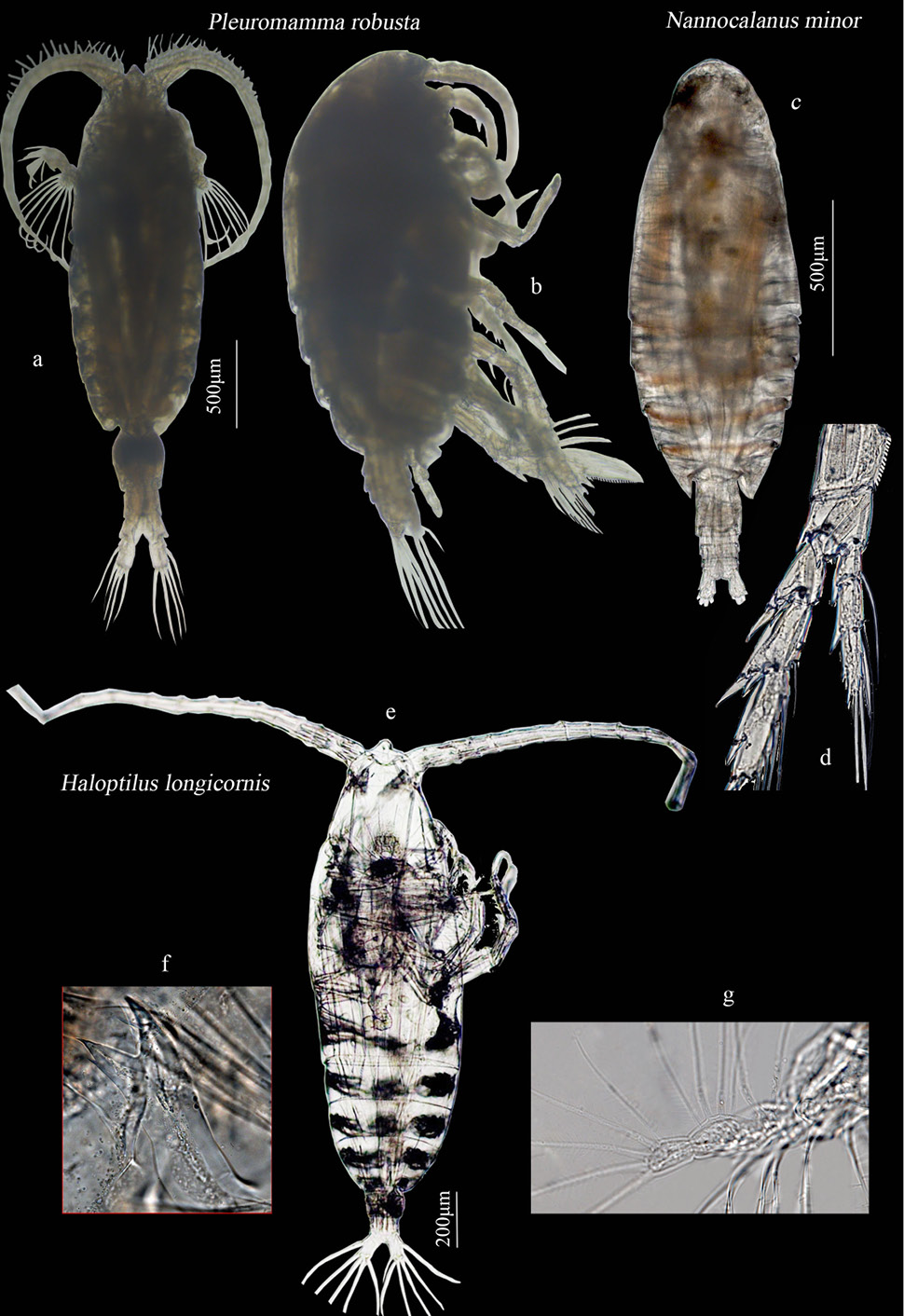
Pleuromamma robusta: a, Female dorsal view; b, Female lateral view. Nannocalanus minor: c, Female dorsal view; d, Female fifth pair of appendages. Haloptilus longicornis: e, Female dorsal view; f, Female mandible; g, Female maxilla.
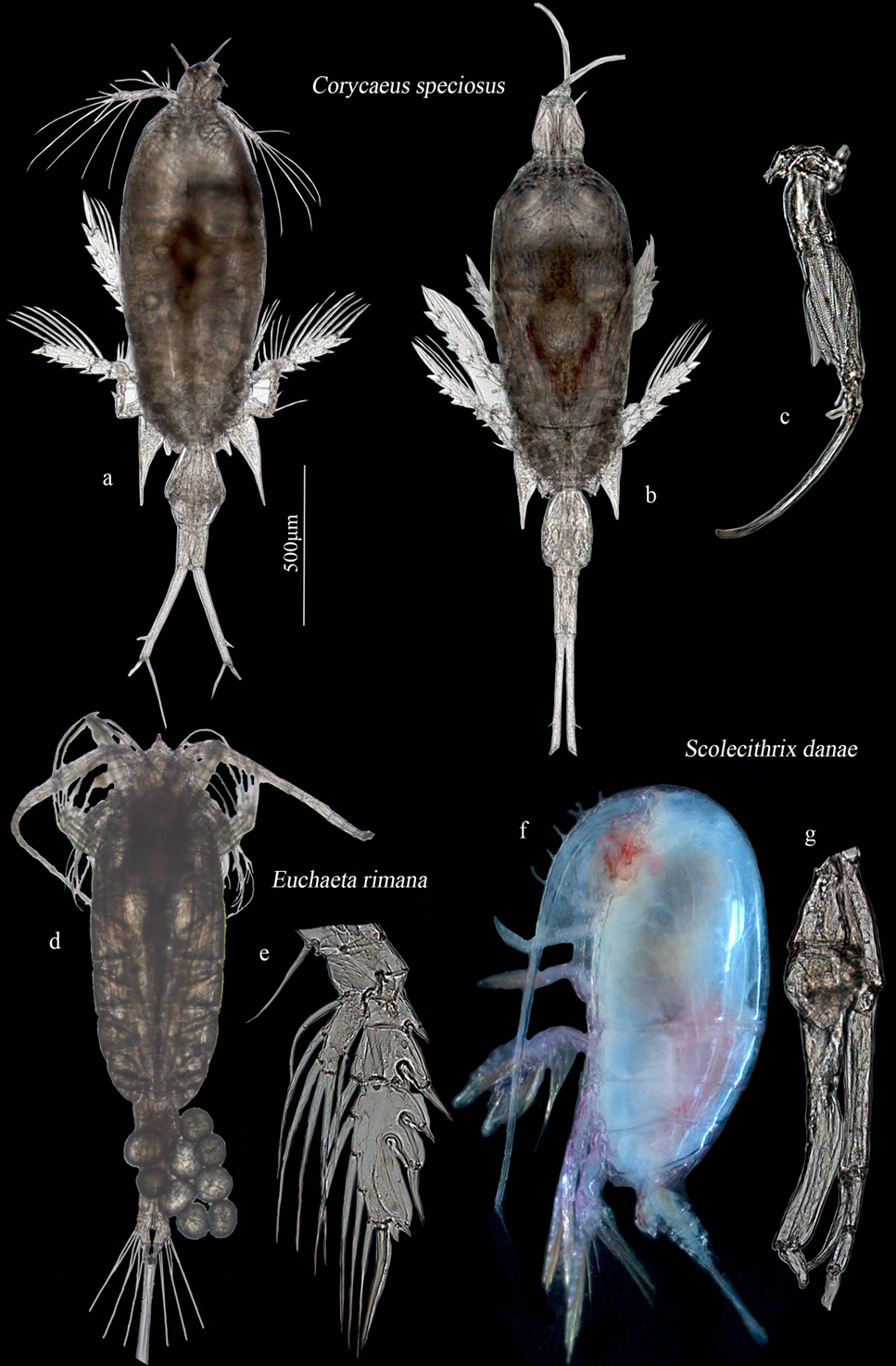
Corycaeus speciosus: a, Female dorsal view; b, Male dorsal view; c, Male second antennae. Euchaeta rimana: d, Female dorsal view; e, Female second pair of appendages. Scolecithrix danae: f, Female lateral view; g, Male fifth pair of appendages.
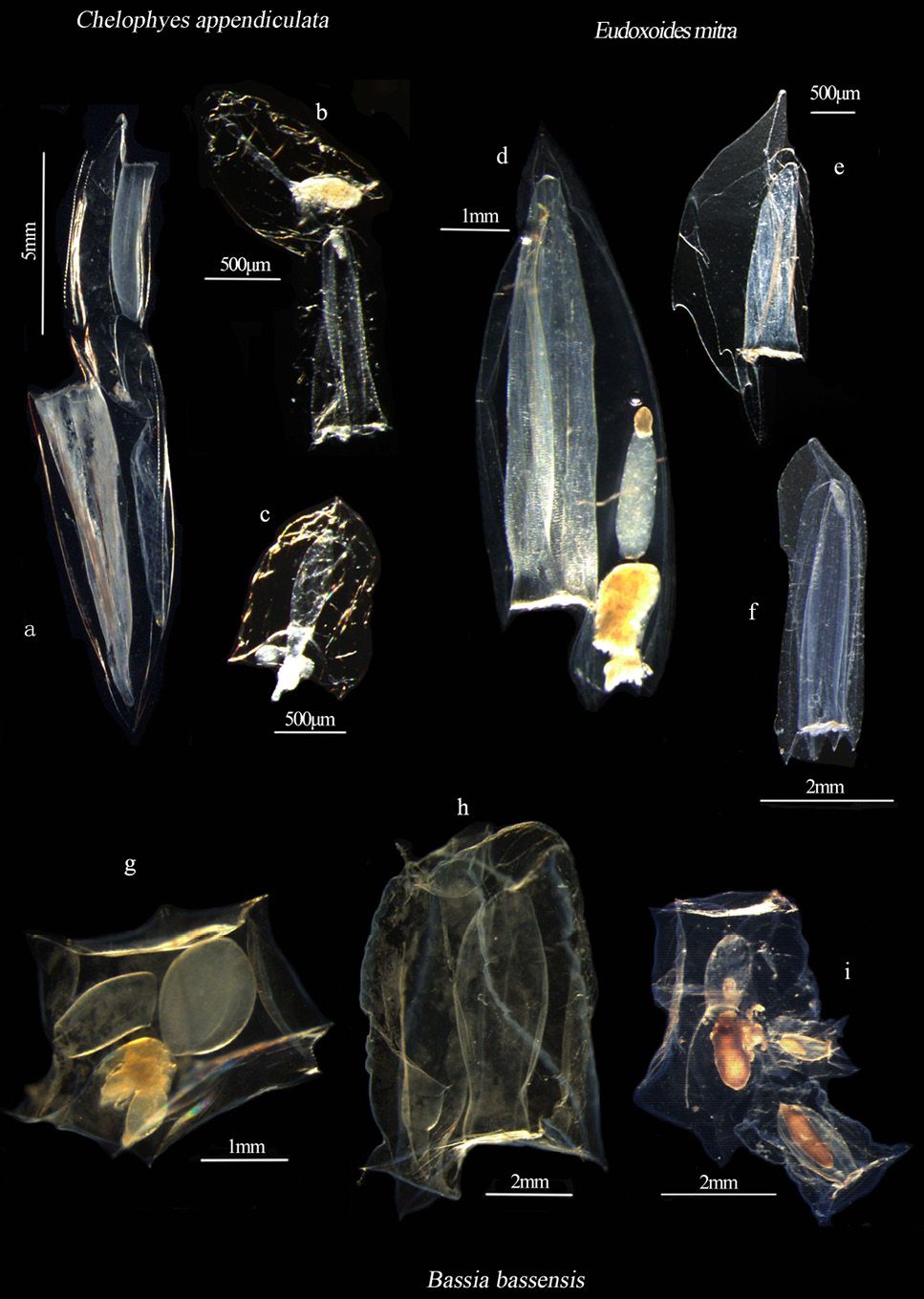
Chelophyes appendiculata: a, Overall view; b, Genital nectophore; c, Bract. Eudoxoides mitra: d, Anterior nectophore; e, Posterior nectophore; f, Genital nectophore. Bassia bassensis: g, Anterior nectophore; h, Posterior nectophore; i, Gastrozooid stage.
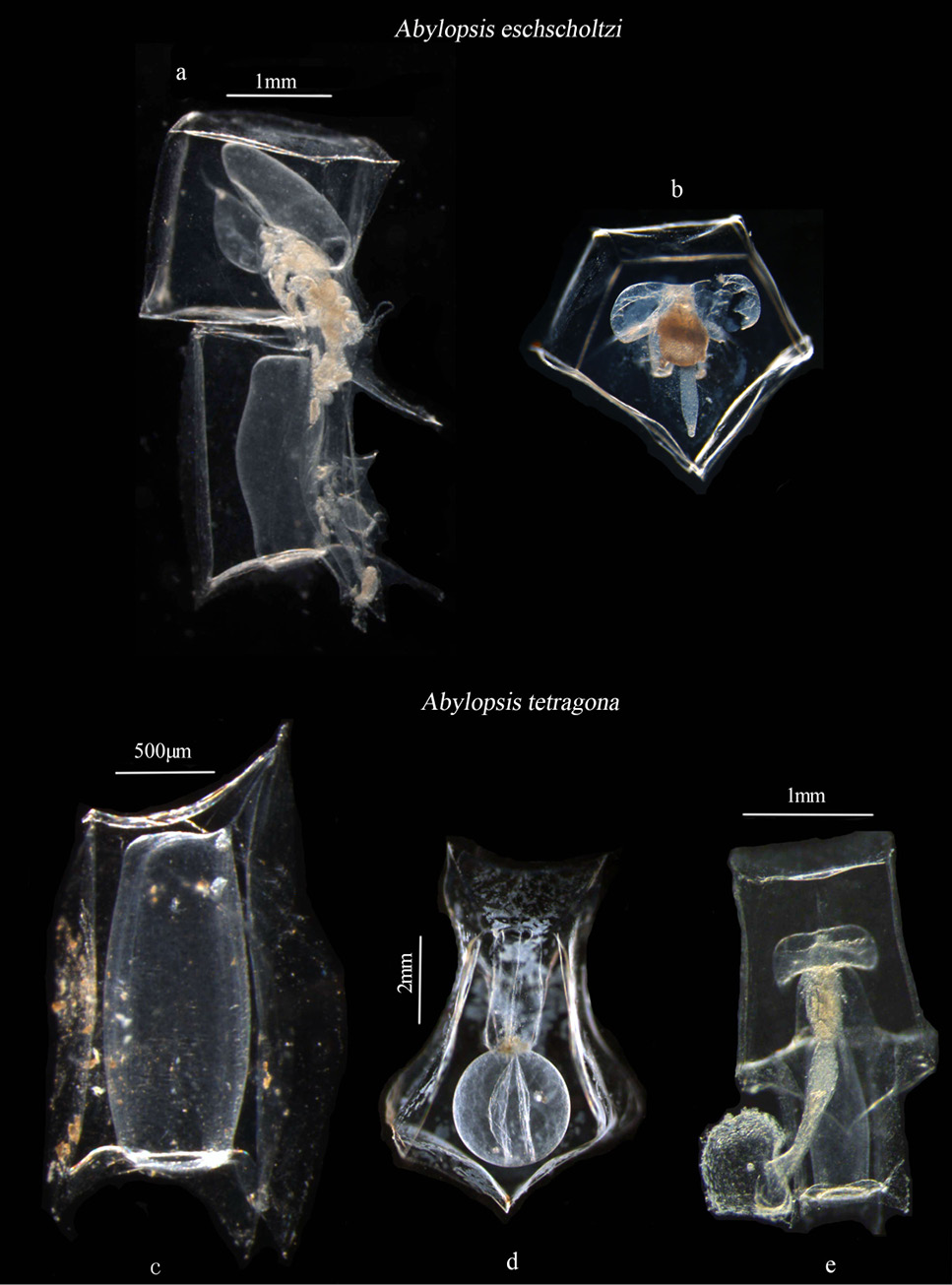
Abylopsis eschscholtzi: a, Overall view; b, Bract. Abylopsis tetragona: c, Anterior nectophore; d, Posterior nectophore; e, Gastrozooid stage.
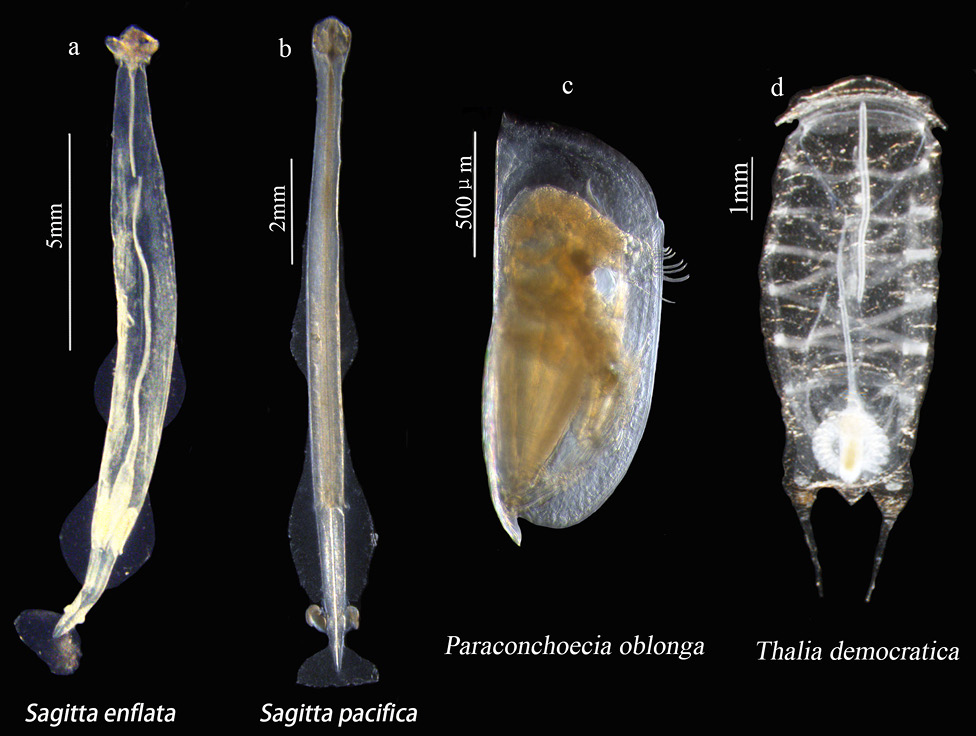
a. Sagitta enflata, b. Sagitta pacifica, c. Paraconchoecia oblonga, d. Thalia democratica (Hrycik et al., 2019).
References
- Allen, G., 2002. Indo-Pacific coral-reef fishes as indicators of conservation hotspots. In: Proceedings of the Ninth International Coral Reef Symposium, Bali, 23-27 October 2000, 2: 921-926.
- Allen, G.R., 2008. Conservation hotspots of biodiversity and endemism for Indo-Pacific coral reef fishes. Aquat. Conserv. Mar. Freshw. Ecosyst., 18. https://doi.org/10.1002/aqc.880[CrossRef]
- Bradford, J.M., Haakonssen, L. and Jillett, J.B., 1983. The marine fauna of New Zealand: Pelagic calanoid copepods: Families Euchaetidae, Phaennidae, Scolecithricidae, Diaixidae, and Tharybidae. New Zealand Oceanographic Institute.
- Briggs, J.C., 2005. The marine East Indies: Diversity and speciation. J. Biogeogr., 32: 1517-1522. https://doi.org/10.1111/j.1365-2699.2005.01266.x[CrossRef]
- Bucklin, A., Nishida, S., Schnack-Schiel, S., Wiebe, P.H., Lindsay, D., Machida, R.J. and Copley, N.J., 2010. A census of zooplankton of the global ocean. In: Life in the World’s Oceans: Diversity, Distribution, and Abundance (ed. A.D. McIntyre). Wiley-Blackwell, pp. 247-265. https://doi.org/10.1002/9781444325508.ch13[CrossRef]
- Carpenter, K.E. and Springer, V.G., 2005. The center of the center of marine shore fish biodiversity: The Philippine Islands. Environ. Biol. Fishes, 72: 467-480. https://doi.org/10.1007/s10641-004-3154-4[CrossRef]
- Chen, Q., 1982. The marine zooplankton of Hong Kong. In: The marine flora and fauna of Hong Kong and Southern China. Hong Kong University Press, pp. 789-799.
- Chihara, M., 1997. An illustrated guide to marine plankton in Japan. (No Title): 1574 (Japanese).
- Dur, G., Hwang, J.S., Souissi, S., Tseng, L.C., Wu, C.H., Hsiao, S.H. and Chen, Q.C., 2007. An overview of the influence of hydrodynamics on the spatial and temporal patterns of calanoid copepod communities around Taiwan. J. Plankton Res., 29: i97-i116. https://doi.org/10.1093/plankt/fbl070[CrossRef]
- Fornshell, J., Ferrari, F.D., 2010. Morphological variability of Pleuromamma abdominalis (Copepoda, Calanoida, Metridinidae) along two latitudinal transects in the eastern North Pacific Ocean. Crustaceana, pp. 753-765. https://doi.org/10.1163/001121610X492120[CrossRef]
- Hale, G., 1999. The classification and distribution of the class Scyphozoa. University of Oregon, Eugene.
- Holmes, J.A., 2001. Ostracoda. Track. Environ. Change Using Lake Sediments: Zool. Indicat., 4: 125-151. https://doi.org/10.1007/0-306-47671-1_7[CrossRef]
- Hrycik, A.R., Shambaugh, A. and Stockwell, J.D., 2019. Comparison of FlowCAM and microscope biovolume measurements for a diverse freshwater phytoplankton community. J. Plankton Res., 41: 849-864. https://doi.org/10.1093/plankt/fbz056[CrossRef]
- Jensen, K.R., 2007. Biogeography of the Sacoglossa (Mollusca, Opisthobranchia). Bonner Zool. Beitr., 55: 255-281.
- Johnson, W.S. and Allen, D.M., 2012. Zooplankton of the Atlantic and Gulf coasts: A guide to their identification and ecology. JHU Press. https://doi.org/10.1353/book.19394[CrossRef]
- Khalil, M.T. and El-Rakman, N.S.A., 1997. Abundance and diversity of surface zooplankton in the Gulf of Aqaba, Red Sea, Egypt. J. Plankton Res., 19: 927-936. https://doi.org/10.1093/plankt/19.7.927[CrossRef]
- Kott, P., Bradford-Grieve, J., Esnal, G. and Murdoch, R., 2009. Phylum Tunicata: Sea squirts, salps, appendicularians. N. Z. Invent. Biodiv., 1: 409-430.
- Li, S.J., 2001. Studies on biology of marine zooplankton in China. J. Xiamen Univ. Natl. Sci., 40: 585-590.
- Mori, T., 1937. The pelagic Copepoda from the neighbouring waters of Japan. Dealer, Yōkendō Company.
- Musayeva, E., 1976. Distribution of siphonophores in the eastern part of the Indian Ocean. ICES J. Mar. Sci., 105: 171-197.
- Nigro, L.M., Angel, M.V., Blachowiak-Samolyk, K., Hopcroft, R.R. and Bucklin, A., 2016. Identification, discrimination, and discovery of species of marine planktonic ostracods using DNA barcodes. PLoS One, 11: e0146327. https://doi.org/10.1371/journal.pone.0146327[CrossRef]
- Park, T., 1983. Calanoid copepods of some scolecithricid genera from antarctic and subantarctic waters. Biol. Antarctic Seas XIII, 38: 165-213. https://doi.org/10.1029/AR038p0165[CrossRef]
- Park, T., 1988. Calanoid copepods of the genus Haloptilus from Antarctic and subantarctic waters. Biol. Antarctic Seas XIX, 47: 1-25. https://doi.org/10.1029/AR047p0001[CrossRef]
- Pugh, P., 1999. Siphonophorae. In: South Atlantic zooplankton (ed. D. Boltovskoy). Backhuys Publishers, Leiden.
- Randall, J.E., 1998. Zoogeography of shore fishes of the Indo-Pacific region. Zool. Stud. Taipei, 37: 227-268.
- Richardson, A.J., Uribe-Palomino, J., Slotwinski, A., Coman, F., Miskiewicz, A.G., Rothlisberg, P.C., Young, J.W. and Suthers, I.M., 2019. Coastal and marine zooplankton: Identification, biology and ecology. In: Plankton: A guide to their ecology and monitoring for water quality. CSIRO publishing.
- Scott, A., 1909. The Copepoda of the Siboga Expedition. Part I. Free-swimming, littoral and semi-parasitic Copepoda. Siboga-Expedition, 29: 1-69. https://doi.org/10.5962/bhl.title.58653[CrossRef]
- Sewell, R.B.S., 1953. The pelagic Tunicata. Scientific Reports John Murray Expedition. 1933–34, 10: 1-90.
- Stocks, K.I., Boehlert, G.W. and Dower, J.F., 2004. Towards an international field program on seamounts within the census of marine life. Arch. Fish. Mar. Res., 51: 320-327.
- Tanaka, O., 1956. The pelagic copepods of the izu region, middle Japan systematic account II.-Families Paracalanidae and Pseudocalanidae. Publ. Seto Mar. Biol. Lab., 5: 367-406. https://doi.org/10.5134/174564[CrossRef]
- Tanaka, O., 1957. On Copepoda of the family Corycaeidae in Japanese waters. https://doi.org/10.5109/22677[CrossRef]
- Tanaka, O., 1958. The pelagic copepods of the izu region, middle Japan systematic account, v-family euchaetidae. Publ. Seto Mar. Biol. Lab., 6: 327-367. https://doi.org/10.5134/174589[CrossRef]
- Tanaka, O., 1964. The pelagic copepods of the IZU region, middle Japan systematic account xi-family augaptilidae. Publ. Seto Mar. Biol. Lab., 12: 39-91. https://doi.org/10.5134/175351[CrossRef]
- Tanaka, O. and Omori, M., 1968. Additional report on calanoid copepods from the Izu region. Part 1. Euchaeta and Pareuchaeta. Publ. Seto Mar. Biol. Lab., 16: 219-261. https://doi.org/10.5134/175551[CrossRef]
- Tang Q., Su J., Sun S., Zhang J., Huang D., Jin X. and Tong L. 2005. A study of marine ecosystem dynamics in the coastal ocean of China. Adv. Earth Sci., 20: 1288.
- Wilson, Jr R.R. and Kaufmann, R.S., 1987. Seamount biota and biogeography. Seamounts, Islands, Atolls, 43: 355-377. https://doi.org/10.1029/GM043p0355[CrossRef]
- Xu, L., Wang, L., Ning, J., Li, H., Ji, Y. and Du, F., 2019. Diversity of marine planktonic ostracods in South China Sea: A DNA taxonomy approach. Mitochond. DNA Part A, 30: 118-125. https://doi.org/10.1080/24701394.2018.1462349[CrossRef]
- Xu, Z., Huang, J., Lin, M., Guo, D. and Wang, C., 2014. The superclass Hydrozoa of the phylum Cnidaria in China. China Ocean Press, Beijing. pp. 945.
- Yamaguchi, A. and Ikeda, T., 2000. Vertical distribution, life cycle and body allometry of two oceanic calanoid copepods (Pleuromamma scutullata and Heterorhabdus tanneri) in the Oyashio region, western North Pacific Ocean. J. Plankton Res., 22: 29-46. https://doi.org/10.1093/plankt/22.1.29[CrossRef]
Services
Article usage statistics
Loading…