
The present study provides the first comprehensive molecular assessment of vespid wasps from Uzbekistan, focusing on the subfamily Vespinae, including Vespa orientalis, Vespa crabro, Vespula rufa, Vespula vulgaris, and Vespula germanica. Field sampling was conducted in the Kashkadaryo region, and mitochondrial cytochrome c oxidase subunit I (COI) sequences were generated from male specimens. Phylogenetic relationships were reconstructed using Maximum Likelihood and Bayesian Inference approaches, revealing well-resolved clades corresponding to recognized genera and species. Vespula species formed a strongly supported monophyletic cluster, whereas Vespa orientalis and V. crabro exhibited close genetic affinity, and V. basalis + V. analis formed a distinct clade. Kimura 2-parameter (K2P) distance analysis demonstrated low intraspecific divergence (<2%) and substantially higher interspecific divergence (8–25%), with a clear barcode gap, confirming reliable species-level discrimination. Uzbek populations clustered closely with global reference sequences, indicating genetic homogeneity and absence of cryptic lineages. These findings provide a molecular baseline for understanding the phylogeny, evolutionary history, and biogeography of Vespidae in Central Asia and support future biodiversity monitoring and conservation efforts.
Research Article · Volume 58, Issue 6, 30 September 2026 · Open Access
COI-Based Molecular Phylogeny of Selected Vespinae Wasps from Uzbekistan
· · · · · · ·
Affiliations & Notes ⌄
- 1Department of Zoology, Karshi State University, Qarshi, Uzbekistan 2Turon University, Qarshi, Uzbekistan 3Institute of Zoology, Academy of Sciences of Uzbekistan, Tashkent, Uzbekistan 4Department of Medicine, Alfraganus University, Tashkent, Uzbekistan 5National Unversity of Uzbekistan, Tashkent, Uzbekistan * Corresponding author: yoldoshxonovazamat9@gmail.com
Article Info ⌄
- Journal:
- Pakistan Journal of Zoology
- Published:
- 30 September 2026

From the article
- The COI-based K2P analysis clearly separates species of Vespa and Vespula, with low intraspecific divergence (≤2%), substantially higher interspecific divergence (≥8%), a distinct barcode gap, no evidence of cryptic diversity in Uzbekistan populations.
- The phylogenetic reconstructions using both maximum likelihood (ML) and Bayesian inference (BI) approaches revealed well-resolved clades corresponding to recognized genera and species, confirming the robustness of COI as a molecular marker for Vespidae taxonomy and species delimitation.
- Mitochondrial COI sequences provide a reliable tool for resolving species boundaries and phylogenetic relationships within Vespidae in Uzbekistan.
- Uzbek populations of Vespa and Vespula exhibit low intraspecific divergence and cluster closely with global references, indicating genetic homogeneity and absence of cryptic lineages.
Selected from the article's own text.
Abstract
Introduction
The family Vespidae, comprising the subfamilies Vespinae and Polistinae, plays a crucial ecological role worldwide, contributing to biodiversity maintenance and ecosystem functioning. Extensive studies have examined various aspects of Vespidae biology, ecology, and phylogeny. For instance, Archer (1992) provided a detailed analysis of the behavior, social structure, and ecological adaptations of Vespa orientalis and Vespa crabro in Europe. Perrard et al. (2013) conducted a comprehensive phylogenetic study encompassing 22 Vespa species, integrating morphological and molecular markers toresolve interspecific relationships. Haddad et al. (2017) analyzed the complete mitochondrial genome of V. orientalis, providing insights into its phylogenetic position and energy-gathering traits. Similarly, Arévalo et al. (2004) demonstrated the effectiveness of molecular approaches based on nuclear and mitochondrial markers for elucidating phylogenetic relationships among social wasps. Ji et al. (2025) studied V. crabro populations in Korea using morphological and COI gene analyses, revealing that subspecies distinctions based on color and thorax morphology do not correspond with genetic data, thereby highlighting the importance of combining morphological and molecular approaches.
In Central Asia, and particularly Uzbekistan, research on the molecular and taxonomic diversity of Vespidae species has intensified only in recent years. Representatives of these subfamilies are widely distributed across diverse natural and geographic zones in the region. Polistinae, in particular, has been the focus of recent studies, with Adhamjon et al. (2025) reporting the first record of Polistes riparius in Uzbekistan and providing its molecular-genetic characterization. This study established an important foundation for understanding the biodiversity, phylogenetic placement, and distribution of vespid wasps in the country. At present, numerous scientific studies are being conducted on the molecular genetics of vertebrate and invertebrate animals within the fauna of our republic. In particular, research on parasitic nematodes of vertebrate animals has been carried out by Aliyev et al. (2025), and Seytveliyeva et al. (2026). In addition, scientific investigations on the molecular genetic characterization of vertebrate animals are being conducted by Amirov et al. (2025) and Kuchboev et al. (2025).
The subfamily Vespinae includes three principal genera: Vespa, Vespula, and Dolichovespula. Social wasps of the genera Vespa and Vespula play critical roles in ecosystems by regulating populations of predatory arthropods, influencing pollination processes, and maintaining ecological balance within food webs. Ecologically significant and widely distributed Palearctic species include Vespa orientalis, Vespa crabro, Vespula rufa, Vespula vulgaris, and Vespula germanica, all of which occur in Central Asia, including Uzbekistan. V. crabro is notable for forming large social colonies and exhibiting active predatory behavior, whereas V. orientalis shows high adaptation to arid and semi-arid environments . Vespula species, such as V. vulgaris and V. germanica are characterized by broad ecological tolerance and rapid colony formation .
Despite these insights, molecular phylogenetic relationships of Vespinae and Polistinae species in Central Asia remain poorly understood. Previous studies have largely focused on European and East Asian populations, revealing clear genetic lineages and hidden diversity within Vespa and Vespula species (Piekarski et al., 2013). Molecular markers, particularly mitochondrial and nuclear DNA sequences, are highly effective for resolving phylogenetic relationships among closely related Hymenoptera species ; . DNA barcoding using the mitochondrial COI gene has proven especially useful for species identification, detecting cryptic diversity, and assessing population structure. Mitochondrial genome analyses further enhance our understanding of the phylogenetic and phylogeographic structure of Vespidae species. Haddad et al. (2017) demonstrated the utility of complete mitochondrial genome analysis of V. orientalis in elucidating its phylogenetic position and ecological traits. Euo et al. (2024) similarly examined the mitogenome of V. rufa, clarifying its placement within Vespinae. Perrard et al. (2013) integrated morphological and molecular data across 22 Vespa species, revealing the genetic proximity of V. orientalis to V. affinis and V. mocsaryana. Comprehensive studies on the molecular phylogeny of Vespa orientalis, Vespa crabro, Vespula rufa, Vespula vulgaris, and Vespula germanica in Uzbekistan are still lacking.
The present study aims to investigate the molecular phylogenetic relationships of these species in Uzbek populations, evaluate their genetic divergence, and characterize the unique features of the regional gene pool. The results will contribute to a deeper understanding of the evolutionary history and phylogeography of Vespidae in Central Asia and provide a scientific foundation for strategies aimed at conserving regional biodiversity.
Materials and Methods
Data collection
In this study, five species of the family Vespidae occurring in Uzbekistan were examined: Vespa orientalis, Vespa crabro, Vespula rufa, Vespula vulgaris, and Vespula germanica (Fig. 1). Specimens were collected from diverse regions of Uzbekistan, including Karakalpakstan, Bukhara, Kashkadarya, Surkhandarya, Jizzakh, Tashkent, and the Fergana Valley (Andijan and Fergana provinces), providing representative coverage of desert, steppe, and mountainous ecosystems. The sampling localities extended from 37.679075°N to 41.614448°N in latitude and from 60.799499°E to 72.317782°E in longitude, encompassing both lowland desert environments in western Uzbekistan and foothill to montane landscapes in the eastern part of the country. Precise geographic coordinates for each specimen were recorded in the field using a GPS device to ensure spatial accuracy and reproducibility. To standardize morphological and molecular analyses, only adult male specimens were selected. The use of male individuals
was intentional to minimize intraspecific genetic variation associated with sex-specific differences and to avoid potential complications arising from the haplodiploid reproductive system of Vespidae, in which females may exhibit higher genetic heterogeneity due to their reproductive role. Additionally, male specimens are often more suitable for COI-based phylogenetic comparisons as they reduce bias associated with colony-level relatedness among workers. Collected individuals were preserved and transported to the laboratory for identification based on established morphological keys. Subsequently, thoracic muscle tissue was carefully dissected and used for genomic DNA extraction.
Comprehensive information on all analyzed specimens, including corresponding GenBank accession numbers for the generated sequences, is presented in Table I.
Table I. COI sequences of Vespa species and outgroup taxa used in this study.
|
No. |
Species |
Accession number |
Note |
|
1 |
Vespa orientalis |
– |
Uzbekistan specimen (this study) |
|
2 |
Vespa orientalis |
OR367661 |
GenBank reference |
|
3 |
Vespa orientalis |
KJ147245 |
GenBank reference |
|
4 |
Vespa orientalis |
KF933083 |
GenBank reference |
|
5 |
Vespa orientalis |
GU596844 |
GenBank reference |
|
6 |
Vespa crabro |
– |
Uzbekistan specimen (this study) |
|
7 |
Vespa crabro |
MT444756 |
GenBank reference |
|
8 |
Vespa basalis |
MK440075 |
GenBank reference |
|
9 |
Vespa analis |
LC728285 |
GenBank reference |
|
10 |
Vespa bicolor |
KJ735511 |
GenBank reference |
|
11 |
Vespa simillima |
NC046020 |
GenBank reference |
|
12 |
Vespa simillima |
MN833127 |
GenBank reference |
|
13 |
Vespa simillima |
KF933080 |
GenBank reference |
|
14 |
Vespula rufa |
– |
Uzbekistan specimen (this study) |
|
15 |
Vespula rufa |
NC081956 |
GenBank reference |
|
16 |
Vespula vulgaris |
MK967498 |
GenBank reference |
|
17 |
Vespula vulgaris |
GU207854 |
GenBank reference |
|
18 |
Vespula vulgaris |
– |
Uzbekistan specimen (this study) |
|
19 |
Vespula germanica |
OM735804 |
GenBank reference |
|
20 |
Vespula germanica |
– |
Uzbekistan specimen (this study) |
|
21 |
Vespula germanica |
MT444757 |
GenBank reference |
|
22 |
A. vicina |
MT444650 |
GenBank reference |
DNA extraction and PCR amplification
Genomic DNA was extracted from male specimens of the family Vespidae, including Vespa orientalis, Vespa crabro, Vespula rufa, Vespula vulgaris, and Vespula germanica. Specimens preserved in 70% ethanol were first air-dried at room temperature for 10–15 min to ensure complete evaporation of residual ethanol prior to DNA isolation. For each sample, a single leg was used for extraction. The lysis buffer was prepared using the following components: 2 ml of 0.5 M Tris/HCl (pH 8.5), 10 ml of 2 M KCl, 500 µl of 1 M MgCl₂, 2 ml of NP-40, 27 ml of sucrose solution, and 200 ml of distilled autoclaved water. Additionally, 2 ml of proteinase K (10 mg/ml) was included to facilitate protein digestion. Each leg sample was placed in a sterile Eppendorf tube containing the lysis solution and incubated at 65 °C for 1–2 h to promote tissue digestion. Following incubation, samples were heated at 92 °C for 10 min to inactivate proteinase K and ensure complete cell lysis. The extracted DNA was then stored at –20 °C until further analysis. Polymerase chain reaction (PCR) amplification was performed using an automated programmable thermocycler (PR-96E). A fragment of the mitochondrial cytochrome c oxidase subunit I (mtCOI) gene was amplified using the universal primers LEP-F (5′-ATTCAACCAATCATAAAGATAT-3′) and LEP-R (5′-TAAACTTCTGGATGTCCAAAAA-3′) described by Hajibabaei et al. (2006). Each PCR reaction was carried out in a total volume of 10 µl, containing 7.1 µl of distilled water, 1 µl of 10× PCR buffer, 0.2 µl of dNTPs, 0.25 µl of each primer, and 0.2 µl of Taq DNA polymerase. Amplification was conducted for 35 cycles under the following thermal profile: An initial denaturation step at 95 °C for 2 min; followed by 35 cycles of denaturation at 93 °C for 20 sec, primer annealing at 52 °C for 45 sec, and extension at 72 °C for 2 min; and a final extension at 72 °C for 10 min. PCR products were visualized and fragment sizes were determined using PstI-digested λ bacteriophage DNA and the ladder 3-1 molecular weight marker (Axigen).
Non-Uzbekistan species such as Vespa basalis and Vespa analis were included as reference taxa in the phylogenetic dataset. These species were incorporated to provide a broader comparative framework for evaluating interspecific relationships within the genus Vespa. Specifically, their inclusion allows for improved phylogenetic tree rooting, validation of species-level clustering, and more robust inference of evolutionary divergence among Central Asian and closely related Palaearctic lineages. Such external reference taxa are commonly used in COI-based phylogenetic analyses to enhance resolution and ensure accurate placement of focal species.
Bioinformatic analysis
Mitochondrial COI sequences of Vespinae species generated in this study, along with additional sequences retrieved from NCBI GenBank, were aligned using MAFFT v7 with default parameters. Raw sequences were checked and edited in MEGA X to generate high-quality consensus sequences. Phylogenetic relationships were reconstructed using both ML and BI approaches. ML analysis was performed in IQ-TREE v2.1.4-beta with the GTR substitution model, and node support was assessed using 1000 ultrafast bootstrap (UFBoot) and 1000 SH-like aLRT replicates . The alignment included 20 sequences of 503 bp, with 136 distinct patterns, 123 parsimony-informative sites, and 41 singleton sites. Base composition tests showed no significant bias, and identical sequences were retained for completeness. The final ML tree had a log-likelihood of -1985.391, with optimized base frequencies (A:0.300, C:0.162, G:0.152, T:0.386) and substitution rates (A–C:3.65, A–G:8.57, A–T:11.04, C–G:0.67, C–T:14.74, G–T:1.00). Bayesian analysis in MrBayes v3.2.7a consisted of two independent MCMC runs with 4 chains each for 5,000,000 generations, sampling every 500 generations, with the first 25% of trees discarded as burn-in to produce a majority-rule consensus tree. The COI sequence of Agelaia vicina (GenBank: MT444650) was used as the outgroup. Trees were visualized and annotated for publication-quality figures using iTOL v6.6 , and pairwise genetic distances were calculated under the Kimura 2-parameter (K2P) model in R (ape, pegas, phangorn packages) to quantify intra- and interspecific divergence supporting the phylogenetic structure.
Results
Phylogenetic analyses
The phylogenetic relationships of Vespidae species from Uzbekistan were inferred using mitochondrial COI sequences under the ML method. A. vicina (MT444650) was designated as the outgroup to root the tree. The resulting topology clearly resolved major lineages within the subfamily Vespinae (Fig. 2). Bootstrap support values ranged from 75.2% to 100%, indicating strong statistical confidence for most nodes.
Phylogenetic clades
Outgroup– A. vicina
A. vicina formed a highly divergent and basal lineage with a long branch length (0.1346), confirming its suitability as an outgroup. Its deep divergence from all ingroup taxa reflects substantial mitochondrial differentiation.
Vespula clade
The genus Vespula formed a strongly supported monophyletic group comprising: Vespula rufa (Uzbekistan, NC081956)–100% bootstrap support, indicating strong genetic cohesion. Vespula vulgaris (MK967498, GU207854, Uzb)– monophyletic with 98–100% support. Vespula germanica (OM735804, MT444757, Uzb) – closely related to V. vulgaris, supported by 75–100% bootstrap values. This clade demonstrates clear genetic structuring within Vespula, with limited intraspecific divergence among Uzbek and reference sequences.
Vespa basalis + Vespa analis clade
Vespa basalis and Vespa analis formed a distinct and moderately supported clade (76–86% bootstrap). This lineage was phylogenetically separate from the Vespula cluster, indicating independent evolutionary history within Vespinae.
Vespa orientalis + Vespa crabro clade
Vespa orientalis sequences (KJ147245, KF933083, GU596844, OR367661, Uzb) clustered as a strongly supported monophyletic group (82.6–99% bootstrap) with extremely low internal divergence (~0.000002). Vespa crabro (Uzb, MT444756) grouped closely with V. orientalis, supported by 80–100% bootstrap values, confirming close genetic affinity despite ecological differentiation.
Vespa bicolor + Vespa simillima clade
Vespa bicolor appeared as an intermediate lineage branching after the V. orientalis/V. crabro clade. Vespa simillima (NC046020, MN833127, KF933080) formed a well-supported clade (75–100% bootstrap), with low regional divergence (0.002–0.005), suggesting population-level differentiation rather than deep lineage splits.
Bootstrap support and branch length interpretation
Most internal nodes showed strong bootstrap support (>80%), confirming the robustness of the ML topology. Moderate support (~60–75%) was observed between V. vulgaris and V. germanica, indicating relatively recent divergence or incomplete lineage sorting. Branch length analysis revealed the highest molecular divergence in A. vicina, while V. orientalis exhibited minimal intraspecific variation, supporting genetic homogeneity across sampled populations.
Phylogenetic implications
The COI-based ML phylogeny resolved five principal evolutionary lineages within Uzbek Vespinae; (i) A. vicina, basal outgroup lineage; (ii) Vespula spp. (rufa, vulgaris, germanica), strongly supported monophyletic cluster; (iii)V. basalis + V. analis, distinct evolutionary unit; (iv) V. orientalis + V. crabro, closely related hornet lineage; (v) V. bicolor + V. simillima, moderately divergent clade.
Overall, Uzbek populations are genetically congruent with global reference sequences, indicating limited geographic structuring at the COI level. These findings provide a robust molecular framework for interpreting the evolutionary history, taxonomy, and biogeography of Vespidae in Central Asia and contribute valuable data for regional biodiversity assessment and conservation planning.
Bayesian Inference (BI) phylogenetic analysis was conducted using sequences of the cytochrome c oxidase subunit I (COI) gene. The analysis produced a 50% majority-rule consensus tree (con_50_majrule) comprising 22 taxa. Although the resulting tree was unrooted ([andU]), clade support was assessed using posterior probability (PP) values. The PP values shown at each node represent the frequency with which the corresponding clade was recovered across Bayesian simulations.
Overall tree topology
The consensus tree revealed a well-defined cladistic structure, with all samples grouped into clearly resolved lineages. The principal large clade was strongly supported (PP = 1.00) and encompassed all remaining taxa. Branch lengths were proportional to the number of nucleotide substitutions in the COI sequences, and 95% highest posterior density (HPD) intervals indicated the credibility ranges of the estimated evolutionary distances.
Clades within the genus Vespula
Species belonging to the genus Vespula were divided into several highly supported subclades. The Vespula rufa group received full support (PP = 1.00). The Uzbek specimen clustered with the GenBank sequence NC081956 and exhibited a very short branch length, indicating minimal genetic divergence. The Vespula vulgaris clade was strongly supported (PP = 0.99–1.00). The Uzbek sample grouped almost identically with sequence GU207854, demonstrating very close genetic affinity. The Vespula germanica subclade was also fully supported (PP = 1.00). However, one internal node showed moderate support (PP= 0.63), suggesting slight intraspecific differentiation between the Uzbek specimen and sequence MT444757. The placement of Vespula basalis and Vespula analis was associated with lower support (PP = 0.54), representing the only major segment of the tree with relatively weak statistical confidence.
Clades within the genus Vespa
Species of the genus Vespa formed distinct and well-resolved clades. The Vespa orientalis group was supported by PP values ranging from 0.91 to 1.00. The Uzbek specimen clustered within the same subclade as global reference sequences. The Vespa crabro clade showed strong support (PP = 0.86), with the Uzbek sample closely related to sequence MT444756. Vespa bicolor was resolved as a separate lineage with moderate support (PP = 0.75). The Vespa simillima subclade was strongly supported (PP = 0.93–0.95), and its three GenBank sequences displayed short evolutionary distances among them.
Outgroup
A. vicina (MT444650) was clearly separated from the main clusters and connected to the Vespula lineage with moderate to high support (PP = 0.75–0.93). This result demonstrates that the COI marker effectively differentiates taxa even at higher taxonomic levels.
Overall interpretation
The Bayesian phylogenetic reconstruction confirms the strong discriminatory power of the COI gene at the species level. Most clades were supported by PP values ≥ 0.90, indicating high reliability of the inferred topology. Specimens collected from Uzbekistan consistently clustered within the same monophyletic lineages as their corresponding global reference sequences, fully validating their molecular identification.
Genetic distance analysis based on the COI gene
Kimura two-parameter (K2P) genetic distances were calculated based on mitochondrial cytochrome c oxidase subunit I (COI) sequences for 22 specimens representing species of the genera Vespula and Vespa, including newly generated sequences from Uzbekistan populations. The resulting pairwise distance matrix revealed clear differentiation among species while maintaining low levels of intraspecific variation (Fig. 4).
Intraspecific divergence
Intraspecific K2P distances were consistently low across all examined taxa, ranging from 0.001 to 0.02. The Uzbekistan specimen of Vespa orientalis showed minimal divergence from reference sequences deposited in GenBank (K2P = 0.006–0.009), indicating strong genetic similarity between Central Asian and previously published populations. Similarly, Vespa germanica specimens from Uzbekistan exhibited extremely low divergence from international sequences (K2P = 0.001–0.002), suggesting high genetic homogeneity within this species. For Vespa vulgaris, intraspecific distances ranged between 0.01 and 0.015, while Vespa simillima showed values between 0.004 and 0.011. In Vespa crabro, divergence between the Uzbekistan sample and the reference sequence reached approximately 0.02, which remains within the typical range of intraspecific COI variation for Vespidae.
Overall, all intraspecific distances were well below the commonly accepted DNA barcoding threshold of 2–3%, confirming the reliability of species-level identification based on COI sequences.
Interspecific divergence
In contrast, interspecific K2P distances were substantially higher, ranging from 0.08 to 0.25. Relatively lower interspecific divergence (0.08–0.12) was observed among closely related species such as V. vulgaris and V. germanica, indicating recent divergence or close phylogenetic affinity. Moderate divergence values (0.13–0.17) were detected between V. orientalis and other congeners. The highest divergence values (0.18–0.23) were observed between species belonging to more distantly related lineages, including comparisons involving Vespa basalis, Vespa analis, and other taxa, reflecting deeper evolutionary separation. Importantly, no overlap was detected between intra- and interspecific distance ranges, demonstrating the presence of a clear barcode gap in the dataset.
Population-level patterns in Uzbekistan samples. The COI sequences generated from specimens collected in Uzbekistan clustered consistently with conspecific sequences from other geographic regions. For example:
The Uzbekistan population of V. orientalis grouped closely with previously published sequences (K2P < 0.01). V. germanica and V. vulgaris specimens from Uzbekistan also showed very low divergence from reference sequences. No evidence of cryptic lineages or unusually elevated divergence was detected within the examined Uzbekistan populations. These results indicate that the studied Uzbek populations do not represent distinct genetic lineages at the COI level but rather form part of broader Palearctic genetic assemblages.
Cluster structure inferred from genetic distances
Hierarchical clustering based on K2P distances revealed well-defined species-level groupings. At lower distance thresholds (≤0.05), specimens clustered strictly by species. At intermediate thresholds (≤0.10), all conspecific samples formed stable monophyletic groups. At higher thresholds (≤0.20), closely related species such as V. simillima and V. bicolor showed greater affinity, reflecting their phylogenetic proximity. The clustering pattern derived from the distance matrix supports the taxonomic validity of all included species and confirms the discriminatory power of the COI barcode region within Vespidae.
General conclusion of genetic distance analysis
The COI-based K2P analysis clearly separates species of Vespa and Vespula, with low intraspecific divergence (≤2%), substantially higher interspecific divergence (≥8%), a distinct barcode gap, no evidence of cryptic diversity in Uzbekistan populations
These findings demonstrate that mitochondrial COI sequences provide reliable resolution for species identification and phylogenetic differentiation within Vespidae and confirm that the studied Uzbekistan specimens are genetically consistent with previously described populations.
Discussion
Our study provides the first comprehensive molecular assessment of Vespidae species from Uzbekistan, focusing on mitochondrial COI sequences to elucidate phylogenetic relationships, genetic divergence, and population structure. The phylogenetic reconstructions using both maximum likelihood (ML) and Bayesian inference (BI) approaches revealed well-resolved clades corresponding to recognized genera and species, confirming the robustness of COI as a molecular marker for Vespidae taxonomy and species delimitation. The ML and BI analyses consistently identified five major lineages within the subfamily Vespinae: the basal outgroup A. vicina, the monophyletic Vespula cluster (V. rufa, V. vulgaris, V. germanica), the Vespa basalis + V. analis clade, the closely related V. orientalis + V. crabro clade, and the moderately divergent V. bicolor + V. simillima clade. The strong bootstrap (75–100%) and posterior probability values (PP ≥ 0.90) observed at most nodes highlight the statistical reliability of these groupings, and the observed low intraspecific divergence among Uzbek samples indicates high genetic homogeneity within populations. These findings are consistent with previous reports of Vespidae in Central Asia, where limited mitochondrial variation has been observed among widespread Palearctic species ; . The K2P genetic distance analysis further supports these phylogenetic inferences, revealing clear differentiation between species while maintaining low intraspecific variation (<2%). Notably, interspecific distances ranged from 0.08 to 0.25, with lower values between closely related species such as V. vulgaris and V. germanica, and higher values among more distantly related taxa, reflecting historical divergence events. The absence of overlap between intra- and interspecific distances indicates a distinct barcode gap, confirming the efficacy of COI for species-level discrimination in Vespidae, consistent with previous studies from Egypt and other Palearctic regions ; .
Our results demonstrate that Uzbek populations of V. orientalis, V. crabro, and other examined species do not form cryptic lineages but are genetically congruent with globally distributed reference sequences. This pattern suggests extensive gene flow or recent colonization events across their Palearctic range, and it mirrors patterns observed in other hymenopterans where mitochondrial homogeneity occurs despite wide geographic distribution . The close genetic affinity between V. orientalis and V. crabro, reflected by minimal COI divergence, also supports the hypothesis of recent evolutionary divergence within the genus Vespa, while maintaining ecological and morphological distinctiveness.
The moderate support observed in some nodes, particularly between V. vulgaris and V. germanica, may reflect incomplete lineage sorting or historical hybridization, phenomena commonly reported in eusocial wasps ; . Similarly, the distinct placement of Vespa basalis + V. analis highlights independent evolutionary trajectories within Vespinae, underscoring the need for integrative studies combining molecular, morphological, and ecological data to resolve finer-scale relationships.
From a biogeographical perspective, these findings fill a critical gap in the molecular knowledge of Vespidae in Central Asia. The inclusion of Uzbek specimens confirms that COI barcoding can reliably identify regional populations, providing a baseline for future studies on population dynamics, invasion potential, and conservation management. Given the ecological significance of hornets and yellowjackets as predators of pest insects, understanding their genetic structure is also relevant for ecosystem monitoring and biological control initiatives . However, an important limitation of this study is the use of only a single specimen per species. This restricts the ability to fully assess intraspecific genetic diversity and population structure. Consequently, the conclusions regarding low intraspecific divergence and high genetic homogeneity presented in this study should be interpreted with caution, as they require validation with a broader sampling dataset. Future studies incorporating multiple individuals per species, wider geographic sampling, and additional molecular markers would allow for more robust population-level inferences. Our study demonstrates that COI sequences provide robust resolution for Vespidae phylogeny and species identification. The concordance between ML and BI analyses, the clear barcode gap, and the close clustering of Uzbek populations with global references collectively support the utility of mitochondrial markers in addressing taxonomic, phylogenetic, and biogeographic questions in wasps. Future work integrating nuclear markers, broader geographic sampling, and ecological data will further enhance our understanding of Vespidae evolution in Central Asia and beyond.
Conclusion
Mitochondrial COI sequences provide a reliable tool for resolving species boundaries and phylogenetic relationships within Vespidae in Uzbekistan. Uzbek populations of Vespa and Vespula exhibit low intraspecific divergence and cluster closely with global references, indicating genetic homogeneity and absence of cryptic lineages. These results establish a molecular baseline for regional biodiversity assessments and future studies on population dynamics, invasion risk, and conservation strategies.
Declarations
Acknowledgement
The authors would like to thank the staff of the Department of Zoology, Karshi State University, and the Institute of Zoology, Academy of Sciences of Uzbekistan, for their assistance in specimen collection and laboratory work.
Funding
The study received no external funding.
Generative AI and AI assisted technology statement
The authors declare that no generative AI and AI assisted technology was used in the creation of this manuscript.
Statement of conflict of interest
The authors have declared no conflict of interest.
Figures
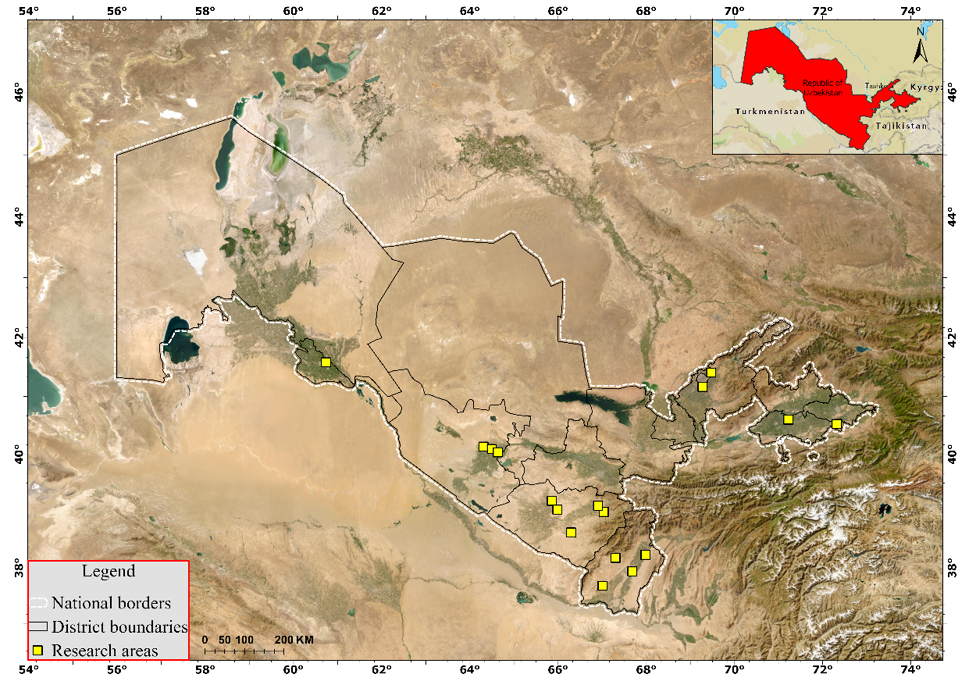
Map of the Republic of Uzbekistan showing the geographic distribution of sampling sites included in this study. Yellow squares indicate research areas where specimens were collected in May 2025. Solid lines represent district boundaries, and dashed lines indicate national borders.
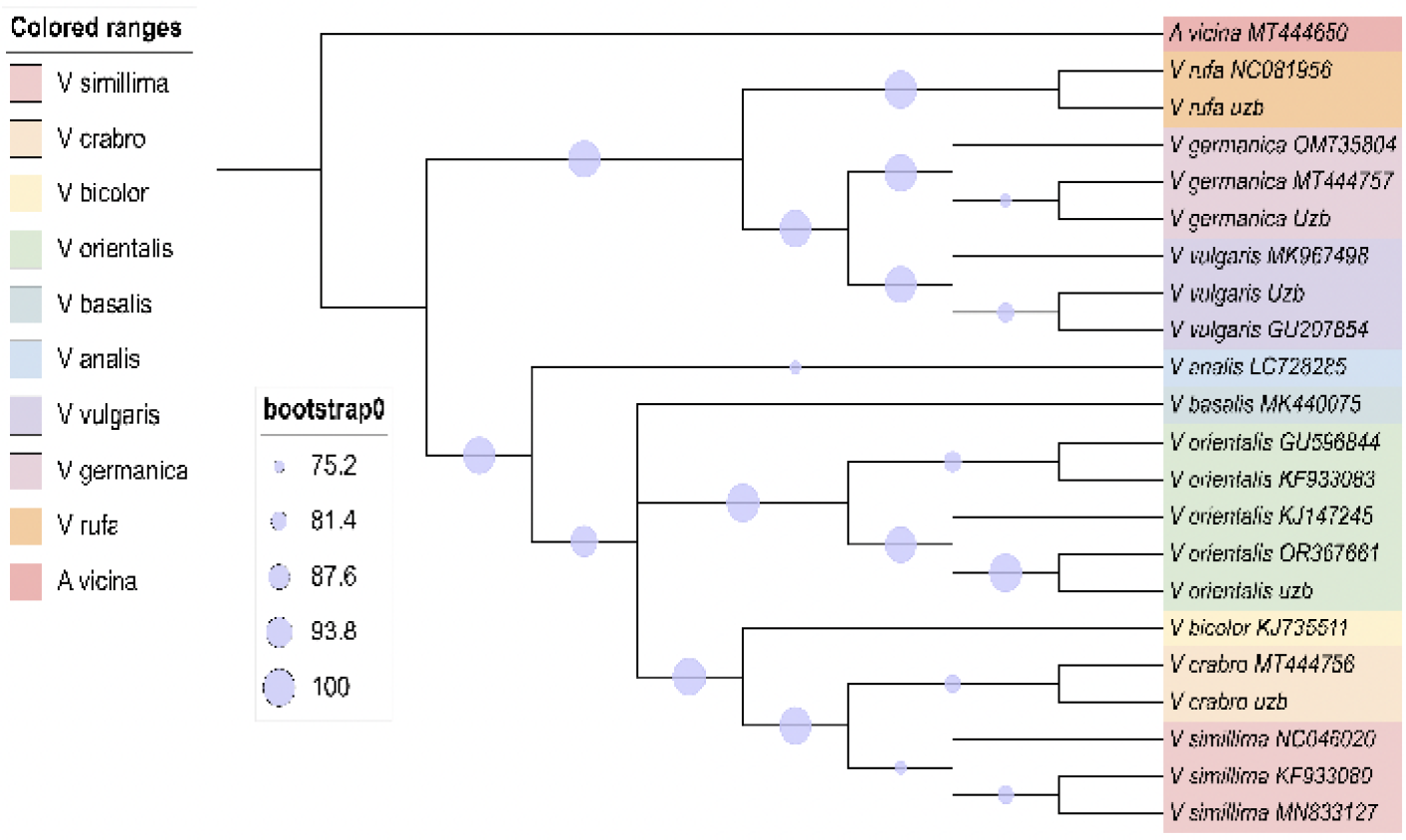
ML phylogenetic tree of Vespa and Vespula based on COI sequences. Bootstrap values are shown; A vicina (MT444650) serves as outgroup. Uzbek samples are labeled “Uzb.”
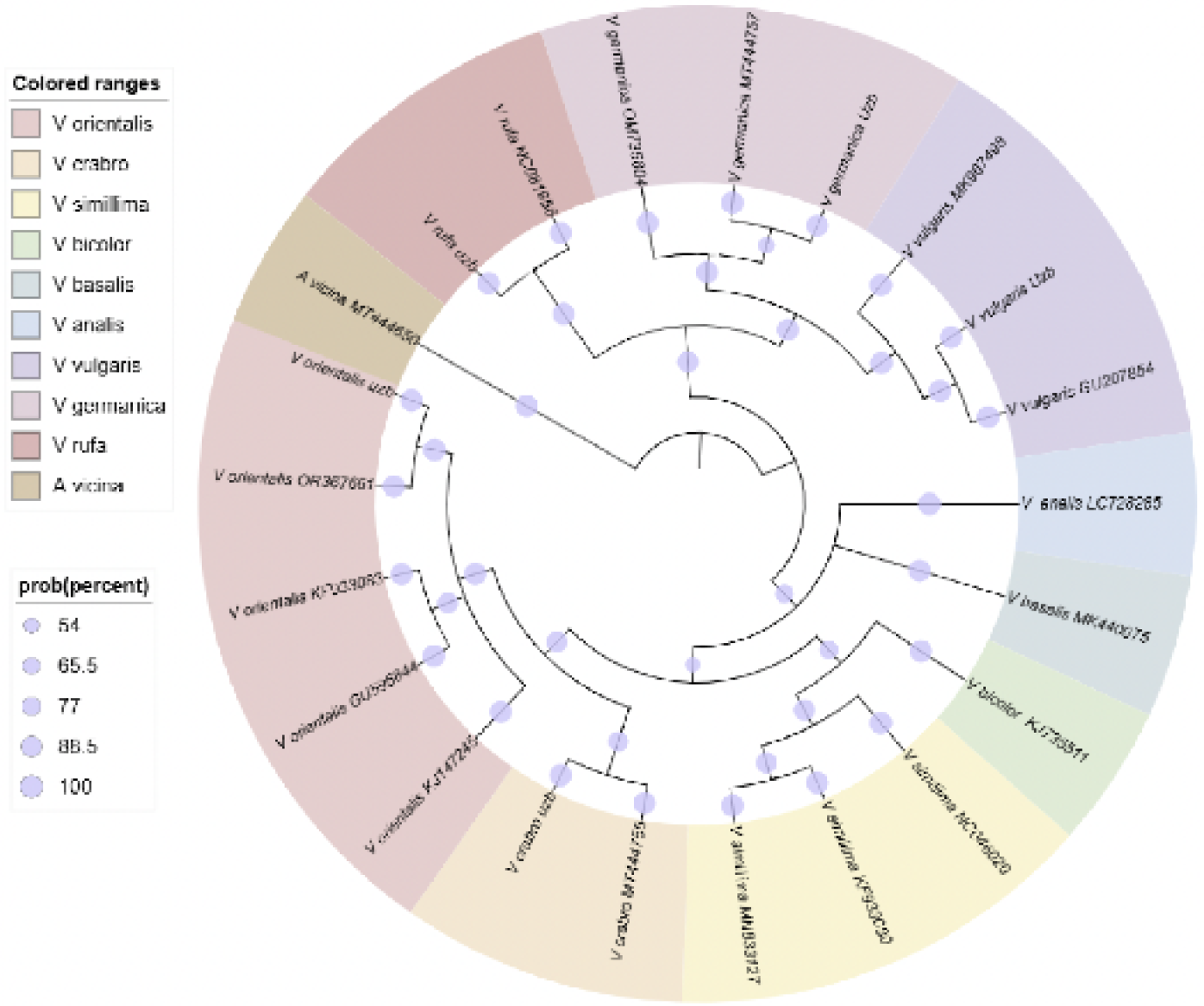
Bayesian Inference (BI) phylogenetic tree based on cytochrome c oxidase subunit I (COI) sequences reconstructed in MrBayes. The 50% majority-rule consensus tree includes 22 taxa of Vespa and Vespula. Posterior probabilities are shown at nodes; branch lengths represent substitutions per site. Uzbek samples are indicated as “Uzb.”
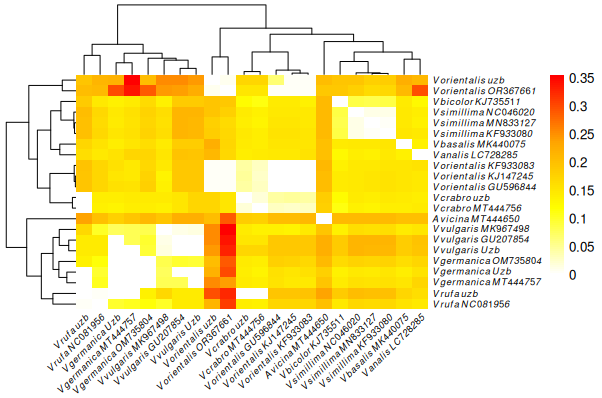
Heatmap of pairwise Kimura 2-parameter (K2P) distances among COI sequences of Vespa and Vespula species, including Uzbekistan specimens (“_uzb”) and GenBank references. Lighter colors indicate low intraspecific divergence, while darker colors show higher interspecific divergence. The heatmap highlights clear species-level separation and a distinct barcode gap.
References
- Abd-El-Samie, E.M., Elkafrawy, I., Osama, M. and Ageez, A., 2018. Molecular phylogeny and identification of the Egyptian wasps (Hymenoptera: Vespidae) based on COI mitochondrial gene sequences. Egypt. J. Biol. Pest Contr., 28: 36. https://doi.org/10.1186/s41938-018-0038-z[CrossRef]
- Adhamjon, R., Islomjon, Z., Shoxistaxon, Y., Nigoraxon, Z., Oybek, A. and Azamatkhon, Y., 2025. First record and molecular-genetic characterization of Polistes riparius (Hymenoptera: Vespidae) in Uzbekistan. Indian J. Ent., 88: 644–647. https://doi.org/10.55446/IJE.2025.3204[CrossRef]
- Aliyev, S.T., Ikromov, E.E., Ravshanova, A.R., Ikramov, T.S., Amirov, O.O., Yuldoshkhonov, A.A., Qarshiyeva, I.B. and Malikov, I.R., 2025. Morphological and molecular-genetic characterization of the nematode Aplectana acuminata Schrank, 1788 (Nematoda: Cosmocercidae) in Uzbekistan. Egypt. J. aquat. Biol. Fish., 29: 2163–2176. https://www.researchgate.net/publication/396769766 https://doi.org/10.21608/ejabf.2025.427950.6679[CrossRef]
- Amirov, O., Yuldoshkhonov, A., Kuchboev, A., Shapaotov, R., Abduraupov, T., Ismatov, A. and Murotova, D., 2025. Molecular genetic characterization and phylogenetic placement of Teratoscincus rustamovi (Squamata, Sphaerodactylidae). Biosyst. Diver., 33: 1–6. https://doi.org/10.15421/012550[CrossRef]
- Archer, M.E., 1992. The taxonomy of Vespa crabro L. and V. dybowskii André (Hym., Vespinae). Ent. Month. Mag., 128: 157–163.
- Arévalo, E., Zhu, Y., Carpenter, J.M. and Strassmann, J.E., 2004. The phylogeny of the social wasp subfamily Polistinae: Evidence from microsatellite flanking sequences, mitochondrial COI sequence, and morphological characters. BMC Evol. Biol., 4: 8. https://doi.org/10.1186/1471-2148-4-8[CrossRef]
- Cervo, R., 2006. Polistes wasps and their social parasites: An overview. Annls Zool. Fenn., 43: 531–549.
- Dowton, M. and Austin, A.D., 1994. Molecular phylogeny of the insect order Hymenoptera: Apocritan relationships. Proc. natl. Acad. Sci. U.S.A., 91: 9911–9915. https://doi.org/10.1073/pnas.91.21.9911[CrossRef]
- Euo, S.S., Choi, J.H., Choi, M.B., Kim, I.K. and Kim, C.J., 2024. The mitochondrial genome of a social wasp, Vespula rufa (Linnaeus, 1758) (Hymenoptera: Vespidae). Mitochond. DNA B: Resour., 9: 1024–1028. https://doi.org/10.1080/23802359.2024.2381788[CrossRef]
- Fateryga, A.V., Proshchalykin, M.Y., Mokrousov, M.V. and Akhmedov, A.G., 2023. To the knowledge of the solitary vespid wasps (Hymenoptera: Vespidae: Masarinae and Eumeninae s. L.) of Uzbekistan. Zootaxa, 5278: 439–460. https://doi.org/10.11646/zootaxa.5278.3.2[CrossRef]
- Haddad, N.J., Al-Nakeeb, K., Petersen, B., Dalén, L., Blom, N. and Sicheritz-Pontén, T., 2017. Complete mitochondrial genome of the Oriental Hornet, Vespa orientalis F. (Hymenoptera: Vespidae). Mitochond. DNA B: Resour., 2: 139–140. https://doi.org/10.1080/23802359.2017.1292480[CrossRef]
- Hajibabaei, M., Janzen, D.H., Burns, J.M., Hallwachs, W. and Hebert, P.D.N., 2006. DNA barcodes distinguish species of tropical Lepidoptera. Proc. natl. Acad. Sci., 103: 968–971. https://doi.org/10.1073/pnas.0510466103[CrossRef]
- Heyer, E., Balaresque, P., Jobling, M.A., Quintana-Murci, L., Chaix, R., Segurel, L., Aldashev, A. and Hegay, T., 2009. Genetic diversity and the emergence of ethnic groups in Central Asia. BMC Genet., 10: 49. https://doi.org/10.1186/1471-2156-10-49[CrossRef]
- Ji, Y., Lee, H., Choi, B., Noh, Y., Jeong, G., Choi, M.B. and Cho, K.S., 2025. Molecular and morphological insights into the taxonomic classification and introduction pathways of Vespa crabro. Sci. Rep., 15: Article 31733. https://doi.org/10.1038/s41598-025-15460-4[CrossRef]
- Katoh, K., Misawa, K., Kuma, K.I. and Miyata, T., 2002. MAFFT: A novel method for rapid multiple sequence alignment based on fast Fourier transform. Nucl. Acids Res., 30: 3059–3066. https://doi.org/10.1093/nar/gkf436[CrossRef]
- Kuchboev, A.E., Amirov, O.O., Yuldoshxonov, A.A., Shapaotov, R.K., Raxmatullayev, B.A. and Abduraupov, T.V., 2025. Taxonomic status and phylogenetic relationships of the desert monitor Varanus griseus caspius (Squamata: Varanidae) from the territory of Uzbekistan. Acta Biol. Sibirica, 11: 1261–1274.
- Letunic, I. and Bork, P., 2024. Interactive tree of life (iTOL) v6: Recent updates to the phylogenetic tree display and annotation tool. Nucl. Acids Res., 52: W78–W82. https://doi.org/10.1093/nar/gkae268[CrossRef]
- Minh, B.Q., Schmidt, H.A., Chernomor, O., Schrempf, D., Woodhams, M.D., von Haeseler, A. and Lanfear, R., 2020. IQ-TREE 2: New models and efficient methods for phylogenetic inference in the genomic era. Mol. Biol. Evol., 37: 1530–1534. https://doi.org/10.1093/molbev/msaa015[CrossRef]
- Otis, G.W., Taylor, B.A. and Mattila, H.R., 2023. Invasion potential of hornets (Hymenoptera: Vespidae: Vespa spp.). Front. Insect Sci., 3: 1145158. https://doi.org/10.3389/finsc.2023.1145158[CrossRef]
- Perrard, A., Pickett, K.M., Villemant, C., Kojima, J.I. and Carpenter, J., 2013. Phylogeny of hornets: A total evidence approach (Hymenoptera, Vespidae, Vespinae, Vespa). J. Hymenop. Res., 32: 1–15. https://doi.org/10.3897/jhr.32.4685[CrossRef]
- Piekarski, A., Khaldi, S., Greene, E., Lassiter, K., Mason, J.G. and Anthony, N., 2014. Tissue distribution, gender- and genotype-dependent expression of autophagy-related genes in avian species. PLoS One, 9: e112449. https://doi.org/10.1371/journal.pone.0112449[CrossRef]
- Seytveliyeva, S.S., Amirov, O.O., Daminov, A.S., Anvarbek, I.N., Turytsin, V.S., Marmazinskaya, N.V. and Yuldoshkhonov, A.A., 2026. Morphological and molecular-genetic characterization of Trichuris discolor (Linstow, 1906) (Nematoda: Trichuridae). Adv. Anim. Vet. Sci., 14: 276–284. https://doi.org/10.17582/journal.aavs/2026/14.2.276.284[Full text][CrossRef]
- Song, S.N., Tang, P., Wei, S.J. and Chen, X.X., 2016. Comparative and phylogenetic analysis of the mitochondrial genomes in basal hymenopterans. Sci. Rep., 6: 20972. https://doi.org/10.1038/srep20972[CrossRef]
- Tamura, K., Stecher, G. and Kumar, S., 2021. MEGA11: Molecular evolutionary genetics analysis version 11. Mol. Biol. Evol., 38: 3022–3027. https://doi.org/10.1093/molbev/msab120[CrossRef]
- Yuldosheva, J., Bobonazarov, G., Burieva, K., Amirov, O. and Shapaotov, R., 2026. Molecular genetic characterization of the species Vespa crabro and Vespa orientalis belonging to the Genus Vespa. Int. J. Genet. Eng., 14: 7–12.
Services
Article usage statistics
Loading…