
Morphological characteristics of turkey Meleagris gallopavo semen were recorded and hatchability percentages of the artificially inseminated hens were assessed. To study the effect of natural mating on hatchability 15 (3♂, 12♀) M. gallopavo were randomly selected, were kept separately and were allowed to mate through stud mating. For artificial insemination, male (n = 3) and female (n = 12) birds were kept separately. Semen of the male birds was collected on weekly basis to record morphological characteristics and to inseminate the female birds. Mean abnormal spermatozoa rate was 14.61±1.61% with most common acrosome defects 39.67±3.80 % followed by defects in mid-piece 29.61±0.24%, head defects 10.15±1.21% and tail defects 20.57±1.97%. Laid eggs were collected, stored and were incubated for hatching. Hatchability percentage in artificially inseminated hens was greater 88.30% than natural mating 80.51%.
Short Communication · Volume 50, Issue 2, 28 March 2018 · Open Access
Studies on Semen Morphology and Effects of Artificial Insemination on Hatchability in Turkeys (Meleagris gallopavo)
· · · · · · ·
Affiliations & Notes ⌄
- 1Department of Zoology, Government College University, Lahore 2Department of Fisheries and Aquaculture, University of Veterinary and Animal Sciences, Lahore 3Department of Poultry Production, University of Veterinary and Animal Sciences, Lahore 4Department of Zoology, Women University Azad Jammu and Kashmir, Bagh 5Department of Zoology, Government College University, Faisalabad 6Department of Life Sciences, The Islamia University of Bahawalpur, Bahawalpur 7Department of Wildlife and Ecology, Univ
Article Info ⌄
- Journal:
- Pakistan Journal of Zoology
- Published:
- 28 March 2018

Abstract
Materials and methods
An experiment was conducted to study semen morphology and effect of AI on hatchability in turkeys Meleagris gallopavo. At the initiation of experiment, the age of the male and female turkeys was eight months. To study the hatchability, fifteen (12♀, 3♂) birds were randomly selected for each of the method i.e. natural mating and AI. These birds were kept separately and for every four females, one male bird was earmarked. The female and male birds were allowed to mate through stud mating for natural mating. For AI, male M. gallopavo were conditioned and trained for semen collection through abdominal massage and semen was collected on weekly basis for six weeks and analyzed for determination of volume, morphology, sperm count, live-dead ratio and mass motility .
AI was achieved following ‘venting’; the females were turned upside down, pressure applied on the right side of the abdomen until the vent everted, a pipette containing fresh semen was inserted to a depth of about 1.5-2 cm into the cloacae and then 0.02 ml of semen was dispensed on weekly basis for a period of six weeks. The laid eggs were collected from each cage and cage number and weight of each egg was noted. The eggs were then transferred to the incubators and hatchability percentage was recorded for natural and artificially inseminated birds.
The collected data was subjected to statistical software SAS 9.1 and analysis of variance was applied to compare the means.
Results
Mean morphological defect rate of sperms was recorded 14.61±1.61%. Acrosome defect rate was highest 39.67±3.80% having most frequent defects of acrosome detachment (without acrosome), hooked shaped acrosome, acrosome swelling and rounded acrosome (Fig. 1A). Mid-piece abnormalities (Fig. 1B) were the second most common defects 29.61±0.24%. Head abnormalities were recorded 10.15±1.21% with most common abnormalities
of bent head, hooked shape head, twin head, swelled head, knotted head, short head and larger head (Fig. 1C). Tail defects were recorded 20.57±1.97% having frequent defects as double tail, coiled tail, knotted tail, bent tail, curled tail, detached tail and short tail (Fig. 1D).
Mean semen volume during the trial was 0.19±0.04 ml, live-dead ratio 71.66±11.72% while mass motility was recorded 81.41±7.19%. Statistically significant (p<0.05) variations were recorded for semen volume during 4th and 6th week (Table I) while non-significant variations in live-dead ratio were recorded from 1st to 6th week of trial. Maximum mass motility was recorded 86.50±6.35% during 1st week and minimum 71.25±3.30 % during 6th week of trial (Table I). Mean hatchability percentage for artificially inseminated eggs was recorded as 88.30% (Table II).
Table I.- Weekly variations in semen characteristics of turkeys (Meleagris gallpavo).
| Week | Semen volume(ml) | Semen count (×109 cell/ml) | Live dead ratio (%) | Mass motility (%) |
| 1 | 0.19±0.04ab | 6.02±0.73a | 70.50±10.14a | 86.50±6.35a |
| 2 | 0.19±0.03ab | 5.59±0.77a | 63.25±16.17a | 83.75±6.60ab |
| 3 | 0.195±0.03ab | 5.75±0.94a | 70.50±7.94a | 72.50±11.21bc |
| 4 | 0.21±0.04a | 6.48±0.47a | 68.75±20.74a | 72.25±6.29bc |
| 5 | 0.19±0.02ab | 5.66±1.59a | 66.25±6.89a | 77.01±7.26abc |
| 6 | 0.16±0.02b | 5.33±0.32b | 85.39±10.41a | 71.25±3.30c |
Means with similar superscript in a column are statistically non-significant.
Table II.- Hatchability percentages of eggs from artificially inseminated and naturally matted hens of Meleagris gallopavo.
| Insemination types | Hens/ cage No. | Mean (eggs) | Hatchability % | |
| Incubated | Hatched | |||
| Natural mating | A | 15 | 13 | 86.67 |
| B | 11 | 9 | 81.82 | |
| C | 14 | 11 | 78.57 | |
| D | 12 | 9 | 75.0 | |
| Artificial insemination | E | 16 | 14 | 87.50 |
| F | 15 | 14 | 93.33 | |
| G | 14 | 12 | 85.71 | |
| H | 15 | 13 | 86.66 | |
Discussion
During present study, mean morphological defect rate of sperms was recorded 4.61±1.61%. Alkan et al. (2002) documented slightly higher percentages 17±0.06% of morphological defects in turkey sperms. Similarly, Tsukunaga (1987) recorded higher values for tail defects. These differences might be attributed to ambient temperature, season of collection, humidity, body weight of the birds and semen collection techniques. Mean semen volume recorded during the experiment was 0.19±0.04 ml and it was in line with the findings of Zahraddeen et al. (2005) and Yahaya et al. (2013) who documented semen volumes as 0.17±0.02 ml and 0.19±0.010 ml, respectively.
During present investigation, mean semen count was 6.35±0.87 (×109 cells/ml), mean live-dead ratio 71.66±11.72% while mass motility was recorded 81.41±7.19%. These findings are in line with the results of Yahaya et al. (2013) while Zahraddeen et al. (2005) recorded lower semen concentrations 2.81±74.93 (×109 cells/ml) and Rekwot et al. (2005) reported higher live-dead ratio of 85.2±2.56% in confined turkeys and these differences might be due to rearing systems.
Statistically significant (p<0.05) variations were recorded for semen volume during 4th and 6th week of trial (Table I). Similar findings have been documented by Noirault and Brillard (1999).
Non-significant variations were recorded in live-dead ratio from 1st to 6th while maximum semen motility was recorded 86.50±6.35% during 1st week and minimum 71.25±3.30% during 6th week of trial (Table I). Yahaya et al. (2013) documented non-significant variations in live-dead ratio and semen motility from 1st to 6th week. Similarly, Zahraddeen et al. (2005) reported non-significant variations for semen of exotic and local turkeys.
After incubation, the mean hatchability percentage for artificially inseminated eggs was 88.30% and it was higher than eggs laid by the females after natural mating with mean hatchability percentage of 80.51% (Table II). Yahaya et al. (2013) documented hatchability rate of 84.75% in eggs from artificially inseminated females.
Conclusion
It can be concluded from the present study that acrosome and mid-piece defects are amongst common morphological semen defects and artificial insemination is feasible and rewarding with higher egg hatchability percentage in in Meleagris gallopavo.
Statement of conflict of interest
Authors have declared no conflict of interest.
Figures
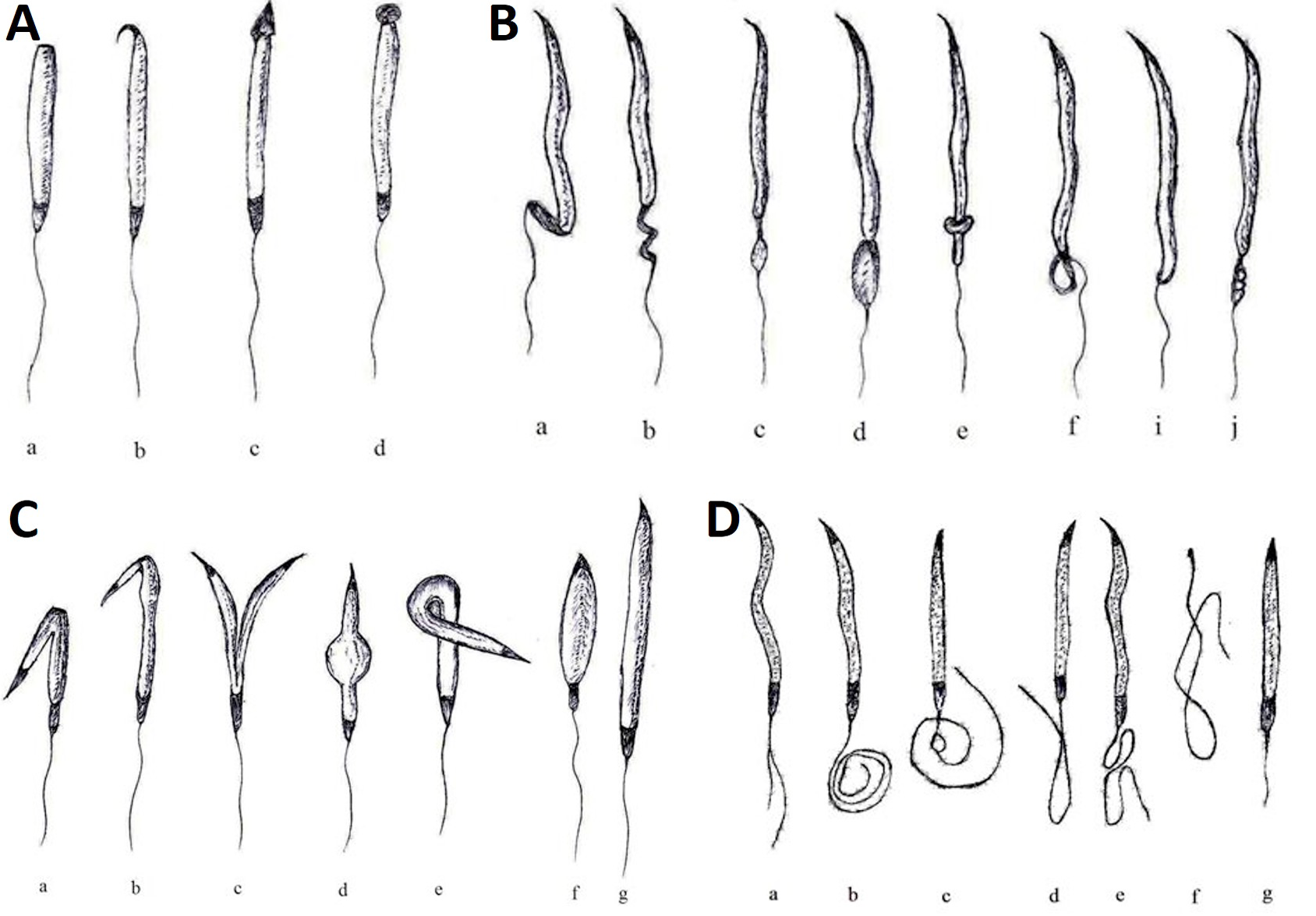
Morphology of sperms of Meleagris gallopavo; A, showing acrosome defects (a) without acrosome, (b) hooked shaped acrosome, (c) acrosome swelling and (d) rounded acrosome; B, showing mid piece defects (a) bent mid piece, (b) irregular mid piece, (c) partially detached mid piece, (d) swelled mid piece, (e) mid piece swelled near neck region, (f) knotted mid piece, (i) without mid piece and (j) spiral mid piece; C, showing head defects (a) bent head, (b) hook shape head, (c) twin head, (d) swelled head, (e) knotted head, (f) short head and (g) larger head; D, showing tail defects (a) double tail, (b) coiled tail, (c) knotted tail, (d) bent tail, (e) curled tail, (f) detached tail and (g) short tail.
References
- Alkan, S., Baran, A., Banu, Z. and Evecen, M., 2002. Turk. J. Vet. Anim. Sci., 26: 1087-1092.
- Burrows, F.A. and Quinn, J.P., 1937. Poult. Sci., 16: 19-24. https://doi.org/10.3382/ps.0160019[CrossRef]
- Etches, R.J., 1996. Reproduction in poultry. University Press Cambridge, UK.
- Gage, M.J.G., Macfarlane, C.P., Yeates, S., Ward, R.G., Searle, J.B. and Parker, G.A., 2004. Curr. Biol., 14: 44-47. https://doi.org/10.1016/S0960-9822(03)00939-4[CrossRef]
- Irfan, Javid, A., Ashraf, M., Mahmud, A., Altaf, M., Hussain, S.M., Azmat, H. and Iqbal, K.J., 2016. Pakistan J. Zool., 48: 1951-1956.
- Noirault, J. and Brillard, J.P., 1999. Poult. Sci., 78: 1034-1039. https://doi.org/10.1093/ps/78.7.1034[CrossRef]
- Ramamurthy, N., Narahari, D., Kothandaraman, P. and Sethumadhavan, V., 1998. Indian Vet. J., 66: 584.
- Rekwot, P.I., Abubakar, Y.U., Anyam, A.A., Sekoni, V.O., Jatau, J. and Magaji, S., 2005. Spermiogram of Rhode Island red breeder cocks. Nigerian Vet. Med. Assoc. Conf., pp. 1-10.
- Sastry, A.G., 2002. Veterinary clinical pathology, 6th ed. CBS Publishers and Distributors, pp. 67-72.
- Tsukunaga, S., 1987. Bull. Hiroshima Agric. Coll. (Japan), 8: 257-303.
- Vladic, T.V., Afzelius, B.A. and Bronnikov, G.E., 2002. Biol. Reprod., 66: 98-105. https://doi.org/10.1095/biolreprod66.1.98[CrossRef]
- Yahaya, M.S., Umaru, M.A. and Aliyu, A., 2013. Sokoto J. Vet. Sci., 11: 67-70.
- Zahraddeen, D., Butswat, I.S.R., Kalla, D.J.U., Sir, S.M. and Bukar, M.T., 2005. Int. J. Poult. Sci., 4: 217-221. https://doi.org/10.3923/ijps.2005.217.221[CrossRef]
Services
Article usage statistics
Loading…