
Pakistan is bestowed with variety of habitats and climatic conditions which leads to diverse range of avian species. Among avifauna of Pakistan, Birds of prey or raptors are well-known because of their beauty and speed of flight. Falcons, hawks, kites, eagles, and vulture are common birds of prey. They are geographically widespread and common among the vertebrates. Being predatory birds, they are found on the top of food chain. Unfortunately, birds of prey are facing serious threats such as loss of habitat, pollution, poaching and injuries. In order to maintain ecological balance and food chains, this is very important to make strategies for conservation of these predatory birds. However, there is still uncertainty in their taxonomy because these birds are not studied well at genetic level. Morphological identification includes size, color, and body weight etc. which are crude and does not lead to accurate identification at species level. In order to overcome such gaps, the aim of this study was the identification of two broad families of raptors; Accipitridae and Falconidae, at molecular level using mitochondrial ND2 gene. The partial sequence of ND2 gene was submitted to GenBank. The novel SNPs were investigated which serves as marker for identification of Pakistani raptorial species. Two sub species of falcons are also characterized at genetic level for the first time. The study represented the first report on genetic data of raptorial species of the Pakistan. This strategy can be used to identify other species of birds of prey to get diverse genetic data which will be helpful for the conservation planning of these birds. Developed genetic markers of identification will be used for forensic purposes and also play a significant role in maintenance of ecosystems.
Short Communication · Volume 56, Issue 4, 15 June 2024 · Open Access
Molecular Identification of Predatory Birds Through Analysis of Mitochondrial ND2 Gene
· · · · · · ·
Affiliations & Notes ⌄
- 1Institute of Biochemistry and Biotechnology, University of Veterinary and Animal Sciences, Lahore, Pakistan 2Institute of Microbiology, University of Veterinary and Animal Sciences, Lahore, Pakistan * Corresponding author: rumishanouman@gmail.com, sehrishfiryal@uvas.edu.pk
Article Info ⌄
- Journal:
- Pakistan Journal of Zoology
- Published:
- 15 June 2024

From the article
- In this study, four randomly selected species of raptors (5 birds from each species) belong to family Accipitridae and Falconidae were analyzed genetically using mitochondrial ND2 gene.
- Partial nucleotide sequences of ND2 gene of four selected species of raptors was submitted to GenBank.
- Phenotypically different studied Pakistani raptor species are monophyletic.
- The developed molecular markers can be used for accurate identification of species as well as for forensic purposes.
Selected from the article's own text.
Abstract
Materials and methods
Four different species of raptors (5 birds each species) were selected randomly namely; Accipiter badius (shikra), Falco peregrinus peregrinator (black shaheen), Falco peregrinus babylonicus (red-naped shaheen) and Falco peregrinus (peregrine falcon) from different regions of Punjab Pakistan in collaboration with the Hawking Club of Punjab and the Global Pet Zone Lahore. About 50-200µL of blood was collected from brachial vein of each adult bird. All the collected samples were labeled as ACCFAL-1 to ACCFAL-20 and stored at -20oC in Molecular Biology and Genomic Laboratory, University of Veterinary and Animal Sciences, Lahore. DNA was extracted from the frozen blood by using standard organic extraction method . Primers specific to ND2 gene were designed through online software Primer3 (http://bioinfo.ut.ee/primer3/) using reference sequence KP336714.1 and NC_000878.1 from NCBI (https://www.ncbi.nlm.nih.gov/) for Accipitridae and Falconidae, respectively. Amplification of ND2 gene was done using Standard PCR at 58oC. PCR reagents were added in following concentrations; Template DNA (15ng/μl) 30ng/μl, 10x Taq polymerase buffer 1x, dNTPs (2.5mM) 0.2mM, MgCl2 (25mM) 1.5mM, primers (10μM) each forward and reverse, Taq DNA polymerase 1.25U. The total volume of reaction mixture was 25 μl. Specific temperature profile was used; for both set of primers. The resulted PCR product was visualized by gel electrophoresis (2% gel).
Purified amplicons were subjected to sequencing using dye-labeled dideoxy terminator cycle sequencing through ABI prism 3130 XL Genetic Analyzer (Applied Biosystems, Inc., Foster City, CA) following standard protocol.
Sequences obtained after sequencing were analyzed using Electropherogram Chromas Software version (V1.45). For homology analysis, sequences were blast against Reference sequence using NCBI BLAST (https://blast.ncbi.nlm.nih.gov/Blast.cgi). Clustal W (https://www.genome.jp/tools-bin/clustalw) was used for multiple alignment and comparative analysis. Phylogenetic relationship among different raptorial species were analyzed by Molecular Evolutionary Genetic Analysis version 11 (MEGA11) .
Results and discussion
In this study, four randomly selected species of raptors (5 birds from each species) belong to family Accipitridae and Falconidae were analyzed genetically using mitochondrial ND2 gene. As a result, we got partial nucleotide sequences of mitochondrial ND2 gene from 4 species include, A. badius, F. p. peregrinator, F. p. babylonicus and F. peregrinus, which were submitted to GenBank NCBI with Accession No. OP719766-OP719769, respectively.
Table I. Novel SNPs in Pakistani A. badius.
| S. No. | Base position | Allele | Pakistani A. badius | A. b. poliopsis |
| 1 | 454 | C/T | C | T |
| 2 | 566 | G/A | G | A |
| 3 | 693 | C/T | C | T |
Table II. Novel SNPs in Pakistani F. peregrinus.
| S. No. | Base position | Allele | Pakistani F. peregrinus | F. peregrinus |
| 1 | 94 | T/A | T | A |
| 2 | 127 | G/A | G | A |
| 3 | 172 | T/A | T | A |
| 4 | 213 | A/T | A | T |
| 5 | 457 | T/C | T | C |
| 6 | 563 | G/A | G | A |
Results from NCBI BLAST predicted that the Pakistani A. badius show maximum identity with reported sequences of A. b. poliopsis. Whereas, we have found 3 novel single nucleotide polymorphisms (SNPs) in Pakistani A. badius (Table I). In case of members of family Falconidae, Pakistani F. peregrinus is found to be related to already reported sequences and thus, shows 6 novel SNPs at certain position (Table II). The other two members of this family, F. p. peregrinator and F. p. babylonicus, possess much similarity with F. peregrinus but their sequences are not identical to any of the reported species. It seems like these two members have not been identified at molecular level before and therefore, their nucleotide sequences are not found on NCBI. Our findings compelled us to declare these two members as sub-species of F. peregrinus. Evolutionary analysis among various species of raptors through MEGA11 (Fig. 1). The results exhibited that A. badius is more closely associated with A. soloensis and A. b. poliopsis. Similarly, F. p. peregrinator and F. p. babylonicus has made ingroup with F. peregrinus. Whereas Pakistani F. peregrinus showed relationship with F. peregrinus voucher. The results from phylogenetic tree coincide with the morphological classification of these four species of raptors (Fig. 2). However, it is recommended to explore such species at molecular level further in order to avoid ambiguities.
Similar studies have been conducted by Firyal et al. (2014) in Pakistan for the identification of Pakistani domestic pigeon using mitochondrial Cytb gene. In another study, molecular approaches have been employed for sex identification in birds . Although, there is less data available on the raptorial bird species at genetic level, but it was exhibited that there is a dire need for the conservation of certain species of hawks (Bjorklund et al., 2015).
In the current study, we cannot predict the novel SNPs in the sequences of sub-species of F. peregrinus due to lack of records on NCBI. Whereas the novel SNPs of A. badius and F. peregrinus can serve as markers for the identification of Pakistani raptors. Such kind of study has not been conducted in Pakistan so far.
Conclusion
Partial nucleotide sequences of ND2 gene of four selected species of raptors was submitted to GenBank. It was found that A. badius is closely associated with A. b. poliopsis with only three novel SNPs. Whereas, Black Shaheen and Red-Naped Shaheen are sub-species of F. peregrinus. Phenotypically different studied Pakistani raptor species are monophyletic. Moreover, Pakistani raptors phylogeny follow the classical ecological divergence pattern.
The developed molecular markers can be used for accurate identification of species as well as for forensic purposes. It can also provide the better conservational activities.
Acknowledgement
The first author acknowledges the honorable Prof. Dr. Aneela Zameer Durrani, Department of Clinical Medicine and Surgery, UVAS Lahore and respected Mr. Kamran Abid, Director of the Hawking Club of Punjab and the Global Pet Zone Lahore, who helped in collection of blood samples of such rare birds of prey.
Funding
This work was funded by University of Veterinary and Animal Sciences (UVAS), Lahore, Pakistan.
Ethics statement
All blood samples were carried according to instructions of Animal Ethics Committee of University of Veterinary and Animal Sciences (UVAS), Lahore, Pakistan (DR/ 71 Dated: 08-02-2016).
Statement of conflict of interest
The authors have declared no conflict of interest.
Figures
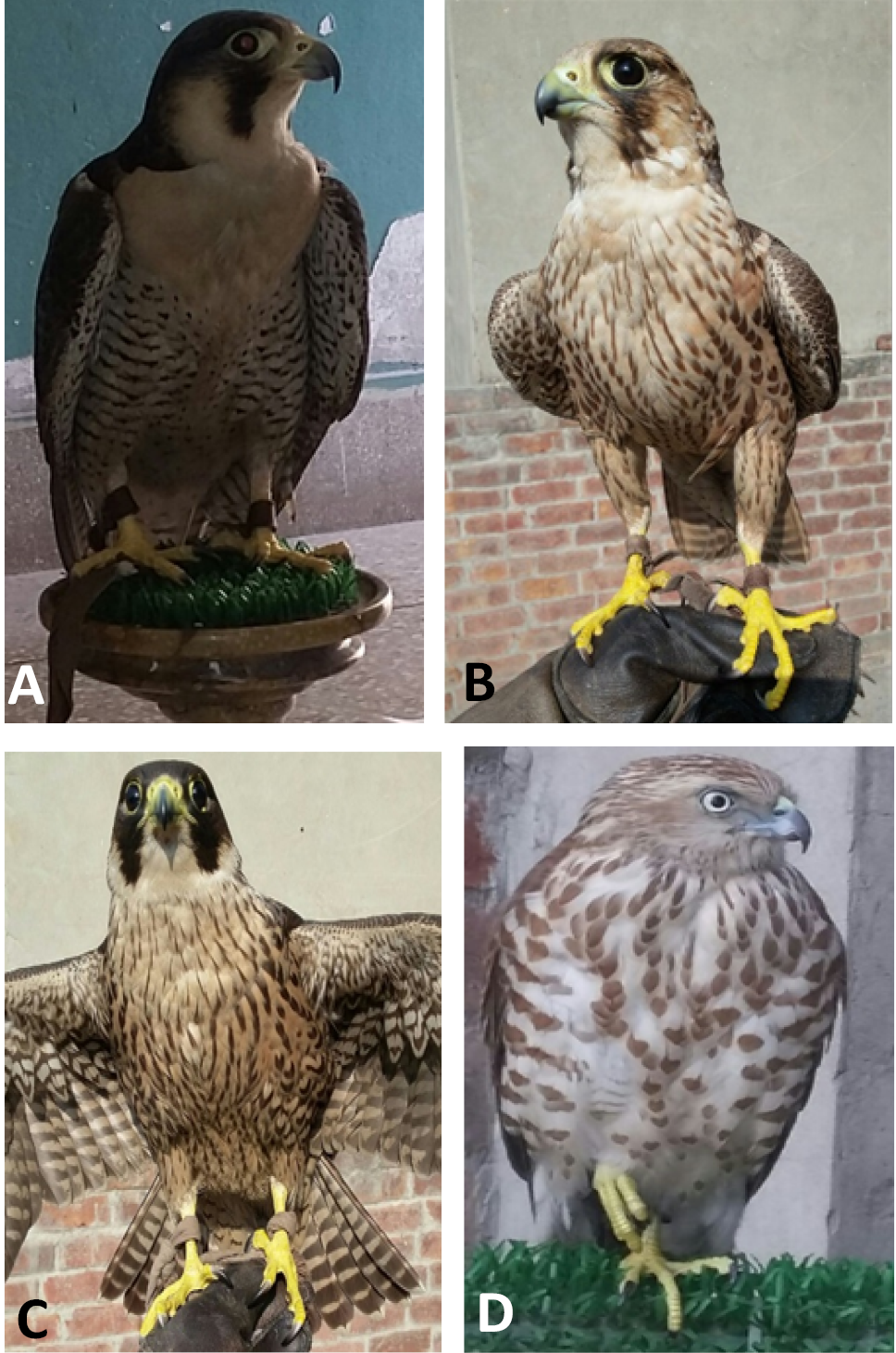
Predatory birds. A, F. peregrinus (Peregrine falcon); B, F. p. babylonicus (Red-naped Shaheen); C, F. p. peregrinator (Black Shaheen); D, A. badius (Shikra).
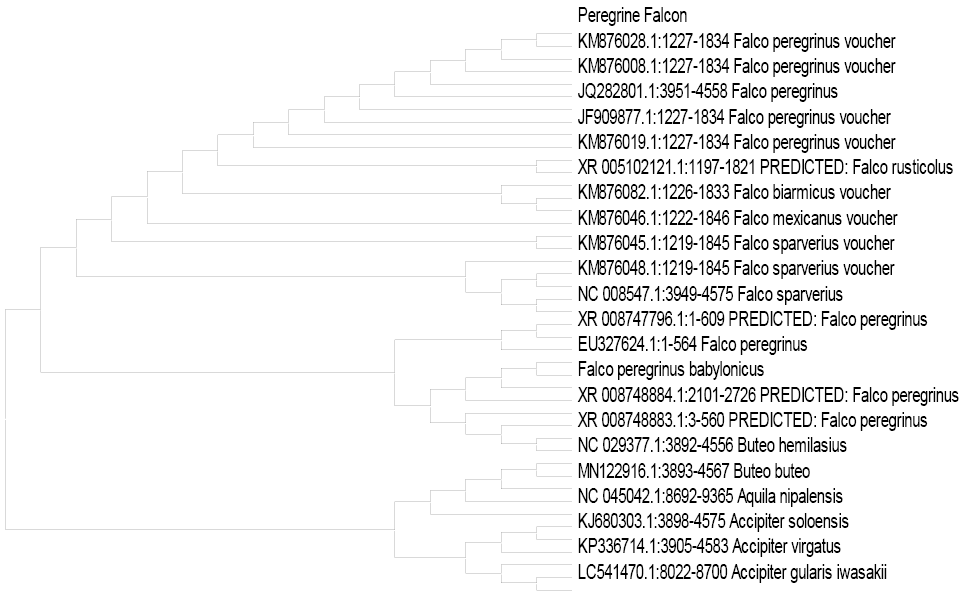
Phylogenetic tree made through MEGA11.
References
- Barbar, F., Werenkraut, V., Morales, J.M. and Lambertucci, S.A., 2015. PLos One, 10: e0118851. https://doi.org/10.1371/journal.pone.0118851[CrossRef]
- Ben, S.H., Schaschi, H., Knauer, F. and Suchentrunk, F., 2017. BMC Evol. Biol., 17: 46. https://doi.org/10.1186/s12862-017-0896-0[CrossRef]
- Björklund, H., Valkama, J., Tomppo, E. and Laaksonen, T., 2015. PLos One, 10: e0137877.
- Coghlan, M.L., White, N.E., Murray, D.C., Houston, J., Rutherford, W., Bellgard, M.I., Haile, J. and Bunce, M., 2013. Invest. Genet., https://doi.org/10.1186/2041-2223-4-27[CrossRef]
- Colihueque, N., Gantz, A. and Parraguez, M., 2021. ZooKeys, 1016: 143-161. https://doi.org/10.3897/zookeys.1016.51866[CrossRef]
- Dubiec, A. and Neubauer, M.Z., 2006. Biol. Lett., 43: 3-12.
- Fathima, J., Afreen, M., Kamalanathan, M., Palanivelrajan, A., Prathipa, M. and Jayathangaraj, M., 2016. Zoo’s Print, 31: 8-9.
- Firyal, S., Awan, A.R., Yaqub, T., Anjum, A.A., Asif, M. and Tayyab, M., 2014. Pak. Vet. J., 34: 254-256.
- Jiang, L., Chen, J., Wang, P., Ren, Q., Yuan, J. and Qian, C., 2015. PLoS One, 10: e0136297. https://doi.org/10.1371/journal.pone.0136297[CrossRef]
- Luttrell, Sarah, A.M., Drovetski, Sergei, Dahlan, Nor Faridah, Eubanks, Damani and Dove, C.J., 2020. Hum. Wildl. Interact., 14: 365–375.
- Pandiyan, J., Zachariah, A., Chandramohan, B., Mahboob, S., Khalid A., Nicoletti, M., Nisa, Z. and Govindarajan, M. 2022. J. King Saud Univ. Sci., 34. https://doi.org/10.1016/j.jksus.2021.101750[CrossRef]
- Sambrook, J. and Russel, D.W., 2001. Molecular cloning: A laboratory manual: 3rd Edn. Cold Spring Harbor Laboratory Press, New York. USA.
- Soto, S.R., Ruiz, V.H., Benitez, M.A., Marchant, M. and Vega, R.E., 2017. ZooKeys, 642: 131-148. https://doi.org/10.3897/zookeys.642.9877[CrossRef]
- Tamura, K., Stecher, G. and Kumar, S., 2021. MEGA 11: Mol. Biol. Evol., https://doi.org/10.1093/molbev/msab120[CrossRef]
- Uddin, A., Mazumder, T.H., Choudhury, M.N. and Chakraborty, S., 2015. J. Biomed. Inform., 11: 407-412. https://doi.org/10.6026/97320630011407[CrossRef]
Services
Article usage statistics
Loading…