
To describe the epidemiological feature of schistosomiasis in China mainland. The information on national schistosomiasis case and incidence were collected, its epidemiological feature was analyzed by time, location and age. A total of 78 656 cases and 15 deaths of schistosomiasis were reported in China between 2004 and 2018. The incidence of schistosomiasis in 2009-2013 was statistical significance higher than before and after. Hubei was the most seriously afflicted among all endemic provinces in the periods of 2004-2009 and 2010-2014. In addition, the 50-59 and 60-69 age groups had significantly higher incidence. The incidence of schistosomiasis was concentrated in the middle and lower reaches of the Yangtze River and people over 50 were at higher risk.
Short Communication · Volume 56, Issue 4, 15 June 2024 · Open Access
Epidemiological Analysis of Endemic Schistosomiasis Prevalence in China, 2004-2018
· · · ·
Affiliations & Notes ⌄
- 1School of Medicine, Huzhou University, 759 Erhuan Rd, Huzhou, Zhejiang, Peoples R China 2Key Laboratory of Vector Biology and Pathogen Control of Zhejiang Province, Huzhou University, Huzhou, Zhejiang, Peoples R China 3School of Life Sciences, Xiamen University, Fujian, Peoples R China * Corresponding author: guoyue66@126.com, yueguo@zjhu.edu.cn
Article Info ⌄
- Journal:
- Pakistan Journal of Zoology
- Published:
- 15 June 2024

From the article
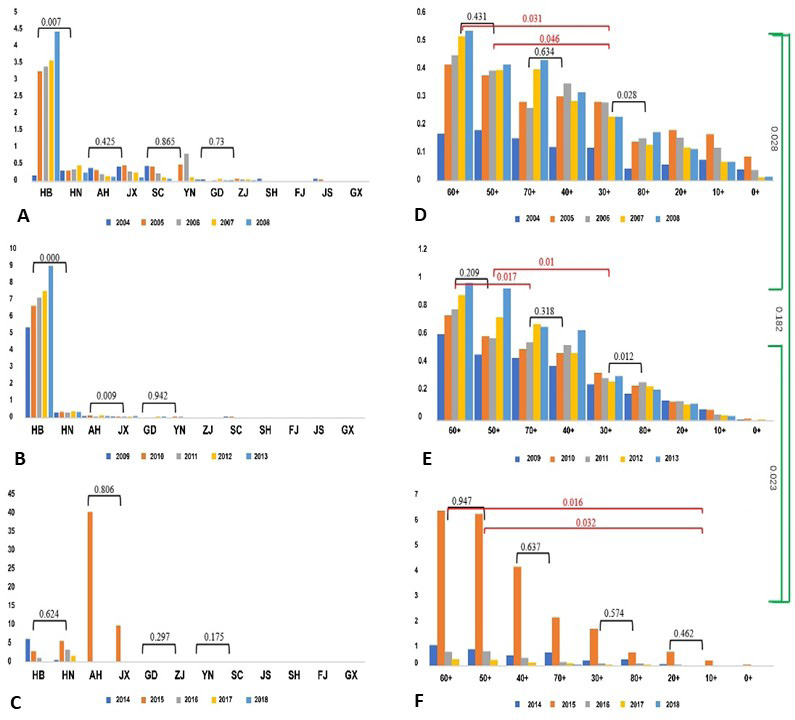
- HB had the statistically significant highest incidence of schistosomiasis during 2004-2008 and 2009-2013 but there were no significant differences by location during 2014-2018.
- Ranking of incidence by age groups showed similar patterns over the 3 time-frames analyzed and the 60+ and 50+ age groups had the highest incidence, significantly different from other age groups (Fig. 2).
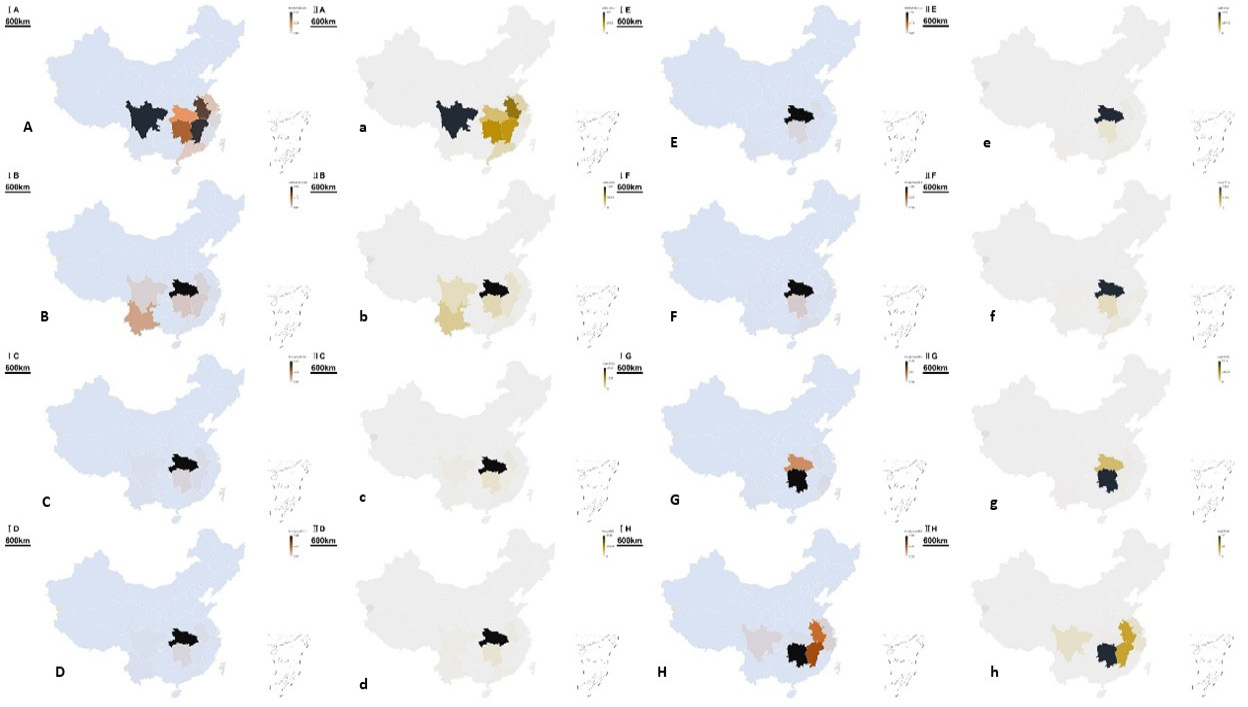
- However, HB showed the largest schistosome-positive population and highest incidence in 2006, 2008, 2010, 2012 and 2014 and HN in 2016 and 2018.
- However, incidence of schistosomiasis in 2009-2013 had statistical difference with the other 2 timeframes, suggesting that incidence of schistosomiasis had increased in 2009-2013 and decreased in 2014-2018.
Selected from the article's own text.
Abstract
Materials and methods
The disease has been long acknowledged as a serious parasitic disease and has resisted efforts to eliminate it. Cases have been recorded in China as recently as 2030, particularly in the established endemic zone .
Data on new schistosomiasis cases, incidence and numbers of deaths were collated from the Public Health Science Center of the People’s Republic of China and population information was taken from the yearbooks of National Bureau of Statistics of China. Rates of disease incidence are presented as people infected with S. japonicum × 100,000/ total population. Mortality was not analyzed due to low sample size.
S. japonicum infection in non-endemic areas was excluded. The prevalence (case numbers and incidence) was analyzed in the following provinces: HB, HN, AH, JX, GD, ZJ, YN, SC, JS, SH, FJ and GX.
Data covered on schistosomiasis cases and incidence from 2004 to 2018, 15 years. We divided the 15 years into 3 timeframes, including 2004-2008, 2009-2013 and 2014-2018.
Raw data was collated in Excel and analyzed by SPSS software (Version 20.0; SPSS Inc, USA). The χ2 test was carried out to compare the incidence by sex and region. A map of schistosomiasis cases and incidence in 2004, 2006, 2008, 2010, 2012, 2014, 2016 and 2018 was generated using ArcGIS 10.0 (version 10.5; ESRI Inc, Redlands, CA, USA).
Results and discussion
Figure 1 shows prevalence of schistosomiasis in mainland China during 2004-2018.
A total of 78,656 cases of schistosomiasis, including 15 deaths, were recorded in China between 2004 and 2018. 99.8% of cases and all deaths occurred in the endemic region.
Trends of incidence and incidental ratios showed similar features. Case numbers and incidental ratios were constant during 2004-2014 but the highest values of both occurred in 2015.
Death from schistosomiasis was rare and well-controlled throughout the period of data collation with no reported death after 2014.
Ranking of average incidence showed a similar pattern over the 3 timeframes investigated with HB, HN, AH and JX having the most cases. HB had the statistically significant highest incidence of schistosomiasis during 2004-2008 and 2009-2013 but there were no significant differences by location during 2014-2018. Analysis by province is shown in Figure 2.
Ranking of incidence by age groups showed similar patterns over the 3 time-frames analyzed and the 60+ and 50+ age groups had the highest incidence, significantly different from other age groups (Fig. 2). The incidence of age groups in 2004-2008 had significant differences with the other 2 time frames.
Maps of schistosomiasis cases and incidence distributions were basically similar with the largest population of schistosome-positive samples giving rise to the highest incidence. In 2004, SC had the largest number and the highest incidence. However, HB showed the largest schistosome-positive population and highest incidence in 2006, 2008, 2010, 2012 and 2014 and HN in 2016 and 2018.
The main region of endemic schistosomiasis is centered around the lower middle and lower reaches of the Yangtze River in southern China, including HB, HN, AH and JX, with few reported cases elsewhere.
Hubei has been described as a province with a thousand lakes and is an ideal habitat for the freshwater snail intermediate host of the Schistosome parasite ; . In the two continuous time periods of 2004-2008 and 2009-2013, Hubei had the statistically significant highest national infection ratio. Hunan and Jiangxi also have large areas of water area with Poyang Lake, the largest freshwater lake in China, located in Jiangxi, and Dongting Lake, the second largest freshwater lake, in Hunan ; ; . O. hupensis has grown and been distributed through these lakes for a thousand years, generating the two areas where schistosomiasis is the most serious endemic problem. The lack of a statistical difference in schistosomiasis between the two provinces during 2004-2018 implies that the endemic situation in Hubei may be well-controlled.
Incidence of schistosomiasis was statistically higher in those aged 50+ and 60+ and people of these ages were likely to have been infected as a result of field labor work since young adults have frequently migrated into cities. The large population of old people, the left-behind-old, should not be neglected in terms of the threat to their health from S. japonicum .
Moreover, death caused by schistosomiasis was rare during 2004-2018. However, incidence of schistosomiasis in 2009-2013 had statistical difference with the other 2 timeframes, suggesting that incidence of schistosomiasis had increased in 2009-2013 and decreased in 2014-2018.
In summary, schistosomiasis was well controlled in China, 2004-2018. Nevertheless, the disease was still a health-threat to some locations and some age group. Much more work plus novel control and prevention strategy are needed to eliminate the disease in 2030.
Acknowledgement
The authors expressed gratitude to the Key Laboratory of Vector Biology and Pathogen Control of Zhejiang Province.
Funding
This research was supported by Huzhou Natural Science Foundation (Grant No. 2022GY06) and the Key Laboratory of Vector Biology and Pathogen Control of Zhejiang Province, Huzhou University (Grant No. HUZUL202101).
Ethical statement
Medical ethics are not involved in this study, so there is no need to provide medical ethics approval.
Statement of conflict of interest
The authors have declared no conflict of interest.
Figures
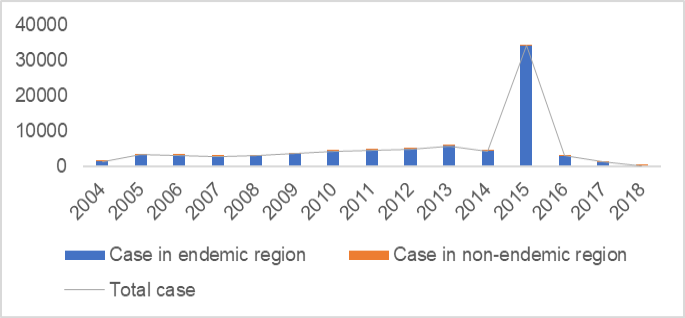
Overview of the prevalence of schistosomiasis in mainland China, 2004-2018.
References
- Chen, Y.Y., Liu, J.B., Jiang, Y., Li, G., Shan, X.W., Zhang, J., Cai, S.X., and Huang, X.B., 2018. Acta. Trop., 180: 88-96. https://doi.org/10.1016/j.actatropica.2018.01.004[CrossRef]
- Faust, C.L., Osakunor, D.N.M., Downs, J.A., Kayuni, S., Stothard, J.R., Lamberton, P.H.L., Reinhard-Rupp, J., and Rollinson, D., 2020. Trends Parasitol., 36: 582-591. https://doi.org/10.1016/j.pt.2020.04.012[CrossRef]
- Gryseels, B., Polman, K., Clerinx, J., and Kestens, L., 2006. Lancet, 368: 1106-1118. https://doi.org/10.1016/S0140-6736(06)69440-3[CrossRef]
- Hu, F., Li, Q.Y., Dai, X.F., Li, Z.J., Lv, S.B., Lu, C.F., Li, Y.F., Yuan, M., Liu, Y.M., Liu, Y., and Lin, D.D., 2020. Infect. Dis. Poverty, 9: 103. https://doi.org/10.1186/s40249-020-00720-4[CrossRef]
- Li, S., Shi, Y., Deng, W., Ren, G., He, H., Hu, B., Li, C., Zhang, N., Zheng, Y., Wang, Y., Dong, S., Chen, Y., Jiang, Q., and Zhou, Y., 2021. Parasit. Vectors, 14: 7. https://doi.org/10.1186/s13071-020-04526-z[CrossRef]
- LoVerde, P.T., 2019. Adv. exp. Med. Biol., 1154: 45-70. https://doi.org/10.1007/978-3-030-18616-6_3[CrossRef]
- Song, L.G., Wu, X.Y., Sacko, M., and Wu, Z.D., 2016. Parasitol. Res., 115: 4071-4081. https://doi.org/10.1007/s00436-016-5253-5[CrossRef]
- Wang, W., Bergquist, R., King, C.H., and Yang, K., 2021. PLoS Negl. trop. Dis., 15: e0009578. https://doi.org/10.1371/journal.pntd.0009578[CrossRef]
- Xu, J., Ouyang, X., He, Q., and Wei, G., 2021. Int. J. environ. Res. Publ. Hlth., 18. https://doi.org/10.3390/ijerph18041950[CrossRef]
- Zhu, H., Liu, J.B., Xiao, Y., Tu, Z.W., Shan, X.W., Li, B., Wu, J.L., Zhou, X.R., Sun, L.C., Xia, J., Liu, S., and Huang, X.B., 2022. Acta Trop., 231: 106417. https://doi.org/10.1016/j.actatropica.2022.106417[CrossRef]
Services
Article usage statistics
Loading…