In the current study, the most common recovered fungi was A. flavus from mastitis milk, letter, water and ration (16%, 36%, 76% and 32%), respectively. While, the yeasts spp. were detected only in mastitis milk samples as C. albicans and Rhodotorela sp. (16%,12%), respectively (Table 3). Whereas other genera of molds were recovered in variable frequencies. Aspergillus flavus constitute a public health hazard due to the production of aflatoxins which cause some degree of acute toxicity and are potential carcinogens (FDA,2000). On the other hand, E. coli potentiated the occurrence of bovine clinical mastitis (Hogan and Smith,2003) and recovered from milk and its product (Quinn et al., 2002). Herein, E. coli was the most predominant isolates from mastitis milk, letters, water, and animals’ ration (16%, 28%, 12%, and 4%), respectively. Currently, the strains of E.coli O157 and E.coli O111 were recovered from all examined samples at the rates of (12%, 8%) in mastitic milk, (4%, 4%) in water, (4%, 4%) in the ration and (4%, 8%) in letter samples respectively (Table 4). Seyffert et al. (2012) recovered S. aureus and E. coli from mastitic milk. Moreover, Parul et al. (2014) recovered E. coli from dairy animal litters, water and ration samples (8.33%, 3, 0%) and (3%, 11.11%, 0%) by Vanitha et al. (2018), respectively. The significant disease of E.coli O157: H7 which produced Shiga toxins (stx1 and stx2) is the hazard of food poisoning (Vali et al., 2007) and dairy cattle is the primary reservoir of infection (Perera et al., 2015). Hence, the discovery of the novel effective antimicrobial agents is required to overcome the microbial infections and resistance to commercial antibiotics (Whitesides, 2003). Today, ZnONPs have significant antimicrobial potentials and friendly safe to the environment (Violeta et al., 2011). Herein, A.flavus and E.coli O157 were the most prevalent isolates in samples of mastitis cattle and were subjected for investigation of the antimicrobial potentials of ZnONPs and C.O. by WD test. The (MIC) of ZnO NPs against A.flavus and E.coli O157 were (100, 50 μg /ml) and inhibition zones were (10±1.0, 13±0.7 mm), respectively (Table 5). In A.flavus, when ZnONPs levels increased from (100-900 µg/ml), the zones of inhibition also increased (10±1.0-30±3.0 mm).While, in E.coli O157, the inhibition zones elevated (13±0.7 to 29±2.0 mm), as levels of ZnONPs increased from (50- 900 µg/ml). The antimicrobial potential of ZnO NPs was detected against bacteria and fungi (Raghupathi et al., 2011; Hassan et al., 2017) that caused skin infection in buffaloes (Hassan et al., 2015b) and mastitis in cattle (E.coli and A. flavus) (Sabir et al., 2014). This is due to the penetration of ZnO-NPs the microbial cell wall, destruction and death of cells (Brayner, et al., 2006). Currently, MIC of C.O. against A.flavus and E.coli O157 were (0.25% for each) and inhibition zones increased as concentration levels increased (Table 6). El-Baroty et al. (2010) detected the significant antimicrobial activity of C.O. and the MIC values were ranged from (20-120 μg/ml). This activity due to C.O. rich with eugenol and cinnamaldehyde which enable them to penetrate the bacterial or fungal cell membrane and mitochondria cause cell death (Anwer et al, 2009) and impairment of cell enzyme system and cause gene toxicity (Abd El-Baky and El-Baroty, 2008). Recently, the awareness about the toxicity of nanoparticle applications resulted in significant attention for its conjugation with natural materials to avoid the toxic doses in animals. Currently, the synergistic effects of ZnONPs (100, 200 μg/ml) with C.O. (0.25% and 1%), resulted in significant growth inhibition of A.flavus and E.coli O157 (Table 7). The combination of low level of ZnONPs (100 μg /ml) with (0.25% C.O) caused increase in inhibitory zone (10±1.0 to15±2.0) and (17±0.2 to 20±0.8), respectively. While, elevation of C.O. concentration to (1%) at a low level of ZnONPs, increased significantly the inhibitory zones to (20±1.5 to 25±2.0), respectively. These results increase the availability of the application of nanomaterial in biomedicine by decreasing the used doses via conjuga
Table 5: Antimicrobial activity of Zinc oxide nanoparticles against A.flavus and E.coli 0157 recovered from cattle mastitis
Table 6: Antimicrobial activity of cinnamon oil against A.flavus and E.coli 0157 recovered from cattle mastitis
Table 7: Synergistic Antimicrobial activity of Cinnamon oil with ZnONPs against A.flavus and E.coli 0157 recovered from cattle mastitis
Table 8: Comparison between agar diffusion tests, PCR amplification and RT-PCR for detection AflaR -gene of A.flavus and stx1-gene of E.coli O157 that treated with ZnONPs singly or in combination with C.O.
- G: growth of microbial cells -NG: no growth -P: positive DNA band -N: no DNA band - C.T.: Cycle Threshold of DNA - ZnO NPs: 100 µg/ml (Low dose), 500 µg/ml (High dose). - C.O.: 0.25% (low dose), 1% (high dose). -.Combination : 100 µg/ml of ZnONPs+ 1% C.O( high dose), 100 µg/ml of ZnONPs+ 0.25% C.O. (low dose).
tion with natural materials. Similarly, Hassan et al. (2019) detected the MIC of ZnONPs against Fusarium sp. was (500 μg/ml) and significantly decreased to (100 μg /ml) when combined with curcumin or probiotic (0.25% for each). This enables to prevent drug resistance and resulted in significant antimicrobial efficacy (Chow and Yu, 1999).
In the present study, PCR detection of the virulent genes in isolated A. flavus (aflR) and E. coli O157( stx1) from cattle mastitis (4 representative isolates). The DNA bands of 2 isolates of A.flavus were similar to the standard strain, while others showed no bands for aflR gene (Figure 1). The expression of the stx1 gene of E.coli O157, 2 isolates not showed any DNA fragment and other isolates were positive for the stx1 gene similar to the standard strain (Figure 2). Cruz and Buttner (2008) detected the alfR gene in A.flavus by PCR and different results of DNA bands occurred. While, Scherm et al. (2005), detected alfR and alfQ in A.flavus isolated from animal feeds. PCR detection of virulent genes stx1 and stx2 in E. coli isolated food and beef samples (Godambe et al., 2017) that cause food-born infection (Ferens and Hovde, 2011). Currently, the positive isolates of virulent genes were used for PCR detection of antimicrobial potentials of ZnONPs and C.O. (Figures, 1, 2). The PCR amplification of DNA bands of control for each used isolate was similar to the general characters of a standard reference untreated species of A.flavus and E.coli O157 (Figures 3, 4). Whereas, treating A.flavus by low (100 g/ml) and high (500 g/ml) doses of ZnO NPs eliminated the signals of DNA bands (Figure 3). But DNA bands were observed in the case of E. coli O157 with low or high doses of ZnO NPs (Figure 4). The C.O. effects on genes of A.flavus, either at low and high doses (0.25%, 1%), not cause any changes in DNA bands signals. On the contrary, the treatment of E.coli O157 with a high dose of C.O.(1%) resulted in the absence of DNA band, but a low dose (0.25%) not cause any changes. Whereas, the combination of ZnO NPs and C.O. presence of DNA band in E. coli. While, there was low faint DNA band in treatment of A.flavus with (100 μg /ml of ZnONPs+ 1% C.O.). Recently, the RT-PCR help in the generation of a specific fluorescent signal in real-time analysis and quantitation of DNA targets (Schena et al., 2004) and allow rapid, sensitive, specific, and high accurate activity than traditional DNA-PCR method (Bilodeau, 2011). Herein, the RT-PCR system directed against DNA extracted from isolates of A.flavus and E.coli 0157 was done (Figures 1-4 and Table 8). The treatment doses of ZnONPs alone or in combination with C.O. increased the DNA cycle threshold (C.T). The treatments of A.flavus with ZnO NPs (100g/ml) resulted in a significant increase in DNA C.T. values (26.62, 28.34) higher than that DNA of non-treated isolates (26.33).
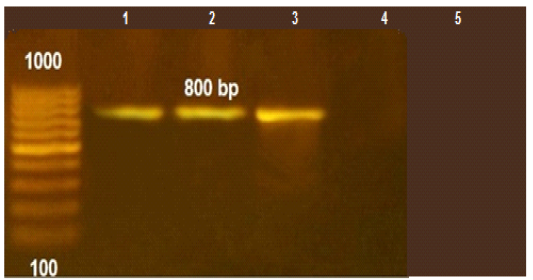
Figure 1: PCR amplification for aflaR gene of A.flavus(at 800pb) Lane L:100 bp DNA ladder standard. Lane 1: Positive control of A.flavus. Lane 2-5 A.flavus isolated from mastitis
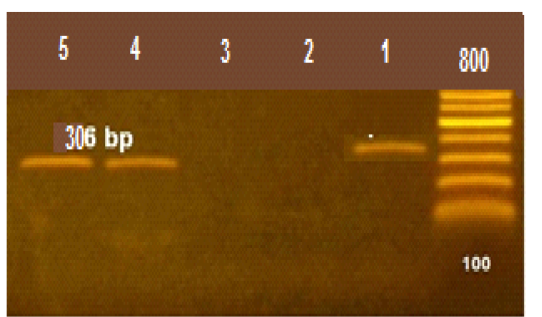
Figure 2: The PCR amplification for stx1gene of E.coli O175(at 306pb).Lane R: 100bp DNA ladder standard; Lane 1: Positive control of E.coli 0157., Lane 2-5: the isolates from mastitis
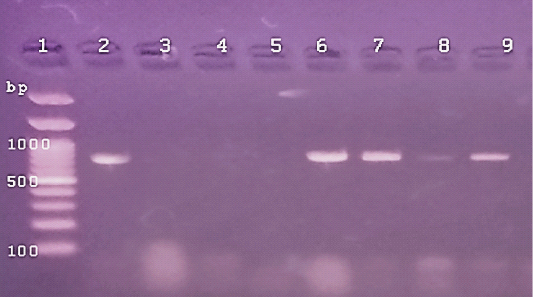
Figure 3: The PCR amplification for aflaR gene of A.flavus(at 800pb) Lane 1:100 bp DNA ladder standard. Lane 2: Positive control of A.flavus.Lane 3: Negative control (Fusarium sp.) Lane 4: Treated 100 μg /ml of ZnONPs).Lane5: Treated 500 μg /ml of ZnONPs). Lane 6: Treated 0.25% C.O. Lane 7: Treated 1% C.O. Lane 8: Combination treat. of 100 μg /ml of ZnONPs+1%C.O. Lane9: Combination treat. of 100 μg /ml of ZnONPs+ 0.25% C.O.
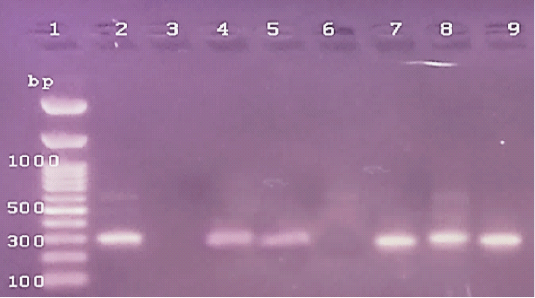
Figure 4: The PCR amplification for stx1gene of E.coli O175(at 306pb).Lane1: 100bp DNA ladder standard; Lane 2: Positive control of E.coli 0157.Lane 3: Negative control (S.aureas) Lane 4: Treated 100 μg /ml of ZnONPs). Lane 5: Treated 500 μg /ml of ZnONPs). Lane 6: Treated 0.25% C.O. Lane 7: Treated 1% C.O.Lane 8: Combination treat. of 100 μg /ml of ZnONPs+ 1% C.O. Lane 9: Combination treat. of 100 μg /ml of ZnONPs+ 0.25% C.O.
While, the treatment of E.coli with low and high doses of ZnONPs caused a treatment with C.O. caused a decrease in DNA C.T. values (Table 8). It is suggested that the higher DNA C.T. due to the lower number of DNA copies of the genes in treated isolates with ZnONPs than that of untreated ones and contrary to this were reported in C.O. (Table 8). Several studies used RT-PCR for rapid detection of genes pathogens as Sharma and Nystromi (2003) and Hu et al. (2020) for stx1 and stx2 in E.coli O157: H7 in food, Scherm et al. (2005), for detecting aflatoxin regulatory genes.Copping et al. (2005) found that the inhibitory concentration of antifungals against C.albicans elevated the activity of secreted proteinase (Sap) and SAP genes detection by RT– PCR. Labeed et al. (2016) and Hassan et al. (2017) detected the absence of DNA band in PCR of Afla gene after bio-control of mycotoxigenic A. flavus and no levels observed in chemical detection of AFB1. Rathore et al. (2018) found that variety in the correlation between disc diffusion and genotypic PCR antibiotic sensitivity pattern against virulent genes in S. aureus that ranged from (58.3%-100%). While, Zheng et al. (2015) resulted in significant antimicrobial activity of Enterococcus faecium against gram-positive and gram-negative bacteria using agar well diffusion method as a simple method and PCR amplification not detected any tested virulence genes. Furthermore, Chomvarin et al. (2004) detected that disc diffusion and agglutination tests are of the highest sensitivity and specificity and both assays are technically simple and can be easier to perform in routine laboratories than PCR in the evaluation of drugs against bacterial and fungal pathogens. Hence, the evaluation of antimicrobials by covenantal method as agar WD yielded significant specific results and despite advances in PCR and RT-PCR we detected variable in accord findings.

