
Length-weight (LW) and length-length (LL) relationships are reported for four fish species (Anabarilius brevianalis, Beaufortia szechuanensis, Yunnanilus sichuanensis, Triplophysa xichangensis) from the Shenyu River, Xining River and Anning River, tributaries of the Jinsha River, located in Sichuan, southwestern China. Totally, 409 specimens collected from April to May 2019, November 2020 and April 2021. The b values of the LW relationship ranged 2.733-3.064 for the studied species. It is worth mentioning that all four species of fish are first described in FishBase and this article also provides new maximum standard length recording for A. brevianalis (16.2 cm), Y. sichuanensis (6.9 cm) and T. xichangensis (14.4 cm) in FishBase.
Short Communication · Volume 57, Issue 3, 12 May 2025 · Open Access
Length–Weight and Length–Length Relationship of Four Native Fish Species from the Middle and Lower Jinsha River, China
· · · ·
Affiliations & Notes ⌄
- 1School of Animal Science and Nutritional Engineering, Wuhan Polytechnic University, Wuhan 430023, China 2Yangtze River Fisheries Research Institute, Chinese Academy of Fishery Sciences, Wuhan 430223, China 3Hunan Fisheries Science Institute, Changsha 410153, China * Corresponding author: huxiangin@163.com
Article Info ⌄
- Journal:
- Pakistan Journal of Zoology
- Published:
- 12 May 2025

From the article
- Descriptive statistics and estimated LWRs and LLRs parameters for each fish species are listed in Table II and III.
- The intercept value (a) ranged between 0.011 for A. brevianalis and 0.019 for B. szechuanensis, and the b value ranged from 2.773 (B. szechuanensis) to 3.064 (A. brevianalis).
- The study identified the A. brevianalis (16.2cm), Y. sichuanensis (6.9cm) and T. xichangensis (14.4 cm) new maximum standard-length value (marked with asterisks in the Table II).
Selected from the article's own text.
Abstract
Materials and methods
The fish specimens were collected from the Shenyu River, Xining River and Anning River (Fig. 1) by trap nets (mesh size 1.5 mm), and backpack electro-fishing during April and May 2019, November 2020 and April 2021 in Sichuan province, China (Table I). After sampling, for each individual, standard length (SL) and total length (TL) were measured with digital calipers to 0.1 cm, total weight (W) were measured with digital balance to 0.1 g . All scientific names were aligned to FishBase .
LWR was estimated as: W= aSLb, where W is the total weight (W, g), SL is the standard length (SL, cm), a is the intercept, and b is the slope . Graphing this equation in logarithmic form gives a straight-line relationship: logW=loga + blogSL. Their 95% confidence limit (CL) and statistical significance of the correlation coefficient (r2) were also determined. Furthermore, the relationship between TL and SL was analyzed by linear regression for the TL= p + qSL . Statistical analyses were performed in SPSS 26.0 and Excel 2016.
Results and discussion
In this study, 409 samples were analyzed, belonging to three families, four genera and four species. Descriptive statistics and estimated LWRs and LLRs parameters for each fish species are listed in Table II and III. The LWRs of the four species were extremely significant (p <0.001) and r2> 0.888. The intercept value (a) ranged between 0.011 for A. brevianalis and 0.019 for B. szechuanensis, and the b value ranged from 2.773 (B. szechuanensis) to 3.064 (A. brevianalis). The t-test indicated that except for B. szechuanensis for which the b value was significantly different from 3 (t = 22.009, p<0.05), the b values of the other three fish including A. brevianalis (t = 0.702), Y. sichuanensis (t = 0.397) and T. xichangensis (t = 0.133) showed not significantly different from 3 (p>0.05). Besides, all LLRs were extremely remarkable (p <0.001) and all decision coefficients (r2) were> 0.975. The study identified the A. brevianalis (16.2cm), Y. sichuanensis (6.9cm) and T. xichangensis (14.4 cm) new maximum standard-length value (marked with asterisks in the Table II).
Table I. Information of fish species from the tributaries of middle and lower Jinsha River.
| Species | Sampling sites | Sampling time | Fishing gear | Latitude | Longitude |
| A. brevianalis | Shenyu River | 2019.04 | Electro-fishing, Trap nets | 26°22′-26°41′ N | 102°32′-102°38′ E |
| B. szechuanensis | Shenyu River Xining River | 2019.04 2019.05 | Trap nets | 26°22′-26°41′ N 28°25′-28°36′ N | 102°32′-102°38′ E 103°29′-103°42′E |
| Y. sichuanensis | Shenyu River | 2019.04 | Trap nets | 26°22′-26°41′ N | 102°32′-102°38′ E |
| T. xichangensis | Anning River | 2020.11, 2021.04 | Trap nets | 28°23′-28°34′ N | 102°18′-102°52′ E |
Table II. Descriptive statistics and parameters of length–weight relationship (LWR) for fish species from the tributaries of middle and lower Jinsha River.
| Family | Species | n | Standard length (cm) | Weight (g) | Parameters | r2 | |||
| Min.-Max. | Min.-Max. | a | b | 95% CL (a) | 95% CL (b) | ||||
| Cyprinidae | A. brevianalis * | 145 | 7.9-16.2 | 3.2-34.5 | 0.011 | 3.064 | 0.007-0.015 | 2.884-3.244 | 0.888 |
| Balitoridae | B. szechuanensis | 53 | 3.0-7.2 | 0.1-3.0 | 0.019 | 2.773 | 0.013-0.025 | 2.566-2.978 | 0.936 |
| Cobitidae | Y. sichuanensis* | 54 | 4.2-6.9 | 0.6-3.0 | 0.015 | 3.057 | 0.009-0.022 | 2.768-3.345 | 0.897 |
| Cobitidae | T. xichangensis* | 149 | 6.6-14.4 | 1.9-22.3 | 0.013 | 2.992 | 0.013-0.017 | 2.805-3.040 | 0.942 |
N, number of individuals; Min., minimum; Max., maximum; a, intercept; b, slope; CL, Confidence limit; r2, coefficient of determination.
Species with new maximum size records are marked with an asterisk (*).
Table III. Descriptive statistics and estimated length–length relationship (LLR) for fish species from the tributaries of middle and lower Jinsha River.
| Species | Parameters | |||||
| n | p | q | 95% CL of p | 95% CL of q | r2 | |
| A. brevianalis | 145 | 0.616 | 1.120 | 0.379-0.852 | 1.095-1.144 | 0.983 |
| B. szechuanensis | 53 | 0.133 | 1.164 | 0.015-0.251 | 1.138-1.190 | 0.993 |
| Y. sichuanensis | 54 | 0.096 | 1.164 | -0.100-0.293 | 1.120-1.209 | 0.981 |
| T. xichangensis | 149 | 0.905 | 0.970 | -0.194-0.329 | 1.146-1.207 | 0.975 |
n, number of samples; a, intercept; b, slope; r2, coefficient of determination.
All regression results are highly significant from the table, the r2 value ranged between 0.888 and 0.993. Although the number of several fish specimens used in this study is small, the b values for four species were within the expected range of 2.5-3.5 recommended by Froese (2006), and therefore can still be used within a certain length range. Values of b are species-specific, and different b values can reflect the growth and diet condition of fish in different environments .
According to the information in FishBase , this paper not only reports the LWRs and LLRs for four species of fish in the Jinsha River basin for the first time, but also records the new maximum standard length of the three species (A. brevianalis, Y. sichuanensis, T. xichangensis). But a sufficiently broad temporal and spatial scope was not included in this survey, making it unrepresentative. In addition, there is also the possibility that inconclusive LWRs may be related to growth stage, health, fecundity, and gut satiety ; , 2021), these reasons were not considered for this study, but the preliminary estimated LWRs were useful but not fully representative of the populations of these four species. However, these data obtained provide the first information on the length-weight relationship of four endemic fish in Sichuan province, China. It can also provide some reference value for the subsequent research and management of these species.
Acknowledgement
The authors would like to thank Tianyi Zhao for his help with field investigation. The research was funded by the National Natural Science Foundation of China (Grant No. 51809280).
Statement of conflict of interest
The authors have declared no conflict of interest.
Figures
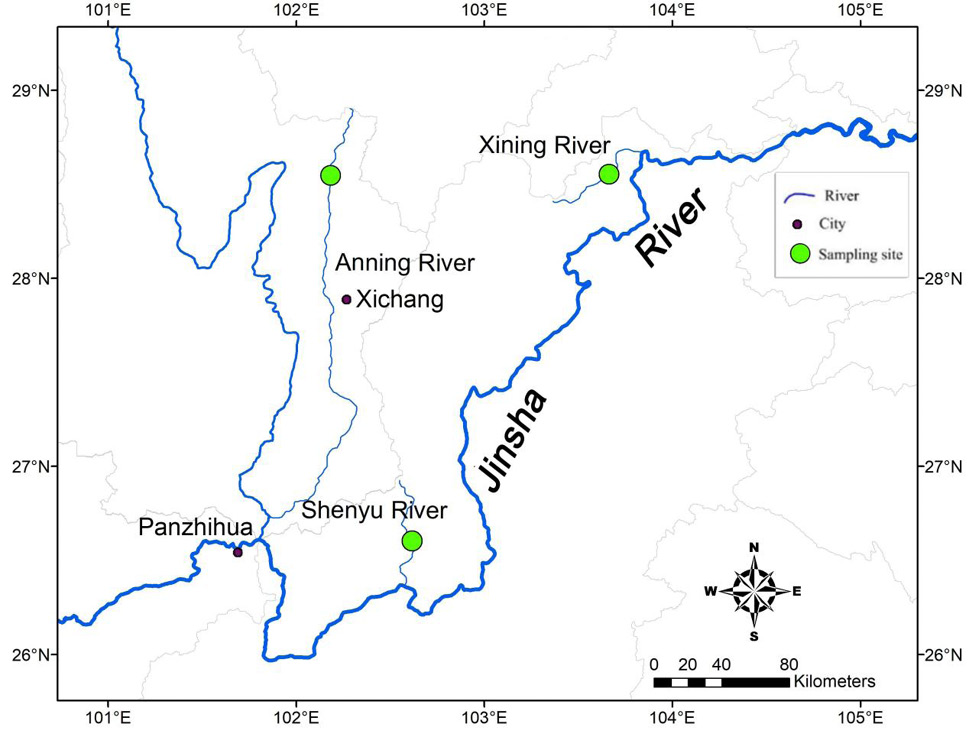
Sampling locations of four species fish from the middle and lower Jinsha River.
References
- Borah, S., Gogoi, P., Bhattacharjya, B., Suresh, V., Yadav, A., Baitha, R. and Das, B., 2018. J. appl. Ichthyol., 34: 788-790. https://doi.org/10.1111/jai.13685[CrossRef]
- Duan, Y. J., Ma, B. S., Yang, X., Xie, C. X. and Huo, B., 2016. J. appl. Ichthyol., 32: 1298-1299. https://doi.org/10.1111/jai.13180[CrossRef]
- Froese, R., 2006. J. appl. Ichthyol., 22: 241-253. https://doi.org/10.1111/j.1439-0426.2006.00805.x[CrossRef]
- Froese, R. and Pauly, D., 2012. FishBase World wide web electronic publication. http://www.fishbase.org, version 4.
- Hossain, M.Y., Ahmed, Z.F., Leunda, P.M., Jasmine, S., Oscoz, J., Miranda, R. and Ohtomi, J., 2006. J. appl. Ichthyol., 22: 304-307. https://doi:10.1111/j.1439-0426.2006.00801.x[CrossRef]
- Karna, S.K., 2017. J. appl. Ichthyol., 33: 1284-1286. https://doi.org/10.1111/jai.13503[CrossRef]
- Lin, F., Wang, Z., Luo, Z., Sun, G. and Chen, X., 2021. J. appl. Ichthyol., 37: 635–637. https://doi.org/10.1111/jai.14152[CrossRef]
- Lin, F., Zhou, Q.H., Yang, D.H., Lu, Z.L. and Zhang, J., 2018. . J. appl. Ichthyol., 34: 203-205. https://doi.org/10.1111/jai.13534[CrossRef]
- Pan, L., Peng, Z.Y., Shao, D.G., Yang, T., Wang, Z.X., Zeng, Z.F. and Shi, X.T., 2018. J. appl. Ichthyol., 34: 1094-1096. https://doi.org/10.1111/jai.13729[CrossRef]
- Salahi, M., Kamrani, E., Solaimani, A., Hajializadeh, P., Mandegari, M. and Sadeghi-Mazidi, S., 2018. J. appl. Ichthyol., 34: 735-736. https://doi.org/10.1111/jai.13592[CrossRef]
- Wang, L. J., Wu, Z. H., Nie, M. M., Liu, M. X., Liu, W. and You, F., 2016. J. appl. Ichthyol., 32: 737-739. https://doi.org/10.1111/jai.13058[CrossRef]
- Wang, T., Wang, H.S., Sun, G.W., Huang, D. and Shen, J.H., 2012. J. appl. Ichthyol., 28: 660-662. https://doi.org/10.1111/j.1439-0426.2012.01971.x[CrossRef]
- Xu, H.L., Gu, D.X., Wang, R., Sun, J.H. and Bai, D.Q., 2017. J. appl. Ichthyol., 33: 642–644. https://doi.org/10.1111/jai.13337[CrossRef]
- Xiong, F., Liu, H.Y., Duan, X.B., Liu, S.P. and Chen, D.Q., 2017. J. appl. Ichthyol., 33: 835-838. https://doi.org/10.1111/jai.13358[CrossRef]
- Yang, C.Q., Chen, J.H., He, F., He, Y.P., Cai, X. H., Fan, H. and Long, T.L., 2010. J. Sichuan Forest. Sci. Technol., 31: 34-40. (in Chinese with English abstract). https://doi:10.16779/j.cnki.1003-5508[CrossRef]
- Yoğurtçuoğlu, B., Atalay, M.A. and Ekmekçi, F.G., 2016. J. appl. Ichthyol., 32: 495–496. https://doi.org/10.1111/jai.12965[CrossRef]
- Zhang, Z., Wei, J., Chen, F., Fang, Y., Chang, X., Chen, J., Huang, D. and Lei, H., 2018. J. appl. Ichthyol., 34: 999-1001. https://doi.org/10.1111/jai.13634[CrossRef]
Services
Article usage statistics
Loading…