ResearchersLinks

Research Article · Volume 40, Issue 1, 1 July 2025 · Open Access

Investigation of the Effect of Temperature and Time on the Eggs and Larva of Lucilia sericata (Diptera: Calliphoridae) for Maggot Debridement Therapy in Laboratory Conditions

· · · · · · ·

Affiliations & Notes ⌄
  1. 1Department of Medical Entomology and Vector Control, School of Public Health, Tehran University of Medical Sciences, Tehran, Iran 2Department of Vector Biology and Control, Faculty of Health, Ilam University of Medical Sciences, Ilam, Iran 3Health and Environmental Research Center, Ilam University of Medical Sciences, Ilam, Iran Corresponding author: Javad Rafinejad jrafinejad@sina.tums.ac.ir
Article Info ⌄
Journal:
Punjab University Journal of Zoology
Published:
1 July 2025

From the article

  • Our study provides maggot debridement therapy with an Assessment of the effect of time and temperature on the survivorship rate of sterile and non-sterile eggs and larvae of L. sericata.
  • According to the researchers results, sterility or non-sterility had no significant effect on the hatching rate of eggs.
  • However, persistence evaluation experiments show that sterile larvae have a longer shelf-life than non-sterile groups.

Selected from the article's own text.

Abstract

Maggot debridement therapy is a controlled myiasis used as an auxiliary method to debride chronically infected wounds and ulcers that contain necrotic tissues without suitable surgical conditions. Today, maggot therapy is used as a simple, fast and effective method with low costs and numerous studies have demonstrated its efficacy. To determine the shelf life of L. sericata eggs and larvae at refrigerator temperature, eggs and larvae were divided into sterile and non-sterile groups. Experiments on batches of 100 eggs and larvae on 8cm plates at three different temperatures of 2, 4 and 6 °C and at three time periods of 24, 48 and 72 h, respectively, and three repetitions of the experiment for each temperature and time had been conducted. The egg sterilization protocol was done with 1% sodium sulphite solution in physiological serum under the hood. The next step, which includes placing the eggs on the blood agar medium at predetermined temperatures and periods, was performed. The detachment of eggs from the blood agar medium and washing them using sterile distilled water were done. The results of the examination of 5400 egg samples, at three time periods (24, 48 and 72 h) showed that the most appropriate time for hatching eggs is 72 h (77.58%). Also, the most appropriate time for storing larvae is 24 h (79.93%). The most suitable temperature for egg hatching was 6 degrees (88.14%). The most suitable temperature for larvae is 6 °C (82.95%). The most appropriate time for all three temperatures was 72 h (80.38%), and the most suitable temperature for all three times was 6°C (86.07%). According to the our study, sterility or non-sterility had no significant effect on the hatching rate of eggs. However, persistence evaluation experiments show that sterile larvae have a longer shelf-life than non-sterile groups. 
 
Novelty Statement | This is the first comprehensive assessment of the effect of temperature and time on sterile and non-sterile eggs and larvae of L. sericata in Iran, adding valuable data to the field of Maggot Debridement Therapy.
Introduction

Chronic and non-healing wounds are a significant healthcare problem the world over . Maggots or larvae of flies have been used to treat open wounds for a long time, which is not new . Still, since the middle of the 1450s, the discovery and introduction of the first class of antibiotics (sulfonamides and penicillin) and the improvement of surgical techniques, there was a relatively long break in utilizing them. The resistance of microbial infections due to overuse of Antibiotics, failure in common treatments of chronic wounds, and the lack of suitable conditions for surgery caused people to return to maggot therapy . They can be used in many types of wounds and ulcers, including diabetic foot ulcers, pressure sores, burns, abscesses and infected surgical wounds .

Maggot therapy is controlled myiasis and involves using sterile larvae of certain species, particularly those within the Calliphoridae family, including Calliphora vicina Robineau-Desvoidy and Lucilia sericata (Meigan, Diptera: Calliphoridae), to debride a sloughy or dirty wound containing necrotic tissue (Biodebridement) that needs cleaning to allow it to heal . Maggots effectively heal these wounds by removing devitalized/ necrotic tissue, disinfecting and secreting powerful enzymes to break down dead tissue, and stimulating growth hormones and the body’s immune systems . It was approved by the Food and Drug Administration of the United States of America (FDA) in 2014 as a prescription-only treatment . About 50,000 cases worldwide are treated with this method. Today, with the increasing spread of chronic wounds that require surgical debridement, the failure of common treatments, and the high costs of treating these wounds, maggot therapy is used as a simple, fast and effective method with low costs and numerous studies have demonstrated its efficacy .

In this regard, accurately identifying the applied samples, laboratory breeding, mass production, and sterilization steps are particularly important. The common green bottle flies L. sericata have medical, veterinary, and forensic importance and do not usually invade live tissues due to their high tendency to use necrotic for feeding. It is a suitable candidate for maggot therapy .

The inside of a flies egg is sterile, although the outer surface is mainly contaminated with bacteria (non-sterile). Sterilizing the outer surface of the flies’ eggs and allowing them to hatch in a sterile condition produces sterile larvae.

Experiences have shown that mass rearing of Lucilia sericata larvae cannot be done in all provinces of Iran. mass rearing of larvae is being carried out in the School of Health, Tehran University of Medical Sciences. Creating Systems and Processes for keeping eggs in the refrigerator, and sterilization provides the possibility of sending packages of sterile larvae to all parts of the country. Experiments show that survival of eggs and larvae is different at different temperatures. Therefore, this study was conducted for the first time to determine the effect of temperature and time on sterile and non-sterile eggs and larvae of L. sericata and the best temperature and time to store the eggs and larvae of these flies in Iran.

Materials and Methods

Research design

The study adopted cross-sectional research using the observational study design method. Descriptive research investigates and describes a case about the current situation of an event or how it has happened in the past.

Collection technique and identification

A sweep net and bottle fly traps (reverse-cone model) were used to collect flies around human habitations in September and October of 2022 from several sites in Tehran and Karaj County. The samples were kept and reared in an insectary at the Medical Entomology Department of Tehran University of Medical Sciences. The flies were identified by using valid flies’ systematic keys.

Mass rearing

The clusters of L. sericata fly eggs were placed separately in 2 and 3L-lidded plastic containers with some meat. With the emergence of black oral hooks (third instar larvae), the larvae were transferred to sawdust containers to transform into pupae. For transformation into adults, pupae are transferred into 40x40x40 cages containing sugar or honey dissolved in water (5% solution), and the water container comprises a cotton wick and meat to feed adult flies. Then flies were transferred to special rearing cages, and fresh meat was placed for females laying eggs.

Laboratory maintenance

To determine the shelf life of L. sericata eggs and larvae at refrigerator temperature, 10,800 eggs and larvae, including 5,400 eggs and 5,400 first instar larvae, were divided into sterile and non-sterile (without intervention) groups. Experiments on batches of 100 eggs and larvae on 8cm plates at three different temperatures of 2, 4 and 6 degrees Celsius and at three time periods of 24, 48 and 72 h, respectively, and three repetitions of the experiment for each temperature and time had been conducted (Table 1).

Disinfecting stages of the eggs and larvae of L. sericata

The egg sterilization protocol was followed: Firstly, separating the eggs from the laying location (inside the adult container), then washing eggs with normal water containing a little detergent. The eggs were washed with sterile distilled water, and sterilization with 1% sodium sulphite solution in physiological serum comprising 5.2% formaldehyde was done under the hood. The next step,

Table 1: Determining the shelf life of L. sericata fly eggs and larvae in refrigerator temperature.

Samples

Condition

Temperature (°C)

Time (hour)

Total

Sterile

Non sterile

Total

2

4

6

Total

24

48

72

Total

Egg

2700

2700

5400

300

300

300

900

300

300

300

900

1800

Larvae

2700

2700

5400

300

300

300

900

300

300

300

900

1800

Total

5400

5400

10800

600

600

600

1800

600

600

600

1800

3600

which includes placing the eggs on the blood agar medium at predetermined temperatures and periods, was performed. The detachment of eggs from the blood agar medium and washing them using sterile distilled water were done, and, finally, they were kept in Eppendorf tubes or sterile plates until usage in the next stage of the experiment.

Results and Discussion

The effect of time on the hatching of L. sericata eggs

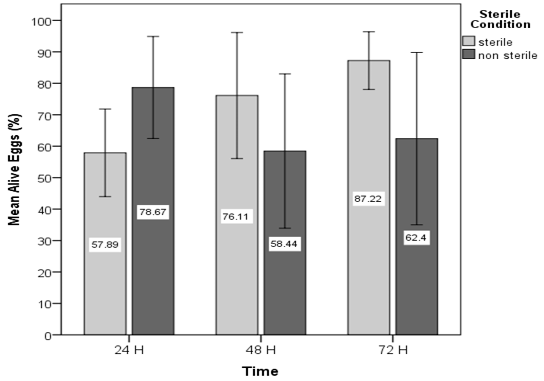
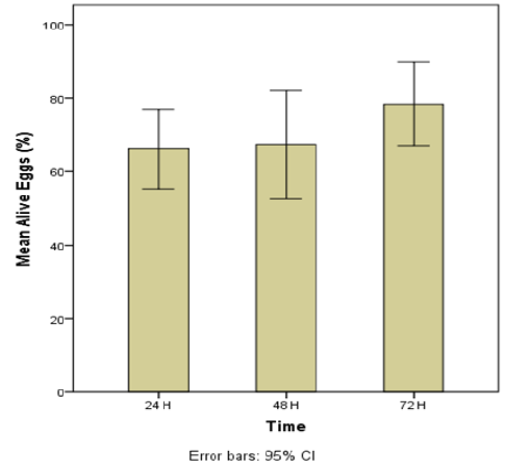
The results of the examination of 5400 egg samples, including 2700 sterile and 2700 non-sterile at three time periods (24, 48 and 72 h) showed that the most suitable time for hatching sterile eggs was 72 h (88.22%) and the most suitable time for hatching non-sterile was 24 h (78.67%). The most appropriate time for hatching eggs (sterile and non-sterile) was 72 h (77.58%) (Figure 1).

Also, the results of the studies showed that, on average, 70.35% of the eggs in both sterile and non-sterile groups hatched in all three desired periods and reached the first instar larval stage. In other words, about 30% of the eggs did not hatch (Figure 2).

The effect of time on 1st instar larvae of L. sericata

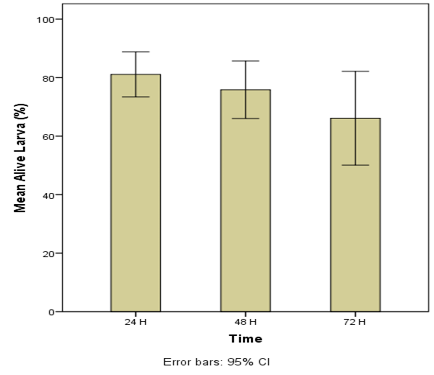
The results of the study on 5400 samples of 1st instar larvae, including 2700 sterile and 2700 non-sterile, in three time periods of 24, 48 and 72 h showed that, on average, the most suitable time for the survival of sterile larvae in refrigerator conditions was 24 h (82.33%) and for non-sterile was 24 h (79.86%). Also, the most appropriate time for storing larvae (sterile and non-sterile) was 24 h (79.93%) (Table 2).

Table 2: Effect of time on sterile and non-sterile 1st instar larvae of L. sericata time for survival in refrigerator conditions.

1st instar larvae condition

Number

Time (hour)

Total

24

48

72

Sterile

2700

82.33

76.89

72.29

83.22

Non-sterile

2700

79.86

74.78

61.33

71.99

Total

5400

79.93

75.83

76.33

77.61

Also, the results show that relatively 77.61% of the larvae in sterile and non-sterile groups hatched in the three periods and reached the 2nd instar stage. In other words, about 23% of the larvae were lost (Figure 3).

The effect of temperature on the hatching of L. sericata eggs

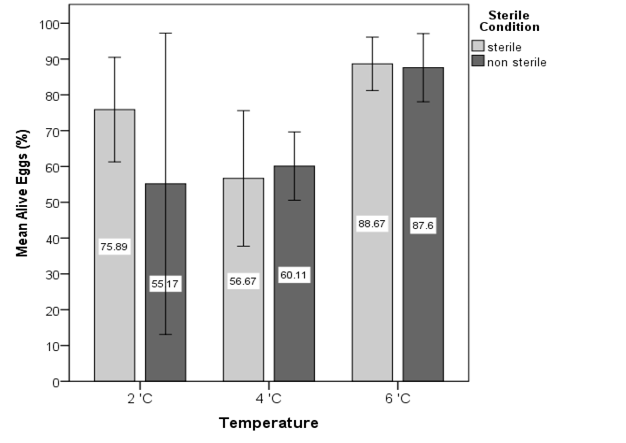
The results of the study of 2700 sterile and 2700 non-sterile eggs at three temperatures of 2, 4 and 6 °C showed that the most suitable temperature for sterile eggs was 6 degrees (88.67%) and for non-sterile also 6 degrees (87.6). %). Thus, the most suitable temperature for egg hatching (sterile and non-sterile) was 6 degrees (88.14%) (Figure 4).

Also, the results of the studies showed that, on average, 70.69% of the eggs in both sterile and non-sterile groups hatched at the three temperatures and reached the 1st instar larval stage; in other words, about 30% of the eggs were lost.

Effect of temperature on 1st instar larvae of L. sericata

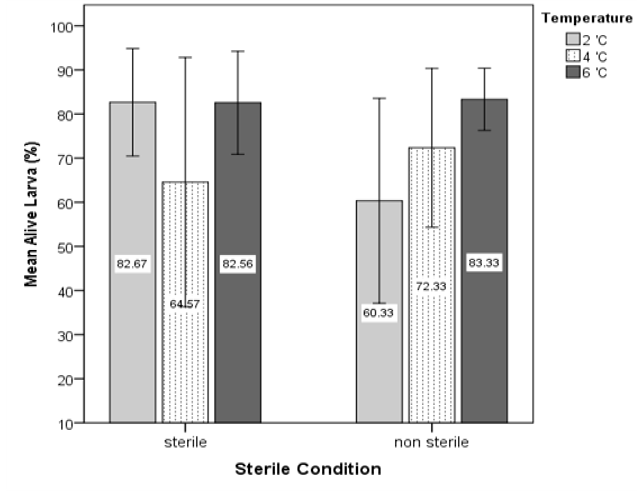
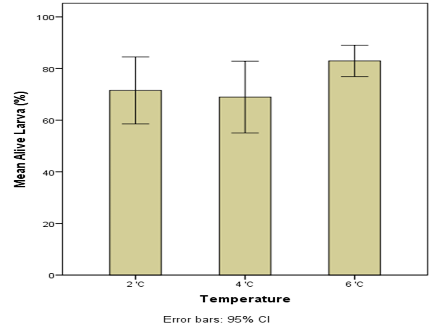
The results of the study of 2700 sterile and 2700 non-sterile larvae at three temperatures of 2, 4 and 6 °C showed that the most suitable temperature for the sterile group was 2 °C (82.67%) and the most suitable temperature for the non-sterile was 6 °C (83.33%). Overall, the most suitable temperature for larvae (sterile and non-sterile) was 6 °C (82.95%) (Figure 5).

Also, the results of the studies showed that, on average, 74.29% of the larvae in both sterile and non-sterile groups hatched in the three desired temperatures and reached the 1st instar larval stage; in other words, about 26% of Larvae were wasted (Figure 6).

Synchronous simultaneous effects of temperature and time on sterile and non-sterile eggs

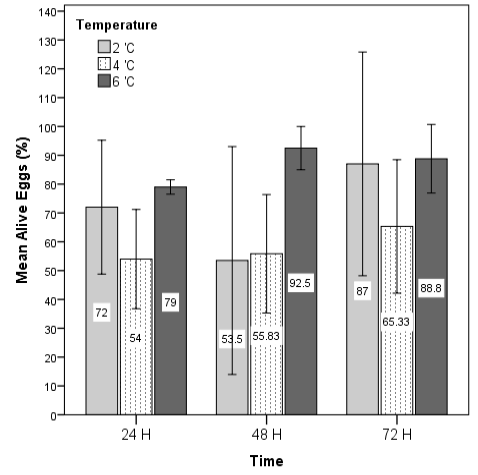
The results of the effect of temperature (2, 4 and 6 degrees °C) and periods (24, 48 and 72 h) on 5400 sterile and non-sterile eggs showed that the most suitable synchronic effect of temperature and time observed in the 2°C and 4°C at the 72 h (87%), and for 6°C at 48 h (92.5%). The most appropriate time for all three temperatures was 72 h (80.38%), and the most suitable temperature for all three times was 6°C (86.07%) (Figure 7) and relatively 74.96% of the eggs hatched and reached the next stage (1st instar larvae).

Simultaneous effect of temperature and time on sterile and non-sterile larvae

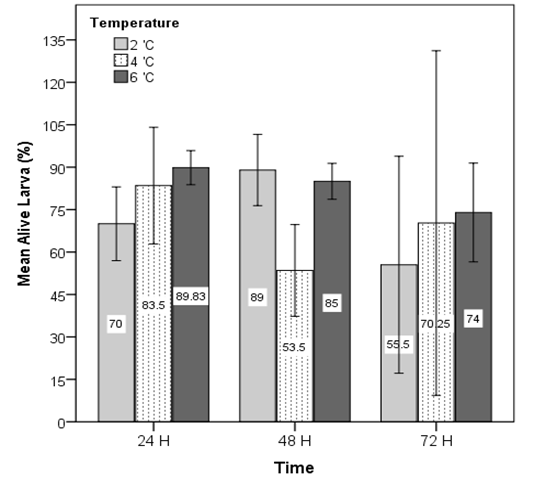
The results of the study on the simultaneous effect of temperature (2, 4 and 6 degrees Celsius) and periods (24, 48 and 72 h) on 5400 sterile and non-sterile larvae showed that the most suitable simultaneous effect observed in the 2°C was at 48 h (89%), for 4 and 6°C was 24 h (83.55%). The most suitable time for all three temperatures was 24 h (81.11%), and the most suitable temperature for each Three time periods was 6°C (82.94%) (Figure 8). About 74.51% of the larvae reach the next stage (2nd instar larvae).

So far, numerous studies have been conducted regarding using sterile larvae in various chronic wounds. The medical literature demonstrates due to the antibiotic resistance of bacteria, that maggot therapy has been widely used in indigenous medicine . Scientific clinical and biomedical evidence shows that it is effective and safe . This method is carried out by flies with facultative myiasis, such as L. sericata, and one of its challenges is the mass breeding of flies and their maintenance conditions . Temperature and humidity are two critical factors in the growth and reproduction of insects, including flies . Much research has been done on the biology of L. sericata, considered the most important and common species in maggot therapy . Before medical use, the larvae of flies must be sterilized as they are often infected with pathogens and can lead to secondary bacterial contamination of wounds when used.

Larvae and non-sterile eggs from the L. sericata population used in this study survived best at 24 °C and with increasing time, the probability of survival decreased. but in sterile eggs, the best time is 72 h. This variation in sterile and non-sterile egg survival may be attributed to the sterilization process under laboratory conditions. The most suitable temperature for sterile eggs and non-sterile larvae and eggs was Six degrees. This reveals that the temperature of 6 °C is the best condition for keeping both sterile and non-sterile eggs to have their highest hatching rate. At lower temperatures, larval development was slower and survival was impaired, particularly at 4°C, so some larvae died when they reached the migratory phase.

The results of this research, show the summary of calculations that help store and utilize eggs and larvae, which are essential in maggot therapy procedures.

Conclusion

Our study provides maggot debridement therapy with an Assessment of the effect of time and temperature on the survivorship rate of sterile and non-sterile eggs and larvae of L. sericata. According to the researchers results, sterility or non-sterility had no significant effect on the hatching rate of eggs. However, persistence evaluation experiments show that sterile larvae have a longer shelf-life than non-sterile groups. Thus, their sterilization process should be considered to assess their maximum shelf-life and reduction of loss and costs.

Declarations

Acknowledgments

This study was part of an MSc dissertation of L KH supported by the Tehran University of Medical Sciences, Tehran, Iran.

Funding

No funding was received from public, commercial, or not-for-profit organizations for this research.

Ethics statement

All the methods were carried out in line with international norms for an invertebrate.

Declaration of generative AI and AI-assisted technologies in the writing process

No Generative AI and AI-assisted technologies wer used in the writing process.

Conflict of interest

The authors have declared no conflict of interest.

Figures

Figure 1:
Figure 1:.

The effect of time on the relative percentage of hatching in sterile and non-sterile eggs of L. sericata (Error bars: 95%cl).

Figure 2:
Figure 2:.

Comparison of the effect of time on the relative rate of egg hatching of L. sericata .

Figure 3:
Figure 3:.

The effect of time on the persistence of 1st instar larvae of L. sericata.

Figure 4:
Figure 4:.

The effect of temperature on the relative percentage of hatching of sterile and non-sterile eggs of L. sericata.

Figure 5:
Figure 5:.

temperature effects on sterile and non-sterile larvae of L. sericata.

Figure 6:
Figure 6:.

The effect of temperature on the persistence of 1st instar larvae of L. sericata.

Figure 7:
Figure 7:.

The effect of temperature and time on the relative percentage of hatching of sterile and non-sterile eggs of L. sericata Error bars: 95%cl.

Figure 8:
Figure 8:.

The effect of time and temperature on the persistence of larvae Error bars: 95%cl.

References

  1. Amiri, Z.S., Akbarzadeh, K., Douraghi, M., Abdi, K.M., Afshar, A.A., Shabani, R.K., Akbari, M. and Rafinejad, J., 2021. Effectiveness of maggot extractions and secretion (E/S) of Lucilia sericata in reducing wound surface in experimental scalding burn injury. Nusantara Biosci., 13. https://doi.org/10.13057/nusbiosci/n130102[CrossRef]
  2. Chia, S.Y., Tanga, C.M., Khamis, F.M., Mohamed, S.A., Salifu, D., Sevgan, S., Fiaboe, K.K., Niassy, S., van Loon, J.J. and Dicke, M., 2018. Threshold temperatures and thermal requirements of black soldier fly Hermetia illucens: Implications for mass production. PLoS One, 13: e0206097. https://doi.org/10.1371/journal.pone.0206097[CrossRef]
  3. Čičková, H., Newton, G.L., Lacy, R.C. and Kozánek, M., 2015. The use of fly larvae for organic waste treatment. Waste Manage., 35: 68-80. https://doi.org/10.1016/j.wasman.2014.09.026[CrossRef]
  4. Harvey, M., 2022. The natural history of medicinal flies. A complete guide to maggot therapy: Clinical practice, therapeutic principles, production, distribution, and ethics: pp. 121-142. https://doi.org/10.11647/obp.0300.07[CrossRef]
  5. Harvey, M.L., Dadour, I.R. and Gasz, N.E., 2021. Maggot therapy in chronic wounds: New approaches to historical practices. Ann. Entomol. Soc. Am., 114: 415-424. https://doi.org/10.1093/aesa/saab012[CrossRef]
  6. Jones, J., Green, J. and Lillie, A.K., 2011. Maggots and their role in wound care. Br. J. Commun. Nurs., 16(Sup. 3): S24-S33. https://doi.org/10.12968/bjcn.2011.16.Sup3.S24[CrossRef]
  7. Jordan, A., Khiyani, N., Bowers,S.R., Lukaszczyk, J.J. and Stawicki, S.P., 2018. Maggot debridement therapy: A practical review. Int. J. Acad. Med., 4: 21. https://doi.org/10.4103/IJAM.IJAM_6_18[CrossRef]
  8. Mohd, Zubir, M.Z., Holloway, S. and Noor, N.M., 2020. Maggot therapy in wound healing: A systematic review. Int. J. Environ. Res. Publ. Hlth., 17: 6103. https://doi.org/10.3390/ijerph17176103[CrossRef]
  9. Nigam, Y., Dudley, E., Bexfield, A., Bond,A.E., Evans, J. and James, J., 2010. The physiology of wound healing by the medicinal maggot, Lucilia sericata. Adv. Insect Physiol., 39: 39-81. https://doi.org/10.1016/B978-0-12-381387-9.00002-6[CrossRef]
  10. Pereira, R.F. and Bartolo, P.J., 2016. Traditional therapies for skin wound healing. Adv. Wound Care, 5: 208-229. https://doi.org/10.1089/wound.2013.0506[CrossRef]
  11. Sherman, R.A., 2009. Maggot therapy takes us back to the future of wound care: New and improved maggot therapy for the 21st century. J. Diabet. Sci. Technol., 3: 336-344. https://doi.org/10.1177/193229680900300215[CrossRef]
  12. Sherman, R.A., Mumcuoglu, K.Y., Grassberger, M. and Tantawi, T.I., 2013. Maggot therapy. Biotherapy-history, principles and practice: A practical guide to the diagnosis and treatment of disease using living organisms, Springer: pp. 5-29. https://doi.org/10.1007/978-94-007-6585-6_2[CrossRef]
  13. Stadler, F., 2020. The maggot therapy supply chain: A review of the literature and practice. Med. Vet. Entomol., 34: 1-9.
  14. Yoshida, T., Aonuma, H., Otsuka, S., Ichimura, H., Saiki, E., Hashimoto, K., Ote, M., Matsumoto, S., Iwadate, K. and Miyawaki, T., 2022. A human tissue-based assay identifies a novel carrion blowfly strain for maggot debridement therapy. Sci. Rep., 12: 12191. https://doi.org/10.1038/s41598-022-16253-9[CrossRef]

Services

Article usage statistics

Loading…

Investigation of the Effect of Temperature and Time on the Eggs and Larva of Lucilia sericata (Diptera: Calliphoridae) for Maggot Debridement Therapy in Laboratory Conditions · ResearchersLinks