
The study contains a detailed description of a larva of the Eratigena atrica spider, which had a well-developed prosoma and an additional, partly developed head with two segmented pedipalps and one chelicera with two fangs. The larva was obtained as a result of a teratological experiment based on the application of temperatures of 14 and 32°C changed every 12 h for the first ten days of spider embryogenesis.
Short Communication · Volume 49, Issue 6, 13 December 2017 · Open Access
Bicephality in Eratigena atrica Larva
·
Affiliations & Notes ⌄
- 1Department of Invertebrate Zoology, Faculty of Biology and Environmental Protection, Nicolaus Copernicus University, 87-100 Toruń, Lwowska 1, Poland , * Corresponding author: tnapiork@umk.pl
Article Info ⌄
- Journal:
- Pakistan Journal of Zoology
- Published:
- 13 December 2017

From the article
- A particularly complex deformity of the prosoma of Eratigena atrica C. L. Koch, was obtained in a teratological experiment based on the application of two different temperatures changed every 12 h for the first 10 days of the spider embryonic development.
- The larva had all the appendages on the prosoma (I), i.e. two chelicerae (ch1 and ch2), two pedipalps (p1 and p2), and four pairs of walking legs (l1-l4).
- The uniqueness of that case lied in the fact that the affected spider had an additional, incomplete head with a well-developed pair of chelicerae and only one set of eyes.
- Exposure of embryos to temperature fluctuations results in individuals with two well-developed heads or with one well-developed head and one incomplete shifted to the side.
Selected from the article's own text.
Abstract
Materials and methods
Teratological studies were conducted on embryos of Eratigena atrica (Agelenidae), obtained from females caught in the summer months 2015 near the towns of Toruń and Chełmża (Poland). Each batch of laid and fertilized eggs was divided into two parts, one of with was the control maintained in conditions optimal for the embryonic development of this spider species, i.e. the temperature of 21-23°C and relative humidity of 70% and the other was subjected to alternating temperatures of 14 and 32°C (change every 12 h). When the first prosoma metameres appeared on the germ band, the embryos from experimental group were incubated at 23°C until casting the egg chorion and prelarval capsule. Hatching took place approximately 20 days after the eggs were laid. From the obtained teratological material individuals with anomalies were successively selected and photographs were taken.
Results and discussion
The mortality rate in the control group was around 5% but larvae with emerged from this eggs did not have any developmental abnormalities. The mortality rate among experimental embryos was around 28% and spiders in this group had various deformities of appendages (oligomely, schistomely, heterosymely).
A particularly complex deformity of the prosoma of Eratigena atrica C. L. Koch, was obtained in a teratological experiment based on the application of two different temperatures changed every 12 h for the first 10 days of the spider embryonic development. Due to the nature of the deformity was classified as a unique case of bicephaly (Fig. 1). The larva had all the appendages on the prosoma (I), i.e. two chelicerae (ch1 and ch2), two pedipalps (p1 and p2), and four pairs of walking legs (l1-l4). However, there was an additional part (II), with appendages, which was classified as a cephalic part. It was located on the right side of the prosoma, on the dorsal side, above walking legs belonging to the second, third and fourth pairs. It covered the first segments of these three legs, making them invisible from the dorsal side. This additional cephalic part (II) was wide, massive and was fully connected with the properly developed prosoma (I). On its outer edge, facing to the right and slightly to the rear, there were the following appendages: two segmented, but relatively short pedipalps (p3, p4) with gnatocoxa, and one chelicera behind them (c3) (Fig. 1). The length and width of the base of this chelicera were comparable to the chelicerae c1 and c2, but it had two fangs. Behind the chelicera the distal edge of the head was semicircular, without appendages.
The complex deformity analyzed in this study was identified for the first time in teratological experiments using thermal shocks. Previously only Napiórkowska et al. (2010) described a different case of bicephaly. The uniqueness of that case lied in the fact that the affected spider had an additional, incomplete head with a well-developed pair of chelicerae and only one set of eyes. It was connected to the normally developed prosoma with a thin stem on the right side of the fovea media and was directed toward the rear.
Our observations indicate that bicephaly in spiders can have many forms. Exposure of embryos to temperature fluctuations results in individuals with two well-developed heads or with one well-developed head and one incomplete shifted to the side. It should be noted, however, that developmental deformities of this kind are extremely rare and usually lead to death of the affected individual in the early stages of postembryonic development.
We believe that there is a close relationship between temperature as a factor disturbing morphogenesis and anomaly in the front part of the prosoma. It is to be noted that temperature affects not only the embryogenesis, but also biology of invertebrates. Moreover, it determines the distribution and dynamics of entire populations ; ; .
Acknowledgements
This work was supported by the Faculty of Biology and Environmental Protection of the Nicolaus Copernicus University (statutory fund research).
Statement of conflict of interest
Authors have declared no conflict of interest
Figures
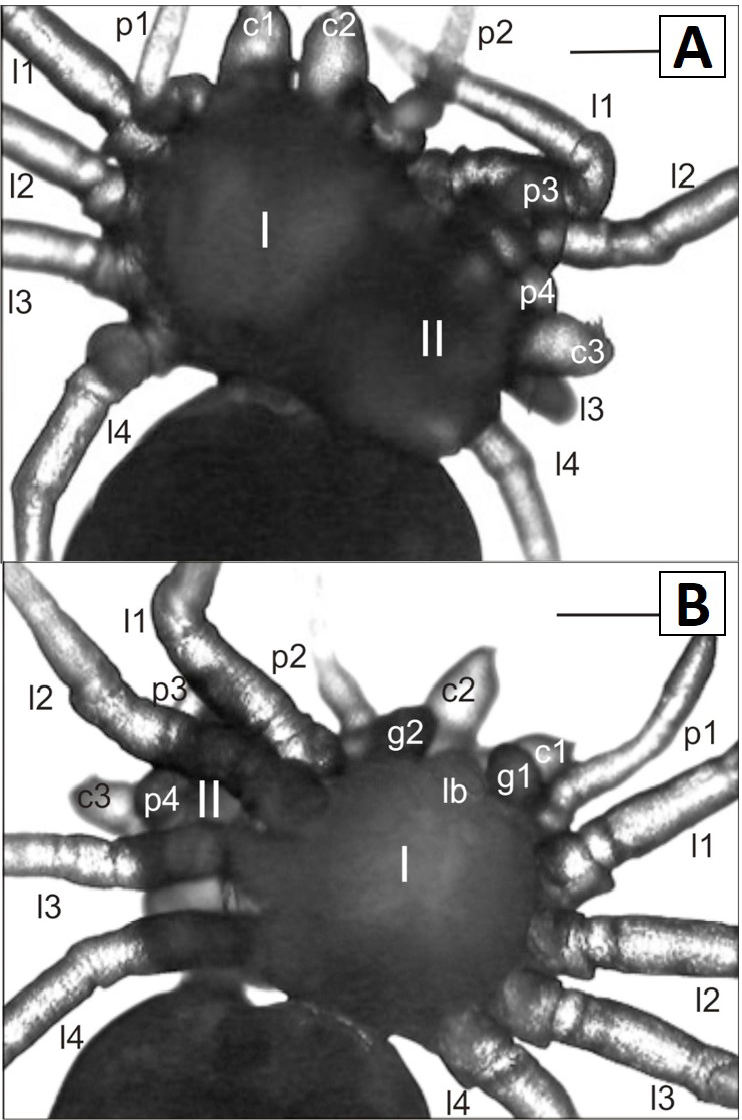
Eratigena atrica larva: A, dorsal view; B, ventral view. I, prosoma; II, additional cephalic part; c1-c3, chelicerae; g1-g2, gnathocoxae; lb, labium; l1-l4, walking legs; p1-p4, pedipalps. Scale bar= 0.32 mm.
References
- Ahmad, T., Hassan, M.W., Jamil, M. and Iqbal, J., 2016. Pakistan J. Zool., 48: 1039-1044.
- Buczek, A., 2000. J. med. Entomol., 37: 807-814.
- Elekcioglu, N.Z., 2017. Pakistan J. Zool., 49: 685-691.
- Itow, T., 1980. J. Nutr. Sci. Vitaminol., 26: 236-245. https://doi.org/10.3177/jnsv.26.237[CrossRef]
- Itow, T., 1982. Dev. Growth Differ., 24: 295-303. https://doi.org/10.1111/j.1440-169X.1982.00295.x[CrossRef]
- Itow, T. and Sekiguchi, K., 1979. Wilhelm Roux’ Arch., 187: 245-254.
- Itow, T. and Sekiguchi, K., 1980. Biol. Bull., 158: 324-338. https://doi.org/10.2307/1540859[CrossRef]
- Jacuński, L., 2002a. Bull. Pol. Acad. Sci. Biol. Sci., 50: 153-157.
- Jacuński, L., 2002b. Bull. Pol. Acad. Sci. Biol. Sci., 50: 183-188.
- Jacuński,, L. and Templin, J., 1992. Bull. Pol. Acad. Sci. Biol. Sci., 40: 165-168.
- Jacuński, L. and Templin, J., 2003. J. Therm. Biol., 28: 393-396. https://doi.org/10.1016/S0306-4565(03)00023-8[CrossRef]
- Jacuński, L., Napiórkowska, T., Templin, J. and Tesznar, L., 2004. Zool. Polon., 49: 97-110.
- Juberthie, C., 1962. C. R. Acad. Sci., 254: 2674-2676.
- Juberthie, C., 1963a. C. R. Acad. Sci., 256: 3363-3365.
- Juberthie, C., 1963b. Bull. Mus. Nat. d’Hist. Natur., 35: 167-171.
- Khan, R.A. and Naveed, M., 2017. Pakistan J. Zool., 49: 999-1003.
- Matthiesen, F.A., 1979. J. Arachnol., 8: 281.
- Mikulska, I. and Jacuński, L., 1970. Acta Arachnol., 23: 17-19. https://doi.org/10.2476/asjaa.23.17[CrossRef]
- Mikulska, I. and Jacuński, L., 1971. Zool. Polon., 21: 281-284.
- Napiórkowska, T. and Templin, J., 2013. Invertebr. Reprod. Dev., 57: 95-100. https://doi.org/10.1080/07924259.2012.678391[CrossRef]
- Napiórkowska, T., Jacuński, L. and Templin, J., 2010. Bull. Br. arachnol. Soc., 15: 83-84. https://doi.org/10.13156/arac.2010.15.3.83[CrossRef]
- Napiórkowska, T., Napiórkowski, P., Templin, J. and Wołczuk, K., 2016. J. Therm. Biol., 60: 125-131. https://doi.org/10.1016/j.jtherbio.2016.06.015[CrossRef]
- Rempel, J.G., 1954. Can. J. Zool., 32: 240-243. https://doi.org/10.1139/z54-023[CrossRef]
- Templin, J., Jacuński, L. and Napiórkowska, T., 2009. Bull. Br. arachnol. Soc., 14: 303-307. https://doi.org/10.13156/arac.2009.14.7.303[CrossRef]
Services
Article usage statistics
Loading…