
To enhance the health of farmed fish, a detailed analysis of their physical and metabolic traits is crucial. A 90-days study was conducted to assess the impact of Chromium chloride hexahydrate (Cr2Cl3.6H2O) supplementation, using sorghum as a carbohydrate source, on the blood parameters and body composition of Labeo rohita. Four experimental diets were formulated as D1, D2, D3, and D4, incorporating 0, 0.3, 0.5, and 0.7 mg of Cr2Cl3.6H2O per kilogram of diet, respectively. The number of red blood cells and hemoglobin content were increased in fish fed with 0.3 to 0.5mg Cr2Cl3.6H2O /kg while white blood cells and hematocrits values were significantly increased (p˂0.05) in 0.3mg Cr2Cl3.6H2O/kg. Thrombocytes number increased by increasing the quantity of supplement in fish diet. Blood metabolites like cholesterol and triglyceride values were significantly decreased (p˂0.05) in fish fed 0.3mg Cr2Cl3.6H2O/kg diet. Low-density lipoprotein decreased while high-density lipoprotein, protein, globulin and albumin, increased in 0.5mg Cr2Cl3.6H2O/kg treated fish. On the other hand alanine transaminase and aspartate aminotransferase values decreased with significant difference (p˂0.05) in .0.5mg Cr2Cl3.6H2O/kg treated fish. The glucose contents decreased by increasing the quantity of Cr in diet. The body composition declared better growth in fish fed 0.3mg Cr2Cl3.6H2O/kg Cr with increased value of organic matter, dry weight and protein contents. The fish muscles DNA/RNA values decreased and Protein/DNA value increased in fish fed 0.3mg Cr2Cl3.6H2O/kg Cr in diet showed that the fish grew faster in that treatment. The whole results revealed that Cr2Cl3.6H2O among sorghum as carbohydrate source has positive impact on fish growth, body composition and blood chemistry.
Research Article · Volume 58, Issue 6, 30 September 2026 · Open Access
Innovative Dietary Strategies: Chromium and Sorghum Impact on Labeo rohita Health Metrics
· · · ·
Affiliations & Notes ⌄
- 1Institute of Zoology, Bahauddin Zakariya University, Multan, Pakistan. 2Institute of Molecular Biology and Biotechnology, Bahauddin Zakariya University, Multan, Pakistan 3Department of Computer and System Sciences Stockholm University, Stockholm, Sweden * Corresponding author: leogul2003leo@gmail.com
Article Info ⌄
- Journal:
- Pakistan Journal of Zoology
- Published:
- 30 September 2026

From the article
- The levels of ALT and AST were lowest in fish fed 0.5 mg Cr/kg diet and increased with further chromium supplementation.
- This indicates that Labeo rohita fed 0.3 mg Cr/kg diet with sorghum as the carbohydrate source exhibited superior growth compared to other groups.
- The inclusion of chromium chloride hexahydrate as a dietary supplement in sorghum-based diets for Labeo rohita demonstrated significant improvements in blood chemistry, body composition, and muscle growth.
- Optimized levels of chromium in sorghum-infused diets were found to enhance the overall physiology of the fish.
Selected from the article's own text.
Abstract
INTRODUCTION
Nutrition plays a pivotal role in the survival and growth of fish. Plant-based feed is an economical and cost-effective option for fish feed formulation, offering a rich source of carbohydrates ; . Dietary carbohydrates, particularly complex polysaccharides, are utilized more efficiently by herbivorous and omnivorous fish compared to simple carbohydrates like mono- and disaccharides ; ; .
Among the various plant-based carbohydrate sources available for animal diets, sorghum stands out due to its nutritional profile, which is comparable to corn. Sorghum contains higher levels of crude protein and starch, along with a greater fraction of amylose and notable antioxidant properties ; . Consequently, sorghum is widely utilized in feed formulations for swine, poultry, and ruminants to lower production costs while maintaining nutritional quality and animal performance ; FAO, 2016).
In Pakistan, sorghum production averages approximately 5.4 tonnes per hectare, surpassing that of wheat and rice. As a multi-purpose crop, sorghum plays a vital role in food and fodder provision ; CEN, 2022). This nutrient-rich grain is abundant in soluble fiber and antioxidants, which contribute to reducing the risk of various diseases . Furthermore, sorghum-based fish diets are more cost-effective than maize-based diets, offering a more economical alternative ; Zarei et al., 2022).
Research has demonstrated that sorghum can be included in fish diets at levels up to 44% for Nile tilapia (Oreochromis niloticus) without adversely affecting fish production performance . Similarly, it can replace maize at up to a 60% inclusion level in the diets of Heteroclarias fingerlings without negative effects on nutrient utilization and growth performance . Sorghum also shows potential as a substitute for corn in diets for Rhamdia quelen, proving to be a viable alternative that enhances fish performance .
On the other hand chromium (Cr) is an essential trace mineral that plays a significant role in the nutritional and physiological responses of fish. Chromium exists in two primary forms in the environment: trivalent chromium (Cr III) and hexavalent chromium (Cr VI) . Trivalent chromium compounds have been widely used as feed additives in aquaculture due to their involvement in carbohydrate, protein, and lipid metabolism ; ; ; . Chromium supplementation is available in both organic and inorganic forms, each with its distinct effects on fish nutrition (Küçükbay et al., 2006; ; .
Monitoring fish health through blood analysis is a well-established practice in aquaculture and environmental studies. Hematological parameters provide critical information about the physiological and biochemical status of fish, helping to identify stress, disease, and the effects of environmental factors ; ; ; . Blood hemoglobin levels, indicative of oxygen-carrying capacity, are commonly used to identify abnormalities and pathological conditions in fish ; . Changes in white blood cell counts and blood glucose levels serve as biochemical indicators of immunosuppression and stress .
Chromium supplementation has shown positive effects on hematological parameters, including hemoglobin (Hb), red blood cell (RBC) counts, and cholesterol levels. Supplementation with chromium chloride hexahydrate improves fish physiology, enzymatic activity, and body composition when paired with an appropriate carbohydrate source . Chromium is known to reduce blood cholesterol levels in rainbow trout (Küçükbay et al., 2006) and other animals, including broiler chickens ; ; ; .
Studies have demonstrated that chromium supplementation positively impacts growth performance in various species, including carp and hybrid tilapia (Oreochromis niloticus × O. aureus) , and decreases serum cholesterol levels in rainbow trout ; . Furthermore, in striped catfish (Pangasianodon hypophthalmus), appropriate dietary chromium supplementation significantly enhances Hb, RBC, and decreased blood glucose levels . These findings highlight the role of chromium in improving fish health and production performance when integrated with well-balanced diets.
The existing body of literature lacks studies investigating the concurrent inclusion of sorghum and chromium in fish diets. This highlights a research gap concerning the potential synergistic effects or interactions of these two components when incorporated together in aquafeeds. This study aims to investigate the effects of a sorghum-based diet supplemented with different levels of chromium chloride hexahydrate on hematological parameters, metabolic processes, and body composition in Labeo rohita (rohu).
MATERIALS AND METHODS
Experimental animal
A total of 300 specimens of Labeo rohita as experimental animal, each weighing 200 ± 3 g, were procured from a Government Fish Hatchery and transferred to well-constructed cemented fish ponds. The fish were acclimatized for a period of 10 days prior to the commencement of the experimental trial.
Feed ingredients and its protocol
The ingredients used in conjunction with sorghum are detailed in Table I. Chromium chloride hexahydrate was incorporated into the diets at varying concentrations: 0.0 mg/kg in D1, 0.3 mg/kg in D2, 0.5 mg/kg in D3, and 0.7 mg/kg in D4. All ingredients were thoroughly dried, ground, and uniformly mixed to ensure homogeneity.
Table I. Feed ingredients (per 100g) and nutrient composition of experimental diets applied to Labeo rohita.
|
Feed ingredient |
D1 |
D2 |
D3 |
D4 |
|
Fishmeal (g) |
31.65 |
31.65 |
31.65 |
31.65 |
|
Soybean meal (g) |
31.65 |
31.65 |
31.65 |
31.65 |
|
Sorghum seeds (g) |
29.70 |
29.70 |
29.70 |
29.70 |
|
Vitamins/Minerals premix* (g) |
4.0 |
4.0 |
4.0 |
4.0 |
|
Canola oil (g) |
2.0 |
2.0 |
2.0 |
2.0 |
|
Methionine (g) |
0.3 |
0.3 |
0.3 |
0.3 |
|
Starch (g) |
0.7 |
0.7 |
0.7 |
0.7 |
|
Chromium chloride hexahydrate (mg/kg) |
0.0 |
0.3 |
0.5 |
0.7 |
*Vitamin A 50000IU; Vitamin D3 50000IU; Vitamin E 500IU; Sodium Selenite 30mg; Cobalt Sulphate 45mg’ Manganese Sulphate 1500mg; Ferrous Sulphate 500mg; Zinc Sulphate 3000mg; Copper Sulphate 3000mg; Magnesium Sulphate 50000mg; Sodium Chloride 80000mg; Phosphorus as Di Calcium Phosphate 50000mg; Calcium as Di Calcium Phosphate 58380 mg.
Experimental design
After the acclimatization period, the fish were transferred to ponds, and a 90-day feeding trial was conducted using four different diets (D1, D2, D3, and D4), each in triplicate. The experimental diets were administered at 3% of the fish’s wet body weight, divided into two feedings per day (morning and evening). Pond water was replaced twice daily, and electric aerators were employed to maintain adequate oxygen levels. Key water quality parameters, including temperature (27-28 °C), dissolved oxygen (5.4-5.6 ppm), and pH (7.3-7.4), were monitored and recorded daily to ensure optimal conditions for fish growth and health.
Hematology and biochemical analysis
At the conclusion of the feeding trial, five fish samples were randomly selected from each pond, and blood was collected via cardiac puncture using a syringe. Heparinized blood samples were obtained for hematological and biochemical analyses. Parameters including hemoglobin (Hb), red blood cell count (RBC), hematocrit (PCV), total white blood cell count (WBC), thrombocytes (PLT), and procalcitonin (PCT) were measured using an Auto Hematology Analyzer (DH 36). A portion of the blood samples was allowed to coagulate, followed by centrifugation at 3500 rpm at 4 °C. The resulting serum was collected as the supernatant and stored at −18 °C for subsequent analysis.
Following blood collection, the fish were sacrificed and stored at −18 °C for further use. The serum was utilized to analyze metabolites, including glucose (GLU), cholesterol (CHO), triglycerides (TG), low-density lipoprotein (LDL), high-density lipoprotein (HDL), serum protein, albumin, globulin, creatinine, urea, alanine transaminase (ALT), and aspartate aminotransferase (AST). These parameters were assessed using a Biochemistry Analyzer (Rayto RT-9200).
Body composition
Triplicate fish samples from each treatment group were collected and analyzed for proximate composition following AOAC (2006) guidelines. Dry weight was determined by drying the fish specimens in an oven at 105 °C for 24 h. Crude lipid content was measured using the Soxhlet extraction method, while crude protein was quantified using the Kjeldahl method following acid digestion. Moisture content was assessed by drying at 105 °C for 24 h, and ash content was determined by incinerating the samples at 550 °C for 12 h.
Muscle growth parameters
A 0.1 g sample of muscle tissue was carefully excised from each fish specimen, and a 10% tissue homogenate was prepared using chilled saline solution. The homogenate was then centrifuged at 4000 rpm for 10 min at 4 °C. The supernatants obtained were transferred into Eppendorf tubes and stored at −20 °C for subsequent analyses. Growth metrics, such as DNA:RNA, Protein:DNA, and DNA:tissue ratios, were analyzed to assess muscle growth in the fish.
Nucleic acid extraction was conducted following the method of Chomczynski and Sacchi (1987). For DNA extraction, equal volumes of phenol-chloroform were mixed with the supernatant and vortexed, followed by centrifugation to isolate the aqueous phase containing DNA. Ethanol and sodium acetate were added, and the mixture was incubated at −20 °C. The DNA was pelleted by centrifugation, washed with 70% ethanol, air-dried, and dissolved in DNase-free water.
For RNA extraction, TRIzol reagent was added to the saline supernatant, incubated, and mixed with chloroform. After centrifugation, the aqueous phase was transferred to a fresh tube, followed by the addition of isopropanol and incubation at −20 °C. The RNA was pelleted by centrifugation, washed with 70% ethanol, air-dried, and dissolved in RNase-free water.
The nucleic acid samples were diluted in RNase/DNase-free water, and absorbance was measured at 260 nm and 280 nm to determine concentration, using conversion factors appropriate for DNA and RNA. Purity was evaluated by calculating the A260/A280 ratio, with target values of ~1.8 for DNA and ~2.0 for RNA .
Protein quantification in muscle tissue was performed using the Lowry method , with bovine serum albumin (BSA) as the protein standard. A 100 µL aliquot of the sample or standard was mixed with 1 mL of alkaline copper solution, incubated for 10 min at room temperature, followed by the addition of 100 µL of Folin-Ciocalteu Reagent. After thorough mixing and a 30-min incubation, absorbance was measured at 750 nm. Protein concentrations were calculated by comparing sample absorbance values to a standard curve generated using known BSA concentrations.
Statistical analysis
The data were presented as mean ± standard deviation (SD) to summarize the central tendency and dispersion. Statistical analysis was performed using one-way analysis of variance (ANOVA) to examine differences across the groups. Post-hoc comparisons were conducted using the Tukey test to identify significant differences between treatment groups. All analyses were conducted using IBM SPSS Statistics software (version 2).
RESULTS
Effect on hematological parameters
Figure 1 shows effect of different contents of chromium on hematological parameters of fish. The results show maximum number of RBCs and Hb quantity in D2 and D3 (2.21±0.24X10⁶/µL; 9.23±0.25g/dl) and D3 (2.11±0.12 X10⁶/µL; 9.06±0.25g/dl) treatment of chromium chloride. WBCs and hematocrits were maximum in D2 (70.31±1.98X10³/µL and 30.60±1.21%, respectively) with significant difference (p˂0.05). Thrombocytes (PLT) and PCT values were lowest in D1 (105.67±6.11; 0.036±.005%) while maximum in D4 (223.00±6.56 X 10³/µL; 0.080±.010%) treatment.
Effect on biochemical components of serum
The biochemical analysis of different metabolites (Table II) revealed that cholesterol and triglyceride values were significantly lower in D2 (133.36±1.31mg/dl and 192.86±2.26mg/dl, respectively). The glucose contents were highest in D2 (101.93±3.72mg/dl) treatment and then decreased by further increasing the concentration of Chromium. The D3 treatment showed maximum value of HDL (82.30±1.97mg/dl) and minimum value of LDL (20.50±2.78mg/dl). The urea contents decreased by increasing the quantity of Cr supplement and were minimum in D4 (16.57±2.30mg/dl) while minimum value of creatine in D2 (0.06±0.02mg/dl). D3 had significantly higher values of protein (4.16±0.40g/dl), globulin (3.40±0.46g/dl) and albumin (0.80±0.10g/dl) on the other hand D3 had minimum values of ALT (17.56±1.85A U/dl) and AST (34.33±1.96A U/dl).
Table II. Effect of different quantities of chromium chloride in the four experimental diets (D1, D2, D3 and D4) alongwith sorghum on blood serum metabolites of L. rohita.
|
Biochemical parameters of serum |
D1 |
D2 |
D3 |
D4 |
|
CHO (mg/dl) |
173.33±2.25b |
133.36±1.31c |
173.53±3.10b |
200.03±9.05a |
|
TG (mg/dl) |
434.33±4.97d |
192.86±2.26a |
355.03±4.55c |
346.16±3.77b |
|
HDL (mg/dl) |
42.70±2.15b |
53.33±1.76c |
82.30±1.97d |
36.63±2.71a |
|
LDL (mg/dl) |
44.56±2.21b |
41.13±1.32b |
20.50±2.78a |
94.56±3.91c |
|
GLU (mg/dl) |
25.83±3.89a |
101.93±3.72b |
27.56±3.64a |
23.33±2.96a |
|
Urea(mg/dl) |
40.36±1.23c |
28.06±2.12b |
29.20±3.54b |
16.566±2.30a |
|
Creatine(mg/dl) |
1.20±0.10b |
0.06±0.02a |
0.12±0.02a |
0.14±0.02a |
|
Protein (g/dl) |
3.16±0.21ab |
2.80±0.20a |
4.16±0.40c |
3.43±0.35b |
|
Albumin (g/dl) |
2.70±.20a |
2.20±0.20a |
3.40±0.46b |
2.30±0.30a |
|
Globulin (g/dl) |
0.40±0.10a |
0.60±0.20ab |
0.80±0.10b |
1.10±0.10c |
|
ALT (U/dl) |
45.10±0.90b |
163.60±2.95d |
17.56±1.85a |
82.23±2.05c |
|
AST (U/dl) |
55.66±1.21b |
267.63±1.75d |
34.33±1.96a |
225.30±1.81c |
Note: The values (mean ± SD) within the same row, denoted by different superscripts (a, b, c and d), indicate significant differences (p < 0.05). CHO, Cholesterol; TG, Triglyceride; HLD, High density lipoprotein; LDL, Low density lipoprotein; GLU, Glucose; ALT, Alanine transaminase; AST, Aspartate aminotransferase
See Table 1 for details of experimental diets.
Table III. Effect of different quantities of chromium chloride in the four experimental diets (D1, D2, D3 and D4) alongwith sorghum on body composition of L. rohita.
|
Proximate composition |
D1 |
D2 |
D3 |
D4 |
|
Moisture (%) |
74.56±4.35a |
74.56±3.70a |
76.59±2.05a |
77.58±1.31a |
|
Fat (%) |
4.57±0.24a |
4.31±0.25a |
3.17±0.28b |
4.59±0.29a |
|
Protein |
18.43±0.36b |
19.52±0.22a |
19.28±0.26a |
17.38±0.16c |
|
Ash (%) |
3.64±0.20ab |
3.79±0.28a |
4.12±0.07a |
3.21±0.26b |
|
Organic contents (%) |
23.31±0.68a |
24.13±1.99a |
22.42±0.44a |
21.89±0.85a |
|
Dry weight (%) |
24.54±0.90b |
25.41±0.44b |
22.20±1.97a |
23.73±0.52ab |
Note: The values (mean ± SD) within the same row, denoted by different superscripts (a, b and c), indicate significant differences (p < 0.05).
See Table 1 for details of experimental diets.
Table IV. Effect of different quantities of chromium chloride in the four experimental diets (D1, D2, D3 and D4) alongwith sorghum on nucleic acids and protein ratio of muscle tissues for muscle growth of Laboe rohita.
|
Muscle tissue |
D1 |
D2 |
D3 |
D4 |
|
DNA/RNA |
1.24±0.02ab |
1.193±0.04b |
1.264±0.03a |
1.243±0.005ab |
|
PRO/DNA |
13.91±0.14b |
18.42±1.64a |
16.92±0.53a |
16.72±0.93a |
|
DNA/TISSUE |
16.71±0. 28a |
14.42±0.20b |
14.81±.060b |
14.41±0.39b |
Note: The values (mean ± SD) within the same row, denoted by different superscripts (a, b and c), indicate significant differences (p < 0.05). PRO, Protein.
See Table 1 for details of experimental diets.
Body composition
The analysis (Table III) showed higher value of organic matter (24.13±1.99%) and dry weight (25.41±0.44%) in D2 treatment. The fat contents were decreased in D3 treatment (3.17±0.28%) The protein contents were little bit higher in D2 (19.52±0.22%) than D3 (19.28±0.26%) treatment while ash contents also showed similar results with D2 (3.79±0.28%) and D3 (4.12±0.07%) treatments.
Muscle growth parameters
The muscle growth analysis (Table IV) revealed that DNA/RNA value of muscle cells is lower in D2 treatment (1.19±0.04) while Protein/DNA ratio is higher in D2 treatment (18.42±1.64). The lower value of DNA/RNA ratio and higher value of protein/DNA ratio showed that the fish growth was maximum in D2 treatment.
DISCUSSION
In contemporary aquaculture, sustainable feed practices have become a critical focus, with feed supplements playing a pivotal role in enhancing the efficiency and utilization of feed ingredients. This study investigates the impact of a sorghum-based diet supplemented with Cr₂Cl₃·6H₂O at varying levels on the body composition, hematology, and metabolism of Labeo rohita. Findings suggest that replacing corn with sorghum in fish diets may serve as a viable alternative to support fish physiology, as reported by Mariana et al. (2020) and Barbacariu et al. (2024). Further, previous studies ; ; Zarei et al., 2022) indicate that sorghum can effectively substitute maize in aquafeeds, maintaining nutritional integrity and promoting fish health.
The experimental outcomes demonstrated that the highest WBC counts were observed at 0.3 mg Cr₂Cl₃·6H₂O/kg diet, whereas RBC counts and Hb levels peaked at 0.5 mg Cr₂Cl₃·6H₂O/kg diet. Comparatively, Cirrhinus mrigala exhibited optimal hematological values at 0.4 mg Cr/kg diet with corn as the base ingredient . However, hematological parameters diminished with chromium levels exceeding these thresholds, aligning with trends observed in Pangasianodon hypophthalmus . HCT levels initially increased at 0.3 mg Cr/kg diet before declining with higher chromium concentrations, mirroring findings in Cirrhinus mrigala and African catfish (Clarias gariepinus) . Similarly, Oreochromis niloticus exhibited reduced hematological parameters when fed diets supplemented with high chromium levels (800 µg/kg) . Interestingly, PLT and procalcitonin (PCT) levels were elevated with increased dietary chromium.
Chromium’s role as an essential nutrient is underscored by its involvement in regulating carbohydrate and lipid metabolism . Biochemical analyses revealed decreased cholesterol and triglyceride levels at 0.3 mg Cr/kg diet, comparable to findings in Oreochromis niloticus ; , but these values increased with higher chromium supplementation, as also reported in red tilapia (Oreochromis sp.) . These results emphasize that an optimal chromium concentration is crucial for effective lipid metabolism and overall fish health.
The experimental results revealed that the highest HDL levels were observed at 0.5 mg Cr₂Cl₃·6H₂O/kg diet, while the lowest low-density lipoprotein (LDL) levels were also recorded at 0.3 mg Cr/kg fish feed. These findings are consistent with observations in Oreochromis niloticus ; , whereas red tilapia (Oreochromis sp.) exhibited similar outcomes at 0.4 mg chromium . Additionally, glucose levels peaked at 0.3 mg Cr/kg diet and subsequently decreased with higher chromium supplementation.
This pattern suggests that chromium acts as a cofactor to enhance insulin activity on target tissues, thereby reducing serum glucose levels and inhibiting gluconeogenesis from amino acids. These findings align with previous studies indicating that chromium chloride mitigates hyperglycemia and exhibits a protein-sparing effect ; . Comparable reductions in blood glucose levels have been documented in Pangasianodon hypophthalmus , Megalobrama amblycephala , and Oreochromis niloticus , corroborating the current study’s results. However, contrary findings have been reported in red tilapia and Clarias gariepinus . The findings indicate specie specific responses.
Regarding nitrogenous waste products, urea concentrations decreased while creatinine levels increased with higher chromium supplementation. Interestingly, the control group (D1) exhibited higher levels of these parameters compared to the treated groups (D2, D3, and D4). Total protein and albumin concentrations increased with chromium supplementation up to 0.5 mg but declined with further increases in dietary chromium, paralleling findings in red tilapia . Similarly, globulin levels rose with increasing chromium concentrations.
The levels of ALT and AST were lowest in fish fed 0.5 mg Cr/kg diet and increased with further chromium supplementation. These results are consistent with those reported for Labeo rohita . Overall, the findings highlight the importance of maintaining optimal chromium levels to achieve desired metabolic and physiological outcomes in aquaculture.
The body composition of fish reflects their physiological status and overall health. In the present study, the highest dry weight and organic content values were observed in Labeo rohita fed a diet containing 0.3 mg Cr/kg, indicating optimal growth under these conditions. Fat content was lowest in fish receiving 0.5 mg Cr/kg in their diet, whereas protein content was highest in fish fed diets with 0.3 mg and 0.5 mg Cr/kg. These findings align with previous studies on Cirrhinus mrigala and Labeo rohita . The results support earlier observations that chromium supplementation can enhance lean body mass while reducing body fat .
Fish growth was assessed through muscle tissue analysis by evaluating the DNA/RNA ratio. In the current evaluation, the DNA/RNA ratio was lowest at 0.3 mg Cr/kg diet. The higher RNA content relative to DNA suggests increased protein synthesis, indicative of enhanced growth ; . Furthermore, the protein/DNA ratio, which reflects cell size, and the DNA/tissue ratio, which indicates cell density ; , were also used as growth metrics. Rapidly growing fish were characterized by larger muscle cells with reduced cell numbers, represented by a higher protein/DNA ratio and a lower DNA/tissue mass ratio ; ; .
The findings of this study revealed that the 0.3 mg Cr/kg fish feed treatment had the highest protein/DNA ratio and the lowest DNA/tissue ratio. This indicates that Labeo rohita fed 0.3 mg Cr/kg diet with sorghum as the carbohydrate source exhibited superior growth compared to other groups.
CONCLUSION
The findings of this study indicate that sorghum is a viable alternative to other plant-based carbohydrate sources, such as corn and maize. The inclusion of chromium chloride hexahydrate as a dietary supplement in sorghum-based diets for Labeo rohita demonstrated significant improvements in blood chemistry, body composition, and muscle growth. Optimized levels of chromium in sorghum-infused diets were found to enhance the overall physiology of the fish. This synergistic combination of sorghum and chromium supplementation shows promising results and holds potential for incorporation into commercial fish feed formulations.
Declarations
Acknowledgement
The authors thank the Government Fish Hatchery, Mian Channu, for providing experimental animals and the Nuclear Institute of Biology and Agriculture for access to laboratory facilities and equipment essential for this research.
Funding
This study received no external funding
Ethical statement
The present study received approval from the Ethical Committee of Institute of Zoology BZU Multan, and all experiments were conducted in accordance with the approved protocols.
Generative AI and AI-assisted technology statement
The authors declare that no generative AI and AI assisted technology was used in the creation of this manuscript.
Statement of conflict of interest
The authors have declared no conflict of interest.
Figures
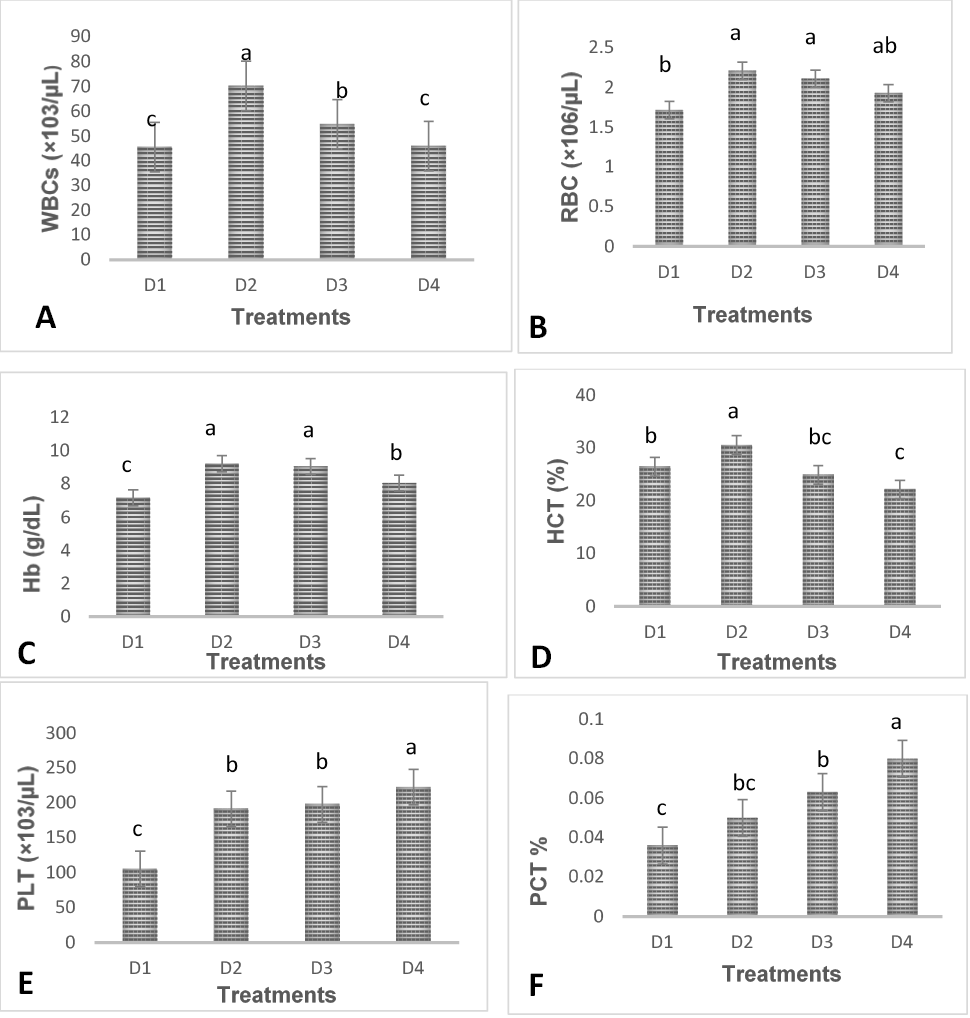
Hematological parameters of Labeo rohita subjected to four experimental diets (D1, D2, D3, and D4) formulated with varying levels of chromium chloride hexahydrate (Crâ‚‚Cl₃·6Hâ‚‚O) alongwith sorghum as carbohydrate source. The values (mean ± SD) denoted by different superscripts (a, b, c and d), indicate significant differences (p < 0.05). WBCS, White blood cells; RBCS, Red blood cells; Hb, Hemoglobin; HCT, Hematocrit; PCT, Procalcitonin; PLT, Platelets/ thrombocytes.
References
- Aderolu, A., Zaid, A., Kuton, M., Odu-Onikosi, S. and Gbolahan, S., 2009. Substitution effect of sorghum meal for maize meal in the diet of catfish (Clarias gariepinus, Burchell, 1822). Juvenile, 4: 41-45.
- Akter, S., Haque, M.A., Sarker, M.A., Atique, U., Iqbal, S., Sarker, P.K., Paray, B.A., Arai, T., Honnain, M.B., 2024. Efficacy of using plant ingredients as partial substitute of fishmeal in formulated diet for a commercially cultured fish, Labeo rohita. Front. Sustain. Fd. Syst., 8: 1376112. https://doi.org/10.3389/fsufs.2024.1376112[CrossRef]
- Akter, S., Jahan, N., Rohani, M. F., Akter, Y. and Shahjahan, M., 2021. Chromium supplementation in diet enhances growth and feed utilization of striped catfish (Pangasianodon hypophthalmus). Biol. Trace Element. Res., 199: 4811–4819. https://doi.org/10.1007/s12011-021-02608-2[CrossRef]
- Anderson, R.A., 1998. Chromium glucose introlerance and diabetes. J. Am. Coll. Nutr., 17: 548-555. https://doi.org/10.1080/07315724.1998.10718802[CrossRef]
- AOAC, 2006. Official methods of analysis, 18th ed. Association of Official Analytical Chemists, Arlington, VA, USA.
- Asad, F., Qamer, S., Behzad, A., Ali, T. and Ashraf, A., 2017a. Growth performance and chemical composition of Cirrhinus mrigala (mori) under the effect of chromium chloride hexahydratre. Pure appl. Biol., 6: 1226–1233. https://doi.org/10.19045/bspab.2017.600130[CrossRef]
- Asad, F., Naseem, N., Ashraf, A., Ali, T. and Behzad, A., 2017b. Chemical composition and growth performance of Labeo rohita under the influence of Chromium chloride hexahydrate marker. Int. J. Biosci., 10: 186-194. https://doi.org/10.12692/ijb/10.1.186-194[CrossRef]
- Asad, F., Qamer, S., Ashraf, A., Rafique, A., Shaheen, Z., Nisar, A. and Javaid, S., 2020. Apparent nutrient digestibility of carbohydrate (corn) in Cirrhinus mrigala under the influence of chromium chloride hexahydrate. Braz. J. Biol., 80: 518-522. https://doi.org/10.1590/1519-6984.214176[CrossRef]
- Asad, F., Ashraf, A., Rafique, A., Qamar, S., Shaheen, Z., Nisar, A., Shaheena, Z. and Mazhara, A., 2021. Chromium supplemented carbohydrate diets for Cirrhinus mrigala: Effects on body composition, gut enzyme activity and hematological parameters. Braz. J. Biol., 83: e247284. https://doi.org/10.1590/1519-6984.247284[CrossRef]
- Ashaf-Ud-Doulah, M., Shahjahan, M., Islam, S.M.M., Al-Emran, M., Rahman, M.S. and Hossain, M.A.R., 2019. Thermal stress causes nuclear and cellular abnormalities of peripheral erythrocytes in Indian major carp rohu Labeo rohita. J. Therm. Biol., 86: 102450. https://doi.org/10.1016/j.jtherbio.2019.102450[CrossRef]
- Azaza, M.S., Saidi, S.A., Dhraief, M.N. and El-Feki, A., 2020. Growth performance, nutrient digestibility, hematological parameters, and hepatic oxidative stress response in juvenile Nile tilapia, Oreochromis niloticus, fed carbohydrates of different complexities. J. Anim., 10(10): 13-19. https://doi.org/10.3390/ani10101913[CrossRef]
- Aziza, A., Zahran, E. and Elseady, Y., 2015. Dietary supplementation of Nile Tilapia (Oreochromis niloticus) with betaine, chromium picolinate and a combination: Effects on growth performance, hematological and biochemical parameters. Annl. Vet. Anim. Sci., 2: 98-108.
- Bagchi, D., Stohs, S.J., Downs, B.W., Bagchi, M. and Preuss, H.G., 2002. Cy7- totoxicity and oxidative mechanisms of different forms of chromium. Toxicology, 180: 5-22. https://doi.org/10.1016/S0300-483X(02)00378-5[CrossRef]
- Bagheri, S., Gholamhosseini, A. and Banaee, M., 2023. Investigation of different nutritional effects of dietary chromium in fish: A literature review. Biol. Trace Elem. Res., 201: 2546–2554. https://doi.org/10.1007/s12011-022-03326-z[CrossRef]
- Barbacariu, C.A., Dumitru, G., Rimbu, C.M., Horhogea, C.E., Dîrvariu, L., Todirașcu-Ciornea, E., Șerban, D.A., Burducea, M., 2024. Inclusion of sorghum in Cyprinus carpio L. Diet: Effects on growth, flesh quality, microbiota, and oxidative status. Animals (Basel), 14: 1549. https://doi.org/10.3390/ani14111549[CrossRef]
- Caldarone, E.M., 2005. Estimating growth in haddock larvae Melanogrammus aeglefinus from RNA: DNA ratios and water temperature. Mar. Ecol. Prog. Ser., 293: 241–252. https://doi.org/10.3354/meps293241[CrossRef]
- Chícharo, M.A. and Chícharo, L., 2008. RNA: DNA ratio and other nucleic acid derived indices in marine ecology. Int. J. mol. Sci., 9: 1453-1471. https://doi.org/10.3390/ijms9081453[CrossRef]
- China Economic Net (CEN), 2022. Sorghum cooperation: A new milestone in CPEC. The Express Tribune. https://tribune.com.pk/story/2353070/sorghum-cooperation-a-new-milestone-in-cpec
- Chomczynski, P. and Sacchi, N., 1987. Single-step method of RNA isolation by acid guanidinium thiocyanate-phenol-chloroform extraction. Anal. Biochem., 162: 156–159. https://doi.org/10.1016/0003-2697(87)90021-2[CrossRef]
- Dalólio, F.S., Albino, L.F.T., Silva, J.N., Alves, T.F.K., Burin, A.M.A., Busanello, M. and Ribeiro, V., 2021. Dietary chromium-methionine supplementation and broiler (22–43 days) responses during heat stress. Growth performance and carcass yield, metabolisable energy and serum biochemistry. Anim. Prod. Sci., 61: 586-595. https://doi.org/10.1071/AN20140[CrossRef]
- Ebrahimnazhad, Y. and Ghanbari, S., 2014. The effect of dietary chromium supplementation on blood biochemical parameters of broiler chicks. Greener J. biol. Sci., 4: 098-102. https://doi.org/10.15580/GJBS.2014.3.042214193[CrossRef]
- El-Sayed, E., Hassanien, E.I., Soliman, M.H. and ElKhatib, N.R., 2010. The effect of dietary chromium picolinateon growth performance, blood parameters and immune status in Nile tilapia, Oreochromis niloticus. Proc. 3rd Glob. Fish. Aquacult. Res. Conf. Foreign Agric. Relat. Egypt, 29: 51-63.
- Elahee, K.B. and Bhagwant, S., 2007. Hematological and gill histopathological parameters of three tropical fish species from a polluted lagoon on the west coast of Mauritius. Ecotoxicol. environ. Saf., 68: 361–371. https://doi.org/10.1016/j.ecoenv.2006.06.003[CrossRef]
- Esmaeili, M., 2021. Blood performance: A new formula for fish growth and health. Biology (Basel), 10: 1236. https://doi.org/10.3390/biology10121236[CrossRef]
- FAO, 2016. SOFIA: The state of word fisheries and aquaculture. Food and Agriculture Organization of the United Nations, Roma.
- Ferguson, M.M. and Danzmann, R.G., 1990. RNA/DNA ratios in white muscle as estimates of growth in rainbow trout held at different temperatures. Can. J. Zool., 68: 1494-1498. https://doi.org/10.1139/z90-221[CrossRef]
- Ferri, J., Matic-Skoko, S., Coz-Rakovac, R., Strunjak-Perovic, I., Beer-Ljubic, B. and Topic, P.N., 2022. Assessment of fish health: Seasonal variations in blood parameters of the widely spread mediterranean scorpaenid Species, Scorpaena porcus. Appl. Sci., 12: 4106. https://doi.org/10.3390/app12094106[CrossRef]
- Foster, F.S., Pavlin, C.J., Lockwood, G.R., Ryan, L.K., Harasiewicz, K.A., Berube, L.R. and Rauth, A.M., 1993. Principles and applications of ultrasound backscatter microscopy. IEEE Trans. Ultrason. Ferroelec. Freq. Contr., 40: 608–617. https://doi.org/10.1109/58.238115[CrossRef]
- Gazza, L., Menga, V., Taddei, F., Nocente, F., Galassi, E., Natale, C., Lanzanova, C., Paone, S. and Fares, C., 2024. Nutritional traits, pasting properties and antioxidant profile of selected genotypes of sorghum, oat and maize eligible for gluten-free products. Foods, 13: 990. https://doi.org/10.3390/foods13070990[CrossRef]
- Giri, A.K., Sahu, N.P., Saharan, N. and Dash, G., 2014. Effect of dietary supplementation of chromium on growth and biochemical parameters of Labeo rohita (Hamilton) fingerlings. Indian J. Fish., 61: 73–81.
- Goes, R.H.T.B., Silva, L.H.X. and Souza, K.A., 2013. Foods and animal feeding, 1st ed. Grande Dourados: UFGD Publishing House.
- Hertz, Y., Mader, Z., Hepher, B. and Gertler, A., 1989. Glucose metabolism in the common carp (Cyprinus carpio L.): The effect of cobalt and chromium. Aquaculture, 76: 255–267. https://doi.org/10.1016/0044-8486(89)90079-3[CrossRef]
- Hoffman, N.J., Penque, B.A., Habegger, K.M., Sealls, W., Tackett, L. and Elmendorf, J.S., 2014. Chromium enhances insulin responsiveness via AMPK. J. Nutr. Biochem., 25: 565-572. https://doi.org/10.1016/j.jnutbio.2014.01.007[CrossRef]
- Islam, S.M.M., Rahman, M.A., Nahar, S., Uddin, M.H., Haque, M.M. and Shahjahan, M., 2019. Acute toxicity of an organophosphate insecticide sumithion to striped catfish Pangasianodon hypophthalmus. Toxicol. Rep., 6: 957–962. https://doi.org/10.1016/j.toxrep.2019.09.004[CrossRef]
- Kaiser, F., Schlachter, M., Schulz, C. and Silva, C.F., 2023. Dietary supplementation with chromium DL-methionine enhances growth performance of African Catfish (Clarias gariepinus). Aquacult. Nutr., 8. https://doi.org/10.1155/2023/7092657[CrossRef]
- Karpinets, T.V., Greenwood, D.J. and Sams, C.E., 2006. RNA: Protein ratio of the unicellular organism as a characteristic of phosphorous and nitrogen stoichiometry and of the cellular requirement of ribosomes for protein synthesis. BMC Biol., 4: 30. https://doi.org/10.1186/1741-7007-4-30[CrossRef]
- Krogdahl, Å., Hemre, G.I. and Mommsen, T.P., 2005. Carbohydrates in fish nutrition: Digestion and absorption in postlarval stages. Aquacult. Nutr., 11: 103-122. https://doi.org/10.1111/j.1365-2095.2004.00327.x[CrossRef]
- Kroliczewska, B., Zawadzki, W., Dobrzanski, Z. and Kaczmarek-Oliwa, A., 2004. Changes in selected serum parameters of broiler chicken fed supplemental chromium. J. Anim. Physiol. Anim. Nutr., 88: 393–400. https://doi.org/10.1111/j.1439-0396.2004.00496.x[CrossRef]
- Kucukbay F.Z., Yazlak, H., Sahin, N. and Cakmak, M.N., 2006. Effects of dietary chromium picolinate supplementation on serum glucose, cholesterol and minerals of rainbow trout (Oncorhynchus mykiss). Aquacult. Int., 14: 259-266. https://doi.org/10.1007/s10499-005-9030-1[CrossRef]
- Liu, T., Wen, H., Jiang, M., Yuan, D., Gao, P., Zhao, Y. and Liu, W., 2010. Effect of dietary chromium picolinate on growth performance and blood parameters in grass carp fingerling, Ctenopharyngodon idellus. Fish Physiol. Biochem., 36: 565–572. https://doi.org/10.1007/s10695-009-9327-5[CrossRef]
- Lowry, O.H., Rosenbrough, N.J., Farr, A.L. and Randall, R.J., 1951. Protein measurement with the Folin Phenol Reagent. J. biol. Chem., 193: 265-275. https://doi.org/10.1016/S0021-9258(19)52451-6[CrossRef]
- Mariana, L.R., Milena, S.S., Jhonis, E.P., Kattia, A.W., Agnaldo, D., Wilson, R.B., Fábio, B. and Altevir, S., 2020. Replacement of corn by sorghum and phytase supplementation in silver catfish (Rhamdi aquelen) diets: Growth performance, physiological variables and bone mineralization. J. appl. Anim. Res., 48: 142-150. https://doi.org/10.1080/09712119.2020.1750411[CrossRef]
- McGinnis, Margaret, J. and Painter, J.E., 2020. History of nutrition: Sorghum, history, use, and health benefits. Nutr. Today, 55: 38-44. https://doi.org/10.1097/NT.0000000000000391[CrossRef]
- Obe, B.W., 2014. Growth performance and nutrient utilization of catfish hybrid (Heterobranchus bidorsalis X Clarias gariepinus) fed fermented sorghum (Sorghum bicolor) waste meal diets. J. appl. Sci. Technol., 4: 130-136
- Pan, Q., Liu, S., Tan, Y.G. and Bi, Y.Z., 2003. The effect of chromium picolinate on growth and carbohydrate utilization in tilapia, Oreochromis niloticus × Oreochromis aureus. Aquaculture, 225: 421-429. https://doi.org/10.1016/S0044-8486(03)00306-5[CrossRef]
- Pan, Q., Liu, S., Zheng, C. and Bi, Y.Z., 2002. The effect of chromium nicotinic acid on growth, feed efficiency and tissue composition in hybrid tilapia (Oreochromis niloticus X O. aureus). Acta Hydrobiol. Sin., 26: 197-200. https://doi.org/10.3724/issn1000-3207-2002-4-393-3[CrossRef]
- Patil, A., Palod, J., Singh, V.S. and Kumar, A., 2008. Effect of graded levels of chromium supplementation on certain serumbiochemical parameters in broilers. Indian J. Anim. Sci., 78: 1149–1152.
- Pelletier, D., Blier, U.P., Dutil, D.J. and Guderley, H., 1995. How should enzyme activities be used in fish growth studies? J. exp. Biol., l198: 1493-1497. https://doi.org/10.1242/jeb.198.7.1493[CrossRef]
- Pires, K.A., Santos, D.C.C., Graça, D.S., Melo, M.M., Barbosa, F.A. and Soto-Blanco, B., 2015. Effects of two sources of chromium on performance, blood and liver lipid levels in nile tilapia (Oreochromis niloticus). Acta Sci. Vet., 43: 1302. https://www.researchgate.net/publication/281449727
- Rakhmawati, R., Suprayudi, M.A., Setiawati, M., Widanarni, W., Junior, M.Z. and Jusadi, D., 2017. Bioefficacy of dietary chromium picolinate and chromium yeast on growth performance and blood biochemical in Red Tilapia, Oreochromis niloticus (Linnaeus). Aquacult. Res., 00: 1–8. https://doi.org/10.1111/are.13527[CrossRef]
- Ratnavathi, C.V. and Komala, V.V., 2016. Sorghum grain quality sorghum biochemistry: An industrial perspective. 1st ed. Academic Press, London. pp. 1–61. https://doi.org/10.1016/B978-0-12-803157-5.00001-0[CrossRef]
- Ren, M., Mokrani, A., Liang, H., Ji, K., Xie, J., Xianping and Liu, B., 2018. Dietary chromium picolinate supplementation affects growth, whole-body composition, and gene expression related to glucose metabolism and lipogenesis in juvenile blunt snout bream, Megalobrama amblycephala. Biol. Trace Element. Res., 185: 205-215. https://doi.org/10.1007/s12011-018-1242-0[CrossRef]
- Seibel, H., Babmann, B. and Rebl, A., 2021. Blood will tell: What hematological analyses can reveal about fish welfare. Front. Vet. Sci., 8: 616955. https://doi.org/10.3389/fvets.2021.616955[CrossRef]
- Shahjahan, M., Uddin, M.H., Bain, V. and Haque, M.M., 2018. Increased water temperature altered hemato-biochemical parameters and structure of peripheral erythrocytes in striped catfish Pangasianodon hypophthalmus. Fish Physiol. Biochem., 44: 1309–1318. https://doi.org/10.1007/s10695-018-0522-0[CrossRef]
- Shiau, S.Y. and Liang, H.S., 1995. Carbohydrate utilization and digestibility by tilapia, Oreochromis niloticus × O. aureus, are affected by chromic oxide inclusion in the diet. J. Nutr., 125: 976–982. https://doi.org/10.1093/jn/125.4.976[CrossRef]
- Stone, D.A.J., 2003. Dietary carbohydrate utilization by fish. Rev. Fish. Sci., 11: 337-369. https://doi.org/10.1080/10641260390260884[CrossRef]
- Subandiyono, S. and Hastuti S., 2015. Trivalent chromium (CR+3) in dietary carbohydrate and its effect on the growth of commonly cultivated fish. J. Teknol., 78. 8214. https://doi.org/10.11113/jt.v78.8214[CrossRef]
- Toniben, K., Franz, G.P., Albrecht, E., Lutze, P., Bochert, R. and Grunow, B., 2024. Pikeperch muscle tissues: A comparative study of structure, enzymes, genes, and proteins in wild and farmed fish. Fish Physiol. Biochem., 50: 1527–1544. https://doi.org/10.1007/s10695-024-01354-1[CrossRef]
- USDA Foreign Agricultural Service, 2021. Sorghum production and utilization in Pakistan. Global Agricultural Information Network. Retrieved from https://ipad.fas.usda.gov\
- Wei, L., Li, Y., Ye, H., Xiao, J., Hogstrand, C., Green, I., Guo, Z. and Han, D., 2021. Dietary trivalent chromium exposure up-regulates lipid metabolism in coral trout: The evidence from transcriptome analysis. Front. Physiol., 12: 640898. https://doi.org/10.3389/fphys.2021.640898[CrossRef]
- Wilfinger, W.W., Mackey, K. and Wilfinger, L., 1997. The quantitation of DNA and RNA using the UV spectrophotometer. BioTechniques, 22: 474–481. https://doi.org/10.2144/97223st01[CrossRef]
- Wilson, M.F., Antonio, C.F. and Valeria, R.B., 2003. Sorghum a potential energy source in Tilapia feed. Global Aquaculture Advocate. https://www.globalseafood.org/advocate/sorghum-a-potential-energy-source-in-tilapia-feed/?headlessPrint=AAAAAPIA9c8r7gs8%E2%80%A6.
- Zarei, M., Amirkolaei, A.K., Trushenski, J.T., Sealey, W.M., Schwarz, M.H. and Ovissipour, R., 2022. Sorghum as a potential valuable aquafeed ingredient: Nutritional quality and digestibility. Agriculture, 12: 669. https://doi.org/10.3390/agriculture12050669[CrossRef]
Services
Article usage statistics
Loading…