
Utilizing waste resources, such as rice straw and Chinese cabbage, is conducive to advancing eco-friendly practices in modern agriculture. The 16 healthy Hu sheep (39.11 ± 1.16 kg, 5.5 months) were randomly divided into two treatments, including the control group and the mixed silage group with eight sheep (four rams and four ewes) in each group. The control group was fed with peanut seedlings, corn husk and high grain shell as roughage, whereas the mixed silage group was fed with the mixed silage of rice straw and Chinese cabbage waste as roughage. Feeding lasted for 7 weeks (1-week adaptation), and all sheep were euthanized on the last day of the experiment to test slaughter performance and meat quality. Our findings indicated that the mixed silage group had no difference on growth and slaughter performance (P > 0.05), while decreased muscle fiber diameter (P < 0.05) as compared with the control group, so as to exhibited a lower shear force and drip loss (P < 0.05). Furthermore, the mixed silage group showed a complete and regular muscle microstructure, with a decrease in muscle saturated fatty acid (SFA) concentrations (P < 0.05), but an increase in methionine concentration (P < 0.05). In conclusion, mixed silage of rice straw and Chinese cabbage waste could enhance meat flavor and quality, and augment muscle antioxidant capacity without influencing growth and slaughter performance. These results could serve as a reference for addressing traditional feed scarcity issues while producing high-quality mutton using Chinese cabbage waste.
Research Article · Volume 58, Issue 6, 28 September 2026 · Open Access
Impacts of Mixed Silage with Rice Straw and Chinese Cabbage Waste on Growth Performance, Carcass Characteristics and Meat Quality of Hu Sheep
· · · · · · · · · · · ·
Affiliations & Notes ⌄
- 1Laboratory of Metabolic Manipulation of Herbivorous Animal Nutrition, College of Animal Science and Technology, Yangzhou University, Yangzhou 225009, China 2State Key Laboratory of Sheep Genetic Improvement and Healthy Production, Xinjiang Academy of Agricultural Reclamation Sciences, Shihezi 832000, China 3College of Animal Science and Technology, Shihezi University, Shihezi 832000, China 4Department of Biosciences, COMSATS University Islamabad, Park Road, Islamabad, 45550, Pakistan Shan Wang a
Article Info ⌄
- Journal:
- Pakistan Journal of Zoology
- Published:
- 28 September 2026

From the article
- In this experiment, there was no difference in MB fat thickness, and rib thickness, but mixed silage group reduced shear force and drip loss of LD, which indicated this treatment may improve meat tenderness.
- Thus, the smaller muscle fiber diameter might explain why meat tenderness increased when feeding mixed silage.
- In this study, the mixed silage group of Hu sheep had significantly higher levels of methionine, whereas other amino acid indices did not differ significantly between the two groups.
- In the present study, the SFA (e.g. C15:0 and C18:0) was lower in the mixed silage group, while no difference in PUFA, which indicated that feeding mixed silage of rice straw and Chinese cabbage waste could benefit to health of sheep, confirmed by the lower MDA content in muscles.
Selected from the article's own text.
Abstract
Introduction
Roughage is a fundamental aspect of animal husbandry (e.g., ruminant) that optimizes the ecological environment and improving livestock production. A proper concentrate-to-coarse diet ratio is necessary to ensure the normal digestion and metabolism of the gastrointestinal tract to improve sheep productivity and economic value. Rice straw production is enormous in China, approximately 21 million tons per year, accounting for about half of the straw production . Rice straw is rich in vitamins, crude fiber (30-40%), and lignin . Therefore, modern agricultural practices involve crushing and compaction of straw before combining it with yeast for ammonification, which is advantageous for enhancing the palatability and utilization rate of straw. Vegetable production in China is accounted for half of the world’s production, but a large amount of vegetable waste is also generated, such as cabbage waste, which occupies the majority of food waste ; . Chinese cabbage waste, including discarded roots, stems, and leaves, or residual leaves from processing, transportation, and storage, can be used to develop feed resources by improving traditional processing technologies . Interestingly, the waste of fruits, vegetables, and fish can be used as an alternative feed source for finishing pigs to meet their nutritional requirements while minimizing landfill waste . Silage treatment can maximize the preservation of the nutritional value of feed and improves its quality for feeding ruminants . Therefore, the rational utilization of agricultural waste (i.e. rice straw and cabbage waste) is critical for promoting eco-friendly practices in modern agriculture.
Diet plays a crucial role in animal production performance and final meat quality. Studies have shown that when a sheep consumes a tannin-rich diet, its myoglobin content decreases and meat becomes lighter . Moreover, supplementing feed with tannin or Vitamin E improves the oxidation stability and antioxidant capacity of meat . Meat tenderness is related to muscle fiber content. The smaller the diameter of the muscle fiber, the higher the density; the smaller the cross-sectional area, the fattier and more tender the meat . In addition, willow silage could replace wheat straw as a source of roughage, which improved patterns of fat deposition in the carcass and improved meat tenderness . This indicated the potential of agricultural waste silage in improving carcass traits and meat quality.
To date, there are few relevant reports regarding the effect of dietary mixed silage of rice straw and Chinese cabbage waste on fattening Hu sheep. Therefore, the study aimed to investigate the effects of mixed silage of rice straw and Chinese cabbage waste on slaughter performance, physical and chemical indices, meat quality, and flavor in fattening Hu sheep, to provide resources for developing cost-effective new feed, overcoming the shortage of traditional feed, and developing high-quality green mutton.
Materials and Methods
Mixed silage preparation
A silage experiment was carried out in Jiangsu Province for 45 days using a mixture of rice straw (40%) and Chinese cabbage waste (60%) obtained from Yangzhou University. The fermentation was performed using Lactobacillus plantarum and cellulase. The ingredients of the mixture are rice straw, 2400 kg; Chinese cabbage waste, 3600 kg; Lactobacillus plantarum (7.0×10⁵ cfu/g), 0.24; Cellulase, (50 U/g) 1.5. The nutritional level of the mixture: dry matter (DM, 21.05%), crude protein (CP, 7.54%), neutral detergent fiber (NDF, 51.79%), acid detergent fiber (ADF, 31.56%), (ash, 10.44%), water soluble carbohydrate (WSC, 2.21%).
Sheep management and sample collection
Sixteen healthy Hu sheep with a body weight of 39.11 ± 1.16 kg, aged 5.5 months, were randomly allocated into two groups (each containing four rams and four ewes)- the control group and the mixed silage group. The control group received peanut seedlings, corn husk and high grain shell as roughage feed, while the mixed silage group was fed with the mixed silage of rice straw and Chinese cabbage waste as roughage. Feed was supplied at a concentrate-to-forage ratio of 5:5 and configured according to the nutritional needs of sheep (NRC, 2007). Each sheep was raised in a single pen and fed twice daily (total supplement accounting for about 3% of body weight), as well as free clean drinking water was provided ad libitum. The experiment lasted for 35 days, including 7 days of pre-feeding and 28 days of normal trial. Dietary formulations and nutritional compositions are shown in Table I.
Before morning feeding, the initial weight on the first day and the final weight on the last day of the trial period were recorded from each sheep to calculate the average daily gain (ADG). Meanwhile, the feed offered and refusal of each sheep were recorded to calculate the average dry matter intake (DMI) according to the protocol mentioned in previous publication .
All sheep were euthanized on the final day of the experiment after fasting for 24 h and having no access to water for 2 h. Nearly 0.5 cm2 of longissimus dorsi (LD) muscle was removed, fixed with paraformaldehyde and glutaraldehyde solution, and stored at 4 ˚C. Next, the LD muscle was cut into small pieces, placed in a frozen storage tube, immediately transferred into a liquid nitrogen tank, and stored at -80 ˚C.
Determination of slaughter indices
After slaughter, the head, four hooves, skin, tail, bone, and carcass were weighed to calculate the dressing percentage, net meat rate, bone/meat ratio, and feed/meat ratio as follows :
Dressing percentage = (carcass weight/live weight before slaughter) × 100%
Net meat rate = (net meat weight/live weight before slaughter) × 100%
Loin eye area = eye muscle height (cm) × eye muscle width (cm) ×0.7
the cross-sectional area of the longest dorsal lumbar muscle between the reciprocal first and second thoracic vertebrae;
Bone/meat ratio= (bone weight/net meat weight) × 100%.
Table I. Dietary formulations and nutritional compositions (dry matter basis/%).
|
Items |
Control group |
Mixed silage group |
|
Ingredients (%) |
||
|
Peanut vine |
30 |
- |
|
Corn husk |
15 |
- |
|
Sorghum shell |
5 |
- |
|
Mixed silage*3 |
- |
50 |
|
Corn |
34 |
34 |
|
Soybean meal |
7 |
5.5 |
|
Bran |
7.5 |
8 |
|
Corn protein powder |
- |
1 |
|
NaHCO₃ |
0.5 |
0.5 |
|
NaCl |
0.5 |
0.5 |
|
Premix** |
0.5 |
0.5 |
|
Total |
100 |
100 |
|
Nutrient levels (%) |
||
|
DE (MJ/kg) |
13.52 |
14.73 |
|
CP |
15.08 |
15.11 |
|
Ash |
4.36 |
12.33 |
|
NDF |
47.64 |
48.23 |
|
ADF |
23.71 |
27.17 |
|
Ca |
0.48 |
0.45 |
|
P |
0.38 |
0.39 |
DE, digestible energy; CP, crude protein; NDF, neutral detergent fiber; ADF, acid detergent fiber; Ca, calcium; P, phosphorus. *3 rice straw, 2400 kg; Chinese cabbage waste, 3600 kg; Lactobacillus plantarum, 0.24 kg; Cellulase, (50 U/g) 1.5 kg. **Each kilogram of premix contains: VA 70~130 kIU, VD3 15~30 kIU, VE ≥130 IU, Fe 0.4~0.8 g, Mn 0.5~1.0 g, Zn 1.5~3.0 g, Cu 0.1~0.2 g, Se 4~8 mg, Ca 8%~16%, P ≥1%, NaCl 5%~10%; DE is calculated value, while the levels of CP, Ash, NDF, ADF, Ca, and P are measured values.
Assessment of the physical and chemical properties of LD
Muscle marbling, backfat thickness, rib thickness, drip loss and shear forces of the LD were evaluated after slaughter. The marbling of the LD was counted in comparison with the standard meat marble pattern card by using a 5-point visual scoring method . Backfat and rib thickness (between the 12 and 13th ribs on the left side of the carcass) were measured using vernier calipers (Mitutoyo, Japan) . Drip loss was measured by following up the previous protocol . Briefly, trimming the meat samples to a size of 1 cm x 1 cm x 1 cm with three repetitions of a sample, and then weighing them after hanging for 24 h at 4 ℃.
To test shear forces, we took a whole piece of meat with a length x width x height of not less than 6 cm x 3 cm x 3 cm, was taken in triplicate from the longest dorsal muscle area of sheep. Tendons, membranes and fat were removed from the surface of the meat, then heated at 80℃ in a constant temperature water bath. The center temperature of the meat was measured with a thermocouple thermometer. When the center temperature of the meat sample reached 70℃, it was taken out and cooled down till it to a central temperature of 0-4℃. Finally, shear forces were measured three times of a sample using a tenderness meter (Tengba, Shanghai, China) .
Histological study of the LD
The muscle samples were dissected and processed for cutting 4.6 µm histological structure according to the established protocol. These section were stained with hematoxylin and eosine.
An optical microscope (40x magnification) was used to capture and store cross-sectional images of LD muscles. The microscopic images of muscle fibers were processed using Image-Pro Plus 6.0, and statistical analysis was performed on the area, number, and diameter of muscle fibers. Muscle fiber density was calculated using the following formula :
Muscle fiber density= the number of intact muscle fiber roots in the field of vision/field area of the microscope.
For transmission electron microscopic study, the LD samples fixed with 2.5% glutaraldehyde (Solarbio, Beijing, China) were cut into a rectangle of 4 mm × 4 mm × 2 mm, rinsed with 0.1 mol/L phosphoric acid buffer (Solarbio, Beijing, China), dehydrated for 2 h with 1 % osmium tetroxide (Solarbio, Beijing, China), and then buried with the inclusion agent. Next, the samples were sliced into ultrathin sections and stained with uranium acetate lead citrate (Solarbio, Beijing, China). Finally, the images were analyzed using an H-7500 transmission electron microscopy .
Determination of the amino acid and fatty acid concentrations in the LD muscles
The amino acid content of the LD was determined using an amino acid automatic analyzer LA8080 (MembraPure Gmph, Hamburg, Germany), following a previously described protocol . Next, the concentration of fatty acids was determined by referring to a previous report using a gas chromatograph equipped with a 0.45 μm filter (Agilent, Wilmington, USA) .
Data analysis
All raw data were preliminarily processed using Excel software and statistically analyzed using independent sample t-tests in SPSS v18.0, with significance levels set to P<0.05 or P<0.01. The results are represented by means and standard error of means (SEM).
Results
Effects of mixed silage on growth and slaughter performance
As shown in Table II, there were no significant differences in growth and slaughter performance of fattening Hu sheep between the mixed silage and control groups (P > 0.05).
Table II. Growth and slaughter performance of fattening Hu Sheep.
|
Item |
Control group |
Mixed silage group |
SEM |
P value |
|
ADG (kg) |
0.23 |
0.22 |
0.764 |
0.556 |
|
DMI (kg) |
1.19 |
1.23 |
0.088 |
0.254 |
|
Live weight (kg) |
47.58 |
47.52 |
0.623 |
0.299 |
|
Carcass weight (kg) |
21.30 |
19.82 |
0.589 |
0.332 |
|
Dressing percentage (%) |
45.67 |
44.50 |
0.005 |
0.556 |
|
Net meat percentage (%) |
37.33 |
36.87 |
0.007 |
0.345 |
|
Meat-bone ratio (%) |
36.00 |
36.58 |
0.022 |
0.329 |
|
Loin eye area (cm2) |
22.75 |
23.67 |
1.323 |
0.674 |
Note: Mean values with different letters were significantly different (P < 0.05). ADG, average daily gain; DMI, Dry matter intake.
Effect of mixed silage on LD muscles
As shown in Table III, there were no significant differences in marbling, backfat thickness and rib thickness (P > 0.05), while the mixed silage group decreased the shear force and drip loss of LD compared with control groups (P < 0.05).
Table III. Physical and chemical indices of the LD in fattening Hu sheep.
|
Item |
Control group |
Mixed silage group |
SEM |
P value |
|
Marbling |
4.05 |
4.08 |
0.378 |
0.999 |
|
Back fat thickness (cm) |
0.42 |
0.48 |
0.187 |
0.581 |
|
Rib thickness (cm) |
1.69 |
1.52 |
0.570 |
0.656 |
|
Shear force (N) |
43.21a |
39.45b |
1.223 |
0.045 |
|
Drip loss (%) |
6.09a |
4.69b |
0.046 |
0.032 |
Note: Mean values with different letters were significantly different (P < 0.05).
By studying the tissue structure of the LD fibers in the control and mixed silage groups, we found that the fibers in the muscle bundles of the control group had variable shapes, disorganized arrangements, neat edges, and loose structures, without any significant difference between different sections. In contrast, muscle fibers in the mixed silage group had a uniform morphology, well-defined arrangement, neat and clear edges, dense structure, and tight arrangement (see Fig. 1A).
The data of the Table IV indicates that in terms of muscle fiber index, the muscle fiber diameter of the LD in fattening Hu sheep from the mixed silage group was significantly lower than that from the control group (P < 0.05). However, there were no significant differences between the groups in terms of muscle fiber density and muscle fiber area (P > 0.05).
Transmission electron microscopy (TEM) (Fig. 1B) revealed that the nuclei (a) of the LD muscles of Hu sheep in the two groups were complete and clear, whereas the mitochondria (b) in the control group were irregular with an opaque mitochondrial matrix. In the control group, various organelles (d) and biofilms (k) were intact, but the contents (m) showed signs of dissolution. The cytoplasmic interstitium (e) was opaque, the connective tissue (f) was disorganized, and the interstitial space (n) was edematous; The sarcomere (c) was short, the Z-line (g) was disorganized and irregular, and the bright (h) and dark bands (i) were not clear.
Table IV. Muscle fiber index of the LD in fattening Hu sheep.
|
Item |
Control group |
Mixed silage group |
SEM |
P value |
|
Muscle fiber areas (μm2) |
1585.71 |
1351.15 |
0.802 |
0.155 |
|
Muscle fiber diameter (μm) |
30.66a |
23.01b |
0.055 |
0.003 |
|
Muscle fiber density (mm2) |
1583.89 |
1808.88 |
0.991 |
0.428 |
|
Connective tissue content (%) |
27.86 |
25.75 |
0.384 |
0.216 |
Note: Mean values with different letters were significantly different (P < 0.05).
The mitochondria (b) in the fattening Hu sheep of the mixed silage group had well-defined morphology, a clear matrix with an intact organelle (d), and biofilm (k) with dense contents (m). The cytoplasmic interstitium (e) was clear and transparent, the connective tissue (f) was evenly distributed, the sarcomere (c) was long, and the Z line (g) was detailed and organized, with distinct bright (h) and dark (i) bands.
Effects of mixed silage on amino acids in the muscles
The concentration of Met in the LD of fattening Hu sheep was significantly higher in the mixed silage group than that in the control group (P < 0.05; Table V), with no significant differences in terms of other amino acids (P > 0.05).
Furthermore, there were no significant differences among different treatment groups for essential, non-essential, total, and flavor amino acids (P > 0.05) (Fig. 2A), as well as the total amount of essential /non-essential amino acids and essential amino acids/amino acids between the two groups (P > 0.05) (Fig. 2B).
Effects of mixed silage on the fatty acids in the muscles
The concentrations of pentadecanoic acid (C15:0) and stearic acid (C18:0) were significantly lower in the mixed silage group (P < 0.05; Table VI), which led to the lower saturated fatty acid (SFA) content (P < 0.05; Fig. 3). Additionally, the concentrations of linoleic acid (C18:2n6) and arachidonic acid (C20:4n6) were also decreased in the mixed silage group (P < 0.05), whereas no differences were found in the contents of monounsaturated fatty acid (MUFA) and polyunsaturated fatty acid (PUFA).
Table V. The concentration of amino acids in the LD of fattening Hu sheep (g/100g).
|
Item |
Control group |
Mixed silage group |
SEM |
P value |
|
Aspartate |
1.92 |
1.93 |
0.043 |
0.980 |
|
Theanine |
0.95 |
0.97 |
0.023 |
0.675 |
|
serine |
0.79 |
0.80 |
0.020 |
0.395 |
|
Glutamate |
3.06 |
3.09 |
0.079 |
0.750 |
|
Glycine |
0.93 |
0.94 |
0.025 |
0.155 |
|
Alanine |
1.19 |
1.21 |
0.026 |
0.528 |
|
Valine |
0.98 |
1.01 |
0.022 |
0.820 |
|
Methionine |
0.20b |
0.34a |
0.038 |
0.030 |
|
Isoleucine |
0.92 |
0.91 |
0.022 |
0.389 |
|
Leucine |
1.76 |
1.75 |
0.037 |
0.930 |
|
Threonine |
0.79 |
0.81 |
0.019 |
0.170 |
|
Phenylalanine |
0.79 |
0.81 |
0.020 |
0.957 |
|
Lysine |
1.89 |
1.91 |
0.042 |
0.780 |
|
Histidine |
0.59 |
0.58 |
0.025 |
0.732 |
|
Arginine |
1.35 |
1.30 |
0.030 |
0.337 |
Note: Mean values with different letters were significantly different (P < 0.05).
Table VI. Concentration of fatty acids in the LD in fattening Hu sheep (%).
|
Item |
Control group |
Mixed silage group |
SEM |
P value |
|
C10:0 |
0.24 |
0.31 |
0.007 |
0.066 |
|
C12:0 |
0.20 |
0.33 |
0.015 |
0.060 |
|
C13:0 |
0.11 |
0.07 |
0.001 |
0.857 |
|
C14:0 |
4.46 |
5.91 |
0.043 |
0.106 |
|
C15:0 |
1.29a |
0.96b |
0.017 |
0.032 |
|
C16:0 |
24.42 |
27.80 |
0.173 |
0.326 |
|
24.55a |
17.56b |
0.075 |
0.039 |
|
|
C14:1 |
0.13 |
0.08 |
0.006 |
0.133 |
|
C16:1 |
1.60 |
1.15 |
0.018 |
0.087 |
|
C18:1T9 |
11.00 |
11.98 |
0.752 |
0.392 |
|
C18:1C9 |
24.97 |
24.50 |
0.962 |
0.321 |
|
4.11a |
3.37b |
0.264 |
0.002 |
|
|
C18:3n6 |
0.08 |
0.07 |
0.001 |
0.886 |
|
C20:4n6 |
1.18a |
0.96b |
0.149 |
0.021 |
|
C22:1n9 |
0.95 |
0.87 |
0.068 |
0.218 |
|
C22:6n3 |
0.03 |
0.03 |
0.001 |
0.981 |
Note: Mean values with different letters were significantly different (P < 0.05).
Discussion
The indices of weight gain and slaughter performance reflect the meat production capacity, fat deposition, organ development in sheep, as well as the economic benefits of livestock production and their health status . In a study, it has been shown that inclusion of sweet sorghum straw in the diet does not affect the performance, nutrient digestibility, or carcass characteristics of sheep when compared to traditional roughage supplemented with corn straw . In addition, replacing alfalfa with broccoli byproduct-wheat straw silage will not affect DMI, ADG and apparent digestibility of fattening lambs . Our study reported no significant changes in growth and slaughter performance of fattening Hu sheep in the two groups, which is consistent with previous studies. These findings suggest that substituting certain feed components may not affect carcass percentage or daily gain, but improves the diet.
Meat quality is generally evaluated on the basis of color, tenderness, and juiciness. Flesh color is a major sensory index used by consumers to observe, judge, and choose meat. Generally, fresh meat is bright red or bright pink ; , which is mainly determined by the ratio of ferrous myoglobin to metmyoglobin in the muscle tissue. Water holding capacity and shear force are also important indices for evaluating meat quality, which directly affect muscle juiciness and tenderness . Eye muscle area and dressing percentage directly reflect the meat production performance of animals. A lower water loss rate and shear force results in more juicy and tender meat . In this experiment, there was no difference in MB fat thickness, and rib thickness, but mixed silage group reduced shear force and drip loss of LD, which indicated this treatment may improve meat tenderness. Similar to our results, lower meat shear force and higher water holding capacity were obtained as feeding lambs citrus pulp and wheat straw silage instead of oat hay . It is worth noting that the muscle fiber diameter of mixed silage decreased, studies have shown that the smaller muscle fiber diameter commonly led to higher muscle density and tenderness ; . Thus, the smaller muscle fiber diameter might explain why meat tenderness increased when feeding mixed silage. However, more studies are required to elucidate the relationship between muscle fiber diameter and mixed silage.
Denser muscle fiber bundles produce more tender meat, whereas thicker muscle fibers increase the amount of connective tissue and fat between muscles . In this study, the muscle fibers of the control group had distinct shapes, irregular arrangements, neat edges, and loose structures, with no significant differences among the various parts. In contrast, the muscle fibers in the mixed silage group presented a uniform shape, regular arrangement, and compact structure, with neat and clear edges, and the fibers in the LD were denser, indicating that the silage group could maintain a better shape of muscle fibers. Slaughtering disrupts the dynamic redox balance of the body, leading to intense oxidative stress and stimulation of muscle glycolysis . Accelerated muscle glycolysis may be responsible for changes in muscle fiber morphology in the control group and the consequent alterations in muscle cell morphology. The electron microscopy results showed that the cell morphology of the mixed silage group was better than that of the control group. This could be due to the higher levels of antioxidant indices. Reactive oxygen species cause lipid peroxidation to produce MDA as the final product, thus the MDA content is negatively correlated with antioxidant levels . Whereas in our previous study, it was found that the mixed silage group increased vitamin C levels, which is the key to maintain cellular antioxidant capacity, so as to reduced MDA content .
The content and composition of amino acids in muscles can influence meat flavor. Flavor-related amino acids may generate volatile compounds through Maillard reactions, which affect the palatability and flavor of the mutton . The essential precursor amino acids for producing meat flavor include isoleucine, leucine, glycine, serine, glutamic acid, alanine, and proline, with glutamic acid being the primary contributor . Cysteine and methionine contribute to the production of hydrogen sulfide and heavy flavors while also influencing fat deposition, while EAA content also affects the quality of muscle protein ; ; . In this study, the mixed silage group of Hu sheep had significantly higher levels of methionine, whereas other amino acid indices did not differ significantly between the two groups. It has been reported that methionine can increase the water content in muscle cells, so as to improve muscle tenderness , which might also be one of the reasons for the increased muscle tenderness of the mixed silage group.
Fatty acids in muscles have a significant effect on tenderness, juiciness, and nutritional value of meat . MUFA, PUFA, and SFA are fatty acids that influence the distinctive flavor of meat; however, UFAs can be readily oxidized, which reduces the shelf life of meat . Additionally, the aldehydes, ketones, phenols, lactones, and sulfides produced by the oxidation of UFAs also affect the flavor of mutton ; . Studies have shown that diets supplemented with buriti oil can increase fatty acids in intramuscular and subcutaneous fat, whereas supplementation with babassu oil increases medium-chain fatty acids (MCFAs) and improves meat flavor . SFAs may be linked to arteriosclerosis, elevated blood lipid levels, thrombotic diseases, and other related health problems, while UFAs can reduce cholesterol and prevent arteriosclerosis, but their presence directly affects the nutritional value of meat ; . In the present study, the SFA (e.g. C15:0 and C18:0) was lower in the mixed silage group, while no difference in PUFA, which indicated that feeding mixed silage of rice straw and Chinese cabbage waste could benefit to health of sheep, confirmed by the lower MDA content in muscles. What’s more, it has also been demonstrated that steer fed mulberry silage had a higher PUFA proportion in meat than those fed hay . Thus, choosing the meat of sheep fed mixed silage of rice straw and Chinese cabbage waste may effectively reduce the damage from SFA and regulate lipid metabolism and immune function, and reduce the risk of cardiovascular diseases.
Last but not least, this study has several limitations. Firstly, it’s the choice of sheep age, as sheep over 5 months may already pass the rapid growth period. The second point is that the experimental period is a bit short, and longer periods are required in the future to evaluate the impact of diet on meat quality. Finally, the representativeness of muscle samples are insufficient, which require sampling from multiple locations, such as neck, foreleg, hindleg, abdomino and glute etc. to systematically study the relationship between diet and meat quality.
Conclusions
Our present data indicate that compared to ordinary roughage, mixed silage of rice straw and Chinese cabbage waste could reduce muscle fiber diameter and increase muscle methionine content, thereby improving muscle water retention, ultimately improving muscle tenderness without affecting the growth and slaughter performance of Hu sheep. In addition, this group reduced SFA content of longissimus dorsi and displayed a complete and regular muscle tissue structure. In short, mixed silage of rice straw and Chinese cabbage waste can be used as a substitute for conventional feed, as well as to compensate for the shortage of forage resources and improve the mutton quality.
Declarations
Funding
This research was supported by the National 14th and 13th Five-Year Plan Key Research and Development Program (2021YFD1600702, 2018YFD0502100), Key Program of the State Key Laboratory of Sheep Genetic Improvement and Healthy Production (2021ZD07; NCG202232), and Priority Academic Program Development of Jiangsu Higher Education Institutions (PAPD), People’s Republic of China.
IRB approval
The authors gratefully acknowledge all members of the research groups led by Prof. Mengzhi Wang, Prof. Bin Zhang and Prof. Wenju Zhang for their invaluable contributions to animal care and sample determination
Data availability statement
The results and analyses presented in this paper freely available upon request.
Generative AI and AI-assisted technology statement
The authors declare that no generative AI and AI assisted technology was used in the creation of this manuscript.
Statement of conflict of interest
The authors have declared no conflict of interest.
Figures
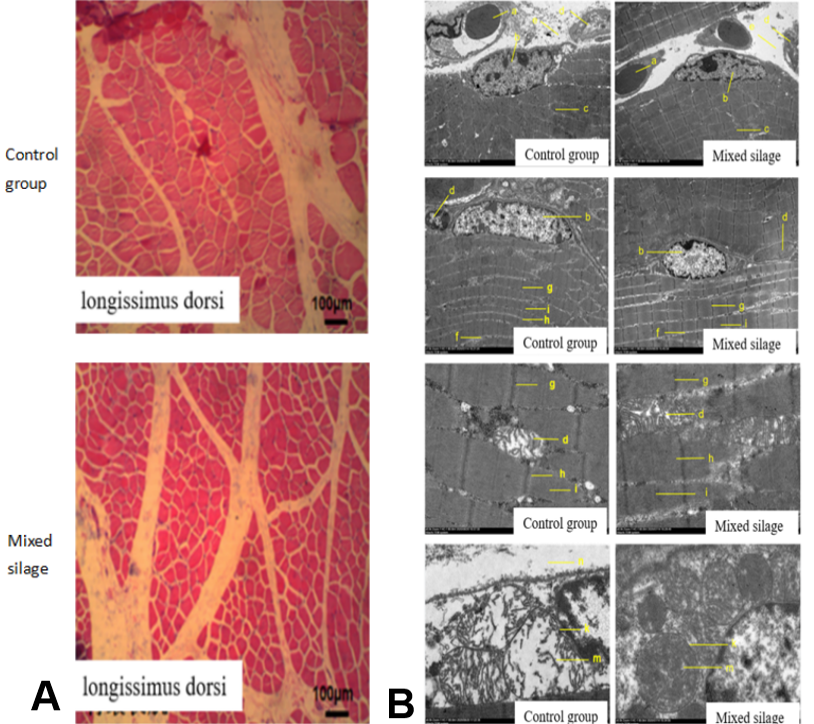
Tissue structure of LD under optical (A) and transmission electron (B) microscopes. a, nucleus; b-mitochondria; c, sarcomere; d, organelle; e, cytoplasmic interstitial; f, connective tissue; G-Z line; h, bright band (I-band); i, dark band (A-band); k, organelle membrane; m, organelle matrix; n, interstitial space.
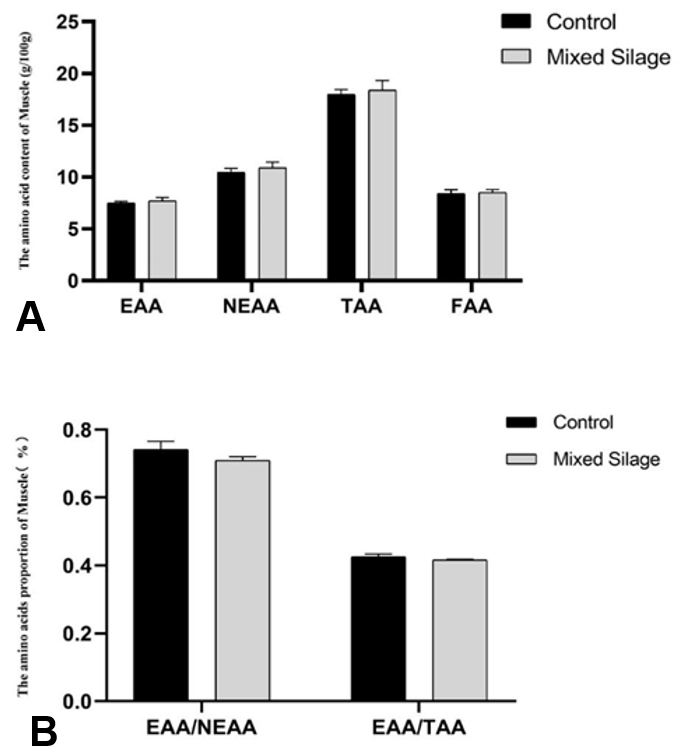
Different types of amino acids in the LD. (A) The amino acid content of the LD (g/100g). (B) The amino acid proportion in the LD (%). EAA, NEAA, TAA and FAA represent essential, non-essential, total, and free amino acids, respectively.
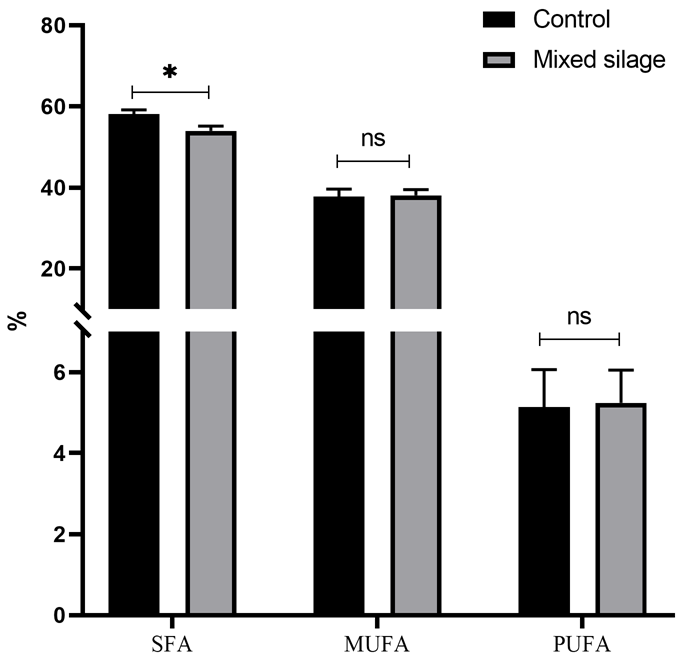
Saturated and unsaturated fatty acids in the LD. SFA, saturated fatty acid; MUFA, monounsaturated fatty acid; PUFA, polyunsaturated fatty acid. Bar chat with * indicates significant differences between groups at p < 0.05, while ns represents no difference.
References
- Abd El-Tawab, A.M., Kholif, A.E., Hassan, A.M., Matloup, O.H., El-Nor, S.A.A., Olafadehan, O.A. and Khattab, M.S.A., 2020. Feed utilization and lactational performance of Friesian cows fed beet tops silage treated with lactic acid bacteria as a replacement for corn silage. Anim. Biotechnol. 31: 473-482. https://doi.org/10.1080/10495398.2019.1622556[CrossRef]
- Abdel-Mohdy, F.A., Abdel-Halim, E.S., Abu-Ayana, Y.M. and El-Sawy, S.M.. 2009. Rice straw as a new resource for some beneficial uses. Carbohydr. Polym., 75: 44-51. https://doi.org/10.1016/j.carbpol.2008.06.002[CrossRef]
- Arruda, M.C.G., Almeida, M.T.C., Bertoco, J.P.A., Pereira-Junior, S.A.G., Castro-Filho, E.S., Feliciano, A.L., Rodrigues, J.L., Torres, R.N.S., Costa, R.V., Grilo, L. and Ezequiel, J.M.B., 2021. Soybean molasses to replace corn for feedlot lambs on growth performance, carcass characteristics, and meat quality. Trans. Anim. Sci., 5: txaa230. https://doi.org/10.1093/tas/txaa230[CrossRef]
- Atsbha, K., Gebremariam, T. and Aregawi, T., 2021. Slaughter performance and meat quality of Begait breed lambs fattened under different diets. Heliyon, 7: e06935. https://doi.org/10.1016/j.heliyon.2021.e06935[CrossRef]
- Awabdeh, S., Sweidan, R. and Landau, S.Y., 2022. Growth performance and carcass characteristics of fattening Awassi lambs fed willow silage. Small Rumin. Res., 215. https://doi.org/10.1016/j.smallrumres.2022.106758[CrossRef]
- Babu, J., Kumari, N.N., Reddy, Y.R., Raghunandan, T. and Sridhar, K., 2015. Effect of feeding sweet sorghum stover-based complete rations on the growth performance and carcass characteristics of ram lambs. Trop. Anim. Hlth. Prod., 47: 623-626. https://doi.org/10.1007/s11250-015-0755-1[CrossRef]
- Bonanno, A., Di Miceli, G., Di Grigoli, A., Frenda, A.S., Tornambè, G., Giambalvo, D. and Amato, G., 2011. Effects of feeding green forage of sulla (Hedysarum coronarium L.) on lamb growth and carcass and meat quality. Animal, 5: 148-154. https://doi.org/10.1017/S1751731110001576[CrossRef]
- Brezina, P.R., Ning, N., Mitchell, E., Zacur, H.A., Baramki, T.A. and Zhao, Y., 2012. Recent advances in assisted reproductive technology. Curr. Obstet. Gynecol., 1: 166-173. https://doi.org/10.1007/s13669-012-0019-2[CrossRef]
- Chikwanha, O.C., Vahmani, P., Muchenje, V., Dugan, M.E.R. and Mapiye, C., 2018. Nutritional enhancement of sheep meat fatty acid profile for human health and wellbeing. Fd. Res. Int., 104: 25-38. https://doi.org/10.1016/j.foodres.2017.05.005[CrossRef]
- Dalen, H., Myklebust, R. and Saetersdal, T.S., 1978. Cryofracture of paraffin-embedded heart muscle cells. J. Microsc., 112: 139-151. https://doi.org/10.1111/j.1365-2818.1978.tb01161.x[CrossRef]
- de Abreu, K.S.F., Veras, A.S.C., de Andrade, F.M., Madruga, M.S., Maciel, M.I.S., Felix, S.C.R., de Melo Vasco, A.C.C. and Urbano, S.A., 2019. Quality of meat from sheep fed diets containing spineless cactus (Nopalea cochenillifera Salm Dyck). Meat. Sci., 148: 229-235. https://doi.org/10.1016/j.meatsci.2018.04.036[CrossRef]
- Elmore, J.S. and Mottram, D.S., 2000. Formation of 2-alkyl-(2H)-thiapyrans and 2-alkylthiophenes in cooked beef and lamb. J. Agric Fd. Chem., 48: 2420-2424. https://doi.org/10.1021/jf000124v[CrossRef]
- Elmore, J.S., Mottram, D.S., Enser, M. and Wood, J.D., 1999. Effect of the polyunsaturated fatty acid composition of beef muscle on the profile of aroma volatiles. J. Agric. Fd. Chem., 47: 1619-1625. https://doi.org/10.1021/jf980718m[CrossRef]
- Essén-Gustavsson, B., Karlsson, A., Lundström, K. and Enfält, A.C., 1994. Intramuscular fat and muscle fibre lipid contents in halothane-gene-free pigs fed high or low protein diets and its relation to meat quality. Meat. Sci., 38: 269-277. https://doi.org/10.1016/0309-1740(94)90116-3[CrossRef]
- Esteban, M.B., García, A.J., Ramos, P. and Márquez, M.C., 2007. Evaluation of fruit-vegetable and fish wastes as alternative feedstuffs in pig diets. Waste Manage., 27: 193-200. https://doi.org/10.1016/j.wasman.2006.01.004[CrossRef]
- FAOSTAT, 2016. FAOSTAT database. Vol. 2023. Food and Agriculture Organization of the United Nations. https://www.fao.org/faostat/
- French, P., Stanton, C., Lawless, F., O’Riordan, E.G., Monahan, F.J., Caffrey, P.J. and Moloney, A.P., 2000. Fatty acid composition, including conjugated linoleic acid, of intramuscular fat from steers offered grazed grass, grass silage, or concentrate-based diets. J. Anim. Sci., 78: 2849-2855. https://doi.org/10.2527/2000.78112849x[CrossRef]
- Hamill, R.M., McBryan, J., McGee, C., Mullen, A.M., Sweeney, T., Talbot, A., Cairns, M.T. and Davey, G.C., 2012. Functional analysis of muscle gene expression profiles associated with tenderness and intramuscular fat content in pork. Meat. Sci., 92: 440-450. https://doi.org/10.1016/j.meatsci.2012.05.007[CrossRef]
- Hocquette, J.F., Gondret, F., Baeza, E., Medale, F., Jurie, C. and Pethick, D.W., 2010. Intramuscular fat content in meat-producing animals: Development, genetic and nutritional control, and identification of putative markers. Animal, 4: 303-319. https://doi.org/10.1017/S1751731109991091[CrossRef]
- Honikel, K.O., 1998. Reference methods for the assessment of physical characteristics of meat. Meat Sci., 49: 447-457. https://doi.org/10.1016/S0309-1740(98)00034-5[CrossRef]
- Idolo-Imafidon, G. and Spanier, A.M., 1994. Unraveling the secret of meat flavor. Trends Fd. Sci. Technol., 5: 315-321. https://doi.org/10.1016/0924-2244(94)90182-1[CrossRef]
- Jeon, B., 2012. Effects of mulberry (Morus alba L) silage supplementation on the haematological traits and meat compositions of Hanwoo (Bos taurus coreanae) steer. Afr. J. Agric. Res., 7: 662-668. https://doi.org/10.5897/AJAR11.2042[CrossRef]
- Jeong, D.W., Choi, Y.M., Lee, S.H., Choe, J.H., Hong, K.C., Park, H.C. and Kim, B.C., 2010. Correlations of trained panel sensory values of cooked pork with fatty acid composition, muscle fiber type, and pork quality characteristics in Berkshire pigs. Meat Sci., 86: 607-615. https://doi.org/10.1016/j.meatsci.2010.04.011[CrossRef]
- Jiang, H., Bian, F., Zhou, H., Wang, X., Wang, K., Mai, K. and He, G., 2017. Nutrient sensing and metabolic changes after methionine deprivation in primary muscle cells of turbot (Scophthalmus maximus L.). J. Nutr. Biochem., 50: 74-82. https://doi.org/10.1016/j.jnutbio.2017.08.015[CrossRef]
- Knight, M.I., Butler, K.L., Linden, N.P., Burnett, V.F., Ball, A.J., McDonagh, M.B. and Behrendt, R., 2020. Understanding the impact of sire lean meat yield breeding value on carcass composition, meat quality, nutrient and mineral content of Australian lamb. Meat Sci., 170: 108236. https://doi.org/10.1016/j.meatsci.2020.108236[CrossRef]
- Li, C., Chen, N., Zhang, X.X., Shahzad, K., Qi, R.X., Zhang, Z.B., Lu, Z.Q., Lu, Y., Yu, X., Zafar, M.H., Wang, M.Z. and Liu, W.J., 2022a. Mixed silage with Chinese cabbage waste enhances antioxidant ability by increasing ascorbate and aldarate metabolism through rumen Prevotellaceae UCG-004 in Hu sheep. Front. Microbiol., 13. https://doi.org/10.3389/fmicb.2022.978940[CrossRef]
- Li, J., Zhang, S., Gu, X., Xie, J., Zhu, X., Wang, Y. and Shan, T., 2022b. Effects of alfalfa levels on carcass traits, meat quality, fatty acid composition, amino acid profile, and gut microflora composition of Heigai pigs. Front. Nutr., 9: 975455. https://doi.org/10.3389/fnut.2022.975455[CrossRef]
- Lorenzo, J.M. and Franco, D., 2012. Fat effect on physico-chemical, microbial and textural changes through the manufactured of dry-cured foal sausage lipolysis, proteolysis and sensory properties. Meat Sci., 92: 704-714. https://doi.org/10.1016/j.meatsci.2012.06.026[CrossRef]
- Ma, Y.Q., Yin, Y. and Liu, Y., 2017. A holistic approach for food waste management towards zero-solid disposal and energy/resource recovery. Bioresour. Technol., 228: 56-61. https://doi.org/10.1016/j.biortech.2016.12.090[CrossRef]
- Muíño, I., Apeleo, E., de la Fuente, J., Pérez-Santaescolástica, C., Rivas-Cañedo, A., Pérez, C., Díaz, M.T., Cañeque, V. and Lauzurica, S., 2014. Effect of dietary supplementation with red wine extract or vitamin E, in combination with linseed and fish oil, on lamb meat quality. Meat Sci., 98: 116-123. https://doi.org/10.1016/j.meatsci.2014.05.009[CrossRef]
- NRC, 2007. Nutrient requirements of small ruminants: Sheep, goats, cervids, and new world camelids. National Academies Press, Washington, D.C.
- Nute, G.R., Richardson, R.I., Wood, J.D., Hughes, S.I., Wilkinson, R.G., Cooper, S.L. and Sinclair, L.A., 2007. Effect of dietary oil source on the flavour and the colour and lipid stability of lamb meat. Meat Sci., 77: 547-555. https://doi.org/10.1016/j.meatsci.2007.05.003[CrossRef]
- Orentreich, N., Matias, J.R., DeFelice, A. and Zimmerman, J.A., 1993. Low methionine ingestion by rats extends life span. J. Nutr., 123: 269-274. https://doi.org/10.1093/jn/123.2.269[CrossRef]
- Parente, M.O.M., Rocha, K.S., Bessa, R.J.B., Parente, H.N., Zanine, A.M., Machado, N.A.F., Lourenço-Júnior, J.B., Bezerra, L.R., Landim, A.V. and Alves, S.P., 2020. Effects of the dietary inclusion of babassu oil or buriti oil on lamb performance, meat quality and fatty acid composition. Meat Sci., 160: 107971. https://doi.org/10.1016/j.meatsci.2019.107971[CrossRef]
- Partovi, E., Rouzbehan, Y., Fazaeli, H. and Rezaei, J., 2020. Broccoli byproduct-wheat straw silage as a feed resource for fattening lambs. Transl. Anim. Sci., 4. https://doi.org/10.1093/tas/txaa078[CrossRef]
- Przybylski, W., Kaczor, D., Żelechowska, E., Jaworska, D., Kajak-Siemaszko, K., Boruszewska, K. and Jankiewicz, U., 2016. Sarcoplasmic protein profile from drip loss in relation to pork quality. J. Fd. Sci., 81: C2320-c2326. https://doi.org/10.1111/1750-3841.13424[CrossRef]
- Reimann, J., Irintchev, A. and Wernig, A., 2000. Regenerative capacity and the number of satellite cells in soleus muscles of normal and mdx mice. Neuromus. Disord., 10: 276-282. https://doi.org/10.1016/S0960-8966(99)00118-2[CrossRef]
- Sahoo, A., Sarkar, S., Lal, B., Kumawat, P., Sharma, S. and De, K., 2021. Utilization of fruit and vegetable waste as an alternative feed resource for sustainable and eco-friendly sheep farming. Waste Manage., 128: 232-242. https://doi.org/10.1016/j.wasman.2021.04.050[CrossRef]
- Scerra, V., Caparra, P., Foti, F., Lanza, M. and Priolo, A., 2001. Citrus pulp and wheat straw silage as an ingredient in lamb diets: Effects on growth and carcass and meat quality. Small Rumin. Res., 40: 51-56. https://doi.org/10.1016/S0921-4488(00)00208-X[CrossRef]
- Suman, S.P. and Joseph, P., 2013. Myoglobin chemistry and meat color. Annu. Rev. Fd. Sci. Technol., 4: 79-99. https://doi.org/10.1146/annurev-food-030212-182623[CrossRef]
- Sun, W., Wang, H., Li, Y., Zhou, X., Teng, Y. and Chen, J., 2013. Acquisition of pig intramuscular preadipocytes through dedifferentiation of mature adipocytes and establishment of optimal induction conditions. Genet. Mol. Res., 12: 5926-5936. https://doi.org/10.4238/2013.November.26.2[CrossRef]
- van Boekel, M.A.J.S., 2006. Formation of flavour compounds in the Maillard reaction. Biotechnol. Adv., 24: 230-233. https://doi.org/10.1016/j.biotechadv.2005.11.004[CrossRef]
- Wang, J.S., Ding, L.Y., Yu, X., Wu, F.F., Zhang, J.Y., Chen, P.G., Qian, S.H. and Wang, M.Z., 2023. Tryptophan improves antioxidant capability and meat quality by reducing responses to stress in nervous Hu sheep. Meat Sci., 204. https://doi.org/10.1016/j.meatsci.2023.109267[CrossRef]
- Wang, Y.J., Bi, Y.Y. and Gao, C.Y., 2010. The assessment and utilization of straw resources in China. Agric. Sci. China, 9: 1807-1815. https://doi.org/10.1016/S1671-2927(09)60279-0[CrossRef]
- Wojtysiak, D., 2013. Effect of age on structural properties of intramuscular connective tissue, muscle fibre, collagen content and meat tenderness in pig longissimus lumborum muscle. Folia Biol., 61: 221-226. https://doi.org/10.3409/fb61_3-4.221[CrossRef]
- Wood, J.D., Richardson, R.I., Nute, G.R., Fisher, A.V., Campo, M.M., Kasapidou, E., Sheard, P.R. and Enser, M., 2004. Effects of fatty acids on meat quality: A review. Meat Sci., 66: 21-32. https://doi.org/10.1016/S0309-1740(03)00022-6[CrossRef]
- Zhang, J., Zhang, Y., Wang, J., Jin, H., Qian, S., Chen, P., Wang, M., Chen, N. and Ding, L., 2023. Comparison of antioxidant capacity and muscle amino acid and fatty acid composition of nervous and calm Hu sheep. Antioxidants, 12. https://doi.org/10.3390/antiox12020459[CrossRef]
- Zhang, Z., Shahzad, K., Shen, S., Dai, R., Lu, Y., Lu, Z., Li, C., Chen, Y., Qi, R., Gao, P., Yang, Q. and Wang, M., 2022. Altering dietary soluble protein levels with decreasing crude protein may be a potential strategy to improve nitrogen efficiency in Hu sheep based on rumen microbiome and metabolomics. Front. Nutr., 8: 815358. https://doi.org/10.3389/fnut.2021.815358[CrossRef]
Services
Article usage statistics
Loading…