ResearchersLinks

Research Article · Volume 14, Issue 4, 8 September 2026 · Open Access

Influence of Dietary Supplementation with Incremental Levels of Dried Rumen Digesta on Milk Production and Composition in Lactating Nili-Ravi Buffaloes

· · · · · ·

Affiliations & Notes ⌄
  1. 1Department of Animal Nutrition, Riphah International University, Raiwind Campus, Lahore 54000, Pakistan
  2. 2Animal Health Division, Myplan Pharmaceuticals (Pvt) Ltd, Lahore 54000, Pakistan
  3. 3Department of Veterinary Physiology and Biochemistry, Sindh Agriculture University, Tandojam 70060, Pakistan
  4. 4Department of Parasitology, Riphah International University, Raiwind Campus, Lahore 54000, Pakistan
  5. 5Centre of Veterinary Drug Research and Evaluation, Laboratory of Veterinary Pharmacology and Toxicology, College of Veterinary Medicine, Nanjing Agricultural University, Nanjing 210095, China
  6. 6Department of Animal Products Technology, Sindh Agriculture University, Tandojam 70060, Pakistan. *Correspondence | Awais Bin Shahid, Department of Veterinary Physiology and Biochemistry, Sindh Agriculture University, Tandojam 70060, Pakistan
  7. 7Email: phd-2k21-bp-03@student.sau.edu.pk
Article Info ⌄
Journal:
Journal of Animal Health and Production
Published:
8 September 2026

From the article

  • Supplementation of dried rumen digesta (DRD) in the diets of lactating Nili-Ravi buffaloes improved performance, particularly at 8% inclusion.
  • DRD-8 significantly increased dry matter intake and milk production compared to the control and 4% groups, while milk composition remained unaffected across all treatments.
  • Overall, DRD can be included up to 8% in total mixed rations to enhance milk production without compromising milk quality or economic efficiency.

Selected from the article's own text.

Abstract

A total of twelve Nili-Ravi buffalos having second phase lactation were selected for this study. Animals having similar stage of lactation (100 ± 10 days of milking) were offered three iso-nitrogenous and iso-caloric rations supplemented with different levels of dried rumen digesta, DRD (DRD-0, control; DRD-4, 4% DRD and DRD-8, 8% DRD) for a period of twelve weeks. The experimental diets formulated were offered to animals as a total mixed ration (TMR). Dry matter intake (DMI) was significantly (P < 0.05) increased in DRD-8 compared to both groups followed by group DRD-4 and DRD-0. Milk production (kg day-1) was improved significantly (P < 0.05) in DRD-8 as compared to both other groups, however, DRD-4 showed increased milk production to that of group DRD-0. Milk fat, milk protein, milk lactose, milk total solids, solid not fat (SNF), milk density, milk salts and the cost kg-1 DMI showed no significant (P > 0.05) difference among all treatments. In conclusion, the diet of lactating Nili-Ravi buffaloes can be supplemented DRD to optimize milk production without any adverse effects on the dry matter intake and milk composition.
 
Keywords | Dried rumen digesta, Dry matter intake, Feed cost, Milk production, Milk composition, Nili-Ravi buffalo

INTRODUCTION

Seasonal and regional variations limit livestock feed availability in Pakistan, resulting in crude protein and metabolizable energy deficits of 37.2% and 38%, respectively. Although fodder supplies only 23.8% of total feed resources, it fulfills approximately 40% of livestock nutritional requirements . Feed shortages remain a significant challenge in livestock production. Abattoir-derived rumen content, an agro-industrial byproduct composed of partially digested feed, represents a sustainable alternative feed ingredient whose utilization can also help minimize environmental pollution caused by improper disposal . Sun-dried rumen content from slaughtered animals is a valuable feed ingredient, supplying metabolizable microbial protein and fermented fiber that support normal rumen function. Beyond its nutritional value, recycling rumen digesta as livestock feed provides a sustainable waste management solution and helps reduce environmental pollution from abattoir waste .

Several studies have reported the beneficial effects of dried rumen content supplementation on ruminant performance. Since, the improved rumen fermentation positively influences papillae growth and increases the absorptive surface area, thereby enhancing productivity ; threrefore, supplementation with dried rumen content also improves rumen fermentation and nitrogen digestibility . Moreover, Cherdthong et al. (2014) reported that inclusion of dried rumen content in cattle diets, as a partial replacement for soybean meal, can enhance wheat straw intake without adversely affecting neutral detergent fiber (NDF) digestibility or rumen fermentation. As illustrated by Elfaki and Abdelatti (2016), the inclusion of rumen contents in ruminant diets has no adverse effects on diet acceptability or animal performance. Similarly, Cherdthong (2020) dried rumen digesta (DRD) has been reported as a low-cost alternative protein source that can enhance nutrient absorption, reduce feed costs, and help manage environmental waste disposal. Moreover, DRD can potentially replace conventional protein sources and may improve production performance, including milk production and composition Cherdthong (2020). At present, DRD is available at the rate of 12 PKR (Pak rupees) kg-1 which contains over 10% protein, primarily in the form of microbial protein that is readily available for metabolism. Considering the advantages of DRD to meet the protein and fiber requirements of dairy animals; the aim and objective of present study was therefore to evaluate the milk production and composition of lactating Nili-Ravi buffaloes with incremental levels of DRD to optimize the feed cost.

MATERIALS AND METHODS

Experimental design

Twelve Nili-Ravi buffaloes in their second lactation having similar stage of lactation (100±10 days in milk) were selected for the study. Prior to the commencement of trial each animal was treated with anthelmintic to avoid worm infestation and vaccinated against foot and mouth disease, and hemorrhagic septicemia. Animals were divided into three groups (n= 4 each) viz., DRD-0, DRD-4, and DRD-8. During the trial animals were offered three iso-nitrogenous and iso-caloric rations with different levels of DRD (DRD-0, Control (non-experimental); DRD-4, 4% DRD and DRD-8 with 8% DRD) for a period of twelve weeks.

Animal feeding and management

Experimental ration was prepared according to the nutritional requirements of animals as described by NRC (2001) and was offered to the animals as a total mixed ration composed of dried rumen digesta (DRD) added in basal experimental diet, corn silage (dry matter, DM 30%; and crude protein, CP 7% fed to animals @ 1.5% of bodyweight on DM basis), and wheat straw. Animals were fed the experimental diet daily at 0900 hrs with ad libitum water access throughout the experiment, and feed intake of each animal was recorded on daily basis. Proximate analysis of dried rumen digesta (DRD), and the nutrient profile including chemical analysis of experimental diets on dry matter (DM) basis are shown in Tables 1 and 2, respectively.

Table 1: Proximate analysis of dried rumen digesta (DRD) used in experimental diets.

Contents

Percentage (%)

Moisture

11.23

Dry matter

88.77

Crude protein

10.73

Ash

9.06

Crude fiber

29.51

Crude fat

0.64

Acid insoluble ash (AIA)

4.86

Milk sample collection and processing

Feed intake for each animal was recorded on daily basis. Animals were milked two times a day through manual milking method followed by sanitizing hands and the animal’s udder in a controlled and hygienic environment, thereafter, milk production was noted for each milking. Collection of milk samples was carried out aseptically using sterile bottles directly from the udder of each animal separately on weekly basis for the determination of milk composition in terms percentage of milk fat, milk protein, milk lactose, milk total solids, solid not fat (SNF), milk density, milk salts using digital milk analyzer (Lactoscan SA, Milkotronic Ltd, Nova Zagora, Bulgaria). For dry matter (DM) analysis of feed, the samples were grinded using Wiley mill (Arthur A. Thomas Co., Philadelphia, PA) and placed in hot air oven (Gallenkamp®, England) at 100 ℃ for 60 minutes, whereas the chemical analysis was carried out according to the standard procedures described by Association of Official Analytical Chemists .

Calculations

Cost of milk production was calculated as:

Figure 1.

Table 2: Nutrient profile and chemical analysis of experimental diets on dry matter basis.

Ingredients (%)

Experimental groups

DRD-0

DRD-4

DRD-8

Corn grains

24.44

24.21

23.33

Maize gluten meal 30%

9.79

8.71

6.46

Canola meal

4

4

4

Palm kernel cake

3

3

3

Wheat bran

26.01

26.41

30

Molasses

9

9

9

Dried rumen digesta

0

4

8

Urea

1

1

1

Wheat straw

20

17

12

Sodium bicarbonate

0.8

0.8

0.8

Sodium chloride

0.5

0.5

0.5

Vitamin and mineral premixa

1

1

1

CaCO3

0.46

0.37

0.91

Cost Kg-1 DMI (PKR)

35.02

34.56

34.2

Chemical analysis

Dry matter (%)

87.20

87.80

88.20

Crude protein (%)

14

14

14

NDF (%)

33.5

32.3

31.5

ME (Mcal/Kg)

2.40

2.40

2.40

Buffaloes were fed diets supplemented with dried rumen digesta (DRD) i.e. dried rumen digesta 0% (DRD-0), dried rumen digesta 4% (DRD-4), and dried rumen digesta 8% (DRD-8) for 12 weeks. DMI, Dry Matter Intake; PKR, Pak Rupees; NDF, Neutral Detergent Fiber; ME, Metabolizable energy. aPer kg of premix = Vitamin A 10,000,000 IU; Vitamin D3 2,000,000 IU; Vitamin E 15 gm; Fe 50 gm; Cu 15 gm; Zn 100 gm; Ca 187 gm; Co 1.5 gm; Mn 50 gm; Mg 1.9 gm; Se 0.4 gm; I 1.5 gm; Na 0.143 mg; K 0.286 mg.

Statistical analysis

The data obtained thus statistically evaluated through analysis of variance technique (ANOVA) using complete randomized design. Differences among treatment means were considered statistically significant at 95% probability (P < 0.05). Results were presented as mean ± SEM (standard error of mean). Statistical analysis was performed using GraphPad Prism, GraphPad Software Inc., version 9.0.0.

RESULTS

Dry matter intake and costing

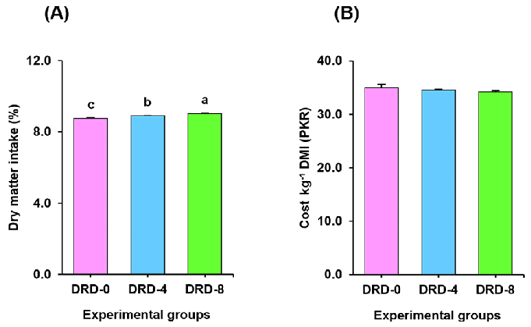
Figure 1 shows the influence of dietary supplementation with incremental levels of dried rumen digesta (DRD) on dry matter intake (DMI) and cost kg-1 DMI in Nili-Ravi buffaloes. DMI showed significant increase (P < 0.05) in group DRD-8 followed by DRD-4 and DRD-0. However, the cost kg-1 DMI in group DRD-0 was slightly raised as compared to other groups but statistically there was no significant (P > 0.05) difference among all groups.

Milk production and milk composition

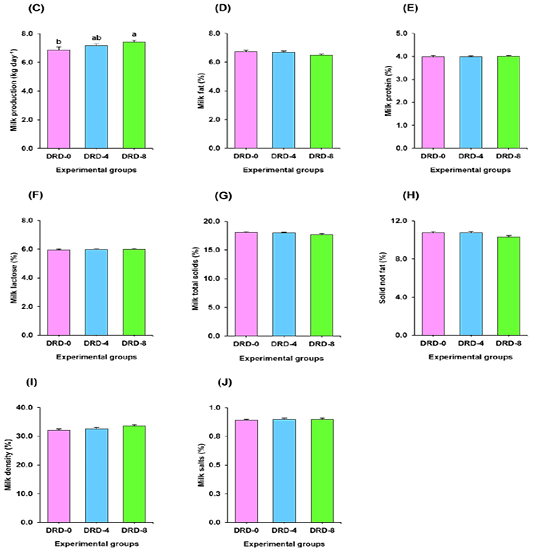
Figure 2 shows the influence of dietary supplementation with incremental levels of dried rumen digesta (DRD) on milk production and milk composition in Nili-Ravi buffaloes. Milk production (kg day-1) in group DRD-8 was significantly improved (P < 0.05) as compared to DRD-0, however group DRD-4 showed no significant (P > 0.05) difference compared to other groups. Milk composition showed that the milk fat, milk protein, milk lactose, milk total solids, solid not fat, milk salts among various groups was non-significant (P > 0.05). However, milk density showed trending increase in DRD-8 and DRD-4 as compared to DRD-0 but statistically showed a non-significant (P > 0.05) difference among all groups.

DISCUSSION

Dry matter intake and costing

Dried rumen digesta (DRD) represents a promising source of protein and fiber for supporting the nutritional requirements of animals. DRD contributes up to 10-16% protein contents which contains rumen fermented fibers and microbial population. Fiber is essential for proper rumen functioning and maintaining rumen pH due to appropriate size and fermented fiber particles .

Current study showed that among different treatments; the average dry matter intake was increased in DRD-8 as compared to DRD-0. As illustrated by Cherdthong et al. (2014); substituting soybean meal with dried rumen digesta (DRD) in cattle diets at levels up to 100% improved straw intake while having no adverse effect on rumen fermentation. Moreover, feed intake also increased in buffalo calves with increased feeding of DRD pellets in ration (Saenkamsorn et al., 2017).

Present study showed the cost kg-1 dry matter intake was not different among different treatments, however, Saenkamsorn et al. (2017) reported improved economics in buffalo calves by feeding DRD pellets. Moreover, Cherdthong (2020) reported the effect of rumen digesta as an alternative protein source for improved nutrient utilization, reduced feed cost, and controlled waste disposal in environment. Supplementation of DRD improves nitrogen digestibility, also with the replacement of expensive ingredients like barley grain and soybean meal with DRD could help to increase economic return and minimize pollution in cattle diet up to 100% dietary level resulting in improved NDF digestibility. Being a low-price item, DRD can be used as a feed ingredient in cattle diet to decrease feed cost and environmental pollution due to heaps of manure waste ; .

Milk production and milk composition

In our study, increase in dry matter intake in DRD-8 increased the milk production. In a study, Elfaki and Abdelatti (2016) documented that the rumen contents could be incorporated in the diets of animals without negative effects on diet acceptability and without any adverse effects on performance. In our study, milk fat, protein, lactose, total solids, SNF, density and salts remained unaffected among treatments. In a previous study, Elfaki and Abdelatti (2016) reported that dried rumen contents feeding produced no adverse effect on the production performance of animals. Moreover, the inclusion of dried rumen contents at 20% in diet of sheep are safe in the replacement of grass .

In a previous study, Cherdthong and Wanapat (2013) reported that supplementation of DRD improved nitrogen digestibility. Similarly, Saenkamsorn et al. (2017) reported increase in CP and NDF digestibility when dried rumen digesta pellets were fed at higher level in the ration.

CONCLUSIONS

Supplementation of dried rumen digesta (DRD) in the diets of lactating Nili-Ravi buffaloes improved performance, particularly at 8% inclusion. DRD-8 significantly increased dry matter intake and milk production compared to the control and 4% groups, while milk composition remained unaffected across all treatments. Feed cost per unit intake also showed no significant differences. Overall, DRD can be included up to 8% in total mixed rations to enhance milk production without compromising milk quality or economic efficiency.

ACKNOWLEDGEMENT

The authors are grateful to the staff of United Dairy Farm for providing valuable support and assistance throughout the study.

NOVELTY STATEMENT

This study assesses the effect of dried rumen digesta (DRD) dietary supplementation at various levels on milk production and composition of Nili-Ravi buffaloes in order to determine the most cost-effective use of DRD.

AUTHOR’S CONTRIBUTION

NS: Writing original draft, investigation, resources. ABS: Software, writing reviewing and editing. MAJ: Supervision, conceptualization, methodology, validation. ASH: Software, data analysis, validation. AI: Formal analysis, writing reviewing and editing, validation. MBA: Software, writing reviewing and editing. GSB: Software, writing reviewing and editing.

Ethical approval

Present study was conducted at United Dairy Farm, Lahore, Pakistan. This study was carried out with a prior approval from the Board of Advanced Studies and Research (BASR) of Riphah International University, Raiwind Campus, Lahore, in accordance with the guidelines of animal care.

Funding sources

No specific grant received from any funding agencies for conducting this study.

Generative AI and AI-assisted technology statement

The authors declare that no Generative AI or AI assisted technology was used in the creation of this manuscript.

Conflict of interest

The authors have declared no conflict of interest.

Figures

Figure 1:
Figure 1:.

Influence of dietary supplementation with incremental levels of dried rumen digesta (DRD) on dry matter intake (DMI) and cost kg-1 DMI in Nili-Ravi buffaloes. Buffaloes were fed diets supplemented with DRD at 0% (DRD-0), 4% (DRD-4), and 8% (DRD-8) for 12 weeks. A: A significant (P < 0.05) effect of DRD on dry matter intake; B: A non-significant (P > 0.05) effect of DRD on cost kg-1 DMI

Figure 2:
Figure 2:.

Influence of dietary supplementation with incremental levels of dried rumen digesta (DRD) on milk production and milk composition in Nili-Ravi buffaloes. Buffaloes were fed diets supplemented with DRD at 0% (DRD-0), 4% (DRD-4), and 8% (DRD-8) for 12 weeks. C: A significant (P < 0.05) effect of DRD on milk production (kg day-1); D, E, F, G, H, I, J: A non-significant (P > 0.05) effect of DRD on milk fat, milk protein, milk lactose, total solids, solid not fat, milk density and milk salts respectively.

References

  1. Abdullahi AM, Mohammed G (2017). Significance of camel rumen content as a feed for broiler chickens. Int. J. Sci. Res., 6: 310-314. https://doi.org/10.5713/ajas.1999.1234[CrossRef]
  2. Abouhief MA, Kraidees MS, Al-Selbood BA (1999). The utilization of rumen content-barley meal in diets of growing lambs. Asian Australas. J. Anim. Sci., 12: 1234-1240.
  3. Adeniji AA, Balogun OO (2002). Utilization of flavor treated blood-rumen content mixture in the diets of laying hens. Niger. J. Anim. Prod., 29: 34-39. https://doi.org/10.51791/njap.v29i1.1502[CrossRef]
  4. Adeniji AA, Jimoh A (2007). Effects of replacing maize with enzyme-supplemented bovine rumen content (BRC) in the diets of pullet chicks. Int. J. Poult. Sci., 6: 814-817. https://doi.org/10.3923/ijps.2007.814.817[CrossRef]
  5. Agbabiaka LA, Amadi SA, Oyinloye GO, Adedokun II, Ekeocha CA (2011). Growth response of African catfish (Clarias gariepinus, Burchell 1822) to dried rumen digesta as a dietary supplement. Pak. J. Nutr., 10: 564-567. https://doi.org/10.3923/pjn.2011.564.567[CrossRef]
  6. Agbabiaka LA, Madubuike FN, Amadi SA (2012). Studies on nutrients and anti-nutrients of rumen digesta from three most domesticated ruminants in Nigeria. Pak. J. Nutr., 11: 678-680. https://doi.org/10.3923/pjn.2012.678.680[CrossRef]
  7. Alao BO, Falowo AB, Chulayo A, Muchenje V (2017). The potential of animal by-products in food systems: Production, prospects and challenges. Sustainability, 9: 1089. https://doi.org/10.3390/su9071089[CrossRef]
  8. AOAC (1990). Official methods of analysis. Association of Official Analytical Chemists, Arlington, VA, USA., 1: 684-688.
  9. Boorman KN, Ellis GM (1996). Maximum nutritional response to poor-quality protein and amino acid utilization. Br. Poult. Sci., 37: 145-156. https://doi.org/10.1080/00071669608417844[CrossRef]
  10. Cherdthong A (2020). Potential use of rumen digesta as ruminant diet: A review. Trop. Anim. Health Prod., 52: 1-6. https://doi.org/10.1007/s11250-019-02018-6[CrossRef]
  11. Cherdthong A, Wanapat M (2013). Rumen microbes and microbial protein synthesis in Thai native beef cattle fed with feed blocks supplemented with a urea–calcium sulphate mixture. Arch. Anim. Nutr., 67: 448-460. https://doi.org/10.1080/1745039X.2013.857080[CrossRef]
  12. Cherdthong A, Wanapat M, Saenkamsorn A, Waraphila N, Khota W, Rakwongrit D, Anantasook N, Gunun P (2014). Effects of replacing soybean meal with dried rumen digesta on feed intake, digestibility of nutrients, rumen fermentation and nitrogen use efficiency in Thai cattle fed on rice straw. Livest. Sci., 169: 71-77. https://doi.org/10.1016/j.livsci.2014.09.008[CrossRef]
  13. Elfaki MO, Abdelatti KA (2016). Rumen content as animal feed: A review. J. Vet. Med. Anim. Health., 7: 80-88.
  14. Habib G, Khan MF, Javaid S, Saleem M (2016). Assessment of feed supply and demand for livestock in Pakistan. J. Agric. Sci. Technol., 6: 191-202. https://doi.org/10.17265/2161-6256/2016.03.006[CrossRef]
  15. Kenenbay G, Chomanov U, Idayatova M (2026). Influence of different levels of rumen content as a replacement for grass meal in compound feed on the productivity of Kazakh fine-wool sheep. Online J. Anim. Feed Res., 16: 90-97. https://doi.org/10.51227/ojafr.2026.11[CrossRef]
  16. NRC (2001). Nutrient requirements of dairy cattle. National Academies Press.
  17. Seankamsorn A, Cherdthong A, Wanapat M, Supapong C, Khonkhaeng B, Uriyapongson S, Gunun N, Gunun P, Chanjua P (2017). Effect of dried rumen digesta pellet levels on feed use, rumen ecology, and blood metabolite in swamp buffalo. Trop. Anim. Health Prod., 49: 79-86. https://doi.org/10.1007/s11250-016-1161-z[CrossRef]
  18. Shahid AB, Malhi M, Soomro SA, Shah MG, Kalhoro NH, Kaka A, Mal R, Soomro MA, Samo SP, Sanjrani MN (2020). Influence of dietary selenium yeast supplementation on fermentation pattern, papillae morphology and antioxidant status in rumen of goat. Pakistan J. Zool., 52: 565-571. https://doi.org/10.17582/journal.pjz/20190205120240[Full text][CrossRef]

Services

Article usage statistics

Loading…

Influence of Dietary Supplementation with Incremental Levels of Dried Rumen Digesta on Milk Production and Composition in Lactating Nili-Ravi Buffaloes · ResearchersLinks